Key Takeaways
- Generative AI adoption in business has accelerated rapidly since 2022, with 79% of employees reporting the use of AI tools at work.
- Many employees access AI through personal accounts on public platforms, creating what security teams call Shadow AI.
- When internal documents, spreadsheets, or code are entered into public AI tools, sensitive corporate data may leave the organization’s controlled environment.
- This creates risks related to data leakage, regulatory compliance, and audit visibility.
- Organizations are increasingly adopting controlled enterprise AI environments that provide secure access to multiple models while maintaining governance and oversight.
The Hidden Risks of Using Public AI Tools in Business
Since the release of generative AI systems such as ChatGPT in 2022, the adoption of AI tools inside organizations has accelerated dramatically. According to research from IBM Security, 79% of office workers report using AI tools in their daily work, often without formal approval from their employer.
In many cases, employees access these tools through personal accounts on public platforms. A marketing specialist may use an AI assistant to generate campaign ideas. A developer may paste code into a chatbot to debug an issue. Analysts may summarize reports in seconds.
From the employee’s perspective, the benefits are obvious: faster workflows, reduced manual work, and instant access to advanced capabilities.
From an organizational perspective, however, the situation is more complex.
When internal data is submitted to a public AI system, it is processed outside the company’s controlled infrastructure. Depending on the service and configuration, organizations may have limited visibility into how prompts are stored, analyzed, or retained by the provider.
For companies handling sensitive information—client records, financial data, intellectual property, or proprietary code—this introduces a new category of risk: enterprise AI data leakage.
Key Statistics on AI Use in the Workplace
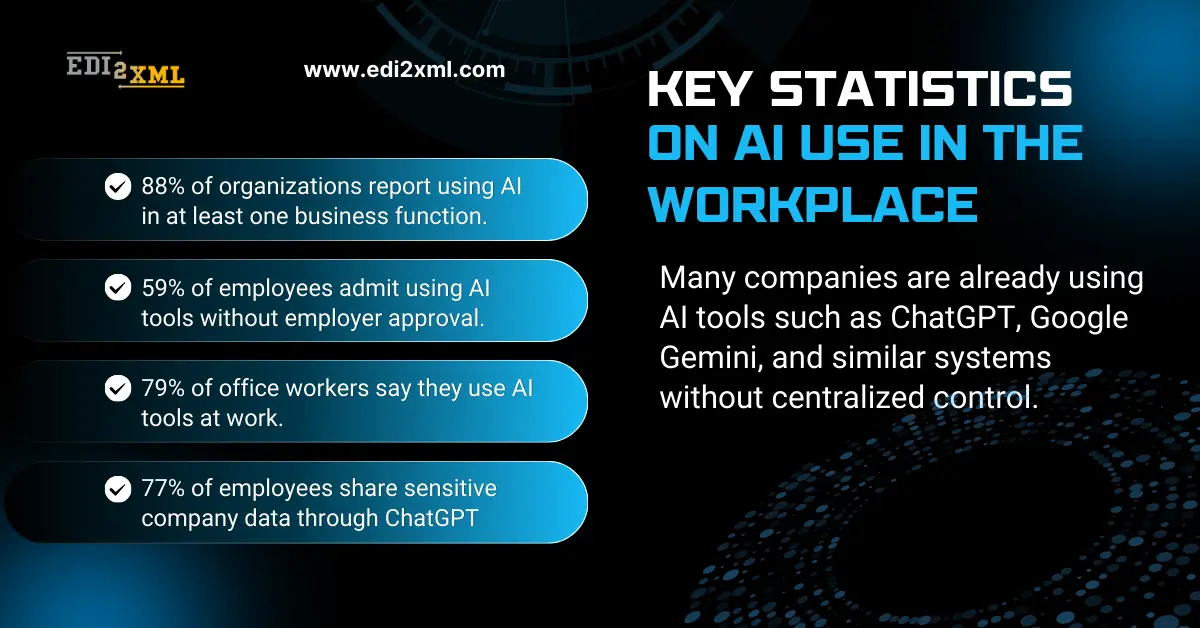
Many companies are already using AI tools such as ChatGPT, Google Gemini, and similar systems without centralized control. What starts as a productivity boost is quickly becoming a significant security concern.
Research from industry analysts highlights the scale of this trend:
- 88% of organizations report using AI in at least one business function. (McKinsey&Co State of AI 2025)
- 79% of office workers say they use AI tools at work. (IBM Security, 2025)
- 59% of employees admit using AI tools without employer approval. (Cybernews)
- 77% of employees share sensitive company data through ChatGPT (eSecurity Planet)
For many organizations, the majority of AI usage is happening outside officially approved tools, a phenomenon increasingly referred to as Shadow AI.
Definition — Shadow AI: The unauthorized or unmanaged use of public AI tools (such as ChatGPT, Google Gemini, Grok, or DeepSeek) by employees within an organization, outside the visibility and control of IT and compliance teams.
Where Enterprise Data Leakage Actually Happens with Public AI Tools
The risk of AI-driven data exposure rarely comes from malicious intent. It arises from routine, well-intentioned workflows where employees use public tools to save time. Below are the most common scenarios:
- Marketing teams paste internal strategy documents, brand guidelines, or campaign briefs into ChatGPT to generate copy or brainstorm ideas, exposing competitive strategy and positioning data.
- Finance employees upload spreadsheets containing revenue figures, forecasts, or client billing information to AI tools for quick trend analysis, exposing financial records and projections.
- Software developers submit proprietary source code to AI assistants (e.g., ChatGPT, Grok) to debug errors or generate functions, exposing intellectual property and codebase architecture.
- HR professionals input employee performance reviews, salary data, or disciplinary records for summarization, exposing personally identifiable information (PII).
- Legal teams paste contract clauses, NDA terms, or litigation details into AI tools for analysis—exposing privileged and confidential legal information.
- Executives and analysts share board-level reports, M&A data, or investor communications for summarization, exposing material non-public information (MNPI).
Each action seems harmless in isolation. But collectively, these interactions can transfer significant volumes of sensitive data outside the organization’s controlled infrastructure—with no audit trail, no retention policy, and no way to recall the data once submitted.
Why this matters: Unlike enterprise software that runs within managed infrastructure, public AI tools operate as external services. Once data is submitted, organizations have zero control over how it is processed, cached, or potentially used for model training.
Compliance Risks of Using Public AI Tools in Enterprises
For companies in regulated sectors – financial services, healthcare, logistics, or government contracts, the stakes are higher. These organizations must comply with strict rules governing where data can be stored and processed.
When employees use public AI tools independently, safeguards may no longer apply. Even if the AI provider maintains strong internal security, the organization may still struggle to demonstrate compliance during audits. In many cases, there is simply no verifiable record of where data was processed or retained.
This gap between actual employee behavior and corporate policy is often invisible until a breach, audit failure, or regulatory inspection occurs.
Fragmented AI Workflows: Challenges of Multiple AI Tools
Another operational risk arises from teams experimenting with different AI platforms:
- One department relies on ChatGPT for research and writing.
- Another team prefers Grok for technical or coding tasks.
- Others explore Google Gemini or DeepSeek for data analysis or document summaries.
While each tool can be useful individually, collectively they create fragmented workflows: multiple subscriptions, separate chat histories, and inconsistent security practices. For management, it becomes difficult to understand usage patterns, control costs, or maintain compliance.
How Enterprises Are Adopting Controlled AI Environments: A Framework
Blocking AI access entirely is rarely effective. Research consistently shows that employees find workarounds—using personal devices, mobile apps, or unmonitored browser sessions. Instead, leading organizations are adopting a “secure enablement” strategy:
The 5-Step Enterprise AI Governance Framework
1. Audit existing AI usage
-
- Survey employees across departments to identify which AI tools are in use, how frequently, and for what purposes.
- Map data flows to understand what types of information are being submitted to external AI services.
2. Define an AI Acceptable Use Policy (AUP)
-
- Specify which AI tools are sanctioned for business use.
- Classify data types (e.g., public, internal, confidential, regulated) and define which categories may be submitted to AI tools.
- Establish clear rules for sensitive data: no PII, no financial records, no source code in public tools.
3. Deploy a centralized, enterprise-grade AI platform
-
- Provide employees with a single, IT-managed interface that offers access to multiple AI models (GPT, Gemini, Grok, DeepSeek, LLaMA).
- Ensure the platform uses enterprise APIs with zero data retention, so prompts are not stored or used for model training.
- Require SSO (Single Sign-On) integration for access control and audit trails.
4. Implement monitoring and analytics
-
- Track usage patterns (volume, departments, models used) without surveilling content.
- Set up alerts for policy violations or unusual activity.
- Generate compliance reports for auditors.
5. Train and iterate
-
- Provide employees with training on responsible AI use, prompt engineering, and data classification.
- Review and update the AUP quarterly based on evolving regulations and new AI capabilities.
How AskElixir.ai Provides a Secure, Compliant AI Environment for Enterprises
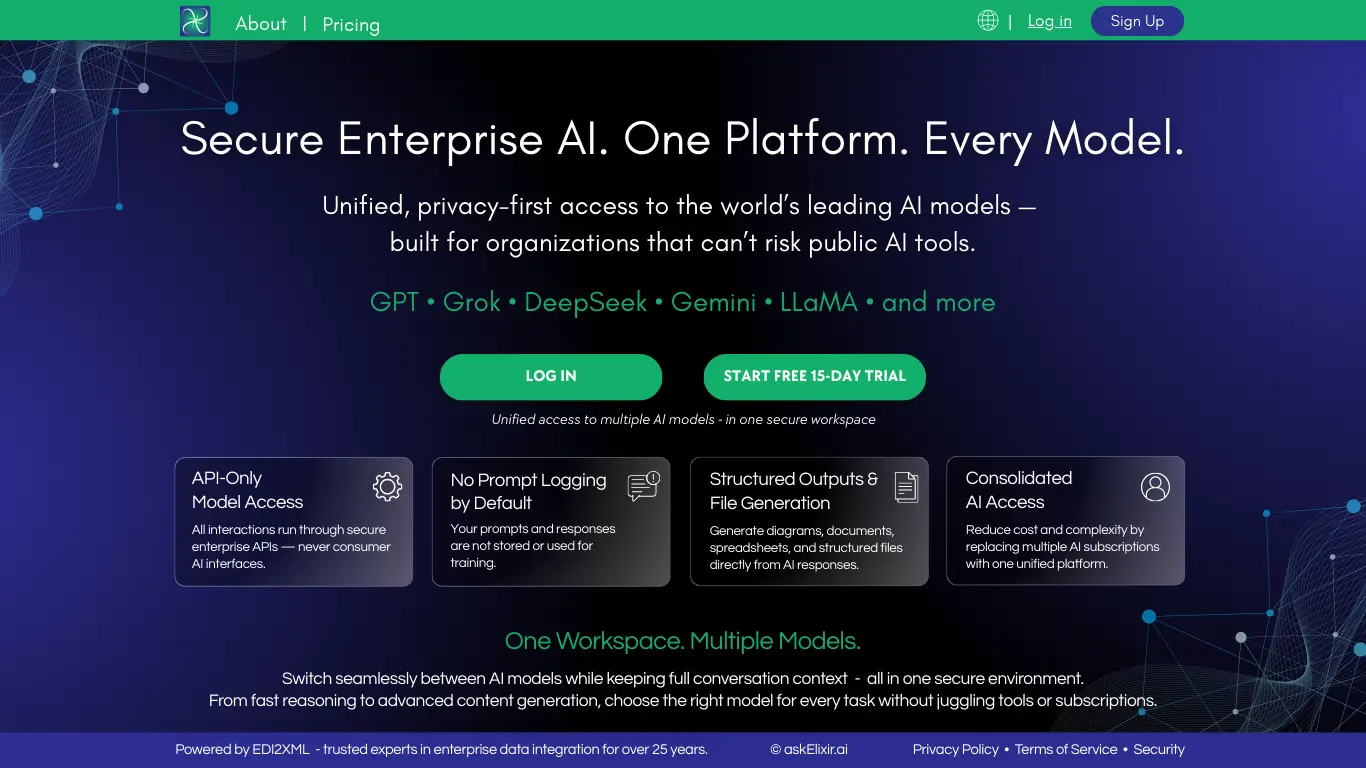
AskElixir.ai is a secure enterprise AI platform designed to give organizations access to leading generative AI models while maintaining strict control over how corporate data is handled. Instead of relying on consumer AI interfaces, the platform provides a unified workspace where teams can interact with multiple models through controlled API connections.
Core Capabilities
Unified access to multiple AI models
AskElixir.ai provides centralized access to leading AI systems—including GPT, Grok, DeepSeek, Google Gemini, and LLaMA—through a single secure interface. Users can switch between models within the same conversation, allowing teams to compare outputs, combine capabilities, and maintain context across workflows.
API-based model access with privacy safeguards
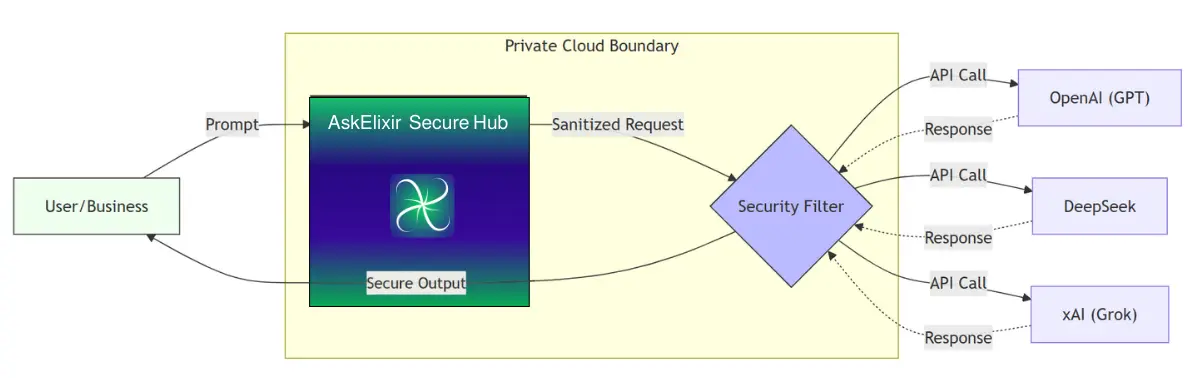
All interactions with AI models occur through enterprise API connections rather than public consumer platforms. Prompts and responses are transmitted through secure API calls, and—by default—are not logged or used for model training by the AI providers. This architecture significantly reduces the risk of sensitive corporate data being exposed through public AI interfaces.
Secure routing and controlled data handling
Model access is managed through a secure routing layer that connects the platform to multiple AI providers while enforcing data-handling policies. Prompt logging is disabled by default, and only limited operational metadata (such as token usage or latency) may be collected for analytics and billing purposes.
Private cloud infrastructure
The platform operates within a controlled private cloud environment designed to minimize data exposure and provide organizations with greater oversight of how AI queries are processed.
Centralized AI workspace and administration
IT and management teams gain a unified environment where employees can access multiple AI models without maintaining separate subscriptions or accounts. Centralized access simplifies administration, improves collaboration, and reduces the operational complexity of managing multiple AI tools.
Structured outputs and workflow integration
AskElixir.ai supports structured responses and file generation, enabling teams to export summaries, reports, or other AI-generated outputs directly into their internal workflows.
How AskElixir.ai Addresses Each Shadow AI Risk
| Shadow AI Risk | How AskElixir.ai Mitigates It |
| Data submitted to public AI tools with no retention controls | Enterprise APIs with zero data retention; prompts not used for training |
| No audit trail for AI usage | Centralized dashboard with usage analytics and reporting |
| GDPR/HIPAA compliance gaps | Compliance-ready infrastructure with data processing controls |
| Fragmented tools across departments | Single platform with access to GPT, Grok, Gemini, DeepSeek, LLaMA |
| Uncontrolled costs and subscriptions | Centralized billing and usage management |
| Employees bypassing AI bans | Sanctioned, easy-to-use alternative that removes the incentive to use shadow tools |
The result: Organizations harness the full productivity potential of generative AI while maintaining data security, regulatory compliance, and operational control.
Conclusion: Visibility and Control Are the New Competitive Advantages in Enterprise AI
The widespread adoption of public AI tools has created a new risk landscape that most organizations are not yet equipped to manage. The data is clear:
- Nearly 6 in 10 employees use AI without employer approval.
- More than 3 in 4 have shared sensitive data through public AI tools.
- Most organizations lack formal AI governance policies.
Shadow AI, fragmented workflows, and uncontrolled data exposure are not hypothetical risks—they are current, measurable challenges affecting enterprises across every industry.
The solution is not to ban AI. It is to redirect AI usage into secure, governed channels that give employees the tools they need while giving IT and compliance teams the visibility they require.
By adopting controlled AI environments—and leveraging platforms like AskElixir.ai—organizations can achieve the right balance of productivity, innovation, and security.
In the evolving world of enterprise AI, the organizations that thrive will be those that treat AI governance not as a constraint, but as a competitive advantage.
FAQ: AI Security and Responsible Use of AI in Organizations
Can companies legally use generative AI tools in the workplace?
Yes. Generative AI tools can be used legally in business environments, but organizations must ensure that their use complies with internal data protection policies and applicable regulations such as GDPR, HIPAA, or industry-specific compliance frameworks. Most companies address this by implementing AI governance policies and restricting how sensitive data can be shared with AI systems.
What is the difference between consumer AI tools and enterprise AI platforms?
Consumer AI tools are designed for individual users and typically operate through personal accounts on public platforms. Enterprise AI platforms, by contrast, provide centralized administration, secure API access, identity management, and compliance controls that allow organizations to manage how employees use AI tools across the company.
Should companies ban AI tools to prevent data leakage?
Most organizations find that outright bans are ineffective. Employees often continue using AI tools through personal devices or external accounts. Instead, many companies implement controlled AI environments that provide secure access to approved AI models while enforcing data protection and governance policies.
Who is responsible for managing AI usage inside a company?
Responsibility for AI governance typically falls across multiple teams, including IT, cybersecurity, legal, and compliance departments. Many organizations now establish internal AI governance committees or policies that define acceptable use and monitor how AI tools are deployed across business units.
How quickly is AI adoption growing in enterprises?
AI adoption in business has expanded rapidly since 2022. Industry research consistently shows that a majority of organizations now use AI in at least one business function, including marketing, software development, customer support, and data analysis. As adoption grows, companies are increasingly focusing on governance and security controls.
What should employees know before using AI tools at work?
Employees should understand which AI tools are approved by their organization and what types of information can safely be shared. In most companies, confidential documents, financial data, personal information, and proprietary code should never be entered into public AI systems unless the platform is specifically approved by IT and compliance teams.
Will AI regulations affect how companies use generative AI?
Yes. Governments and regulatory bodies around the world are introducing new rules for artificial intelligence. These regulations focus on transparency, data protection, and responsible AI deployment. As a result, many organizations are proactively implementing AI governance frameworks to ensure their AI usage aligns with emerging regulatory requirements.
Is it safe to upload company documents to AI tools?
Uploading internal company documents to public AI tools can introduce security and privacy risks. When files or text are submitted to external AI services, organizations may lose control over how that data is processed or stored. For this reason, many companies restrict the use of public AI tools for confidential information.
What industries face the highest risk from AI data exposure?
Industries that handle sensitive or regulated data face the greatest risks. This includes financial services, healthcare, logistics, legal services, and government contractors. In these sectors, improper handling of data through AI tools may lead to compliance violations or regulatory penalties.
Can AI tools accidentally expose intellectual property?
Yes. When developers or engineers submit proprietary code, product documentation, or technical designs to AI tools, this information may leave the company’s controlled environment. Without proper governance, this can expose intellectual property or confidential technical knowledge.
Why are IT teams concerned about generative AI tools?
IT and cybersecurity teams are concerned because AI adoption often happens without centralized oversight. Employees may independently adopt multiple AI tools, making it difficult to monitor data usage, enforce security policies, or manage compliance requirements.
Do companies monitor how employees use AI tools?
Some organizations monitor AI usage patterns to understand adoption trends and enforce internal policies. Typically, monitoring focuses on usage metrics and platform access rather than the content of prompts, allowing companies to balance governance with employee privacy.
What is an AI acceptable use policy (AUP)?
An AI Acceptable Use Policy defines how employees are allowed to use artificial intelligence tools at work. It typically outlines approved AI platforms, types of data that can or cannot be shared with AI systems, and guidelines for responsible use.
Will AI governance become a standard practice for companies?
Yes. As AI adoption continues to grow, many organizations are formalizing governance frameworks to manage risk and ensure responsible AI use. Analysts expect AI governance policies and secure enterprise AI platforms to become a standard component of corporate IT strategy.