EDI2XML
  • About
    • The Company
    • EDI2XML
    • Advantages
    • Partnership with EDI2XML
    • Testimonials
  • Services
    • Enterprise AI
    • Fully Managed Integration
    • Fully Managed EDI Services
    • EDI Web Portal
    • EDI Web Service
    • EDI On Premises
    • Managed Cloud Services
    • Amazon Integration
    • Shopify Integration
    • BigCommerce Integration
    • NetSuite Integration
    • JD Edwards Integration
    • Dynamics 365 Integration
    • SAP B1 Integration
    • Salesforce Integration
    • Industry 4.0 Integration
  • Pricing
    • EDI Managed Services
    • EDI Web Service
    • EDI On-Premises
    • Managed Cloud Services
    • Shopify Integration
    • JD Edwards Integration
    • E-commerce Integration
    • All other Integrations
  • Blog
  • Resources
    • Resource Center
    • List of EDI Codes
    • List of EDIFACT Messages
    • EDI Documents Library
    • Trading Partners
  • Contact us
  • Book a Consultation
  • Click to open the search input field Click to open the search input field Search
  • Menu Menu
  • Link to Facebook
  • Link to LinkedIn
  • Link to X
  • Link to Youtube

JDE integration services to optimize your JD Edwards system, enhancing business workflows and data accuracy across platforms

Tag Archive for: JDE

JDE Integration Using Magic xpi Certified Oracle JD Edwards Connector

Blog

The smooth flow of data between business systems and applications is an important element in the day-to-day business operations of any enterprise. This cannot be achieved without integrating business systems with each other.

Integration & Automation

As an integration service provider with more than 24 years of experience, we help companies find the best integration solution that not only works but also improves their business processes.

Continuing our series of articles about various integration methods of Oracle JD Edwards, today we will look at the integration of JD Edwards using Magic xpi Certified Connector.

Oracle JD Edwards – Overview

Oracle JD Edwards EnterpriseOne, often abbreviated as JDE, is an enterprise resource planning (ERP) software system. JD Edwards helps organizations manage their business processes and streamline operations. It covers areas such as financial management, supply chain, manufacturing, human capital management, and more.

The Oracle JD Edwards EnterpriseOne solution can be installed either on-premises or through a cloud-based service. Business owners can choose the deployment model that best suits their needs thanks to this flexibility.

Oracle Cloud Infrastructure (OCI): You can provision JD Edwards EnterpriseOne on Oracle Cloud Infrastructure. This allows you to create a multi-host, secure, high-availability topology. Benefits include elastic expansion, lower costs, and risk reduction.

A hybrid cloud approach is widely adopted by many organizations. For example:

  • Deploy development and test environments on the cloud while keeping production on-premises.
  • Run JD Edwards instances on the cloud while integrating with on-premises systems.
  • Extend JD Edwards functionality using cloud-based services like Oracle Mobile Cloud or Business Intelligence Cloud.

Content and Collaboration: JD Edwards integrates with Oracle Content and Experience Cloud, enabling real-time enterprise conversations and access to content in the cloud.

Magic xpi Integration Platform and its Certified Oracle JD Edwards Connector

Magic xpi is an integration platform that connects different software applications, systems, and databases. It acts as a bridge, allowing them to communicate and share data seamlessly.

The Magic xpi Oracle certified JDE Connector acts as a bridge, connecting your JD Edwards ERP system with other applications, databases, and systems. Its goal is to enable smooth data exchange, automate processes, and enhance business agility.
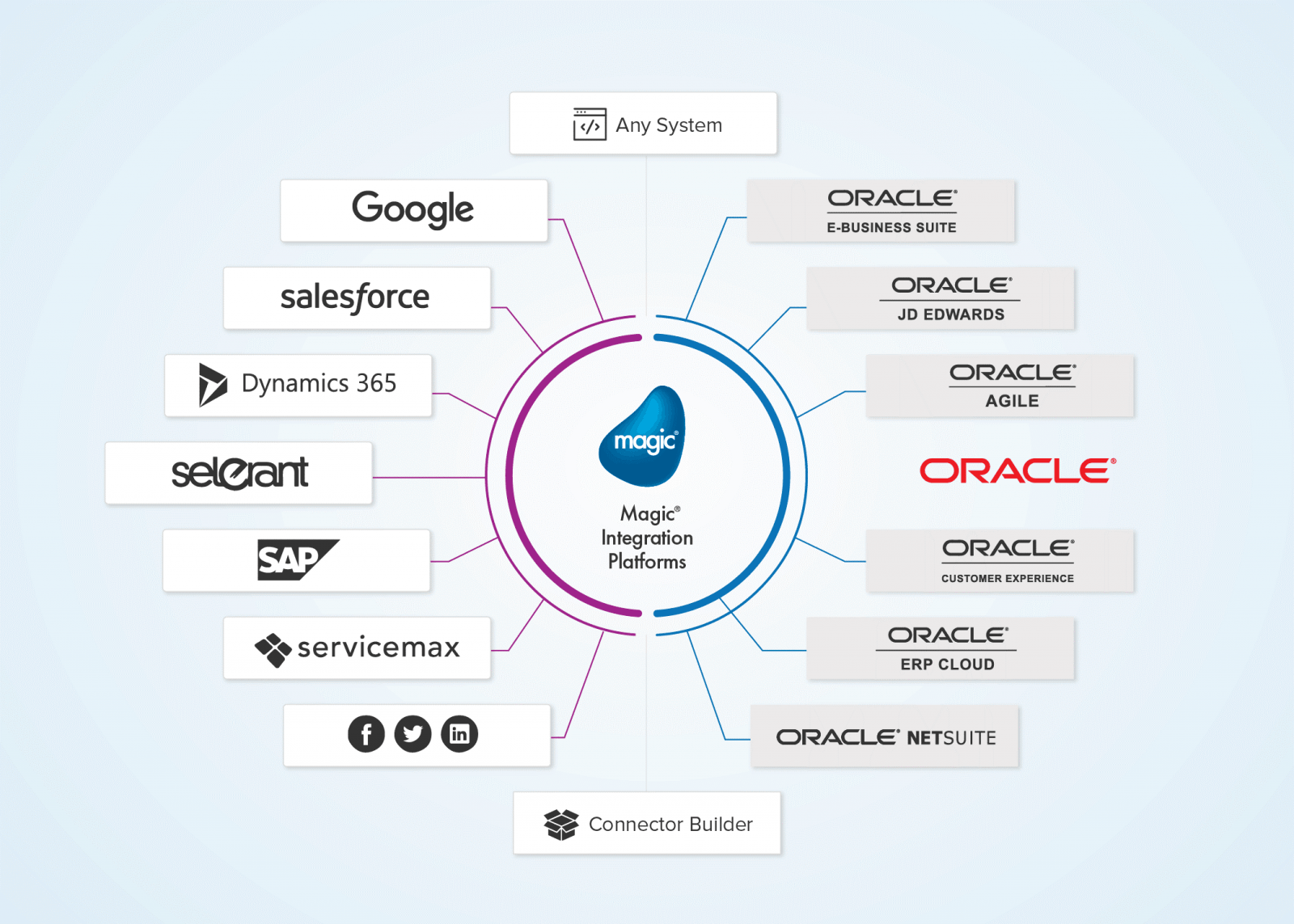
JDE Integration using Magic xpi
 

JDE Connector – Certified and Validated by Oracle

Magic xpi is the only solution that comes with a built-in, certified JD Edwards connector. Magic xpi’s JDE connector has undergone rigorous testing and evaluation by Oracle. Thus, Oracle has independently verified that Magic xpi’s JDE connector meets specific criteria and confirms that the connector works harmoniously with Oracle products.

Why it matters:

  • Reliability: Certification ensures that the connector functions as intended, minimizing errors and issues.
  • Compatibility: It seamlessly integrates with JD Edwards, adhering to JDE’s standards and protocols.
  • Peace of Mind: Organizations can trust that the connector won’t disrupt their JDE environment.

Out-of-the-Box Integration with JDE Connector

When a solution offers out-of-the-box integration, it means that you can use it immediately without requiring extensive custom development or additional coding.

Magic xpi JDE Connector is specifically designed to work seamlessly with JD Edwards’ business functions right out of the box. So, you don’t have to spend weeks writing custom code or configuring intricate settings. Instead, you can start integrating JDE with other systems quickly, leveraging the connector’s built-in capabilities.


USEFUL: Download Free Whitepaper – Magic xpi Integration Platform

Magic xpi – Loosely Coupled Integration

Often organizations face difficulties in the process of upgrading their customized JD Edwards environment. When businesses have tailored their JDE system to meet specific needs (custom fields, workflows, etc.), upgrading to a new version can be complex.

Challenges may include:

  • Ensuring that customizations remain compatible with the upgraded JDE version.
  • Migrating custom data and business logic seamlessly.
  • Testing and validating the entire environment post-upgrade.

Magic xpi’s certified connector addresses these challenges by providing a reliable integration solution that bridges the gap between customized JDE environments and other systems.

Magic xpi Integration Platform and Business Logic Enhancement

Business logic refers to the rules, processes, and calculations that govern how an application or system behaves based on business requirements.

Business logic resides in the core functionality of software applications. It defines how data is processed, validated, transformed, and acted upon.

Examples:

  • Order Processing: When an order is placed online, business logic determines how it’s validated, whether inventory is available, and how payment is processed.
  • Pricing Calculations: Business logic calculates prices based on discounts, taxes, and other factors.
  • Workflow Approval: Logic defines who approves a purchase request and under what conditions.

In the context of integration flows, business logic plays a crucial role:

Data Transformation: Logic ensures that data from one system is correctly mapped and transformed to fit the requirements of another system.

Decision Making: Logic determines when certain actions should occur. For example, if an order exceeds a certain amount, additional approval steps might be needed.

Error Handling: Logic defines how errors are handled—whether to retry, notify, or take alternative actions.

Data Enrichment: Logic can enhance data by adding context (e.g., customer segmentation, product categorization).

Event Triggers: Logic decides when an integration flow should be triggered (e.g., when a new customer is added to the CRM system).

Magic xpi’s Role in Business Logic Enhancement

Oracle Orchestrator connects to JD Edwards (JDE) and handles basic integration tasks. Magic xpi complements this by providing additional layers of intelligence:

  • Custom Logic: Magic xpi allows you to add custom business rules specific to your organization.
  • Complex Workflows: You can create intricate workflows involving multiple systems, approvals, and notifications.
  • Conditional Logic: Magic xpi lets you define conditions for data routing (e.g., if the order value is high, send it for manager approval).
  • Data Enrichment: Enhance data during integration by adding relevant information.
  • Error Handling Strategies: Magic xpi provides options for handling errors gracefully.

By enhancing business logic, Magic xpi ensures that integration flows align with your organization’s unique processes and requirements. Therefore, business logic is the brain behind how systems behave, and Magic xpi enriches this logic to create powerful, customized integration flows.

Free Consultation with an Integration expert
 

Business Functions in JD Edwards

Business functions are modular units of code within JD Edwards. They encapsulate specific tasks, operations, or business logic.

These functions serve as building blocks for various processes within JDE. They handle data validation, security, and data integrity. For example:

  • An order processing function that validates customer orders.
  • An inventory adjustment function that updates stock levels.
  • A financial calculation function that computes tax amounts.

Magic xpi and Business Functions

As previously stated, JDE Business Functions are specific actions or operations performed within the JD Edwards framework, that encompass a wide range of tasks to facilitate data transformation, validation and manipulation.
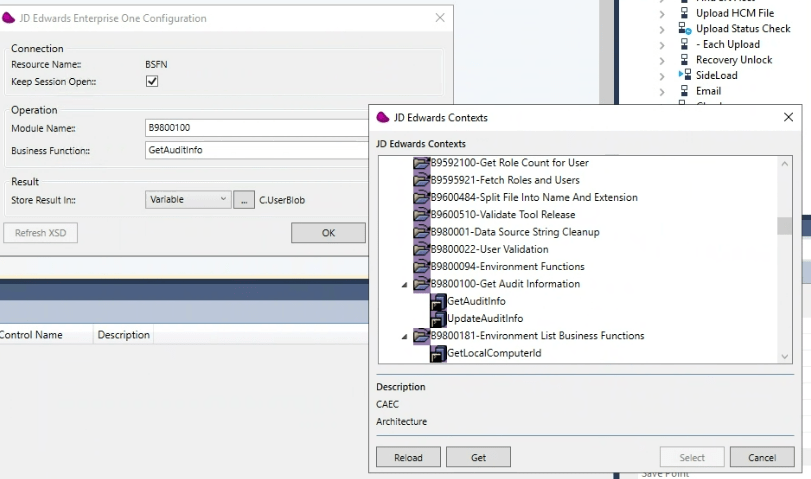
JDE Contexts in Magic xpi
Magic xpi JD Edwards Contexts

Invoking Business Functions from within Magic xpi:

Magic xpi allows you to invoke JD Edwards business functions directly similar to triggering functions and procedures of other applications, databases, or APIs. For example, an e-commerce platform can trigger an HTTP request (or webhook) running on top of Magic xpi, at the same time, Magic xpi, will issue a call to a JDE business function to create the new order in JDE, as soon as a consumer places the order online.

Triggering Business Functions:

Magic xpi can trigger JDE business functions based on specific events. Events might include:

  • New orders received.
  • Inventory updates (e.g., stock replenishment).
  • Changes in customer data (e.g., address updates).

When an event occurs, Magic xpi initiates the execution of the corresponding JDE business function.

Magic xpi and Data Flow:

When integrating JDE with external systems, data needs to flow smoothly between these components.

As mentioned above, the data flow involves both sending data to JDE (e.g., invoking a business function) and retrieving data from JDE (e.g., querying for information).

Magic xpi ensures that data can move between the source and JDE through business functions.
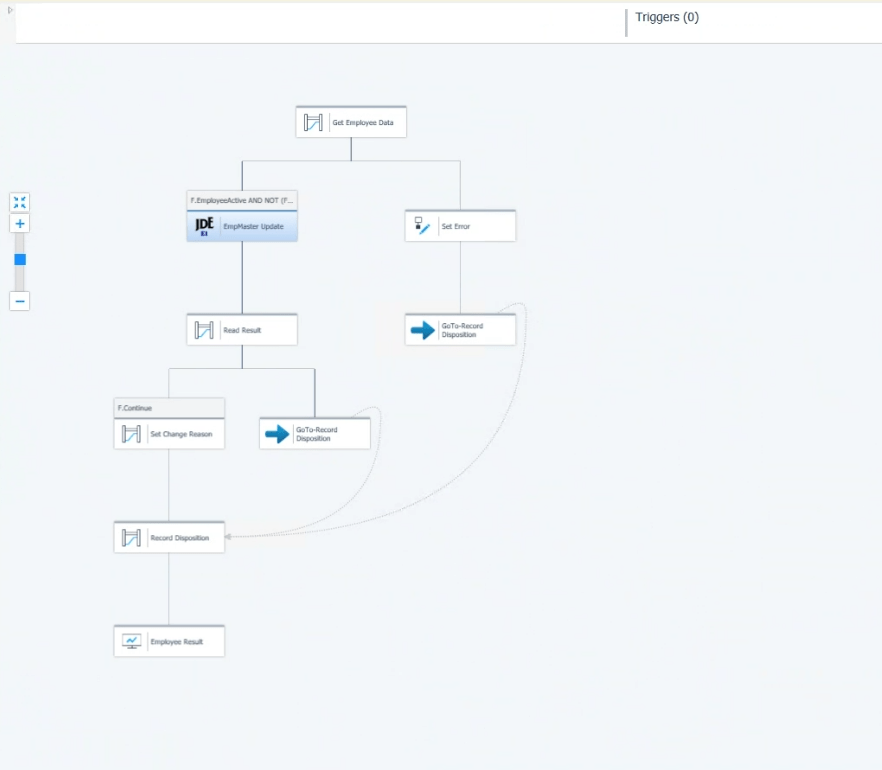
Magic xpi JDE flow
Magic xpi – JDE Flow
 

Why Integrate Oracle JD Edwards with Third-Party Software and Applications?

Integrating other business systems and applications with Oracle JD Edwards (JDE) is essential for businesses:

Centralized Data Management: JDE serves as a comprehensive enterprise resource planning (ERP) solution, consolidating core business functions such as finance, inventory, and manufacturing. Integrating with JDE enables businesses to centralize their data, providing a single source of truth for critical operational information.

Optimized Workflows: Integration with JDE streamlines business processes by automating data exchange between disparate systems. This automation reduces manual intervention, minimizes errors, and accelerates workflows such as order fulfillment, procurement, and supply chain management.

Real-Time Analytics: JDE integration facilitates access to real-time data insights, empowering decision-makers with up-to-date information for strategic planning and operational optimization. By leveraging timely analytics, businesses can identify trends, anticipate customer needs, and respond swiftly to market dynamics.

Competitive Differentiation: Integration with JDE confers competitive advantages by enhancing operational efficiency, customer service, and agility. Businesses can achieve faster order processing, improved inventory management, and superior customer experiences, positioning themselves ahead of competitors in the market.

JD Edwards Integration – Your Next Steps

Evaluate Your Needs: Assess your integration requirements. What systems need to communicate with JDE (e.g., EDI, CRM, HR, logistics)? Visualize your end-to-end business processes. How does information flow within your organization?

Reach Out: Connect with EDI2XML, the integration experts with over 24 years of experience. We’ll guide you through the process, tailor solutions to your unique needs, and ensure a successful implementation.


Free consultation
March 22, 2024/0 Comments
https://www.edi2xml.com/wp-content/uploads/2024/03/EDI2XML-JDE-Magic-xpi-integration.png 675 1200 Tatyana Vandich https://www.edi2xml.com/wp-content/uploads/2024/08/edi2xml.com-EDI2XML-company-logo.png Tatyana Vandich2024-03-22 15:16:212026-05-28 14:59:34JDE Integration Using Magic xpi Certified Oracle JD Edwards Connector

Oracle JD Edwards Orchestrator: A Powerful Tool for Digital Transformation

Blog

Are you looking for a way to leverage the power of data automation in your business? Do you want to integrate your Oracle JD Edwards EnterpriseOne with other applications, devices, and systems? Do you want to explore how JDE Orchestrator can help achieve your business goals? If you said “yes” to any of these questions, then this blog is for you.

Introduction: Oracle JD Edwards Orchestrator

In this article, we will provide a comprehensive overview of the Oracle JD Edwards Orchestrator. We will discuss the components of JDE Orchestrator, and answer some common FAQs about this technology. We will also share some expert tips and advice based on our experience as a successful business systems integration provider, with more than 24 years of experience.

What is Oracle JD Edwards Orchestrator?

Oracle JD Edwards Orchestrator is a JDE component, provided by Oracle as an add-on to their JDE install, at no additional charge. It enables us to collect, filter, analyze, and act on real-time data extracted from JD Edwards ERP using REST API. It can also trigger actions in EnterpriseOne based on predefined rules and logic.

Thus, JDE Orchestrator can help transform your JDE system from a static record-keeper to a dynamic modern, API provider/consumer of real-time business operations.

JDE Orchestrator was first introduced in 2015 as a tool for IoT integration, but since then it has evolved into a powerful and versatile tool for digital transformation in the JDE world. According to Oracle documentation, JDE Orchestrator is compatible with JD Edwards EnterpriseOne 9.1 and above, and it is constantly updated with new features and enhancements. However, some of the features and capabilities of JDE Orchestrator may require a higher tools release or patch level.

What are the Components of JDE Orchestrator?

Oracle JD Edwards Orchestrator consists of several key components that work together to automate and streamline business processes. These components include:

JDE Orchestrator Studio

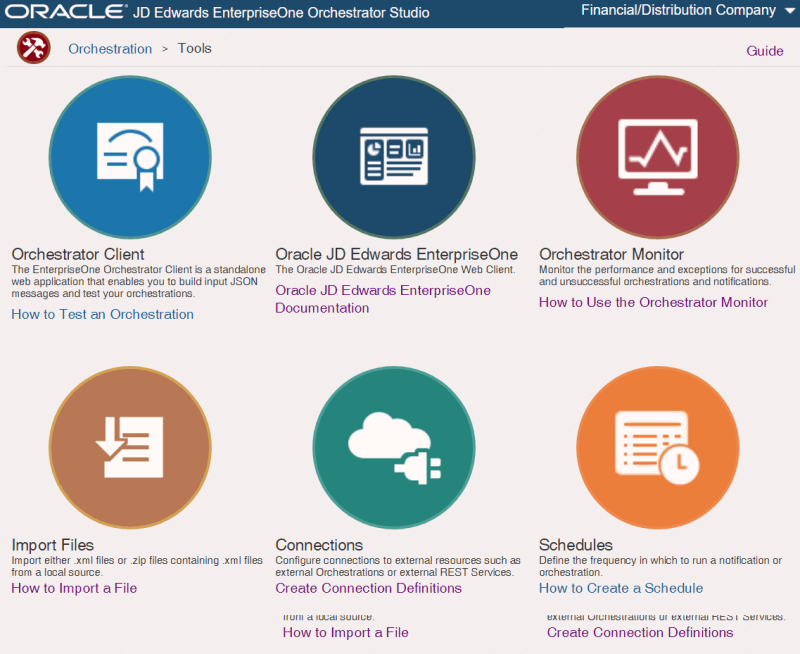
JDE Orchestrator Studio is a web-based application that allows you to design, test, and deploy orchestrations, which are the workflows that define the logic and actions of JDE Orchestrator. JDE Orchestrator Studio features a graphical drag-and-drop interface, a simplified data mapping tool, a built-in testing tool, and a version control system.

JDE Orchestrator Studio is a user-friendly and intuitive tool for creating and managing orchestrations for various use cases, such as automation, integration, IoT, and user experience enhancement.

The Orchestration Studio empowers users to automate and streamline business processes with ease, leveraging a combination of visual design tools, pre-built components, and customization options. Its intuitive interface and robust features make it a powerful tool for driving digital transformation and improving operational efficiency within JD Edwards environments.

JDE Orchestrator Server

JDE Orchestrator Server is a component of the Application Interface Services (AIS) Server that executes the orchestrations and communicates with the EnterpriseOne system and other external systems.

JDE Orchestrator Server is responsible for processing the input data, applying the logic and rules, performing the actions and service requests, and generating the output data for each orchestration. The JDE Orchestrator Server can handle multiple orchestrations concurrently and efficiently, using a queue-based mechanism and a thread pool.

JDE Orchestrator Server can also handle large data sets, parallel processing, and temporary tables to optimize and scale the orchestration performance.

The Orchestrator Server of JDE, can be configured and managed using the Server Manager Console, where you can set up the server properties, security settings, logging options, and runtime parameters.

The Orchestrator Server can also be monitored and troubleshooted using the Orchestrator Monitor, where you can view the health and exception records, as well as the run details and results of each orchestration.

JDE Orchestrator Monitor

JDE Orchestrator Monitor is a web-based interface that allows you to view and manage the performance and status of the JDE Orchestrator and its orchestrations, as well as troubleshoot any issues or exceptions. The Orchestrator Monitor enables you to:

  • Monitor the health and exception records of the JDE Orchestrator, which indicates the availability and reliability of the Orchestrator Server and the orchestrations.
  • Monitor the run details and results of each orchestration, which show the input, output, and execution logs of the orchestrations.
  • Manage the health and exception records, such as deleting, archiving, or resubmitting them, to resolve any issues or errors that occur during the orchestration execution.
  • Filter and sort the records by different criteria, such as user, environment, role, date, time, status, etc., to find the relevant information quickly and easily.
  • Refresh and reset the data displayed in the JDE Orchestrator Monitor, to ensure that the information is up-to-date and accurate.

What is the Use of JDE Orchestrator?

Oracle JD Edwards (JDE) Orchestrator can be used for critical mission purposes within an organization:

JDE Orchestrator for Automation of Business Processes

One of the primary uses of JDE Orchestrator is to automate various business processes within the JD Edwards ERP system. This includes tasks such as order processing, inventory management, procurement, financial transactions, and more. By automating these processes, organizations can improve efficiency, reduce manual errors, and accelerate decision-making.

Integration with External Systems via JDE Orchestrator

The Orchestrator enables seamless integration between JD Edwards and external systems, such as CRM/ERP platforms, supply chain management systems, e-commerce platforms, EDI, and IoT devices. This integration allows for the exchange of data and transactions, facilitating real-time decision-making and enhancing overall business agility.

Streamlining Workflows with JDE Orchestrator

With JDE Orchestrator, organizations can streamline complex workflows that involve multiple steps and stakeholders. For example, they can create orchestrations to automate approval processes, route documents for review, and notify stakeholders of important events. This streamlining of workflows helps in reducing bottlenecks and improving collaboration across departments.

Integration
 

JDE Orchestrator for Real-Time Data Processing

The Orchestrator enables real-time data processing by triggering actions based on predefined events or conditions. This allows organizations to react quickly to changing circumstances, such as inventory shortages, customer inquiries, or production delays. Real-time data processing enhances decision-making and enables organizations to stay responsive in dynamic business environments.

What are Some Common FAQs about Oracle JDE Orchestrator?

The JDE Orchestrator is a relatively new and innovative technology that may raise some questions and concerns among JD Edwards users and partners. Here are some of the common FAQs about JDE Orchestrator, along with their answers:

How does the Orchestrator integrate with external systems?

The Orchestrator integrates with external systems using connectors that support various protocols such as REST, SOAP, and others. These connectors facilitate the exchange of data and transactions between JD Edwards and external applications.

Do I need coding knowledge to use the Orchestrator?

While coding knowledge is not required, basic understanding of concepts like data mapping and conditional logic can be helpful. The Orchestrator provides a graphical interface for designing orchestrations, but users may need to write custom scripts for advanced functionalities.

To take advantage of all the benefits of Orchestrator, you don’t have to figure it out yourself, entrust the integration to professionals. We, at EDI2XML can quickly and efficiently perform integration of any complexity for you using JDE Orchestrator. Book your free JDE consultation now!

Is the Orchestrator scalable for enterprise use?

Yes, the Orchestrator is designed to be scalable and can handle a large number of orchestrations and transactions to meet the needs of enterprise-level businesses.

Can I customize orchestrations to fit my specific business requirements?

JDE
 

Yes, the Orchestrator provides flexibility for customization. You can create custom data structures, define complex logic using JavaScript, and integrate with custom business functions and services to tailor orchestrations to your specific needs.

What is JDE Orchestrator REST API?

JDE Orchestrator REST API is a set of endpoints that allow you to interact with the JDE Orchestrator and its orchestrations using HTTP requests and responses. The JDE Orchestrator REST API enables you to execute, monitor, and manage orchestrations from any external application or system that supports REST.

What are Some Expert Tips and Advice for Using JDE Orchestrator?

As a successful business systems integration provider with more than 24 years of experience, we have gained a lot of knowledge and expertise in using JDE Orchestrator for various projects and clients. Here are some of our expert tips and advice for using the JDE Orchestrator:

Plan and design your orchestrations carefully, considering the business requirements, the data sources, the logic and actions, the input and output formats, the error handling, and the security aspects.

Test and debug your orchestrations thoroughly, using the built-in testing tool in the Orchestrator Studio, and the Orchestrator Monitor for troubleshooting and resolving any issues or exceptions.

Document and maintain your orchestrations properly, using the version control system in the Orchestrator Studio, and the export and import features for backup and recovery.

Optimize and scale your orchestrations efficiently, using the Orchestrator Capability for large data set retrieval, the parallel processing option, and the temporary tables feature.

Conclusion: Oracle JD Edwards Orchestrator

Oracle JD Edwards Orchestrator stands out as a great tool for businesses seeking to embrace digital transformation. Its ability to seamlessly integrate with external systems, automate processes, streamline workflows, and process real-time data makes it a valuable asset for organizations aiming to enhance efficiency and agility.

For those who are considering using JDE Orchestrator’s capabilities but aren’t sure where to start or how to navigate the complexities, it’s essential to seek guidance from experienced professionals.

At EDI2XML, we offer comprehensive integration services tailored to your specific business requirements. Our team of experts with over 20 years of experience can efficiently guide you through the integration process, ensuring seamless implementation and optimal utilization of the JDE Orchestrator. Don’t let the potential of your JD Edwards system go untapped. Take the first step towards unlocking its full capabilities by engaging with us for a free JDE consultation. Together, we can propel your business toward success.

Free Consultation
February 23, 2024/0 Comments
https://www.edi2xml.com/wp-content/uploads/2024/02/EDI2XML-JDE-Orchestrator-Service.png 675 1200 Tatyana Vandich https://www.edi2xml.com/wp-content/uploads/2024/08/edi2xml.com-EDI2XML-company-logo.png Tatyana Vandich2024-02-23 16:16:172026-05-28 14:57:00Oracle JD Edwards Orchestrator: A Powerful Tool for Digital Transformation

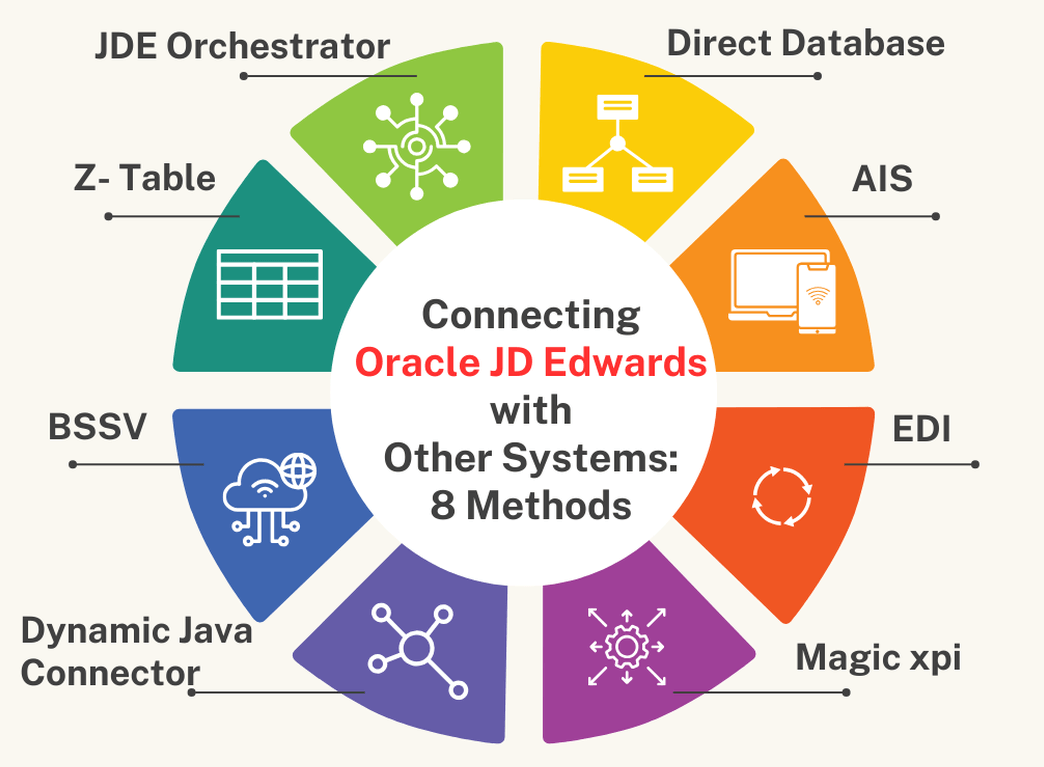
How to Connect Oracle JD Edwards with Other Systems: Overview of Eight Methods

Blog

As an experienced systems integrator, EDI2XML has completed many successful integrations across diverse industries. Based on our extensive experience, in this article, we want to discuss what the various integration methods available to businesses to integrate with Oracle JD Edwards.

We’ll keep it simple and give you a basic understanding of each method. Our goal is to give you the knowledge you need to make integration easier for your business. In future articles, we’ll dive deeper into each method to help you understand them better.

Oracle JD Edwards (JDE) Explained: ERP Integration & Key Features

Oracle JD Edwards, or JD Edwards EnterpriseOne, or just JDE is a comprehensive suite of enterprise resource planning (ERP) software that helps businesses manage their financial, operational, and human resources processes.

Oracle JD Edwards utilizes cutting-edge technologies like cloud computing, mobile platforms, the Internet of Things (IoT), artificial intelligence (AI), and machine learning (ML) to create smart solutions and make users’ experience better.

In the past, Oracle JD Edwards went by various names like OneWorld, B732, Xe, and 8.98, each representing different software versions. However, its current and widely recognized name is Oracle JD Edwards EnterpriseOne. People may also refer to it informally as JDE, JDEdwards, JDE E1, or OJDE, which are typically shortened versions or acronyms based on its official name.


USEFUL READING: Oracle JD Edwards Integration: The Key to Digital Transformation


While Oracle JD Edwards provides over 80 configurable modules to meet specific customer needs, it may not address all enterprise application requirements. Nevertheless, it seamlessly integrates with other business applications and systems, offering various interaction and integration patterns for optimal integration.

Oracle vs. JD Edwards: Understanding the Relationship for ERP Users

JD Edwards (JDE) is not the same as Oracle, but it is a product line owned and developed by Oracle. Here’s how they are related:

JD Edwards (JDE): Initially an independent company, JD Edwards developed ERP solutions that became widely used by industries requiring robust supply chain and financial management tools. Its flagship products include:

    • JD Edwards EnterpriseOne: A flexible, web-based ERP platform that supports multiple databases and operating systems.
    • JD Edwards World: A platform designed for IBM System i (AS/400) hardware, known for its reliability.

Oracle’s Acquisition: In 2003, PeopleSoft acquired JD Edwards. Then, in 2005, Oracle purchased PeopleSoft, which included JD Edwards as part of the acquisition. Since then, JD Edwards has been under Oracle’s ownership.

Oracle’s Role: Oracle has continued to develop and support JD Edwards products. JD Edwards now benefits from Oracle’s broader ecosystem, including integration with Oracle Cloud Infrastructure, Oracle Database, and other Oracle applications.

Key Difference:

    • JD Edwards remains a product line within Oracle’s extensive portfolio.
    • Oracle, as a company, offers a vast range of software, hardware, and cloud services beyond JD Edwards, such as Oracle Fusion ERP, Oracle E-Business Suite, and Oracle NetSuite.

Oracle JD Edwards Integration: Essential Methods for System Connectivity

Oracle JD Edwards (JDE) EnterpriseOne offers various integration methods that enable the system to interact with external applications, databases, and services.

Thus, integrating JDE with other systems involves linking its robust functionalities with diverse software applications like CRM, ERP, HRM, EDI, and more. This integration facilitates data exchange, automation, and real-time insights, enhancing overall business performance.

Comparing Oracle JD Edwards Integration Methods: Orchestrator, EDI, & More

Here’s a list outlining different methods of Oracle JD Edwards (JDE) integration, including JDE Orchestrator, Direct Database integration, Dynamic Java Connector, and Magic xpi.

Oracle JD Edwards Orchestrator: Streamlining JDE Integration with REST Services

JDE Orchestrator is a tool that enables you to create, test, and deploy REST services that interact with JD Edwards EnterpriseOne applications and data.

  • Easy to use and configure
  • Supports real-time integration
  • Supports JSON and XML formats
  • Supports IoT devices and cloud services

USEFUL READING: Streamlining Business Operations: Expert Perspectives on JD Edwards Orchestrator Integration


Direct Database Integration for Oracle JD Edwards: SQL & Real-Time Data

Integrating external systems directly with the JD Edwards database, typically using SQL queries and database connections.

  • Fast and simple
  • Supports batch and real-time integration
  • Supports any database format
  • No additional software required

We have the expertise and the tools to help you integrate JDE with other systems in the most efficient and effective way. Book a free consultation now

Java Connector for Oracle JD Edwards: Custom Integration & Business Logic

A tool that enables you to create Java classes that interact with JDE business functions using the Java Connector Architecture (JCA) specification.

  • Supports real-time integration
  • Supports complex business logic
  • Supports any Java-based platform or application
  • Supports transactions and security

Z-Table Processing in Oracle JD Edwards: Bulk Data Integration Methods

The “Z tables” are transition tables in SQL/Oracle, whose sole objective is to load data into JDE. In general, this way is used for “Bulk import” of data into the JDE database.

  • Can be done using various methods, such as flat files (CSV, TXT, etc.) to import and export data between JDE and external systems.
  • In general, used for “Bulk import” of data into the JDE database.
  • Z-table integration can be used for both inbound and outbound transactions

Oracle JD Edwards BSSV: Enterprise-Level Integration & Transaction Management

BSSV is a component within the JDE system that facilitates communication and integration between JD Edwards applications and external systems.

  • Supports SOAP-based and RESTful services for integration.
  • BSSV efficiently manages high volumes of transactions, ideal for enterprise-level deployments


Oracle JD Edwards AIS: RESTful API Integration for Mobile & External Systems

AIS is a component of Oracle JDE that provides a lightweight RESTful interface that allows JDE applications to run on various devices such as smartphones and tablets through REST API calls.              

  • Acts as a middleware layer, allowing external systems, mobile applications, and other software solutions to interact with JDE.

EDI Integration with Oracle JD Edwards: Streamlining B2B Data Exchange

EDI is one of the integration methods with Oracle JDE. JDE has a data interface system (code 47) that acts as a staging area for moving data in and out of the application systems using EDI standard formats.

  • Supports various EDI standard formats, such as X12, EDIFACT, HL7, and others
  • Enables JDE to communicate with external systems.

Magic xpi for Oracle JD Edwards: Visual Integration & Drag-and-Drop Solutions

Magic xpi is an integration platform designed for connecting various enterprise applications, including JD Edwards, through a visual drag-and-drop interface. It has an Oracle certified connector to JDE, that can interact directly with JDE Business Services and its Dynamic Java Connector.

  • Easy to use and maintain.
  • Supports batch and real-time integration.
  • Supports multiple protocols and formats.
  • Supports cloud and on-premises. deployment
  • Visual mapping, drag and drop from source to destination.

These methods can be used separately or in combination, depending on the complexity and requirements of the integration. It’s also important to note that integration strategies should be selected and implemented in a way that suits the organization’s IT policies, security standards, and performance requirements.

Optimizing Oracle JD Edwards Integration: Choosing the Right Methods for Your Business

Integrating JD Edwards (JDE) with other systems is crucial for streamlining business processes and maximizing operational efficiency. Each method offers unique advantages and capabilities, enabling seamless data exchange and collaboration across your organization and beyond.

If you’re ready to explore the possibilities of JDE integration or have questions about implementing these methods in your organization, our team is here to help.

Book your free consultation today to learn more and start optimizing your JD Edwards system for enhanced performance and productivity.

Free IT Consultation

We’d love to hear from you! What integration methods have you found most effective in your JDE implementation? Do you have any questions or suggestions regarding JDE integration? Leave a comment below and let’s continue the conversation!

February 14, 2024/0 Comments
https://www.edi2xml.com/wp-content/uploads/2024/02/EDI2XML-JDE-Integration.png 675 1200 Tatyana Vandich https://www.edi2xml.com/wp-content/uploads/2024/08/edi2xml.com-EDI2XML-company-logo.png Tatyana Vandich2024-02-14 14:38:022026-05-28 15:00:43How to Connect Oracle JD Edwards with Other Systems: Overview of Eight Methods

Streamlining Business Operations: Expert Perspectives on JD Edwards Orchestrator Integration

Blog

Explore how JD Edwards Orchestrator simplifies automation and integration across different systems. See real-life examples of JDE integration from experts with real-world JD Edwards knowledge.

What is JDE EnterpriseOne?

JD Edwards EnterpriseOne, or JDE EnterpriseOne commonly known as JDE, is an integrated applications suite of comprehensive enterprise resource planning (ERP) software. It is developed and marketed by Oracle Corporation. JD Edwards offers a wide range of modules and applications to support various business functions.

JD Edwards and Companies

Oracle JD Edwards is used by a significant number of businesses globally, spanning various industries such as manufacturing, distribution, construction, and services.

Oracle, being a major player in the enterprise software market, has a significant customer base for its JD Edwards EnterpriseOne software. The adoption of JDE varies across regions and industries, and many large and mid-sized enterprises leverage JD Edwards EnterpriseOne for their ERP needs.

Is JD Edwards a Good ERP System?

Determining whether JD Edwards is a good ERP system depends on various factors, including the specific needs and requirements of your business. Here are some considerations to help you evaluate whether JD Edwards is a good fit for your organization:

Industry Fit: JD Edwards is known for providing industry-specific solutions. It may be a good fit if your business operates in industries such as manufacturing, distribution, construction, or services, as JD Edwards offers modules tailored to these sectors.

Scalability: JDE is designed to scale with the growth of your business. If scalability is a crucial factor for your organization, JD Edwards’ modular structure and ability to handle increased data volumes can be an advantage.

Integration Capabilities: JD Edwards (JDE) is designed to be easily integrated with other systems and applications. Oracle recognizes the importance of interoperability in the modern business landscape, and JD Edwards provides various tools and capabilities to facilitate seamless integration.

Global Operations: If your business has a global presence, JD Edwards offers features to support multi-language and multi-currency requirements, making it suitable for companies with international operations.

Functionality: Consider whether JD Edwards provides the specific functionality your business needs. It covers a wide range of ERP functions, including finance, human resources, manufacturing, distribution, and CRM. Evaluate whether these modules align with your business processes.

User-Friendly Interface: JD Edwards is designed with a user-friendly interface, which can contribute to faster adoption and ease of use for employees. Evaluate the system’s usability based on the needs of your user base.

Thus, the “goodness” of an ERP system depends on how well it aligns with your business goals, processes, and long-term strategy.

What is JD Edwards Orchestrator?

JD Edwards Orchestrator is a powerful tool within JD Edwards EnterpriseOne suite that enables organizations to automate, integrate, and streamline business processes. Here are key points about JDE Orchestrator:

JDE Automation and Orchestration

The Orchestrator allows users to create and manage orchestrated processes. These processes can automate a wide range of tasks and activities within JD Edwards, such as data entry, data validation, and business process automation. Best of all, it turns a JDE process or form into a REST API endpoint, that can be called to POST or Get data from/to JDE.

JDE Orchestrator Integration Capabilities

JDE Orchestrator is designed to simplify integration between JD Edwards EnterpriseOne and external systems. It supports integration with other applications, databases, EDI and services, enabling the seamless exchange of data and processes.

JDE Web-Based Design Studio

Orchestrations are created and managed through a web-based design studio. This intuitive interface allows users to define, design, and configure orchestrations without the need for extensive coding or scripting.

JDE-Orchestration-tools
 

JDE Real-Time Event Monitoring

JDE Orchestrator can respond to real-time events and triggers within the JD Edwards system. This capability enables organizations to build responsive and event-driven workflows that react to changes in the business environment.

JDE Orchestrator Interoperability

Orchestrator supports interoperability with various protocols and data formats, making it versatile for connecting with different systems and technologies. It often leverages industry standards such as REST and JSON for communication.

Interoperability refers to the ability of software systems or components to work together, exchange information, and use each other’s functionality seamlessly.

In the context of JD Edwards Orchestrator, interoperability means that the Orchestrator is designed to work well with various systems, technologies, and data formats, allowing for smooth communication and integration.

Various Protocols and Data Formats

Orchestrator is capable of communicating with other software systems using different communication protocols. A protocol is essentially a set of rules that determines how data is transmitted over a network. Examples of communication protocols include HTTP (Hypertext Transfer Protocol) and HTTPS (HTTP Secure).

Data formats refer to the structure in which data is organized. Common data formats include JSON (JavaScript Object Notation) and XML (eXtensible Markup Language).

Integration
 

Versatility for Connecting

Orchestrator’s versatility lies in its ability to connect and interact with different types of systems and technologies. For example, it can integrate with databases, external applications, or web services.

This flexibility is crucial for businesses that use a variety of software solutions and need them to work cohesively.

Communication

Orchestrator often leverages industry standards like REST and JSON for communication between different systems. This means that when Orchestrator interacts with external applications or services, it does so using established and widely adopted methods and formats.

REST (Representational State Transfer) is an architectural style for designing networked applications. RESTful APIs are common in modern web development.

JSON is a lightweight data interchange format that is easy for humans to read and write, and easy for machines to parse and generate. It’s often used as a data format for transmitting information between a server and a web application.

Mobile Access

Orchestrator supports mobile access, allowing users to create and manage orchestrations using mobile devices. This is especially useful for organizations with mobile workforces or those looking to manage processes on the go.

Pre-Built Orchestrations

Oracle provides pre-built orchestrations that serve as templates for common business processes. These templates can be customized to fit specific organizational needs, providing a starting point for implementation.

Data Transformation

Orchestrator includes capabilities for data transformation, allowing organizations to map and transform data between different systems or formats as part of the orchestrated processes.

Security Features

Orchestrator integrates with JD Edwards security features, ensuring that access to orchestrations and sensitive data is controlled and secure.

JD Edwards EnterpriseOne Common Integration

Here are some common types of systems and applications that are frequently integrated with JD Edwards using Orchestrator:

E-Commerce Platforms

Integration with e-commerce platforms like Shopify is common, allowing businesses to synchronize order and inventory data between their online stores and JD Edwards.

EDI (Electronic Data Interchange) Systems

EDI integration is a popular use case for JD Edwards Orchestrator. It enables the exchange of standardized business documents such as purchase orders and invoices electronically, improving efficiency in supply chain management.

Marketplaces

Integration with Amazon, allows businesses to automate the transfer of order and inventory data between Amazon and JD Edwards.

CRM (Customer Relationship Management) Systems

Integration with Salesforce CRM enables the synchronization of customer data, sales leads, and opportunities between Salesforce and JD Edwards.

Other ERP Systems

In scenarios where businesses have multiple ERP systems, Orchestrator can be used to integrate and synchronize data between JD Edwards and other enterprise systems.

Custom Applications

Orchestrator’s flexibility allows businesses to integrate with their Custom-built applications, providing a tailored solution to meet specific business requirements.

HR Systems

Orchestrator can be used to connect JD Edwards with human resources management systems, ensuring seamless data exchange related to employee information, payroll, and benefits.

Logistics and Warehouse Management Systems

Orchestrator can streamline processes related to inventory management, order fulfillment, and shipping by integrating with systems designed for these purposes.

It’s important to note that the suitability of integration depends on the specific business goals and processes. JD Edwards Orchestrator’s flexibility allows organizations to adapt and integrate with a wide range of systems, enabling them to create a cohesive and interconnected IT ecosystem tailored to their needs.

The mentioned integrations are common examples, but the possibilities are extensive based on the unique requirements of each organization.

JD Edwards Orchestrator Services by EDI2XML

Companies often face the challenge of integrating their EDI or eCommerce processes with Oracle JD Edwards EnterpriseOne, and this is where integration providers like EDI2XML play a crucial role.

EDI2XML offers a comprehensive integration service that leverages the power of Oracle Orchestrator studio and experienced Orchestrator engineers.

The combination of EDI2XML’s managed services and Orchestrator’s capabilities offers quick development and deployment, transforming integration projects into efficient and streamlined workflows.

EDI2XML supports a wide range of EDI documents and e-commerce platforms, ensuring flexibility and adaptability to diverse business needs. Whether a company needs integration with Shopify, Amazon, BigCommerce, Magento, or any API-ready platform, EDI2XML offers a tailored solution.

With EDI2XML’s expertise, companies can entrust their integration projects to a team that understands JDE technology, EDI, and all the details of an integration project. EDI2XML it is your trusted integration partner to simplify complex processes and optimize Oracle JD Edwards integration. Contact us for a free consultation with one of our integration experts.

Get A Free EDI Consultation
January 8, 2024/0 Comments
https://www.edi2xml.com/wp-content/uploads/2023/12/EDI2XML-JDE-Orchestrator.png 675 1200 Tatyana Vandich https://www.edi2xml.com/wp-content/uploads/2024/08/edi2xml.com-EDI2XML-company-logo.png Tatyana Vandich2024-01-08 08:23:222026-05-28 14:58:28Streamlining Business Operations: Expert Perspectives on JD Edwards Orchestrator Integration

Join the EDI2XML Team at Collaborate17 in Las Vegas

Blog, EDI2XML

We are excited to share with you that we will be attending Collaborate17, in Las Vegas, Nevada, from April 2nd to the 6th. This Technology and Applications Forum for the Oracle Community is presented by IOUG (Independent Oracle Users Group), OAUG (Oracle Applications User Group) and Quest International Users Group, and will be held at the Mandalay Bay Convention Center.

Along with our Magic Software partner, we will be participating in education sessions and demos to teach Oracle users about the latest products, services and technologies that can accelerate and enhance their current Oracle Applications and help them overcome EDI challenges.

Visit us at booth 909 to learn more about how EDI2XML, partnered with Magic Software’s xpi platform, can be your efficient and affordable solution.

To learn more about this EDI integration solution, read our latest blog on “How to solve EDI integration challenges with Oracle’s JD Edwards”.

Click on the image below to join us in Las Vegas at Collaborate17!

EDI2XML at Collaborate 2017 for Oracle JDE integration

March 31, 2017
https://www.edi2xml.com/wp-content/uploads/2024/08/edi2xml.com-EDI2XML-company-logo.png 0 0 Tatyana Vandich https://www.edi2xml.com/wp-content/uploads/2024/08/edi2xml.com-EDI2XML-company-logo.png Tatyana Vandich2017-03-31 14:08:222018-04-26 10:43:53Join the EDI2XML Team at Collaborate17 in Las Vegas

What you need to know about EDI integration in JD Edwards World

Blog

EDI integration project into JD Edwards (JDE) system.


The same questions and concerns keep arising when designing the requirements for an EDI integration project into JD Edwards (JDE) system. As I have been involved in my fair share of EDI integration projects, I have witnessed companies struggling with integrating EDI in JDE systems. I’ve decided to share my experience, not as a JDE expert but as an EDI integration expert and consultant, to help those with this kind of project. Let’s begin…

Why EDI integration is important

More and more companies are adopting different communication protocols to exchange business-related messages electronically. Today’s business environments are working harder to be well connected with outside parties for improved communication. It is almost impossible nowadays for a company to trade and do business without having the capability to electronically exchange messages and important documents with its suppliers and customers. This is why EDI has gained tremendous attention in recent years; businesses, no matter how large or small they are, are looking to receive EDI documents (i.e. customer orders) and send out responses such as invoices, or advance shipping notices (ASNs).

On top of this, with the expansion and popularity of eCommerce (electronic commerce), businesses have no choice but to integrate EDI into their systems as consumers expect quick response times in providing more accurate inventory availabilities and quick order processing for better customer service.

All of the above make it almost impossible for any company to ignore electronic processing of sensitive data, all in real-time. However, what’s been challenging for most, is that various business partners adopt different EDI standards, some even choosing a “custom made” version, which all adds new layers of complexity to an EDI integration project in JDE and more pressures to comply with tons of different EDI standards (i.e. X12, EDIFact, XML, CSV,…).

Benefits of integrating EDI into a company’s system

EDI has been around for quite some time now. At this point, there’s no question about the real benefits that come from using this B2B communication method. Companies are seeing more advantages and improvements when they integrate EDI transactions (incoming and outgoing) into their management software system. Some of these EDI integration benefits include:

  • An increase in a company’s response time and a decrease in their fulfillment cycle
  • Increased information integrity and a reduction in errors due to the elimination of manual data entry and human intervention
  • Fast and accurate delivery of goods and services

There’s no doubt that companies gain a competitive advantage by successfully integrating EDI into their management system. They are better equipped to handle more orders and have no problem doing business with large retailers who expect electronic messaging. 

How EDI processing works in JD Edwards

Let me give a quick description of the EDI processing cycle in JDE, as described by Oracle’s own documentation of the JDE system.

“When you receive inbound documents, the translator software retrieves the data using network communications and translates the data from EDI Standard format to JD Edwards World application file format”.

Here is a simple drawing posted in their online documentation:

EDI processing cycle in JDE

In simple terms, when a company running JD Edwards World or its previous version (Enterprise One) needs to process EDI data received from a business partner for example, the data will go through different stages:

  1. A communication software (a third party software) would connect and get incoming EDI files using network communications.
  2. The translator software translates the data from EDI Standard format to JD Edwards World application file format.
  3. Once the above two steps are completed, the system 47 of JD Edwards application, will take the data from the JDE flat format to JD application files.

JDE has its own EDI (Electronic Data & eCommerce) integration module. This module, can be configured to integrate EDI data formatted in JDE acceptable format and turn it into JDE application files. While doing so, tons of automatic triggers are fired up, such as billing address, items and pricing verification. In addition, error reports are generated and email alerts are sent.

Unfortunately, the file format that JDE is capable of processing is still a flat file format. I invite you to read this article where the author had explained a lot about JDE EDI integration and its file format.

It is important to know that the user must complete several tasks in order to customize the Electronic Commerce system to interact with your other applications and to fit your company’s needs, as per JDE’s online documentation.

Challenges with EDI integration in JD Edwards World

As I mentioned at the beginning of this article, there are many challenges that business executives struggle with when deciding to implement EDI and integrate it into their JDE system. I will highlight the most important ones and give my recommendations as an EDI integrator and expert on the topic.

Writing directly in JDE application file or using the EDI interface module

A very good question that comes up regularly is “Should we plan the integration engine to translate and write DIRECTLY inside the JD Edwards World applications files or use the Electronic Commerce module in JDE?

I personally recommend to work with the EDI module of JDE for the following reasons:

  • Out of the box, it works well once the right data in the appropriate format is provided to the engine.
  • Obviously, in the beginning, your JDE team will need to spend some time and effort setting things up; they can either do this all themselves or with the help of your EDI consultants.
  • Out of the box, when set up is completed correctly, the JDE engine is capable of taking the data and passing it through tons of validation steps (i.e. price, items, billing instructions…) prior to moving the clean data to JDE application files, without any human intervention.
  • Please note, however, that if you choose to have the EDI integration engine write directly to the JDE application files, a new JDE update or application upgrade can result in potential damages to this process. Upgrading the JDE application will require a full cycle of QA to make sure the integration engine of EDI into JDE is still working 100% efficiently.

Exchanging and translating XML, JSON, and other non-Flat File formats

The other challenge many have faced is knowing how to enforce JDE with the capability to translate non-standard EDI files such as XML, JSON or any other format given the fact that JDE’s EDI module is only capable of integrating with one single file format (more specifically a Flat file).

My recommendation would be to adopt a strategy where any file no matter its format received from your Trading Partner is automatically translated into a single format that is acceptable by your JDE EDI module, prior to initiating the process in JDE. I know it may seem difficult to achieve for such a mechanism considering the level of limitations provided by JDE, but this option is more feasible than you may think. I will go on to explore this possibility in the following section.


Looking to integrate your EDI or eCommerce processes with Oracle JDE enterprise one, look no further, since we have the best integration option where we turn your Oracle JDE system into a modern REST API, that receives https requests and acts accordingly. LEARN MORE>


What is the best option to integrate EDI in JD Edwards

Having listed the major challenges above, it is clear that the best option for a seamless, simple and quick EDI integration with your Trading Partners or your eCommerce platform is to adopt one single protocol of communication between your outside world and your JDE system.

In fact, Oracle’s JDE team have anticipated for such a protocol. They refer to in their documentation as the “translation software (third party)”.

I understand that managing a third party translation software internally by your team will add another layer of complexity, additional resources and expertise, not accounting for the countless number of EDI file formats found in today’s business world: TXT, CSV, EDIFACT, X12, XML, Json, etc.

You’re in luck though! There are a few companies out there, like Namtek Consulting Services, that can outsource the job of managing your translation software. Our EDI2XML cloud integration platform can act as your translation software; it can turn all your incoming files, no matter its format, into one format that your JDE loves to work with. The opposite works for outgoing files; your JDE-preferred format is easily and automatically converted into the specified format of your Trading Partners.

What challenges have YOU faced regarding EDI integration into your JD Edwards World system?

Free consultation ecommerce JDE integration

August 3, 2015/0 Comments
https://www.edi2xml.com/wp-content/uploads/2024/08/edi2xml.com-EDI2XML-company-logo.png 0 0 Pierre Namroud https://www.edi2xml.com/wp-content/uploads/2024/08/edi2xml.com-EDI2XML-company-logo.png Pierre Namroud2015-08-03 14:24:022025-08-27 16:01:06What you need to know about EDI integration in JD Edwards World

How to Sync eCommerce with Supply Chain Management Using EDI & Modern Integration Tools

Blog

This post was updated to reflect current trends and information.

eCommerce today goes far beyond selling products online. Behind every smooth customer experience lies a complex web of backend operations—from electronic data interchange (EDI) to supply chain logistics and real-time inventory updates.

In this article, we’ll break down how integrated software, automated data exchange, and modern IT solutions help synchronize your eCommerce platform with your supply chain, enabling faster deliveries, better customer satisfaction, and scalable growth.

Key Takeaways

  • eCommerce operations depend on seamless backend integration, not just a storefront.

  • EDI and automated data exchange help sync demand with supply.

  • Legacy systems often block real-time communication, but cloud-based integration tools can bridge the gap.

  • Adopt flexible platforms that support multiple formats (XML, JSON, CSV) and protocols (AS2, sFTP, APIs)

What is Supply Chain Management (SCM) in eCommerce?

 Supply-Chain-Management-SCM

In general business terms, Supply Chain Management (SCM) is the management of the flow and movement of finished goods from point A (manufacturing and storage), where goods are produced and stored, to point B (the consumer), where the goods are consumed (final destination). Effective SCM ensures that products are delivered quickly, efficiently, and at the right time.

There are many elements, parameters and interconnecting networks involved in the process of provision of products and services required by the consumer. The challenge with supply chain management is to synchronize the line of supplies with consumer demand and also be able to measure the performance and success rate.

eCommerce & SCM Challenges

In today’s digital world, more and more businesses are embracing the online trade by building electronic stores and creating a web presence to promote and sell their products and services to a wider range of consumers around the world. Due to the revolution of mobility and Internet connectivity, consumers today are much more Internet savvy and are very capable of browsing and shopping online to quickly find the products or services they want. However, in turn, consumers are becoming impatient and request their bought products to be delivered to them in the shortest amount of time. This has created some challenges for e-retailers, such as the following:

  • How to keep the supply chain line full in order to respond to the growing demands and trends of the consumers
  • How to balance between incoming demands and production, knowing that major production facilities today are overseas and avoid a high level of inventory storage and great “over-stock”
  • How to quickly communicate the right business information and requests between the different systems of multiple business partners involved in the supply chain pipeline?

#1 – Ditch Manual Work: Embrace Integrated eCommerce & SCM Platforms

The first tip in overcoming the above challenges would be to use integrated software systems when running an e-commerce Store. Whether it is a small business or a larger enterprise, having one platform to manage and run your business is very advantageous. I have witnessed many enterprises with over 50% of their business coming in from their eCommerce store and they are still keying in information manually. To be efficient, enterprises should be using integrated software systems to manage their eCommerce and retail business.

Truly modern platforms also leverage AI for predictive analytics, forecasting demand fluctuations more accurately to further optimize inventory levels and responsiveness.

#2- Bridge the Gap: Leverage EDI & APIs for Real-Time Supply Chain Sync

To be able to balance between the demands of products and services coming in from the eCommerce site and the supply chain demands, the best option is to empower the eCommerce platform with EDI capabilities. This way, businesses can exchange data automatically in real-time with suppliers and business partners, in order to keep the supply chain filled.

Most of the time, enterprises are not able to change their “legacy systems” quickly and at a low or affordable cost. This kind of project requires a large budget and a lot of resources. Therefore, unfortunately we still find too many legacy systems based on AS400/DB2 and other platforms that are still in production.

At the same token, modern ERP systems such as JDE and SalesForce lack many built-in features capable of exchanging data such as EDI. They offer the gateways for integration (i.e. API, Web Services…) but they expect the company to invest time and effort on integration and data exchange projects.

Read: EDI, XML or Web Services; what’s Best for eCommerce Integration

#3- Future-Proof Your Flow: Invest in Scalable, Multi-Protocol Integration Hubs

In order to be able to exchange data electronically, enterprises should invest in modern, scalable integrated IT solutions that are flexible enough to grow with the business. The ideal integration solution should have the capabilities to parse data of different formats (such as EDI, XML, Json, CSV…), translate EDI from one format to another and it should be powerful enough to interact with different systems and platforms.

In addition, a modern efficient integration solution is the one that offers the flexibility to communicate with different business partners, using various modern communication protocols such as AS2, sFTP, Web services, etc.

Is your eCommerce & Supply Chain out of sync?

We often believe that we are sheltered from these common problems and that our IT systems work fine. After taking the time to analyze your business processes a little more you may begin to see some problems or room for improvement. With my 20+ years of experience on the matter, I have seen it all. Start empowering your eCommerce site with the best tools and processes.


June 9, 2014/0 Comments
https://www.edi2xml.com/wp-content/uploads/2024/08/edi2xml.com-EDI2XML-company-logo.png 0 0 Pierre Namroud https://www.edi2xml.com/wp-content/uploads/2024/08/edi2xml.com-EDI2XML-company-logo.png Pierre Namroud2014-06-09 13:37:252025-06-12 15:11:29How to Sync eCommerce with Supply Chain Management Using EDI & Modern Integration Tools

Top 3 Challenges to Overcome in Salesforce and EDI Integration Projects

Blog

Today’s business environment is full of complex business processes; lead time to deliver, merchandise fulfillment, forecasting and more. On top of these processes, there are constantly new strict regulations imposed on businesses by major retailers, like Amazon, Sears and Wal-Mart. Most often, restrictions are enforced when dealing with data exchange, stock and inventory availability and other compliances.

Top 3 Challenges to Overcome in Salesforce and EDI Integration Projects

Luckily for companies, a diversity of efficient ERP systems, EDI tools and enterprise software applications, such as JDE, Salesforce, SAP, are running businesses of all sizes. Integration between different systems is becoming more than a luxury, it is a necessity. Enterprises of all sizes are making greater efforts to equip their IT systems with the capability to comply with requirements imposed on them by major retailers. One such issue is EDI integration and the ability to exchange and comply with retailer’s requirements. The key is to ensure you have chosen the right technology and the best team to handle the integration projects.

In my previous article, I addressed the major issues related to EDI integration with JDE. In today’s blog, my focus is on EDI integration with Salesforce or any other software CRM application. These projects can be long and costly if not done right, therefore read below to have an efficient, cost effective and solid integration for EDI communication.

What is Salesforce?

Top 3 Challenges to Overcome in Salesforce and EDI Integration Projects 2Salesforce is a cloud-based CRM (Customer Relationship Management) software system. It is very popular amongst enterprises of all sizes as it is best known for its openness for integration. Developers and integrators can read and write data using API and web services. Many companies use Salesforce as a unified tool for leads, campaigns, opportunities and customer tracking.

EDI Integration with Salesforce

Salesforce is simply a CRM system but add-on modules have been developed so users can enter sales orders for clients and confirm processing. However, when it comes down to needing to complete further business processes, which are included in an ERP solution, such as EDI communication, a different approach should be followed. Integrating EDI orders sent by retailers to a CRM user requires further expertise by a team of IT professionals with a solid knowledge of integration and EDI.

Read: Why we love EDI2XML for EDI Integration with JDE (And You Should Too!)

Following are the top 3 challenges that any EDI integration project manager should consider and overcome:

1) The Technology

It is essential in any EDI integration project with Salesforce to be using good technology; that is scalable, flexible and easy to use, with little training necessary. Such technologies exist in the IT marketplace and if properly used, it can be leveraged to save a lot of time, effort and money in the integration process. The ideal tool should be able to interact with XML and Salesforce and all its interfaces (API, SOAP…).

2) EDI via AS2 or VAN

The second issue to consider during an EDI integration project with Salesforce is in regards to the communication protocol to transmit EDI data between you and the retailer. More and more, retailers such as Amazon, Wal-Mart and Sears, are mainly offering AS2 connectivity for suppliers wishing to exchange EDI with them. AS2 is a protocol of secured communication of EDI files from point A to point B. When setup and implemented correctly, this kind of implementation saves a lot of money.

However, most often, companies go with a VAN due to the retailers’ incompliance with AS2. It is difficult to do business with these big players without them enforcing their rule by using the service of EDI VAN to all their suppliers. Therefore, the choice to even go with a third party service provider is not given but it does exist.

3) EDI Translation

The EDI translation and integration into the Salesforce databases is the biggest challenge of all. It truly takes some major evaluation and analysis of the situation before beginning. One major question to consider and ask is whether to do the EDI translation and mapping on-premises or as a service. Of course, it all depends on the company’s budget and the capacity of the company’s IT team and knowledge of EDI communication. Also, another consideration is the type of technology. Nowadays, there are experienced service providers that are capable of taking on the service of:

  1. Receiving EDI transactions from the retailer
  2. Processing the EDI files
  3. Translating the EDI files and integrating it into the company’s Salesforce system

What’s Next?

As you might know, a lot of parameters are involved in EDI integration projects, whether you want to integrate with Salesforce or any other software application. A professional opinion from EDI experts is important and very much needed for any business.

Namtek’s IT & EDI Consultation is free and at your convenience. Do business the right way – contact us today.

2 copy

May 23, 2014/0 Comments
https://www.edi2xml.com/wp-content/uploads/2024/08/edi2xml.com-EDI2XML-company-logo.png 0 0 Pierre Namroud https://www.edi2xml.com/wp-content/uploads/2024/08/edi2xml.com-EDI2XML-company-logo.png Pierre Namroud2014-05-23 16:07:022017-10-11 14:36:39Top 3 Challenges to Overcome in Salesforce and EDI Integration Projects

Take this QUIZ: Is your business cut out for on-premises EDI software?

Blog

This post was updated to reflect current trends and information.

As an EDI expert, I receive many questions related to deployment of the EDI software. “Should our business go with on-premises or “in the cloud”?” As many business executives are not sure which way to go, I have listed a few questions that will make their EDI deployment decision easier.

Below are the right questions to ask yourself in order to make the best decisions for your company when it comes time to implementing EDI software.

Please note: if your major problem is how to integrate EDI with JDE, please refer to my previous blog entitled, ‘How to Solve the Biggest EDI Integration Problems with JDE’.

1. Do we have the proper in-house EDI expertise?

Before making any decision about how to deploy EDI2XML, Namtek’s EDI conversion solution, or any other EDI software internally, one should ask the very basic question: Do we have an IT professional in-house with a basic understanding of EDI? A basic understanding is all an IT expert needs when dealing with EDI2XML on premises.

2. Do we have the expertise to work with XML?

The second question is of course asking whether your internal IT team has the necessary capabilities and expertise to work with XML and its schemas. An IT professional having expertise in XML is much more probable than EDI expertise. However, never assume, as it is always best to confirm this beforehand.

3. Do we have enough time for our IT resources?

Once you realize you have an in-house IT team with the expertise in EDI and XML, you need to evaluate if they have enough time to handle an EDI implementation project. Many executives underestimate the time and effort involved in EDI communication, especially if their IT team is handling other priority projects and tasks. The same question should be asked if the company does not have an in-house team and has hired outside IT consultants for their day-to-day IT needs.

Read: SaaS EDI or On-Premises EDI Translation Software: What you should know

4. Do we have the necessary IT infrastructure?

Another very important factor to consider before deploying EDI translation software on premises is your company’s current IT infrastructure. If your current hardware and infrastructure cannot support an EDI software solution, then it is time to invest, which can of course add more costs to your project’s budget. Nowadays, many business executives do not want to worry about this and have opted for “cloud-based” software services. Adopting SaaS solutions (Software as a Service) does not require any investment in IT hardware and infrastructure.

5. Can my current ERP software handle EDI integration?

Any time there is an integration project within a company, a crucial question to ask is if your current ERP software (if your company even has one) can handle EDI integration, or any add-on software integration. If your company is still running a legacy software system or out-dated software, with no support and maintenance, integration becomes very difficult. The best way to go for any integration project, including EDI, is to begin with an upgradable and scalable management software solution where integration is easy and quick.

Please review my article about the importance of fully integrated software in a business of any size.

Where do we go from here?

If you’ve answered “YES” to all 5 questions above, then your company is suited for an on-premises EDI implementation process. However, if you’ve answered “NO” to at least one of the questions, then it is best to go with an EDI conversion service that does the complex work while your team of IT consultations take care of the integration with your internal software system. If however you do not have an internal IT team, then simply go with an EDI software solution “in the cloud” with full service. At this point, you wouldn’t need any IT infrastructure or in-house IT team as all you would need to do is hire an outside team of EDI experts to implement and handle the EDI communication. Please check out our EDI2XML as a Service for more information on how an EDI solution “in the cloud” works.

If you need further help in determining what the best steps are for your company, I am be happy to offer my team’s long time EDI and systems’ integration expertise for a Free Consultation.

Free EDI consultation

March 27, 2014/0 Comments
https://www.edi2xml.com/wp-content/uploads/2024/08/edi2xml.com-EDI2XML-company-logo.png 0 0 Pierre Namroud https://www.edi2xml.com/wp-content/uploads/2024/08/edi2xml.com-EDI2XML-company-logo.png Pierre Namroud2014-03-27 12:28:202024-04-05 14:38:50Take this QUIZ: Is your business cut out for on-premises EDI software?

EDI Integration with JDE Made Easy with EDI2XML

Blog, Magic xpi

EDI integration project

This post was updated to reflect current trends and information.

What is Magic xpi

Magic xpi is a business integration platform proprietary technology for Magic Software. This business integration suite is very powerful and comes loaded with tons of built-in components to build workflows and orchestrate an entire business flow:

  • Database gateways: to connect “natively” to the most common databases used within an enterprise (i.e. SQL server, Oracle, DB2, Pervasive, MySQL, ODBC…).
  • Connectors: to directly connect to JDE, SAP, Dynamics, SalesForce.
  • Triggers and Data mappers: whether to monitor a folder content or to parse and map from one file format to another
  • Connectivity and messaging: through FTP, SOAP, MSMQ, etc.

And the list goes on…

Read: How to Solve the Biggest EDI integration Problems With JDE

How EDI2XML works within Magic xpi

As you might already know by now, EDI2XML is our own technology to convert an X12 EDI transaction to XML. When doing the conversion from EDI to XML, EDI2XML is able to generate the FA 997 (Functional Acknowledgment) as a response to the incoming EDI transaction. In the meantime, EDI2XML installer comes with all the xml schemas (.xsd) of the EDI2XML format.

Since Magic xpi is missing a component to transform X12 EDI to XML, EDI2XML can fill this gap. By creating a custom component and inserting the command to trigger EDI2XML from within a Magic xpi business flow, EDI2XML will turn an incoming EDI file (i.e. 850) into XML format.

In a subsequent step, using a Data mapper component, the user can map the content of the EDI file in XML and map it to any other format (Flat file, database….).

Read: Top 3 Challenges to Overcome in Salesforce and EDI Integration Projects

Mapping EDI from EDI2XML to JDE

As mentioned previously, Magic xpi comes loaded with connectors to major systems such as SAP, JDE, Salesforce, etc. As an example, any table in JDE can be used as a source or destination in data mapping process, using a Data Mapper step within Magic xpi.

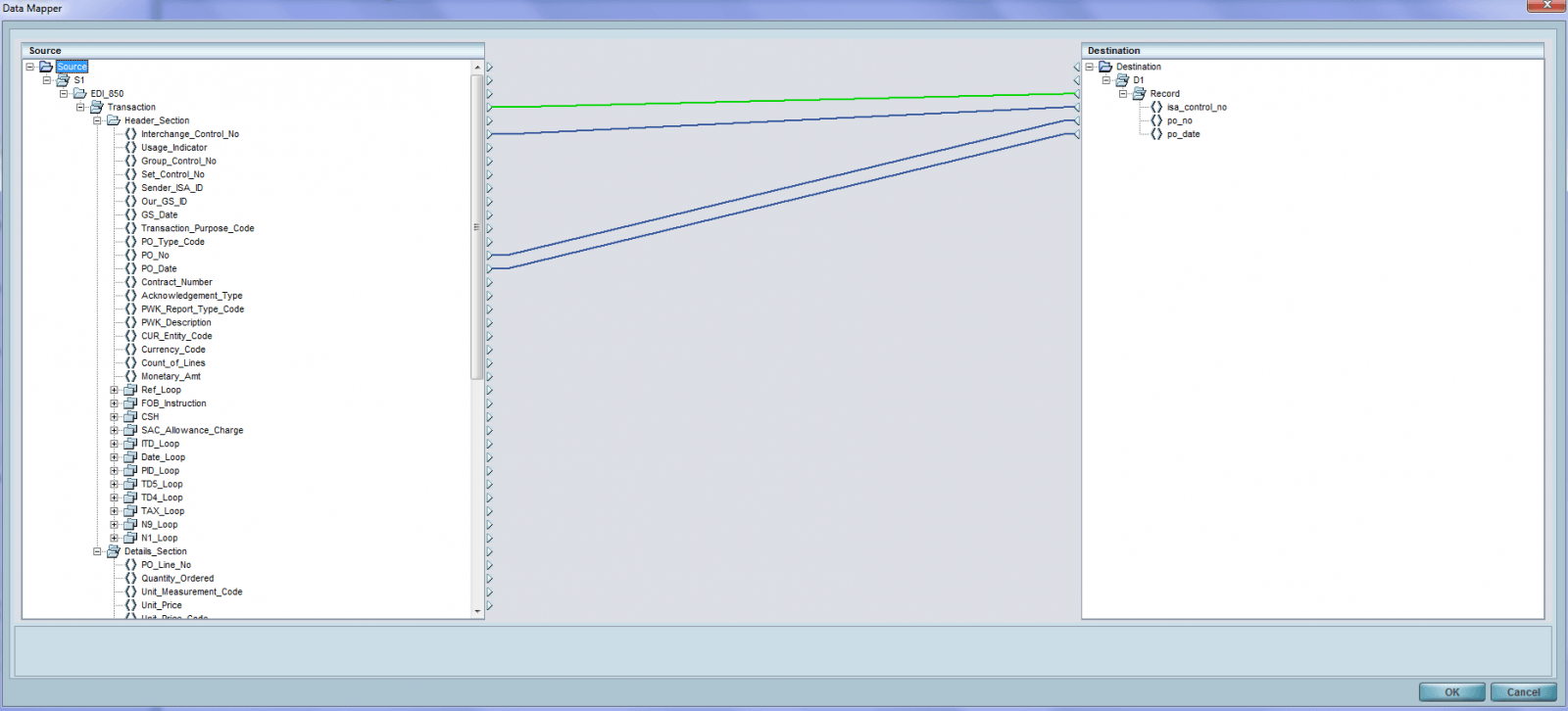
Once the incoming EDI X12 file is converted to XML, it is very simple to then map it to JDE:

  • Create a step with a Data mapper
  • Source: XML based on the EDI2XML .xsd (schema file)
  • Destination: the JDE table to feed from the XML format

Once the source and destination are defined, the user can use his mouse to drag and drop to map fields from the source to the destination (JD table).

EDI Integration with JDE


Looking to integrate your EDI or eCommerce processes with Oracle JDE enterprise one, look no further, since we have the best integration option where we turn your Oracle JDE system into a modern REST API, that receives https requests and acts accordingly. LEARN MORE>


This is why we love EDI2XML in EDI integration with JDE

EDI2XML has a rich library of EDI documents to translate and it is expandable. In addition, using EDI2XML within a flow in Magic xpi is a MUST in order to map EDI data to XML and from XML directly to JDE. Most importantly, there is no need for EDI knowledge to interpret the fields and segments, as it is all easily understandable by any person. On top of it all, all .xsd files are provided with the EDI2XML engine!

EDI integration into JDE is as simple as mapping from XML to JDE using drag and drop!

Free EDI consultation
February 26, 2014/0 Comments
https://www.edi2xml.com/wp-content/uploads/2024/08/edi2xml.com-EDI2XML-company-logo.png 0 0 Pierre Namroud https://www.edi2xml.com/wp-content/uploads/2024/08/edi2xml.com-EDI2XML-company-logo.png Pierre Namroud2014-02-26 13:18:252020-06-05 14:03:51EDI Integration with JDE Made Easy with EDI2XML
Recent
  • EDI compliance with Loblaw
    How to Meet Loblaw EDI Requirements as a Small BusinessJune 4, 2026 - 2:05 pm
  • The Infrastructure Behind Modern Commerce: Why EDI Still Matters
    EDI in E-Commerce and Retail: Why Modern Commerce Still...May 1, 2026 - 4:54 pm
  • Key Statistics on AI Use in the Workplace
    The Risks of Using Public AI Tools in Business: Data Privacy,...March 11, 2026 - 5:51 pm
  • Enterprise AI
    How to Securely Access Enterprise AI: GPT, DeepSeek &...February 20, 2026 - 3:09 pm
  • EDI 754 Guide
    EDI 754 Routing Instructions: Complete Guide to Purpose,...February 18, 2026 - 4:54 pm
Popular
  • How to Quickly Connect to a Large Retailer's EDI Requirements
    How to Get EDI-Compliant Quickly For A Large RetailerNovember 21, 2025 - 4:29 pm
  • EDI-as-a-services
    EDI Translation Software “On-premises” or “As...January 21, 2014 - 1:28 pm
  • order-automation in e-commerce
    Why Is It Crucial to Automate the E-Commerce Order Fulfillment...May 10, 2022 - 1:58 pm
  • EDI for Logistics and transportation
    EDI Integration for Efficient Transportation ManagementOctober 6, 2023 - 1:33 pm
  • information technology definitions
    Business Tech Terms DefinitionsMay 24, 2018 - 1:32 pm

Browse by tag

Amazon Amazon Integration ANSI ASC x12 ASC X12 EDI B2B EDI integration e-commerce e-commerce business e-commerce integration eCommerce eCommerce integration EDI EDI2XML EDI 850 EDI as a Service EDI Communication EDI converter EDIFACT EDI for supply chain EDI for Third-Party Logistics EDI for transportation EDI implementation EDI Integration EDI Integration Project EDI project EDI Translation EDI Web Service EDI x12 ERP Integration integration platform integration project JDE Magic xpi Magic xpi Integration platform NetSuite online store Salesforce Shopify Shopify eCommerce integration Shopify integration Supply Chain Supply Chain Management Translation Software X12 EDI XML

Subscribe to our Blog

Menu

  • Home
  • About the EDI2XML Company
  • About EDI2XML EDI Converter
  • Blog
  • Book A Free Consultation
  • Privacy Policy EDI2XML Company

Our Services

Fully Managed Integration

E-Commerce Integration

Business Systems Integration

Fully Managed EDI

EDI Web Service 

On Premises EDI 

Managed Cloud Service


Latest Blog Posts

  • EDI compliance with Loblaw
    How to Meet Loblaw EDI Requirements as a Small BusinessJune 4, 2026 - 2:05 pm
  • The Infrastructure Behind Modern Commerce: Why EDI Still Matters
    EDI in E-Commerce and Retail: Why Modern Commerce Still Depends on EDIMay 1, 2026 - 4:54 pm
  • Key Statistics on AI Use in the Workplace
    The Risks of Using Public AI Tools in Business: Data Privacy, Compliance, and Shadow AIMarch 11, 2026 - 5:51 pm

Contact Us

400 Blvd Curé-Labelle, #304 Laval QC H7V 2S7 Canada

Contact EDI2XML Team
Phone: +1 450-681-3009
Website: https://www.edi2xml.com/

© 2000-2026 EDI2XML (by Namtek Consulting Services). All rights reserved.
  • Link to Facebook
  • Link to LinkedIn
  • Link to X
  • Link to Youtube
  • Blog
Scroll to top Scroll to top Scroll to top