EDI2XML
  • About
    • The Company
    • EDI2XML
    • Advantages
    • Partnership with EDI2XML
    • Testimonials
  • Services
    • Enterprise AI
    • Fully Managed Integration
    • Fully Managed EDI Services
    • EDI Web Portal
    • EDI Web Service (API)
    • EDI On Premises
    • Managed Cloud Services
    • Amazon Integration
    • Shopify Integration
    • BigCommerce Integration
    • NetSuite Integration
    • JD Edwards Integration
    • Dynamics 365 Integration
    • SAP B1 Integration
    • Salesforce Integration
    • Industry 4.0 Integration
  • Pricing
    • EDI Managed Services
    • EDI Web Service
    • EDI On-Premises
    • Managed Cloud Services
    • Shopify Integration
    • JD Edwards Integration
    • E-commerce Integration
    • All other Integrations
  • Blog
  • Resources
    • Downloadable Guides
    • List of EDI Codes
    • List of EDIFACT Messages
    • EDI Documents Library
    • Trading Partners
    • Customer Case Studies
  • Contact us
  • Book a Consultation
  • Click to open the search input field Click to open the search input field Search
  • Menu Menu
  • Link to Facebook
  • Link to LinkedIn
  • Link to X
  • Link to Youtube

Optimize your logistics with 3PL EDI integration. Ensure seamless data exchange, improve accuracy, and enhance supply chain efficiency for your clients.

Tag Archive for: 3PL EDI integration

EDI and WMS Integration: A Practical Guide for Warehouses and 3PL Providers

Blog

Most warehouse management systems are good at managing what happens inside the four walls of a warehouse – receiving, putaway, picking, packing, and shipping. What they are generally not built to do is communicate with the outside world using the language that large trading partners, retailers, and manufacturers require: EDI (Electronic Data Interchange).

EDI-WMS integration connects the warehouse management system to a companyโ€™s trading partners, so orders, shipment information, and other warehouse transactions can be exchanged without manual file handling.

This article explains how that integration works, what is involved in setting it up, and what warehouses and third-party logistics (3PL) companies need to consider before and during implementation. To illustrate the concepts, we reference a real-world integration project completed for Piper Warehouse, a division of Piper Logistics, a U.S.-based 3PL provider headquartered in Indianapolis.

EDI and WMS Integration: Key Takeaways

  • EDI-WMS integration automates the exchange of warehouse instructions and confirmations between trading partners and a warehouse management systemโ€” replacing manual data entry with structured, electronic data flows.
  • The four core warehouse EDI transactions are the 940 (shipping order), 943 (stock transfer shipment advice), 944 (stock transfer receipt advice), and 945 (shipping advice). Together, they cover the full cycle of receiving instructions and confirming execution.
  • Most WMS platforms do not natively read or generate EDI documents. An integration layer โ€” often called middleware โ€” is needed to translate between X12 EDI formats and the WMS’s internal data structures, and to manage secure communication with each trading partner.
  • The integration layer connects to a WMS through direct SQL, APIs, or file-based exchange, depending on the WMS architecture. Direct SQL provides the most control; APIs are common with cloud-hosted platforms.
  • Every trading partner can have different EDI mapping requirements, even for the same transaction type. The integration platform must support partner-specific configurations without requiring changes to the WMS itself.
  • Monitoring, acknowledgments, and error handling are not optional. Missed or failed EDI transactions can delay shipments and damage trading partner relationships. A production integration needs centralized logging, automated alerts, and retry logic.
  • Warehouses and 3PLs without in-house EDI expertise often benefit from a managed EDI servicerather than building and maintaining the integration internally. In the Piper Warehouse project, this approach reduced IT overhead and allowed the operations team to focus on warehouse execution rather than EDI infrastructure.
  • A well-architected EDI-WMS integration is scalable. Onboarding a new trading partner becomes a configuration task โ€” adding a new set of mappings and connection details โ€” rather than a re-engineering effort.

What EDI-WMS Integration Actually Means

EDI (Electronic Data Interchange) is a standardized format for exchanging business documents between organizations electronically. In North America, the most common standard is ANSI X12. When a retailer sends a warehouse a shipping order or a request to transfer stock, they often send it as an X12 EDI document rather than an email, a PDF, or a phone call.

A WMS (Warehouse Management System) – is the software a warehouse uses to manage inventory, direct warehouse operations, and track the movement of goods.

EDI-WMS integration is the connection between these two worlds. It allows a warehouse to automatically receive instructions from trading partners in EDI format, convert them into data the WMS understands, and then send confirmations and status updates back to the trading partner, again in EDI format โ€” without manual re-keying of data.

For a 3PL handling goods on behalf of multiple clients, this kind of integration is not optional. It is a requirement for doing business with most mid-size and large companies.

Why Warehouses and 3PLs Need This Integration

The core reason is straightforward: trading partners require it.

Large retailers, manufacturers, and distributors use EDI as their primary method of communicating logistics instructions. If a 3PL cannot receive a shipping order electronically and confirm shipment in the expected EDI format, they either cannot win the account or they are forced to handle the process manually.

Manual handling – downloading files, reading them, re-entering data into the WMS, then manually creating response documents – introduces delays, increases errors, and does not scale. A warehouse managing a handful of orders per day might tolerate this. A facility processing hundreds or thousands of transactions daily cannot.

Beyond trading partner compliance, EDI-WMS integration provides:

  • Faster order processing: instructions reach the WMS within minutes of being sent, with no human bottleneck.
  • Fewer data entry errors: automated mapping eliminates the mistakes that come with manual re-keying.
  • Better visibility: both the warehouse and the trading partner can track the status of orders and shipments through the documents exchanged.
  • Scalability: onboarding a new trading partner becomes a configuration task rather than a staffing decision.

How Data Flows Between Trading Partners and a WMS

The data exchange is bidirectional. Instructions flow in from trading partners, and confirmations flow back out. Understanding both directions is essential.

Inbound: Trading Partner โ†’ WMS

The typical inbound flow works like this:

  1. A trading partner deposits an EDI document (for example, a shipping order) on a secure SFTP server or transmits it through a VAN (Value-Added Network).
  2. The integration layer picks up the file on a scheduled cycle.
  3. It parses the raw EDI data and transforms it into a structured format the WMS can consume – typically by mapping specific EDI fields to database columns.
  4. The transformed data is written into the WMS, usually via direct SQL insertion into the WMS database or through an API if the WMS supports one.
  5. A functional acknowledgment (X12 997) may be generated and sent back to the trading partner to confirm receipt.
  6. Stakeholders may receive automated email notifications.

At this point, the warehouse team sees a new order or receipt instruction in their WMS, ready to act on.

Outbound: WMS โ†’ Trading Partner

The outbound flow is the reverse:

  1. The integration layer monitors the WMS database for new or updated records, for example, a shipment that has been completed and marked as ready.
  2. It extracts the relevant data (shipment details, quantities, tracking numbers, carrier information).
  3. It maps and converts the data into the specific X12 EDI format required by the trading partner.
  4. The completed EDI document is transmitted to the trading partner’s SFTP mailbox or VAN.

Each trading partner may require slightly different mappings, segments, or qualifiers within the same EDI transaction type. This is normal in EDI – and it is one of the reasons the integration layer needs to be flexible enough to support partner-specific configurations.

The Piper Warehouse Implementation

In the integration project completed for Piper Warehouse, EDI2XML deployed a cloud-based integration engine that operates on automated 15-minute processing cycles. On the inbound side, the system connects to trading partner SFTP mailboxes, retrieves X12 940 (shipping order) and 943 (stock transfer shipment advice) documents, transforms them, and writes the data directly into Piper’s WMS database via SQL.

On the outbound side, the engine monitors the WMS for completed transactions, generates X12 945 (shipping advice) and 944 (stock transfer receipt advice) documents according to each partner’s specifications, and delivers them to the partner’s SFTP location.

This means that from the time a trading partner sends a shipping order to when it appears as an actionable record in Piper’s WMS, the delay is a maximum of roughly 15 minutes – with no manual steps in between.

Key Warehouse EDI Transaction Sets

Not every EDI transaction is relevant to warehouse operations. The following four X12 transaction sets are the most commonly used in the context of warehouse and 3PL EDI integration.

EDI 940 โ€” Warehouse Shipping Order

This is the instruction that tells the warehouse to ship goods. It is sent by the trading partner (or the goods owner) to the warehouse, specifying what needs to be picked, packed, and shipped – including item details, quantities, ship-to addresses, and any special handling instructions. In operational terms, the EDI 940 is what generates a pick ticket or outbound order in the WMS.

EDI 943 โ€” Warehouse Stock Transfer Shipment Advice

An EDI 943 notifies the warehouse that inventory is being shipped to it. It serves as an advance notice of an inbound stock transfer, allowing the warehouse to plan receiving and allocate resources. Think of it as the trading partner saying, “These goods are on the way to your facility.”

EDI 944 โ€” Warehouse Stock Transfer Receipt Advice

This is the warehouse’s response to an EDI 943. Once the goods described in the EDI 943 actually arrive and are received into inventory, the warehouse sends an EDI 944 back to the trading partner confirming what was received, including quantities and any discrepancies. The 944 closes the loop on the inbound transfer.

EDI 945 โ€” Warehouse Shipping Advice

The EDI 945 is the outbound counterpart to the EDI 940. After the warehouse fulfills a shipping order, it sends an EDI 945 back to the trading partner confirming what was shipped, how it was shipped (carrier, tracking number, weight), and when. This document is critical for the trading partner’s own downstream processes – updating inventory records, triggering invoicing, and providing shipment visibility to end customers.

In the Piper Warehouse project, these four transaction types โ€” EDI 940, EDI 943, EDI 944, and EDI 945 – formed the core of the EDI exchange, covering both the inbound instruction and outbound confirmation sides of warehouse operations.

Why a WMS Does Not Just “Speak EDI”

A common question is: why can’t the WMS handle EDI directly?

Some enterprise-grade WMS platforms do include EDI modules or built-in connectors. But in practice, most WMS platforms – especially those used by mid-market warehouses and 3PLs, store and manage data in their own internal database format. They are not designed to parse raw X12 EDI files, which have a very specific, segment-based syntax that looks nothing like a database table or a JSON object.

Even when a WMS includes EDI capabilities, an external integration layer may still be preferred when EDI requirements become complex or involve multiple business systems:

  • Partner-specific requirements. Trading partners may have different EDI versions, transaction requirements, mappings, segments, or qualifiers. Managing these variations in a dedicated integration layer can reduce the amount of partner-specific logic embedded in the WMS.
  • Connectivity requirements. Trading partners may use different connectivity methods, including SFTP, AS2, or VAN services. A dedicated integration platform can manage these connections independently of the WMS.
  • Centralized monitoring and error handling. An integration layer can provide a central place to monitor EDI transactions, manage errors, configure alerts, and retry failed exchanges across multiple trading partners and systems.

In the Piper implementation, the WMS is an in-house, SQL-based system. EDI2XML’s integration engine handles all EDI translation, partner communication, acknowledgment generation, and data mapping outside the WMS. The WMS simply reads from and writes to its own database tables โ€” it never needs to deal with raw EDI data.

Common Integration Methods

How the integration layer connects to the WMS depends on the WMS architecture. The three most common approaches are:

Direct SQL connectivity. The integration engine reads from and writes to the WMS database directly. This is common when the WMS is built on SQL Server, MySQL, or a similar relational database and provides staging tables or well-documented table structures for inbound and outbound data. The Piper project uses this approach.

API-based integration. Some modern or cloud-based WMS platforms expose REST or SOAP APIs. The integration layer sends and retrieves data through these API endpoints. This is typical with SaaS WMS products that do not allow direct database access.

File-based exchange (flat files, CSV, XML). In some cases, the WMS is configured to import and export data through files placed in designated folders. The integration layer drops transformed files in an import directory and picks up export files from an output directory. This is a simpler approach, though it may offer less real-time visibility.

The right method depends on what the WMS supports and what level of access is available. SQL connectivity tends to offer the most control and flexibility, while API integration is often the most practical option for cloud-hosted WMS platforms.

Partner-Specific Mapping and Configuration

One of the realities of EDI that can surprise companies new to it is how much variation exists between trading partners. Two partners may both send an EDI 940, but the specific segments, element positions, and qualifier codes they use can differ significantly. One partner may require a particular ship-to address format; another may include custom reference fields that need to be mapped to specific WMS columns.

This means that for each trading partner, the integration layer typically needs a dedicated mapping configuration. This configuration defines:

  • Which EDI segments and elements map to which WMS fields
  • How to handle optional versus required data
  • What acknowledgment documents to generate
  • Where to send completed outbound documents
  • Any data transformation rules (date formats, unit conversions, code lookups)

In the Piper project, EDI2XML maintains partner-specific mappings that control how outbound 945 and 944 documents are generated based on each partner’s requirements. This allows Piper to work with multiple trading partners through a single integration platform without needing to modify its WMS for each one.

EDI in E-Commerce Fulfilment

Monitoring, Acknowledgments, and Error Handling

EDI transactions are business-critical. A missed shipping order or a failed transmission can delay shipments, create inventory discrepancies, and damage trading partner relationships. For this reason, monitoring and error handling are not optional features โ€” they are essential parts of any production EDI-WMS integration.

A well-designed integration should include:

  • Transaction monitoring – a central view of all documents received, processed, and sent, with status tracking.
  • Functional acknowledgments – automatic generation of X12 997 documents confirming receipt of inbound transactions, when required by the trading partner.
  • Error alerts – automated notifications (typically email) when a document fails parsing, transformation, or delivery.
  • Retry logic – automatic reattempts for transient failures, such as an SFTP connection timeout.
  • Audit trails – full logging of every transaction for troubleshooting and compliance purposes.

These capabilities are usually more practical to implement in a dedicated EDI middleware layer than inside the WMS itself.

Managing EDI Internally vs. Using a Managed Service

Companies approaching EDI-WMS integration generally have two options: build and manage the integration in-house, or use a managed EDI service provider.

In-house management means the company’s IT team is responsible for the EDI translation software, trading partner connectivity, mapping maintenance, monitoring, and troubleshooting. This can work well for large organizations with dedicated EDI staff, but it requires specialized knowledge and ongoing operational attention.

A managed EDI service means an external provider handles the EDI infrastructure, partner communication, mapping, monitoring, and support. The warehouse company focuses on its WMS and its operations; the EDI provider handles everything between the trading partner and the WMS boundary.

For many 3PLs and mid-market warehouses, the managed approach makes more sense. EDI expertise is specialized, and the cost of hiring and retaining in-house EDI staff can exceed the cost of a managed service. Additionally, a managed provider typically brings established connectivity to many trading partners and experience with a wide range of EDI requirements.

Piper Warehouse chose the managed service model with EDI2XML. As Robert Jackson, Piper’s CIO, noted: “EDI2XML delivered a highly reliable and fully managed integration solution that allowed us to connect our trading partners with our internal WMS. Their team demonstrated strong technical expertise in EDI and system integration, and the implementation process was smooth and well-structured.” This approach reduced IT overhead and allowed Piper’s team to focus on warehouse operations rather than EDI infrastructure.

Book your Free Consultation with Integration expert

What to Consider Before Implementing EDI-WMS Integration

If your company is evaluating EDI-WMS integration, the following questions will help define the scope and approach:

What does your WMS support? Understand whether your WMS allows direct SQL access, offers APIs, or works through file-based imports and exports. This determines how the integration layer will connect.

Which trading partners require EDI, and which transactions? Get the specific EDI requirements from each partner. Do not assume all partners use the same versions or mappings.

What is your transaction volume? Volume affects architecture decisions, including how frequently the integration engine should poll for new data and whether near-real-time processing is needed.

Do you have in-house EDI expertise? If not, a managed service is likely more practical and cost-effective than building internal capability from scratch.

How will you handle onboarding new partners? Your integration approach should make it straightforward to add new trading partners without re-engineering the entire setup.

What are your monitoring and compliance requirements? Some industries and trading partners have strict requirements for acknowledgments, response times, and audit trails.

Making EDI-WMS Integration Work

EDI-WMS integration is the connective layer that allows warehouses and 3PL providers to exchange structured business data with their trading partners automatically. It sits between the external world of EDI – with its X12 standards, partner-specific mappings, and communication protocols – and the internal world of the WMS, where warehouse operations are actually managed.

The integration requires a translation and orchestration layer that can handle the variability of trading partner requirements, connect to the WMS using whatever method it supports, and run reliably without constant manual intervention. Whether that layer is built in-house or provided as a managed service depends on the company’s resources, EDI volume, and strategic priorities.

For companies that need to connect their warehouse management system with trading partners through EDI, EDI2XML provides managed EDI integration services with direct WMS connectivity, partner-specific mapping, and automated processing – handling the complexity of EDI so warehouse teams can focus on operations. Contact the EDI2XML team to discuss your integration requirements.

EDI-WMS Integration: Frequently Asked Questions

What is EDI-WMS integration?

EDI-WMS integration is the automated connection between Electronic Data Interchange (EDI) systems and a Warehouse Management System. It allows warehouses and 3PLs to receive operational instructions from trading partners (such as shipping orders) and send back confirmations (such as shipment notices) in standardized EDI format – without manual data entry.

Which EDI transactions are most common in warehouse operations?

The four most commonly used warehouse EDI transaction sets are: EDI 940 (Warehouse Shipping Order), EDI 943 (Warehouse Stock Transfer Shipment Advice), EDI 944 (Warehouse Stock Transfer Receipt Advice), and EDI 945 (Warehouse Shipping Advice). Together, they cover the core cycle of receiving instructions and confirming execution.

Why can’t a WMS handle EDI on its own?

Most WMS platforms are designed to manage warehouse operations, not to parse and generate EDI documents. EDI requires specialized translation between X12 formatted data and the WMS’s internal data structures, plus secure communication with each trading partner’s system. A dedicated integration layer or middleware handles these functions more effectively.

How does the integration layer connect to a WMS?

The three most common methods are direct SQL database connectivity, API-based integration (REST or SOAP), and file-based exchange (CSV, XML, or flat files). The best approach depends on the WMS architecture and what level of access is available.

What is the difference between managing EDI in-house and using a managed EDI service?

In-house management means your IT team handles EDI software, partner connectivity, mapping, and monitoring. A managed service means an external provider handles those functions on your behalf. For warehouses without dedicated EDI staff, a managed service typically offers faster implementation, lower overhead, and access to established trading partner connectivity.


Contact EDI2XML today for a free consultation


August 21, 2026/0 Comments
https://www.edi2xml.com/wp-content/uploads/2026/08/EDI2XML-EDI-WMS-Integration.webp 628 1200 Tatyana Vandich https://www.edi2xml.com/wp-content/uploads/2024/08/edi2xml.com-EDI2XML-company-logo.png Tatyana Vandich2026-08-21 16:26:272026-08-21 16:26:27EDI and WMS Integration: A Practical Guide for Warehouses and 3PL Providers

EDI 945 Warehouse Shipping Advice in Transportation Management, 3 PL Warehouse, and Third-party Logistics.

Blog

Many different processes take place in the warehouse every day, whether it’s a regular or 3PL warehouse. All of them must be carried out quickly and accurately. In this article, we will look at the importance of using EDI (Electronic Data Interchange) especially, an electronic document โ€“ EDI 945 Warehouse Shipping Advice associated with shipment of goods. Let’s figure out who and when to use EDI 945, what information a Warehouse Shipping Advice contains, 945 EDI specifications, benefits of using this EDI document, and much more.

What is EDI 945 transaction?

The Warehouse Shipping Advice Transaction Set (EDI 945) is an electronic data interchange (EDI) document. EDI 945 is usually used by 3PL warehouse/ remote warehouse or third-party logistics company, to notify its client (depositor) that a shipment has been made. It is used to match order quantities with shipment quantities.

945 EDI document type

EDI X12 945 Warehouse Shipping Advice Transaction Set is a document base on the X12 standard. X12 is a non-profit, ANSI-accredited standards development organization for cross-business transactions that support electronic data interchange in North America.

Each set of EDI transactions is supported by a subcommittee working within the X12 Accredited Standards Committee. EDI 945 falls under X12M – Supply Chain Subcommittee.

How is EDI 945 – Warehouse Shipping Advice used?

When a supplier/depositor (for example, a manufacturer or a wholesaler) needs to ship goods from the warehouse, he sends his 3PL warehouse an EDI document 940 Warehouse Shipping Order. EDI 940 contains all the necessary information regarding the goods required for shipment (description and quantity of goods, delivery date, recipient information, etc.) as well as shipping instructions.

Useful Reading: What is EDI 940 Warehouse Shipping Order?

The warehouse, having received the EDI 940, makes the shipment of the order and returns the EDI 945 immediately after the parcel has left the warehouse.

EDI 945 transfers detailed information about the merchandise shipped and the detail of the delivery.

Based on transaction EDI 945, the supplier can generate EDI 856 Advance Ship Notice as needed to notify its customer of an upcoming delivery.

What is the shipping process in a warehouse?

Shipment is the process of preparing and sending goods to the designated location. The shipping procedure at the warehouse is carried out according to predetermined rules. Each company develops shipping regulations independently, taking into account the characteristics and specifics of the goods and warehouse space.


The procedure for shipping goods from the warehouse/ 3PL warehouse can include many stages:

  • processing of the depositor’s order (for example, entering data into the warehouse system);
  • checking the availability of goods in the warehouse;
  • receiving a picking list;
  • selection of the necessary goods from the storage place;
  • moving to the picking area;
  • packaging and labeling in containers/pallets;
  • loading of transport;
  • Preparation and entry into the warehouse system of the relevant information.
EDI- Price
 

The main task of the warehouse manager is to organize efficient work, which will ensure fast processing of orders since all shipments must be carried out on time.

Automation of warehouse processes, for example, the use of EDI can significantly improve the quality and speed of shipment of goods.

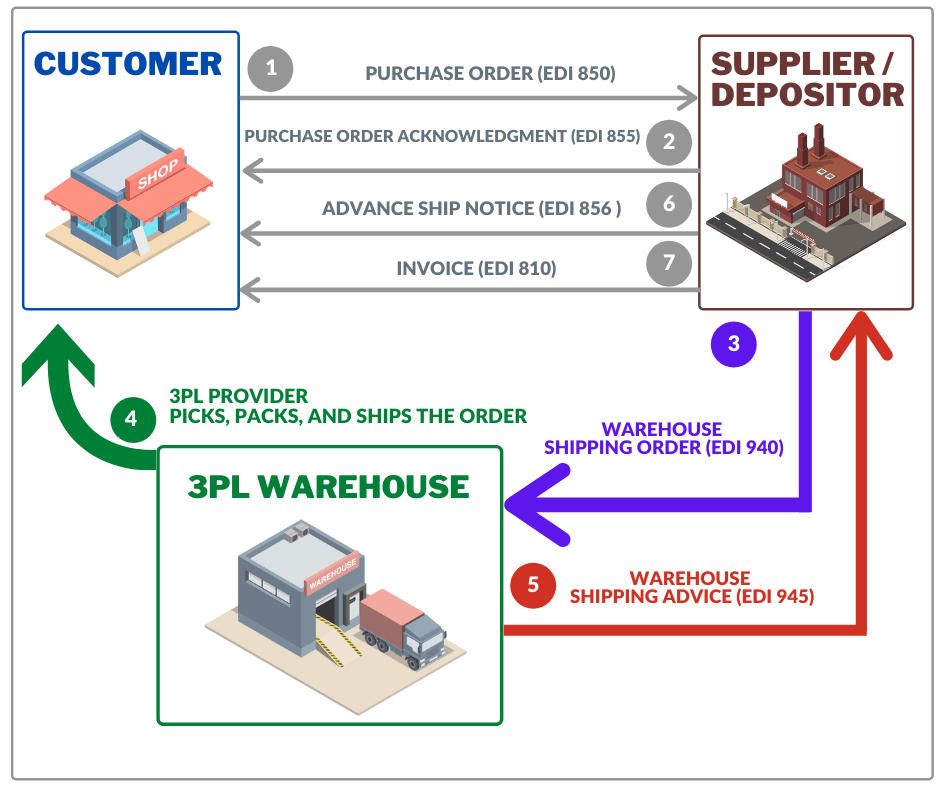
Workflow to Exchange Warehouse Shipping Advice (EDI 945)

Let’s take a closer look at the process of shipment of goods from a third-party warehouse and analyze what other EDI documents are involved in the logistics process. Of course, keep in mind that the process below may reflect only one of the possible options. Each company can establish its own business process with a third-party warehouse, which depends on the type of the companyโ€™s activity, type of product, etc.

In the figure below you can see that usually the process in which EDI 945 is involved consists of at least three participants:

– Customer (it could be a retail outlet)

– Supplier (who is a client of the 3PL warehouse, or a depositor)

– 3PL Warehouse / or 3 PL logistics company.


1. The business flow begins with a Purchase Order – EDI 850 which is sent by the customer to the supplier.

2. The supplier responds to the customer with the EDI 855 PO Acknowledgement

3. The supplier sends the Warehouse Shipping Order (EDI 940) to the 3 PL warehouse

4. 3PL Warehouse process a Shipping Order and sends the goods to the supplier’s customer by the address specified in EDI 940.

5. Immediately after dispatch, the warehouse transfers the EDI 945 to the supplier.

6. Based on EDI 945, the supplier generates an Advance Ship Notice (EDI 856) and transfers it to his client.

7. The supplier sends the customer an EDI invoice 810

So, as you saw from the EDI workflow, 945 Warehouse Shipping Advice โ€“ is the main document, which confirms the fact of shipment of goods. It is used by many companies operating in wholesale and retail, including online stores.

Useful Reading: EDI Integration for Transportation and Logistics

What information does EDI 945 contain?

EDI document Warehouse Shipping Advice contains accurate and detailed information about the item shipped from the warehouse. Thus, EDI 945 includes the following information:

  • Information about the depositor, warehouse, and place of delivery (addresses, contacts).
  • Details of the carrier and the method of delivery of the goods.
  • Information about the product – cost, product name, SKUs, etc.
  • The number of goods shipped.
  • Complete order detail of the original order (EDI 940)
  • Date and time of shipment from the warehouse.
  • Transportation method

EDI 945 Warehouse Shipping Advice Structure

Like any other EDI document, EDI 945 transaction set has a precise structure and sequence of elements.

  • ISA – Interchange Control Header
  • GS – Functional Group Header
  • ST – Transaction Set Header
  • W06 – Warehouse Shipment Identification (numbers, dates, and other basic data)
  • 0100 – Loop Name (to identify a party by type of organization, name, and code)
  • N1 – Name
  • N9 – Reference Identification
  • G62 – Date/Time
  • W27 – Carrier Detail
  • W10 – Warehouse Additional Carrier Information
  • 0300 – Loop Assigned Number
  • LX – Assigned Number
  • MAN – Marks and Numbers
  • PAL – Pallet Information
  • 0310 – Loop Warehouse Item Detail
  • W12 – Warehouse Item Detail
  • N9 – Reference Identification
  • W03 – Total Shipment Information
  • SE – Transaction Set Trailer 
  • GE – Functional Group Trailer
  • IEA – Interchange Control Trailer

Benefits of using EDI 945 in Warehouses/ 3PL warehouses and Logistics

The use of EDI 945 in a 3 PL warehouses or 3 PL logistics company, allows you to get significant competitive advantages due to:

  • increasing the speed and accuracy of logistics operations;
  • reducing the cost of manual processing of documents;
  • reducing the risks of losses and information inaccuracies;
  • Increasing the speed of order processing due to receiving timely, fast, and accurate information.

Thus, automation of warehouse processes through the use of EDI document such as EDI 945, significantly improves the quality of 3PL warehouse processes.

Automate Warehouse Shipping Advice with EDI2XML Web Service

We have a ready-made EDI solution for the exchange of electronic documents in the X12 and EDIFACT standards. It is a unique HTTP service running over the internet that is capable of receiving HTTP requests to translate EDI messages to XML, and XML to EDI.

Try all the possibilities of the EDI2XML Web Service for free. We offer a 15 days free trial.

Contact us for a free consultation and find out how within an hour you can start exchanging electronic documents such as EDI 945 and many others with your trading partner.

EDI in transportation and 3PL

You may also be interested in reading about:
โ€“ Electronic Data Interchange (EDI) in the Supply Chain
โ€“ How EDI can speed the receiving of goods in a warehouse
โ€“ EDI for Third-Party Logistics providers (3PL)
โ€“ DELFOR, DELJIT, DESADV โ€“ key EDI messages in supply chain management for manufacturing


October 18, 2021
https://www.edi2xml.com/wp-content/uploads/2021/10/EDI-945-EDI2XML.png 675 1200 Tatyana Vandich https://www.edi2xml.com/wp-content/uploads/2024/08/edi2xml.com-EDI2XML-company-logo.png Tatyana Vandich2021-10-18 14:31:452026-08-10 10:30:19EDI 945 Warehouse Shipping Advice in Transportation Management, 3 PL Warehouse, and Third-party Logistics.

EDI for Third-Party Logistics providers (3PL)

Blog


Almost every manufacturing and distribution company today, work with third-party logistics providers (3PL) to organize and manage their transportation of goods. This allows companies to save on their cost of warehouse management, easily track the movement of their goods, inventory, preparation of documentation, cargo handling, and delivery to the buyer.

In this article, let us talk about 3PL and EDI (Electronic Data Interchange) since this is the key technology in logistics.

What is Third-Party Logistics?

A third-party logistics company or 3PL provider is a company that provides full logistics services: transportation, forwarding, warehousing, customs clearance, and other logistics-related activities. 3PL stands for Third Party Logistics. In other words, the term 3PL is synonymous with logistics outsourcing, which means the transfer of part or all the logistics functions, to a logistics service provider.

The Third-Party Logistics Study shows that shippers and their 3PL providers are increasingly looking to work together. Both parties confirm that the use of technology helps them to progress. According to the study, many 3PLs are already making significant investments in technology. Most of the shippers indicate that IT capabilities are a necessary element of 3PL expertise.

The table below shows the answers of the shipper and 3PL to the question: โ€œWhat information technologies, systems or tools should 3PL have to successfully serve customers?โ€

3PL IT study

You can see from the table above, EDI transactions such as order, shipment, inventory, advanced shipment notices, invoicing, etc. are very important in the logistics. Thus, this once again underlines the importance of EDI for 3PLs.

Why EDI Is Important For 3PL Companies?

EDI provides the best results in exchanging data with 3PL providers. This is the most reliable, secure, and economical way to share business information.

A 3PL provider for example, needs detailed information about the location of the delivery points, the date of shipment, the quantity of the goods, information on the packaging, its size, etc.

The supplier of goods needs to monitor the state of inventory, track the movement, and write-off of the goods, as well as receive information about shipments to certain outlets for a specific range.

Lack of reliable information can lead to a shortage of goods in the store, lost profits, as well as monetary and temporary losses due to erroneous deliveries, long approvals, and frequent account adjustments.

On average, every day large logistics companies must send from several hundred to thousands of documents. To process such a volume of data manually using traditional paper documents, couriers, faxes, e-mail, or telephone, is rather a difficult and costly task.

Therefore, 3PL providers and their clients use EDI to exchange all necessary information about orders, deliveries, shipments, balances, reports, etc. electronically.

To automate the process of data exchange, 3PL providers and product suppliers usually integrate EDI into their business systems. This allows business partners to eliminate intermediate steps in which they must manually enter data into the accounting or business system. EDI messages are transmitted instantly, and they exclude errors related to the human factor.


Useful reading: A must-have guide for a successful systems integration with EDI


Third-Party Logistics EDI Documents

Third-Party Logistics (3PL) providers use a variety of Electronic Data Interchange (EDI) documents to exchange information with their customers, suppliers, carriers, and other partners. Some of the commonly used EDI documents in 3PL include:

  1. 850 Purchase Order: This document is used to transmit a purchase order from a customer to a 3PL provider. It includes information such as item description, quantity, and price.
  2. 855 Purchase Order Acknowledgement: This document is used by the 3PL provider to acknowledge the receipt of a purchase order from the customer.
  3. 856 Advance Shipment Notice: This document is used to inform the customer of the expected delivery date and time of the shipment.
  4. 940 Warehouse Shipping Order: This document is used by the 3PL provider to notify the warehouse of an impending shipment.
  5. 945 Warehouse Shipping Advice: This document is used by the warehouse to notify the 3PL provider that the shipment has been shipped.
  6. 944 Warehouse Stock Transfer Receipt Advice: This document is used by the warehouse to notify the 3PL provider that a stock transfer has been received.
  7. 997 Functional Acknowledgment: This document is used to acknowledge the receipt of an EDI document by the recipient.
  8. 810 Invoice: This EDI document is used to provide the customer with an electronic invoice for services rendered, including information such as the billing period, charges, and payment due date.

These EDI documents help 3PL providers to automate their processes and improve their efficiency in handling orders, inventory, and shipments. They also help to reduce errors and improve communication between the 3PL provider and their partners.

Let us look for the most used EDI documents by 3 PL providers. These messages could be used in ANSI X12 standard (if the company is in North America), or in UN/EDIFACT standard (which is more common in Europe). However, messages in both standards perform a similar function.

Sales Report and Sales Forecast: EDI 852 / EDIFACT –  SLSRPT and EDI 830 / EDIFACT-  SLSFCT

Inventory data can be used in conjunction with actual sales data transmitted in SLSRPT – Sales Data Report message (EDI 852 Product Activity Data) and SLSFCT – Sales Forecast (EDI 830 Planning Schedule)

Accurate data on inventory and sales forecasting allows manufacturers to better control their production needs, and distributors to maintain the necessary stock of goods, considering the market situation.

Inventory update: EDI 846 / INVRPT

One of the most used documents for Inventory management calls EDI 846 Inventory Inquiry/Advice in ANSI X12 Standard or INVRPT โ€“ Inventory Report in EDIFACT.

Inventory report allows suppliers to control their inventory of materials and products.

The message contains information about the quantity in stock, as well as data on the receipt and withdrawal of goods for a certain period. Information about the quantity of the product and packaging can be detailed in different groups: by lot, location, expiration date, etc.

Companies use this type of messages to reduce the costs and errors associated with manual processing. INVRPT or EDI 846 is also used to inform trading partners about the availability of goods, without obliging them to make a purchase. Besides, the buyer or trading partner can request information to obtain up-to-date data on product balances.

Typical EDI Workflow with 3PL

Advanced Ship Notice (ASN) 856 transaction set?

The direct interaction between the supplier and its 3PL provider is based on a standard set of EDI messages widely used in retail.

First, the supplier transfers its nomenclature (master data) to the logistics company using the PRODAT message. The message contains basic data that rarely changes – to identify and describe products. This long-term information includes a technical and functional description of the product, but not commercial terms.

Next, goods are shipped to the warehouse, accompanied by the DESADV – Despatch advice message (or EDI 856 Advanced Ship Notice (ASN) in case partners use the ANSI X12 standard).

This message does not physically accompany the delivery but utilized to inform in advance the recipient of the contents of the shipment.

Due to Advanced Ship Notice, the logistics company will know in advance that the goods are on the way. For acceleration and convenience of reception, SSCC codes and scanners are used: the goods can be taken in pallets.

At the next stage, the warehouse sends the supplier the RECADV message โ€“ Receiving Advice (EDI 861 – Receiving Advice/Acceptance Certificate) informing about the delivered and received goods.

When the supplier company receives a request for the supply of goods from its customers, it sends an ORDERS message – Purchase (EDI 850 Purchase Order) to the 3PL operatorโ€™s warehouse.

If the EDI was fully integrated with the business system, the information immediately goes to the accounting system of 3 PL providers, bypassing outdated communications, for example, e-mail, where information may be missed or may not reach the destination.

A 3PL company forms a shipment and sends it to the right address, notifying the other side using DESADV (EDI 856).

Of course, it should be noted that different logistic projects may use other, more specialized EDI messages.

How EDI Contributes To The Success of Third-Party Logistics Providers (3PL)

Even by introducing a minimum number of EDI messages for working with orders, deliveries, and reports, the parties achieve the following benefits:

  • Reducing manual entry and saving time for operators, managers, accountants, warehouse workers, drivers.
  • Ability to optimize/reduce staff.
  • Reduction in operating expenses.
  • Fast transfer of data and documents.
  • Elimination of losses and reduction of errors during data transmission.
  • Reducing conflict situations and increasing the loyalty of partners.
  • Security of data transmission.
  • Acceleration of payments due to prompt receipt of documents by customers.

3PL-companies can generate significant additional profit by optimizing business processes and increasing work efficiency.

New Opportunity For 3PL Companies with EDI2XML

EDI2XML is a Cloud based B2B integration service provider, focused on EDI and eCommerce integration, since year 2000.

Our EDI integration service offerings help solve business problems associated with electronic document management – in logistics, retail, healthcare, and other industries.

Contact us today for a free consultation.

EDI integration for 3PL

RELATED POSTS:

DELFOR, DELJIT, DESADV โ€“ key EDI messages in supply chain management for manufacturing

ORDERS and ORDRSP: The main EDIFACT messages in the supply chain management

What is Advanced Ship Notice (ASN) 856 transaction set?

What Are the Differences Between ANSI X12 and UN/EDIFACT

May 13, 2020
https://www.edi2xml.com/wp-content/uploads/2020/05/EDI-3PL-1.png 350 1024 Tatyana Vandich https://www.edi2xml.com/wp-content/uploads/2024/08/edi2xml.com-EDI2XML-company-logo.png Tatyana Vandich2020-05-13 10:34:152023-06-15 15:02:35EDI for Third-Party Logistics providers (3PL)
Recent
  • Case Study about EDI and WMS Integration
    Piper Warehouse Case Study: Automating EDI-to-WMS Integration...August 27, 2026 - 4:19 pm
  • EDI Integration with WMS
    EDI and WMS Integration: A Practical Guide for Warehouses...August 21, 2026 - 4:26 pm
  • EDI 213 โ€“ Motor Carrier Shipment Status Inquiry: A Complete Guide for Supply Chain and Logistics Professionals
    EDI 213 โ€“ Motor Carrier Shipment Status Inquiry: A Complete...August 10, 2026 - 3:33 pm
  • EDi Integration for SMB - Complete Guide
    Electronic Data Interchange (EDI): The Complete Guide for...July 17, 2026 - 4:46 pm
  • EDI Process Guide from EDI EDI Provider
    How EDI Documents Work Together: A Complete Guide to the...July 9, 2026 - 1:22 pm
Popular
  • How to Quickly Connect to a Large Retailer's EDI Requirements
    How to Get EDI-Compliant Quickly For A Large RetailerNovember 21, 2025 - 4:29 pm
  • EDI-as-a-services
    EDI Translation Software “On-premises” or “As...January 21, 2014 - 1:28 pm
  • order-automation in e-commerce
    Why Is It Crucial to Automate the E-Commerce Order Fulfillment...May 10, 2022 - 1:58 pm
  • EDI for Logistics and transportation
    EDI Integration for Efficient Transportation ManagementOctober 6, 2023 - 1:33 pm
  • information technology definitions
    Business Tech Terms DefinitionsMay 24, 2018 - 1:32 pm

Browse by tag

Amazon Amazon Integration ANSI ASC x12 ASC X12 EDI B2B EDI integration e-commerce e-commerce business e-commerce integration eCommerce eCommerce integration EDI EDI2XML EDI 850 EDI as a Service EDI Communication EDI converter EDIFACT EDI for supply chain EDI for Third-Party Logistics EDI for transportation EDI implementation EDI Integration EDI Integration Project EDI project EDI Translation EDI Web Service EDI x12 ERP Integration integration platform integration project JDE Magic xpi Magic xpi Integration platform NetSuite online store Salesforce Shopify Shopify eCommerce integration Shopify integration Supply Chain Supply Chain Management Translation Software X12 EDI XML

Subscribe to our Blog

Menu

  • Home
  • About the EDI2XML Company
  • About EDI2XML EDI Converter
  • Blog
  • Book A Free Consultation
  • Privacy Policy EDI2XML Company

Our Services

Fully Managed Integration

E-Commerce Integration

Business Systems Integration

Fully Managed EDI

EDI Web Service 

On Premises EDI 

Managed Cloud Service


Latest Blog Posts

  • Case Study about EDI and WMS Integration
    Piper Warehouse Case Study: Automating EDI-to-WMS Integration for a 3PLAugust 27, 2026 - 4:19 pm
  • EDI Integration with WMS
    EDI and WMS Integration: A Practical Guide for Warehouses and 3PL ProvidersAugust 21, 2026 - 4:26 pm
  • EDI 213 โ€“ Motor Carrier Shipment Status Inquiry: A Complete Guide for Supply Chain and Logistics Professionals
    EDI 213 โ€“ Motor Carrier Shipment Status Inquiry: A Complete Guide for Supply Chain and Logistics ProfessionalsAugust 10, 2026 - 3:33 pm

Contact Us

400 Blvd Curรฉ-Labelle, #304 Laval QC H7V 2S7 Canada

Contact EDI2XML Team
Phone: +1 450-681-3009
Website: https://www.edi2xml.com/

ยฉ 2000-2026 EDI2XML (by Namtek Consulting Services). All rights reserved.
  • Link to Facebook
  • Link to LinkedIn
  • Link to X
  • Link to Youtube
  • Blog
Scroll to top Scroll to top Scroll to top