
Over the past two decades, I’ve worked with countless businesses struggling to integrate their data efficiently across various systems applications, and trading partners. In all this time, one thing has remained constant: businesses need a reliable way to exchange data quickly and accurately, without unnecessary complexity.
Streamlining Data Integration with EDI and APIs
Electronic Data Interchange (EDI) has traditionally been the go-to for this, especially in industries like logistics and retail. However, as technology evolves, Application Programming Interfaces (APIs) have emerged as a powerful and flexible alternative for real-time data exchange.
While both technologies serve the same fundamental purpose of facilitating data integration, they do so in different ways, and understanding how to leverage each can significantly improve operational efficiency.
Moreover, there is a possibility to work with EDI via REST API, which will be addressed in this article.
In this blog post, I will explain how companies today can leverage their own expertise into consuming REST API to work with EDI, without the need for an extensive EDI knowledge or experience. This will effectively improve their data integration efficiency and delivery in a fast-paced technological and supply chain world.
Let’s start with a little refresher about both terminologies:
EDI vs. API: A Quick Overview
What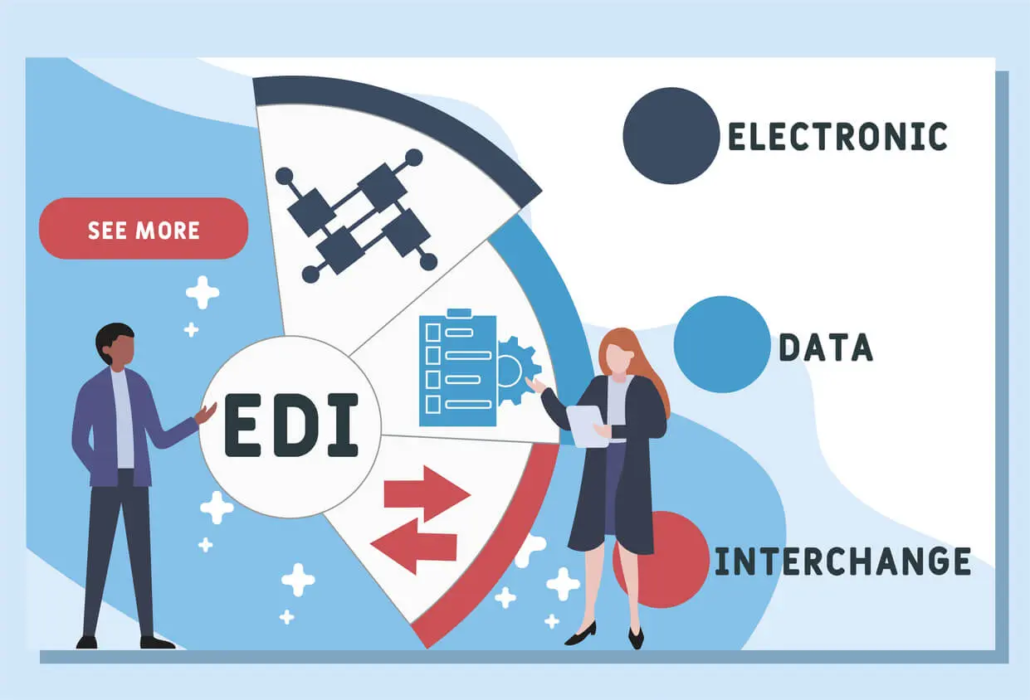 is EDI?
Electronic Data Interchange (EDI) is a transmission of structured data between organizations using predefined formats following a certain standard (i.e. x12); The EDI standard has been around for decades and is commonly used in industries like manufacturing, logistics, retail, and healthcare, where businesses frequently exchange standardized documents such as invoices, purchase orders, and shipment notifications.
For more on EDI, check out this article from our blog: What is EDI (Electronic Data Interchange)?
What is API?
Application Programming Interface (API) is a modern technology that allows different applications to communicate with one another, usually over the internet using standard web protocols (i.e. HTTPS), to exchange data based on a pre-defined structured format (i.e. JSON, XML…) without the presence of a third party in the middle. APIs are flexible, versatile, and widely used in software development and integration.
For more on APIs, check out our article: API Web Service for EDI X12 exchange – Discover the advantages
Use Cases: EDI and API Integration Side by Side
In a well-connected business world of today, there are plenty of use cases where data integration enforces the use of EDI along with API; here is a short list:
- E-commerce Platforms: Retailers often use EDI to communicate with suppliers and manufacturers but rely on API implementation from another side, to update their online storefronts in real-time.
- Logistics and Transportation: EDI is often used to exchange shipment details, but on the other side, APIs can provide real-time tracking and status updates to customers.
- Healthcare: EDI facilitates the exchange of patient records and insurance claims, while APIs enable the integration of modern cloud-based applications and patient portals.
The list can go on and we can uncover more use cases where API and EDI work side by side, for a complete integration cycle.
Can EDI and API Work Together Using Just One Modern Technology?
The short answer is yes. Instead of managing two separate technologies, businesses can streamline their integration processes by leveraging EDI through a REST API.
let me elaborate, by explaining how to work with an EDI process via REST API, using one of the above use cases (e-commerce platforms).
EDI Integration for an E-commerce Platform (Use Case)
In a real-world use case, a retailer (i.e. Amazon) would send a specific transport company an EDI document (EDI 204) “Motor Carrier Load Tender”. The receiving party would be a logistic and transportation company and will be asked to send his pricing and bid for a transportation job.
That transportation and logistics company will need to receive this EDI 204 document, process this EDI transaction into their own system that can be based on a cloud ERP/CRM software, or home-grown ERP or even and branded CRM/ERP.
Currently, the integrators at the transport company would be transforming these 204 documents than mapping each field into their own ERP, to be able to process.
What we can offer is a single “API call” step to transform the EDI 204 document to xml, via EDI2XML’s own REST API for them to be able to work with a modern XML file (rather than x12 raw files) in such an integration project.
Adding one step into the flow of integration, that does not require much efforts, will allow the developer to work and map the “equivalent” xml file of the EDI document and be able to easily process.
Why Use EDI2XML’s REST API for EDI Integration?
There are several advantages for an integrator to use EDI2XML’s REST API, in his integration project, rather than working with raw EDI files in such an integration:
- Simplicity: Working with xml is much more comprehensive and simpler than working with EDI, x12 format for example
- Data Accuracy: While doing the transformation from x12 to xml, EDI2XML REST API will extract every node and element found in the edi file; all data are accounted for
- Standardized Schemas: When processing an xml message processed by the EDI2XML REST API, the manufacturer is providing the xsd schemas built from the ground up with comprehensive naming terminology based on the appropriate standard (i.e. x12)
- Cross-Platform Compatibility: Calling a REST API in general is not technology or O/S dependant; in today’s world, all technologies support https and REST api calls.
- No EDI Expertise Required: No need for any EDI expertise to understand and interpret the transaction converted to xml, it is self-explanatory based on the schemas

Improve Integration Efficiency Using a Middleware
While EDI2XML REST API is clearly an API to transform EDI to xml and xml to EDI, it is not by any means a middleware to allow mapping of fields and data to accelerate the integration development, the deployment and onboarding process.
However, based on our many years of experience and hundreds of implementations, I can recommend a great middleware and integration platform Magic xpi.
This great platform would turn integration projects from months and weeks into a matter of days from development to go live.
Useful reading: How to Optimize Your Business Processes with Magic xpi Integration Platform
Best Practices in Data Integration Projects
To make the most out of your integration projects, please consider these best practices:
- Understand project requirements: Determine what type of data integration and what are the business needs.
- Adopt a Hybrid Approach: Combining EDI via API using EDI2XML REST API for standardized EDI, along with batch processing with APIs for real-time updates gives businesses the flexibility to meet various demands without sacrificing operational efficiency.
- Prioritize Security: Exchanging EDI and API handle sensitive data, so it’s important to ensure that your integration strategy includes robust security measures like encryption, authentication, and regular audits.
- Utilize Middleware: Middleware platforms such as Magic xpi, can streamline data integration, allowing systems to communicate without heavy custom development, especially if your company is operating one of the branded ERP/CRM solutions. Thanks for Magic xpi validated and certified connectors to most of the systems in the marketplace.
- Future-Proof Your Integration Strategy: As more businesses transition to the cloud and leverage APIs, make sure your systems are agile and adaptable to new technologies.
Can We Review Your API Integration Strategy Together?
Our specialists with over 24 years of experience in EDI and API integration will be happy to help hope on a FREE one-hour Teams meeting to listen to your challenges and offer you the best approach and recommendation.
Just book a time convenient for you in our calendar.
Or click on this image to book your FREE consultation.