
In this article, I want to walk through a real-world EDI integration project we at EDI2XML delivered for Renaissance Global Logistics: a fully managed, cloud-based EDIFACT integration with JD Edwards (JDE), using Z-tables and a VAN mailbox.
About the Client
Renaissance Global Logistics (division of James Group) is a Detroit-based logistics and supply chain company known for its work in transportation, warehousing, kitting, sequencing, and inventory management. With decades of experience supporting automotive operations, the company depends on fast, accurate data exchange to keep shipments, schedules, and inventory flowing smoothly.
Why Renaissance Global Logistics Needed a Managed EDIFACT – JDE Integration
Renaissance Global Logistics is a logistics provider operating in a demanding environment: tight delivery windows, strict OEM requirements, and a constant flow of shipping schedules, forecasts, and inventory updates.
They were already using JD Edwards (JDE) as their ERP system and wanted to keep it as the single source of truth for operations. At the same time, their main trading partner (TP) required EDIFACT messages over a VAN (Value‑Added Network). The company did not want to:
- Install and maintain on‑premise EDI software
- Build and support custom EDI mappings internally
- Manage VAN connectivity, acknowledgments, and error handling
- Change how their users work inside JDE
In short, they wanted to keep full control of JDE, but outsource all EDI responsibilities to a trusted, cloud‑based EDI provider.
Key Takeaway:
Challenge: A leading logistics provider needed to automate complex EDIFACT exchanges with a key partner directly through Oracle JDE, without installing new software or burdening internal IT.
Solution: EDI2XML’s fully managed, cloud-based EDIFACT integration service, handling secure VAN communication, transformation, and JDE Z-Table updates.
Outcome: A reliable, self-running EDI pipeline that delivers accurate, timely data with zero manual intervention, allowing James Group to focus on core logistics operations.
Technical Scope: Automating Bidirectional EDIFACT – JDE Exchange
The goal was to implement a clean, fully managed workflow for both inbound and outbound EDIFACT documents, integrated directly with JDE through its native Z‑tables.
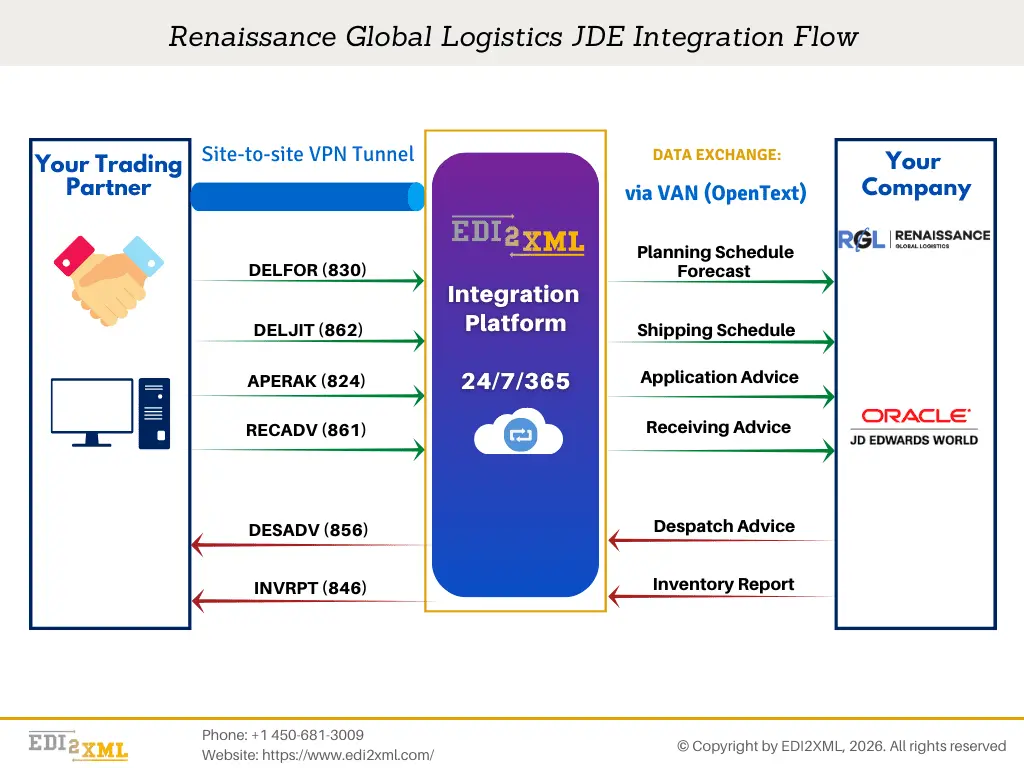
The project covered six EDIFACT documents, mapped to their ANSI X12 equivalents for clarity:
Inbound (TP → JDE):
- DELJIT (EDI 862) – Shipping Schedule
- DELFOR (EDI 830) – Planning Schedule / Forecast
- APERAK (EDI 824) – Application Advice
- RECADV (EDI 861) – Receiving Advice
Outbound (JDE → TP):
- DESADV (EDI 856) – Despatch Advice
- INVRPT (EDI 846) – Inventory Report
These are core messages in automotive and logistics supply chains. Any delay, error, or mismatch in these documents can quickly turn into missed shipments, penalties, or inventory issues.
Integration Architecture: EDIFACT, VAN, and JDE Z‑Tables
Instead of installing an on-premise EDI translator, the integration was built around a cloud‑based, fully managed EDI2XML platform positioned between the trading partner and the customer’s JD Edwards system. The architecture relies on two secure communication channels:
VPN connection to the trading partner
The trading partner exchanges EDIFACT messages directly with EDI2XML through a site‑to‑site VPN tunnel. This encrypted link ensures stable, secure delivery of inbound and outbound documents.
VAN mailbox connection to JDE
EDI2XML communicates with the customer’s JD Edwards environment through a VAN mailbox.
- Incoming EDIFACT files received from the trading partner are delivered to the VAN after processing.
- Outbound documents extracted from JDE are picked up from the VAN and converted into EDIFACT before being sent through the VPN to the trading partner.
EDI2XML cloud platform
The cloud platform acts as the central processing layer:
- Parses, validates, and maps EDIFACT messages
- Transforms them into a structured format aligned with the customer’s JDE Z‑table requirements
- Manages acknowledgments, retries, and error handling
- Operates on a secure private cloud with full monitoring and logging
This architecture keeps JDE untouched, centralizes all EDI logic in the cloud, and ensures secure, reliable communication with both the trading partner and the customer’s ERP environment.

How the EDIFACT Integration Works in Practice
Inbound EDIFACT Flow
Every 15 minutes, the EDI2XML platform automatically:
- Retrieves incoming EDIFACT messages from the VAN mailbox
- Performs structural and business-level validation
- Sends acknowledgements when required
- Transforms EDIFACT data into JDE-compatible formats
- Inserts validated data into the appropriate JDE Z-Tables
- Triggers email notifications so the client knows exactly what was processed
This approach ensures that inbound data is controlled, traceable, and fully auditable.
Outbound EDIFACT Flow
For outbound messages, the process works in reverse:
- The system connects securely to JDE on the same schedule
- Eligible transactions are identified in JDE
- Data is extracted from JDE tables
- Records are transformed into EDIFACT messages based on partner rules
- Messages are delivered to the VAN mailbox
- Processed records are flagged to prevent duplicates
The result is a predictable, repeatable outbound flow with built-in safeguards.
Security and Connectivity: Built for Stability
The integration uses two separate communication channels to keep partner connectivity and ERP connectivity clearly segmented. All EDIFACT exchanges with the trading partner run through a dedicated site‑to‑site VPN tunnel, ensuring encrypted and stable communication.
Communication with the customer’s JD Edwards system is handled through a VAN mailbox. This setup prevents JDE from receiving any direct external connections; all inbound and outbound EDI traffic flows through the VAN, which serves as the controlled interface for document exchange. This approach maintains compatibility with the customer’s existing EDI workflow while reducing exposure of the ERP environment.
By combining VPN‑based partner connectivity with VAN‑based ERP integration, the solution provides a secure and resilient architecture that supports continuous EDIFACT processing without requiring changes to the internal JDE system.
Implementation Approach: Structured and Collaborative
This was not a “plug-and-play” deployment. The integration followed a structured implementation process:
- Detailed analysis of partner EDIFACT specifications
- Review of JDE Z-Table structures and business rules
- Secure VPN setup
- VAN connectivity configuration and testing
- Data mapping and validation rule configuration
- Full-cycle testing with both the client and trading partners
- Go-live and transition to continuous monitoring
Close collaboration with the Renaissance Global Logistics IT team played a key role in keeping the project on track and avoiding surprises during go-live.
Results: From Manual Effort to Quiet Automation
After go‑live, the integration stopped being a “project” and became part of the company’s operational backbone. Here are the main outcomes.
1. Fully automated EDI workflow
Manual handling of EDIFACT files disappeared. The entire flow—from VAN to JDE and back—runs automatically on a schedule.
- No more manual downloads from VAN
- No manual imports into JDE
- No manual file conversions
This saved hours of repetitive work and reduced the risk of human error.
2. Reliable compliance with trading partner requirements
Because the mappings and validations are maintained centrally in EDI2XML:
- All documents follow the trading partner’s specifications
- Changes in partner requirements are handled by our team
- The logistics team can focus on operations, not on EDI formats
3. Better operational visibility
Real‑time email notifications and logs give the customer:
- Visibility into which documents were received or sent
- Quick detection of issues
- A clear audit trail for internal and external reviews
4. IT resource liberation
The internal IT team no longer has to:
- Maintain EDI software
- Troubleshoot VAN connectivity
- Update mappings for every partner change
They can focus on higher‑value projects, while EDI runs as a managed service.
EDI2XML had been very easy to work with. They have been instrumental in establishing our EDI automation. They have been very responsive to our needs and changing requirements. The proactive error detection and data validation checks that they put in place catch data issues before transactions are sent, avoiding rejections and downstream disruptions.
Our team gained a fully automated process without changing how we work inside JDE. It feels like the integration just runs by itself.
EDI Terminology Glossary (Clear Definitions)
EDIFACT. An international EDI message standard created by the UN and widely used in transportation, logistics, and global trade. It defines a strict structure for messages — segments, elements, and codes — used for documents like shipment notices, purchase orders, forecasts, and inventory reports.
JDE Z tables / Z transactions. Interface or staging tables in JD Edwards used to load external or non‑native data before it becomes live production data. They allow validation, error checking, and auditing so that only clean, approved data is posted into core JDE modules.
VAN mailbox. A virtual mailbox on a Value‑Added Network where trading partners send and receive EDI files. The VAN acts as a secure hub that handles routing, delivery confirmations, retries, archiving, and sometimes format conversions.
EDI mapping. The set of rules that convert data between an internal system format (ERP/WMS/TMS) and an EDI standard (EDIFACT, X12, XML, JSON). Mapping defines which fields correspond, how values are transformed, and what validations apply.
AS2. A secure internet protocol for direct EDI communication between partners. It provides encryption, digital signatures, and delivery confirmations (MDNs). Often used as a modern alternative to VANs.
X12. A major EDI standard used primarily in North America. Similar purpose to EDIFACT but with different segment structures, naming conventions, and document types.
Fully managed EDI. A Fully Managed EDI Service is an end‑to‑end solution designed to remove the complexity, cost, and technical burden of managing EDI in‑house. Instead of installing software, maintaining integrations, or dealing with trading partner requirements, businesses rely on a dedicated EDI team that handles every step of the process — from initial setup to daily operations.
Our Fully Managed EDI Service, powered by EDI2XML, provides a complete translation, communication, and integration environment delivered through a secure private cloud. It is designed for companies of all sizes and industries that want reliable, compliant, and scalable EDI without investing in infrastructure or specialized staff.
Ready to Automate Your EDI Exchange?
If your business faces similar challenges with EDIFACT, ANSI X12, or any EDI standard, EDI2XML can provide a tailored, fully managed solution.
Schedule a Free Consultation with our EDI experts to discuss your JDE integration needs.