EDI2XML
  • About
    • The Company
    • EDI2XML
    • Advantages
    • Partnership with EDI2XML
    • Testimonials
  • Services
    • Enterprise AI
    • Fully Managed Integration
    • Fully Managed EDI Services
    • EDI Web Portal
    • EDI Web Service
    • EDI On Premises
    • Managed Cloud Services
    • Amazon Integration
    • Shopify Integration
    • BigCommerce Integration
    • NetSuite Integration
    • JD Edwards Integration
    • Dynamics 365 Integration
    • SAP B1 Integration
    • Salesforce Integration
    • Industry 4.0 Integration
  • Pricing
    • EDI Managed Services
    • EDI Web Service
    • EDI On-Premises
    • Managed Cloud Services
    • Shopify Integration
    • JD Edwards Integration
    • E-commerce Integration
    • All other Integrations
  • Blog
  • Resources
    • Resource Center
    • List of EDI Codes
    • List of EDIFACT Messages
    • EDI Documents Library
    • Trading Partners
  • Contact us
  • Book a Consultation
  • Click to open the search input field Click to open the search input field Search
  • Menu Menu
  • Link to Facebook
  • Link to LinkedIn
  • Link to X
  • Link to Youtube

EDI implementation involves setting up electronic data interchange systems to automate data exchange, improve accuracy, and facilitate communication.

Tag Archive for: EDI implementation

A must-have guide for a successful systems integration with EDI

Blog

The concept of Electronic Data Interchange (EDI) is still very abstract for a business owner up until today. More often, as soon as an SME (small to medium-sized enterprise) is requested by an important partner to comply with the electronic data interchange process or do EDI, everyone gets into a big pig panic inside the enterprise, and all reinforcements are being called to help with such a project.

Why EDI Integration Projects Often Turn Into a Headache

Large retail chains are critical customers for many small and medium-sized businesses. Complying with their requirements isn’t optional—it can make or break a partnership. And since these retailers communicate almost exclusively through EDI, integrating it correctly is non-negotiable.

Yet many companies underestimate what it takes. Diving into EDI integration without a clear understanding of your own processes and specific business needs often leads to delays, errors, and frustration. In short: without proper planning, EDI projects can quickly become a nightmare.

Recommendations and Steps for a Successful Integration

EDI technology can have a bigger impact on a company’s business processes than almost any other IT solution. That’s why EDI integration projects need to be carefully planned and executed, following a clear, structured approach.

Here are the key steps to ensure a smooth and successful integration:

Step 1: Preparation of an EDI implementation team

It is essential that senior management be involved in any EDI integration project and implementation, at least at a high level.

Ideally, the EDI implementation team should include representatives from different departments, such as operations management, sales, and information services.

It is important for the team to design together a good flow of information, so everyone understands the issues, the scope, and the benefits of the project. A project manager should be assigned to take charge of such a mandate.

Step 2: Setting a project timeline

The implementation team should set an ETA and develop a plan with a complete list of tasks, resources required, and delivery estimates.

Step 3: Choice of standards

While the choice of standard of EDI format and communication protocols is very limited, this phase consists on just reviewing and making sure all specs and documentations are in place for the kick-off.

Step 4: Choice of documents for EDI transaction

Often, trading partners specify the EDI standard and the type of documents they will send or accept. Sometimes partners use only a few of the possible documents such an Invoice EDI 810 form and purchase orders EDI 850 form.

Step 5: “On premises” or “cloud” based or EDI Web Sevice?

There are many ways to do EDI. It is depending of the anticipated transaction volume, or the size of the business. Going with a software solution deployed “on-premises” or adopting a “cloud based software” or maybe EDI Web Service

♦ The Cloud-based EDI Service is an excellent solution for Small and Medium-sized enterprises that do not have a budget for large EDI projects, and who do not have experienced staff with EDI exchange.

USEFUL: Learn more about EDI Solution as a Service for SMEs 

♦ The other way to get the most out of EDI, is by adopting a full EDI integration with your internal software management system like your ERP, CRM etc.

♦ EDI2XML Web Service, is for developers and businesses, interested in building their own EDI (Electronic Data Interchange) integration flows and programs. Normally, these individuals, are capable of interacting with external API and Web Services to translate EDI to XML and XML to EDI, and have the resources and expertise to work with Web Services and HTTP requests in order to achieve their goals. EDI2XML web service, is the premier choice for IT people as a reliable service to accomplish such integration projects.

Step 6: File Integration or direct system integration

When it comes to integration, the implementation should be decisive on how the integration to their CRM/ERP is going to happen: there are (2) methods to do such an integration; either through file integration, Where the ERP has already some built-in jobs to import data based on specific format, or direct integration. Obviously, this decision is also dependent on whether the software management system is a legacy system or a modern one, fully loaded with all kinds of API and programming interfaces. This part can be the most difficult and lengthy part, unlike what most people think…

Step 7: Integration project testing

Pilot projects are conducted both within the company and with external business partners. EDI test should be of a specified duration. They will help identify possible loopholes and establish a problem-solving plan. Technical employees should be trained in the technical aspects of EDI.

Step 8: Setting up

The implementation of the EDI system must be combined with several factors in order to be successful: adequate users training, proper implementation plan, and establishment of an emergency procedure.

For small to medium-sized enterprises, EDI integration is a good deal. An Electronic Data Interchange (EDI) capable enterprise retains an important customer or supplier and have a lot of opportunities to enter into new contracts with large companies.

For many years, our EDI2XML service has been offering up-to-date integrated solutions at an affordable cost. We have been helping companies of all sizes, to optimize operations and improve their competitiveness.

cta_edi2xml

December 14, 2017
https://www.edi2xml.com/wp-content/uploads/2024/09/edi2xmlcom-EDI-cloud-software.webp 628 1200 Tatyana Vandich https://www.edi2xml.com/wp-content/uploads/2024/08/edi2xml.com-EDI2XML-company-logo.png Tatyana Vandich2017-12-14 16:33:202026-03-13 12:28:55A must-have guide for a successful systems integration with EDI

How does EDI2XML work ?

Blog, EDI, EDI2XML

How does EDI2XML work?


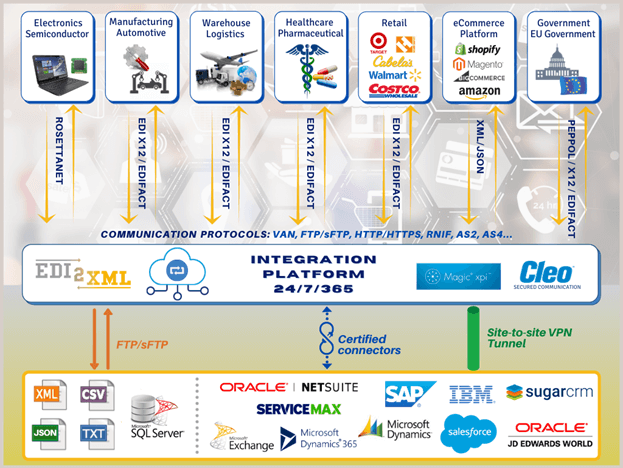
In simple terms, EDI2XML is a converter from EDI X12 format to XML format. The result XML format file is based on a pre-defined schema (xsd); we call it our “EDI2XML format”. Here is a very simple graphical description of the EDI2XML engine “in action”.

EDI Platform

Read: What is EDI ?

EDI2XML can work in two directions by changing a little switch when executing the command:

  • Convert incoming EDI X12 files to XML format
  • Convert outgoing XML format files to EDI format
For incoming EDI files, after a raw X12 EDI file is received using communication software and the EDI2XML engine is triggered, the following actions are executed one after the other:
– EDI2XML will verify the structure of the received file to make sure it is a valid raw EDI X12 format file
– If the raw EDI X12 file is valid in terms of structure, it will run another path to eliminate any information not considered part of EDI; for example, some headings and footers sent through the EDI VAN are automatically cleaned as it does not relate to any business information exchanged with the EDI partner
– The engine is smart enough to split a batch of incoming EDI files inside the same physical file, by envelop (ISA) and by ISA id, as a preparation for the conversion to XML, regardless of its EDI standard and revision
– Once all of the above is completed, the engine would generate for each one of the EDI files an equivalent XML formatted file.
The EDI2XML engine works a little differently when converting raw X12 files from an XML format. Once the engine is triggered with the option to convert XML to EDI X12 format, it will do the following actions:
– For each XML file found, EDI2XML will validate its structure and find out if it is well formed, to make sure it is compliant with edi2xml format and schema
– For each valid XML file, the engine will convert from XML to X12 raw EDI format
*It is important to note that the XML file should comply with a pre-defined xsd (or schema). All necessary information related to EDI versions and standards are sent within the XML file. For incoming and outgoing edi2xml formatted files, only files from the “ licensed” partners are being processed. Any EDI or XML file sent from/to an unlicensed partner will NOT be processed at all.

Read: How is EDI2XML licensed ?


Free EDI Demo


August 22, 2013/0 Comments
https://www.edi2xml.com/wp-content/uploads/2024/08/edi2xml.com-EDI2XML-company-logo.png 0 0 Tatyana Vandich https://www.edi2xml.com/wp-content/uploads/2024/08/edi2xml.com-EDI2XML-company-logo.png Tatyana Vandich2013-08-22 08:37:462024-04-05 09:37:31How does EDI2XML work ?

What is a VAN?

Blog

EDI Communication and VANs

What is a VAN ?


A Value Added Network (VAN) is considered the “post office” where business partners can collect and sort EDI documents coming through. As of today, a considerable amount of EDI transactions are still going through VANs, however this number is always in constant decline considering the popularity of the internet, its reduced cost as well as the level of security someone can implement with internet communication protocols. Most of the “major players” in the retail industry, have switched to a point-to-point communication of EDI files and transactions using one or many of the following secured communication protocols for a point-to-point EDI exchange:

FTP (not secured – plain text)

sFTP

Https

AS2

AS3

telnet

“bisync modem” to communicate through a value added network (VAN). This is the oldest method of secured communication.

VAN vs Direct EDI Communication

Communication Method Description Security Cost Usage Today
VAN 3rd-party network that stores, routes and manages EDI messages High (managed by provider) High Declining, but still used in government, healthcare, and legacy systems
FTP Basic file transfer (unencrypted) ❌ Not secure Low Not recommended
sFTP Encrypted file transfer ✅ Secure Low Common
HTTPS Secure web communication ✅ Secure Low Popular
AS2 Real-time encrypted transmission over internet ✅ Very secure Low Industry standard
AS3 File-based (FTP-style) but secure and standards-based ✅ Secure Low Less common
Bisync modem / Telnet Legacy dial-up communication methods Obsolete High Rare (legacy systems only)

Should You Still Use a VAN?

While VANs still serve a purpose — especially in industries like healthcare and government where legacy infrastructure and compliance are key — most businesses now prefer AS2, HTTPS, or sFTP for faster, cheaper, and more flexible data exchange.

If you’re evaluating EDI communication options, consider the following:

  • How many partners still require a VAN?

  • Do you need full audit trails, data backup, and message tracking?

  • Is your team equipped to manage point-to-point protocols like AS2?

At EDI2XML, we support both VAN-based and direct communication, offering our clients flexibility depending on their partners’ requirements and their internal capabilities.


Key Takeaways

  • A VAN is a secure intermediary for EDI document exchange but is declining in use.

  • Direct communication methods like AS2 and HTTPS are now preferred for cost, speed, and control.

  • Businesses often adopt a hybrid model to accommodate different trading partners.

August 15, 2013/2 Comments
https://www.edi2xml.com/wp-content/uploads/2024/09/edi2xml.com-EDI.webp 793 1322 Pierre Namroud https://www.edi2xml.com/wp-content/uploads/2024/08/edi2xml.com-EDI2XML-company-logo.png Pierre Namroud2013-08-15 10:10:502025-10-16 09:40:30What is a VAN?
Page 2 of 212
Recent
  • The Infrastructure Behind Modern Commerce: Why EDI Still Matters
    EDI in E-Commerce and Retail: Why Modern Commerce Still...May 1, 2026 - 4:54 pm
  • Key Statistics on AI Use in the Workplace
    The Risks of Using Public AI Tools in Business: Data Privacy,...March 11, 2026 - 5:51 pm
  • Enterprise AI
    How to Securely Access Enterprise AI: GPT, DeepSeek &...February 20, 2026 - 3:09 pm
  • EDI 754 Guide
    EDI 754 Routing Instructions: Complete Guide to Purpose,...February 18, 2026 - 4:54 pm
  • All you need to know about EDI 753 Transaction
    What Is EDI 753? Purpose, Structure & Routing Rule...February 12, 2026 - 3:59 pm
Popular
  • How to Quickly Connect to a Large Retailer's EDI Requirements
    How to Get EDI-Compliant Quickly For A Large RetailerNovember 21, 2025 - 4:29 pm
  • EDI-as-a-services
    EDI Translation Software “On-premises” or “As...January 21, 2014 - 1:28 pm
  • order-automation in e-commerce
    Why Is It Crucial to Automate the E-Commerce Order Fulfillment...May 10, 2022 - 1:58 pm
  • EDI for Logistics and transportation
    EDI Integration for Efficient Transportation ManagementOctober 6, 2023 - 1:33 pm
  • information technology definitions
    Business Tech Terms DefinitionsMay 24, 2018 - 1:32 pm

Browse by tag

Amazon Amazon Integration ANSI ASC x12 ASC X12 EDI B2B EDI integration e-commerce e-commerce business e-commerce integration eCommerce eCommerce integration EDI EDI2XML EDI as a Service EDI Communication EDIFACT EDI for supply chain EDI for Third-Party Logistics EDI for transportation EDI implementation EDI Integration EDI Integration Project EDI project EDI to XML converter EDI Translation EDI Web Service EDI x12 ERP Fully managed EDI Integration integration platform integration project JDE Logistics EDI Transactions Magic xpi NetSuite online store Shopify Shopify eCommerce integration Shopify integration soa integration Supply Chain Supply Chain Management Translation Software X12 EDI XML

Subscribe to our Blog

Menu

  • Home
  • About the EDI2XML Company
  • About EDI2XML EDI Converter
  • Blog
  • Book A Free Consultation
  • Privacy Policy EDI2XML Company

Our Services

Fully Managed Integration

E-Commerce Integration

Business Systems Integration

Fully Managed EDI

EDI Web Service 

On Premises EDI 

Managed Cloud Service


Latest Blog Posts

  • The Infrastructure Behind Modern Commerce: Why EDI Still Matters
    EDI in E-Commerce and Retail: Why Modern Commerce Still Depends on EDIMay 1, 2026 - 4:54 pm
  • Key Statistics on AI Use in the Workplace
    The Risks of Using Public AI Tools in Business: Data Privacy, Compliance, and Shadow AIMarch 11, 2026 - 5:51 pm
  • Enterprise AI
    How to Securely Access Enterprise AI: GPT, DeepSeek & LLaMAFebruary 20, 2026 - 3:09 pm

Contact Us

400 Blvd Curé-Labelle, #304 Laval QC H7V 2S7 Canada

Contact EDI2XML Team
Phone: +1 450-681-3009
Website: https://www.edi2xml.com/

© 2000-2026 EDI2XML (by Namtek Consulting Services). All rights reserved.
  • Link to Facebook
  • Link to LinkedIn
  • Link to X
  • Link to Youtube
  • Blog
Scroll to top Scroll to top Scroll to top