EDI2XML
  • About
    • The Company
    • EDI2XML
    • Advantages
    • Partnership with EDI2XML
    • Testimonials
  • Services
    • Enterprise AI
    • Fully Managed Integration
    • Fully Managed EDI Services
    • EDI Web Portal
    • EDI Web Service
    • EDI On Premises
    • Managed Cloud Services
    • Amazon Integration
    • Shopify Integration
    • BigCommerce Integration
    • NetSuite Integration
    • JD Edwards Integration
    • Dynamics 365 Integration
    • SAP B1 Integration
    • Salesforce Integration
    • Industry 4.0 Integration
  • Pricing
    • EDI Managed Services
    • EDI Web Service
    • EDI On-Premises
    • Managed Cloud Services
    • Shopify Integration
    • JD Edwards Integration
    • E-commerce Integration
    • All other Integrations
  • Blog
  • Resources
    • Downloadable Guides
    • List of EDI Codes
    • List of EDIFACT Messages
    • EDI Documents Library
    • Trading Partners
    • Customer Case Studies
  • Contact us
  • Book a Consultation
  • Click to open the search input field Click to open the search input field Search
  • Menu Menu
  • Link to Facebook
  • Link to LinkedIn
  • Link to X
  • Link to Youtube

Electronic Data Interchange (EDI): The Complete Guide for Modern Businesses

Blog, EDI

Electronic Data Interchange (EDI): How Businesses Automate Orders, Reduce Errors, and Improve Supply Chain Efficiency

E-commerce has changed the way businesses sell, but behind every online order is a complex network of suppliers, retailers, warehouses, carriers, and technology systems that must communicate accurately.

When a customer places an order online, multiple business processes happen behind the scenes:

  • The order must reach the supplier or warehouse.
  • Inventory availability must be updated.
  • Shipping information must be exchanged.
  • Invoices must be generated.
  • Payments must be processed.

For companies managing hundreds or thousands of transactions, exchanging this information manually through email, spreadsheets, or file uploads quickly becomes inefficient and error-prone.

This is exactly why Electronic Data Interchange (EDI) is so important.

EDI allows businesses to exchange standardized electronic documents directly between systems, eliminating manual data entry and improving communication between trading partners.

For more than 25 years, EDI2XML has helped organizations automate B2B document exchange, connect trading partners, and integrate EDI solutions with ERP platforms, accounting systems, and custom applications. With 1,000+ successful EDI integrations completed, our team brings hands-on experience helping businesses across industries improve transaction accuracy, reduce manual processes, and build reliable connections with their trading partners.

This guide explains how EDI works in e-commerce, the most common EDI documents, implementation considerations, and how businesses can use EDI to improve operational efficiency.
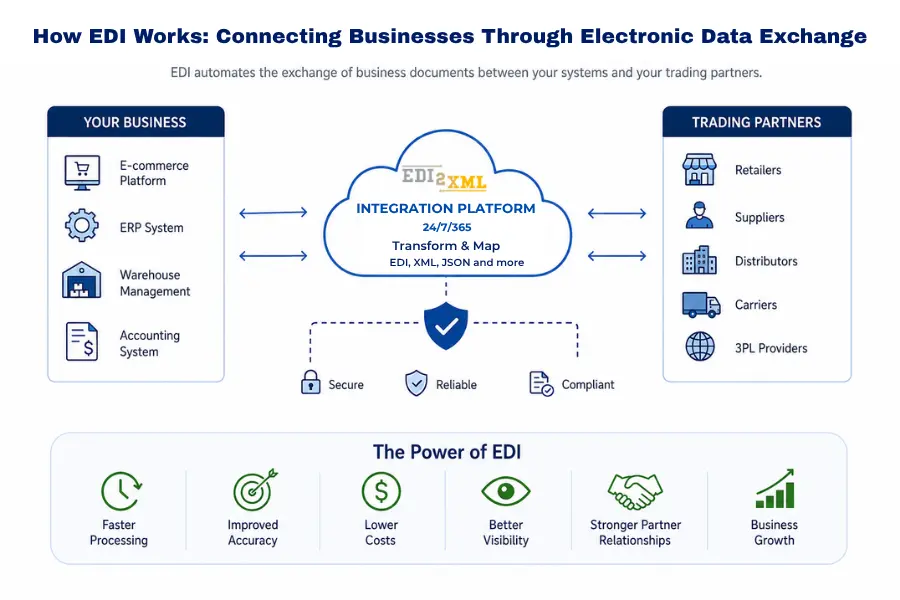
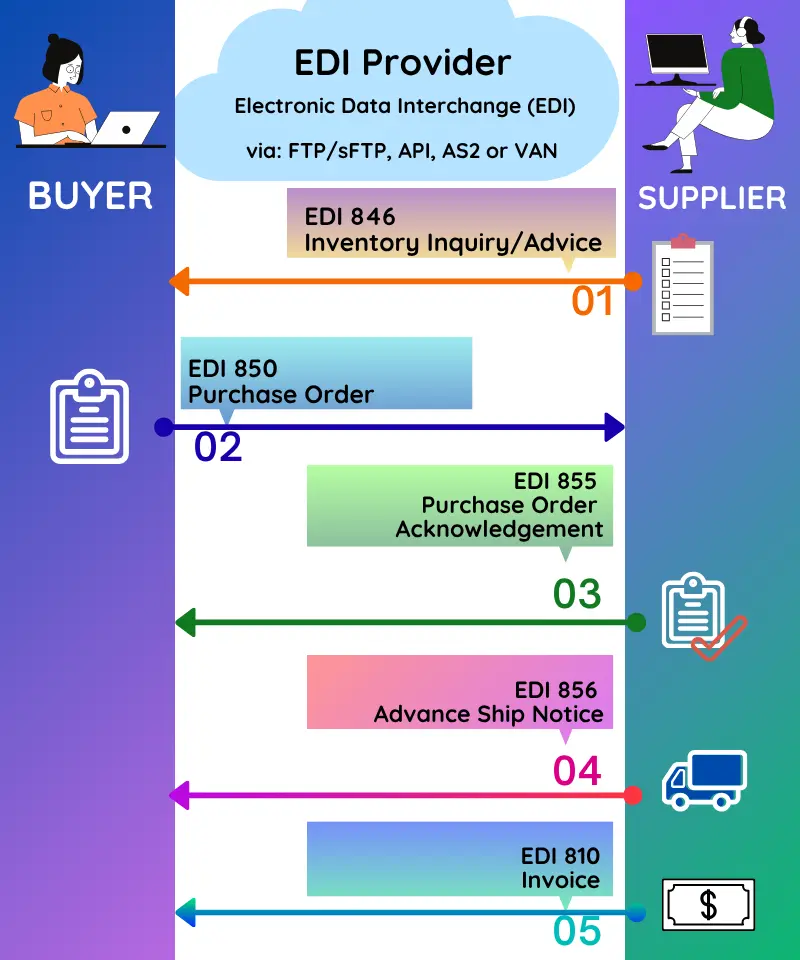
Understanding EDI: How Companies Exchange Data Automatically Diagram

What Is Electronic Data Interchange (EDI)?

Electronic Data Interchange (EDI) is the automated exchange of structured business documents between organizations using standardized electronic formats.

Instead of employees manually entering purchase orders, invoices, or shipment details, EDI enables computer systems to exchange this information automatically.

Common EDI documents include:

Business Process EDI Document
Purchase order EDI 850
Purchase order acknowledgment EDI 855
Advance shipping notice EDI 856
Invoice EDI 810
Functional acknowledgment EDI 997

EDI standards ensure that information exchanged between companies is understood correctly, even when organizations use different internal systems.

The two most widely used EDI standards are:

  • ANSI X12 — commonly used in North America
  • UN/EDIFACT — widely used internationally

Modern EDI integrations support multiple communication protocols such as AS2, FTP/SFTP, APIs, and cloud integration platforms. While traditional EDI documents remain in X12 or EDIFACT formats, modern systems often transform these documents into XML or JSON for internal processing or API‑based integrations.

How Does EDI Work in E-Commerce?

A typical e-commerce transaction involves multiple organizations: the online retailer, a supplier or manufacturer, a warehouse, a third-party logistics provider (3PL), a carrier, and the customer.

Without EDI, information moves manually: Customer order → email notification → employee downloads order → data entered into ERP → warehouse receives instructions → invoice created manually.

With EDI, the process is automated: Customer order → EDI transaction → ERP system → warehouse → shipping → invoice.

Example: EDI Order-to-Cash Workflow

Imagine a retailer places an order with a supplier.

Step 1: Purchase Order Sent (EDI 850)

The retailer sends an electronic purchase order with product information, quantities, pricing, delivery requirements, and shipping instructions. The supplier’s ERP system, for example, NetSuite, SAP S/4HANA, Microsoft Dynamics 365, Oracle, or Acumatica, receives the order automatically.

Step 2: Order Confirmation (EDI 855)

The supplier acknowledges that the order was received, that products are available, and that the requested quantities can be fulfilled. Any exceptions are flagged before fulfillment begins.

Step 3: Shipment Notification (EDI 856)

When the order ships, the supplier sends an Advance Ship Notice (ASN) with shipment details, package information, tracking numbers, and expected delivery dates, so warehouses and receiving teams can prepare in advance.

Step 4: Invoice Exchange (EDI 810)

After shipment, the supplier sends an electronic invoice that can enter the buyer’s accounts payable system automatically.

Step 5: Transaction Confirmation (EDI 997)

The receiving system sends a Functional Acknowledgment confirming whether the EDI transaction was received and processed successfully.

This same flow also powers high-volume consumer order processing: when a shopper places an order on a retailer’s website, the retailer’s system sends an EDI 850 to the supplier or dropshipper, the supplier responds with an EDI 856 for shipment tracking, and an EDI 810 bills the retailer once the order is fulfilled — allowing retailers and suppliers to process thousands of orders per day with full visibility.

Integration price

Why EDI Matters for E-Commerce Businesses

Modern e-commerce companies compete on speed, accuracy, and customer experience.

A delayed order, incorrect inventory count, or missing shipment update can affect customer satisfaction and revenue.

EDI helps businesses improve operations by automating the flow of information between systems.

1. Faster Order Processing

Manual order entry creates unnecessary delays.

A purchase order received by email may require:

  1. Employee opens the email.
  2. Downloads the attachment.
  3. Reviews the information.
  4. Enters data into an ERP.
  5. Confirms the order.

With EDI, the order can flow directly into the business system.

The result:

  • Faster processing
  • Fewer manual steps
  • Reduced order delays

2. Improved Data Accuracy

Manual data entry is one of the most common sources of business errors.

A misplaced number, incorrect product code, or wrong quantity can result in:

  • Shipping mistakes
  • Invoice disputes
  • Customer complaints
  • Additional processing costs

EDI validates information using predefined formats and business rules before transactions are processed.

3. Better Inventory Visibility

E-commerce businesses need accurate inventory information to avoid:

  • Stockouts
  • Overstocking
  • Delayed fulfillment

EDI allows retailers, suppliers, and logistics providers to exchange inventory and order information automatically.

This improves:

  • Demand forecasting
  • Replenishment planning
  • Warehouse coordination

4. Stronger Trading Partner Relationships

Many large retailers require suppliers to support EDI.

Companies working with organizations such as retailers, distributors, manufacturers, and logistics providers often need EDI capabilities to:

  • Become approved suppliers
  • Meet customer requirements
  • Reduce compliance issues
  • Scale transaction volumes

EDI Guide

Integrating EDI with E-Commerce Platforms and ERP Systems

An EDI solution becomes significantly more valuable when it is integrated with the systems your business already uses. Instead of manually transferring information between applications, integrated EDI automatically moves data between your online store, ERP, warehouse management system (WMS), transportation management system (TMS), accounting software, and trading partners.

For example, when a customer places an order through your e-commerce platform, the information can flow directly into your ERP, generate the appropriate EDI transaction, notify the warehouse, and update inventory—all without manual intervention.

At EDI2XML, we’ve found that businesses see the greatest operational improvements when EDI is fully integrated into existing workflows rather than operating as a standalone application. The objective isn’t simply exchanging EDI documents; it’s eliminating repetitive manual work across the entire order lifecycle.

See how Supplies Outlet accelerated fulfillment, reduced errors, and scaled operations with a cloud‑based EDI2XML integration connected directly to NetSuite.

Case Study: EDI & NetSuite Integration for Supplies Outlet

Common ERP Systems That Work with EDI

Most modern ERP systems support EDI through APIs, middleware, connectors, or custom integrations.

ERP System Typical EDI Integration
Oracle NetSuite Purchase orders, invoices, inventory synchronization
SAP S/4HANA Supply chain automation, procurement, invoicing
Microsoft Dynamics 365 Sales orders, warehouse operations, financial transactions
Oracle ERP Enterprise procurement and distribution
Acumatica Order management and inventory automation
Sage Purchasing, invoicing, accounting
Epicor Manufacturing and distribution workflows
QuickBooks Invoice automation for small and mid-sized businesses

Depending on business requirements, integrations may be developed using REST APIs, web services, file transfers, or middleware solutions.

Common E-Commerce Platforms

Many growing businesses eventually require EDI because large retailers or distributors request standardized electronic transactions.

EDI is commonly integrated with:

  • Shopify
  • Adobe Commerce (Magento)
  • WooCommerce
  • BigCommerce
  • Wix / Squarespace
  • Salesforce Commerce Cloud
  • Custom e-commerce applications

Once integrated, online orders can automatically generate EDI transactions for suppliers, warehouses, or logistics providers.

What We’ve Learned from More Than 25 Years of EDI Implementations

One misconception we frequently encounter is that implementing EDI is simply a matter of connecting two systems.

While establishing the technical connection is an important step, successful EDI projects typically involve much more than technology alone.

In our experience, the greatest challenges often include:

  • Interpreting retailer or trading partner implementation guides
  • Mapping business rules between different ERP and business systems
  • Onboarding and testing with multiple trading partners
  • Validating transactions and handling exceptions during testing
  • Accommodating customer-specific document requirements
  • Maintaining integrations as business processes and partner requirements evolve

Every retailer and trading partner has its own requirements, even when using the same ANSI X12 transaction sets. An EDI 850 Purchase Order from one retailer may contain mandatory fields that another retailer doesn’t use.

That’s why successful EDI projects require more than technical expertise, they require experience working with different industries, document standards, and partner-specific implementation guides.

And this is exactly why fully managed EDI services exist: to handle the ongoing complexity, not just the initial connection.

Real-World EDI Use Cases Across Industries

Although EDI is often associated with retail, its applications extend across many industries where organizations exchange large volumes of structured business information.

From manufacturers and distributors to logistics providers and healthcare organizations, businesses use EDI to automate transactions, improve accuracy, and create more efficient supply chains.

At EDI2XML, we work with organizations that need reliable communication between trading partners, internal systems, and external platforms. The specific requirements vary by industry, but the underlying goal remains the same: reducing manual processes and creating a more reliable flow of business information.

EDI in Retail and E-Commerce

Retail is one of the largest users of EDI because retailers often require suppliers to exchange standardized documents before they can begin doing business.

A typical retail EDI workflow may include:

Business Activity EDI Document
Retailer places order EDI 850 Purchase Order
Supplier confirms availability EDI 855 Purchase Order Acknowledgment
Supplier ships products EDI 856 Advance Ship Notice
Retailer receives invoice EDI 810 Invoice
Transaction confirmation EDI 997 Functional Acknowledgment

EDI helps retailers and suppliers:

  • Reduce order processing time
  • Improve inventory accuracy
  • Reduce invoice discrepancies
  • Meet retailer compliance requirements
  • Improve supply chain visibility

EDI in Manufacturing

Manufacturers often exchange thousands of transactions with suppliers, distributors, and customers.

Common manufacturing EDI transactions include:

  • Purchase orders
  • Forecast schedules
  • Inventory updates
  • Shipment notices
  • Invoices
  • Order acknowledgments

For example, a manufacturer supplying components to an automotive company may receive production requirements electronically and automatically update internal planning systems.

Benefits include:

  • Better production planning
  • Reduced manual order entry
  • Faster supplier communication
  • Improved inventory management

EDI in Transportation and Logistics

Transportation companies and third-party logistics providers (3PLs) rely heavily on EDI because shipment information must move quickly between carriers, brokers, warehouses, and customers.

Common logistics EDI transactions include:

Process EDI Document
Load tender EDI 204
Shipment status EDI 214
Freight invoice EDI 210
Functional acknowledgment EDI 997

For example:

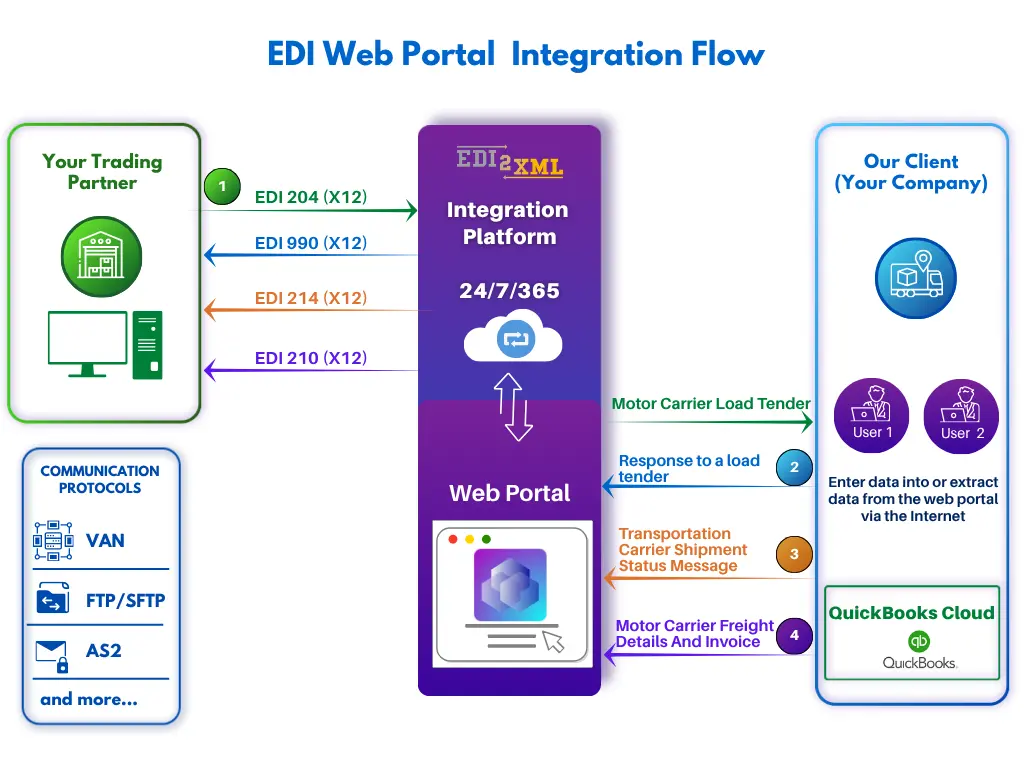
  1. A shipper sends an EDI 204 Load Tender.
  2. The carrier accepts or rejects the shipment.
  3. Shipment updates are transmitted through EDI 214.
  4. Freight charges are submitted electronically using EDI 210.

This reduces phone calls, emails, and manual status updates.

EDI in Healthcare

Healthcare organizations use EDI to exchange information between providers, insurance companies, clearinghouses, and government organizations.

Common healthcare EDI transactions include:

  • Claims
  • Eligibility inquiries
  • Payment information
  • Healthcare status reports

EDI helps healthcare organizations improve:

  • Data accuracy
  • Processing speed
  • Regulatory compliance

EDI for Small and Medium-Sized Businesses

A common misconception is that EDI is only for large enterprises.

Today, cloud-based EDI solutions allow small and medium-sized businesses to connect with major trading partners without building complex internal infrastructure.

Many SMBs adopt EDI because their customers require it.

Typical examples include:

  • A growing supplier partnering with a national retailer
  • A distributor connecting with multiple manufacturers
  • A logistics provider automating shipment communication
  • An online seller expanding into wholesale channels

Managed EDI services allow smaller organizations to benefit from enterprise-level automation without maintaining a dedicated EDI team.

Example Case Study: See how Bad Korean, a growing Canadian consumer food company operating without an ERP system, successfully automated its order and shipment communication using our cloud‑based EDI Web Portal. By connecting directly with a major trading partner, the company eliminated manual data entry and achieved reliable EDI compliance, all without investing in internal IT infrastructure.
EDI Web Portal

Common Challenges When Implementing EDI

Although EDI provides significant operational benefits, successful implementation requires careful planning.

1. Trading Partner Requirements

Every trading partner may have different requirements.

Even when two companies use the same EDI standard, their implementation guidelines may differ.

For example:

  • One retailer may require specific fields in an EDI 850 Purchase Order.
  • Another retailer may use different validation rules.
  • A third partner may require additional segments or business rules.

Experienced EDI providers help businesses manage these differences.

2. Data Mapping Between Systems

EDI documents and internal business systems often use different data structures.

For example:

An EDI 850 Purchase Order may contain:

  • Customer item numbers
  • Supplier item numbers
  • Quantities
  • Units of measure
  • Pricing information

The ERP system may store this information differently.

Mapping ensures that data moves correctly between systems.

3. Testing Before Production

EDI transactions must be tested before going live.

Testing typically verifies:

  • Document formatting
  • Data accuracy
  • Trading partner requirements
  • Error handling
  • Acknowledgment responses

A successful testing process reduces disruptions after launch.

4. Ongoing Maintenance

EDI is not a “set it and forget it” technology. Reliable EDI operations require continuous updates and daily monitoring to ensure transactions flow correctly.

Businesses may need updates when:

  • Trading partners change requirements
  • ERP or internal systems are upgraded
  • New document types are added
  • Business processes evolve

In addition, day‑to‑day monitoring is critical to catch issues early, such as:

  • Failed or rejected EDI transactions
  • Missing acknowledgments (997, 999, CONTRL)
  • Incorrect or incomplete data
  • Communication errors (AS2, SFTP, API failures)
  • Delayed inbound or outbound documents

Managed EDI services provide continuous monitoring, quick issue resolution, and proactive updates, ensuring that integrations remain stable as the business grows.

EDI2XML-Integration

The Future of EDI: Cloud, APIs, and Artificial Intelligence (EDI is evolving, not disappearing)

The future of EDI is not about replacing X12 or EDIFACT. Instead, modern EDI providers focus on making EDI:

  • easier to implement
  • easier to manage
  • easier to integrate with ERP, WMS, and eCommerce systems

This is exactly what cloud‑based EDI and API‑driven integrations are doing today.

Cloud-Based EDI

Cloud EDI Solutions provide:

  • Faster deployment – no servers, no installations
  • Reduced infrastructure requirements – everything runs in the cloud
  • Easy scalability – add partners or documents without hardware
  • Managed updates – EDI provider handles changes to specs
  • Remote accessibility — monitoring and support from anywhere

This is especially valuable for SMBs and mid‑market companies that don’t want to maintain servers or hire EDI specialists.

APIs and EDI Working Together

Modern businesses increasingly combine EDI with APIs.

For example:

  • APIs may provide real-time inventory availability.
  • EDI may exchange purchase orders and invoices.
  • ERP systems may use both technologies.

The choice depends on the business process and trading partner requirements.

Artificial Intelligence in EDI

AI technologies are beginning to improve EDI processes through:

  • Automated data mapping assistance
  • Error detection
  • Transaction analysis
  • Exception identification
  • Predictive insights

However, AI does not replace the need for EDI expertise.

Successful EDI implementations still require an understanding of business processes, industry standards, and trading partner requirements.

Why Companies Choose EDI2XML

For more than 25 years, EDI2XML has helped businesses streamline electronic data interchange and integrate EDI with their ERP, eCommerce, and logistics systems. Businesses worldwide rely on EDI2XML to automate transactions, reduce manual work, and maintain reliable connections with their trading partners.

We support a wide range of industries, including:

  • Manufacturers
  • Distributors
  • Retail suppliers
  • Transportation companies
  • Logistics providers
  • Healthcare organizations

Our solutions include:

  • Fully Managed EDI Services
  • Cloud‑based EDI platform
  • EDI Web Services (REST API integration)
  • Custom EDI mapping and transformation
  • Trading partner onboarding & compliance
  • ERP integration support (NetSuite, SAP, Microsoft Dynamics, Sage, Acumatica, and more)

We work with industry‑standard formats such as:

  • ANSI X12
  • EDIFACT
  • XML
  • JSON

And communication methods including:

  • AS2
  • FTP/SFTP
  • VAN
  • VPN Tunnel
  • APIs

Our Mission

To help organizations of all sizes automate EDI workflows, eliminate manual data entry, and ensure fast, accurate, and compliant document exchange with every trading partner.

Frequently Asked Questions About Electronic Data Interchange (EDI)

What is Electronic Data Interchange (EDI)?

Electronic Data Interchange (EDI) is the automated exchange of standardized business documents between organizations using electronic formats instead of manual processes such as email, paper documents, or spreadsheets.

EDI allows companies to exchange documents such as purchase orders, invoices, shipment notices, and acknowledgments directly between business systems.

Common EDI standards include ANSI X12 in North America and EDIFACT internationally.

Why do businesses use EDI?

Businesses use EDI to automate repetitive document exchange, reduce manual data entry, improve transaction accuracy, and speed up communication with trading partners.

Common benefits include:

  • Faster order processing
  • Reduced administrative work
  • Fewer data-entry errors
  • Improved supply chain visibility
  • Better compliance with customer requirements
  • Easier integration between business systems

Is EDI still used today?

Yes. EDI remains one of the most widely used methods for exchanging business documents across industries including retail, manufacturing, transportation, healthcare, and logistics.

Many large organizations continue to require EDI because it provides standardized, reliable communication between trading partners.

While newer technologies such as APIs have become popular for real-time application integration, EDI continues to play an important role in supply chain transactions.

What are the most common EDI documents?

The most common EDI documents depend on the industry, but frequently used ANSI X12 transactions include:

EDI Transaction Purpose
EDI 850 Purchase Order
EDI 855 Purchase Order Acknowledgment
EDI 856 Advance Ship Notice
EDI 810 Invoice
EDI 997 Functional Acknowledgment
EDI 204 Motor Carrier Load Tender
EDI 214 Transportation Shipment Status

These transactions automate communication between buyers, suppliers, warehouses, and logistics providers.

What is the difference between EDI and API?

EDI and APIs are both methods of exchanging data, but they are designed for different purposes.

EDI is primarily used for standardized business transactions between trading partners, such as purchase orders, invoices, and shipping notices.

APIs are commonly used for real-time communication between software applications, such as retrieving inventory availability or customer information.

Many modern organizations use both EDI and APIs together.

How long does EDI implementation take?

The timeline depends on the complexity of the project.

A simple EDI connection with one trading partner may be completed within several weeks.

More complex implementations involving multiple trading partners, ERP integration, custom mapping, and extensive testing may require several months.

Typical implementation phases include:

  1. Requirements analysis
  2. Document mapping
  3. System integration
  4. Trading partner testing
  5. Production deployment
  6. Ongoing monitoring

How much does EDI implementation cost?

EDI costs vary depending on:

  • Number of trading partners
  • Transaction volume
  • Required document types
  • ERP integration complexity
  • Communication requirements
  • Support model

Cloud-based managed EDI services can reduce upfront costs by eliminating the need to purchase and maintain dedicated EDI infrastructure.

Businesses should evaluate EDI costs based on the total operational value, including reduced manual work, fewer errors, faster processing, and improved customer relationships.

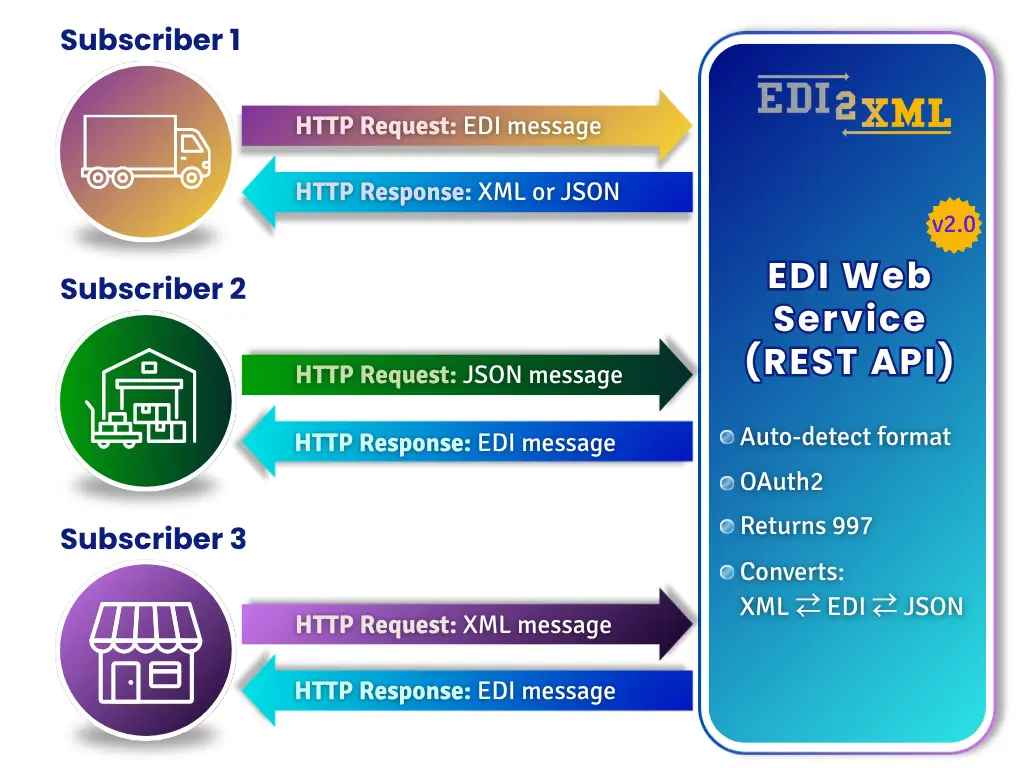
EDI2XML Rest API for EDI Price

Does EDI work with ERP systems like NetSuite and SAP?

Yes. EDI can integrate with many ERP systems, including:

  • NetSuite
  • SAP S/4HANA
  • Microsoft Dynamics 365
  • Oracle ERP
  • Acumatica
  • Sage
  • QuickBooks

Integration allows companies to automatically exchange EDI transactions between their ERP and trading partners without manually entering data.

Can small businesses use EDI?

Yes. Modern cloud-based EDI solutions make EDI accessible to small and medium-sized businesses.

Many SMBs implement EDI because a large customer, retailer, distributor, or logistics partner requires electronic document exchange.

Managed EDI services allow smaller organizations to benefit from automation without hiring specialized EDI staff.


What industries use EDI?

EDI is used across many industries, including:

Retail and E-Commerce

  • Supplier orders
  • Inventory updates
  • Shipping notifications
  • Invoices

Manufacturing

  • Supplier communication
  • Production schedules
  • Forecasts
  • Purchase orders

Transportation and Logistics

  • Load tenders
  • Shipment tracking
  • Freight invoices

Healthcare

  • Claims
  • Eligibility verification
  • Payment transactions

Distribution

  • Order management
  • Warehouse communication
  • Inventory coordination

EDI in E-Commerce Fulfilment

Key Takeaways: Why EDI Matters for Modern Businesses

Electronic Data Interchange remains a critical technology for organizations that need reliable communication with customers, suppliers, and partners.

The main benefits of EDI include:

  • Automation: Business documents move directly between systems without manual entry.
  • Accuracy: Standardized transactions reduce errors caused by manual processing.
  • Efficiency: Orders, shipments, and invoices are processed faster.
  • Visibility: Businesses gain better insight into supply chain activity.
  • Scalability: Companies can manage increasing transaction volumes more easily.
  • Integration: EDI connects trading partners with ERP and business applications.

For organizations working with retailers, manufacturers, distributors, or logistics providers, EDI provides the foundation for efficient and reliable B2B communication.

Why Choose EDI2XML for Your EDI Integration?

Implementing EDI successfully requires more than exchanging electronic files.

It requires understanding business processes, industry standards, trading partner requirements, and system integration.

With more than 25 years of experience in EDI and business integration, EDI2XML helps organizations simplify EDI adoption through:

  • Cloud-based Fully Managed EDI Services
  • EDI Web Services (REST API integration)
  • ERP integration
  • Trading partner onboarding
  • Ongoing monitoring and support

Whether you need to connect with a major retailer, automate supplier transactions, integrate EDI with your ERP, or modernize existing EDI processes, EDI2XML provides the expertise needed to build and maintain reliable connections.

Ready to simplify your EDI integration? Contact EDI2XML to discuss your requirements and find the right approach for your business.

Free consultation

July 17, 2026/0 Comments
https://www.edi2xml.com/wp-content/uploads/2026/07/EDI2XML-EDI_Guide-for-modern-businesses.webp 628 1200 Tatyana Vandich https://www.edi2xml.com/wp-content/uploads/2024/08/edi2xml.com-EDI2XML-company-logo.png Tatyana Vandich2026-07-17 16:46:392026-07-17 16:46:39Electronic Data Interchange (EDI): The Complete Guide for Modern Businesses

How EDI Documents Work Together: A Complete Guide to the EDI Transaction Process

Blog, EDI

What Is the EDI Document Exchange Process?

Many businesses know that EDI (Electronic Data Interchange) helps companies exchange documents electronically, but understanding how individual EDI transactions work together can be confusing. An EDI process is not based on a single document; it is a sequence of connected transactions that helps buyers and suppliers manage the entire order lifecycle, from purchase order creation to invoicing.

In a typical EDI workflow, a buyer sends a purchase order (EDI 850), the supplier confirms the order (EDI 855), provides shipment details (EDI 856), and sends an invoice (EDI 810). Together, these documents create an automated flow of business information between trading partners.

However, EDI document exchange does not happen automatically. Before two companies can exchange EDI transactions, they must first define business requirements, select the appropriate EDI standards, configure document mappings, establish communication methods, and complete testing.

Understanding how EDI documents work together helps businesses see the complete process behind electronic transactions, from the initial customer order to final invoicing.

How do EDI documents work together in a business transaction?

EDI documents work together as a sequence of electronic transactions that support different stages of a business process. Each document has a specific purpose and provides information required for the next step.

For example, a common order fulfillment workflow includes:

  • EDI 850 Purchase Order: Buyer sends order details to supplier.
  • EDI 855 Purchase Order Acknowledgment: Supplier confirms whether the order can be fulfilled.
  • EDI 856 Advance Ship Notice: Supplier provides shipment details before delivery.
  • EDI 810 Invoice: Supplier sends billing information electronically.

Together, these transactions replace many manual processes such as email-based orders, spreadsheet updates, and paper invoices.

What needs to happen before companies can exchange EDI documents?

Before companies can exchange EDI documents, trading partners must agree on technical and business requirements. An EDI connection requires more than simply sending a file from one company to another.

The preparation process typically includes:

  • Identifying required EDI documents and transaction types
  • Selecting the appropriate EDI standard
  • Defining communication requirements
  • Mapping data between business systems
  • Testing transactions before production use

Each trading partner may have different requirements, which is why EDI implementations are often customized based on the companies involved.

What EDI standards are used for electronic document exchange?

EDI standards define the structure and format of electronic business documents so different organizations can exchange information consistently.

The two most common EDI standards are:

ANSI X12

ANSI X12 is widely used in North America across industries such as retail, manufacturing, transportation, and healthcare.

Common X12 transactions include:

  • EDI 850 — Purchase Order
  • EDI 810 — Invoice
  • EDI 856 — Advance Ship Notice
  • EDI 855 — Purchase Order Acknowledgment
  • EDI 997 — Functional Acknowledgment

EDIFACT

EDIFACT (Electronic Data Interchange for Administration, Commerce and Transport) is an international EDI standard commonly used in Europe and for global business transactions.

Although X12 and EDIFACT use different structures, both serve the same purpose: enabling businesses to exchange standardized electronic information.

EDI Guide

Why do EDI documents require mapping and translation?

EDI documents require mapping and translation because companies often use different business systems, data formats, and internal processes.

For example, a retailer may send an EDI 850 Purchase Order using the ANSI X12 standard, while the supplier’s ERP system may require a different internal format.

EDI translation helps convert information between these systems so that:

  • Incoming transactions can be processed by internal applications
  • Outgoing documents meet trading partner requirements
  • Business data remains accurate during exchange

Mapping requirements can vary between trading partners because each company may define its own rules for required fields, codes, and data elements.

What role does an EDI provider play in document exchange?

An EDI provider helps businesses connect with trading partners by managing the technology required for electronic document exchange.

An EDI provider can help with:

  • Connecting business systems with trading partners
  • Translating EDI documents into usable formats
  • Managing document requirements
  • Monitoring transactions
  • Supporting changes and troubleshooting

For many businesses, especially those without dedicated EDI specialists, working with an EDI provider simplifies the process of becoming EDI capable.

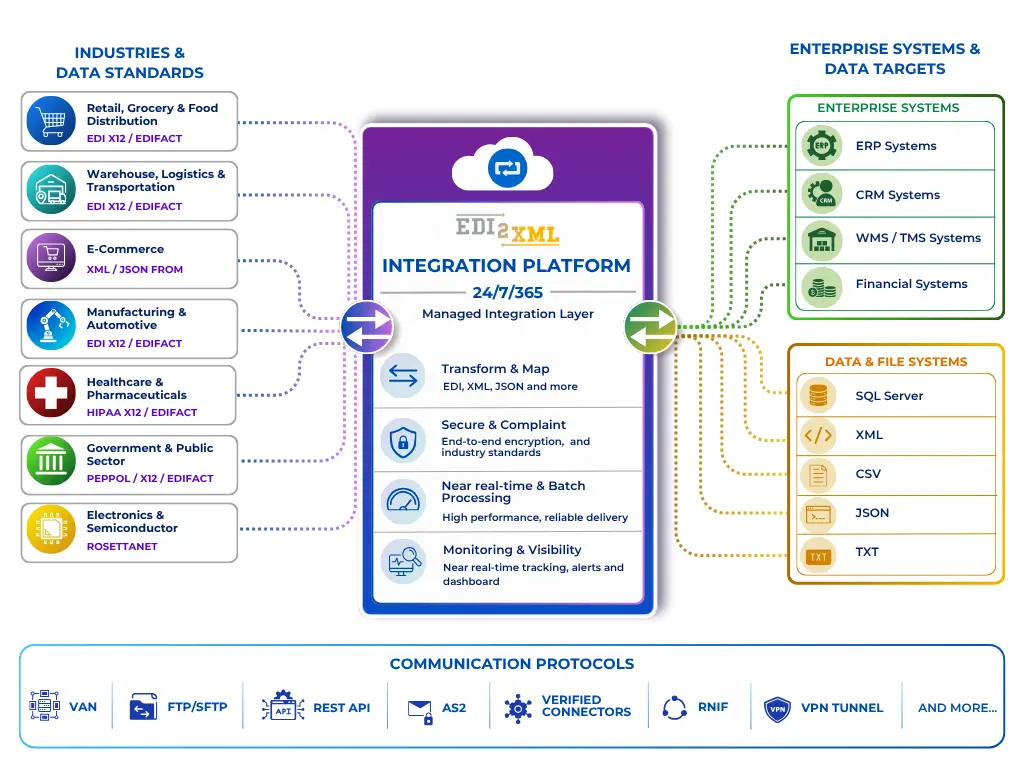
Infographic of an integration platform linking industries (left) to enterprise systems (right) with data formats (SQL Server, XML, CSV, JSON, TXT) below.

What happens during a typical EDI transaction flow?

A typical EDI transaction flow involves several systems working together:

  1. A buyer creates a purchase order in their ERP/CRM or business system.

The order contains the information required by the supplier, such as products, quantities, and delivery details.

  1. The EDI provider converts the business data into the required EDI transaction format and prepares it for secure exchange.

For example, the purchase order can be converted into an ANSI X12 EDI 850 transaction set based on the trading partner’s requirements.

  1. The EDI provider securely transmits the EDI document to the supplier or trading partner.

The document is exchanged using the required communication method, such as AS2, SFTP, VAN, VPN Tunnel etc.

  1. The supplier’s system receives and processes the EDI document.

Depending on the supplier’s setup, the EDI document can be integrated directly with their ERP, WMS, or other business application, allowing the order information to be processed automatically.

  1. The supplier processes the order in their business system.

The order information becomes available for fulfillment, inventory management, and order processing.

  1. Additional EDI documents are exchanged as the order moves through fulfillment and invoicing.

Depending on trading partner requirements, this may include documents such as EDI 855 Purchase Order Acknowledgment, EDI 856 Advance Ship Notice, and EDI 810 Invoice.

The exact workflow depends on the industry, trading partner requirements, and systems used by each company.

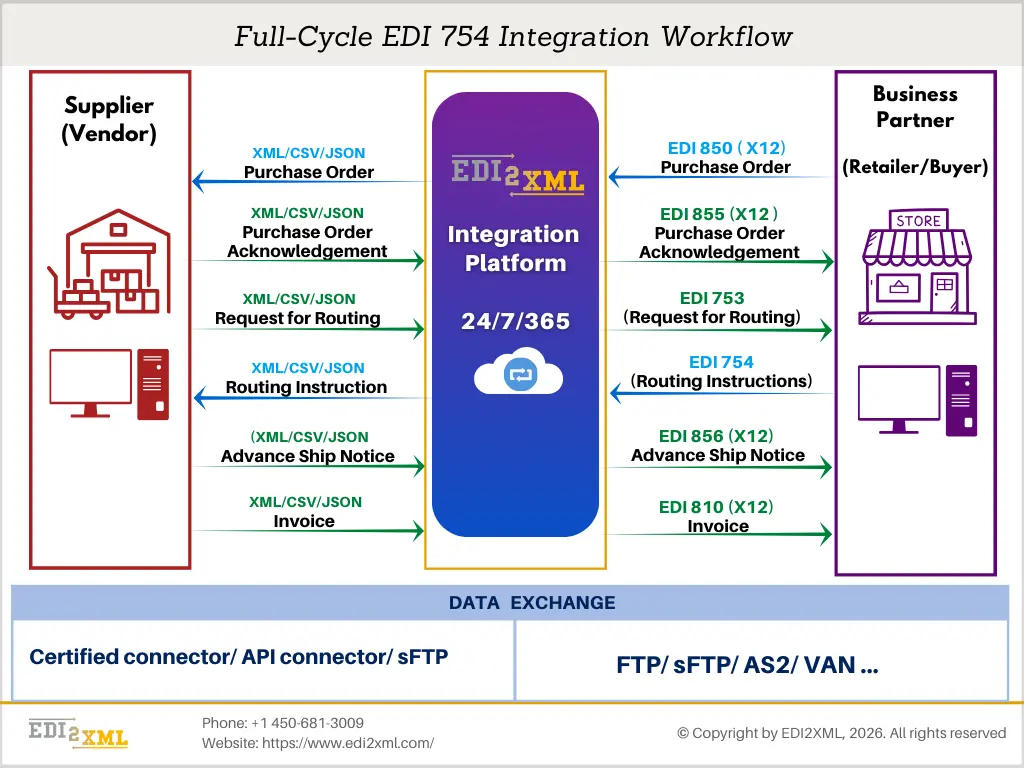
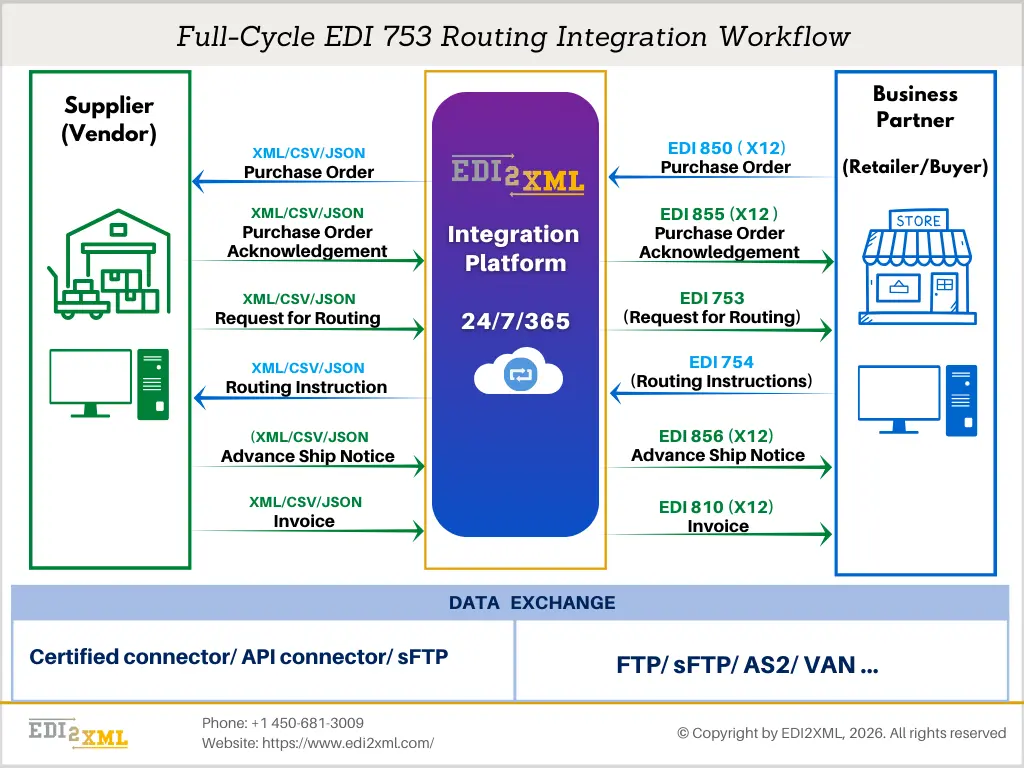
How Do EDI Documents Work Together? Diagram

Why do companies use multiple EDI documents instead of one document?

Companies use multiple EDI documents because each stage of a business transaction requires different information.

A purchase order answers:

  • What products are being ordered?
  • How many items are required?
  • When should they be delivered?

A shipment notice answers:

  • What has been shipped?
  • When will it arrive?
  • What items are included?

An invoice answers:

  • What products were delivered?
  • What amount should be paid?

Using separate documents allows businesses to automate each stage of the process while maintaining accurate information between trading partners.

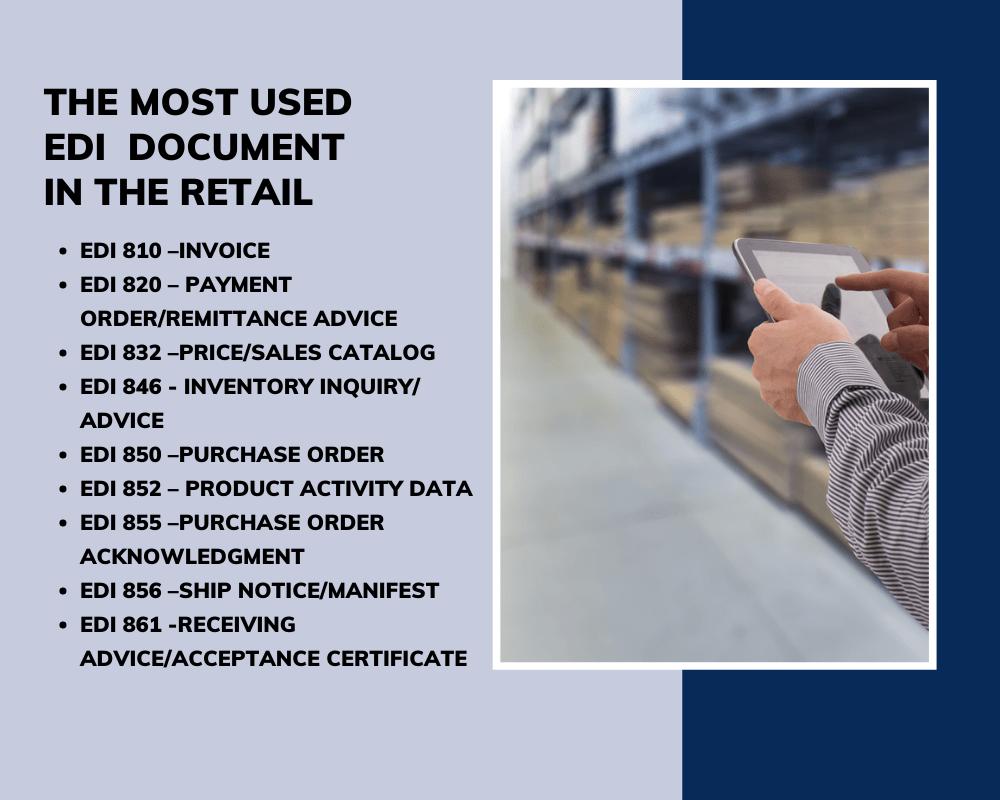
What are the most common EDI documents used by businesses?

The most common EDI documents depend on the industry and trading partner requirements. However, many businesses commonly exchange:

  • EDI 850 Purchase Order
    Used by buyers to send order information to suppliers.
  • EDI 855 Purchase Order Acknowledgment
    Used by suppliers to confirm order acceptance or changes.
  • EDI 856 Advance Ship Notice
    Used to provide shipment information before goods arrive.
  • EDI 810 Invoice
    Used by suppliers to send electronic invoices.
  • EDI 997 Functional Acknowledgment
    Used to confirm that an EDI transaction was received and processed successfully at a technical level.

EDI documents in retail

What challenges do businesses face when implementing EDI workflows?

Businesses implementing EDI often face challenges related to partner requirements, system integration, and ongoing maintenance.

Common challenges include:

  • Different requirements from each trading partner
  • Integration with existing ERP or business systems
  • Testing before exchanging live transactions
  • Maintaining connections when requirements change
  • Monitoring transactions and resolving issues

Based on experience working with businesses implementing EDI solutions, successful EDI projects require both technical configuration and a clear understanding of business processes.

Real-world example:
Every EDI implementation is different because trading partners, business systems, and document requirements vary. In our Supplies Outlet – EDI and NetSuite Integration case study, we explain how we helped automate EDI document exchange by integrating NetSuite with multiple trading partners, reducing manual processing and improving order accuracy.

Frequently Asked Questions About How EDI Documents Work Together

Do all companies use the same EDI documents?

No. EDI documents depend on industry requirements, trading partners, and business processes. One company may require purchase orders, invoices, and shipping notices, while another may require additional transaction types.

Can companies exchange EDI documents without an EDI provider?

Yes, companies can build and manage their own EDI infrastructure. However, many businesses choose an EDI provider to simplify integration, document translation, monitoring, and ongoing support.

What is the difference between EDI X12 and EDIFACT?

ANSI X12 and EDIFACT are different EDI standards used to structure electronic business transactions. X12 is commonly used in North America, while EDIFACT is widely used internationally.

Are EDI documents sent directly between companies?

EDI documents are exchanged electronically between trading partners through an EDI solution that manages communication, translation, and integration with business systems.

How Can Businesses Simplify EDI Document Exchange?

EDI document exchange involves multiple steps, including managing trading partner requirements, converting data into the correct EDI format, securely transmitting transactions, and integrating information with business systems.

For many businesses, a managed EDI service simplifies this process by providing the technology, expertise, and ongoing support needed to maintain reliable EDI connections.

Whether you need to connect with new trading partners, integrate EDI with your existing systems, or reduce the complexity of managing EDI transactions internally, an experienced EDI provider can help.

Ready to simplify your EDI document exchange?

Explore how EDI2XML’s Fully Managed EDI Service can help your business automate EDI transactions and connect with trading partners.

Free Consultation


July 9, 2026/0 Comments
https://www.edi2xml.com/wp-content/uploads/2026/07/EDI2XML-EDI-Process-Guide.webp 628 1200 Tatyana Vandich https://www.edi2xml.com/wp-content/uploads/2024/08/edi2xml.com-EDI2XML-company-logo.png Tatyana Vandich2026-07-09 13:22:182026-07-09 13:22:18How EDI Documents Work Together: A Complete Guide to the EDI Transaction Process

Wayfair EDI & API Integration Guide for Suppliers

Blog

How to Start Selling on Wayfair. EDI, API & Integration Methods Explained (Complete Supplier Guide)

Wayfair has transformed significantly over the past few years. What began as a purely online home‑goods retailer is now a multi‑channel commerce ecosystem with online sales, CastleGate fulfillment centers, and a growing network of physical Wayfair retail stores across North America.

For manufacturers, distributors, and brands, this expansion means one thing: Wayfair needs reliable suppliers and expects automated, professional integrations.

If you’re considering selling on Wayfair, the most important part of onboarding is choosing how you integrate your business systems with Wayfair (EDI – Electronic Data Interchange vs API vs Portal).

This guide explains how Wayfair’s supplier program works today, what integration methods are available, and how EDI2XML helps suppliers go live quickly and efficiently.

How Selling on Wayfair Works Today

Wayfair is not an open marketplace like Amazon or Walmart Marketplace. You cannot simply upload products and start selling. Instead, Wayfair operates a closed supplier network, where businesses must be:

  • Approved through onboarding
  • Matched to operational requirements
  • Fully integrated with Wayfair systems

Once approved, suppliers work with Wayfair through two official operational models:

1) Dropship (Direct‑to‑Consumer Model)

This is Wayfair’s primary supplier model. Wayfair sends purchase orders to the supplier, and the supplier ships directly to the end customer.

Dropship suppliers must use automated integration, typically EDI or API, to exchange:

  • Orders (EDI 850)
  • Inventory (EDI 846)
  • Shipping confirmations (EDI 856)
  • Invoices (EDI 810)

2) CastleGate Fulfillment

CastleGate is Wayfair’s warehouse and logistics network which handles the storage, picking, packing, and delivery of goods. Suppliers physically ship their products (pallets, cartons, bulk shipments) to Wayfair’s CastleGate warehouses where Wayfair stores, picks, packs, and ships orders to customers.

Integration is still done through EDI or API, with additional routing and labeling requirements.

Wayfair - EDI, API & Integration Methods Explained

Does Wayfair Have a Retail Store Supplier Program?

Many suppliers misunderstand this.

Here is the reality:

  • Wayfair has physical retail stores (Wayfair, AllModern, Joss & Main)
  • BUT there is no separate supplier onboarding model for retail stores
  • No separate integration system exists for store supply

Important clarification:

Suppliers integrate once, and Wayfair internally allocates inventory across:

  • Online store
  • CastleGate
  • Physical retail locations

Integration Methods with Wayfair

Wayfair supports three integration methods for suppliers. These determine how orders, inventory, shipping, and invoicing data flow between your systems and Wayfair.

Wayfair EDI Integration (Most Common & Recommended)

EDI remains Wayfair’s most established and widely used integration method. It is strongly recommended for most suppliers.

Wayfair supports standard EDI documents:

  • EDI 850 — Purchase Order
  • EDI 855 — PO Acknowledgment
  • EDI 856 — Advance Ship Notice
  • EDI 810 — Invoice
  • EDI 846 – Inventory Inquiry/Advice

EDI Guide

Why EDI is still dominant:

  • Fully automated order processing
  • Stable and standardized workflows
  • High-volume transaction support
  • Reduced manual errors
  • Faster invoice reconciliation

Definition:

EDI Integration (Wayfair): A standardized electronic system that automates the exchange of orders, shipping data, inventory, and invoices between suppliers and Wayfair using ANSI X12 standard.

European Alternatives: Because EDIFACT is the dominant standard in Europe and Asia, Wayfair offers alternatives for EU suppliers who do not support ANSI X12.

EDI Provider

2) API Integration (Modern & Fast-Growing)

Wayfair’s Supplier API has expanded significantly in 2025-2026.

API capabilities include:

  • Product data submission
  • Inventory updates
  • Order retrieval
  • Shipment confirmations
  • Pricing updates

API is ideal for:

  • Brands with internal development teams
  • Businesses using modern ERP or OMS systems
  • Companies needing real‑time synchronization

Limitation:

API onboarding is more technical and requires development resources.

Definition:

An API, or Application Programming Interface, is a set of rules and protocols that allows different software applications to communicate and exchange data with one another.

EDI2XML Rest API for EDI Price

3) Supplier Portal (Manual, Limited Use)

Wayfair still offers a manual Supplier Portal, but it is intended only for:

  • Very small suppliers
  • Temporary onboarding
  • Exception handling

It is not scalable and not recommended for long‑term operations.

How EDI2XML Helps You Integrate with Wayfair

EDI2XML specializes in fast, reliable Wayfair integrations, especially for companies without internal EDI or API development teams.

With over 25 years of experience in EDI integration for retail and supply chain environments, we help suppliers streamline onboarding and ensure compliance with Wayfair requirements.

Here’s how we help:

Full EDI Integration Setup for Wayfair

We support all required Wayfair EDI documents:

  • EDI 850 (Orders)
  • EDI 855 (Acknowledgments)
  • EDI 856 (ASN shipping)
  • EDI 810 (Invoices)
  • EDI 846 (Inventory synchronization)

We convert data across:

  • EDI ↔ XML ↔ JSON

Our EDI integration layer connects Wayfair workflows with leading ERP and CRM systems, including:

  • SAP
  • Microsoft Dynamics
  • NetSuite
  • JD Edwards
  • Salesforce
  • Custom ERP systems

API Integration Support

If you prefer API instead of EDI, we can:

  • Connect your ERP to Wayfair’s API endpoints
  • Automate product data, inventory, and order flow
  • Build custom connectors
  • Monitor and maintain API performance

Dropship and CastleGate Integration

Whether you ship directly to customers or send inventory to CastleGate, we handle:

  • Labeling requirements
  • ASN accuracy
  • Inventory synchronization
  • Multi‑warehouse routing

Fast Onboarding — Weeks, Not Months

Wayfair onboarding can be slow if you try to build everything yourself. With EDI2XML, suppliers typically go live in 2–4 weeks, not months.

Managed Services

Our managed services include continuous monitoring of all integration flows to ensure data integrity and operational stability:

  • EDI transactions
  • API calls
  • Processing errors and rejections
  • Inventory synchronization accuracy

This helps prevent disruptions, reduce manual intervention, and maintain consistent data exchange with trading partners.

How to Start Selling on Wayfair (Step‑by‑Step)

  1. Apply to become a Wayfair supplier
  2. Choose your integration method (EDI or API)
  3. Prepare your product catalog
  4. Complete technical onboarding
  5. Test order flow
  6. Go live and start receiving Wayfair POs

FAQ Selling on Wayfair

Do I need EDI to sell on Wayfair?

Yes, most suppliers are required to use EDI or API for automated order processing. Manual portal usage is limited and not scalable.

What EDI documents does Wayfair use?

Wayfair commonly uses:

  • EDI 850 (Purchase Orders)
  • EDI 855 (Order Confirmation)
  • EDI 856 (Shipping Notice)
  • EDI 810 (Invoices)

Can I integrate with Wayfair using the API instead of EDI?

Yes. Wayfair supports a Supplier API, but it is best suited for companies with internal technical resources or integration partners.

How long does Wayfair onboarding take?

Typical onboarding ranges from a few weeks to several months, depending on integration complexity. Managed EDI integration can reduce this to 2–4 weeks.

What is CastleGate in Wayfair?

CastleGate is Wayfair’s fulfillment network where suppliers send inventory to Wayfair warehouses, and Wayfair handles storage and delivery.

Is Wayfair an open marketplace?

No. Wayfair is a closed supplier network. Suppliers must be approved before they can sell products.

Wayfair Integration: Key Takeaways for New Suppliers

Wayfair is rapidly evolving into a multi-channel commerce ecosystem, combining online retail, CastleGate fulfillment, and physical stores.

But one thing remains constant:

Success on Wayfair depends on strong system integration – not just product listing.

For most suppliers, the most stable and widely supported option remains:

  • EDI integration

And for modern digital businesses:

  • API integration is gaining fast adoption

Ready to Integrate with Wayfair?

Whether you’re preparing for Wayfair supplier onboarding or looking to automate your existing order workflow, EDI2XML can help you implement a reliable EDI or API integration tailored to your business.

EDI2XML helps manufacturers, distributors, and brands integrate with Wayfair quickly and reliably through:

  • Fully managed EDI services
  • API integration solutions
  • Business Systems connectivity (ERP/CRM)

Our team manages the technical setup, testing, and ongoing support, so you can focus on growing your business instead of managing integration challenges.

Contact EDI2XML today to discuss your Wayfair integration requirements and get your project started.

Free EDI Consultation


June 30, 2026/0 Comments
https://www.edi2xml.com/wp-content/uploads/2026/06/EDI2XML-Wayfair-EDI-API-Integration.webp 628 1200 Tatyana Vandich https://www.edi2xml.com/wp-content/uploads/2024/08/edi2xml.com-EDI2XML-company-logo.png Tatyana Vandich2026-06-30 15:24:262026-06-30 15:24:26Wayfair EDI & API Integration Guide for Suppliers

Is EDI Required for Small Businesses? A Supplier’s Guide to Retail Onboarding

Blog

Do Small Suppliers Need EDI to Work with Major Retailers? What Businesses Should Know

Direct Answer – Yes. In most cases, major retailers and distributors require suppliers to use EDI (Electronic Data Interchange) to exchange critical supply chain documents such as purchase orders, invoices, and shipping notices.

EDI is a standardized method of digital communication used across supply chains to ensure consistent, automated, and error-free data exchange between trading partners.

Small and mid-sized businesses can meet these requirements using modern managed EDI solutions, without needing to build or maintain internal IT infrastructure.

When Do Growing Suppliers Encounter EDI Mandates?

Many growing suppliers reach a pivotal point where expanding their business depends less on finding new customers and more on entering large retail networks, distribution hubs, or major e-commerce platforms like Amazon Vendor Central and Wayfair.

At this stage, onboarding with tier-one buyers introduces a mandatory requirement: electronic document exchange EDI.

For many small and growing businesses, EDI is completely unfamiliar territory. Teams may not have internal IT departments, EDI specialists, or dedicated technical resources to support retailer onboarding.

In many cases, business owners first hear about EDI after a retailer requests it as part of the onboarding process. Suddenly, they are expected to understand technical terminology, exchange electronic documents, and meet retailer deadlines — all while continuing to run their day-to-day operations.

This is one of the reasons EDI often feels intimidating at first. The challenge is rarely a lack of willingness to adopt new technology. More often, it is a lack of internal expertise, limited resources, and uncertainty about where to begin.

USEFUL: Free Intro to EDI Guide – Download Now

Why Major Retailers Require EDI Compliance

Large retailers and distributors process thousands of transactions daily across vast supplier networks. Manual workflows, such as processing orders via email, PDFs, or manual spreadsheets, do not scale. They cause communication delays, increase operational overhead, and introduce costly data-entry errors.

EDI standardizes and automates system-to-system document exchange. To comply with most major retail networks, a small supplier must be able to handle specific EDI X12 transaction sets directly through their workflow:

  • EDI 850 (Purchase Order): Receiving orders directly into your system without typing them out.
  • EDI 855 (PO Acknowledgement): Confirming you can fill the order.
  • EDI 856 (Advance Ship Notice / ASN): Telling the retailer’s warehouse exactly what is on the truck before it arrives. Missing or misformatted ASNs are the #1 cause of heavy financial penalties (chargebacks) for small suppliers.
  • EDI 810 (Invoice): Getting paid automatically.

USEFUL: How to Get EDI-Compliant Quickly For A Large Retailer

If your data contains typos, or if you send an invoice manually, retail systems will flag it. These automated compliance errors don’t just cause delays, they result in costly chargebacks that can completely wipe out a small supplier’s profit margins.

Did a Retailer Just Drop an EDI Requirement on You? Don’t panic, and don’t spend hours trying to decode their technical PDF. Send your retailer’s guidelines to the EDI2XML team. We will review them for you for free and explain exactly what you need. Get a Free Consultation with our EDI Experts

The Typical Retailer Onboarding Pattern

Across almost all major retail integrations, a recurring pattern appears for growing businesses:

  • Approval: A supplier is successfully approved by a retailer or distributor.
  • Requirements Shared: The retailer shares technical onboarding documentation.
  • The Discovery: The supplier realizes strict EDI mandates are included in the onboarding package.
  • The Bottleneck: The supplier realizes they do not have an EDI infrastructure in place.
  • The Deadline: Implementation becomes highly time-sensitive due to rigid retailer launch deadlines.

Expert Insight: The Hidden Bottlenecks of “Going Live”

Most small business owners assume EDI is just a software plug-in. It isn’t. Setting up the connection is the easy part. The real bottlenecks that stall retail launches include:

  • Custom Data Mapping: Translating your item numbers and warehouse codes into the exact format Target or Home Depot
  • Strict Testing Windows: Passing mandatory “sandbox” testing phases required by the retailer before you are allowed to ship your first order.
  • Workflow Adjustments: Making sure your warehouse staff can print the exact pallet labels that match your EDI 856 (ASN) data.

Because a small business rarely has a dedicated IT specialist to handle this back-and-forth testing, trying to do it yourself usually leads to missed deadlines.

EDI Provider

The Real Cost of EDI: In-House Infrastructure vs. Managed Services by EDI Provider

Let’s be honest: for a growing business, any unexpected technical cost feels expensive. Traditional EDI setups, where you buy software licenses, rent servers, and hire an IT consultant, are completely out of reach for most SMBs.

Fortunately, businesses have long moved away from managing EDI entirely in-house and now rely on EDI service providers.

Instead of building your own infrastructure, you outsource the entire process. The comparison is simple:

Factor Doing It Yourself (In-House) Fully Managed EDI (Outsourced)
IT Staff Needed Requires an EDI specialist or developer None. The partner handles everything
Upfront Cost High (Software, hardware, setup) Low predictable fee
Testing & Mapping You do the trial-and-error with the retailer Partner uses pre-built maps for fast approval
Risk of Financial Penalties High if your staff makes a data-entry error Minimized. Automated validation stops errors

For small suppliers using accounting software like QuickBooks Online or scaling up to an ERP like NetSuite or SAP, a managed service integrates seamlessly in the background. Your team keeps working in the software they already know, while the EDI partner handles the translation.

Common EDI Deployment Models and Service Options

Usually, EDI deployment options generally fall into several widely used models, depending on a company’s size, technical resources, and integration needs.

In practice, many businesses work with an established EDI provider that offers multiple service models rather than a single rigid solution. For example, providers such as EDI2XML, with more than 25 years of experience in EDI integration and managed services, support different deployment approaches to accommodate both small suppliers and large enterprises.

Common service models include:

Fully Managed EDI Services

A fully managed approach where the provider handles the complete EDI lifecycle, including mapping, translation, testing, monitoring, and ongoing compliance with trading partner requirements.
This model is often used by companies that do not have internal EDI or IT resources and prefer to outsource operational complexity.

Infographic of an integration platform linking industries (left) to enterprise systems (right) with data formats (SQL Server, XML, CSV, JSON, TXT) below.


EDI Web Portal for Small and Mid-Sized Businesses

A browser-based solution designed for companies without ERP systems or with limited technical infrastructure.

Users can manually create, view, and manage EDI transactions through a secure web interface, making it suitable for smaller trading volumes or gradual onboarding scenarios.

Web portal EDI

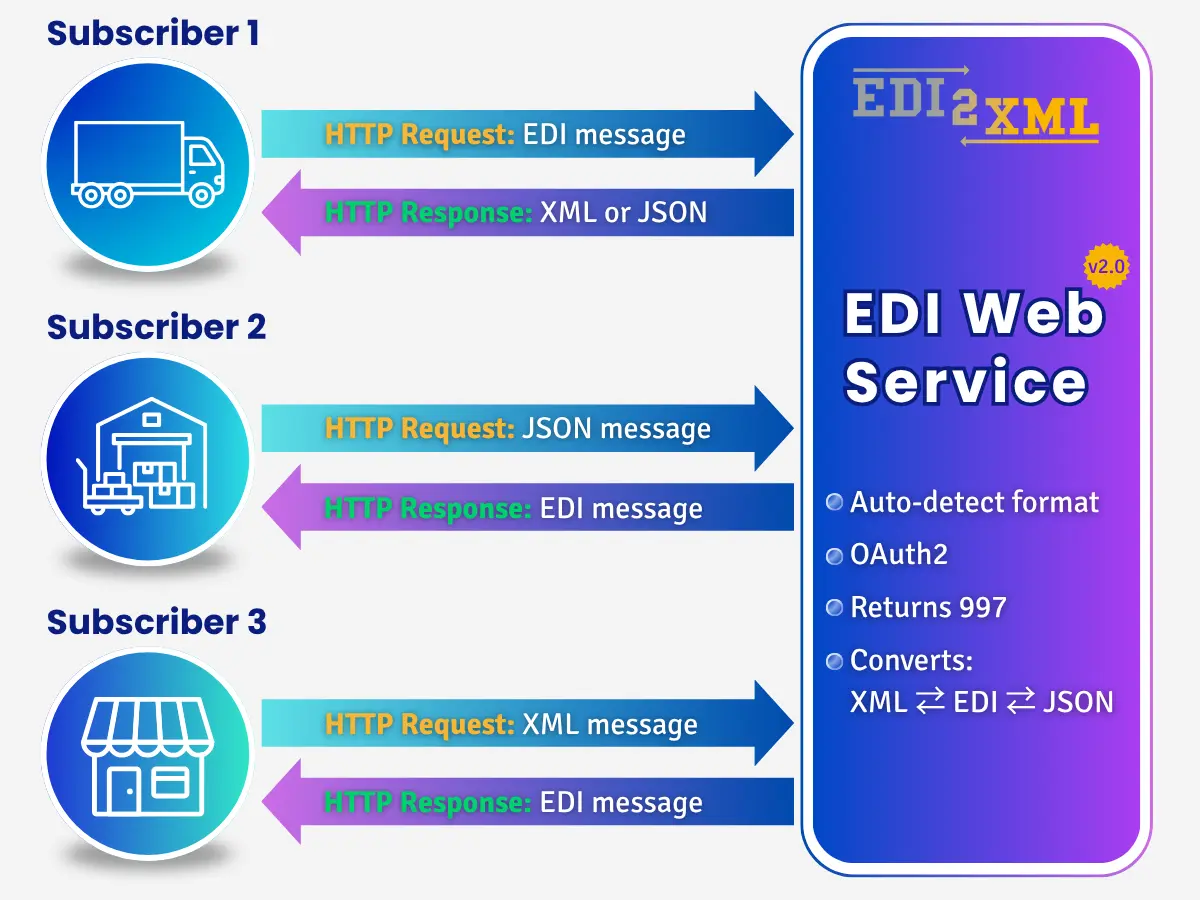
EDI Web Service (REST API)

A modern API-based integration model that connects EDI processes directly with internal systems such as ERPs, accounting platforms, or warehouse management systems (WMS).

Getting started with the EDI2XML Web Service is very simple and quick. Within less than an hour, you can issue the first Call to the Web Service and see the response. Our Web Service is very well documented, and instructions are provided with each subscription.

REST API diagram

On-Premises / EDI2XML Service Deployment

For organizations that require full control over infrastructure, EDI can also be deployed on-premises within their own environment. This model supports custom security policies, internal hosting requirements, and deeper system-level integration.

The most suitable approach depends on several operational factors, including transaction volume, number of trading partners, internal system maturity, available technical expertise, and retailer onboarding timelines.

For many growing suppliers, the key decision is not only technical architecture, but operational simplicity. In these cases, managed EDI services are often chosen to reduce internal workload while maintaining compliance with retailer requirements.

Stop Guessing: What You Actually Need to Know Before You Start with EDI

If you are talking to an EDI provider, don’t let them confuse you with technical jargon. You only need to know three things:

  • Who is the retailer? (Onboarding with Walmart is different from onboarding with Wayfair).
  • What systems do you use? (Do you run on QuickBooks, a basic warehouse system, or just spreadsheets?)
  • What documents do you need to exchange (Order, Invoice, ASN)?

You don’t need to master the technology. Your job is to make your product and fulfill the orders; the technology should adapt to you, not the other way around. An experienced EDI provider can take care of the rest.

Common Misunderstanding About EDI

A frequent misconception among business leaders is treating EDI purely as an isolated IT project.

In reality, EDI is a supply chain process alignment exercise that uses technology as its execution layer. The technical implementation is only one piece of a broader operational integration between two separate business ecosystems. Success requires looking at how data flows from an incoming order all the way to final delivery and invoicing.

Business Impact Beyond Retailer Compliance

While most small businesses introduce EDI solely because a major retailer mandates it, automation yields significant long-term internal operational benefits.

As transaction volumes scale up, businesses leveraging automated EDI workflows consistently report:

  • Drastically reduced manual data entry
  • Fewer order processing and shipping errors
  • Faster, more predictable invoicing and payment cycles
  • Enhanced shipment and inventory visibility
  • Elimination of operational bottlenecks during peak seasons

What begins as a strict compliance checkbox ultimately transforms into a core operational efficiency that protects your business margins.

Is EDI Strictly Required to Work With Major Retailers, Or Can I Use An API?

The short answer is: retailers require automated document exchange, but the method – EDI or API – depends on the specific retailer and the program you’re operating under.

Traditional big-box retailers like Walmart and Costco strictly mandate classic EDI protocols with no manual alternative. If you want to sell to Walmart, EDI compliance is non-negotiable from day one. The picture is more nuanced for e-commerce platforms:

  • Wayfair supports both traditional EDI and a modern REST API, but which one you’ll use depends on your specific supplier program (for example, CastleGate dropship programs typically use EDI, while marketplace suppliers may use the API).
  • Target requires EDI for store vendors, but third-party sellers on Target.com use API-based integration instead.
  • Amazon operates two separate models. If you’re a wholesale supplier on Vendor Central (1P), EDI remains mandatory for purchase orders, invoices, and ship notices — there is currently no general opt-out. If you sell directly to consumers through Seller Central (3P), Amazon’s Selling Partner API (SP-API) is the primary integration path.

The takeaway for your business: the question isn’t simply “EDI or API” – it depends on which retailer you’re working with and under which program. In many cases, especially if you operate across both wholesale and marketplace channels, you may need both.

EDI Providers like EDI2XML typically act as a translation and integration layer between internal business systems and external trading partners.

For example, when a retailer such as Walmart sends a purchase order in ANSI X12 EDI format, the EDI provider translates and maps that document into a structured format compatible with the supplier’s internal systems, such as an ERP or order management system. This allows the business system to process the order without needing to understand EDI standards directly.

When the supplier generates an invoice or shipping confirmation from their internal system, the EDI provider performs the reverse process — converting the structured data back into the required X12 format and transmitting it to the retailer through the appropriate communication channel (such as AS2, VAN, or API-based exchange, depending on the trading partner’s requirements).

The same principle applies to API-based integrations. In cases where a retailer uses REST APIs instead of traditional EDI formats, the integration provider manages the connection layer, ensuring that internal systems can exchange data with external platforms without needing to natively support each individual protocol or format.

Read Case Study: How CIEL Book Distribution Automated 26M+ Amazon Records Using EDI2XML API Integration

Frequently Asked Questions (FAQ)

What is EDI, and why do retailers require it?

EDI (Electronic Data Interchange) is a standardized method for exchanging business documents such as purchase orders, invoices, and shipping notices between companies. Retailers require it to automate and standardize high-volume supply chain transactions.

Can small businesses realistically implement EDI?

Yes. Modern cloud-based and fully managed EDI solutions are specifically engineered to give small and mid-sized suppliers the exact same compliance capabilities as enterprise corporations, without the need for an in-house IT team.

Can EDI operate without an ERP system?

Yes. Suppliers can manage EDI transactions via web-based portals without an ERP/CRM system.

How long does it take to get compliant with a major retailer?

If you try to do it in-house, it can take months of failed testing cycles. With a fully managed partner who already knows the specific routing rules for companies like Target or Amazon, onboarding typically takes just a few weeks.

What documents are typically required in EDI?

Common documents include purchase orders (EDI 850), invoices (EDI 810), advance ship notices (EDI 856), and order acknowledgements (EDI 855).

Can EDI integrate with existing business systems?

Yes. EDI can connect with ERP systems, accounting platforms, warehouse systems, or operate independently through web portals or managed services.

Can a business without technical staff manage EDI long-term?

Yes. Many suppliers rely on managed EDI services where ongoing monitoring, troubleshooting, and compliance are handled externally, allowing internal teams to focus on operations.

Is EDI a one-time setup or an ongoing process?

EDI is not a one-time implementation. It requires ongoing monitoring, updates, and adjustments as retailers change requirements or introduce new document types.

What is the difference between EDI and API integration?

EDI and API are both methods for automating data exchange with retail partners, but they serve different contexts. EDI uses standardized batch documents (like X12 purchase orders and invoices) transmitted over protocols such as AS2 — it’s required by most big-box retailers like Walmart and Target. API integration is real-time and more flexible, typically used by e-commerce platforms like Amazon Seller Central. In many cases, suppliers need both depending on which retailers they work with.

The Bottom Line: EDI Is Now a Standard Business Requirement

EDI is no longer a specialized technology reserved for large enterprises. It has become a standard business requirement in modern supply chains, where retailers and distributors expect suppliers to exchange information electronically.

For growing suppliers, the question is no longer whether EDI is necessary, but how quickly they can implement a solution that supports future growth instead of delaying retailer onboarding.

Streamline Your Retailer Integration with EDI2XML

Navigating complex retailer mandates, strict mapping rules, and tight onboarding deadlines can overwhelm internal teams. At EDI2XML, we specialize in fully managed EDI integration and seamless trading partner connectivity.

We handle the entire technical lifecycle—from initial data mapping and mandatory retailer testing to continuous transaction monitoring—so you can focus on scaling your business. Whether you need to connect to your very first major retail partner or integrate EDI directly with your existing business systems, we ensure you achieve fast, reliable, and hassle-free compliance.

Schedule Your Free EDI Integration Assessment Today

Free EDI Consultation


June 17, 2026/0 Comments
https://www.edi2xml.com/wp-content/uploads/2026/06/EDI2XML-EDI-for-small-business.webp 628 1200 Tatyana Vandich https://www.edi2xml.com/wp-content/uploads/2024/08/edi2xml.com-EDI2XML-company-logo.png Tatyana Vandich2026-06-17 19:02:102026-07-06 13:47:18Is EDI Required for Small Businesses? A Supplier’s Guide to Retail Onboarding

How to Meet Loblaw EDI Requirements as a Small Business

Blog

From DTC to Loblaw Shelves: How Bad Korean Solved EDI Without an IT Team

Small companies often run successfully on e-commerce and lightweight operational tools until they begin working with major retailers. At that point, retailers like Loblaw introduce strict requirements for data exchange, including EDI workflows for orders and invoices.

The product is usually not the issue. The gap is operational readiness for retail integration.

Bad Korean represents a typical case of this shift from direct-to-consumer operations to structured retail onboarding.

With more than 25 years of EDI project experience, our team at has seen this pattern from many angles. For a scaling brand, it is completely normal not to have a massive IT department, an in-house EDI specialist, or a complex ERP stack, and frankly, you shouldn’t need them.

That’s why EDI2XML handles the entire technical heavy lifting. We operate not just as an EDI provider, but as an extension of your IT team.

When Bad Korean needed a way to meet Loblaw’s EDI requirements, process EDI 850 Purchase Orders, and send EDI 810 Invoices while keeping operations lean, they turned to a fully managed EDI solution that eliminated the need for internal EDI infrastructure and specialized technical resources.

Why Small Companies Struggle to Start Selling to Major Retailers

A startup that sells direct-to-consumer can run on simple tools for a long time. A brand may use QuickBooks, spreadsheets, email, and a lightweight warehouse process. That works until a large retailer enters the conversation.

When you look to place your products on the shelves of major retailers like Loblaw, Walmart, Costco, or Sobeys, having a great product is only half the battle. These giants operate on a strict requirement called EDI (Electronic Data Interchange).

USEFUL: Free Intro to EDI Guide – Download Now

Thus, these giants require EDI – a digital system for automatically exchanging business documents like purchase orders, invoices, shipment confirmations and more. No emails, no PDFs. Most major retailers require EDI compliance as part of onboarding, which makes it a functional requirement for most suppliers.

The good news? You don’t need to hire IT specialists or build a complex system. Most small businesses use an EDI provider, a service that handles the technical side for you.

Another common worry: small companies see the price tags of the big American EDI providers that major retailers use (e.g., Loblaw or Walmart) and assume EDI is too expensive. But you don’t have to use the same provider. Independent EDI providers, such as EDI2XML, offer more affordable solutions and better pricing specifically for small companies.

With the right EDI provider, even a one-person operation can meet the retailer’s EDI requirements.

USEFUL: How to Choose the Right EDI Provider for Your Small or Medium Business

Case Study: Bad Korean + Loblaw

Bad Korean faced operational constraints common among growing brands:

  • No internal EDI system for structured document exchange
  • No ERP system connected to retail workflows
  • No EDI specialists on the team
  • Needed to process inbound purchase orders in EDI 850 format
  • Needed to generate compliant EDI 810 invoices

This is where many small companies stall. They either delay retail expansion or accept a solution that is heavier than they need.

What Bad Korean Needed

Bad Korean needed a solution that could do several things at once:

  1. Receive EDI 850 Purchase Orders from Loblaw
  2. Transform them into a usable workflow visible in a simple browser‑based interface
  3. Support shipping label generation matching retailer expectations
  4. Create and transmit EDI 810 Invoices
  5. Keep the process manageable for a small team that cannot spend its day inside an integration console

The Solution (Without an IT Department)

A fully managed EDI solution with a web portal gave Bad Korean a central workspace for document handling, order visibility, and outbound processing – all through a browser.

  • No software installation.
  • No need to build an internal EDI department first.

The portal became the operational hub:

  • Inbound purchase orders are received and reviewed within a clear interface
  • Staff managed the workflow from one place
  • Outbound invoices are created through web forms, then translated and transmitted in the correct EDI format
  • Retailer‑specific document rules are handled behind the scenes

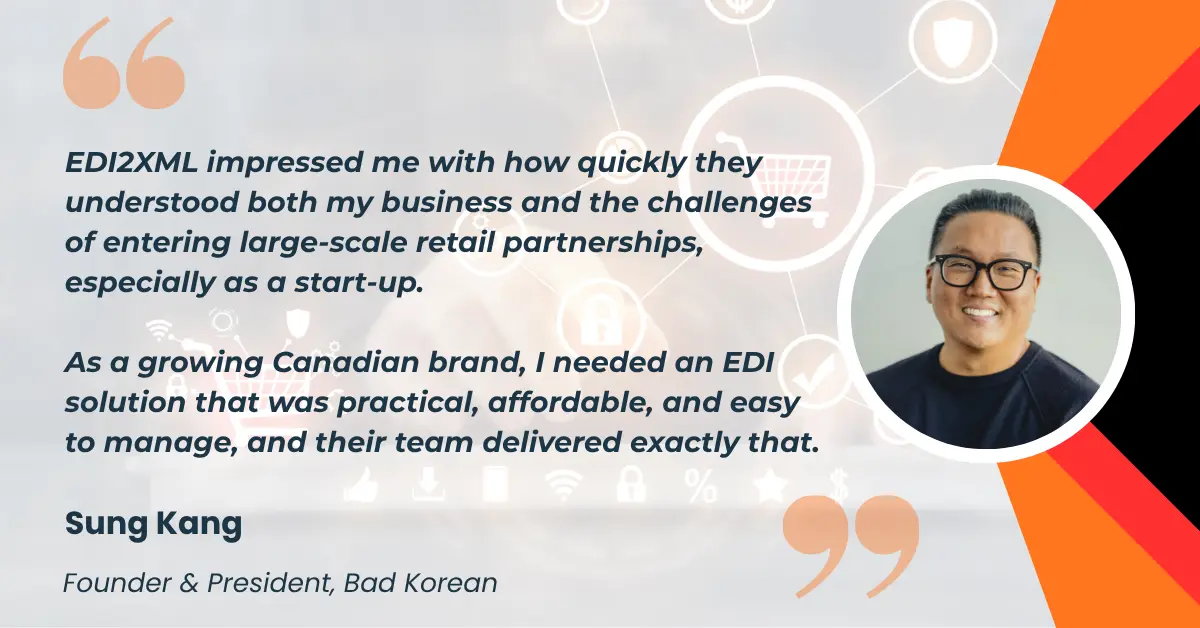
EDI2XML clients testimonial

Small companies need usable systems, not abstract integration promises. Someone has to answer the purchase order, prepare the shipment, generate the label, issue the invoice, and know the document will land in the right format. Bad Korean gained that capability without turning the business into an IT project.

How Managed Cloud EDI Supports Retail Compliance

The EDI2XML platform automatically retrieves inbound EDI 850 Purchase Orders from the trading partner mailbox on a scheduled basis. Documents are validated, transformed, and made visible in the portal.

When a functional acknowledgment is required, the system can generate and transmit the EDI 997 response. That keeps the transaction cycle clear and controlled.

For outbound activity, the portal supports shipping label generation and EDI 810 Invoice creation. Bad Korean can review the order, enter the required fulfillment and billing details, and send the data through a workflow designed for retail trading.

EDI Web Portal

Why Loblaw Is a Meaningful Target for Growing Brands Like Bad Korean

Loblaw matters because it represents the kind of retail partner that can change a brand’s trajectory. A supplier that earns a place in a major Canadian retail chain gains more than sales volume. It gains credibility, distribution reach, and a stronger platform for growth.

That opportunity comes with operational expectations. EDI is part of the price of entry. For a small company, this can feel like a barrier. For a prepared company, it becomes a competitive advantage.

Bad Korean approached the challenge with the right mindset. The business wanted a solution that would let it work with a major retailer while staying lean. EDI2XML delivered a path that matched that stage of growth. The result was retail readiness without forcing the company into a large and expensive infrastructure project.

This is the part many small brands miss. Retail onboarding is not only a technical task. It is a business decision. The integration model affects cash flow, fulfillment speed, staffing, compliance risk, and how much time the team spends on operations instead of growth. The right EDI partner can keep those pressures under control.

Why Small Companies Choose EDI2XML For Retail Integration

Bad Korean chose EDI2XML for reasons that come up often with small and mid-size brands.

The first reason is simplicity. A browser-based portal is easier to adopt than a heavy internal system. The team can work inside a workflow that fits the business as it grows.

The second reason is cost structure. EDI2XML offers Canadian-dollar billing and a subscription model that fits the Canadian market. For a growing Canadian company, that is a practical advantage. Budgets stay easier to plan, and the pricing model is aligned with a smaller business reality.

The third reason  is support. Small companies need clear language, fast answers, and a partner that can explain the process without turning every discussion into technical noise. Bad Korean needed a team that understood retail onboarding and could make the path feel manageable. That is the kind of work we do every day.

The fourth reason is experience. With more than 25 years in EDI projects, our team has worked across many trading relationships, document types, and operating models. That experience matters when a brand needs more than software. It needs judgment. It needs a partner that can identify the leanest workable solution and keep the implementation focused on business results.


“When evaluating EDI partners, I was intentional about finding a Canadian alternative to the large US-based providers that dominate the space. Beyond the practical preference for working in Canadian dollars, I needed a partner that would take a small startup seriously, one that recognized that every business begins somewhere and that sustainable growth takes time. Without an IT department or a technical background to draw on, it was equally important to find a team that could translate complex EDI concepts into clear, approachable language from day one.

EDI2XML provided a professional, fast, and highly supportive experience while offering excellent value. Their team made enterprise retail integration accessible without unnecessary complexity, and I truly appreciated their commitment to supporting a Canadian business like mine. ”

Sung KangFounder & President–Bad Korean

Business Outcomes for Bad Korean

Bad Korean came into the project with a clear goal: meet Loblaw’s requirements and keep the company’s internal workload under control. The result was a managed cloud EDI environment that supported purchase order handling, invoice transmission, shipping label generation, and retailer compliance.

That created several benefits for Bad Korean.

The company reduced technical overhead because there was no need to build internal EDI infrastructure. It improved workflow efficiency because purchase orders and invoices moved through a centralized portal. It strengthened compliance because document formatting and acknowledgments were handled consistently. It also created a foundation for future expansion, which matters a great deal for a brand that expects to add more retail partners later.

This is the real value of the Bad Korean case. The project shows how a small company can step into a large retail environment without losing operational control. It also shows that retail readiness is achievable long before a business feels “enterprise-sized.”

How Small Brands and Startups Can Meet Retail EDI Requirements (Without an IT Team)

Bad Korean is one example, but the pattern is much bigger.

Small brands, consumer packaged goods (CPG) companies, and fast-growing startups often have the same problem. They have a product that is ready for retail. They have a retailer that is ready to buy. The missing piece is the integration layer that connects the two sides cleanly.

That is where an experienced EDI Provider creates leverage, letting a company work with major retail partners like Loblaw while keeping systems light. Teams can process EDI 850 Purchase Orders, issue EDI 810 Invoices, and manage retail trading requirements without building a full technical department first.

Book your Free Consultation with Integration expert

Why The Right EDI Partner Matters for Small Brands (Bad Korean Case Study)

Bad Korean shows what is possible when a growing brand gets the right EDI setup at the right time.

What made it work:

  • Simplicity: A browser‑based portal is easier to adopt than a heavy internal system
  • Cost structure: Different dynamic monthly service packages, to satisfy all data volume and number of EDI transactions per month.
  • Support: Clear language, fast answers, no technical noise
  • Experience:  25+ years across many trading relationships and document types

Small companies do not need to wait until they become large to work with major retailers. They need a partner that understands retail integration, protects their time, and turns complex EDI requirements into a workflow they can actually run.

If your brand is preparing to work with Loblaw or another major retailer, the integration model you choose will shape how fast you grow and how much operational strain you carry. Bad Korean chose a path that supports scale, compliance, and control.

Ready To Start Your Retail Journey?

Contact us for a free EDI consultation with our experts. Let us show you how an experienced EDI provider like EDI2XML can help your small brand meet major retailer requirements without breaking your budget or your team.

FAQ: Bad Korean, Loblaw, And Retail EDI Integration

Can a small company work with Loblaw without a full EDI department?

Yes. Bad Korean is a good example. A small brand can work with a major retailer when it has a managed EDI partner that handles document translation, routing, and compliance.

Do you need an ERP system to onboard with a retailer like Loblaw?

No. Some businesses use ERP systems, while others succeed with a lighter setup. Bad Korean used a cloud-based portal that fit its stage of growth and did not require a heavy internal system.

Which documents matter most in retail EDI?

For this type of retail workflow, EDI 850 Purchase Orders and EDI 810 Invoices are central. EDI 856 Advance Ship Notices and EDI 997 Functional Acknowledgments can also be part of the process, depending on partner requirements.

Why are managed EDI services useful for startups?

Because it removes a large amount of technical work from the internal team. A startup can focus on sales, operations, and fulfillment while the EDI provider manages the integration layer.

How does EDI2XML help Canadian companies specifically?

EDI2XML supports Canadian businesses with a practical, managed approach, CAD billing, and a service model designed for smaller teams that need retail compliance without enterprise overhead.


Free EDI Consultation

June 4, 2026/0 Comments
https://www.edi2xml.com/wp-content/uploads/2026/06/EDI2XML-Loblaw-EDI-Integration.webp 628 1200 Tatyana Vandich https://www.edi2xml.com/wp-content/uploads/2024/08/edi2xml.com-EDI2XML-company-logo.png Tatyana Vandich2026-06-04 14:05:462026-06-11 11:16:05How to Meet Loblaw EDI Requirements as a Small Business

EDI in E-Commerce and Retail: Why Modern Commerce Still Depends on EDI

Blog

The Invisible Infrastructure Powering Modern Commerce: Why EDI Still Matters in an AI-Driven World

While businesses race to adopt AI and next-generation automation, the technology quietly keeping every order accurate, every shipment on time, and every supply chain synchronized is decades old, and more critical than ever.

There is a certain kind of infrastructure that earns no headlines. You do not see it in conference keynotes or venture capital announcements. Nobody posts about it on LinkedIn with words like “disruptive” or “game-changing.” And yet without it, the Amazon package that arrived at your door yesterday would still be sitting in a warehouse, waiting. The groceries restocked overnight on a Tuesday would be missing from the shelf by Wednesday afternoon. The purchase order your retailer sent to your supplier on Monday morning would have disappeared into someone’s inbox, unprocessed and unacknowledged.

That infrastructure is Electronic Data Interchange (EDI), and it has been running the operational backbone of global commerce for a long time before the internet made everything feel instant. Today, as businesses invest heavily in artificial intelligence, warehouse robotics, same-day delivery networks, and omnichannel retail platforms, the conversation around EDI deserves a fresh and honest look. Not because EDI is in danger of becoming obsolete, but because the opposite is true: the more sophisticated commercial ecosystems become, the more they depend on the structured, reliable, standards-based communication that EDI provides.

This is not a nostalgic argument for old technology. It is a practical one.

The Speed Economy and Its Hidden Requirements

E-commerce has fundamentally changed what buyers expect, and those expectations are now reshaping the entire supply chain from manufacturer to doorstep. According to Forbes Advisor, the e-commerce market is expected to total over $7.9 trillion, by 2027. Marketplaces like Amazon, Walmart Marketplace, Target Plus, and Shopify-powered storefronts now connect millions of sellers with hundreds of millions of buyers across every product category imaginable.

The commercial promise of this era is speed. Same-day shipping. Two-hour grocery delivery. Real-time inventory visibility. Automated replenishment. These capabilities feel like pure technology stories, artificial intelligence predicting demand, robotics picking and packing, algorithms routing shipments. And those systems do matter enormously.

But here is the operational reality that often gets overlooked: none of those downstream capabilities function reliably without accurate, structured data flowing upstream. A warehouse robot cannot pick an order that was never confirmed. A demand forecasting algorithm cannot optimize inventory it cannot see. A fulfillment center cannot ship a product it received no advance notice of. Every technology layer in modern commerce depends on clean, timely, standardized business data, and that is precisely what EDI delivers.

The phrase “garbage in, garbage out” has been a computing axiom for fifty years. In retail and supply chain operations, bad data does not just produce bad outputs – it produces costly ones. Chargebacks from retailers. Delayed shipments. Compliance failures. Inventory discrepancies. Customer service failures. These are not abstract risks; they are line items that erode margins at exactly the moment businesses are trying to grow.

Integration price

What EDI Actually Does — and Why Replacing It Is Harder Than It Sounds

EDI is, at its core, a standardized method for exchanging business documents electronically between trading partners. Instead of a buyer emailing a purchase order as a PDF attachment and a supplier manually entering that data into their own system, EDI automates the entire exchange – machine to machine, in a standardized format both systems understand, with documented acknowledgment of receipt.

The formats ANSI X12 in North America, EDIFACT internationally, and various retail-specific adaptations represent decades of industry consensus about how business documents should be structured. That standardization is not bureaucratic overhead. It is the reason a mid-size apparel brand can trade electronically with Target, Costco, Amazon, and thirty regional retail chains simultaneously, each with its own internal systems, without writing custom software for every single relationship.

The Core EDI Documents That Keep Commerce Moving

Most businesses outside the supply chain industry underestimate how many distinct document types flow through a typical retail or distribution relationship. The table below shows some of the most common EDI transaction sets and what they actually accomplish in practice:

EDI Transaction Document Type What It Does
EDI 850 Purchase Order Retailer sends a structured order to a supplier – item numbers, quantities, ship-to locations, price expectations, and delivery windows.
EDI 855 Purchase Order Acknowledgment Supplier confirms receipt and acceptance of the PO, noting any discrepancies or changes before fulfillment begins.
EDI 856 Advance Ship Notice (ASN) Supplier notifies the retailer exactly what is being shipped, how it is packaged, and when it will arrive — enabling receiving dock preparation and system pre-receiving.
EDI 810 Invoice Structured billing document sent supplier to buyer, enabling automated three-way matching against the PO and ASN to accelerate payment.
EDI 846 Inventory Inquiry / Advice Shares real-time or scheduled inventory levels between trading partners — essential for drop-ship programs, VMI, and demand planning.
EDI 820 Payment Order / Remittance Communicates payment details, enabling automated cash application on the supplier side.
EDI 214 Transportation Carrier Shipment Status Provides structured shipment tracking updates from carriers to shippers and receivers.
EDI 753 / EDI 754 Request for Routing / Routing Instructions Coordinates carrier selection and routing approvals between supplier and retailer logistics teams.
EDI 997 Functional Acknowledgment Confirms that a transmitted EDI document was received and syntactically valid — the handshake that closes the loop on every transaction.

Taken together, these documents represent the operational nervous system of a retail supply chain. They are not forms to be filled out — they are automated signals passed between systems, enabling fulfillment, payment, inventory management, and logistics coordination to happen at machine speed rather than human speed.

No API call to a generative AI model replaces this. No no-code automation platform solves the problem of a retailer that requires EDI 856 compliance before accepting a shipment. No chatbot accelerates payment cycles the way automated three-way matching of an EDI 810, 850, and 856 does. These are not comparable tool categories – they operate at different layers of the business stack.

AI, Automation, and Why Foundational Data Infrastructure Matters More Than Ever

The current wave of AI adoption in business is genuine and significant. Supply chain teams are using machine learning to improve demand forecasts. E-commerce operators are deploying AI-driven personalization engines. Logistics companies are using predictive analytics to optimize routing and reduce fuel costs. Retailers are experimenting with generative AI for product descriptions, customer service automation, and inventory scenario planning.

None of this is hype. These tools are creating real value. But organizations implementing AI across their supply chain and commerce operations are discovering a consistent bottleneck: the quality and structure of their underlying business data. AI models are only as useful as the data they can access and learn from.

Businesses that invested in reliable EDI infrastructure — clean, structured, machine-readable transaction data flowing between systems automatically — are in a fundamentally better position to extract value from AI and analytics investments. Their order data is accurate the moment it arrives. Their inventory numbers reflect real-time movement. Their financial data can be reconciled automatically. The AI has good inputs to work with.

Omnichannel Retail, Drop-Shipping, and the Complexity EDI Was Built to Handle

One of the defining commercial trends of the past five years is the expansion of omnichannel retail – the expectation that a product available in a physical store is also orderable online for home delivery, available for curbside pickup, shippable from a third-party supplier’s warehouse, and trackable at every step. Meeting this expectation operationally is far more complicated than it appears from the customer side.

Drop-shipping programs illustrate the challenge well. When a retailer adds a new vendor to its drop-ship program, that supplier is now responsible for receiving individual consumer orders directly, picking and packing them to retail standards, shipping them with the retailer’s branding, and transmitting shipment confirmations back to the retailer in time for the customer-facing order status to update. All of this must happen reliably, at volume, with minimal human involvement on either side.

This is an EDI problem. The retailer sends an EDI 850 to the supplier for each drop-ship order. The supplier acknowledges with an EDI 855. When the order ships, the supplier transmits an EDI 856 with tracking information. The retailer’s system ingests that ASN, updates the customer order record, and triggers a shipping notification email — all automatically. The EDI 810 invoice follows, gets matched against the original PO, and payment is issued without a human touching a piece of paper.

Scale this to tens of thousands of daily transactions across hundreds of vendors, and the value of standardization becomes immediately obvious. Manual processes collapse under this volume. Proprietary integrations between every retailer-supplier pair would require enormous ongoing engineering resources. EDI – specifically because it is standardized – is what makes large-scale omnichannel and marketplace operations manageable.

Operational requirements EDI addresses in modern omnichannel retail

  • Automated order transmission from retailer ERP to supplier system — no manual intervention required.
  • Supplier order acknowledgment within defined SLA windows, reducing fulfillment ambiguity.
  • Advance Ship Notices enabling dock-ready receiving and automated inventory updates on arrival.
  • Structured invoice matching to eliminate manual processing and accelerate payment cycles.
  • Real-time or scheduled inventory feeds supporting in-stock accuracy on product detail pages.
  • Shipment status updates are flowing into customer-facing tracking systems without human relay.
  • Retailer compliance requirements – ASN timing, label specifications, carton content data – enforced through EDI transaction rules.

How the EDI Industry Itself Has Modernized

EDI has not become simpler; it has become more flexible in how it is delivered and managed.

The technical foundations remain the same: structured standards, strict data formats, and precise mapping between trading partners. These requirements have not changed, because they are what make reliable large-scale business communication possible.

What has changed is how businesses access and operate EDI. Instead of every company having to manage all technical and operational aspects internally, experienced EDI providers now offer different service models that distribute and abstract this complexity in practical ways.

This shift has made EDI more adaptable to different types of organizations, from enterprise retailers with complex integrations to smaller suppliers entering regulated retail ecosystems for the first time.

Today, the focus is less on how EDI is built and more on how it is consumed.

HTTP EDI Web Service (REST API)

An HTTP-based EDI Web Service is a simple way to exchange EDI data using standard API calls. It allows systems to send and receive EDI documents (such as orders, invoices, and shipping notices) through REST requests over HTTP.

The service automatically converts data between EDI, XML, and JSON formats, so applications can interact using modern data structures while still communicating in standard EDI formats with trading partners.

USEFUL: Try EDI2XML Web Service risk-free for 15 days. Test how easily you can translate and exchange EDI and XML messages without any commitment.

API-Converter for EDI XML and JSON

Fully Managed EDI Services

For many businesses – particularly growing brands, mid-market distributors, and suppliers entering new retail channels – maintaining an in-house EDI team is neither practical nor cost-effective. The managed EDI service model addresses this directly.

Fully Managed EDI Services allow businesses to become EDI-compliant without managing EDI internally. The provider handles setup, trading partner onboarding, mapping, document conversion, communications, and ongoing support.

This model is ideal for companies that need reliable EDI exchange with retailers or partners but prefer to avoid the technical complexity, time, and cost of running EDI themselves.

EDI Web Portals for Businesses Without ERP or EDI Infrastructure

Not every supplier has a sophisticated ERP system. Smaller vendors, startups entering the retail channel, and businesses in categories where enterprise software adoption has been slower may have no EDI infrastructure whatsoever, and no realistic path to implementing one in the traditional sense.

Web portal-based EDI solutions address this segment specifically. These platforms allow a supplier to log into a web interface, view incoming purchase orders from their retail partners, confirm orders, generate ASNs, and submit invoices — all through a browser, without any EDI software installed locally and without any system-to-system integration required on the supplier side. The portal handles the EDI translation and transmission behind the scenes.

This approach is not a workaround or a compromise — it is a legitimate, widely-used access model that allows businesses of varying technical maturity to participate in EDI-mandated retail relationships without being locked out by infrastructure costs or complexity.

Get demo of EDI web Portal

Retailer Compliance Is Not Optional – and Neither Is EDI

One dimension of this conversation that deserves plain-language treatment is the reality of retailer mandates. Major retailers — Walmart, Target, Home Depot, Costco, Amazon Vendor Central, and many others — do not merely prefer EDI-enabled suppliers. They require it. Compliance specifications run to hundreds of pages. Transaction format requirements, transmission timing windows, label specifications, ASN accuracy rates, and invoice formatting standards are all codified and enforced through chargeback programs.

A supplier that cannot produce a compliant EDI 856 within the retailer’s required timeframe after shipment will receive a chargeback against their invoice, sometimes substantial. A supplier whose ASN carton counts do not match the physical shipment will face compliance fees. A supplier that consistently submits malformed or late EDI transactions risks losing their vendor relationship with the retailer entirely.

This is not a technology conversation. It is a business relationship conversation. EDI compliance is a condition of doing business at scale in modern retail. Businesses that treat it as optional or peripheral until they have a compliance problem are generally the ones learning this lesson the hard way, via chargeback reports.

The good news is that this creates a well-defined problem with well-understood solutions. Working with an experienced EDI provider — whether through a managed service, an API-based integration, or a portal solution — allows businesses to meet retailer requirements reliably without building deep internal EDI expertise from scratch.

Thinking About Infrastructure the Right Way

Technology investment conversations in business tend to cluster around what is new and visible: the AI tool that promises to transform customer service, the automation platform that will streamline operations, the analytics dashboard that will finally bring clarity to inventory decisions. These investments are worth having. But they have a tendency to crowd out equally important conversations about foundational infrastructure — the systems that, when they work well, are invisible, and when they fail, are catastrophic.

This is a well-documented phenomenon in complex systems thinking. Infrastructure earns attention in inverse proportion to how well it functions. EDI, when properly implemented and maintained, generates no drama. Orders flow. Invoices match. Shipments arrive with the right paperwork. Nobody calls a meeting about it. This invisibility is, paradoxically, its greatest strength and the source of its greatest underappreciation.

The businesses that understand this — the ones that treat EDI infrastructure as a strategic asset rather than a compliance checkbox — tend to scale more smoothly when volume grows, onboard new retail partners more efficiently, and extract more value from the AI and automation investments they layer on top. They are not choosing between innovation and foundational infrastructure. They recognize that one depends on the other.

The Path Forward: Integration, Not Replacement

The most productive framing for EDI in 2026 is not “legacy versus modern” — it is integration. EDI is not a system that needs to be replaced by newer technology. It is a standards layer that needs to be properly connected to the modern systems around it.

A business running Shopify for its DTC channel, NetSuite for ERP, a 3PL warehouse management system, and selling into Walmart, Target, and three regional chains simultaneously needs EDI as the connective tissue between its retail relationships and its internal operations. What it also needs is an EDI solution that integrates cleanly with the rest of that technology stack — ideally through APIs, with clear error monitoring, and without requiring a dedicated internal EDI team to keep it running.

This is achievable. The EDI industry has invested substantially in making it achievable, through managed services that absorb operational complexity, through API-based connectivity that fits modern integration patterns, and through web-based access models that bring smaller suppliers into compliant EDI relationships without massive upfront investment.

USEFUL READING: How CIEL Book Distribution Automated 26M+ Amazon Records Using EDI2XML API Integration

The businesses positioned best for the next decade of commercial growth are not the ones who have replaced EDI with something newer. They are the ones who have modernized how they run EDI – integrating it more tightly with their systems, reducing manual intervention, and treating it as the operational foundation it actually is rather than the afterthought it is sometimes treated as.

The Foundation Is Not Optional

Commerce is moving faster than ever, and the pace will not slow. AI is making demand forecasting more accurate. Automation is making fulfillment faster. E-commerce is bringing more buyers and sellers into contact across more channels than any previous era of trade. All of it is real, and all of it matters.

But none of it replaces the need for accurate, structured, standards-based business data flowing reliably between trading partners. That is what EDI does. That is what EDI has always done. And as the systems built on top of that foundation become more sophisticated, the quality of the foundation matters more, not less.

Businesses that understand this are not looking for a world where EDI is replaced. They are building a world where EDI is better integrated, more automated, and more accessible to organizations of every size — so that the operational backbone of modern commerce can keep pace with the innovation happening above it.

Frequently Asked Questions About EDI in Modern Commerce

These are the questions practitioners, operations leaders, and suppliers ask most often when evaluating EDI’s role in their business — answered directly.

Is EDI still relevant in 2026 and beyond?

Yes – EDI is more relevant than ever. As e-commerce volume, omnichannel retail, and supply chain automation expand, the need for structured, machine-readable business document exchange between trading partners increases in parallel.

Major retailers, including Walmart, Target, Amazon Vendor Central, and Home Depot, continue to mandate EDI compliance for all suppliers. The technology has also modernized: today’s EDI solutions are available as REST API integrations, fully managed services, and web portal platforms, making EDI accessible to businesses of all sizes and technical maturity levels.

What is the difference between EDI and API?

EDI and APIs operate at different layers of the business stack — and they are not alternatives to each other. EDI is a set of standards for exchanging structured business documents (purchase orders, invoices, advance ship notices) between trading partners in formats such as ANSI X12 and EDIFACT. An API is a method of connectivity between software systems. Modern EDI providers now expose their services through REST APIs, meaning businesses can use standard API calls to send and receive EDI-compliant documents. In short, EDI defines what is exchanged and in what format; the API defines how it is transmitted between systems.

What EDI documents does Walmart require from suppliers?

Walmart requires suppliers to exchange a core set of EDI transactions: the EDI 850 (Purchase Order), EDI 855 (Purchase Order Acknowledgment), EDI 856 (Advance Ship Notice), EDI 810 (Invoice), and EDI 997 (Functional Acknowledgment). Walmart enforces strict compliance requirements around ASN timing, carton-level detail accuracy, and label specifications. Non-compliance results in chargebacks against supplier invoices. Suppliers new to Walmart’s program typically work with a managed EDI provider to handle setup, mapping, and ongoing compliance monitoring.

What is an EDI 856 Advance Ship Notice — and why does it matter?

An EDI 856 is an Advance Ship Notice (ASN) — a structured document sent by a supplier to a retailer before a shipment physically arrives. It communicates exactly what is being shipped, how it is packaged (down to carton and pallet level), carrier information, and the expected delivery date. Retailers use the ASN to prepare receiving docks, pre-receive inventory in their warehouse management systems, and update purchase order statuses automatically — all without manual intervention. Most major retailers require ASNs to be transmitted within a specific time window after the shipment leaves the warehouse. Late or inaccurate ASNs are among the most common sources of EDI chargebacks.

Can small businesses use EDI without an ERP system?

Yes. Businesses without an ERP or internal EDI infrastructure can participate in EDI-mandated retail relationships through web portal-based EDI solutions. These platforms let suppliers log into a browser interface, view incoming purchase orders, generate Advance Ship Notices, and submit invoices — without installing any software or building any system-to-system integration. The portal handles all EDI translation and transmission in the background. This model is widely used by growing brands and first-time retail suppliers as a practical, low-barrier entry point into EDI compliance.

How does EDI support AI and automation in the supply chain?

EDI provides the structured, machine-readable business data that AI and automation systems depend on to function accurately. Demand forecasting models, warehouse automation systems, and inventory optimization algorithms all require clean, timely order and inventory data as inputs. When EDI is properly implemented, purchase orders, shipment confirmations, and inventory updates flow automatically between systems — creating a reliable data foundation. Businesses with strong EDI infrastructure are better positioned to extract value from AI investments because the underlying data is accurate, consistently formatted, and arrives without manual processing delay. Without this foundation, AI tools are working with noisy, incomplete inputs.

What is a fully managed EDI service — and who is it for?

A fully managed EDI service is a model where an external EDI provider handles all aspects of a company’s EDI operations on their behalf — trading partner onboarding, document mapping, compliance testing, transmission monitoring, error resolution, and ongoing maintenance. The business sends and receives data with its retail and logistics partners without managing any EDI infrastructure internally. This model is well suited to growing brands, mid-market distributors, and suppliers entering new retail channels who need reliable EDI compliance but lack the internal technical resources or transaction volume to justify a dedicated in-house EDI team.


EDI2XML has been helping businesses integrate, automate, and manage their EDI operations for over two decades — through REST API and HTTP web service integrations, fully managed EDI services, and web portal solutions for businesses without internal EDI or ERP infrastructure. Learn more at edi2xml.com.

Free EDI consultation

May 1, 2026/0 Comments
https://www.edi2xml.com/wp-content/uploads/2026/05/EDI2XML-Why-EDI-Still-Matters.webp 628 1200 Tatyana Vandich https://www.edi2xml.com/wp-content/uploads/2024/08/edi2xml.com-EDI2XML-company-logo.png Tatyana Vandich2026-05-01 16:54:562026-06-23 10:47:46EDI in E-Commerce and Retail: Why Modern Commerce Still Depends on EDI

The Risks of Using Public AI Tools in Business: Data Privacy, Compliance, and Shadow AI

Blog

Key Takeaways

  • Generative AI adoption in business has accelerated rapidly since 2022, with 79% of employees reporting the use of AI tools at work.
  • Many employees access AI through personal accounts on public platforms, creating what security teams call Shadow AI.
  • When internal documents, spreadsheets, or code are entered into public AI tools, sensitive corporate data may leave the organization’s controlled environment.
  • This creates risks related to data leakage, regulatory compliance, and audit visibility.
  • Organizations are increasingly adopting controlled enterprise AI environments that provide secure access to multiple models while maintaining governance and oversight.

The Hidden Risks of Using Public AI Tools in Business

Since the release of generative AI systems such as ChatGPT in 2022, the adoption of AI tools inside organizations has accelerated dramatically. According to research from IBM Security, 79% of office workers report using AI tools in their daily work, often without formal approval from their employer.

In many cases, employees access these tools through personal accounts on public platforms. A marketing specialist may use an AI assistant to generate campaign ideas. A developer may paste code into a chatbot to debug an issue. Analysts may summarize reports in seconds.

From the employee’s perspective, the benefits are obvious: faster workflows, reduced manual work, and instant access to advanced capabilities.

From an organizational perspective, however, the situation is more complex.

When internal data is submitted to a public AI system, it is processed outside the company’s controlled infrastructure. Depending on the service and configuration, organizations may have limited visibility into how prompts are stored, analyzed, or retained by the provider.

For companies handling sensitive information—client records, financial data, intellectual property, or proprietary code—this introduces a new category of risk: enterprise AI data leakage.

Key Statistics on AI Use in the Workplace

Many companies are already using AI tools such as ChatGPT, Google Gemini, and similar systems without centralized control. What starts as a productivity boost is quickly becoming a significant security concern.

Research from industry analysts highlights the scale of this trend:

  • 88% of organizations report using AI in at least one business function. (McKinsey&Co State of AI 2025)
  • 79% of office workers say they use AI tools at work. (IBM Security, 2025)
  • 59% of employees admit  using AI tools without employer approval. (Cybernews)
  • 77% of employees share sensitive company data through ChatGPT (eSecurity Planet)

For many organizations, the majority of AI usage is happening outside officially approved tools, a phenomenon increasingly referred to as Shadow AI.

Definition — Shadow AI: The unauthorized or unmanaged use of public AI tools (such as ChatGPT, Google Gemini, Grok, or DeepSeek) by employees within an organization, outside the visibility and control of IT and compliance teams.

Key Statistics on AI Use in the Workplace


Where Enterprise Data Leakage Actually Happens with Public AI Tools

The risk of AI-driven data exposure rarely comes from malicious intent. It arises from routine, well-intentioned workflows where employees use public tools to save time. Below are the most common scenarios:

  • Marketing teams paste internal strategy documents, brand guidelines, or campaign briefs into ChatGPT to generate copy or brainstorm ideas, exposing competitive strategy and positioning data.
  • Finance employees upload spreadsheets containing revenue figures, forecasts, or client billing information to AI tools for quick trend analysis, exposing financial records and projections.
  • Software developers submit proprietary source code to AI assistants (e.g., ChatGPT, Grok) to debug errors or generate functions, exposing intellectual property and codebase architecture.
  • HR professionals input employee performance reviews, salary data, or disciplinary records for summarization, exposing personally identifiable information (PII).
  • Legal teams paste contract clauses, NDA terms, or litigation details into AI tools for analysis—exposing privileged and confidential legal information.
  • Executives and analysts share board-level reports, M&A data, or investor communications for summarization, exposing material non-public information (MNPI).

Each action seems harmless in isolation. But collectively, these interactions can transfer significant volumes of sensitive data outside the organization’s controlled infrastructure—with no audit trail, no retention policy, and no way to recall the data once submitted.

Why this matters: Unlike enterprise software that runs within managed infrastructure, public AI tools operate as external services. Once data is submitted, organizations have zero control over how it is processed, cached, or potentially used for model training.

Compliance Risks of Using Public AI Tools in Enterprises

For companies in regulated sectors – financial services, healthcare, logistics, or government contracts, the stakes are higher. These organizations must comply with strict rules governing where data can be stored and processed.

When employees use public AI tools independently, safeguards may no longer apply. Even if the AI provider maintains strong internal security, the organization may still struggle to demonstrate compliance during audits. In many cases, there is simply no verifiable record of where data was processed or retained.

This gap between actual employee behavior and corporate policy is often invisible until a breach, audit failure, or regulatory inspection occurs.

Fragmented AI Workflows: Challenges of Multiple AI Tools

Another operational risk arises from teams experimenting with different AI platforms:

  • One department relies on ChatGPT for research and writing.
  • Another team prefers Grok for technical or coding tasks.
  • Others explore Google Gemini or DeepSeek for data analysis or document summaries.

While each tool can be useful individually, collectively they create fragmented workflows: multiple subscriptions, separate chat histories, and inconsistent security practices. For management, it becomes difficult to understand usage patterns, control costs, or maintain compliance.

How Enterprises Are Adopting Controlled AI Environments: A Framework

Blocking AI access entirely is rarely effective. Research consistently shows that employees find workarounds—using personal devices, mobile apps, or unmonitored browser sessions. Instead, leading organizations are adopting a “secure enablement” strategy:

The 5-Step Enterprise AI Governance Framework

1. Audit existing AI usage

    • Survey employees across departments to identify which AI tools are in use, how frequently, and for what purposes.
    • Map data flows to understand what types of information are being submitted to external AI services.

2. Define an AI Acceptable Use Policy (AUP)

    • Specify which AI tools are sanctioned for business use.
    • Classify data types (e.g., public, internal, confidential, regulated) and define which categories may be submitted to AI tools.
    • Establish clear rules for sensitive data: no PII, no financial records, no source code in public tools.

3. Deploy a centralized, enterprise-grade AI platform

    • Provide employees with a single, IT-managed interface that offers access to multiple AI models (GPT, Gemini, Grok, DeepSeek, LLaMA).
    • Ensure the platform uses enterprise APIs with zero data retention, so prompts are not stored or used for model training.
    • Require SSO (Single Sign-On) integration for access control and audit trails.

4. Implement monitoring and analytics

    • Track usage patterns (volume, departments, models used) without surveilling content.
    • Set up alerts for policy violations or unusual activity.
    • Generate compliance reports for auditors.

5. Train and iterate

    • Provide employees with training on responsible AI use, prompt engineering, and data classification.
    • Review and update the AUP quarterly based on evolving regulations and new AI capabilities.

 How AskElixir.ai Provides a Secure, Compliant AI Environment for Enterprises

AskElixir.ai is a secure enterprise AI platform designed to give organizations access to leading generative AI models while maintaining strict control over how corporate data is handled. Instead of relying on consumer AI interfaces, the platform provides a unified workspace where teams can interact with multiple models through controlled API connections.

Core Capabilities

Unified access to multiple AI models
AskElixir.ai provides centralized access to leading AI systems—including GPT, Grok, DeepSeek, Google Gemini, and LLaMA—through a single secure interface. Users can switch between models within the same conversation, allowing teams to compare outputs, combine capabilities, and maintain context across workflows.

API-based model access with privacy safeguards
All interactions with AI models occur through enterprise API connections rather than public consumer platforms. Prompts and responses are transmitted through secure API calls, and—by default—are not logged or used for model training by the AI providers. This architecture significantly reduces the risk of sensitive corporate data being exposed through public AI interfaces.

Secure routing and controlled data handling
Model access is managed through a secure routing layer that connects the platform to multiple AI providers while enforcing data-handling policies. Prompt logging is disabled by default, and only limited operational metadata (such as token usage or latency) may be collected for analytics and billing purposes.

Private cloud infrastructure
The platform operates within a controlled private cloud environment designed to minimize data exposure and provide organizations with greater oversight of how AI queries are processed.

Centralized AI workspace and administration
IT and management teams gain a unified environment where employees can access multiple AI models without maintaining separate subscriptions or accounts. Centralized access simplifies administration, improves collaboration, and reduces the operational complexity of managing multiple AI tools.

Structured outputs and workflow integration
AskElixir.ai supports structured responses and file generation, enabling teams to export summaries, reports, or other AI-generated outputs directly into their internal workflows.

How AskElixir.ai Provides a Secure, Compliant AI Environment for Enterprises

How AskElixir.ai Addresses Each Shadow AI Risk

Shadow AI Risk How AskElixir.ai Mitigates It
Data submitted to public AI tools with no retention controls Enterprise APIs with zero data retention; prompts not used for training
No audit trail for AI usage Centralized dashboard with usage analytics and reporting
GDPR/HIPAA compliance gaps Compliance-ready infrastructure with data processing controls
Fragmented tools across departments Single platform with access to GPT, Grok, Gemini, DeepSeek, LLaMA
Uncontrolled costs and subscriptions Centralized billing and usage management
Employees bypassing AI bans Sanctioned, easy-to-use alternative that removes the incentive to use shadow tools

The result: Organizations harness the full productivity potential of generative AI while maintaining data security, regulatory compliance, and operational control.

Conclusion: Visibility and Control Are the New Competitive Advantages in Enterprise AI

The widespread adoption of public AI tools has created a new risk landscape that most organizations are not yet equipped to manage. The data is clear:

  • Nearly 6 in 10 employees use AI without employer approval.
  • More than 3 in 4 have shared sensitive data through public AI tools.
  • Most organizations lack formal AI governance policies.

Shadow AI, fragmented workflows, and uncontrolled data exposure are not hypothetical risks—they are current, measurable challenges affecting enterprises across every industry.

The solution is not to ban AI. It is to redirect AI usage into secure, governed channels that give employees the tools they need while giving IT and compliance teams the visibility they require.

By adopting controlled AI environments—and leveraging platforms like AskElixir.ai—organizations can achieve the right balance of productivity, innovation, and security.

In the evolving world of enterprise AI, the organizations that thrive will be those that treat AI governance not as a constraint, but as a competitive advantage.

 FAQ: AI Security and Responsible Use of AI in Organizations

Can companies legally use generative AI tools in the workplace?

Yes. Generative AI tools can be used legally in business environments, but organizations must ensure that their use complies with internal data protection policies and applicable regulations such as GDPR, HIPAA, or industry-specific compliance frameworks. Most companies address this by implementing AI governance policies and restricting how sensitive data can be shared with AI systems.

What is the difference between consumer AI tools and enterprise AI platforms?

Consumer AI tools are designed for individual users and typically operate through personal accounts on public platforms. Enterprise AI platforms, by contrast, provide centralized administration, secure API access, identity management, and compliance controls that allow organizations to manage how employees use AI tools across the company.

Should companies ban AI tools to prevent data leakage?

Most organizations find that outright bans are ineffective. Employees often continue using AI tools through personal devices or external accounts. Instead, many companies implement controlled AI environments that provide secure access to approved AI models while enforcing data protection and governance policies.

Who is responsible for managing AI usage inside a company?

Responsibility for AI governance typically falls across multiple teams, including IT, cybersecurity, legal, and compliance departments. Many organizations now establish internal AI governance committees or policies that define acceptable use and monitor how AI tools are deployed across business units.

How quickly is AI adoption growing in enterprises?

AI adoption in business has expanded rapidly since 2022. Industry research consistently shows that a majority of organizations now use AI in at least one business function, including marketing, software development, customer support, and data analysis. As adoption grows, companies are increasingly focusing on governance and security controls.

What should employees know before using AI tools at work?

Employees should understand which AI tools are approved by their organization and what types of information can safely be shared. In most companies, confidential documents, financial data, personal information, and proprietary code should never be entered into public AI systems unless the platform is specifically approved by IT and compliance teams.

Will AI regulations affect how companies use generative AI?

Yes. Governments and regulatory bodies around the world are introducing new rules for artificial intelligence. These regulations focus on transparency, data protection, and responsible AI deployment. As a result, many organizations are proactively implementing AI governance frameworks to ensure their AI usage aligns with emerging regulatory requirements.

Is it safe to upload company documents to AI tools?

Uploading internal company documents to public AI tools can introduce security and privacy risks. When files or text are submitted to external AI services, organizations may lose control over how that data is processed or stored. For this reason, many companies restrict the use of public AI tools for confidential information.

What industries face the highest risk from AI data exposure?

Industries that handle sensitive or regulated data face the greatest risks. This includes financial services, healthcare, logistics, legal services, and government contractors. In these sectors, improper handling of data through AI tools may lead to compliance violations or regulatory penalties.

Can AI tools accidentally expose intellectual property?

Yes. When developers or engineers submit proprietary code, product documentation, or technical designs to AI tools, this information may leave the company’s controlled environment. Without proper governance, this can expose intellectual property or confidential technical knowledge.

Why are IT teams concerned about generative AI tools?

IT and cybersecurity teams are concerned because AI adoption often happens without centralized oversight. Employees may independently adopt multiple AI tools, making it difficult to monitor data usage, enforce security policies, or manage compliance requirements.

Do companies monitor how employees use AI tools?

Some organizations monitor AI usage patterns to understand adoption trends and enforce internal policies. Typically, monitoring focuses on usage metrics and platform access rather than the content of prompts, allowing companies to balance governance with employee privacy.

What is an AI acceptable use policy (AUP)?

An AI Acceptable Use Policy defines how employees are allowed to use artificial intelligence tools at work. It typically outlines approved AI platforms, types of data that can or cannot be shared with AI systems, and guidelines for responsible use.

Will AI governance become a standard practice for companies?

Yes. As AI adoption continues to grow, many organizations are formalizing governance frameworks to manage risk and ensure responsible AI use. Analysts expect AI governance policies and secure enterprise AI platforms to become a standard component of corporate IT strategy.

AskElixir.ai Provides a Secure, Compliant AI Environment for Enterprises

March 11, 2026/0 Comments
https://www.edi2xml.com/wp-content/uploads/2026/03/EDI2XML-AI.webp 628 1200 Tatyana Vandich https://www.edi2xml.com/wp-content/uploads/2024/08/edi2xml.com-EDI2XML-company-logo.png Tatyana Vandich2026-03-11 17:51:232026-03-11 17:51:23The Risks of Using Public AI Tools in Business: Data Privacy, Compliance, and Shadow AI

How to Securely Access Enterprise AI: GPT, DeepSeek & LLaMA

Blog

The Modern Business Challenge: AI’s Promise vs. Its Pitfalls

Artificial Intelligence (AI) has quickly become essential for businesses, offering new levels of efficiency, insights, and innovation. From creating strong marketing content with ChatGPT to advanced problem-solving with DeepSeek and precise instruction-following with Llama, its capabilities are wide‑ranging. But using this power often brings big challenges:

Scattered Access & Operational Slowdown:

Are you using multiple subscriptions, logins, and interfaces for different AI tools? Each model has its strengths, but jumping between them wastes time. Copying information from one chat to another, checking usage on separate dashboards, and keeping track of multiple billing cycles quickly become frustrating. This scattered setup hurts productivity and makes your workflow more complicated than it needs to be.

  • The Looming Cloud of Data Privacy: This is one of the biggest concerns for any modern business. When you enter sensitive company information, client details, or proprietary research into public AI tools, what really happens to that data? Where is it stored, and who might have access to it? These questions create uncertainty and make many organizations hesitant to fully adopt AI.
  • Data Transmission: Your requests are sent to the AI provider’s servers—such as OpenAI for GPT models, xAI for Grok, DeepSeek for DeepSeek models, or Meta for Llama. These servers are often spread across different global regions.
  • Data Retention & Use: For many free and even some standard-paid AI accounts, your inputs and the model’s responses may be stored and used by the provider to further train and improve their systems. This means your confidential information could unintentionally become part of a larger training dataset, potentially exposing intellectual property, client details, or strategic business insights.

This risk is especially concerning businesses in highly regulated sectors like:

  • Financial Institutions: Handling sensitive client financial data, investment strategies, and fraud detection.
  • Healthcare Providers: Managing protected patient health information (PHI) under strict compliance laws like HIPAA.
  • Legal Firms: Processing confidential case details, client communications, and proprietary legal research.
  • Research & Development: Protecting new product designs, formulas, and experimental data. …this risk is simply unacceptable and can lead to severe regulatory penalties and reputational damage.

Introducing Your AI Powerhouse: Secure, Simple, and Built for Business – AskElixir.ai

Driven by 25 years of EDI2XML innovation in high‑security, high‑reliability data integration, we have engineered a platform that removes the obstacles standing between your business and the full power of AI. The AskElixir platform gives you one secure, intuitive entry point to the world’s top AI models—engineered specifically for organizations that require both high performance and strict privacy.

askElixir.ai - AI for Enterprise

Advantage: Uncompromised Data Security

This is EDI2XML’s cornerstone. When you use AskElixir, your sensitive queries and data are processed within a secure private cloud environment honed by decades of handling enterprise data. Leveraging our background as integration specialists, the platform acts as an intelligent, secure intermediary.

Your request comes to EDI2XML’s highly protected servers in our private cloud, which is then securely transmitted to the specific AI provider (e.g., OpenAI, xAI, DeepSeek AI), and the response is routed back to you through our proven secure architecture. Your raw data never enters the public training datasets of the third-party AI models. This unparalleled level of data isolation ensures full confidentiality and compliance, giving you peace of mind. For a full technical breakdown of our protocols, visit our Security Center.

All Leading AI Models, One Unified Interface

Say goodbye to tab overload and login fatigue. Our intuitive dashboard gives you seamless, centralized access to a comprehensive suite of top-tier AI models:

  • GPT (OpenAI): A versatile, broadly-capable model family for conversation, reasoning, and content generation.
  • DeepSeek: A family of open-source AI models with scalable MoE architecture (MoE = Mixture‑of‑Experts), strong reasoning/coding performance, and extended context capabilities.
  • LLaMA (Meta): An open-source base model widely used for fine-tuning instruction-following and task-specific applications when adapted properly.
  • Grok (xAI): xAI’s conversational AI chatbot built on proprietary LLMs, featuring witty responses and integrated real-time data via X.
  • Gemini (Google): A multimodal AI model optimized for long-context reasoning, document analysis, coding, and deep integration with Google’s productivity ecosystem.

With askElixir.ai, conversations are not tied to a single model. You can start with GPT, switch to DeepSeek for deeper reasoning, and continue seamlessly – all within the same chat. Context is preserved, workflows stay uninterrupted, and teams work faster from one streamlined interface.

Effortless Integration, Zero IT Overhead

Forget complex API integrations, server setups, or hiring specialized AI engineers. AskElixir is designed by the EDI2XML integration team for instant deployment. Simply sign up for your subscription, log in securely, and you’re ready to harness the power of enterprise-grade AI. EDI2XML manages all the underlying technical complexities, infrastructure management, and security protocols, freeing up your internal IT resources to focus on your core business.

askElixir.ai-Data-Flow


Who Benefits from Our AI Service?

Our platform is ideal for any organization that:

  • Uses AI regularly for various tasks.
  • Handles sensitive or confidential data.
  • Wants to avoid the high costs and complexities of building in-house AI infrastructure.
  • Seeks to consolidate AI tools for improved team efficiency and collaboration.
  • Needs to ensure compliance with data privacy regulations.

Unlock the Full Potential of AI, Securely and Simply

The future of business demands smart, secure, and simplified access to AI. Don’t compromise on data privacy or get bogged down by technical hurdles. Empowered by EDI2XML’s legacy of data trust, our AI Service allows you to:

  • Gain Deeper Insights: Rapidly analyze vast datasets across multiple models for more informed decision-making.
  • Boost Productivity: Streamline workflows, accelerate content creation, and automate complex tasks.
  • Innovate Faster: Experiment with diverse AI capabilities without infrastructure limitations.
  • Ensure Compliance: Protect your sensitive data with our robust private cloud security.

Frequently Asked Questions (FAQ) – AI for Enterprise

What is the Enterprise AI Platform – AskElixir.ai?

AskElixir.ai is a secure Enterprise AI Platform developed by EDI2XML – leaders in data integration since 2000. It provides businesses with centralized access to multiple leading AI models through a single interface. It removes the complexity, fragmentation, and data privacy risks associated with using multiple public AI tools.

All AI interactions are handled within a protected private cloud environment, allowing organizations to use AI for content creation, analysis, reasoning, and decision support—while maintaining full control over sensitive business data.

Is my data used to train AI models?

No. Your data is never used to train third-party AI models. When you use AskElixir.ai, your prompts and responses are processed through EDI2XML’s secure private cloud. We act as a protected intermediary, ensuring that your raw data does not enter public or provider-managed training datasets.

Where is my data stored?

Your data is processed and managed within EDI2XML’s secure private cloud environment. Drawing on over two decades of compliance experience, we apply strict access controls and isolation mechanisms to protect sensitive business information at every stage of the request lifecycle.

Can I switch between AI models within the same conversation?

Yes. This is a core feature of AskElixir.ai. You can start a conversation with one model (for example, GPT), switch to another (such as DeepSeek or Gemini), and continue seamlessly within the same chat. The conversation context is preserved, allowing you to compare reasoning styles or leverage different model strengths without restarting your workflow.

Do I need separate subscriptions for GPT, Gemini, Grok, or other models?

No. AskElixir.ai gives you centralized access to multiple leading AI models under a single subscription, eliminating the need for multiple vendor accounts, billing cycles, and dashboards.

Is AskElixir.ai suitable for regulated industries?

Absolutely. Our platform is designed specifically for organizations that handle sensitive or regulated data, including:

  • Financial services
  • Healthcare and life sciences
  • Legal and compliance teams
  • Research and development environments

Our secure architecture helps support compliance with data protection and confidentiality requirements.

You can review our compliance in detail on our Security Page.

Do I need technical expertise or IT resources to use the platform?

No technical setup is required. There are no APIs to configure, no servers to manage, and no AI engineers needed. Simply log in and start using enterprise-grade AI immediately.

How is AskElixir.ai different from using public AI tools directly?

Public AI tools are designed for individual, general-purpose use. AskElixir.ai is built for business and enterprise needs, offering:

  • Enhanced data privacy and isolation
  • Unified access to multiple AI models
  • Centralized management and usage
  • Reduced operational complexity

Can teams collaborate using AskElixir.ai?

Yes. The platform supports shared workflows and consistent access across teams, helping organizations standardize AI usage while maintaining security and visibility.

Is there a free trial available?

Yes. You can start with a free 15-day trial, giving you full access to the platform and its AI models so you can evaluate its capabilities before committing.

How do I get started?

Getting started is simple. Sign up, log in securely, and begin working,  all within minutes.

Built on a Foundation of Enterprise Trust

Backed by over 25 years of expertise in secure data exchange, EDI2XML delivers enterprise-grade integration and governance frameworks trusted in complex, regulated environments. As a sister company of Namtek Consulting Services, a firm recognized for digital transformation and IT expertise, the AI platform AskElixir.ai reflects deep, practical experience in deploying secure, scalable enterprise solutions.

Contact our team today to discuss your specific requirements or to schedule a tailored demo.

Enterprise AI

February 20, 2026/0 Comments
https://www.edi2xml.com/wp-content/uploads/2026/02/EDI2XML-AskElixirai_.webp 628 1200 Tatyana Vandich https://www.edi2xml.com/wp-content/uploads/2024/08/edi2xml.com-EDI2XML-company-logo.png Tatyana Vandich2026-02-20 15:09:532026-02-23 10:32:26How to Securely Access Enterprise AI: GPT, DeepSeek & LLaMA

EDI 754 Routing Instructions: Complete Guide to Purpose, Structure & Automation

Blog

Automating EDI 754 Routing Instructions

EDI 754 (Routing Instructions) is the X12 transaction buyers use to communicate who will move the freight, when it should be picked up, and how it must be handled, typically in response to a supplier’s EDI 753 (Request for Routing Instructions). Implemented well, 754 prevents misrouted freight, avoids chargebacks, and accelerates ASN (EDI 856) readiness.

What the EDI 754 is, and How It Fits the Routing Workflow

  • Definition: X12 Transaction Set 754 – Routing Instructions. Sent by a buying organization (or its logistics authority) to provide authoritative routing direction – carrier (SCAC), equipment, pickup window, and special handling. It may directly reference the initiating EDI 753.
  • Who sends/receives: Typically retailer/buyer → supplier/shipper, sometimes via 3PL/TMS acting as the routing authority.
  • When it’s used: After a supplier signals “ready to ship” via EDI 753, the buyer answers with EDI 754. Supplier acknowledges with 997, then uses the instructions to build shipment and generate EDI 856 (ASN).

High‑level flow:

PO (EDI 850) → Supplier staging and PO Acknowledgement (EDI855) → Request for routing (EDI 753) → Routing decision → Routing Instructions (EDI 754) → EDI 997 ack → Pick/Pack/Ship → ASN (EDI 856) → Invoice (EDI 810)

EDI 754 automation diagram

Business Value and Outcomes

  • Inventory & cost control on the buyer side: EDI 754 centralizes carrier selection and timing, enabling consolidation, appointment scheduling, and lower inbound costs.
  • Supplier benefits: Clarity on the authorized carrier and pickup timing reduces back‑and‑forth, prevents rework, and supports on‑time ASN creation.
  • Governance & auditability: Routing via EDI 754 leaves a machine‑readable trail tied to purchase orders and loads, useful for claims and performance analytics.

Required Data Elements in an EDI 754

A compliant EDI 754 must contain accurate and validated routing information. Missing or inconsistent data is one of the main causes of processing failures.

Essential information typically included

  • Shipment or load reference number
  • Ship-from and ship-to addresses
  • Requested ship and delivery dates
  • Authorized carrier identification
  • Routing method and transportation mode
  • Reference identifiers such as bill of lading numbers
  • Quantity, cartons, or weight data used for routing decisions

These elements allow receiving systems to automatically determine how the shipment must be executed.

EDI Provider

The Structure of an EDI 754 (Segments That Actually Matter in Operations)

While exact usage varies by version and trading‑partner guide, these core segments/loops are common in 004010–008010 families:

  • ST – Transaction Set Header → control number.
  • BGN – Beginning Segment → instruction ID, date/time.
  • PER – Contacts (for routing questions).
  • G62 – Date/Time (pickup windows, must‑arrive‑by, etc.).
  • L11 – References (link to 753 request ID, PO, load/tender ID).
  • TD1/TD5 or BLR – Carrier details (SCAC, equipment, service level). Some guides use BLR explicitly for carrier ID and effective date.
  • N1/N3/N4 – Parties & locations (Ship‑From, Ship‑To, carrier remit or DC). At least one N1 must identify the ship‑from.
  • LX – Line counter for detail loops.
  • OID – Order Information Detail (ties routing to PO/lines, qtys, packs).
  • PO1/PID/PKG (optional) – Item‑level detail and packaging notes when required.
  • SE – Transaction trailer (segment count, control number).

Why this list differs across guides: X12 allows optionality; retailers publish their own implementation conventions. Always reconcile with the partner’s EDI 754 guide. Public examples and dictionaries illustrate the variability.

A Simplified, Readable Example of a EDI 754

Note: Delimiters and exact segment choices vary by partner/version. This is intentionally minimal to illustrate intent; always follow the trading partner’s guide.

ISA*00*          *00*          *ZZ*SENDERNAME     *12*RECEIVERID     *YYMMDD*HHMM*|*00403*000000001*0*P*}

GS*RG*SENDERNAME*RECEIVERID*YYYYMMDD*HHMM*1022*X*004030

ST*754*1022

BGN*00*LD000000001*YYYYMMDD

N1*CA*CARRIER NAME*92*CARRIERID

N1*SF*SENDER COMPANY NAME

N3*STREET ADDRESS

N4*CITY*STATE*ZIP*COUNTRY

N1*ST*RECEIVER COMPANY NAME*92*RECEIVERID

N3*STREET ADDRESS

N4*CITY*STATE*ZIP*COUNTRY

LX*1

L11*0000-0*BM

BLR*CARRIERID

OID*00000*0000000*00000-0000-0*CTN*000*L*0000

G62*69*YYYYMMDD

MSI*W*0

SE*16*1022

GE*1*1022

IEA*1*000000001

EDI 753 vs EDI 754

  • 753 – Request for Routing Instructions: from supplier; communicates ready‑to‑ship details, requested dates, ship‑from/ship‑to, weights, and references; asks the buyer to decide routing.
  • 754 – Routing Instructions: from buyer; authorizes shipment, names the carrier (SCAC), confirms pickup window, and special handling; provides references back to the 753/PO.

Many large retailers (e.g., Amazon, Kohl’s, Dick’s) operate this 753/754 pattern to maintain inbound transportation control.

EDI 754 vs EDI 204

  • EDI 204 is a Motor Carrier Load Tender sent directly to carriers to request transportation
  • EDI 754 communicates routing rules, not a transportation tender
  • The 204 is operational execution; the 754 is compliance and routing control

Incorrectly using a 204 without validated 754 routing instructions can result in routing violations and rejected shipments.

High‑Level Implementation Blueprint (What Your EDI Provider Handles)

Modern EDI routing workflows involve multiple interconnected systems. While companies rely on EDI 754 for routing direction, the operational work behind the scenes is managed by an EDI provider.

1. Integration Touchpoints

Effective EDI 754 processing requires connecting the right systems at the right time, a task usually handled by the EDI integration layer:

  • Inbound (Supplier Side): WMS/TMS systems consume the buyer’s 754 to plan dock schedules, prepare inventory, and align carrier-specific shipping requirements. These workflows are documented in WMS implementations.
  • Outbound (Buyer Side): Routing authorities (TMS, 3PL, or retailer systems) generate the EDI 754 with the appropriate X12 envelope structure and send it to the supplier. Standards define how the ISA/GS/ST envelopes must be formed.

Why this matters to buyers: You don’t need to manage integrations manually – the EDI provider ensures each system receives complete and compliant routing data.

2. Mapping Essentials (Handled by Your EDI Partner)

Each trading partner may use slightly different qualifiers, references, or segment rules. Your EDI provider standardizes these so you don’t manage them internally:

  • Party/Location Qualifiers: N1/N3/N4 loops must consistently identify ship‑from, ship‑to, and carrier parties — a requirement documented in the X12 754 structure.
  • Reference Linking (L11): Many partners require the EDI 754 to reference the original EDI 753 or purchase order for traceability.
  • Date/Time (G62): Pickup and delivery windows must follow structured formats to avoid ambiguity.

Why this matters: Your EDI partner eliminates mapping inconsistencies that otherwise cause delays or chargebacks.

3. Testing & Certification (Your EDI Provider Ensures This)

Before going live, EDI workflows must be validated end‑to‑end:

  • Scenario Testing: SCAC validation, date window checks, ship‑from identification, and other core rules must pass partner tests. These are common validation areas noted in published 754 specs.
  • Workflow Testing: The complete lifecycle — 753 → 754 → 997 → 856 — must align with the partner’s transportation workflow. Retailers explicitly define this exchange sequence.
  • Envelope Verification: ISA/GS control numbers, functional group (RG), and transaction structure must match X12 standards.

Why this matters: Your EDI provider manages certification with each trading partner so your internal teams don’t have to.

4. Common Production Issues (Your EDI Provider Shields You From Them)

Real-world routing flows can be disrupted by common data errors. EDI providers monitor and prevent them:

  1. Incorrect carrier codes (SCAC mismatch): 754 relies on correct BLR/TD5 carrier identification.
  2. Ambiguous pickup/delivery times: Partners require standardized G62 qualifiers, not free‑text notes.
  3. Missing or incorrect ship‑from: At least one N1 must designate the ship‑from party. This is a mandatory rule in 754 specifications.
  4. Missing references (L11): Partners often expect the 754 to reference the 753 for routing traceability.

Why this matters: Your EDI provider monitors all exchanges to prevent disruptions before they reach your operations.

5. Security, Compliance & Version Control (Handled by Your EDI Provider)

  • Acknowledgments (997): Receipt confirmation is required in 754 workflows, especially in retailer-driven environments. EDI systems track unacknowledged 754s as potential incidents.
  • Version Alignment: Partners may require 4010, 4030, 5010, or 8010 variants of the EDI 754.

Why this matters: Your EDI provider ensures all versions and partner requirements stay aligned, so your team doesn’t have to manage technical compliance.

USEFUL: Most companies rely on an EDI integration provider to manage these controls and mapping rules, since maintaining carrier codes, partner‑specific versions, and validation logic in‑house is resource‑heavy.


Integration price

Entities and Terminology

  • ANSI ASC X12 – Standards body and format governing EDI 754.
  • SCAC – Standard Carrier Alpha Code in BLR/TD5.
  • Routing Authority – The buyer or 3PL/TMS that decides the carrier/routing and issues EDI 754.
  • 753 / 754 Pair – Request/Response that governs controlled routing.

Automating EDI 753 and EDI 754 with an Integration Platform

Automation of the 753/754 routing workflow can be achieved in several ways, depending on a company’s systems, resources, and integration strategy.

Automation of the 753/754 routing workflow always starts inside the business systems themselves – ERP, WMS, TMS, or order management platforms generate the operational data that becomes the basis for EDI messages. An external EDI integration layer is then responsible for translating this data into compliant 753 and 754 transactions, validating segments and references, applying partner-specific rules, and securely exchanging the documents with trading partners. Depending on the integration model, companies either manage this EDI layer internally or rely on a managed EDI provider to handle mapping, communication, acknowledgments, monitoring, and partner compliance — but the business data itself always originates from the organization’s internal systems.

Where EDI2XML Typically Fits

In practice, solutions such as EDI2XML fit into the automation landscape by offering multiple integration models that support different business needs. A company may choose a fully managed EDI service, where all mapping, translation, communication, partner configuration, testing, and monitoring are handled externally – eliminating the need for on‑premises software or specialized staff.

Others may prefer an HTTP‑based EDI Web Service (REST API) to convert EDI ↔ XML/JSON programmatically, or use a browser‑based EDI Web Portal when they need to exchange EDI without integrating an ERP.

For organizations requiring full internal control, an on‑premises EDI2XML deployment provides local processing using standardized XML schema and EDI conversion engines.

Each method supports automated EDI 753 and EDI 754 workflows; the difference lies in how much of the operational responsibility the business chooses to outsource versus manage internally.

EDI Web Portal FAQ – EDI 754


What is the difference between EDI 753 and EDI 754?

EDI 753 requests routing instructions; 754 provides the approved routing details.

Is 754 always a response to 753?

Often yes, especially in retailer‑controlled freight. However, partners may also issue 754 as direct routing direction tied to POs/loads without a preceding 753 in some programs. Check the partner guide.

What happens after the EDI 754 is received?

Supplier returns EDI 997, books the pickup per instructions, and proceeds toward ASN (EDI 856) reflecting the instructed carrier and windows.

Which industries use EDI 754?

Retail, automotive OEM, 3PL, and any supplier with retailer-controlled inbound freight programs.

Can EDI 754 be fully automated?

Yes. Most organizations generate EDI 754 automatically from ERP, WMS, or TMS systems to ensure accurate routing, compliance with partner routing guides, and reduced manual intervention.

Who sends and who receives an EDI 754 document?

The document is typically sent by a retailer, manufacturer, or shipper to a carrier, 3PL provider, or logistics partner responsible for executing the shipment according to routing requirements.

Is EDI 754 mandatory for all retail supply chains?

No. It is commonly required by large retailers and distribution networks that enforce routing guide compliance. Smaller trading relationships may rely on manual routing instructions instead.

Can an EDI 754 be updated or corrected after transmission?

Yes. If routing conditions change (carrier availability, delivery window adjustments, consolidation changes), a revised EDI 754 can be issued, provided trading partner agreements allow updates.

Conclusion: EDI 754 Transaction Set

EDI 754 is more than a routing memo – it’s the authoritative instruction that synchronizes buyer, supplier, and carrier behavior across systems. If you automate the EDI 753, EDI 754 and EDI 856, you’ll materially reduce detention, misroutes, and ASN defects, while gaining auditable control of inbound freight.

Free consultation

February 18, 2026/0 Comments
https://www.edi2xml.com/wp-content/uploads/2026/02/EDI2XML-EDI-754.webp 628 1200 Tatyana Vandich https://www.edi2xml.com/wp-content/uploads/2024/08/edi2xml.com-EDI2XML-company-logo.png Tatyana Vandich2026-02-18 16:54:452026-02-18 16:54:45EDI 754 Routing Instructions: Complete Guide to Purpose, Structure & Automation

What Is EDI 753? | Request for Routing Instructions | Purpose, Structure & Routing Rules

Blog

EDI 753 (Request for Routing Instructions) is a key Electronic Data Interchange (EDI) transaction used to request routing instructions before shipments are released. This guide explains the purpose, structure, compliance requirements, and implementation strategies of EDI 753 to help suppliers, logistics providers, and IT teams support routing workflows accurately and efficiently.

What Is an EDI 753 Transaction Set?

EDI 753 is an ANSI X12 transaction set titled Request for Routing Instructions.

It is used by a supplier or shipper to formally request routing instructions from a carrier, retailer, or logistics authority before shipping goods.

It belongs to the ANSI ASC X12 700-series (Transportation transaction sets) and typically initiates a routing exchange process that is completed by EDI 754 (Routing Instructions).

Official Context (ASC X12)

The EDI 753 transaction set is designed to:

  • Communicate shipment details prior to dispatch
  • Identify involved parties (ship-from, ship-to, bill-to)
  • Provide shipment reference numbers
  • Specify the requested ship or pickup dates
  • Enable routing approval workflows

It does not provide routing instructions itself. It requests them.

What Is an EDI 753 Document Used For?

The EDI 753 document is used to:

  • Request carrier routing authorization
  • Initiate transportation planning workflows
  • Comply with retailer-controlled freight routing requirements
  • Standardize routing communication within EDI environments
  • Automate routing exchanges between ERP/TMS systems

It is commonly required in:

  • Retail distribution networks
  • Automotive supply chains
  • Consumer packaged goods (CPG) logistics
  • High-volume manufacturing environments
  • 3PL-managed transportation operations

Where EDI 753 Fits in the Transportation Workflow

EDI 753 is used in environments where the supplier does not control freight routing decisions.

Instead, the retailer, buyer, or designated logistics authority determines which carrier must be used.

Typical Roles in the Routing Process

  • Supplier/Vendor – Prepares goods for shipment, but cannot ship until the routing is approved.
  • Retailer / Buyer / Routing Authority – Controls inbound freight and determines which carrier to use.
  • Carrier – Executes the physical transportation after routing is assigned.

Standard Routing Exchange Process

1. Supplier prepares shipment details

Includes purchase order number, shipment weight, pallet count, ready date, and ship-from location.

2. Supplier sends EDI 753 (Request for Routing Instructions)

The 753 is sent to the retailer or routing authority to request transportation instructions.

3. Retailer or routing authority reviews the request

They determine:

  • Approved carrier
  • Pickup date or window
  • Freight terms
  • Routing reference numbers

4. Retailer or logistics authority sends EDI 754 (Routing Instructions)

The EDI 754 communicates the approved carrier and routing details back to the supplier.

5. Supplier releases shipment according to approved routing

The designated carrier is scheduled for pickup.

Why This Process Exists

This routing control model is common in:

  • Large retail distribution networks
  • Big-box retailers
  • Automotive OEM supply chains
  • Centralized freight management programs

It ensures:

  • Freight cost control
  • Carrier contract compliance
  • Consolidated inbound transportation
  • Audit traceability

EDI 753 is therefore the trigger document in retailer-controlled freight environments. Without it, shipment release may violate compliance requirements.

EDI Guide

EDI 753 Document Structure (Based on ANSI X12 4050 Example)

Below is a real-world EDI 753 structure (X12 4050 format), illustrating how routing requests are organized at interchange, group, and transaction levels.

ISA*00*          *00*          *12*51427-7555     *08*006959555      *210725*1453*U*4050 *000000007*0*T*>~

GS*RF*5142707555*006959555*20250910*145301*7*X*4050~

ST*753*00001~BGN*00*18-1*20250411***100~

N1*SF*Demo Company # 1*1*DUNS_COMPANY1~

LX*1~N1*ST*Company stock*92*9999900~

N4*Montreal*QC*H2V1A6*CA~

G62*EP*20251001*EP*000000~

G62*LP*20121001*LP*000000~

USI*0*PLT*N~

OID**IMPORT_TEST1**CTN*0*L*0*E*0~

CMC*DFT*100~

OID**IMPORT_TEST3**CTN*0*L*0*E*0~

CMC*DFT*100~

SE*14*00001~

GE*1*7~

IEA*1*000000007~

Delimiters:

  • * = data element separator
  • ~ = segment terminator

Actual production files may include additional loops and qualifiers.

The Golden Rule of 753 Compliance: Always validate your EDI 753 against the specific Trading Partner Implementation Guide. While the X12 standard defines the structure, each retailer (e.g., Amazon, Home Depot) may have unique requirements for mandatory fields in the L11 (Reference) or G62 (Date) segments. Failure to meet these partner-specific rules leads to “EDI syntax errors” and potential shipment delays.

How to Read This EDI 753 Sample

This example follows ANSI X12 version 4050 and shows a standard Request for Routing Instructions structure.

Interchange Level (ISA / IEA)

  • ISA – Identifies sender, receiver, date/time, and X12 version.
  • IEA – Closes the interchange and validates the control number.

These segments control the entire transmission envelope.

Functional Group Level (GS / GE)

  • GS (RF) – Groups routing-related transactions.
  • GE – Confirms the number of transactions in the group.

RF indicates Routing and Freight transactions.

Transaction Set Level (ST / SE)

  • ST*753 – Identifies the document as an EDI 753.
  • SE – Confirms the total number of segments and validates the transaction control number.

Core Business Segments

  • BGN – Routing request reference number and date.
  • N1 (SF) – Ship-from party.
  • N1 (ST) – Ship-to location.
  • N4 – Geographic location details.
  • LX – Starts shipment detail loop.
  • G62 – Pickup date window (Earliest / Latest).
  • USI – Unit shipping information (e.g., pallets).
  • OID – Order-level details.
  • CMC – Transportation or equipment information.

What This Document Represents

This EDI 753 message:

  • Identifies the shipment
  • Specifies origin and destination
  • Defines pickup timing
  • Lists shipment unit and order details
  • Requests routing instructions from the routing authority

The responding document would typically be EDI 754 (Routing Instructions).

EDI- Price

EDI 753 vs EDI 754: Key Differences

The routing process is a two-part exchange that ensures the right carrier arrives at the right time:

  1. EDI 753 (Request): The supplier sends shipment details including weight, volume, ready date, and location.
  2. EDI 754 (Response): The routing authority processes the request and responds with the EDI 754 Routing Instructions, which include the carrier assignment and the scheduled pickup window.
Feature EDI 753 EDI 754
Full Name Request for Routing Instructions Routing Instructions
Purpose Requests routing decision Provides routing decision
Sender Supplier/Shipper Carrier/Routing Authority
Workflow Role Initiates routing exchange Completes routing exchange
Transportation Data Shipment details Carrier assignment, routing info


EDI 753 and 754 function as complementary documents in controlled freight routing environments.

Industries That Commonly Use EDI 753

  • Retail supply chains
  • Big-box distribution networks
  • Automotive manufacturing
  • Consumer packaged goods
  • Apparel and fashion logistics
  • Third-party logistics providers

Usage is most common where retailers control inbound freight routing.

EDI 753 Compliance Requirements

Compliance typically requires:

  • ANSI ASC X12 standard adherence
  • Version alignment (4010, 5010, or partner-specific)
  • Validation against the trading partner implementation guide
  • Segment syntax validation
  • Control number reconciliation
  • Functional acknowledgment (997) handling

Vendors must ensure:

  • Correct qualifiers
  • Mandatory segment presence
  • Accurate reference numbers
  • Consistent envelope configuration

Retailers may impose routing request deadlines and response timing rules.

How to Integrate EDI 753 into a Supply Chain Management System

Integration typically involves:

  1. Mapping 753 segments to ERP/TMS data fields.
  2. Configuring an EDI translator (on-premise or cloud).
  3. Establishing communication protocol (AS2, SFTP, VAN).
  4. Testing with trading partner certification.
  5. Automating acknowledgment processing (997/999).

Integration approaches:

  • Direct ERP mapping
  • Middleware integration
  • Managed EDI service providers
  • Cloud-based EDI platforms

Benefits of Automating EDI 753 Processing

Automation enables:

  • Faster routing approval cycles
  • Reduced manual entry errors
  • Standardized audit trail
  • Improved shipment planning accuracy
  • Real-time workflow tracking
  • Reduced compliance penalties

High-volume suppliers benefit most from automated routing exchanges.

Order-Fulfillment-Automation

EDI 753 vs EDIFACT: Is There an Equivalent Message?

For organizations operating globally, it is important to understand how ANSI X12 EDI 753 compares to EDIFACT standards.

There is no direct 1-to-1 EDIFACT equivalent to the ANSI X12 753 (Request for Routing Instructions). However, similar routing and transportation instruction functions may be handled using EDIFACT IFTMIN (Instruction message).

ANSI X12 753 (North America)

  • Standard: ANSI ASC X12
  • Purpose: Request routing instructions before shipment
  • Typically used in retailer-controlled freight environments
  • Usually followed by EDI 754 (Routing Instructions)

EDIFACT IFTMIN (Global Use)

  • Standard: UN/EDIFACT
  • Message type: IFTMIN (Instruction message)
  • Used to transmit transport instructions from the consignor to the carrier or logistics provider
  • Supports multimodal transportation scenarios

Key Difference

  • EDI 753 is specifically designed to request routing approval within controlled inbound freight programs.
  • IFTMIN is broader and used to issue transport instructions, not strictly to request routing authorization.

Because EDIFACT implementations vary by industry and country, routing workflows using IFTMIN may differ significantly from X12 753/754 exchanges.

Common Errors in EDI 753 Transmissions

Frequent Issues

  • Missing BGN reference ID
  • Incorrect N1 qualifier codes
  • Invalid date format in G62
  • Control number mismatch in SE
  • Envelope configuration errors
  • Non-compliant trading partner formatting

Troubleshooting Checklist

  • Validate against X12 syntax rules
  • Confirm partner-specific implementation guide
  • Check element lengths and qualifiers
  • Reconcile control numbers
  • Confirm correct delimiter usage

Testing in a validation environment before production reduces routing rejections.

Implementation Strategy: Build In-House or Use an EDI Provider?

When implementing EDI 753 workflows, companies typically choose between two approaches:

Option 1: Develop and Maintain an In-House EDI Solution

This involves:

  • Building or configuring an internal EDI translator
  • Developing custom parsing and validation logic
  • Mapping 753 segments to ERP or TMS systems
  • Maintaining communication protocols (AS2, SFTP, etc.)
  • Managing compliance updates and trading partner changes

While technically feasible, this approach often presents challenges:

  • Difficulty finding experienced EDI specialists
  • High salary and retention costs
  • Ongoing maintenance tied to X12 version updates
  • Retailer-specific implementation guide complexity
  • 24/7 monitoring and error handling requirements

For many mid-sized suppliers, maintaining internal EDI expertise becomes operationally expensive and resource-intensive.

Option 2: Work With an EDI Service Provider

Many organizations choose to outsource EDI 753 integration and compliance management to specialized providers.

EDI providers typically offer:

  • Mapping and implementation based on partner specifications
  • Ongoing compliance monitoring
  • Communication protocol management
  • Error handling and transaction validation
  • Support for multiple trading partners

For example, providers such as EDI2XML offer different integration models depending on company structure and technical capacity:

Fully Managed EDI Service (with EDI Portal)

  • Complete EDI handling and monitoring
  • No in-house EDI expertise required
  • Web-based portal access for document visibility
  • Suitable for suppliers without internal EDI infrastructure

EDI Web Service (API Integration)

  • REST-based integration model
  • Direct system-to-system automation
  • Designed for companies with ERP or custom platforms
  • Enables embedded EDI workflows within existing applications

Automated EDI 753/754 Routing Workflow via EDI2XML Integration Platform

EDI 753 Integration


This workflow illustrates how EDI2XML acts as a seamless bridge between a Supplier’s internal data and a Buyer’s strict EDI requirements. Instead of the Supplier manually generating complex X12 files, they simply export shipment details from their ERP. The EDI2XML Platform automatically translates these into a compliant EDI 753 request. Once the Buyer responds with an EDI 754, our platform converts those instructions back into a human-readable format for the warehouse, ensuring 100% compliance without the need for in-house EDI expertise.

EDI 753 Implementation Strategy and Next Steps

EDI 753 is a critical transaction for retailer-driven routing control. Errors, delays, or non-compliance can result in shipment holds, chargebacks, and strained trading partner relationships. Building and maintaining in-house EDI expertise is often expensive and operationally risky – especially when X12 versions, retailer requirements, and integration needs continuously evolve.

Partnering with an experienced EDI provider significantly reduces implementation time, eliminates compliance risk, and ensures scalable integration across trading partners. With more than 25 years of EDI experience, EDI2XML delivers fully managed EDI services, API-based integrations, and routing workflow automation designed for supply chain environments. If you are planning to implement or optimize EDI 753 workflows, contact an EDI2XML expert today for a free consultation and technical assessment.

Frequently Asked Questions (FAQ)

What is an EDI 753 document used for?

It is used to request routing instructions from a carrier or routing authority before shipping goods.

Is EDI 753 mandatory?

It is mandatory only if required by a trading partner or retailer compliance program.

What version includes EDI 753?

Common versions include ANSI X12 4010 and 5010, depending on partner requirements.

Can EDI 753 be automated?

Yes. It can be integrated into ERP, TMS, or managed EDI environments with automated validation and acknowledgments.

Can EDI 753 be sent after the shipment has left?

No. The 753 must be sent and a 754 response must be received before the shipment is dispatched to ensure the correct carrier is used.

What is the international equivalent of EDI 753?

While 753 is an ANSI X12 standard (North America), international shippers using UN/EDIFACT may use the IFTMIN (Instruction Message) for similar purposes.

Free IT Consultation


February 12, 2026/0 Comments
https://www.edi2xml.com/wp-content/uploads/2026/02/EDI2XML-EDI-753.webp 628 1200 Tatyana Vandich https://www.edi2xml.com/wp-content/uploads/2024/08/edi2xml.com-EDI2XML-company-logo.png Tatyana Vandich2026-02-12 15:59:252026-07-06 13:49:19What Is EDI 753? | Request for Routing Instructions | Purpose, Structure & Routing Rules
Page 1 of 24123›»
Recent
  • EDi Integration for SMB - Complete Guide
    Electronic Data Interchange (EDI): The Complete Guide for...July 17, 2026 - 4:46 pm
  • EDI Process Guide from EDI EDI Provider
    How EDI Documents Work Together: A Complete Guide to the...July 9, 2026 - 1:22 pm
  • Wayfair EDI & API Integration Guide
    Wayfair EDI & API Integration Guide for SuppliersJune 30, 2026 - 3:24 pm
  • Promotional banner about whether EDI is required for small businesses and a supplier’s guide to retail onboarding. Women at a desk inside a circular cutout image on the right.
    Is EDI Required for Small Businesses? A Supplier’s Guide...June 17, 2026 - 7:02 pm
  • EDI compliance with Loblaw
    How to Meet Loblaw EDI Requirements as a Small BusinessJune 4, 2026 - 2:05 pm
Popular
  • How to Quickly Connect to a Large Retailer's EDI Requirements
    How to Get EDI-Compliant Quickly For A Large RetailerNovember 21, 2025 - 4:29 pm
  • EDI-as-a-services
    EDI Translation Software “On-premises” or “As...January 21, 2014 - 1:28 pm
  • order-automation in e-commerce
    Why Is It Crucial to Automate the E-Commerce Order Fulfillment...May 10, 2022 - 1:58 pm
  • EDI for Logistics and transportation
    EDI Integration for Efficient Transportation ManagementOctober 6, 2023 - 1:33 pm
  • information technology definitions
    Business Tech Terms DefinitionsMay 24, 2018 - 1:32 pm

Browse by tag

Amazon Amazon Integration ANSI ASC x12 ASC X12 EDI B2B EDI integration e-commerce e-commerce business e-commerce integration eCommerce eCommerce integration EDI EDI2XML EDI 850 EDI as a Service EDI Communication EDI converter EDIFACT EDI for supply chain EDI for Third-Party Logistics EDI for transportation EDI implementation EDI Integration EDI Integration Project EDI project EDI Translation EDI Web Service EDI x12 ERP Integration integration platform integration project JDE Magic xpi Magic xpi Integration platform NetSuite online store Salesforce Shopify Shopify eCommerce integration Shopify integration Supply Chain Supply Chain Management Translation Software X12 EDI XML

Subscribe to our Blog

Menu

  • Home
  • About the EDI2XML Company
  • About EDI2XML EDI Converter
  • Blog
  • Book A Free Consultation
  • Privacy Policy EDI2XML Company

Our Services

Fully Managed Integration

E-Commerce Integration

Business Systems Integration

Fully Managed EDI

EDI Web Service 

On Premises EDI 

Managed Cloud Service


Latest Blog Posts

  • EDi Integration for SMB - Complete Guide
    Electronic Data Interchange (EDI): The Complete Guide for Modern BusinessesJuly 17, 2026 - 4:46 pm
  • EDI Process Guide from EDI EDI Provider
    How EDI Documents Work Together: A Complete Guide to the EDI Transaction ProcessJuly 9, 2026 - 1:22 pm
  • Wayfair EDI & API Integration Guide
    Wayfair EDI & API Integration Guide for SuppliersJune 30, 2026 - 3:24 pm

Contact Us

400 Blvd Curé-Labelle, #304 Laval QC H7V 2S7 Canada

Contact EDI2XML Team
Phone: +1 450-681-3009
Website: https://www.edi2xml.com/

© 2000-2026 EDI2XML (by Namtek Consulting Services). All rights reserved.
  • Link to Facebook
  • Link to LinkedIn
  • Link to X
  • Link to Youtube
  • Blog
Scroll to top Scroll to top Scroll to top