
EDI (or Electronic data interchange) is the electronic file format used to exchange business transactions between trading partners. ANSI X12 is the most commonly used format of EDI in North America in the retail, manufacturing and healthcare industries.

EDI2XML is a mapping tool, capable of converting EDI files to XML. “Out of the box” EDI2XML translates EDI documents (i.e. 850, 860, 820…) into XML format that is readable by people and systems. It is capable of translating an XML format into an EDI format (i.e. 810,856,..). Basically, EDI2XML is an EDI to XML converter; it is also an XML to EDI converter.

Using EDI2XML helps you:

  • Streamline and simplify EDI projects, and cut EDI mapping software costs by 75 %.
  • Increase your Return on investment on EDI integration projects, by eliminating the need for complex EDI systems, and expensive EDI software that takes weeks and months to setup and configure.
  • Increase efficiency of your developers and EDI integrators, by providing them with a great EDI translation software, without the need of  extensive EDI expertise. “Out of the box”, the edi2xml engine provides an easy to read EDI document in a user friendly XML format which is very simple to integrate into any business software application.

EDI2XML converts EDI to XML. The same engine is intelligent enough to process XML and convert to EDI. Both engines, are bundled together and offered under the SAAS model (software as a service), where you pay per EDI docmeunt, per trading partner and per year. EDI2XML is the EDI translation software as a service that can help you get started with your EDI integration projects at a very low initial capital investment.

Read: Convert EDI to XML: the Winning SaaS Option

Free EDI Demo 


Not interested in EDI integration projects, and looking for a complete Business Management Software Suite, that has a built-in EDI capability? Click here to learn more about our ErpWizard Suite, our premium management software solution!
The licensing scheme of EDI2XML


EDI2XML is licensed in two ways: On Premises or as a Service. Both of these plans consist of converting EDI X12 files to XML format, as well as XML to EDI X12. The licensing scheme is affordable and very simple, allowing users to have unlimited EDI transactions per month per partner.

A license consists of an affordable one-time initial investment fee per partner as well as a recurring fee – maintenance & support fee paid yearly for the ‘on Premises’ option and a monthly subscription fee for the SaaS option.

Please consult our list of features for EDI2XML on premises as well as for EDI2XML as a Service.

We provide an EDI2XML portal for self-service users, where they are able to login and manage their EDI2XML profile at any moment.

EDI2XML was developed to simplify EDI projects and keep them under budget. Start enjoying cost savings and more free time when it comes to your EDI assignments!


Read: How much does a license subscription cost?


Free EDI Demo


*Please note that the EDI2XML “on premises” engine (or executable) runs on your server, on a platform running Microsoft windows operating system and .NET framework.

*VAN fees are NOT included

How does EDI2XML work?


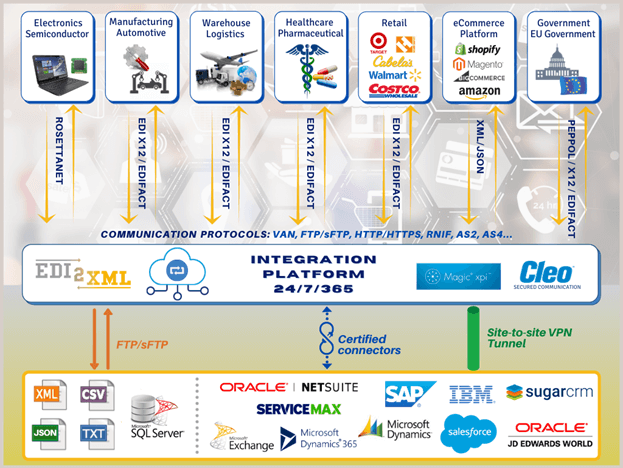
In simple terms, EDI2XML is a converter from EDI X12 format to XML format. The result XML format file is based on a pre-defined schema (xsd); we call it our “EDI2XML format”. Here is a very simple graphical description of the EDI2XML engine “in action”.

EDI Platform

Read: What is EDI ?

EDI2XML can work in two directions by changing a little switch when executing the command:

  • Convert incoming EDI X12 files to XML format
  • Convert outgoing XML format files to EDI format
For incoming EDI files, after a raw X12 EDI file is received using communication software and the EDI2XML engine is triggered, the following actions are executed one after the other:
– EDI2XML will verify the structure of the received file to make sure it is a valid raw EDI X12 format file
– If the raw EDI X12 file is valid in terms of structure, it will run another path to eliminate any information not considered part of EDI; for example, some headings and footers sent through the EDI VAN are automatically cleaned as it does not relate to any business information exchanged with the EDI partner
– The engine is smart enough to split a batch of incoming EDI files inside the same physical file, by envelop (ISA) and by ISA id, as a preparation for the conversion to XML, regardless of its EDI standard and revision
– Once all of the above is completed, the engine would generate for each one of the EDI files an equivalent XML formatted file.
The EDI2XML engine works a little differently when converting raw X12 files from an XML format. Once the engine is triggered with the option to convert XML to EDI X12 format, it will do the following actions:
– For each XML file found, EDI2XML will validate its structure and find out if it is well formed, to make sure it is compliant with edi2xml format and schema
– For each valid XML file, the engine will convert from XML to X12 raw EDI format
*It is important to note that the XML file should comply with a pre-defined xsd (or schema). All necessary information related to EDI versions and standards are sent within the XML file. For incoming and outgoing edi2xml formatted files, only files from the “ licensed” partners are being processed. Any EDI or XML file sent from/to an unlicensed partner will NOT be processed at all.

Read: How is EDI2XML licensed ?


Free EDI Demo


This post was updated to reflect current trends and information. 


A Technical Introduction to EDI

Before I start explaining anything about EDI2XML, I would like to start by giving a more technical introduction to EDI, its usage, and its history. EDI is an acronym for Electronic Data Interchange. It has been around for a long time and has been used by retailers and private corporations in several verticals (health, retail, insurance…). When people in the business community talk about exchanging “EDI transactions“, they refer to a combination of the following:

  • Structured EDI file format including version, revision, standard…
  • Protocol of communication, medium and security (FTP, sFTP, AS2, VAN)
  • Business partners (vendors, retailers…)

Simply speaking, EDI is the process of “electronically” exchanging documents between business partners in a pre-defined format. The information is transmitted in a secured manner. Normally, files with EDI format are structured and follow “EDI standards”.

EDI Standards

There are several widely used EDI standards, including:

  1. ANSI ASC X12: This is the predominant standard used in North America for various industries, such as retail, healthcare, transportation, and finance. It defines specific transaction sets like purchase orders (850), invoices (810), and shipping notices (856).
  2. UN/EDIFACT: This is an international EDI standard developed by the United Nations. It is widely used outside of North America and is popular in sectors like transportation, logistics, and customs. UN/EDIFACT includes a comprehensive set of message types covering various business processes.
  3. GS1 EDI: This standard is developed by GS1, a global organization focused on supply chain standards. It is used primarily in the retail and consumer goods industries. GS1 EDI incorporates the GS1 barcoding standards and provides specific message types for processes like product catalog synchronization, purchase orders, and invoices.
  4. HIPAA EDI: The Health Insurance Portability and Accountability Act (HIPAA) introduced specific EDI standards for healthcare-related transactions. These standards ensure the secure and standardized exchange of sensitive patient data between healthcare providers, insurers, and other entities.
  5. TRADACOMS: Developed in the United Kingdom, TRADACOMS is an EDI standard commonly used in the retail industry. It includes message types for processes like order management, stock control, and invoicing.

These are just a few examples of the many EDI standards available. Each standard has its own message formats, data elements, and communication protocols. Organizations typically choose the appropriate standard based on their industry, geographic location, and trading partner requirements.


Read: What is a VAN ?


EDI X12

EDI has been evolving with different versions, revisions and sub-revisions. For example, in the X12 standard EDI format, I started my EDI career with the EDI version 3010. Today, we are working with much higher EDI versions such as 4010, 5010, 5020… It is important to note that within each one of the above versions, different revisions might exist.

EDI Transactions and Documents

Read: How does EDI2XML work ?

EDI documents are “number coded”; for example, a Purchase Order sent by a retailer to a vendor using EDI format is coded under the number “850”. The same applies for other documents such as 810 (for invoice), 856 (for Advance shipping notice), 820 (for Payment Advice), and 860 (for Retailer triggered Purchase Order Change). The list goes on and it is not limited to the above. For a more extensive list of EDI documents that EDI2XML supports,  visit our EDI Document Library.

Each EDI document sent to a party has to be responded to by the other party by sending back a Functional Acknowledgment (FA 997). The 997 designates that the “structure” of the EDI file was certainly received, without looking at the “content” of the EDI formatted file. Both business partners understand the “content” of the information and they are able to translate into business terms. This is where EDI2XML comes into play to convert and translate the content and make it ready for integration.

To learn more about EDI, read our new blog What is EDI (Electronic Data Interchange)?” 


RELATED POSTS:

What is EDIFACT? | UN / EDIFACT standard overview

Electronic Data Interchange: Key Information You Need to Know

ANSI ASC X12 Standards Overview

What Are the Differences Between ANSI X12 and UN/EDIFACT