EDI2XML
  • About
    • The Company
    • EDI2XML
    • Advantages
    • Partnership with EDI2XML
    • Testimonials
  • Services
    • Enterprise AI
    • Fully Managed Integration
    • Fully Managed EDI Services
    • EDI Web Portal
    • EDI Web Service
    • EDI On Premises
    • Managed Cloud Services
    • Amazon Integration
    • Shopify Integration
    • BigCommerce Integration
    • NetSuite Integration
    • JD Edwards Integration
    • Dynamics 365 Integration
    • SAP B1 Integration
    • Salesforce Integration
    • Industry 4.0 Integration
  • Pricing
    • EDI Managed Services
    • EDI Web Service
    • EDI On-Premises
    • Managed Cloud Services
    • Shopify Integration
    • JD Edwards Integration
    • E-commerce Integration
    • All other Integrations
  • Blog
  • Resources
    • Resource Center
    • List of EDI Codes
    • List of EDIFACT Messages
    • EDI Documents Library
    • Trading Partners
  • Contact us
  • Book a Consultation
  • Click to open the search input field Click to open the search input field Search
  • Menu Menu
  • Link to Facebook
  • Link to LinkedIn
  • Link to X
  • Link to Youtube

Industry 4.0: Do legacy Manufacturing Systems Stand a Chance?
Blog
Industry4.0

Last Updated on July 4, 2025 by Tatyana Vandich


Manufacturing companies around the world are in the process of digital transformation. Industry 4.0 is fundamentally changing the models of industrial markets and increasing the competitiveness of their members. Thus, the level of digitalization determines the growth prospects of any manufacturing company.

Table of Contents

Toggle
  • Understand the Benefits of Digital Transformation
  • Manufacturing Digital Transformation and Prejudice
  • Transformation of Legacy Systems with FactoryEye
  • Why is the Transformation of Legacy Systems Useful in Manufacturing?
  • Looking for an IT Service Provider with Hands-On Experience? 

Understand the Benefits of Digital Transformation

Now, more and more manufacturing enterprises are investing not only in the automation of existing processes, but also in the implementation of new, breakthrough business models and technologies based on Industry 4.0, to improve their capacity in integration and maximize the use of their digital platforms. This kind of aggressive approach will only help in improving their digital ecosystems and allow companies to get in-depth analytics of big data, and wider implementation of the Internet of Things (IoT).

According to the McKinsey Global Institute by 2025 the Internet of Things (IoT) applications could have a total economic impact of $11 trillion US dollars annually.

Implementation of Industry 4.0 technologies should be a priority for all manufacturers. By integrating production machines, business systems and their legacy systems, manufacturers can achieve much greater productivity and efficiency and become more agile and lean. The principle of Industry 4.0 is based on the massive introduction of information technology into industry, as well as large-scale automation of business processes.

The main goal of Industry 4.0 is to make manufacturing and its related industries, such as logistics, faster, more efficient, and more customer-centric. At the same time, moving beyond automation and optimization, and discovering new business opportunities.

Manufacturing Digital Transformation and Prejudice

Many factories are lagging behind the rapid growth of new technologies. This can be explained by the cost of the equipment (which is very expensive to change to a new one), as well as by the fear of changing their production processes. Despite outdated technology and old machines, they still work and play a main role in the entire manufacturing business.

Often, manufacturing executives think they cannot do anything with their old equipment, which may have been made even before the Internet. Therefore, they continue to use these bulky and expensive to maintain production machines. Moreover, older technologies cannot provide complete real-time data.

The lack of real-time information makes it difficult to make decisions and prevents executives from successfully developing further and competing on an equal footing with more technologically advanced competitors in the market.

IoT integration

Meanwhile, the erroneous assumption about the need to replace all equipment drives them away from increasing productivity and taking full advantage of the integration of new technologies into production. We have a solution that can help any factory and any production!

Transformation of Legacy Systems with FactoryEye

All factories have different resources, strengths, and weaknesses, and unique capabilities. However, there are proactive and proven solutions that can be applied across all industries, even with legacy systems and old equipment, to accelerate IT transformation.

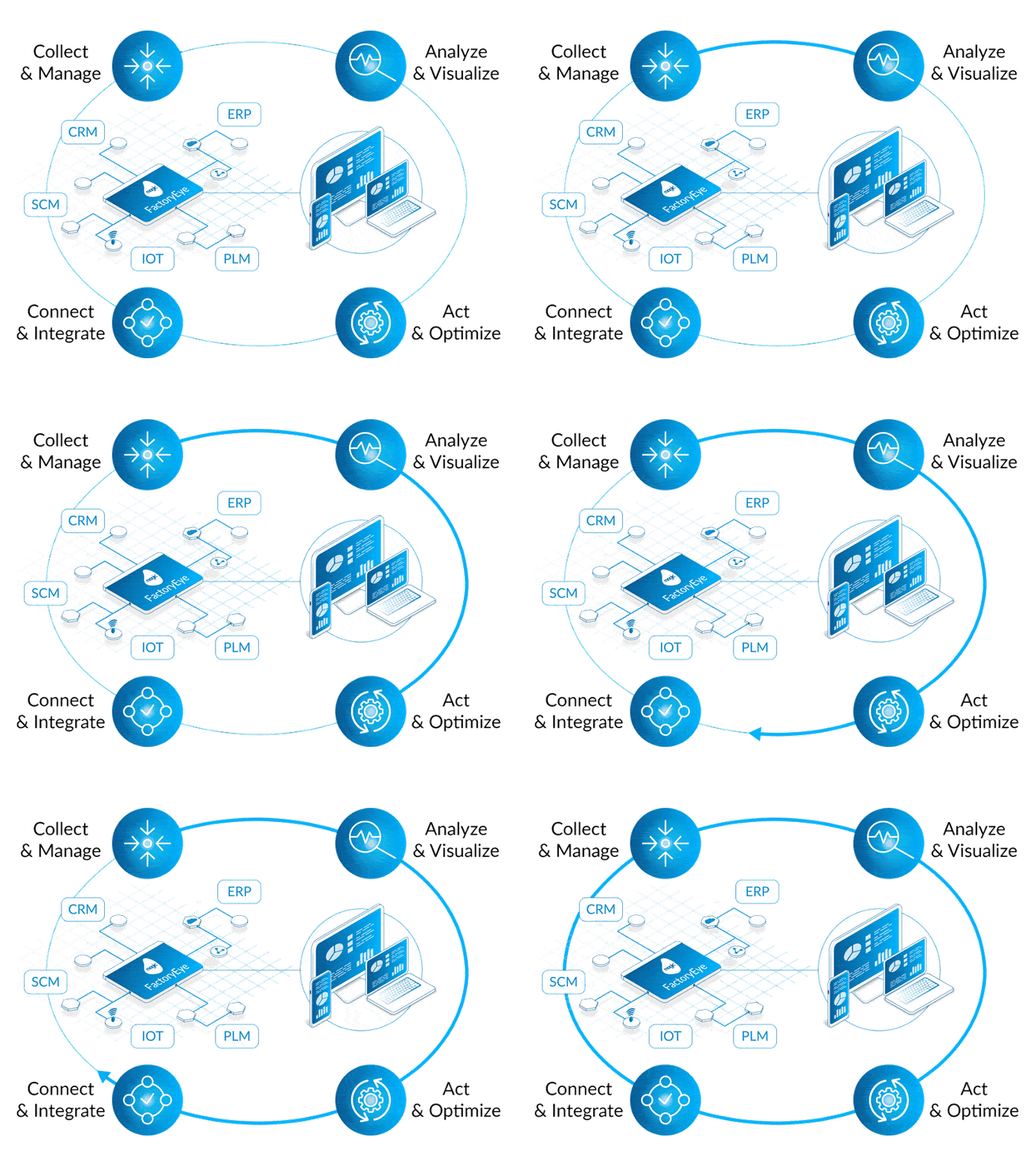
FactoryEye is a unique solution capable of fully integrating all IT systems in your company (ERP, CRM, PLM, MES, WMS, SCM) with manufacturing production machines. It provides complete visibility and analysis of operational processes in real time.
Industry 4.0: and legacy Manufacturing

With FactoryEye, all critical and disparate data is visible and accessible in real time. Most importantly, you do not need to change existing manufacturing machines, existing systems and infrastructure to do this.

Why is the Transformation of Legacy Systems Useful in Manufacturing?

Reduces operating costs. IoT sensors monitor hard-to-reach parts and signal hazards, record fuel consumption, monitor equipment temperatures, and automatically alerts when something goes wrong.

Reduces labor costs. Employees receive the necessary data using sensors and cameras. They don’t have to go anywhere anymore to take the readings off the equipment or request information from colleagues.

Reduces the risks of accidents and, accordingly, the costs of eliminating the consequences. Devices and sensors have learned to predict abnormal situations or accidents.

In other words, the optimization of processes and productivity is the first advantage that manufacturers enjoy. In addition to cost savings, increased profitability, reduced waste, automation to avoid errors and delays, which results in faster production.

Looking for an IT Service Provider with Hands-On Experience? 

To help in such concept implementation, a manufacturing company should team up and partner with a service provider who can share their own experience in implementing digital transformation projects for the manufacturing world, based on Industry 4.0

An experienced IT provider with such engineering expertise will be able to define the project path and actions, recommend the best procedures and services, and help you find the best way to transform your factory to gain new benefits. If the project is planned and executed correctly, it will lead to increased profits and quicker ROI.

To learn more about how our solutions can help your business overcome manufacturing challenges, contact us today

Industry 4.0 whitepaper
author avatar
Tatyana Vandich Marketing Manager
Tatyana Vandich is a marketing and business technology expert specializing in EDI, B2B integration, and digital transformation. She helps companies automate supply chain operations and achieve seamless data exchange through practical, experience-based insights.
See Full Bio
Electronic Data Interchange (EDI) EDI X12 Standard EDIFACT Standard B2B Integration Digital Transformation in Business Supply Chain Automation
social network icon
November 30, 2020
Tags: Digital transformation, Industrial Internet of Things, Industry 4.0, Internet of Things, IoT, legacy Manufacturing Systems, Manufacturing Digital Transformation, What is Industry 4.0
Share this entry
  • Share on Facebook
  • Share on X
  • Share on LinkedIn
  • Share on Tumblr
  • Share on Reddit
  • Share by Mail
https://www.edi2xml.com/wp-content/uploads/2020/11/EDI2XML-_-FactoryEye.png 350 1024 Tatyana Vandich https://www.edi2xml.com/wp-content/uploads/2024/08/edi2xml.com-EDI2XML-company-logo.png Tatyana Vandich2020-11-30 14:19:052025-07-04 14:45:14Industry 4.0: Do legacy Manufacturing Systems Stand a Chance?
You might also like
EDI-for Manufacturing companies EDI for Manufacturing Companies
What is IoT? What is the Internet of Things (IoT): How It Works and Some Examples Use Cases
manufacturing EDI Integration Leveraging Advanced EDI Strategies for Manufacturing Excellence
Industry 4.0 The Fourth Industrial Revolution and Industry 4.0: How to maximize the benefits of innovation?
SaaSEDI EDI as a Service, a winning model in the digital transformation of your business
Manufacturing 4.0 Industry 4.0: How to Manage Digital Transformation in Manufacturing Enterprises?
Recent
  • The Infrastructure Behind Modern Commerce: Why EDI Still Matters
    EDI in E-Commerce and Retail: Why Modern Commerce Still...May 1, 2026 - 4:54 pm
  • Key Statistics on AI Use in the Workplace
    The Risks of Using Public AI Tools in Business: Data Privacy,...March 11, 2026 - 5:51 pm
  • Enterprise AI
    How to Securely Access Enterprise AI: GPT, DeepSeek &...February 20, 2026 - 3:09 pm
  • EDI 754 Guide
    EDI 754 Routing Instructions: Complete Guide to Purpose,...February 18, 2026 - 4:54 pm
  • All you need to know about EDI 753 Transaction
    What Is EDI 753? Purpose, Structure & Routing Rule...February 12, 2026 - 3:59 pm
Popular
  • How to Quickly Connect to a Large Retailer's EDI Requirements
    How to Get EDI-Compliant Quickly For A Large RetailerNovember 21, 2025 - 4:29 pm
  • EDI-as-a-services
    EDI Translation Software “On-premises” or “As...January 21, 2014 - 1:28 pm
  • order-automation in e-commerce
    Why Is It Crucial to Automate the E-Commerce Order Fulfillment...May 10, 2022 - 1:58 pm
  • EDI for Logistics and transportation
    EDI Integration for Efficient Transportation ManagementOctober 6, 2023 - 1:33 pm
  • information technology definitions
    Business Tech Terms DefinitionsMay 24, 2018 - 1:32 pm

Subscribe to our Blog

Please verify that you are human.

Browse by tag

Amazon Amazon Integration ANSI ASC x12 ASC X12 EDI B2B EDI integration e-commerce e-commerce business e-commerce integration eCommerce eCommerce integration EDI EDI2XML EDI as a Service EDI Communication EDIFACT EDI for supply chain EDI for Third-Party Logistics EDI for transportation EDI implementation EDI Integration EDI Integration Project EDI project EDI to XML converter EDI Translation EDI Web Service EDI x12 ERP Fully managed EDI Integration integration platform integration project JDE Logistics EDI Transactions Magic xpi NetSuite online store Shopify Shopify eCommerce integration Shopify integration soa integration Supply Chain Supply Chain Management Translation Software X12 EDI XML

Menu

  • Home
  • About the EDI2XML Company
  • About EDI2XML EDI Converter
  • Blog
  • Book A Free Consultation
  • Privacy Policy EDI2XML Company

Our Services

Fully Managed Integration

E-Commerce Integration

Business Systems Integration

Fully Managed EDI

EDI Web Service 

On Premises EDI 

Managed Cloud Service


Latest Blog Posts

  • The Infrastructure Behind Modern Commerce: Why EDI Still Matters
    EDI in E-Commerce and Retail: Why Modern Commerce Still Depends on EDIMay 1, 2026 - 4:54 pm
  • Key Statistics on AI Use in the Workplace
    The Risks of Using Public AI Tools in Business: Data Privacy, Compliance, and Shadow AIMarch 11, 2026 - 5:51 pm
  • Enterprise AI
    How to Securely Access Enterprise AI: GPT, DeepSeek & LLaMAFebruary 20, 2026 - 3:09 pm

Contact Us

400 Blvd Curé-Labelle, #304 Laval QC H7V 2S7 Canada

Contact EDI2XML Team
Phone: +1 450-681-3009
Website: https://www.edi2xml.com/

© 2000-2026 EDI2XML (by Namtek Consulting Services). All rights reserved.
  • Link to Facebook
  • Link to LinkedIn
  • Link to X
  • Link to Youtube
  • Blog
Link to: Must-Have BigCommerce Integrations Link to: Must-Have BigCommerce Integrations Must-Have BigCommerce IntegrationsBigCommerce ERP and CRM Integration Link to: What Is Amazon Integration & How Does It Work? Link to: What Is Amazon Integration & How Does It Work? Amazon automationWhat Is Amazon Integration & How Does It Work?
Scroll to top Scroll to top Scroll to top