Streamline global trading with EDIFACT—facilitate electronic data interchange, improve accuracy, and enhance collaboration across international business.

Tag Archive for: EDIFACT

Article written by Pierre Namroud, EDI Integration Specialist & Business Consultant

During my professional career as an integrator and EDI expert, I had the opportunity to work on several major integration projects. Some of them were in an Oracle environment while others had to do with integrating with SAP/R3. Other projects included integrations with different types of systems such as Salesforce, Shopify, Microsoft suites, etc.

In today’s EDI2XML post, I will share my experience as an ‘Integrator’ to lay down the basis of a successful integration project of EDI and SAP/R3. Please note, however, that I am not an SAP expert and during these integration projects I worked closely with SAP professionals and credit them for all of their efforts in completing the SAP portions of this type of project.

What is SAP/R3?

SAP/R3 is an Enterprise Resource Planning (ERP) software solution produced by the well-known German company, SAP. This specific version,“R3”, has been renamed to ECC (ERP Central Component). SAP Business One is also a sub-set ERP software from the same Software Provider and it is designed for Small Businesses.

SAP ERP Solutions are widely present in corporate enterprises in North America, Europe and all around the world. It is one of the most popular corporate ERP software solutions.

Does SAP support EDI Integration?

SAP ECC (or R3), out of the box, does in fact support EDI integration. The EDI format that is currently supported by SAP is called iDoc. Simply put, iDoc format files or messages are proprietary to SAP and they are similar to, and based on, EDIFACT messages.

In essence, if an iDoc file is provided to SAP, it will get processed using some specific BAPI and it will turn the iDoc into an order, in SAP.

EDI Transformation for SAP Integration

Most integration projects that I have worked on involved integrating EDI X12 formats within the SAP system, in both directions (incoming and outgoing messages). Since X12 EDI format is far from the iDoc format, our team was tasked with handling the transformation and EDI translation from X12 EDI to iDoc format.

Checklist for a Successful EDI Integration Project with SAP

Now that the basics are defined, I will share my recommendations, in a checklist format, to help guide you through a successful integration project for SAP and EDI.

  • Make sure you know how to work with SAP backend. If you are not highly knowledgeable or an expert in SAP, make sure to most definitely include someone who is, as part of your team. This is a must.
  • Make sure you work in a Development SAP environment, rather than a Production environment when doing the work.
  • Make sure to use the appropriate SAP BAPIs or RFC, well identified for each point you plan to integrate with SAP. This is very important and it is crucial to be identified. Your SAP expert can take the lead in this area.
  • Make sure to equip yourself and your integration team with an efficient integration framework. The completion timeline and success rate of this project will definitely be better if you equip your integration team with an efficient integration tool.
  • To avoid getting into an unknown space, outsource the translation of the EDI X12 or EDIFACT (or any other protocol) to a reliable, knowledgeable Service Provider. By teaming up with an EDI partner, you’ll quickly notice the real value they will bring to the table since they will handle all of the complexities that an EDI project can bring. Their task will be to do the EDI transformations and create one single iDoc format of EDI for your integration flows to SAP.

Conclusion

I sure hope that I was able to expose some of the challenges and complexities surrounding a typical SAP integration project, with the above checklist, and properly explained my recommendations, from my own personal experiences.

If you are interested to learn more about this topic or any other issue related to EDI integration projects, please click on the image below and I will be more than happy to contact you for a FREE consultation.

Free EDi Consultation and pricing

This post was updated to reflect current trends and information.

Article written by Pierre Namroud, EDI Integration Specialist & Business Consultant

I had the pleasure of attending Collaborate17, a Technology and Applications Forum for the Oracle community. This opportunity brought together Oracle professionals, integrators, project managers and IT experts from around the world, who all work in different spaces of integration. It was such a great experience speaking with so many Oracle experts and attending educational sessions.

One of the main points of discussion during the various speaking engagements was on the challenges that professionals were facing when it came to integration projects involving EDI (Electronic Data Interchange) as well as eCommerce data to JDE (JD Edwards). The opinions were unanimous in the sense that Oracle still has more work to be done in order to strengthen and simplify integration with legacy EDI protocols and build simpler integration flows for protocols such as X12, EDIFACT, Rosetta Net, etc.

I’m writing this article, in order to share my own expertise as a data and EDI integrator, where I had the chance to be involved in several eCommerce and EDI integration projects with Oracle JDE. Hopefully it will help inform other Oracle professionals looking to overcome some of these integration challenges.

Challenges currently being faced by Oracle JDE professionals

There are many challenges that any JDE professional might see when it comes to data and systems integration with Oracle ERP software in general, whether for on-premises or cloud systems. [As a side note, Oracle’s cloud systems have their own specific limitations that I recently learned about during one of the Collaborate Sessions].

Below, I have listed some of the most common challenges that not only have I experienced in my own projects with Oracle customers but that others have expressed during the Collaborate conference;

  • Oracle’s JDE does not have a seamless built-in integration with all EDI X12 documents “out of the box”.
  • The current integration process for EDI X12, EDIFACT, HL7 or any other data format now happens by writing into transition tables (or Z files) and then triggering a business function to process those incoming data.
  • Even though Oracle’s JDE system supports business functions, some older versions do not support new API functions, which can cause some headaches.

    Looking to integrate your EDI or eCommerce processes with Oracle JDE enterprise one, look no further, since we have the best integration option where we turn your Oracle JDE system into a modern REST API, that receives https requests and acts accordingly. Learn More>


Integration Project Checklist

Before starting an integration project with your Oracle JDE system, I recommend that you go through the following list of questions. This way, you’ll be able to make the best decisions to move forward with development efforts as efficiently as possible.

  • Who are the Business or Trading Partners you want to exchange electronic data with?
  • Which documents (or types of data) are you requested to exchange from your Business Partners? In normal circumstances, they’ll provide you with the necessary documentation and specifications as a road map and for compliance reasons.
  • The exchanged data will be sent under what format or standard/version? (X12, EDIFACT, RosettaNet, XML, custom format…?)
  • What is the protocol of communication used to send the data back and forth between you and your Business Partner? Is it point-to-point, such as AS2 or sFTP?
  • Is a VAN required in order to transport the data?
  • Do you have the necessary expertise to select the appropriate certified communication software (for first time project implementation)?
  • Do you have the necessary expertise in your development team to decrypt and understand the terminologies of legacy EDI formats?
  • Has your team ever done an EDI integration project, that includes a full certification process?
  • How many partners will you be exchanging with? The more partners you have, the more complex the project can become.
  • Check the specs of all of your partners (when possible) to verify the differences in their requirements. It is well known in the EDI integration world that there can be many distinctions and exceptions found per Business Partner and per document. Every EDI project can be unique.
  • What is the lead-time to complete the certification and testing phase with your business partner before going live?
  • What is the volume of exceptions that your development team can currently handle in the project in order to be on time and within budget?
  • Do you have the necessary integration tools to simplify the EDI syntax in order to work with one format regardless of the format of the data you receive from different sources?
  • Is your team coding directly in Oracle JDE native framework, or are you using any efficient integration tool available today?
  • Will you be doing end-to-end integration using Z tables of Oracle JDE, or you are going to use API (or business functions) of JDE?

Recommendations for a Successful Integration Project

As you might have noticed, data integration projects involving legacy EDI protocols or custom data format exchange are not simple. They are projects that need a lot of expertise and experience in data communication and transportation, data mapping and systems integration into Oracle’s JDE system.

Moreover, at most enterprises that we’ve completed EDI integration projects for, it was evident how stretched and overwhelmed the internal JDE development team was in their own day-to-day operations, support and maintenance of the application and were incapable of learning new standards to respect the strict timeline given by Trading Partners. In these cases, they looked for help from an outside Service Provider, such as EDI2XML.

My recommendations for such projects are as follows:

  • Outsource the EDI part of the project to a reliable Service Provider, who is highly focused on service availability and quality, since EDI is quite sensitive. This will allow your team to continue working on their daily tasks and keep doing what they do best (JDE support and maintenance, for example). This way, you’ll have a simplified and streamlined EDI integration process; you build one tunnel between your EDI provider, where they deal with the exceptions, and your own process.
  • In case your company policy requires you to deploy the EDI integration solution on-premises, make sure to use an efficient EDI conversion tool such as our EDI2XML technology that has the capability to turn the EDI documents from X12 format to a human readable XML format, for example.
  • Equip your team with the right tools for data integration such as Magic xpi, which we have been using for many years in our data and systems integration projects. Leveraging such technologies allowed us to integrate anything-to-anything (JDE to SAP, SAP to Salesforce, EDI to any system as examples).

I sure hope I was able to expose the most common EDI integration challenges and complexities and help you to overcome these obstacles with the above checklist and recommendations.

If you are interested in learning more about this topic or any other issue related to EDI integration projects, please click on the image below and I will be more than happy to contact you personally for a FREE consultation.


Free consultation ecommerce JDE integration


This post was updated to reflect current trends and information.
x12-to-xmlcsv

EDI formats are not understood or easily read by just anyone. It requires an EDI expert to be able to read the files and dissect them. Many large Trading Partners impose their own rules and requirements on top of those outlined by the standards, which is why, in many cases of translation, it is not always as straightforward as hoped. Most business executives are hesitant to begin trading via EDI because of these complexities.

However, if you find the right EDI Provider, who can handle all translations, all EDI mapping, all Partner configurations and all outbound and inbound communication with your partners, then you have nothing to worry about.

Our very own EDI2XML translation and integration services eliminate all of these complexities for you and you can begin trading electronically in no time. If you have your own in-house EDI and IT integration expert(s), then they can simply use our EDI2XML Web Service.

If you’re looking to meet your Trading Partner’s requirements but also keep your business processes streamlined and integrated internally, then check out EDI2XML. Our team of EDI experts are experienced and flexible enough to work with any EDI format, where specs are readily available, and convert to a format your team or system can work with. It’s about keeping costs low and simplifying the whole EDI communication process. Contact us today!


Free EDI Consultation

This article went on to describe the beginnings of EDI in the business world and how far we’ve advanced with technology to simplify these B2B transactions with EDI2XMLRead more


This post was updated to reflect current trends and information.


EDI Communication
is one of the best ways to exchange important business documents with Trading Partners. Documents such as Purchase Orders, Invoices and ASNs can be safely exchanged electronically with business partners, like retailers, in a matter of seconds. In many cases however, Small and Medium Enterprises do not have the budget for some of these EDI communication solutions out there and do not have any in-house staff experienced with EDI exchange. What should these businesses do?

EDI Solution as a Service for SMEs

After over a decade of working hand in hand with Small and Medium Businesses, we’ve come up with a solution. Our EDI specialists realized that it might not be realistic to have SMEs hire in-house EDI experts or purchase expensive EDI communication solutions on the market. This is when our experienced team designed and developed a tool that can be implemented as a Service – no need for any setup or equipment on premises – called EDI2XML as a Service. Here’s how it works:

  1. We communicate with your EDI Trading Partner in order to pick up any incoming EDI documents from their mailbox
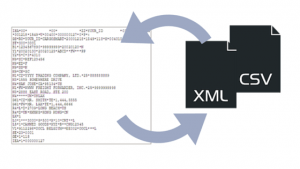
  2. We convert all EDI documents into XML or CSV format (whichever works best to be integrated into your management system (ERP suite, CRM system, etc.))
  3. We push all XML documents to you, to be integrated into your system
  4. You will be notified every time EDI documents are sent and received
  5. The opposite process (from XML to EDI) works for outgoing documents.

Click here to view an infographic on EDI2XML as a Service.

Converting from unreadable formats like EDI x12 or EDIFACT (for those companies in Europe) to XML or CSV, allows for easy integration into ERP suits or CRM systems out on the market. On top of this, XML format is easy to read by any businessperson. Our goal was and continues to be to simplify the EDI communication process for Small and Medium Enterprises that are looking to increase efficiency. It’s time SMEs eliminated manual data entry (or human intervention) and enjoyed a smooth, continuous order processing flow.