
Integrating CRM With Business Software Using Magic xpi
Last Updated on September 2, 2025 by Tatyana Vandich
This post was updated to reflect current trends and information.
More and more businesses are running multiple software systems – CRM, ERP, EDI, eCommerce platforms, and more – to manage their operations. But without integration, these systems often work in silos, causing data errors, inefficiencies, and lost opportunities.
CRM integration with ERP, EDI, and other business applications is the key to automating workflows, improving data quality, and gaining a complete view of your customers. In this article, we’ll explore why CRM integration matters, real-world use cases, benefits, and how platforms like Magic xpi make integration simple and effective.
Key Takeaways
- CRM (Customer Relationship Management) systems help businesses manage customer data, improve relationships, and increase sales growth.
- The CRM market is booming – expected to reach nearly $100 billion by 2025, driven largely by SaaS solutions.
- The top CRM vendors include Salesforce, SAP, Oracle, and Microsoft Dynamics 365, each offering different deployment models and strengths.
- CRM integration with ERP, EDI, eCommerce, and finance applications ensures data consistency, reduces errors, and enables a unified view of customers.
- Common use cases include syncing eCommerce orders, automating accounting data, and connecting CRM with ERP for order management.
- Benefits of CRM integration: streamlined workflows, reduced costs, fewer errors, and better customer insights.
- Magic xpi Integration Platform provides a no-code, pre-built connector approach to easily integrate CRM with ERP, EDI, HRMS, logistics, and more.
- Digital transformation success depends on embracing integration to stay competitive and meet evolving customer expectations.
What is CRM (Customer Relationship Management) and Why Is It Important?
If you refer to Wikipedia, you find the following definition: “Customer-relationship management (CRM) is an approach to manage a company’s interaction with current and potential customers. It uses data analysis about customers’ history to improve business relationships with customers, specifically focusing on customer retention and ultimately driving sales growth”.
In other words, a CRM is a tool for managing clients and their related information, as well as a way to speed up and streamline sales processes.
CRM Software Market Growth: Key Trends and Forecasts (2025 and Beyond)
According to Statista, the revenue for the Customer Relationship Management Software market is forecasted to reach US$98.84bn in 2025. The market was driven by strong software as a service (SaaS) growth.
The Customer Relationship Management (CRM) software market is expected to grow over 14% through 2025 according to Gartner.
There are a lot of companies in the CRM system market, but the four largest vendors of CRM system offerings are:
Salesforce: is a leader of the CRM software market. American developer of the CRM system, provided only the SaaS model. Technical experts mark the company as the “main players in the cloud computing market” along with Oracle, SAP, Google, Microsoft, Amazon.com
Suggested Readings: How to get more out of Salesforce with EDI Integration
SAP: is a European multinational software corporation that develops enterprise software to manage business operations and customer relations. SAP provide new generation of CRM tools and customer engagement solutions. SAP Hybrid solutions are more than traditional CRM software, they provide in-memory technology and Big Data insights to help companies drive contextual, personalized customer engagement in real time – across any channel or line of business.
Suggested Readings: How To Successfully Complete SAP/R3 EDI Integration Projects Using iDoc
Oracle: is an American multinational computer technology corporation. Oracle CRM is one of the leading products in the CRM market. It has a robust and intuitive interface and a variety of product lines and deployment models:
a) Oracle CRM On-Premises: is a traditional on-premises deployment where the customer needs to buy or lease his own hardware, operating systems and databases, and install a packaged Oracle CRM system on it.
b) CRM On Demand and Oracle Sales Cloud are cloud CRM solutions which are accessible over the internet and paid for by a monthly subscription fee.
Suggested Readings: Oracle JD Edwards Integration: the key to Digital Transformation
Microsoft is an American multinational technology company. One of the leading companies in the CRM space with its Microsoft Dynamics 365. Dynamics 365 platform offers companies an exceptional set of productivity tools across sales, marketing, and customer service. Microsoft Dynamics 365, is unique of its kind in the CRM marketplace, and leading the way in innovation, usability and user experience.
Suggested Readings: The main reasons why you need Microsoft Dynamics Integration with your business Systems
What is CRM Integration and How Does It Work with ERP, EDI, and Other Systems?
Today, it is very common to see enterprises running different types of systems to run their business. It is common for example, to see a company adopting JD Edwards Enterprise One as an ERP, while at the same time, having their sales and marketing department leveraging Salesforce.com as their CRM software.
Natively, both branded software systems (JDE and Salesforce), do NOT connect together “out-of-the-box”. However, both of these solutions, offer an API or web service to read/write data.
Integration of a CRM with an ERP helps automate the processes, reduce human errors and maintain a better quality of data for the enterprise.
Additionally, integrating a CRM system to another ERP software, aims at creating an omnichannel (unified) system to collect data about the client from all sources: call center, store, online store, website and social networks. The company must have complete information about its client — this will make the most advantageous offers and provide the best support. Analysis of CRM systems shows that the effect of integrating CRM with other corporate applications can significantly increase company productivity.
Thanks to the integration, data into a CRM system can be visible and transferred to other applications.
Real-World CRM Integration Use Cases (eCommerce, ERP, Finance, and More)
Integration of CRM with the e-commerce site(s): This is very common integration, that allows to synchronize data from an eCommerce site into a CRM system. On the e-commerce site your customers can register and make orders and at the same time, customer contacts are sent from the e-commerce site to your CRM systems. Next, with these contacts, the work can be done already in the CRM system. Namely, the initial call to the customer, the appointment, the second call and so on.
Integration of CRM with accounting and finance: Most often this method is used to upload customer data to accounting programs. Back from the accounting program can be taken in CRM information about payments and receivables from customers.
Large companies that use ERP systems can integrate applications even more closely. For example, orders are initially sent from the e-commerce site to CRM and processed by sales managers, then, automatically transferred to the ERP system. In ERP, further work will be done with the customer’s order (production, logistics, etc.). The status of the order will be returned to CRM.

Top Benefits of CRM Integration for Businesses (Efficiency, Cost Savings, Customer Insights)
Integration of CRM with other business applications and systems used by the business will allow:
- spend less time on search and exchange of information between departments;
- reduce personnel costs;
- reduce the risk of losing contacts and other important information about the clients;
- see full statistics of company activity and configure the end-to-end analytics;
- migrate workflows into a single interface;
- reduce paperwork to the minimum;
- configure automatic data exchange with partners and contractors — for example, a delivery service, bookkeeping outsourcing company or coalition loyalty programs;
How to Overcome CRM Integration Challenges with Magic xpi (No-Code Platform)
Using the Magic xpi Integration platform, you can easily integrate enterprise-level solutions due to Magic xpi code-free, business process automation, and data synchronization solutions.
Magic xpi has pre-build, optimized, and certified adaptors for most branded CRM systems such as Microsoft Dynamics, Salesforce, SugarCRM, and other.
Magic xpi extends the capability and usage of your CRM system. You can achieve simple and intuitive integration with your company’s business applications, like IBM i, JD Edwards, SAP, Lotus Notes, accounting, ERP, supply chain management, HRMS, logistics, and many more.
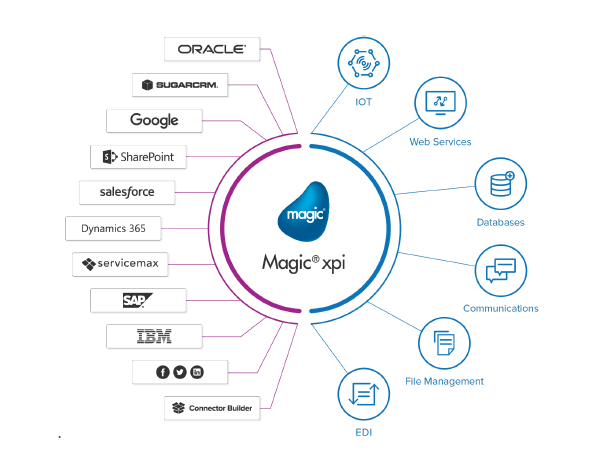
Magic xpi, using its visual and intuitive design tools, can simplify and unify the interfaces of your CRM, as well as other business systems in use, while not using any custom coding.
To learn more about the Magic xpi integration platform, watch this video
Magic xpi Integration Project Lifecycle: From Analysis to Monitoring
- Analysis: Analyze your business processes.
- Design: Design and build your business processes and integration flows in the Magic xpi Studio.
- Connection: Quickly connect all your existing enterprise applications using Magic xpi’s built-in certified connectors and adaptors.
- Testing: Test the integration flows on simulated business processes, without interrupting real business activity.
- Optimization: Before full deployment, perform risk-free optimization of your business processes and integration flows.
- Deployment: Deploy your new integration solution using the Magic xpi server.
- Monitoring: Monitor the integration of your business processes.
Click here to download our free White Paper on Magic xpi Integration Platform
Digital Transformation: Why CRM Integration Is the Key to Business Success
Changing traditional workflows and introducing new technologies is never easy. Employees may resist change, but automating and integrating your business systems has proven benefits: higher efficiency, better data quality, and improved customer experience.
Why now? With competition increasing and AI-powered tools reshaping customer expectations, businesses that delay digital transformation risk losing market share. Integrating CRM with ERP, EDI, and other systems ensures companies can respond faster, deliver personalized experiences, and stay ahead in an increasingly data-driven world.
FAQ: CRM Integration & Business Systems
Q1: How can small businesses benefit from CRM integration without a full ERP system?
A: Even without a full ERP, small businesses can automate workflows between CRM, eCommerce, and accounting software. This reduces manual data entry, prevents errors, and provides a complete view of customer interactions.
Q2: Can CRM integration improve customer loyalty programs?
A: Yes. By syncing CRM with loyalty platforms, companies can track purchases, preferences, and engagement. This enables targeted promotions and personalized offers, improving retention and satisfaction.
Q3: How does real-time data exchange work in integrated CRM systems?
A: Modern integration platforms allow instant synchronization between CRM, ERP, and other systems. Real-time updates ensure accurate stock levels, order status, and customer information across all channels.
Q4: Is CRM integration secure for handling sensitive customer data?
A: Absolutely. Platforms like Magic xpi support secure protocols, encryption, and audit trails to protect customer data while enabling seamless integration between business applications.
Q5: What role does automation play in reducing operational costs through CRM integration?
A: Automation eliminates repetitive manual tasks, accelerates order processing, and minimizes human errors. This reduces labor costs and allows employees to focus on higher-value activities.