EDI2XML
  • About
    • The Company
    • EDI2XML
    • Advantages
    • Partnership with EDI2XML
    • Testimonials
  • Services
    • Enterprise AI
    • Fully Managed Integration
    • Fully Managed EDI Services
    • EDI Web Portal
    • EDI Web Service
    • EDI On Premises
    • Managed Cloud Services
    • Amazon Integration
    • Shopify Integration
    • BigCommerce Integration
    • NetSuite Integration
    • JD Edwards Integration
    • Dynamics 365 Integration
    • SAP B1 Integration
    • Salesforce Integration
    • Industry 4.0 Integration
  • Pricing
    • EDI Managed Services
    • EDI Web Service
    • EDI On-Premises
    • Managed Cloud Services
    • Shopify Integration
    • JD Edwards Integration
    • E-commerce Integration
    • All other Integrations
  • Blog
  • Resources
    • Downloadable Guides
    • List of EDI Codes
    • List of EDIFACT Messages
    • EDI Documents Library
    • Trading Partners
    • Customer Case Studies
  • Contact us
  • Book a Consultation
  • Click to open the search input field Click to open the search input field Search
  • Menu Menu
  • Link to Facebook
  • Link to LinkedIn
  • Link to X
  • Link to Youtube

Electronic Data Interchange: Key Information You Need to Know

Blog


This post was updated to reflect current trends and information.


EDI
(or Electronic Data Interchange), has been part of business for long time; However, questions about its functioning, pros and cons are still not clear for new EDI users and those who have been using EDI for years in their business.

To help better understand EDI, we created this e-book “Electronic Data Interchange: Key Information You Need to Know”, where you find answers to most of the frequent questions like What is EDI? Benefits of EDI, EDI communication (EDI-VAN) and (EDI -INT) and much more.

It was built for beginners and those who have strong EDI technical knowledge. We are certain you will get important information out of this eBook, that is certainly useful to your EDI projects.

We invite you to download this e-book from EDI2XML Resource Page

Free EDI eBookFree EDI consultation


January 1, 2019
https://www.edi2xml.com/wp-content/uploads/2019/01/Free-edi-gude.png 350 1024 Tatyana Vandich https://www.edi2xml.com/wp-content/uploads/2024/08/edi2xml.com-EDI2XML-company-logo.png Tatyana Vandich2019-01-01 12:09:152020-06-25 14:02:39Electronic Data Interchange: Key Information You Need to Know

Magic xpi and EDI2XML HTTP Web Service: the Best EDI Software Option

Blog

This post was updated to reflect current trends and information.


More and more questions related to EDI software, systems integration, EDI, and best EDI software are being raised every day by our contacts and clients. I decided to tackle those questions in this post, hoping it will help consultants, as well as companies looking for the most suitable EDI software solution.

How EDI Automation Transforms eCommerce Operations

It does not matter which industry a company is part of, be it sales, manufacturing, or service delivery, at some point, every company seeks to automate its internal processes, increase efficiency, and eliminate human errors.

A very common situation is the automation in e-commerce, namely, online eCommerce stores. Typically, there are several people who will work on order processing, after an order is keyed in and entered by the consumer:

  • Operators who manually transferred orders received from the e-commerce site to the internal system.
  • A warehouse worker who will ship orders.

In an environment where EDI is implemented in such a company, and systems eCommerce and on-premises systems are directly integrated, the need for operators to enter orders, disappears as the order is automatically transferred to the internal system of the company.

As a result, the persons in charge of shipping orders can prepare the goods for dispatch without the help of operators. So, operators are not needed at all.

The company saves money by reducing staff, eliminating errors due to human factors, moreover, the company will be able to quickly ship and deliver orders in a short window of time, which improves greatly its customer service experience.

With the growth of the business, a new need arises – the necessity for interaction between various business partners who use different systems. Nowadays many companies have realized that EDI (Electronic data interchange) along with integration of its business applications, helps enterprises and qualitatively changes the work of employees.

Grow Your Potential with EDI Web Service Solution

Today, there are many EDI software solutions in the market that allows you to trade electronically with your business partners. Before making a decision and choosing an EDI software, you should pay attention to:

  • the possibility of modernization and scaling
  • the simplicity of EDI implementation
  • ability to send and receive a variety of EDI documents
  • ease of use and feature-rich
  • ability to integrate with other solutions

one important trend in the tech industry today that is very popular is the use of REST API Web Services. It is a trend as a technology and as a business methodology.

If you what to know more about web services technology read our article: Seamless EDI implementation through Web Services

Our unique EDI software includes a combination of EDI2XML EDI Web services, and Magic xpi, the code free integration platform, with drag and drop visual aping, simple to use. This combination will reduce the complexity of EDI development, allowing organizations to quickly reap the benefits of this powerful technology, quickly on-board its partners, and most importantly, fully automate and integrate its own ERP or CRM system in a matter of days.

EDI2XML Web Service, is an HTTP service running over the internet, on EDI2XML own private platform that is capable of receiving HTTP requests to translate EDI messages to XML, and XML messages (based on EDI2XML’s proprietary format) to EDI.

EDI2XML HTTP services provide technological and business benefits which include:

  • Application and data integration
  • Versatility
  • Cost savings (no contract: pay as you go)
  • Very simple and dynamic pricing scheme
  • Quick start of using (you can start with less than an hour)
  • Availability and reliability
  • Based on proven technology in the field for over 18 years now
  • Outstanding technical support

Who is EDI2XML Web Service For?

EDI2XML Web Service, is for developers and businesses, interested in building their own EDI (Electronic Data Interchange) integration flows and programs. Normally, these individuals, are capable of interacting with external API and Web Services to translate EDI to XML and XML to EDI, and have the resources and expertise to work with Web Services and HTTP requests in order to achieve their goals. EDI2XML web service, is the premier choice for IT people as a reliable service to accomplish such Integration projects.

Getting started with EDI2XML Web Service, is very simple and quick. Within less than an hour, you can issue the first Call to the Web Service and see the response.

EDI2XML Web Service currently, supports the EDI transactions as listed on our website. In case a transaction you are looking for is not on the list, we can simply just add it within 24 hours.

Increase Competitive Power Through Integration EDI Software

Often, companies are already using different business applications such as CRM or ERP systems, which they are quite satisfied. But the question is: can they work in harmony with each other, and integrate together? What is the best way to integrate EDI software to them?

Have you ever thought that EDI software can improve your business by integration all of your business applications and organizing a new way of transferring data and processes through your CRM, ERP, WMS, SCM, finance, third-party applications, and other outdated or cloud-based system?

As mentioned above our EDI software include EDI web service and Magic xpi integration platform;  this technology combination can cover all your business needs. Before we review what is Magic xpi integration platform, let’s see what integration is.

Integration (from the Latin. Integratio – “insert”) – the process of inserting parts into something. Depending on the context, it may mean:

  • Web integration – the integration of heterogeneous web applications and systems into a single web-based environment.
  • Data Integration – Data integration involves combining data residing in different sources and providing users with a unified view of them. (definition from Wikipedia)

I would add this Wikipedia definition as follow: The integration of software systems and products is the exchange of data between systems with possible subsequent processing. The point of integration is that the data entered by the user (or directly injected by another application or API) into one system is automatically migrated to another.

Magic xpi – Efficient Integration For Any Business and Any System

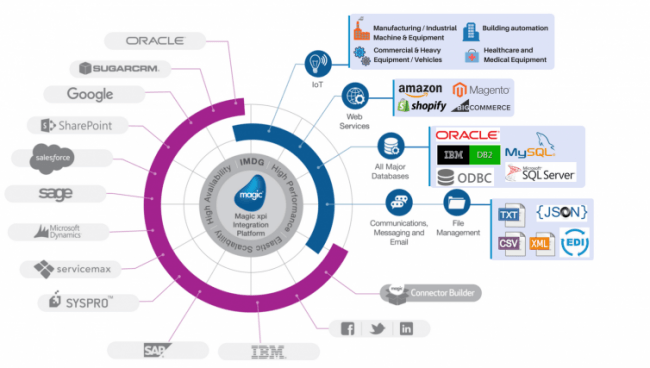
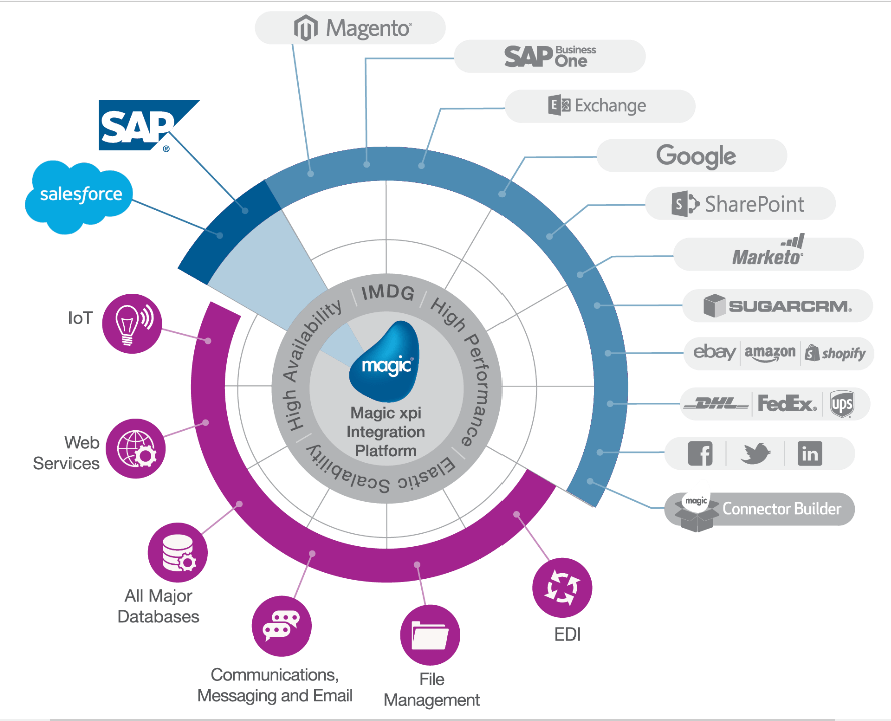
Magic xpi makes integration fast and uninterrupted due to pre-built components, proven and certified connectors as well as code-free, visual approach.

Using Magic xpi Integration Platform, you can connect a varied business application and systems and improve the capabilities of your ERP, CRM, finance, and other enterprise systems.

Unlike other integration platforms that use complex point-to-point coding, Magic xpi have easy to use, code-free, drag and drop visual data mapper. You can manage the performance of your system at all times thanks to comprehensive monitoring and management tools. Magic xpi has incomparable connectivity including 100+ prebuilt components, certified and optimized adapters for leading IT systems, and a Connector Builder for all your needs.

Magic xpi Integration Platform

Start with the Best EDI Software Solution

We do offer EDI projects consultancy. We help companies plan, deploy, test and integrate EDI projects. You can simply call us (450) 68-3009 Ext 223 or write us sales@namtek.ca if you need any EDI consulting work. We have a proven 20+ years of experience in EDI and integration projects.

December 10, 2018
https://www.edi2xml.com/wp-content/uploads/2018/12/edi2xml-web-service-magic-xpi.png 350 1024 Tatyana Vandich https://www.edi2xml.com/wp-content/uploads/2024/08/edi2xml.com-EDI2XML-company-logo.png Tatyana Vandich2018-12-10 11:28:572025-07-02 14:24:27Magic xpi and EDI2XML HTTP Web Service: the Best EDI Software Option

SOAP or REST Web Services: what you should use for EDI implementation?

Blog


This post was updated to reflect current trends and information.


In my previous article Seamless EDI implementation through Web Services, I covered various types of web services. Perhaps, if you’re still worried about choosing between SOAP or REST for your EDI implementation, this brief comparative review should help you make a choice. But in any case, you should remember that the focus of your decision must concentrate on which web service best responds to your needs.

First, look at the difference between the SOAP and REST request and response packets.

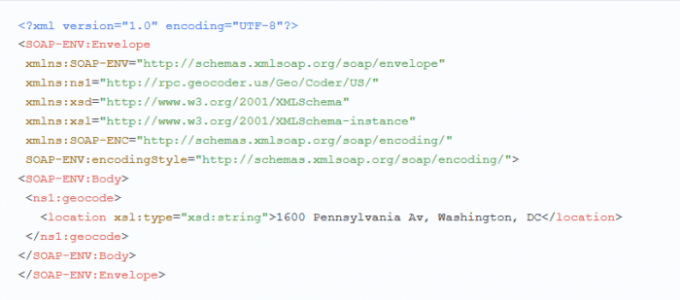
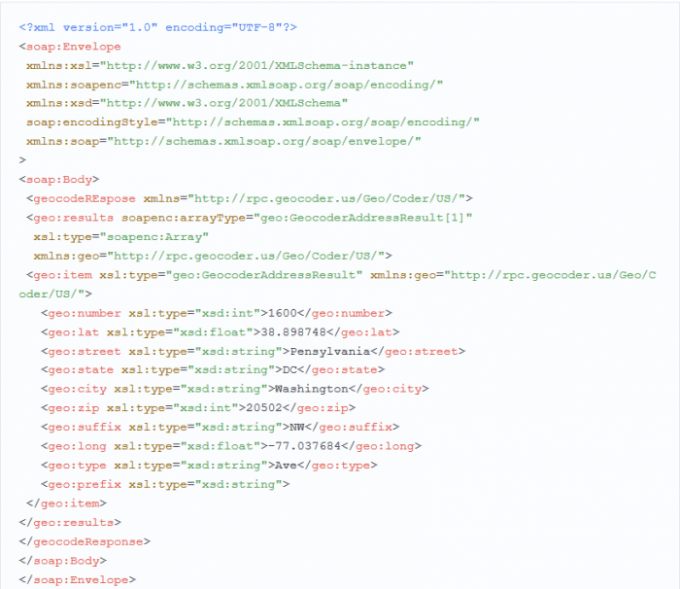
Here is a SOAP request and response packets:

SOAP request sample

SOAP response sample

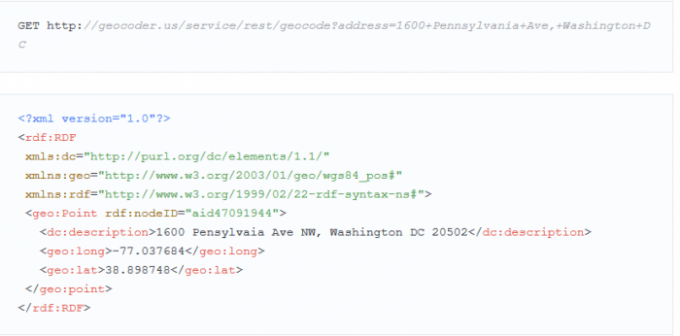
Here is a REST request and response:

REST sample request and response

What is difference between SOAP and REST Web services?

1. SOAP actively uses XML to encode requests and responses, as well as strong data typing, ensuring the integrity of the information is intact, during transmission between the client and the server. On the other hand, requests and responses in REST can be transmitted in ASCII, XML, JSON or any other formats that can be recognized by both the client and the server. In addition, there are no built-in data type requirements in the REST model. As a result, the request and response packets in REST are much smaller than their corresponding SOAP packets.

2. In the SOAP model, the HTTP data transfer layer is a “passive observer,” and its role is limited to sending SOAP requests from a client to the server using the POST method. Service request details, such as the remote procedure name and input arguments, are encoded in the request body. Opposite of SOAP the REST architecture, considers the HTTP data transfer layer as an active participant in an interaction using existing HTTP methods, such as GET, POST, PUT, and DELETE, to indicate the type of service requested. Therefore, from a developer’s perspective, REST requests are generally simpler to be formulated and understood since they use existing and well-understood HTTP interfaces.

3. The SOAP model allows service developers to describe its APIs in a Web Service Description Language (WSDL) file format. Creating these files is quite difficult, but it’s well worth the effort since SOAP clients can automatically retrieve detailed information from these files. For example, about the names and method signatures, input and output types and return values. On the other hand, the REST model avoids the complexity of WSDL in favor of a more intuitive interface based on the standard HTTP methods described above.

4. At the “heart” of REST is the concept of resources, while SOAP uses interfaces based on objects and methods. The SOAP interface can contain an almost unlimited number of methods; the REST interface, in contrast, is limited to four possible operations, corresponding to the four HTTP methods.


Useful link: Download EDI Web Service overview. 

This EDI Web Service overview covers the following topics:

  • What is EDI2XML Web Services?
  • Advantages of using EDI2XML HTTP service
  • Who is EDI Web Service for?

The best Web Service for EDI

EDI2XML Web Service, is for developers, systems integrators and businesses, interested in building their own EDI (Electronic Data Interchange) integration flows and programs. Normally, these individuals, are capable of interacting with external API and Web Services to translate EDI to XML and XML to EDI, and have the resources and expertise to work with Web Services and HTTP requests in order to achieve their goals. EDI2XML web service, is the premier choice for IT people as a reliable service to accomplish such Integration projects.

The best way to discover how REST works for EDI is to try our free 15- days trial version of EDI2XML Web Service.

Click here to request the price list in order to access EDI2XML Web Service


EDI Web Service for edi integration


Continue Reading About Web Service: 

  • API Web Service for EDI X12 exchange – Discover the advantages

  • What is EDI2XML web Service?

  • Fully managed EDI service VS HTTP Web Service: Which is Better for Your Business ?


November 21, 2018
https://www.edi2xml.com/wp-content/uploads/2018/11/SOAP-vs-REST-EDI-integration.png 350 1024 Tatyana Vandich https://www.edi2xml.com/wp-content/uploads/2024/08/edi2xml.com-EDI2XML-company-logo.png Tatyana Vandich2018-11-21 11:16:062020-03-31 10:50:02SOAP or REST Web Services: what you should use for EDI implementation?

Seamless EDI Implementation Through Web Services

Blog

EDI is used almost everywhere regardless of industry or company size. The most extensive use of EDI is in the retail industry. EDI compliance is mandatory in order to trade with big retailers such as Target, Costco, Walmart,… even giants of electronic commerce like Amazon are heavy users of EDI.

There are a lot of different types and approach of implementing EDI in your company. It can fully managed EDI service, or gaining popularity lately EDI Web Service, because, service architects and developers want EDI to be easy to implement, maintainable, extensible, and scalable.

What is Web Service?

Web service is a network technology that provides inter-program interaction based on web standards. More specifically, it’s client and server application that communicate over the World Wide Web’s (WWW).

The W3C consortium defines a web service as: “A Web service is a software system designed to support interoperable machine-to-machine interaction over a network”.

Thus, the web service is identified by a URI string. The Web service has a User Programmatic Interface (UPI) that is represented in WSDL format. Other systems interact with this web service by exchanging SOAP or REST protocol messages. HTTP Hypertext Transfer Protocol is used to transport the messages. The description of Web services and their APIs can be found by UDDI.

♦ WSDL (Web Services Description Language) – is an XML-based interface definition language that is used for describing the functionality offered by a web service.

♦ UDDI (Universal Discovery, Description and Integration) – is an XML-based registry for business internet services

Web services are rich in functionality and extensibility, as well as their machine-readable descriptions through the use of XML. Web services can be combined to achieve complex operations.

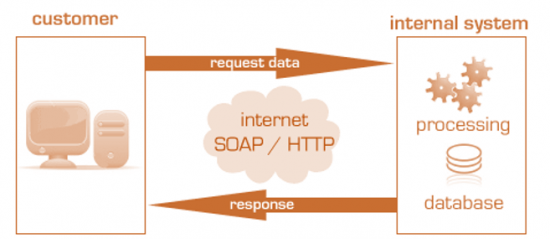
web service diagram

The diagram above shows a very simplified view of how a web service works. The client invokes a web service call by sending a request to a server which hosts the actual web service, then get the response from the web service.

What are the Different Types of Web Services?

Web services can be deployed in several ways. The following web-services are the most commonly used http web services:

♦ SOAP (Simple Object Access Protocol) — in fact, it is a triple of standards SOAP/WSDL/UDDI

♦ REST (Representational State Transfer) – quite often called as RESTful API (Application Program Interface that uses HTTP requests to GET, PUT, POST and DELETE data) or RESTful web service – is based on (REST) technology.

Actually, SOAP originated from XML-RPC (XML Remote Procedure Call) and is the next generation of its development and evolution. While REST is a concept, based on an architectural style.

Of course, there are other types of web services, but since they are not widely used, we will focus on these two in this brief review: SOAP and REST.

A Quick Overview of SOAP Web Services

SOAP stands for Simple Object Access Protocol. It is an XML-based protocol for accessing web services.

It is platform and language independent. It means that by using SOAP, you can interact with other programming language applications.

Initially, SOAP was primarily intended to implement a remote procedure call (RPC). Now SOAP is used to exchange arbitrary messages in XML format, not just to call procedures.

Like any text protocol, SOAP can be used with any application layer protocol: SMTP, FTP, HTTPS, etc., but more often SOAP is used over HTTP.

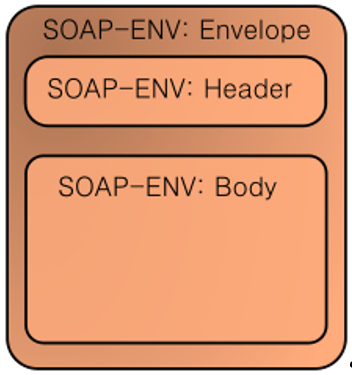
All SOAP messages are structured as an envelope (is the root element in every SOAP message), including the following elements:

  • Message ID (local name)
  • Optional Header element
  • Mandatory Body element (message body)

Structure of SOAP message:

SOAP message structure

The expanded list of SOAP message elements is shown in the data schema (for SOAP version 1.2).

A Quick Overview of REST Web Services

REST stands for Representational State Transfer. As it was mentioned above, REST is not a protocol but an architectural style built on existing standards that are well known and controlled by the W3C consortium, such as HTTP, URI (Uniform Resource Identifier), XML and RDF (Resource Description Format).

In a REST services, the emphasis is placed on access to resources, and not on the execution of remote services; this is the fundamental difference from SOAP-services. However, the remote procedure call is also applicable to REST. It uses the PUT, GET, POST, and DELETE methods of the HTTP protocol to perform tasks. The cardinal difference between REST and SOAP is that REST remains an HTTP request.

According to many developers, SOAP is cumbersome and difficult to use. REST is an easy alternative.

REST is using the URL approach. Often, to make a request, REST relies on a simple URL Instead of using XML.

Advantages of REST Web Services

REST is more flexible and easier to use for the most part. There are following advantages when:

  • Agile: Unlike SOAP, there is no strict specification for REST Web services and it consumes less bandwidth and resources, thus, REST Web services are very fast.
  • Language and Platform independent: REST web services can be written in any programming language and run on any platform.
  • Can be used with different data format: REST web service permits different data format such as Plain Text, XML, HTML, and JSON.

SOAP vs REST: What to Choose?

SOAP is more applicable in complex architectures where interaction with objects is beyond the scope of the CRUD model. In applications having the CRUD model, it can be quite applicable to REST due to its simplicity and transparency.

In fact, if any objects in your service do not need a complex relationship than: “Create”, “Read”, “Update”, “Delete” (usually in 99% of cases is enough), it is possible that REST will be the best choice.

In addition, REST compared to SOAP can be more productive because it does not require parsing complex XML commands on the server (regular HTTP requests are performed — PUT, GET, POST, DELETE).

EDI2XML HTTP Service

EDI2XML Web Service, is an HTTP (based on REST) service running over the internet, on EDI2XML private cloud platform that is capable of receiving HTTP requests to translate EDI messages to XML, and XML messages to EDI (based on EDI2XML’s proprietary XML format). Advantages of using EDI2XML HTTP service:

⇒ You can start with less than an hour

⇒ No contract: pay as you go

⇒ Very simple and dynamic pricing scheme

⇒ Availability and reliability

⇒ Based on proven technology in the field for over 18 years now

⇒ Outstanding technical support

Our EDI Web Service solution solves developer’s problem because we have over 18 years of expertise in EDI, that is difficult for every developer and integrator to acquire quickly.

You can start with the free 15 – days trial of EDI2XML Web Service to see how real-time translation services works.

EDI Web Service for edi integration


Related Posts:

What is EDIFACT? | UN / EDIFACT standard overview

EDI ANSI ASC X12 Standards – Technical Overview – 2020

EDI Integration of B2B e-commerce for small companies

November 20, 2018
https://www.edi2xml.com/wp-content/uploads/2018/11/edi-web-services-.png 350 1024 Tatyana Vandich https://www.edi2xml.com/wp-content/uploads/2024/08/edi2xml.com-EDI2XML-company-logo.png Tatyana Vandich2018-11-20 16:33:062025-07-02 14:32:40Seamless EDI Implementation Through Web Services

Efficient Salesforce and SAP Integration with Magic xpi Integration Platform

Blog

This post was updated to reflect current trends and information.


To improve the productivity of their business, companies invest in the best software solutions and platforms to become more efficient. Numerous large and medium-size companies around the world use SAP’s enterprise resource planning (ERP) along with Salesforce’s Customer Relationship Management (CRM).

However, at some point, companies realize the inefficiencies due to the fact end-users have to maintain two different systems simultaneously, which results in duplicating data entry, therefore, creating inconsistencies between both systems. They realize how crucial it is to have these two important systems work together in synchronized mode. Efficient and faster system integration with Magic xpi is a proven solution in a similar case.

Before we start reviewing Salesforce and SAP Integration, let’s describe in a quick summary what Salesforce CRM and SAP ERP systems are.

What is ERP?

ERP – Enterprise Resource Planning – is an integrated business-management software for administrating internal and external company resources. The system’s purpose is to unify the flow of information between all business units in a company.

ERP Integration with Magic xpi

ERP systems allow to create a standardized and unified information space of the enterprise. In other words, an ERP system is a single-entry point, a single processing center and a single source of information of the activities in an enterprise.

SAP ERP – Overview

The company SAP (Systems, Applications and Products) was founded in 1972 in Germany, by former employees of IBM. It is the world’s largest software corporation. The company now, has over 404,000 customers in over 180 countries.

SAP ERP (SAP R/3)

SAP ERP system (SAP R/3) is a multi-component system that allows to connect business processes of production, procurement, sales and marketing in a company. SAP ERP, is made up of separate components and modules, natively integrated.

SAP R/3 Components

SAP ERP (SAP R / 3) includes three core functional areas, divided into modules.

  • Financial – include financial accounting, controlling, fixed asset management etc.
  • Human Resources – organizational management, includes functionality for recruitment, personnel records, payroll.
  • Logistics – integrates sales and distribution, materials management, production planning, quality management, plant maintenance

What is CRM?

CRM – customer relationship management is a software designed to help businesses improve their customer relationships. CRM focuses on the preservation and analysis of data to improve the marketing, service and business relations with customers.

Salesforce CRM – Overview

Integration Salesforce

Salesforce.com, Inc. is a cloud computing company that provides Customer Relationship Management (CRM) platform. Salesforce has been holding leadership in the global CRM systems market for many years.


There are a large variety of Salesforce CRM categories for all customer needs:

  • Salesforce Sales Cloud – The Sales Cloud is a CRM platform that enables a company to manage sales, marketing and customer support.
  • Salesforce Marketing Cloud –to manage customer journey, email, mobile, social media, web personalization, content creation, content management and data analytics.
  • Salesforce Service Cloud –is a service platform for customer service and support.
  • Salesforce Community Cloud is an online social platform to connect customers, partners, and employees with each other. So, a company can service customers more effectively, and get work done in real time.
  • Salesforce Commerce Cloud is a highly scalable, cloud-based SaaS ecommerce solution.

Read: How to get more out of Salesforce with EDI Integration


What is Magic xpi ?

Magic xpi, is one of the key integration and orchestration technologies on the system integration market. Actually, it is one of the oldest in this space. Magic xpi helps companies in their digital transformation journey, and enable them to integrate heterogenous systems, databases and business processes using certified connectors by the manufacturer. It is a reliable SOA, API-driven integration platform for all connectivity needs.

System Integration with Magic xpi
 

Why System Integration is Important?

Systems integration with Magic xpi can help avoid problems related to the interaction of corporate systems. Companies can get closer to its client by putting together ERP, CRM, social networks and mobile apps.

Salesforce and SAP integration will allow companies to take advantage of both Systems. For example, Salesforce for collecting and registering orders and the ability of the ERP system to process them. In addition, the process of entering orders into the corporate system is significantly accelerated and the percentage of operator errors decreases.


Read: Salesforce integration and Magic xpi: Things you should know


The best of both: ERP and CRM

Salesforce and SAP integration is essential to maximize each system’s output, reduce errors, and improve overall organizational efficiency.

As mentioned above, SAP is one of the world’s leading providers of enterprise software solution and an important advantage of SAP ERP is its capability to integrate with third-party solutions through either iDOC or BAPI. This integration improves performance and helps automate many business processes. But in order to achieve the desired results, you need to be sure that the integration process is done properly, using certified connectors by SAP themselves, and all systems work as planned.

SAP and Salesforce Integration Challenge

Despite the fact that Salesforce and SAP offer a complete and documented APIs, integration of these two complex systems is not as simple as it may seem at first glance, especially if going through the legacy point-to-point integration using traditional coding methodology.

Each one of these systems, provides its own API:

SAP offers connectivity using BAPI (Business Application Programming Interface) and iDoc (for standard and customized schemes) or web services interfaces via SAP Netweaver XI/PI.

Salesforce also provides a Web service interface.

Understanding the structure, dependencies and requirements of each API during a systems integration, requires a lot of efforts, because each API is different, specific to the corresponding vendor, and typically very time consuming to learn and read all documentation.

The integration challenge is further complicated by the fact that SAP is an on-premises solution, while Salesforce is a fully cloud-based software as a service (SaaS) solution.

Systems integration and automation processes usually require a lot of custom coding, which is very difficult and tedious to write with a point-to-point approach.

Experience has shown, the system integration using manual coding is inefficient. In case you have integrated with complex and lengthy individual coding, you will almost certainly have less opportunity to incorporate appropriate and unified mechanisms for live processes managing. If the appropriate integration tools are not used, companies lose sight of the benefits of integration opportunities due to the direct costs and risks that manual integration entails.

Overcoming integration problems using Magic xpi

Magic xpi integration platform, provides fast and efficient enterprise-grade integration. With Magic xpi, there is no need for additional coding. This is a proven solution for automating business processes and data synchronization.

ERP/CRM  Integration

Magic xpi has “certified connectors” certified by Salesforce and SAP and Salesforce respectively. It extends the proficiencies of any Salesforce CRM and SAP systems. Magic xpi easily synchronize, integrates and orchestrates business processes, enterprise applications using a visual “drag and drop” mechanism, between source and destination.


Without custom coding, using visual and intuitive design tools Magic xpi unifies and makes Salesforce and SAP interface easier. Magic xpi allows you to create simple or very complex integration scenarios between several systems, data retrieval and conversion, use of any communication protocol, monitoring, scheduled tasks, reliable deployment, and more.

With Magic xpi, a company can get accurate and real-time view of corporate information, without any user intervention. Magic xpi’s code-free approach enables companies to quickly deploy integration projects, in a matter of days rather than months. Thus, benefiting from an immediate return on investment.


Read: How to Choose the Right Integration Platform?


Efficient and easy integration

Our main priority is to find solutions that increase business efficiency. We have a successful experience in integrating different systems using Magic xpi integration platform. Our deep understanding of business context and various industry specifics, allows us to create solutions that make any business activity as efficient as possible.

October 24, 2018
https://www.edi2xml.com/wp-content/uploads/2018/10/SAP-and-salesforce-Integration.png 350 1024 Tatyana Vandich https://www.edi2xml.com/wp-content/uploads/2024/08/edi2xml.com-EDI2XML-company-logo.png Tatyana Vandich2018-10-24 13:21:582025-08-01 13:23:58Efficient Salesforce and SAP Integration with Magic xpi Integration Platform

All About EDI: 11 Complete Answers about Electronic Data Interchange

Blog

This post was updated to reflect current trends and information.


We often get asked questions about EDI (Electronic Data Interchange), so we decided to write this article to answer the most common questions we get. We also provide you with useful links in case you’d like to explore further.

1. What is EDI? (Electronic Data Interchange)

Electronic Data Interchange (EDI) In simple words, EDI is the process of electronically exchanging business documents (in a pre-defined format) between trading partners. EDI replaces the faxing of paper and mailing documents.

Any standard business documents (e.g. a purchase order, invoice, shipping notice etc.) can be transferred by EDI, considering both parties have been setup to exchange with the appropriate EDI communication.

Useful Reading: EDI Document Library

2. Who uses EDI?

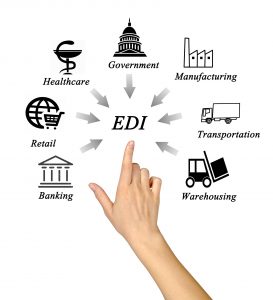
Electronic data interchange EDI Organizations of all types and sizes are able to utilize EDI. EDI communication is used in Government and various industries such as banking, healthcare, retail, automotive and others. Any company that buys, sells goods or services can potentially use EDI.

3. To be EDI capable or EDI compliant – what does it mean?

In simple words, EDI capable or EDI compliant is the ability to exchange business documents electronically in a specific format based according to an EDI standard.
Being EDI compliant, means your company has complied with the pre-agreed EDI standard which allows you to send and receive EDI documents to any business/trading partner located anywhere in the world.

4. What are the EDI standards?

All EDI transactions are determined according to EDI standards. Many industries have developed their own EDI standards to fit their requirements and business terms. EDI standards are built on the concept of making electronic business documents uniform, without regard to a country or place of origin. EDI standards regulate the correct order and location of the units of data in an EDI document. Below are some of the most commonly-used standards:

ANSI ASC x12 Uniform standard, developed by the American National Standards Institute, and Accredited Standards Committee X12 (ASC X12) to support companies across different industry sectors in North America.

EDIFACT Electronic Data Interchange for Administration, Commerce, and Transport (EDIFACT), developed by the United Nations. EDIFACT is the international standard but is widely used by multiple industries in Europe.

RosettaNet A standard widely used in the global semiconductor industry, but also in electronic components, consumer electronics, telecommunication, and logistics. RosettaNet is widely used in the USA, but it is also well accepted and even supported by governments in Asia.

Useful Reading: RosettaNet and B2B EDI Integration: All you need to know

PEPPOL (Pan-European Public Procurement Online) allows public organizations and their suppliers to exchange standard-based electronic documents over its network. PEPPOL simplify the trading process between private companies and government.

Useful Reading: B2G Integration: PEPPOL EDI Data Interchange

ODETTE A standard used by the automotive industries in Europe, developed by the Organization for Data Exchange by Tele Transmission in Europe.

SWIFT (Society of Worldwide Interbank Financial Telecommunication) The main goal is to exchange messages between financial institutions and banks. Financial and bank institutions from over 200 countries used SWIFT.

Tradacoms Standard mainly used in the UK retail sector.

5. What is EDI Mapping?

Mapping is the process of taking data from EDI format, to a company specific format and vice versa.

6. What does an EDI document, an EDI message or EDI transaction set, mean, is there a difference between them?

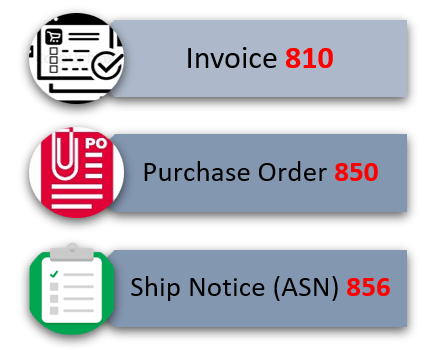
In the EDI environment each business document, such as an invoice or a purchase order, is called an EDI message or EDI transaction set or EDI document. Technically, there is no difference between them… The most commonly used EDI documents, especially in the retail and manufacturing industries, are as follows:

  • 810 Invoice
  • 846 Inventory Inquiry message
  • 850 Purchase Order
  • 855 Purchase Order Acknowledgment
  • 856 Ship Notice/manifest (ASN)
  • 997 Functional Acknowledgment

Useful reading: The most used EDI messages in the supply chain management

What is Advanced Ship Notice (ASN) 856 transaction set?

What is EDI 846 document?

Why EDI 846 is important to do business with big-box retailers

7. What are EDI Communication Protocols?

EDI protocols are the communication platform used for constant transmission of data between business partners.

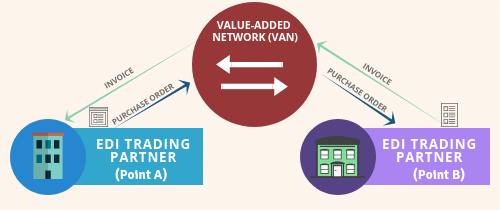
Companies can either exchange documents directly to their Trading Partners (Point-to-Point) or through an EDI Network (VAN).

Direct

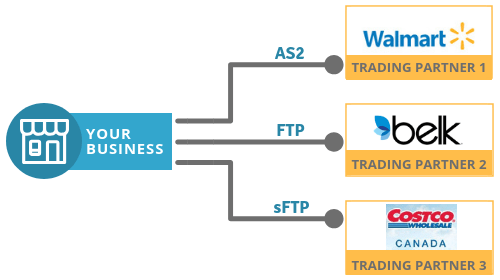
Direct EDI also known as Point-to-Point, allows companies to establish a single secure connection with their Trading Partner. Following are the most common communication protocols used to exchange EDI data in a point-to-point or direct connectivity:

  • FTP/SFTP – File Transfer Protocol/Secure File Transfer Protocol. These file transfer protocols allow businesses to connect with their partners via the Internet in order to exchange EDI documents.
  • AS2 A secure way to exchange documents over the Internet by using digital certificates and encryption of the EDI data. Communication protocols EDI AS2 FTP sFTP

VAN (Value Added Network)

VAN – is a private network provider, that only transmits EDI transactions in a secured manner between private networks. A VAN is a mediator who moves data from point A to point B. Until recently, this method of transferring data was considered the safest.

Useful reading: EDI Communication and VANs

EDI VAN connection

8. Which EDI Standard, Document(s) and Protocol should I use?

If you are just starting out, then you will most likely receive a list of requirements from your Trading Partner. It all depends which EDI standard they use, which documents they require from their Partners and how they expect these documents to be sent to them. Your trading partner is one that most of the times dictates the documents to exchange.

9. What are the Benefits of EDI?

There are multitudes advantages to use EDI (Electronic Data Interchange) both for small and mid-size companies as well as to big corporations. Below some impressive benefits from implementing EDI:

  • Improves Shipment Accuracy
  • Accelerates the movement of goods to customers
  • Improves customer/partner relationships
  • Improves cycle time reductions
  • Decision makers are able to quickly access order statuses
  • Improves document accuracy due to the elimination of manual labor.
  • Enhances the flow of information between 2 trading companies
  • Internal teams can now focus on core business tasks and

10. What is the difference between SaaS EDI & On-Premise EDI Software?

SaaS EDI

EDI2XML EDI SaaSUsing SaaS EDI model customers do not pay for ownership of the software, but for renting it (i.e. using it through a mobile application or Web interface). The main advantage of the SaaS model for the company is the absence of costs associated with the installation, update, and maintenance of the equipment and software that is being used by the company.


On-premises EDI

In on-premises deployment model, the company needs to maintain and manage the EDI software system itself. There is a whole control over all aspects of the EDI system including security, access and data integrity. EDI software is loaded onto the company’s owned PC or servers. If you choose the on-premises EDI model, keep in mind that you need the skills and expertise within your IT team. You also need the budget to maintain and upgrade EDI software and hardware when needed.

Useful reading: SaaS EDI or On-Premises EDI Translation Software: What you should know

11. What is EDI2XML?

EDI2XML is a SaaS EDI Solution, capable of converting EDI documents into XML/CSV/TXT format files and vice versa. EDI2XML is a Full Translation Service, which includes the translation of incoming and outgoing documents as well as communication with Trading Partners.

If you are still not finding the answer in our frequently asked questions post, please contact us.

Do you want to implement EDI at your company? Find out how to get started – request a live demo of EDI2XML.

Free EDI and System Integration consultation

October 22, 2018
https://www.edi2xml.com/wp-content/uploads/2018/10/All-about-EDI.png 350 1024 Tatyana Vandich https://www.edi2xml.com/wp-content/uploads/2024/08/edi2xml.com-EDI2XML-company-logo.png Tatyana Vandich2018-10-22 11:58:222019-02-28 14:02:49All About EDI: 11 Complete Answers about Electronic Data Interchange

ANSI ASC X12 Standards Overview

Blog

This post was updated to reflect current trends and information.

To exchange business documents and transactions between business partners via EDI (electronic data interchange), most companies in North America use the EDI ANSI ASC X12 Standards. This overview provides some basic information about the X12 standards for electronic data interchange (EDI).

What do ANSI, ASC, X12, and RSC mean?

The American National Standards Institute (ANSI) is a non-profit organization that controls the development of standards for processes, services, and products in the United States. ANSI also synchronizes U.S. standards with international standards so that American products can be used all over the world.

X12 Overview

Chartered by the ANSI for over 40 years, X12 develops and maintains EDI standards and XML schemas that govern business processes around the world.
X12 is comprised of thousands of experts representing over 600 companies from various industries. X12 Membership is open to any organization, company, or even individual who is directly and materially affected by X12 activities.
To facilitate the exchange of business transactions, X12 members regularly optimize the EDI standard.
X12 consists of two committees:
– Accredited Standards Committee (ASC)
– Registered Standards Committee (RSC).

Useful: What is EDI? (A technical introduction to EDI)

Accredited Standards Committee ACS

Since 1979, the Accredited Standards Committee X12 (ASC) has been developing and maintaining the X12 standard, which can be represented as US national standards or UN / EDIFACT international electronic data interchange standards.

The ASC is composed of different subcommittees:
– X12C – Communications and Controls
– X12F – Finance
– X12I – Transportation
– X12J – Technical Assessment
– X12M – Supply Chain
– X12N – Insurance

Registered Standards Committee (RSC)

The RSC is responsible for the development and support of X12 work products for various industries, but it is not intended to be presented as US national standards.

What is EDI ANSI ASC X12 Standards?

The ANSI ASC X12 Standards is sometimes called the EDI ASC X12, ANSI X12, ASC X12, or simply the X12 Standard. X12 is a set of standards and rules that determine a specific syntax for structuring and transferring electronically business documents between partners. There are different types of business documents in EDI, which are often called “Transaction Sets”.

ASC X12 Transaction Set

The Transaction Set is a single business document, such as a Purchase Order, Invoice, Student Educational Record (Transcript), Healthcare claim, Ship Notice (ASN). There are hundreds of Transaction Sets available in the ANSI ASC X12 standards. Each set of transaction data is identified by a 3-digit code number:

ASC X12 Transaction Set

X12 Transaction Set Structure

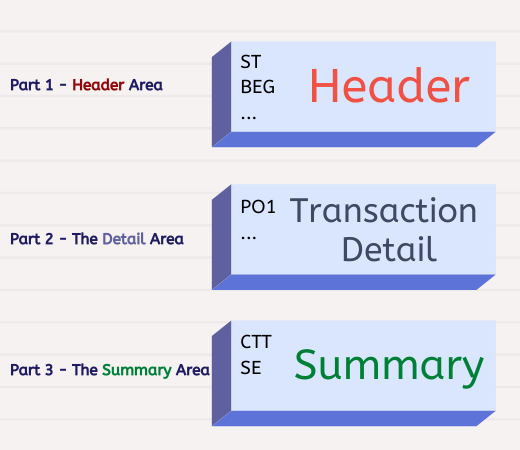
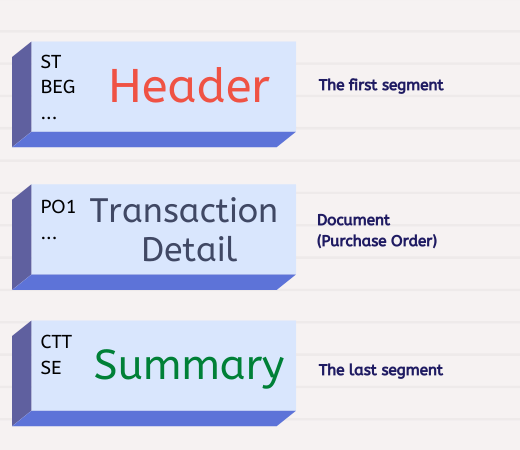
Many X12 transaction sets have 3 parts. The segments that can be used in each of these parts in a particular document (such as an invoice) are listed in the related tables defined in the X12 standards document. For example:

X12 Transaction Set Structure
 

ASC X12 Segments and Sequence

The following Purchase Order example shows which segments can be used in the transaction set and the desired sequence of segments:

ID            TITLE

ST           Transaction Set Header

BEG        Beginning Segment for Purchase Order

CUR       Currency

REF         Reference Identification

PER        Administrative Communications Contract

TAX        Tax Reference

FOB        F.O.B. Related Information

CTP        Pricing Information

PAM      Period Amount

CSH        Sales Requirements

TC2         Commodity

Beginning and Ending ASC X12 Transaction Sets:

• A transaction in an X12 document always begins with the Transaction Set Header (ST) segment

• A transaction in an X12 document always ends with the Transaction Set Trailer (SE) segment

X12 Structure

If you want to learn more about the structure of EDI ANSI ASC X12, please read this article: EDI ANSI ASC X12 – Technical Overview


ANSI X12 EDI document types

Since a uniform standard of EDI (electronic data interchange), ANSI X12 was developed, a huge number of companies use it in their business-to-business (B2B) operations. Although the ANSI X12 standard was developed to support companies in different types of industries in North America, these days, businesses worldwide are using the X12 EDI standard.

As mentioned above, there is a huge amount of ANSI X12 document types available for use. The ANSI X12 standard is used in finance, transportation, healthcare, insurance, government, supply chain, and other industries for performing diverse operations. The example below shows some of those EDI documents:

Communications and Control:

  • EDI 864 Text Messages
  • EDI 997 Functional Acknowledgment
  • EDI 999 Implementation Acknowledgment
  • EDI 993 Secured Receipt or Acknowledgment

Finance:

  • EDI 130 Student Educational Record (Transcript)
  • EDI 262 Real Estate Information Report
  • EDI 810 Invoice
  • EDI 812 Credit/Debit Adjustment
  • EDI 131 Student Educational Record (Transcript) Acknowledgment
  • EDI 149 Notice of Tax Adjustment or Assessment
  • EDI 150 Tax Rate Notification
  • EDI 821 Financial Information Reporting

Transportation:

  • EDI 120 Vehicle Shipping Order
  • EDI 106 Motor Carrier Rate Proposal
  • EDI 419 Advance Car Disposition
  • EDI 216 Motor Carrier Shipment Pickup Notification
  • EDI 309 Customs Manifest

Supply Chain:

  • EDI 846 Inventory Inquiry/Advice
  • EDI 856 ASN (Advance Ship Notice)
  • EDI 860 PO Change (Customer triggered)
  • EDI 850 Purchase Order
  • EDI 830 Planning Schedule with Release Capability

Insurance:

  • EDI 270 Health Care Eligibility/Benefit Inquiry
  • EDI 271 Health Care Eligibility/Benefit Response
  • EDI 111 Individual Insurance Policy and Client Information
  • 837 Health Care Claim

EDI Outsourcing

We support all EDI standards, including ANSI(ASC) X12, EDIFACT, RosettaNet, and HIPAA / X12. We provide a cloud-based, fully managed EDI integration solution under our program EDI2XML Managed Services, which allows our clients to interact with their business partners without implementing a complex EDI infrastructure.

Our popular managed EDI integration service is accessible and affordable to even small and medium-sized businesses.


Book a FREE one-on-one EDI consultation session with our in-house experts.


Benefits of a fully managed EDI service:

• Time: Reduced transaction processing time and improved customer service

• Cost: Improved inventory management and minimized use of paper and physical storage

• Quality: Enhanced business relationships with your business partners, and accuracy of information

• Profit: Reduce costs

• Efficiency: Increased productivity

EDI2XML Web Services (Rest API)

EDI2XML web services, our REST API to convert X12 to XML and vice versa meant for companies who got their own technical resources to work with the REST API (call and consume HTTP REST Web services).

Benefits of EDI2XML web service:

  • Self-service solution
  • Low cost
  • Quick entry: you can be up and running in less than an hour, and it is proven
  • We offer a 15-day free trial, without any commitment.

Contact us for more information and for pricing.

October 11, 2018
https://www.edi2xml.com/wp-content/uploads/2018/10/ANSI-ASC-X12-Standards-edi2xml.png 350 1024 Tatyana Vandich https://www.edi2xml.com/wp-content/uploads/2024/08/edi2xml.com-EDI2XML-company-logo.png Tatyana Vandich2018-10-11 09:00:432026-02-24 11:11:11ANSI ASC X12 Standards Overview

EDI 130 Student Educational Record (Transcript)

Blog

This post was updated to reflect current trends and information.

In this post, I would like to introduce a very important EDI document, becoming very popular in use, especially in the Education Industry – EDI 130 Student Educational Record (Transcript).

EDI Student Educational Record (Transcript)We are used to the fact that EDI is an integral part of a business, so you may ask: “Why do educational institutions use EDI?” It is for the same reasons that commercial organizations use EDI in their business transactions. EDI improves security, accuracy of data, speed in information transmission, and at the same time reduces costs.

What is EDI 130 Student Educational Record (Transcript)?

X12 130 Student Educational Record (Transcript) was developed for the Education Community in order to exchange the information about students. With EDI 130 X12 transaction, educational institutions are able to exchange the historical and current information on academic achievements and other important data about their students.

The student transcript contains the following information about the student:

  • identity information and personal history
  • the actual academic status
  • dates of attendance
  • courses completed with grades received
  • degrees and diplomas awarded
  • test score Record
  • health information (only up to Grade 12)

When is an EDI 130 Student Educational Record (Transcript) Used?

The Student Educational Record (Transcript) (EDI 130) is exchanged between educational institutions when a student transfers from one educational institution to another. For the receiving institution, it is important to know what courses the student has already completed so that he will be placed in the appropriate educational programs at the new institution.

The EDI 130 transaction set may also be used when a student looks for a job or wishes to inform other institutions about his academic accomplishments, so the student transcripts may be sent to a prospective employer, a division of the military, or another government agency.

This EDI 130 document is heavily exchanged in the following educational institutions:

  • Elementary/secondary schools
  • Post-secondary schools (universities, academies, colleges, seminaries, conservatories, and institutes of technology)
  • State and Federal education agencies
  • Student data providers and other third parties

The Content of X12 Transaction Sets

In the process of exchanging students’ information, an educational establishment may operate the four main X12 Transaction Sets: The content of X12 Transaction Sets

  • ANSI X12 EDI – 130 Student Educational Record (Transcript)
  • ANSI X12 EDI – 131 Student Educational Record (Transcript) Acknowledgment.
  • ANSI X12 EDI – 146 Request for Student Educational Record (Transcript)
  • ANSI X12 EDI – 147 Response to Request for Student Educational Record (Transcript)

EDI 130 Student Educational Record (Transcript) Exchange between educational institutions. As mentioned above, the student transcript contains all personal history and identifying information about the student. These data elements (items of information) are grouped into data segments (sets of related data elements) which are corresponding to “records” in a paper document. Many of the data segments are optional, but data segments that provide the necessary information to determine which record sent is mandatory. Most of the information in the transcript format are set up in “loops.” Loops are sets of segments that provide multiple instances of the related information.

EDI 131 Student Educational Record (Transcript) Acknowledgment.

EDI 131 transaction set is used in response to the initiation of the request of EDI 130 Student Educational Record (Transcript). It serves both security and information purpose. Most of the data segments in this transaction set are mandatory. Included are segments containing information about the sender, the student’s name, its identification number, number of course segments, and academic summary information.

EDI 146 Request for Student Educational Record (Transcript) Communicates from one institution to another a request for a student’s educational record. EDI 146 includes data segments containing information needed to provide appropriate student’s record such as student and parents names, previous address, identification numbers, demographic information, and dates of enrollment.

EDI 147 Response to Request for Student Educational Record (Transcript). Communicates back to the requesting institution that the request was received, but the receiving institution is unable to respond immediately. EDI 147 can also be used to inform the requesting institution when the transcript will be sent or why it can’t be sent. Included are segments repeating information about the student whose record was requested, a request rejection reason code.

EDI 997 Functional Acknowledgment. This transaction set also may be used. Communicates to the sender that a receiver has in fact successfully received EDI transactions.

Become EDI Compliant with EDI2XML

EDI2XML as a Service is the perfect option for Educational Institutions that want to start or to simplify their entire EDI communication process. Our EDI2XML tool was designed to capture more than 90% of the EDI information in any EDI document. However, we can configure the converters to function according to your specific requirements.

Contact us for more information or for pricing.

Free IT Consultation

October 9, 2018
https://www.edi2xml.com/wp-content/uploads/2018/10/Featured-image-EDI130.png 512 1024 Tatyana Vandich https://www.edi2xml.com/wp-content/uploads/2024/08/edi2xml.com-EDI2XML-company-logo.png Tatyana Vandich2018-10-09 10:20:582026-02-10 15:10:43EDI 130 Student Educational Record (Transcript)

RosettaNet and B2B EDI Integration: All you need to know

Blog, EDI, EDI2XML

This post was updated to reflect current trends and information.


This article is dedicated to B2B EDI Integration using RosettaNet standard. It describes the RosettaNet business-to-business (B2B) standard, RosettaNet terminology such us PIPs (Partner Interface Processes), RNIF (RosettaNet Implementation Framework), Action Message, Signal Message, and other key RosettaNet features. The information in this topic will be helpful to understand RosettaNet standards and concept before its implementation.

Overview of RosettaNet

RosettaNet is a group of Technology corporations that have created and implemented B2B protocol standards. These standards define the exchange of electronic business documents. RosettaNet is one of B2B protocol standard which allows different businesses to communicate electronically over a network.

The RosettaNet description from Wikipedia is: “RosettaNet is a consortium of major Computer and Consumer Electronics, Electronic Components, Semiconductor Manufacturing, Telecommunications and Logistics companies working to create and implement industry-wide, open e-business process standards. These standards form a common e-business language, aligning processes between supply chain partners on a global basis.”

What Is RosettaNet Standards?

RosettaNet it is one of the EDI (Electronic Data Interchange) standards for exchanging business messages using HTTP(S) with MIME headers. As Identifiers RosettaNet uses DUNS numbers. RosettaNet messages contain a Preamble, Delivery Header, Service Header, and Service Content. RosettaNet Standards are free and open to the public as well as private organizations and individuals. You can have access to standards on RosettaNet website.

RosettaNet is used in the IT Supply Chain by (3) main industries:

  • Electronic Components
  • Semiconductor Manufacturing
  • Information Technology

RosettaNet Implementation Framework (RNIF)

The RosettaNet Implementation Framework (RNIF) is an open, common networked-application framework generated to allow trading partners to exchange RosettaNet PIPs.

The RNIF regulate implementation guidelines for developing software applications components that simplify the RosettaNet PIP messages fulfillment between business partners. Recommendations are provided for packaging, security, transport, routing, signals, trading partner agreements.

In simple words, RNIF defines how to build, parse, secure, and send RosettaNet messages.

 RNIF Version 1.1 and RNIF version 2.0 key features comparison

There are two versions of RNIF:

  • RosettaNet Implementation Framework v1.1 (RNIF 1.1)
  • RosettaNet Implementation Framework v2.0 (RNIF 2.0)

The table below describes some RNIF version 1.1 and version 2.0 implementation guidelines.

Guideline RNIF Version 1.1 RNIF Version 2.0
 Transport  Supports the secure HTTP transport   protocol for exchanging messages   between trading partners  Supports multiple transport   protocols  (such as secure HTTP and   SMTP)
 Packaging  Supports the format (RNO)   RosettaNet Object.  Supports the Internet standard that   extends the format of email   Multipurpose Internet Mail   Extensions (MIME) format
 Authorization  Guarantee that the sender of the message is allowed to send a message to the   receiving partner.
 Encryption  Not provides  Guarantees that transmitted messages   can be seen only by the expected   recipient, who is able to decrypt and   extract the information.
 Authentication  It is required a digital signature from the message sender


 Nonrepudiation  Provides total proof that a certain action has occurred. The following       nonrepudiation  types are available:

•  The digital signature of the message. This prevents the sender from   attempting to reject the sending of the message. The recipient of the message   must keep the message for an agreed period of time (usually three to seven   years).

•  Send back a signed acknowledgment. The message recipient has to store   both the receipt and the original message for an agreed-on period of time.

RNIF may be used different protocols such as HTTP, HTTPS, Simple Mail Transfer Protocol (SMTP)

What Is RosettaNet Partner Interface Process (PIPs)?

In RosettaNet, a Partner Interface Process (PIP) defines a fulfillment of a business transaction between trading partners. The principal objective of PIPs, is the exchange of business data between trading partners. PIPs determine the messages structure, steps order, role (buyer and seller) activities, values, for each message transmitted between trading partners. Compliance with these specifications allows the trading partners to achieve business goals.

PIPs require the following:

  • A specific business result (for example, the receipt of a purchase order from a trading partner)
  • A role to fulfill at least one action (for example, a buyer role requests a Purchase Order from a seller role and a seller role submits a Purchase Order Acknowledgment to the buyer role).

Each partner has to fulfill his specific requirements of the PIP. If one trading partner does not satisfy his requirements, then the business transaction is voided for all participating PIP trading partners.

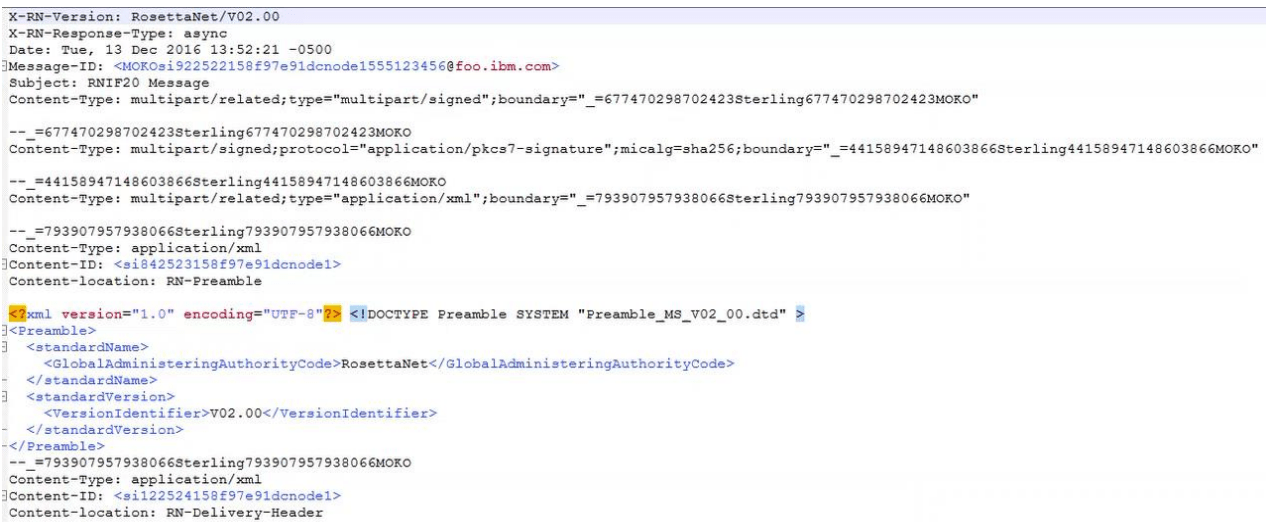
What does a PIP document look like?

A PIP in its entirety consists of:

  • Preamble
  • Delivery Header (if using RNIF 2.0)
  • Service Header
  • Service Content (the actual data – the Purchase Order, Advance Ship Notice, etc.) RosettaNet-sample
 PIP Classifications

RosettaNet PIPs are classified into seven clusters. Each cluster is broken down into segments, within each segment, individual PIPs contain one or more activities, which specify actions to be performed.

Here is a list of the PIP clusters:

Cluster 0: RosettaNet Support. Delivers administrative functionality.

  • Segment 0A: Administrative.
  • Segment 0C: Testing.

 Cluster 1: Partner Product and Service Review. Collect information of trading partner and product-information subscriptions.

  • Segment 1A: Partner Review
  • Segment 1B: Product and Service Review

 Cluster 2: Product Information. Distribution and periodic update of product notices and product technical specifications.

  • Segment 2A: Preparation for Distribution
  • Segment 2B: Product Change Notification
  • Segment 2C: Product Design Information

 Cluster 3: Order Management. Supports full order management business area.

  • Segment 3A: Quote and Order Entry
  • Segment 3B: Transportation and Distribution
  • Segment 3C: Returns and Finance

 Cluster 4: Inventory Management. Inventory management, including reporting and allocation of constrained product.

  • Segment 4A: Collaborative Forecasting
  • Segment 4B: Inventory Allocation
  • Segment 4C: Inventory Reporting
  • Segment 4D: Inventory Replenishment
  • Segment 4E: Sales Reporting

Cluster 5: Marketing Information Management. Communication of marketing information.

  • Segment 5C: Design Win Management (EC)
  • Segment 5D: Ship from Stock and Debit (EC)

Cluster 6: Service and Support. Post-sales technical support.

  • Segment 6A: Provide and Administer Warranties, Service Packages, and Contract Services.
  • Segment 6C: Technical Support and Service Management

Cluster 7: Manufacturing. Exchange of design, configuration, process, quality and other manufacturing floor information.

  • Segment 7B: Manage Manufacturing WO & WIP.
  • Segment 7C: Distributed Manufacturing Information.

Type of RosettaNet Messages

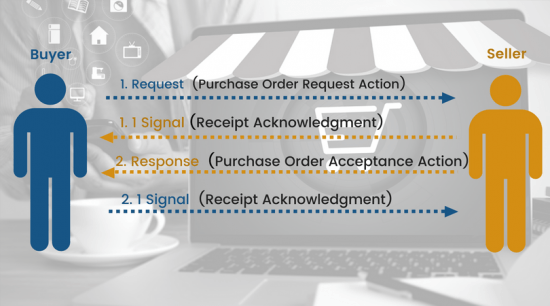
Messages related to PIP business document exchange can be divided into two categories: Business Action messages and Business Signal messages. The Business Action message is the basic business message such as a Purchase Order or Request for Quote, that is exchanged within a RosettaNet trading process. The Business Signal message is a positive or negative Acknowledgment message sent in response to a business Action Message. RosettaNet has five types of business Signal Messages:

Receipt Acknowledgment

A Receipt Acknowledgment is a positive signal acknowledging receipt of a Business Action message. It is sent when structurally and syntactically valid RosettaNet action.

Receipt Acknowledgment Exception (supported only in the RNIF 1.1.)

A Receipt Acknowledgment Exception is a negative signal indicating a problem (structurally or syntactically invalid RosettaNet action).

Acceptance Acknowledgment (supported only in the RNIF 1.1.)

An Acceptance Acknowledgement is a positive signal acknowledging. This message sent when a partner receiving accepts the RosettaNet Action Message for processing. The signal does not indicate a success or failure of message processing.

Acceptance Acknowledgment Exception (supported only in the RNIF 1.1.)

An Acceptance Acknowledgement Exception is a signal indicated a negative acknowledgment of acceptance A message is sent when the partner receiving the RosettaNet action message cannot accept the message for processing in the backend system.

General Exception

A General Exception is a negative signal. It’s signified that actions performed by processes outside of RosettaNet caused an error.

Note: Business Action messages are acknowledged. Business Signal messages are never acknowledged. The following figure shows a message flow: 
 Structure of a RosettaNet Business Messages

A business message exchanged between trading partners via RosettaNet 1.1 protocol is called RosettaNet Object (RNO).

The business message exchanged via the RosettaNet 2.0 protocol, is called RosettaNet Business Message (RBM).

RNIF 1.1 and RNIF 2.0. have different basic message structure.

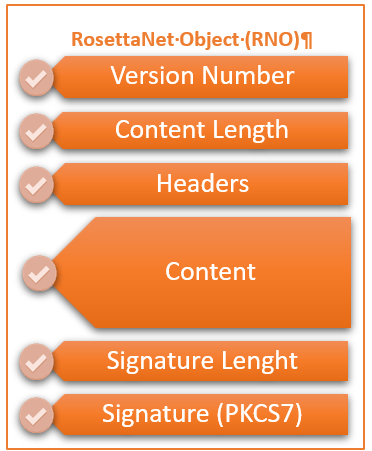
RosettaNet Object (RNO) for RNIF 1.1

The RNIF 1.1 message has the following structure:
RNO-structure Rosettanet

• Version – Specifies the RNIF version (1.1), in binary format.

• Content Length – Length of the multi-part MIME message, in binary format.

• Headers – Comprises the next headers:

  • Preamble Header
  • Service Header

• Content (Payload) – Contains the following components:

  • Service Content—contains either an action or a signal message.
  • Attachments—Optional. Can contain zero or more attachments, which comprise of XML and non-XML (binary) data. It can be attachments such as PDF files, Word documents, GIF images, and other. The information for each attachment is included in the Service Header of the message.

• Digital Signature (Optional)

  • Length of the signature in binary format.
  • Signature (PKCS7) in binary format.

RosettaNet Business Message (RBM) for RNIF 2.0

The RosettaNet Implementation Framework 2.0 presented the notable differences in the components of a RosettaNet Business Message (RBM):

• In the version RNIF 2.0 the Delivery Header was added.

• In RNIF 2.0 the Service Header and Content can be encrypted.

The figure below shows the components and structure of an RBM: RosettaNet RBM-structure
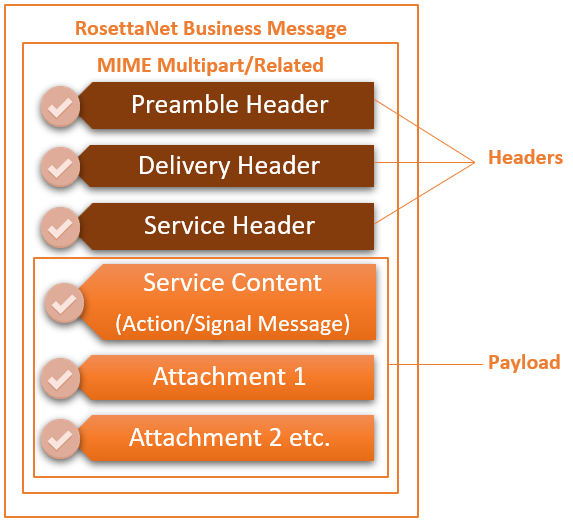
• Headers. Includes the following headers:

  • Preamble Header
  • Delivery Header
  • Service Header

All headers are essential and there is only one header of each type, per message. The general purpose of these headers is that the recipient can:

  • Recognize the message as a RosettaNet Business Message
  • Identify the context of the message
  • Identify the sender for authentication and authorization.

• Payload. Includes the following components:

  • Service Content—Contains either an action or a signal message.
  • Attachments—Optional. Can contain zero or more attachments, which comprise of XML and non-XML (binary) data. It can be attachments such as PDF files, Word documents, GIF images, and other. The information for each attachment is included in the Service Header of the message.

EDI ANSI X12 and RosettaNet PIPs Cross reference

In the process of computer-to-computer exchange of business documents, such as purchase orders, invoices etc. with a Trading partner, exchanging documents occurs in a standard electronic format. It can be standards such as ANSI X12, EDIFACT, or RosettaNet in the high-tech industry. In each standard, there are different requirements for electronic documents and they can be called differently. On the example below, you can see the comparison of two standards ANSI X12 and RosettaNet.

  • ANSI X12 EDI 810 Invoice – RosettaNet PIP 3C3 Notify of Invoice
  • ANSI X12 EDI 846 Inventory Inquiry/Advice – RosettaNet PIP 4C1 Distribute Inventory Report
  • ANSI X12 EDI 850 Purchase Order message – RosettaNet PIP 3A4 Request Purchase Order
  • ANSI X12 EDI 855 Purchase Order Acknowledgment – RosettaNet PIP 3A20 Notify of Purchase Order Confirmation
  • ANSI X12 EDI 856 ASN (Advance Ship Notice) – RosettaNet PIP 3B2 Notify of Advance Shipment
  • ANSI X12 EDI 860 Buyer triggered P/O change – RosettaNet PIP3A8 Request Purchase Order Change

Trading Partner Integration

Our company focuses on the integration of Trading partners, which is also known as business-to-business integration (or B2B Integration). For more than 18 years we have been automating business processes and helping our clients, manage business relationships with their trading partners. We are EDI Integration experts and we have a strong expertise around RosettaNet. So, if you need help with RosettaNet or any EDI Integration contact us today.


Free EDI Consultation


August 28, 2018
https://www.edi2xml.com/wp-content/uploads/2018/08/Rosettanet-B2B-EDI-Integration-edi2xml.png 512 1024 Tatyana Vandich https://www.edi2xml.com/wp-content/uploads/2024/08/edi2xml.com-EDI2XML-company-logo.png Tatyana Vandich2018-08-28 14:31:142019-01-24 12:37:58RosettaNet and B2B EDI Integration: All you need to know

B2G Integration: PEPPOL EDI Data Interchange

Blog

This post was updated to reflect current trends and information.


Increasingly across Europe, when dealing with public sector organizations, suppliers have to communicate electronically and present their business documents such as Orders, Advance Shipping Notes, Invoices, Catalogues, etc. in PEPPOL (Pan-European Public Procurement Online) format.

What is PEPPOL?

What does Peppol stand for? PEPPOL (Pan-European Public Procurement Online), is an EDI (electronic data interchange) protocol that allows public organizations and their suppliers to exchange standard-based electronic documents over its network. PEPPOL is designed to simplify the trading process between the government and private companies.

PEPPOL permits private companies to communicate electronically with any European public sector organization in the trading process, increasing opportunities for greater competition for government contracts.

What is OpenPEPPOL- AISBL

OpenPEPPOL – is an international non-profit association operating in accordance with Belgian law (Association Internationale Sans But Lucratif – AISBL) Association was established in 2012 and includes members from the public and private sector.

The OpenPEPPOL AISBL is responsible for developing and maintaining the PEPPOL specifications, building blocks and conducts PEPPOL implementation in Europe.

On 27th March 2019, at the OpenPEPPOL Annual General Assembly, OpenPEPPOL and GS1 formally signed a Memorandum of Understanding to generate further benefits for their users

Peppol

What is PEPPOL access point?

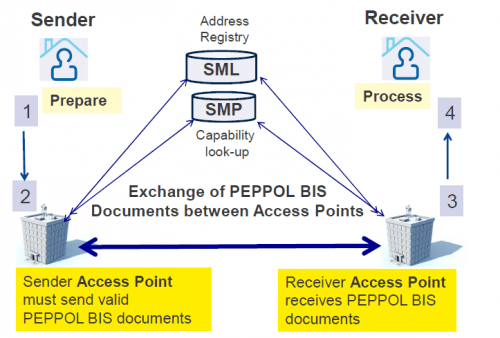
PEPPOL Access Points connect users to its network through accredited “Access Points”. Any organization on the network can become a PEPPOL Access Point themselves by respecting published specifications. Users can choose their preferred single Access Point provider to connect to all PEPPOL members already on the network. (“Connect once, connect to all’).

The PEPPOL components

PEPPOL is based on three key components:

  • the network: PEPPOL eDelivery Network – 4-corner model. Technical specifications and sample software (open source).
  • the document specifications: PEPPOL Business Interoperability Specifications ‘BIS’ utilizing the Universal Business Language
  • the legal framework that defines the network governance (PEPPOL Transport Infrastructure Agreements – TIA)

PEPPOL eDelivery network overview

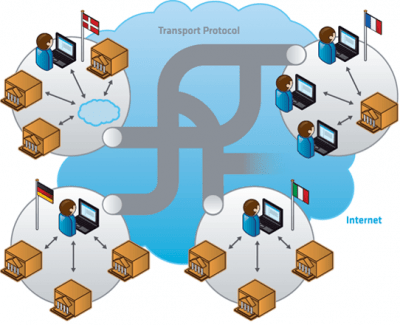
PEPPOL uses the eDelivery Network based on the 4-corner model that allows business and government organizations to exchange e-documents.

The 4-corner model is where the trading partners can use different service providers to exchange electronic documents. Service providers can deliver their services through software or in the cloud. To transfer the documents in the 4-corner model, a service provider needs to work with the other clients’ service provider.

We can compare PEPPOL 4 -corner model with the use of mobile phones where each mobile phone is assigned to a network supplier and they have to work together to connect their client.  

Access Point providers have agreed to be interoperable, using the same electronic messaging protocol and formats, so once connected to the PEPPOL eDelivery Network (via a PEPPOL Access Point), public organizations and private companies become part of the network and can exchange documentation with any participant on the network.

PEPPOL eDelivery network features

    • Free to choose ANY Access Point (173) in 21 countries in Europe and North America
    • Sign ONE Agreement Connect to ALL
    • Open FOUR-corner model
    • NO ROAMING fees between PEPPOL Access PointsPeppol exchange

What are the benefits of the PEPPOL

  • For government organizations, it simplifies the process of electronic procurement and invoicing, also across borders.
  • It allows privates companies to communicate electronically with any European government institution in the trading process, increasing efficiencies and reducing costs.

Magic xpi and PEPPOL Integration

Our integration solution Magic xpi is a fully reliable SOA, API-driven integration platform for all connectivity needs. We use standardized components to facilitate integration with your existing business systems. Transmission and conversion of information and documents make full use of the advantages of PEPPOL, combined with Electronic Data Interchange (EDI).

B2G and B2B Integration, PEPPOL and EDI

EDI comprises a large number of formats, communication protocols, and standards. We can handle the vast majority of formats used, such as EDIFACT, XML, RosettaNet, PEPPOL, and plain files. Our team of experts has extensive knowledge in Electronic Data Interchange (EDI) and has been helping customers communicate with their business partners for over 18 years.

We will help you save on EDI, quickly perform the integration, configure the connection with any trading partner or supplier.

Contact us today for more information and for pricing.

Free EDI consultation

August 27, 2018
https://www.edi2xml.com/wp-content/uploads/2018/08/Peppol-Magic-xpi-1.png 512 1024 Tatyana Vandich https://www.edi2xml.com/wp-content/uploads/2024/08/edi2xml.com-EDI2XML-company-logo.png Tatyana Vandich2018-08-27 15:22:422020-06-03 11:49:14B2G Integration: PEPPOL EDI Data Interchange
Page 18 of 24«‹1617181920›»
Recent
  • EDi Integration for SMB - Complete Guide
    Electronic Data Interchange (EDI): The Complete Guide for...July 17, 2026 - 4:46 pm
  • EDI Process Guide from EDI EDI Provider
    How EDI Documents Work Together: A Complete Guide to the...July 9, 2026 - 1:22 pm
  • Wayfair EDI & API Integration Guide
    Wayfair EDI & API Integration Guide for SuppliersJune 30, 2026 - 3:24 pm
  • Promotional banner about whether EDI is required for small businesses and a supplier’s guide to retail onboarding. Women at a desk inside a circular cutout image on the right.
    Is EDI Required for Small Businesses? A Supplier’s Guide...June 17, 2026 - 7:02 pm
  • EDI compliance with Loblaw
    How to Meet Loblaw EDI Requirements as a Small BusinessJune 4, 2026 - 2:05 pm
Popular
  • How to Quickly Connect to a Large Retailer's EDI Requirements
    How to Get EDI-Compliant Quickly For A Large RetailerNovember 21, 2025 - 4:29 pm
  • EDI-as-a-services
    EDI Translation Software “On-premises” or “As...January 21, 2014 - 1:28 pm
  • order-automation in e-commerce
    Why Is It Crucial to Automate the E-Commerce Order Fulfillment...May 10, 2022 - 1:58 pm
  • EDI for Logistics and transportation
    EDI Integration for Efficient Transportation ManagementOctober 6, 2023 - 1:33 pm
  • information technology definitions
    Business Tech Terms DefinitionsMay 24, 2018 - 1:32 pm

Browse by tag

Amazon Amazon Integration ANSI ASC x12 ASC X12 EDI B2B EDI integration e-commerce e-commerce business e-commerce integration eCommerce eCommerce integration EDI EDI2XML EDI 850 EDI as a Service EDI Communication EDI converter EDIFACT EDI for supply chain EDI for Third-Party Logistics EDI for transportation EDI implementation EDI Integration EDI Integration Project EDI project EDI Translation EDI Web Service EDI x12 ERP Integration integration platform integration project JDE Magic xpi Magic xpi Integration platform NetSuite online store Salesforce Shopify Shopify eCommerce integration Shopify integration Supply Chain Supply Chain Management Translation Software X12 EDI XML

Subscribe to our Blog

Menu

  • Home
  • About the EDI2XML Company
  • About EDI2XML EDI Converter
  • Blog
  • Book A Free Consultation
  • Privacy Policy EDI2XML Company

Our Services

Fully Managed Integration

E-Commerce Integration

Business Systems Integration

Fully Managed EDI

EDI Web Service 

On Premises EDI 

Managed Cloud Service


Latest Blog Posts

  • EDi Integration for SMB - Complete Guide
    Electronic Data Interchange (EDI): The Complete Guide for Modern BusinessesJuly 17, 2026 - 4:46 pm
  • EDI Process Guide from EDI EDI Provider
    How EDI Documents Work Together: A Complete Guide to the EDI Transaction ProcessJuly 9, 2026 - 1:22 pm
  • Wayfair EDI & API Integration Guide
    Wayfair EDI & API Integration Guide for SuppliersJune 30, 2026 - 3:24 pm

Contact Us

400 Blvd Curé-Labelle, #304 Laval QC H7V 2S7 Canada

Contact EDI2XML Team
Phone: +1 450-681-3009
Website: https://www.edi2xml.com/

© 2000-2026 EDI2XML (by Namtek Consulting Services). All rights reserved.
  • Link to Facebook
  • Link to LinkedIn
  • Link to X
  • Link to Youtube
  • Blog
Scroll to top Scroll to top Scroll to top