EDI2XML
  • About
    • The Company
    • EDI2XML
    • Advantages
    • Partnership with EDI2XML
    • Testimonials
  • Services
    • Enterprise AI
    • Fully Managed Integration
    • Fully Managed EDI Services
    • EDI Web Portal
    • EDI Web Service
    • EDI On Premises
    • Managed Cloud Services
    • Amazon Integration
    • Shopify Integration
    • BigCommerce Integration
    • NetSuite Integration
    • JD Edwards Integration
    • Dynamics 365 Integration
    • SAP B1 Integration
    • Salesforce Integration
    • Industry 4.0 Integration
  • Pricing
    • EDI Managed Services
    • EDI Web Service
    • EDI On-Premises
    • Managed Cloud Services
    • Shopify Integration
    • JD Edwards Integration
    • E-commerce Integration
    • All other Integrations
  • Blog
  • Resources
    • Downloadable Guides
    • List of EDI Codes
    • List of EDIFACT Messages
    • EDI Documents Library
    • Trading Partners
    • Customer Case Studies
  • Contact us
  • Book a Consultation
  • Click to open the search input field Click to open the search input field Search
  • Menu Menu
  • Link to Facebook
  • Link to LinkedIn
  • Link to X
  • Link to Youtube

EDIFACT for Logistics and Transportation: Optimizing EDI Processes & Enhancing the Supply Chain

Blog

As an EDI provider with over 20 years of experience, in this article we dive into how EDIFACT standard, used in logistics and how this standard is transforming logistics and transportation by automating key processes across the supply chain.

Introduction to EDIFACT: What is Electronic Data Interchange in Logistics?

Efficient data exchange has always been crucial for transportation, shipping, and overall logistics. However, some companies still create an invoice in a plain text file or Excel spreadsheet and send it via email. But many successful companies have been exchanging such documents via EDI (Electronic Data Interchange) for a long time now.

EDIFACT (Electronic Data Interchange for Administration, Commerce, and Transport) is an EDI standard that has transformed supply chain communications worldwide.

For businesses looking to streamline communication with partners, suppliers, or customers, adopting the right data exchange standard is crucial. When it comes to international trade, UN/EDIFACT (Electronic Data Interchange for Administration, Commerce, and Transport) is the global choice.

EDIFACT plays a key role in optimizing business communications, reducing errors and speeding up transactions such as purchase orders, invoices, shipping notices, and other business documents.

UN/EDIFACT Standard Development

UNECE (United Nations Economic Commission for Europe): The UNECE is the primary body responsible for the development, maintenance, and promotion of the UN/EDIFACT standard. They are the core drivers and have the ultimate authority.

ISO (International Organization for Standardization): The ISO publishes the EDIFACT standard as ISO 9735. This provides wider dissemination and formal recognition. However, the ISO doesn’t develop the standard’s content. They essentially adopt and publish what the UNECE develops. The ISO giving their stamp of approval and making it available through their channels.

So, while both organizations are involved, the UNECE is the developer and the ISO is the publisher. The UNECE is the driving force behind EDIFACT, while the ISO plays a role in making it officially recognized and broadly accessible.

What is EDIFACT? A Comprehensive Guide for Logistics Companies

EDIFACT is an international standard developed by the United Nations for electronic data interchange (EDI). It facilitates the automated exchange of business documents between organizations in a structured, standardized format.

Because EDIFACT is widely used in Europe and internationally, it’s particularly beneficial for businesses engaged in global trade.

EDIFACT messages are a crucial part of modern business operations, especially for companies involved in sectors like freight forwarding, customs clearance, and logistics.

Here are some core EDIFACT aspects:

  • EDIFACT Messages: These are structured documents like ORDERS, DESADV, INVOIC, SHIP, RECADV, UTILMD, IFTMIN, and IFTSTA that facilitate business transactions.
  • EDIFACT Formats: Well-defined layouts that ensure all trading partners understand and process the information uniformly.
  • Electronic Data Interchange (EDI): The process that enables this automated and standardized communication, eliminating paper-based processes.
  • Global Reach: Widely adopted in international trade and transport.

The main advantage of EDIFACT, like any other EDI standard, is that it provides a structured format and standardized rules that help avoid errors and misunderstandings when exchanging information between different companies, regardless of where they are located, what language they communicate in, and what business systems they use.

Simplify your EDIFACT integration. Our comprehensive code list makes it easy. Find the codes you need: Complete List of EDIFACT Messages

Why is Your New Trading Partner Asking for EDIFACT for Orders?

When your business partner says you need to use EDIFACT to send orders (or any other business document) it means they want you to send your orders in a specific format that integrates easily with their system, allowing them to process the data automatically.

What it Means for You

In your case, your trading partner likely uses EDIFACT to automate order processing. By sending your order in EDIFACT format, you’ll enable their system to:

  • Receive and interpret your order details accurately.
  • Process the order quickly.
  • Potentially generate automated responses, such as order confirmations or shipping updates.

For example, EDIFACT documents can be used to streamline order management, inventory management, and shipping processes. Transport management systems (TMS) and warehouse management systems (WMS) often rely on EDIFACT messages to automate data exchange between warehouses, suppliers, and transportation providers. These systems help businesses manage their supply chain more efficiently, ensuring that orders are processed accurately, inventories are updated in real-time, and goods are delivered on time. Whether you’re handling order management, coordinating freight, or ensuring smooth customs clearance, EDIFACT helps businesses automate and optimize these essential functions.

USEFUL: What is EDIFACT? | UN / EDIFACT Standard Overview

The Role of EDIFACT in Managing Logistics, Transportation, and the Supply Chain

EDIFACT plays a pivotal role in modern supply chain management by enhancing communication between various systems and stakeholders. It benefits the entire network of transport, transportation, and shipping through:

  • Enhanced Data Accuracy: Automated EDIFACT messages reduce manual errors in data entry, ensuring accurate order management and inventory management.
  • Faster Processing: Integration with transport management systems (TMS) and warehouse management systems (WMS) speeds up the exchange of information and decision-making.
  • Improved Freight Forwarding: Real-time updates streamline customs clearance and overall shipment tracking.
  • Global Standardization: Adhering to EDIFACT standards allows companies to easily communicate with international partners.

By leveraging EDIFACT, companies can achieve smoother operations in supply chain and supply chain management while benefiting from reduced delays and lower administrative costs.
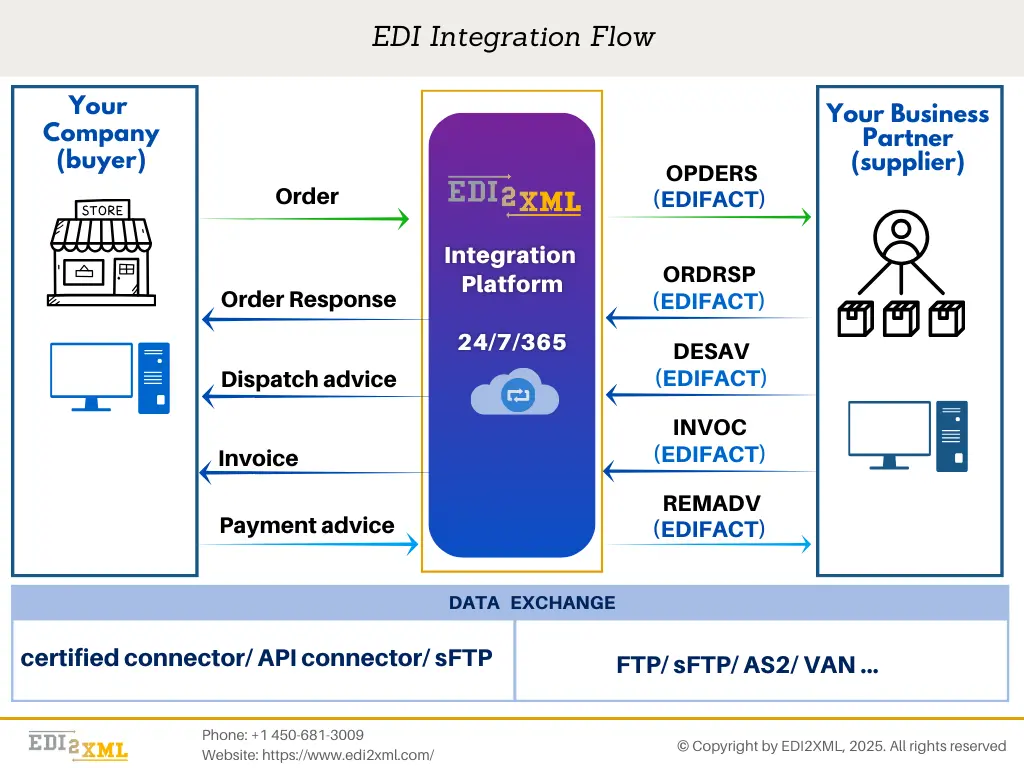
EDIFACT data exchange flow in logistics.

Key EDIFACT Documents: ORDERS, DESADV, INVOIC, and Other Essential Messages

Several EDIFACT messages are critical in logistics and transportation. These messages enable companies to automate communication and ensure that key processes—from procurement to delivery—are managed efficiently. Here’s a detailed look at each of these messages:

  • ORDERS: The ORDERS message is used for placing orders and managing procurement. This message facilitates the transmission of order details from buyers to sellers, ensuring that product specifications, quantities, pricing, and delivery dates are clearly communicated. By standardizing order information, the ORDERS message helps reduce errors and misunderstandings, ultimately streamlining the procurement process within the supply chain.
  • DESADV: The DESADV (Dispatch Advice) message is essential for shipping and delivery operations. It is used to notify the recipient about the dispatch of goods, including critical details such as shipment contents, packaging information, and expected delivery times. DESADV messages play a vital role in logistics by providing transparency into the dispatch process, enabling both shippers and receivers to prepare for the arrival and handling of goods efficiently.
  • INVOIC: The INVOIC message handles invoicing and billing details between trading partners. This document captures all the necessary financial information related to the transactions, such as itemized charges, taxes, and total amounts due. By automating the invoicing process, the INVOIC message minimizes manual data entry errors and expedites payment cycles, thereby contributing to more effective cash flow management and financial reconciliation.
  • RECADV: The RECADV (Receipt Advice) message is crucial for confirming the reception of goods. Once a shipment arrives, the RECADV message is sent to acknowledge receipt and provide details on the condition and quantities of the received items. This confirmation process is important for inventory reconciliation, quality control, and triggering subsequent processes such as payments and returns if discrepancies are found.
  • IFTMIN: The IFTMIN (Instruction Message) is used to convey instructions related to the movement of goods within the supply chain. It can include directives on routing, handling, or any special conditions that need to be adhered to during transportation. This message is integral to ensuring that goods are moved correctly and efficiently from one location to another, supporting effective supply chain management and operational coordination.
  • IFTSTA: The IFTSTA (Cargo Status) message communicates real-time status updates in the logistics process. It informs stakeholders about the current state of a shipment—whether it is in transit, delayed, or has reached a specific checkpoint. By providing timely status updates, the IFTSTA message enhances transparency, enables proactive decision-making, and helps manage exceptions in the transportation process.

These messages, along with robust EDIFACT formats, ensure that processes like customs clearance and freight forwarding are managed efficiently. Additionally, technologies like we use in EDI2XML help convert EDIFACT documents into XML for easier integration with modern software systems, further enhancing interoperability.

How EDIFACT Works: A Step-by-Step Guide to Integration and Automation

The process of using EDIFACT involves several key steps:

  1. Creating an EDIFACT Messa
    ge:
    EDIFACT utilizes predefined formats for various document types. For instance, a specific EDIFACT message structure exists for invoices, containing essential data like amount, recipient, invoice number, and date.
  2. Converting Your Data into EDIFACT Format: Your internal systems likely aren’t designed to directly generate EDIFACT messages. Therefore, you’ll need a way to convert your standard invoices (perhaps in Excel, CSV, or another internal format) into the correct EDIFACT structure. This is where an EDIFACT converter comes in, transforming your invoice data into an EDIFACT message.
  3. Sending the Message: Once your invoice is in the correct EDIFACT format, it’s transmitted electronically through an EDI system. This typically occurs over secure connections like FTP, AS2, or other EDI communication protocols. Your trading partner’s system then automatically receives, validates, and integrates the message data into their workflow, eliminating manual entry.

The Catch: You Probably Can’t Do This Alone

While the above steps outline the EDIFACT process, most companies find they cannot handle these tasks independently. It’s rare for businesses to have in-house staff with the specialized expertise required for EDI implementation. Setting up and maintaining EDI connections, mapping data, handling conversions, managing transmissions, and troubleshooting issues requires a significant investment in both time and training.

EDI- Price

Why You Need an EDI Provider: The Benefits of Working with Professionals

This is where EDI providers come in. Companies like EDI2XML offer fully managed EDI services, handling the entire project from start to finish. These providers take on all aspects, including:

  • Project Management: Overseeing the entire EDI implementation process.
  • Configuration: Setting up the necessary software and connections.
  • Mapping: Defining how your internal data corresponds to EDIFACT elements.
  • Conversion: Transforming your data into the EDIFACT format.
  • Transmission: Managing the secure sending and receiving of EDI messages.
  • Integration: We integrate EDIFACT messaging into your existing business systems, so you can automate the entire process and reduce the chance of errors.
  • Testing: Conducting thorough testing with your trading partners to ensure seamless communication.
  • Support for EDIFACT Standards: Pr
  • oviding assistance and troubleshooting after implementation. Whether you need help with invoice messages (e.g., INVOIC), orders (ORDERS), or shipping messages (IFTMIN), we support a wide range of EDIFACT message types and ensure you stay compliant with the latest standards.

By working with Edi2Xml, you can simplify your transition to using EDIFACT and ensure your data exchanges with business partners are smooth, secure, and efficient. No need to worry about manual data entry or mismatched formats—let us handle the technical side while you focus on growing your business.

EDIFACT FAQ

EDIFACT FAQ: Answers to Frequently Asked Questions

What is the primary benefit of using EDIFACT in logistics and transportation?

EDIFACT automates the exchange of business documents like ORDERS, DESADV, and INVOIC, which improves efficiency, accuracy, and speed in managing supply chain and transportation operations.

How do EDIFACT standards integrate with TMS and WMS?

Modern transport management systems (TMS) and warehouse management systems (WMS) are designed to support EDIFACT messages and EDIFACT formats, enabling seamless integration for order management and inventory management.

Can EDIFACT improve customs clearance processes?

Yes, by using standardized EDIFACT messages for customs clearance, companies can ensure faster and more accurate processing of shipments, reducing delays and minimizing errors in documentation.

What role does EDI2XML play in EDIFACT solutions?

EDI2XML helps convert EDIFACT documents into XML format, making it easier for modern systems to integrate and process data.

How can my company get started with EDIFACT implementation?

Begin by assessing your current data exchange processes and identifying key documents that need standardization. Consult with an EDI provider to evaluate your needs, set up the necessary infrastructure, map your data to EDIFACT standards, and conduct thorough testing with your trading partners.

What are the common challenges when implementing EDIFACT?

Challenges can include mapping your internal data to EDIFACT standards, ensuring compatibility with various trading partner systems, managing change within existing processes, and training staff to handle the new system. Partnering with an experienced EDI provider can help mitigate these issues.

How secure is the EDIFACT data exchange process?

EDIFACT transactions are typically conducted over secure communication channels (such as AS2, FTP/S, or VPNs). Moreover, proper implementation of security protocols, data encryption, and compliance with industry standards ensures that the data exchange remains secure.

Can EDIFACT be integrated with our existing ERP and legacy systems?

Yes, EDIFACT can be integrated with most ERP systems and legacy applications through middleware or conversion tools. Many EDI providers offer services that bridge the gap between modern EDIFACT formats and older systems.

Are there any regulatory or compliance issues associated with EDIFACT?

EDIFACT itself is a standardized format, so it generally supports compliance with industry regulations and international trade standards. However, companies should ensure that their specific implementation meets all applicable local and international legal requirements, especially in sectors with strict data governance.

How do I choose the right EDI provider for my EDIFACT implementation?

Look for a provider with proven experience in your industry, strong technical expertise, comprehensive support services, and a track record of successful EDIFACT integrations. Request case studies, testimonials, and details about their implementation process to make an informed decision.

What kind of support and maintenance can I expect post-implementation?

A reliable EDI provider will offer ongoing support, system monitoring, regular updates to comply with evolving standards, and troubleshooting assistance. This ensures that your EDIFACT system remains robust and continues to meet your operational needs over time.

Conclusion: How EDIFACT is Transforming Logistics and Transportation

EDIFACT is a cornerstone of modern Electronic Data Interchange (EDI) in the logistics and transportation sectors. By integrating EDIFACT standards into transport, shipping, and supply chain management systems, companies can enjoy streamlined processes, enhanced data accuracy, and improved operational efficiency. Whether you’re looking at freight forwarding, customs clearance, or managing transport management systems (TMS) and warehouse management systems (WMS), EDIFACT provides the structure and reliability needed for success.

Ready to harness the power of EDIFACT in your operations? Contact us today to learn more about implementing EDIFACT solutions and transforming your logistics and transportation processes with industry-leading EDI technology.

IT-consultation

February 4, 2025/0 Comments
https://www.edi2xml.com/wp-content/uploads/2025/02/EDI2XML-EDIFACT-for-Logistics.webp 628 1200 Tatyana Vandich https://www.edi2xml.com/wp-content/uploads/2024/08/edi2xml.com-EDI2XML-company-logo.png Tatyana Vandich2025-02-04 14:35:332025-03-10 14:21:53EDIFACT for Logistics and Transportation: Optimizing EDI Processes & Enhancing the Supply Chain

Customer Case Study: How EDI2XML Delivered Seamless EDI Integration for Opengear

Blog

EDI Integration with EDI2XML – Introduction

Opengear, a leader in secure and resilient network solutions, sought to streamline their business operations by automating the exchange of critical business documents with trading partners. This case study highlights how EDI2XML’s Fully Managed EDI Service provided Opengear with a scalable and efficient solution, enabling them to transition from manual processes to a fully automated EDI integration with their Salesforce CRM system. By leveraging cutting-edge technology and expert implementation, Opengear significantly improved their operational efficiency, accuracy, and customer satisfaction.

Our Client: Opengear Overview

Opengear specializes in providing secure, resilient network access and automation solutions, helping IT and network operations teams improve efficiency and reliability. Headquartered in Edison, New Jersey, with engineering in Brisbane, Australia, and production in Sandy, Utah, Opengear supports critical infrastructure across industries.

Their offerings include out-of-band management and NetOps solutions tailored to business continuity. The company has built a strong reputation for its ability to provide reliable solutions that ensure uninterrupted access to critical systems, even during network outages.

Opengear’s mission is to empower IT teams with the tools necessary to manage, monitor, and remediate network issues efficiently. With a growing customer base and expanding operations, the need for streamlined and automated processes became essential to maintaining their high standards of service.

Challenges

Before adopting EDI, Opengear faced several operational inefficiencies and challenges:

  1. Manual Data Entry: Employees manually processed sales orders from PDF documents into Salesforce CRM, leading to time inefficiencies and a high risk of human error. This process required significant staff hours, particularly during high-volume periods.
  2. Inconsistent Data Accuracy: Errors during manual entry affected order details, inventory management, and customer satisfaction. These inaccuracies often resulted in delays and the need for manual corrections, further slowing operations.
  3. Operational Inefficiency: Manual processes slowed order processing and fulfillment, particularly during peak periods like quarter-end and month-end. This created bottlenecks that impacted both internal operations and customer experiences.
  4. Delayed Processing: Manual workflows created time lags between receiving and entering orders, delaying production planning and fulfillment. The lack of real-time data visibility hindered decision-making and responsiveness.
  5. Limited Scalability: The growing volume of transactions outpaced the capabilities of manual processes, hindering growth. Opengear found it increasingly challenging to meet the demands of their expanding customer base without risking service quality.
  6. Lack of Real-Time Updates: Without automated updates, responding to changes or issues with orders was challenging. This lack of agility occasionally led to missed opportunities and strained relationships with trading partners.

These issues underscored the need for a robust, automated EDI solution to enhance efficiency, accuracy, and scalability.

EDI2XML Solution

EDI2XML’s Fully Managed EDI Service was the chosen solution to address Opengear’s challenges. The integration platform seamlessly connected Opengear’s trading partners with their Salesforce CRM, automating the entire document exchange process. By leveraging EDI2XML’s expertise, Opengear was able to implement a tailored solution designed to meet their specific needs.

Key components of the solution included:

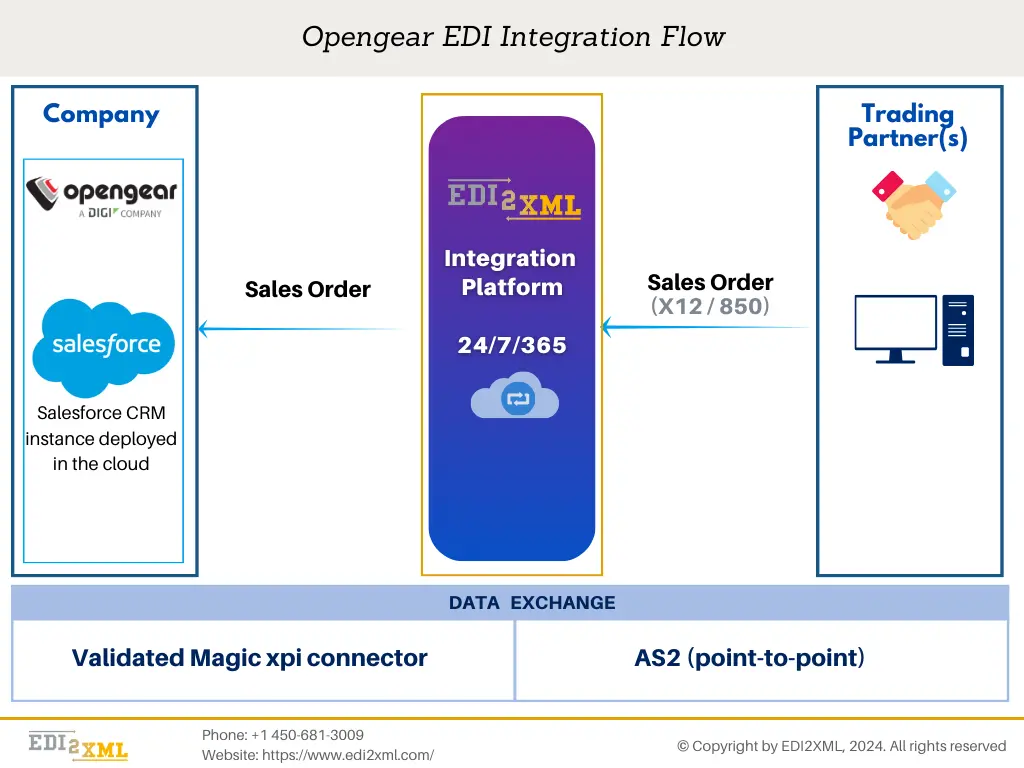
  1. Automated Document Collection: EDI2XML collected incoming EDI documents (e.g., X12 850 purchase orders) every 15 minutes, ensuring timely processing.
  2. Data Transformation: The EDI documents were transformed into formats compatible with Salesforce CRM, using validated Magic xpi connectors to ensure seamless integration.
  3. Salesforce Integration: The transformed data was automatically transferred to Opengear’s Salesforce instance, updating relevant fields and enabling real-time visibility.
  4. Validation and Notifications: The platform validated item-level pricing against predefined criteria, triggering automated email notifications based on validation results. If discrepancies were found, orders were flagged, and corrective actions were initiated.
  5. Continuous Monitoring: Functional acknowledgments were sent to trading partners as needed, ensuring compliance and smooth operations. EDI2XML monitored all transactions to identify and resolve potential issues proactively.

Useful reading: How to get more out of Salesforce with EDI Integration

EDI integration diagram

Implementation Process

The implementation was completed in several key stages:

  1. Initial Analysis: EDI2XML conducted a detailed analysis of Opengear’s requirements, including a review of their existing processes, Salesforce CRM configuration, and trading partner specifications. This phase involved close collaboration to ensure all requirements were accurately captured.
  2. Configuration: The platform was configured to handle X12 850 Purchase Orders and other relevant document types. EDI2XML set up the AS2 communication protocol for secure data exchange with trading partners.
  3. Mapping and Development: Business flows were developed, and data mapping was conducted to align EDI document fields with Salesforce CRM columns. This ensured accurate data transfer and compatibility.
  4. Testing: Comprehensive testing included full-cycle validation of data flows, functional acknowledgment processes, and Salesforce CRM integration. Opengear’s team worked closely with EDI2XML to verify all aspects of the implementation.
  5. Deployment: The solution went live within a month, showcasing rapid implementation capabilities. Opengear experienced minimal disruption during the transition.
  6. Ongoing Support: Continuous monitoring and support ensured optimal performance and timely resolution of issues. EDI2XML provided training and documentation to Opengear’s team, enabling them to maximize the benefits of the solution.

Integration with Magic xpi: Streamlining EDI and Salesforce CRM Workflows

Magic xpi is a robust integration platform designed to simplify and accelerate the process of connecting diverse systems, applications, and data sources. In the context of Opengear’s integration with Salesforce CRM, Magic xpi played a pivotal role by providing a secure, scalable, and highly efficient environment for managing EDI-to-Salesforce transformations.

Magic xpi ensured the accurate mapping and transformation of data fields, facilitating automated and error-free document exchanges. The following points detail how Magic xpi was utilized in this implementation:

  1. Mapping Data Fields: Magic xpi’s graphical interface was used to map EDI document fields, such as purchase order details (X12 850) and customer information, to the corresponding fields in Salesforce CRM. For instance, product codes, quantities, and prices from incoming orders were mapped directly to Salesforce Opportunity Line Items, ensuring consistency and accuracy.
  2. Connector Capabilities: The Magic xpi Salesforce connector allowed for real-time data updates and retrieval. For example, customer contact details from EDI files were used to create or update Salesforce Contact and Account records automatically. This reduced manual input and enhanced data synchronization.
  3. Custom Business Logic: Magic xpi provided tools to define and execute custom business rules. For example, if an EDI order contained invalid product codes or incomplete shipping details, the integration logic flagged these orders for review while sending notifications to the appropriate teams.
  4. Visualization of Data Flows: Using Magic xpi’s mapping tools, Opengear’s team could visually understand how data moved from EDI sources to Salesforce destinations. This transparency was crucial for validating data flows during the testing phase.
  5. Error Handling and Notifications: In cases where mapping errors occurred, Magic xpi triggered automated notifications, allowing Opengear’s team to address issues promptly. Logs and error reports generated by Magic xpi facilitated rapid troubleshooting.
  6. Scalability: Magic xpi’s scalable architecture ensured that the integration could handle increasing volumes of EDI transactions as Opengear’s operations expanded. Adding new trading partners or document types required minimal adjustments to existing mappings.

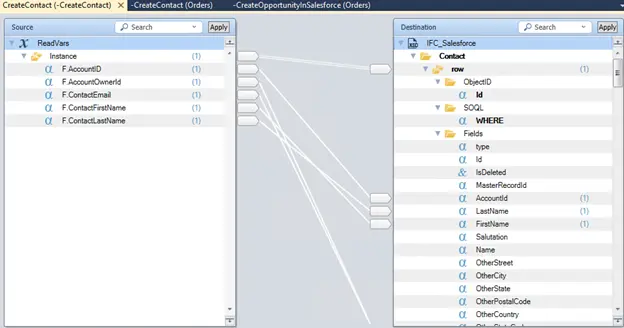
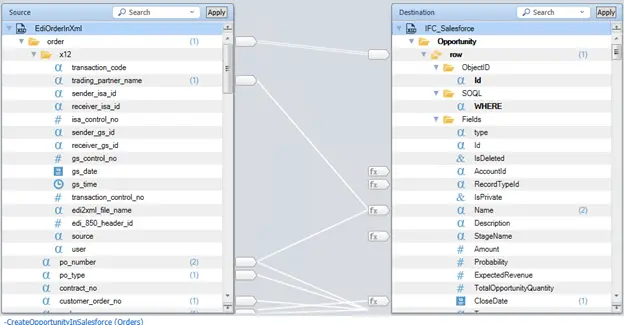
The integration process, powered by Magic xpi, was instrumental in transforming Opengear’s manual workflows into efficient, automated processes, saving time and reducing errors. Below are examples of data mappings between EDI documents and Salesforce CRM, as shown in Magic xpi’s interface:

magic xpi edi mapping

magic xpi Salesforce integration

  • Mapping Opportunity Line Items: EDI order details, such as line item descriptions, prices, and quantities, were mapped to Salesforce Opportunity Line Items. This ensured accurate and real-time updates to Salesforce opportunities.
  • Mapping Customer Details: Shipping and billing addresses from EDI orders were mapped to Salesforce Account and Contact records, enabling quick and error-free creation or updates.

Key features of Magic xpi include:

  1. Pre-Built Connectors: Magic xpi offers pre-built connectors for Salesforce CRM, enabling seamless integration without extensive custom coding. These connectors ensure compatibility with Salesforce APIs and simplify the mapping of EDI fields to Salesforce objects such as Opportunities, Orders, or Accounts.
  2. Visual Data Mapping: Magic xpi’s intuitive visual interface allows developers to map EDI data fields (e.g., from X12 850 purchase orders) to corresponding Salesforce fields. For example, the “Item Number” in the EDI document can be mapped to the “Product Code” in Salesforce, ensuring accurate data transfer.
  3. Real-Time Data Processing: The platform supports real-time data flows, ensuring that incoming EDI documents are processed and pushed to Salesforce CRM almost instantaneously. This capability was critical for Opengear’s requirement to eliminate delays in order processing.
  4. Error Handling and Validation: Magic xpi includes built-in tools for data validation and error handling. For Opengear, this meant that any discrepancies in pricing or other critical fields were flagged during the mapping process, allowing for automated notifications and corrective actions.
  5. Scalability: As a cloud-based platform, Magic xpi is designed to handle increasing volumes of data and transactions. This ensured that Opengear’s integration solution could grow alongside their expanding business needs.

How Magic xpi Integrates EDI with Salesforce CRM

The integration process facilitated by Magic xpi involves several critical steps:

  1. Data Extraction: Magic xpi collects incoming EDI files from a designated mailbox. These files are then parsed and prepared for transformation.
  2. Transformation: The platform translates the raw EDI data into a format compatible with Salesforce CRM. This includes converting EDI segments like “BEG” (beginning segment for purchase orders) into Salesforce fields such as “Order ID.”
  3. Data Mapping: Using Magic xpi’s graphical interface, the transformed data is mapped to specific Salesforce fields. This step ensures that all critical information, such as customer details, order items, and pricing, is accurately captured.
  4. Validation: Before transferring data, Magic xpi validates it against predefined business rules. For instance, if an order contains an invalid product code or mismatched pricing, the platform triggers an alert.
  5. Data Transfer: Once validated, the data is pushed into Salesforce CRM via the pre-configured connector. Magic xpi ensures that the integration adheres to Salesforce’s API guidelines, maintaining data integrity and security.
  6. Notifications: Magic xpi sends automated email notifications to relevant stakeholders, summarizing the results of the data transfer and highlighting any issues that require attention.

Integration price

Positive Experience During Integration

Throughout the integration process, Opengear experienced exceptional support and expertise from the EDI2XML team. The specialists at EDI2XML demonstrated a deep understanding of EDI processes and Salesforce integration, ensuring a smooth and efficient implementation. Their responsiveness to inquiries and proactive approach to problem-solving left a lasting impression on the Opengear team. Any questions or concerns were addressed promptly, and the team’s professionalism and technical competence exceeded expectations.

Opengear particularly appreciated the clear communication and collaborative mindset of EDI2XML’s specialists. Regular updates and progress reports kept the project on track, and their commitment to delivering a tailored solution underscored their dedication to client success. As a result, the integration process was not only seamless but also a valuable learning experience for Opengear.

Given the nature of the Fully Managed EDI Service, Opengear continues to rely on EDI2XML for ongoing support and maintenance. This partnership ensures that Opengear’s EDI processes remain optimized and scalable, providing confidence as their business grows.

Results and Benefits

Opengear experienced significant improvements in operational efficiency and business performance:

  • Enhanced Efficiency: Automation eliminated manual data entry, reducing errors and freeing up employee time for strategic tasks. Staff could focus on value-added activities, improving overall productivity.
  • Improved Accuracy: Real-time data validation ensured consistent and reliable order processing. The solution significantly reduced the incidence of errors, enhancing order accuracy and customer satisfaction.
  • Scalability: The cloud-based solution scaled effortlessly with Opengear’s growing transaction volume, accommodating new trading partners and document types as needed.
  • Faster Fulfillment: Automated workflows accelerated order processing and fulfillment times. Opengear could now process orders within minutes of receipt, improving responsiveness.
  • Cost Savings: Reduced manual work minimized labor costs and errors, contributing to overall cost efficiency.
  • Improved Relationships: Real-time updates and streamlined communication strengthened partnerships with trading partners, fostering trust and collaboration.

Client Testimonial

Dom Battista, Director of Global Sales Operations at Opengear, shared his thoughts on the EDI implementation:

“The integration was flawless—accurate, efficient, and incredibly quick. The EDI2XML team accommodated our needs at every step, ensuring a seamless transition. This solution transformed our operations, allowing us to scale and keep up with the demands of a growing business.”

EDI Integration FAQ

1. What is EDI integration with Salesforce CRM?

EDI integration with Salesforce CRM involves automating the process so that business documents like purchase orders (EDI 850) and invoices (EDI 810) are transformed into a format compatible with Salesforce and directly entered into Salesforce without manual data entry. This is specifically for trading partners who use Salesforce as their CRM. This eliminates manual data entry, ensuring accuracy and efficiency.

2. How does a Fully Managed EDI Service work?

A Fully Managed EDI Service from EDI2XML handles all aspects of EDI implementation, including document collection, transformation, and integration. It also includes continuous monitoring and support to ensure smooth operations.

3. What are the benefits of automated EDI processes for small businesses?

Automated EDI processes reduce manual effort, minimize errors, improve scalability, and enhance trading partner relationships. They enable small businesses to operate more efficiently and compete effectively in their markets. Moreover, small EDI-compliant companies can quickly begin doing business with large retailers like Costco, Walmart, and Target that require EDI for their transactions.

4. How long does it take to implement EDI integration?

Implementation timelines vary, but EDI2XML’s solution for Opengear was completed within one month, showcasing the potential for rapid deployment with minimal disruption.

5. What is the role of the Magic xpi connector in this solution?

The Magic xpi connector acts as a bridge between the EDI2XML platform and Salesforce CRM, ensuring seamless data transformation and transfer.

Glossary of Terms

AS2 (Applicability Statement 2): A communication protocol used for securely exchanging EDI documents over the internet. AS2 ensures reliable and encrypted transmission between trading partners.

X12 850 (Purchase Order): A standard EDI transaction set used by businesses to place purchase orders with their suppliers. It includes details like item descriptions, quantities, and prices.

Functional Acknowledgment (997): An EDI document sent to confirm the receipt of another EDI document, ensuring that it was successfully received and processed without errors.

EDI (Electronic Data Interchange): A standardized method for exchanging business documents (e.g., purchase orders, invoices) between companies electronically, eliminating the need for manual data entry.

Salesforce CRM: A cloud-based customer relationship management platform that allows businesses to manage sales, service, and customer interactions efficiently.

Magic xpi Integration Platform: A middleware solution that connects different systems, applications, and services, enabling seamless data integration and communication between them. It provides pre-built connectors and tools to facilitate integrations like Salesforce and EDI systems.

Integration: The process of connecting different systems, software, or platforms to work together as a unified solution. Integration ensures seamless data exchange and streamlines workflows across platforms.

Cloud-Based Solution: Software or services hosted on remote servers and accessed via the internet, offering scalability, flexibility, and reduced infrastructure costs.

Trading Partner: A business entity (e.g., supplier, distributor) involved in exchanging EDI documents with another organization.

Mapping: The process of linking data fields from one format (e.g., EDI) to another (e.g., Salesforce CRM) to ensure accurate data transfer and compatibility between systems.

Validation: A process to ensure that incoming or outgoing data meets predefined criteria or standards, such as correct pricing, formatting, or completeness.

Conclusion – EDI Integration

By partnering with EDI2XML, Opengear successfully modernized their business processes, overcoming inefficiencies and preparing for future growth. This case study demonstrates the power of a tailored, fully managed EDI solution in driving operational excellence and scalability for growing businesses.

The seamless integration with Salesforce CRM has positioned Opengear to meet increasing demands, maintain exceptional service standards, and achieve long-term success.

Want to streamline your EDI integration like Opengear? Contact EDI2XML today for a free consultation!

Contact EDI2XML today for a free consultation

December 24, 2024/0 Comments
https://www.edi2xml.com/wp-content/uploads/2024/12/edi2xml-Customer-Case-Study.webp 628 1200 Tatyana Vandich https://www.edi2xml.com/wp-content/uploads/2024/08/edi2xml.com-EDI2XML-company-logo.png Tatyana Vandich2024-12-24 17:16:552026-06-04 15:09:45Customer Case Study: How EDI2XML Delivered Seamless EDI Integration for Opengear

How to Become EDI Capable: A Comprehensive Guide

Blog

What Does “EDI Capable” Mean for Your Business?

To be EDI capable means having the ability to seamlessly exchange electronic business documents that comply with established industry standards required by your trading partners. Whether you’re sending purchase orders (EDI 850), invoices (EDI 810), or advanced ship notice (EDI 856), EDI capability ensures your systems can handle the required communication formats like X12, EDIFACT, RosettaNet, and others. At EDI2XML, we simplify the journey to becoming EDI capable with tailored solutions that align with your business needs—so you can focus on growth, not technical hurdles.

Useful Reading: What are the differences between RosettaNet, EDI ANSI X12 and EDIFACT

Why Is EDI Capability Important for Modern Companies?

EDI capability is crucial for keeping your business operations smooth and efficient in the technology-driven business environment, especially in supply chains. Without it, companies risk delays, errors, and strained relationships with partners and customers. EDI2XML provides tailored solutions to help businesses achieve compliance and streamline workflows effortlessly.

How Can I Make My Business EDI Capable?

Achieving EDI capability involves understanding your partners’ requirements, selecting the right tools, and implementing a solid plan. At EDI2XML, we guide you step-by-step, from ensuring compliance with major standards to testing and deploying seamless solutions that align with your goals. Here’s how:

1. Understand Your Trading Partners’ Requirements: Compliance starts with knowing what formats, protocols, and document types your partners require. We ensure your EDI solution supports all major standards, including X12, EDIFACT, and HIPAA.

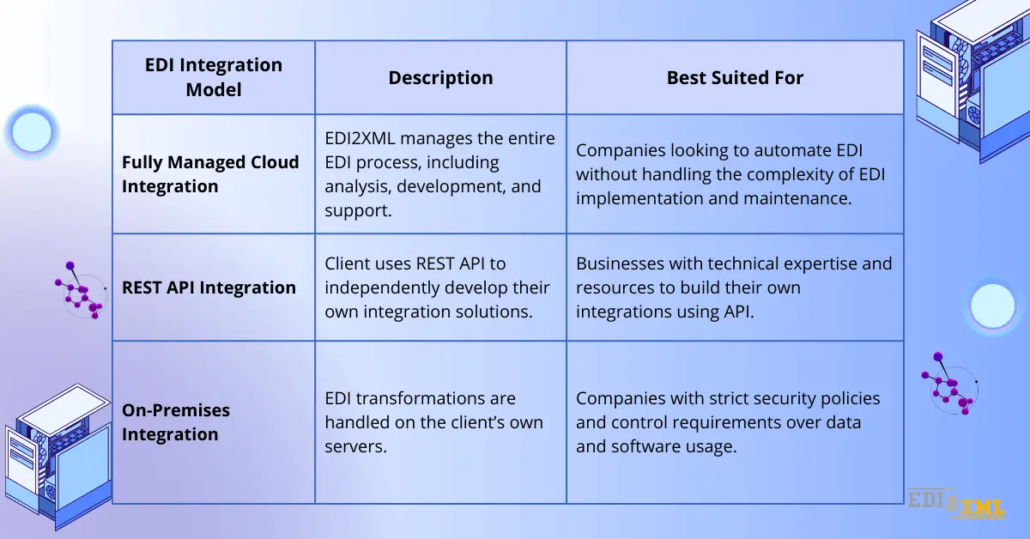
2. Choose Your EDI Approach: Decide whether you want an in-house (on-premises EDI) solution, a fully managed EDI service, or a Web EDI service (REST API). We offer flexible options to meet your needs—whether you prefer an on-premises EDI setup fully integrated with your business systems, like ERP or accounting software, or a cloud-based, fully managed service where we handle all aspects of EDI for you.

3. Select the Right EDI Solution: Not all “EDI tools” are created equal. Our cloud-based solutions are scalable, secure, and built to handle complex business requirements with ease.

4. Test and Deploy: Testing is critical to ensure seamless communication with your trading partners. At EDI2XML, we handle rigorous testing to guarantee flawless implementation.

EDI- Price

What’s the Best EDI Approach: In-House or Fully Managed?

Trying to decide between EDI in-house or outsourcing it? In-house EDI requires infrastructure, expertise, and maintenance, which can be costly. Fully Managed EDI, like EDI2XML’s service, removes these burdens by handling everything for you—from infrastructure to compliance—so you can focus on growth. Here’s a quick comparison:

  • In-House EDI: Requires software, infrastructure, technical expertise, and ongoing maintenance. While this works for companies with dedicated IT teams, it can be costly and time-consuming.
  • Fully Managed EDI: With EDI2XML’s Fully Managed EDI Service, you don’t need to worry about infrastructure, mapping, or compliance. We handle everything—so you can focus on growing your business.

Example: Streamlining Operations with EDI2XML

Opengear, a global technology company, faced significant inefficiencies with manual processes for exchanging business documents like sales orders. These inefficiencies included:

  • Manual data entry into their CRM system.
  • Frequent errors and inconsistencies.
  • Delays in order processing.

By adopting EDI2XML’s fully managed solution, they automated the entire document exchange process. Using EDI2XML’s cloud-based platform, they:

  • Seamlessly converted incoming EDI transactions into a format compatible with their CRM.
  • Eliminated manual tasks and errors.
  • Improved communication with trading partners.

This transformation resulted in enhanced operational efficiency, reduced costs, and faster processing times.

Learn more about EDI X12 and its real-world use cases: EDI X12 Explained: Codes, Standards, and Real-World Impact

What Are the Benefits of Becoming EDI Capable?

Becoming EDI capable transforms business operations with:

1. Cost Savings: Automating document exchanges reduces manual labor, paperwork, and transaction costs.

2. Speed: EDI accelerates order processing and cuts delivery times in half, enabling faster response to customer needs.

3. Accuracy: Eliminate manual errors with automated data exchanges, reducing inaccuracies

4. Efficiency: Streamlined processes improve productivity, customer satisfaction, and business agility.

5. Security: EDI2XML ensures data is exchanged securely, meeting industry and partner compliance mandates.

Why Should I Choose EDI2XML for EDI Services?

EDI2XML offers 20+ years of expertise in EDI integration, helping businesses across North America simplify and modernize their processes. Whether you’re new to EDI or need to modernize your existing processes, our solutions are flexible, scalable, and tailored to your needs. From onboarding partners to managing complex integrations, we ensure you’re ready to meet the demands of modern supply chains.

How Can EDI2XML Help Me Become EDI Capable?

EDI2XML makes the process of becoming EDI capable straightforward and stress-free. Our solutions improve efficiency, reduce costs, and enhance growth by aligning with your specific business needs. Contact us today to learn how we can help you achieve seamless EDI integration.

Contact EDI2XML today for a free consultation

December 17, 2024/0 Comments
https://www.edi2xml.com/wp-content/uploads/2024/12/edi2xmlcom-How-to-EDI.webp 628 1200 Tatyana Vandich https://www.edi2xml.com/wp-content/uploads/2024/08/edi2xml.com-EDI2XML-company-logo.png Tatyana Vandich2024-12-17 16:02:052025-05-09 09:00:53How to Become EDI Capable: A Comprehensive Guide

EDI 830 – Planning Schedule with Release Capability Overview

Blog

When it comes to EDI (Electronic Data Interchange), the EDI 830 document, also known as Planning Schedule with Release Capability EDI 830 Transaction Set, plays an important role. For manufacturers, suppliers, and their trading partners, this document helps optimize production planning and inventory management. Let’s understand what this document is, why it is important, and how it works in real-world scenarios.

What is EDI 830?

In simple terms, EDI 830 is a forecast document. It allows buyers to communicate their production schedules and demand forecasts to suppliers. These forecasts can help suppliers plan their production and ensure that products are available when needed. Unlike a purchase order, the EDI 830 doesn’t guarantee a purchase. Instead, it’s a planning tool that gives a clear picture of expected demand.

EDI 830 for Buyers

A buyer is typically the entity that forecasts demand and initiates communication via an EDI 830 document. Buyers can be:

Manufacturers: Companies that produce finished goods often act as buyers. For example, an automobile manufacturer might use EDI 830 to forecast the quantity of automobile parts it will need from suppliers for future production.

Retailers: Large retailers, such as department stores or grocery chains, send EDI 830 documents to their suppliers to communicate forecasted demand for products based on expected sales.

Wholesalers or Distributors: These businesses often purchase products in bulk for resale. They may forecast demand for items they will need from suppliers to replenish their inventory.

EDI 830 and Suppliers

A supplier is the entity that receives an EDI 830 document and uses the forecasted data to prepare inventory, plan production, and allocate resources. Suppliers may include:

Component or raw material suppliers: In manufacturing industries, these suppliers provide raw materials or components used in production. For example, a steel supplier supplies materials to an automobile manufacturer.

Finished goods manufacturers: In retail or distribution, suppliers may be manufacturers of finished goods that buyers sell to consumers. For example, a food company supplies packaged goods to a grocery chain.

Logistics service providers: Sometimes the supplier role extends to third-party logistics providers who manage inventory storage or shipping based on the EDI 830 schedule.

EDI Guide

How Does EDI 830 Work?

The process begins when a buyer sends an EDI 830 document to a supplier. This document contains detailed information such as:

  • Projected quantities: How much of each product the buyer expects to need.
  • Release dates: When the buyer expects to receive the goods.
  • Time periods: Weekly, monthly, or another specified time period.
  • Delivery additional information: Shipping preferences.

Suppliers receive this information and use it to plan production schedules, manage inventory, and allocate resources. Often, the 830 works in tandem with other EDI documents such as EDI 850 (Purchase Order) or EDI 862 (Shipping Schedule).

What is the difference between EDI 830 and 862? EDI 830 vs EDI 862

The key difference between EDI 830 (Planning Schedule with Release Capability) and EDI 862 (Shipping Schedule or Shipping Schedule with Release Capability) is their purpose, timing, and level of detail. Here’s a side-by-side comparison:

Feature EDI 830 EDI 862
Purpose Long-term planning and forecasting Short-term shipping and delivery details
Timing Regular intervals (weekly, monthly) Near shipment or delivery date
Detail Broad forecasts and release capability Specific shipping instructions
Common Industries Automotive, manufacturing, retail Automotive, just-in-time manufacturing


If your business needs to implement or integrate EDI 830 or EDI 862, EDI2XML can help streamline the process, ensuring seamless communication with your trading partners and minimizing delays.

Is EDI 830 only for the automotive industry?

No. While the automotive industry relies heavily on EDI 830, it is also used in other sectors, including retail and manufacturing. Any business that needs to share demand forecasts with suppliers can benefit.

How often are EDI 830 documents sent?

It depends on the buyer’s needs. Some companies send them weekly, while others send them monthly or on an individual basis.

The frequency usually aligns with the industry standards and the trading partners’ agreements.

What Challenges Do Companies Face with EDI 830?

One of the biggest challenges is ensuring data accuracy. Since the EDI 830 is a forecast document, any inaccuracies in the buyer’s predictions can have significant consequences. For example, if the buyer overestimates demand, the supplier may overproduce, leading to excess inventory and wasted resources. On the other hand, underestimating demand can cause shortages, resulting in missed opportunities and delays.

Another major challenge is integration with internal systems, such as ERP (Enterprise Resource Planning) software. ERP systems play a central role in a company’s operations, performing key functions such as inventory management, production planning, and order processing.

For EDI 830 to be effective, forecast data must be seamlessly integrated into the supplier’s ERP system. Without proper integration, it can be difficult for the supplier to translate the forecast into actionable tasks such as scheduling production runs or ordering raw materials. For example:

For ex ample:

  • If the ERP system doesn’t properly sync with EDI 830 data, it might create duplicate or incorrect production orders.
  • Poor integration can also lead to delays in updating inventory levels, causing confusion in supply chain planning.

This complexity increases when dealing with multiple trading partners, each with unique EDI requirements or formats. Without robust EDI solutions, companies often resort to manual data entry, which is error-prone and time-consuming.

EDI 943

Why is EDI 830 Important?

For suppliers, it’s all about preparation. By knowing what buyers might need in the future, suppliers can:

  • Reduce inventory costs.
  • Improve production efficiency.
  • Avoid missed opportunities due to stockouts.

For buyers, sharing this data helps ensure their supply chain runs smoothly, minimizing delays and disruptions.

How EDI2XML Can Help

EDI integration can be tricky, especially when dealing with complex documents like the EDI 830.

Our team specializes in EDI integration services tailored to your needs. Whether you’re new to EDI or looking to improve your current setup, we’ve got you covered. Here’s how we can help:

  • Fully Managed EDI Services: Let us handle everything—from setup to ongoing monitoring.
  • EDI Web Services: Seamlessly connect your systems to trading partners.
  • Business Systems Integration: We work with your existing ERP, CRM, or other software to ensure smooth data exchange.

At EDI2XML, we’ve spent over 20 years helping businesses master their EDI processes. Our expertise ensures your company can handle EDI 830 and other critical documents with ease.

EDI 830 – Final Thoughts

EDI 830 might seem overwhelming at first, but it’s an essential EDI document for effective supply chain management. By understanding its role and leveraging the right integration services, businesses can optimize operations and strengthen relationships with trading partners.

If you have questions about implementing or managing EDI 830, don’t hesitate to contact the team at EDI2XML. We’re here to simplify EDI for you.

Free EDI consultation

December 6, 2024/0 Comments
https://www.edi2xml.com/wp-content/uploads/2024/12/How-to-Simplify-EDI-Processes-Through-API-for-Faster-Data-Integration-5.webp 628 1200 Tatyana Vandich https://www.edi2xml.com/wp-content/uploads/2024/08/edi2xml.com-EDI2XML-company-logo.png Tatyana Vandich2024-12-06 16:16:182024-12-06 16:16:18EDI 830 – Planning Schedule with Release Capability Overview

How to Choose the Right EDI Provider for Your Small or Medium Business

Blog

Choosing the right EDI (Electronic Data Interchange) provider isn’t always straightforward, and we, at EDI2XML, get it—it can feel like a big decision. Over the years working with businesses in a variety of industries, especially retail and transportation, we’ve seen a wide range of needs and challenges. That experience has taught us one thing: there’s no one-size-fits-all solution when it comes to EDI.

Choosing EDI Provider

Search online, and ask other business owners, and you will come across a plethora of EDI providers, there are many options, and each provider promises to make your business operations smoother, faster, and more efficient. But how do you really know which one is right for your business?

Here’s the truth: the key to finding the best EDI provider isn’t about choosing the most popular name or the biggest provider. It’s about understanding your unique needs and choosing a partner who can meet them.

We have been involved in electronic data interchange for over 20 years and have seen what works and what doesn’t. Here are a few tips based on real-world experience to help you make the right choice.

New to EDI X12? Start with this comprehensive guide: EDI X12 Explained: Codes, Standards, and Real-World Impact

Start by Taking Stock of Your Needs

Before you even start comparing EDI providers, spend some time thinking about your business. What’s driving your need for EDI? Are you trying to meet a new trading partner’s requirements, or is it about automating tasks that are eating up your team’s time?

For example, we have worked with small retailers who just needed to exchange a couple of EDI documents, like purchase orders (EDI 850) and invoices (EDI 810). On the flip side, we have helped larger companies integrate EDI into their ERP systems for a full end-to-end solution. The point is, that knowing what you need helps you figure out which providers are worth your time.

Ask yourself:

  • What types of EDI transactions do I need?
  • How many trading partners am I dealing with, and what are their requirements?
  • Do I need this to integrate with my existing systems, like Shopify, QuickBooks, Salesforce or SAP?

When we work with clients at EDI2XML, these are the kinds of questions we ask upfront. Our team makes sure you get exactly what you need without overcomplicating the process.

Useful: If you find it challenging to assess your EDI needs, book a free consultation with our experts. They will help you identify your requirements and determine the most effective solution for your business.

The Right EDI Provider: It’s Not About Size, It’s About Fit

When choosing an EDI provider, the size and nature of your business play a significant role. Large corporations with complex operations, multiple trading partners, and high transaction volumes often benefit from partnering with a large EDI provider. These providers typically offer enterprise-grade solutions designed to handle extensive integrations and high levels of customization.

But for smaller companies, especially suppliers who need EDI to fulfill requirements from a large retailer or trading partner, these big providers can feel like overkill. These larger providers often come with higher costs, lengthy onboarding processes, and services that exceed what a smaller business actually needs.

A small supplier doesn’t need an expensive, feature-packed solution designed for a Fortune 500 company. What they need is something straightforward, cost-effective, and tailored to their specific use case—like the ability to exchange a few essential EDI documents, such as purchase orders (EDI 850) or invoices (EDI 810).

In cases like this, a more tailored, flexible EDI provider is often the better choice. At EDI2XML, we specialize in helping small and medium-sized businesses implement EDI solutions that are cost-effective, easy to use, and perfectly aligned with their trading partners’ requirements.

For example, if you’re a small manufacturer trying to meet the EDI requirements of a large retail chain, we can set up an EDI solution that keeps things simple and affordable.

Look for an EDI Provider That Speaks Your Language

EDI can get technical fast, and we have seen businesses struggle with providers who just throw jargon at them. It shouldn’t be like that. You want a provider who can break things down in plain language and guide you through the process.

One thing we pride ourselves on at EDI2XML is making EDI accessible, even for clients who are completely new to it. Whether you’re a small business owner or a team manager, we’ll walk you through everything—no tech talk needed.

Useful: Download Guide: Intro to EDI

Check for Integration Options and Scalability

This one’s a biggie. Integration is what takes EDI from being just another system you use to being a tool that works with your business. Whether it’s your ERP, accounting software, or e-commerce platform, the right provider will make sure everything connects seamlessly.

But it’s not just about today. Think about where your business is headed. Will the provider be able to scale with you? Can their solutions adapt if you take on new trading partners or enter new markets?

We have seen clients get stuck with rigid systems that couldn’t keep up as their business grew. It’s one of the reasons we focus on flexible, scalable solutions at EDI2XML.

EDI integration

Compare Prices without Compromising Quality

Budget matters, especially for SMEs. We have seen it a lot—small companies start by looking for the cheapest option, or often free online EDI converter. Sure, it’s tempting to save money, but the reality is, you usually get what you pay for. And with something as critical as EDI, you’re not just risking your business operations—you’re also putting your data security on the line.

Look for providers that are upfront about their pricing and can offer a good mix of affordability and solid service.

With EDI2XML there are no hidden fees. Our goal is to provide cost-effective solutions that really add value. That is why we offer various EDI solutions such as Fully Managed EDI Services and Web EDI Service for which we provide a free trial period, so you can see how EDI Web Service works before committing.  However, in both cases, you receive full support from our specialists.

Don’t Overlook Support

This might sound obvious, but it’s worth emphasizing: choose a provider who’s there for you when you need help. Things can and do go wrong with EDI—files don’t transmit, compliance requirements change, and errors creep in. Having someone you can call makes all the difference.

At EDI2XML, we’ve built a reputation for being hands-on with support.

Let’s Talk About Your EDI Needs

With over two decades of EDI implementation, we’ve seen the challenges companies face when trying to implement EDI and have successfully helped them overcome them.

Whether you’re a retailer managing purchase orders, a shipping company coordinating deliveries, or a business in another industry, we’re here to help.

Our company works closely with customers across the U.S. and Canada to provide EDI solutions that are a perfect fit for any business.

We’re not just another EDI provider – we’re your partner in making your business work electronically. Contact us for a free consultation with our experts and see the difference!

EDI


November 27, 2024/0 Comments
https://www.edi2xml.com/wp-content/uploads/2024/11/How-to-choose-EDI-Provider.webp 628 1200 Tatyana Vandich https://www.edi2xml.com/wp-content/uploads/2024/08/edi2xml.com-EDI2XML-company-logo.png Tatyana Vandich2024-11-27 15:56:552025-05-09 09:02:48How to Choose the Right EDI Provider for Your Small or Medium Business

Salesforce, EDI, ERP, and WMS Integration: From Chaos to Control

Blog

The Challenges of Siloed Systems: Salesforce, EDI, ERP, and WMS

Let’s be real—running a business means juggling a lot of systems, each doing its own thing. Salesforce keeps track of your customers. EDI is all about exchanging documents with trading partners. ERP (like SAP, NetSuite, or Microsoft Dynamics 365) manages your inventory, finances, and other internal operations. And then there’s the WMS (like Manhattan Associates or Fishbowl), making sure your warehouse knows what’s in stock and what’s shipping out.

The problem? None of these systems talk to each other unless you make them. And if you don’t, you’re left with endless manual updates, duplicate entries, and a constant feeling that something might’ve been missed. Sound familiar?

The truth is, these systems were designed to solve specific problems—just not together. They’ve evolved separately, and connecting them doesn’t happen by accident. That’s where integration comes in.

What is a Unified Ecosystem? A unified ecosystem connects various business tools and systems, enabling smooth data flow and real-time communication between them. Instead of operating in silos, your CRM (like Salesforce), EDI (Electronic Data Interchange), ERP (Enterprise Resource Planning), and WMS (Warehouse Management System) work together to optimize operations.

How Do These Systems Work Together?

Here’s a breakdown of how Salesforce, EDI, ERP, and WMS fit into the puzzle:

  • Salesforce is your CRM, the front-end tool for managing customer relationships, leads, and sales data. It’s the “face” of your business in terms of interacting with clients.
  • EDI handles external communications, like sending purchase orders (EDI 850) or invoices (EDI 810) to your trading partners. It’s all about ensuring compliance and automating repetitive tasks.
  • ERP keeps track of internal operations—inventory, finances, production schedules, and more. Think of it as the backbone of your business.
  • WMS focuses on your warehouse operations: what’s in stock, what’s shipping out, and what needs to be reordered.

When these systems are integrated, Salesforce becomes much more than a CRM. It’s where sales teams can see if inventory is available (thanks to the ERP), check order statuses (pulled from the WMS), and get real-time updates from trading partners (via EDI).

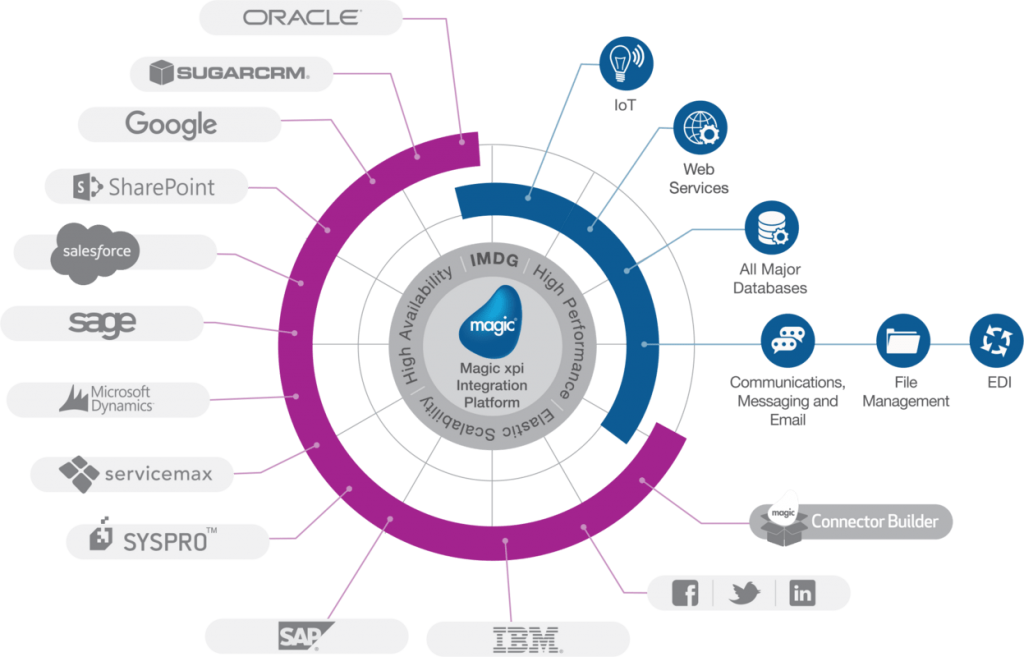
The Magic xpi Integration Platform

Let’s talk about Magic xpi for a second. If integration feels overwhelming, this platform can make it a lot easier. Think of Magic xpi as the glue that holds all your systems together.

Useful reading: How to Optimize Your Business Processes with Magic xpi Integration Platform

It’s got pre-built connectors for Salesforce, SAP, Oracle NetSuite, Dynamics —you name it. Instead of writing custom code, you use a drag-and-drop interface to map out how data flows between systems. Real-time sync means no more waiting for updates, and it’s scalable enough to handle growing businesses without falling apart.

EDI2XML-Magic-xpi-integration-platform

Why Integration Really Matters

Integration isn’t just a tech upgrade; it’s a sanity-saver. When your systems are connected:

  • Your sales team always knows what’s in stock.
  • Your warehouse team gets orders instantly.
  • Your trading partners are updated automatically.

No more miscommunication or wasting time tracking down information. Integration isn’t just about making things faster; it’s about making them work the way they should have from the start.

At EDI2XML, we’ve seen what happens when businesses take the leap to unify their systems. Processes become smoother, teams work better together, and customers are happier. It’s not magic—but with platforms like Magic xpi, it’s pretty close.

What Are the Integration Benefits?

Here’s the honest truth: integration takes work. It’s not magic—you can’t snap your fingers and expect everything to connect seamlessly overnight. But when done right, the payoff is enormous:

  • Accurate Data, Everywhere: No more duplicate entries or mismatched information.
  • Faster Processes: Orders move through your pipeline automatically, saving hours of manual effort.
  • Better Visibility: Sales, operations, and warehouse teams have access to the same data.
  • Happier Customers: Faster, more reliable service because your systems are aligned.Integration price

Business Systems Integration Challenges You Might Face


Every business is unique, which means integration isn’t one-size-fits-all. You’ll need to consider:

  • Compatibility: Do your current systems support APIs or connectors?
  • Scalability: Will your solution grow as your business expands?
  • Implementation Costs: While integration saves money in the long run, there’s an upfront investment in tools and expertise.

While compatibility and scalability are significant hurdles, the technical intricacies of system integration can be even more daunting.

For instance, ensuring seamless data exchange between systems with different data formats and structures can be a complex task. Moreover, integrating legacy systems with modern technologies often requires careful planning and technical expertise.

To overcome these challenges, businesses should invest in robust integration platforms, leverage API-based integrations, and consider data mapping and transformation techniques to bridge the gaps between disparate systems.

Where Do You Start?

The best place to begin is by mapping your current processes. Which systems need to communicate, and what data do they need to share? Once you have that figured out, look for integration solutions that fit your needs—whether it’s custom development, middleware, or managed services.

We’ve been helping businesses with system integration for over 20 years, and one thing we see time and again is hesitation. Many companies are afraid to change their processes, often thinking integration will be too complex or expensive to take on. But here’s the good news: with today’s technologies, integrating business systems has become far more accessible and cost-effective than ever before.

If you’re unsure where to start or worried about the investment, we encourage you to reach out to us. We offer free consultations where we can discuss your specific needs and provide a clear estimate, so you’ll know exactly what to expect.

Synchronizing Accounts in Salesforce with Customers in NetSuite using Magic xpi

November 15, 2024/0 Comments
https://www.edi2xml.com/wp-content/uploads/2024/11/edi2xmlcom-integration-selesforce-edi-erp.webp 628 1200 Tatyana Vandich https://www.edi2xml.com/wp-content/uploads/2024/08/edi2xml.com-EDI2XML-company-logo.png Tatyana Vandich2024-11-15 15:58:352024-11-15 15:58:35Salesforce, EDI, ERP, and WMS Integration: From Chaos to Control

The Bullwhip Effect in Supply Chains: What It Is and How to Keep It Under Control

Blog

What is the Bullwhip Effect in Supply Chains? Understanding Causes and Impacts on Inventory and Efficiency

If you’re in logistics and supply chain management, you’ve probably heard of the bullwhip effect, also known as the Forrester effect. It’s a common challenge that can create huge, costly headaches for businesses. Basically, it’s when small changes in customer demand end up creating much bigger waves in the supply chain—sometimes all the way up to raw material suppliers. So, something as small as a sudden spike in demand for a product can snowball into major inefficiencies, inaccurate inventories, and even excess stock no one ends up needing.

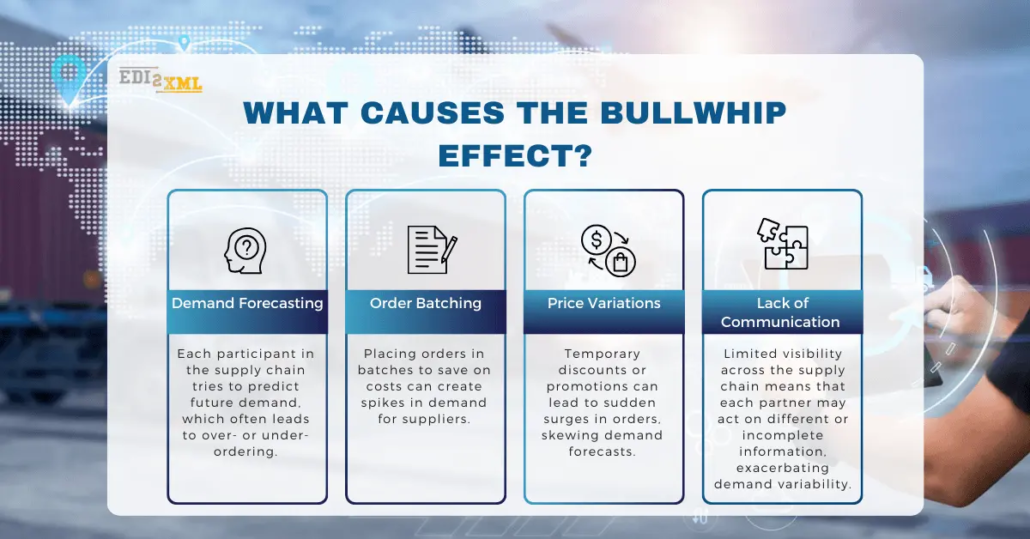
What Exactly Causes the Bullwhip Effect?

There are a few big drivers behind the bullwhip effect:

  1. Inaccurate Forecasting: Every player in the supply chain—from retailers to manufacturers—tries to predict demand. But forecasts are rarely perfect, so each party may over- or under-order to cover themselves.
  2. Order Batching: Many businesses order in bulk to cut costs. But this batch ordering can cause uneven spikes in demand, which don’t actually reflect what customers want right now.
  3. Price Changes and Promotions: Discounts or temporary deals can drive sudden surges in orders. Great for sales, but not so much for the supply chain—it often means that everyone upstream scrambles to keep up, which can lead to an oversupply later.
  4. Limited Visibility Across the Supply Chain: Without transparent, real-time data, every participant in the chain relies on their own (sometimes outdated) info. This leads to decisions that don’t always sync up with actual customer demand.

What Exactly Causes the Bullwhip Effect?

How Does the Bullwhip Effect Impact Your Business?

The bullwhip effect in the supply chain isn’t just a theoretical problem—it can have a real impact on profitability, efficiency, and customer satisfaction. When supply chains are reacting to outdated or inaccurate data, they’re prone to overstocking, understocking, and inaccurate inventories. This translates to wasted resources, higher carrying costs, and lost sales if products aren’t available when customers need them. And these inefficiencies affect nearly every part of the business, from supply chain management to the customer experience.

Where Does the Bullwhip Effect Have Its Greatest Impact?

The bullwhip effect has its greatest impact on manufacturers and suppliers at the beginning of the supply chain. As you move further from the consumer (e.g., from retailers to wholesalers to manufacturers to raw material suppliers), small changes in customer demand get magnified. This leads to:

  • Overproduction or shortages,
  • Excess inventory costs,
  • Inefficient resource use,
  • Strained relationships between supply chain partners.

Manufacturers and suppliers bear the brunt because they react to wildly inflated orders, not actual demand, causing disruptions and higher costs.

How to Prevent the Bullwhip Effect: Practical Solutions

Now, let’s talk solutions. With all the buzz around supply chain analytics and retail analytics platforms powered by AI, there’s good news: you don’t have to just put up with the bullwhip effect. Solution like Electronic Data Interchange (EDI) can help to smooth out these swings in demand and keep your supply chain running more predictably.

Expanding on Real-Time Data Accuracy with EDI Integration, let’s dive deeper into the EDI process and how specific EDI documents can help avoid or minimize the bullwhip effect in the supply chain.

Real-Time Data Accuracy with EDI Integration

EDI allows companies to seamlessly exchange business documents with their supply chain partners, so everyone is finally on the same page — whether retailers, suppliers, or manufacturers.

With EDI, real-time data flows throughout the supply chain, so everyone is working with the same numbers and the same information. This visibility is powerful because it helps everyone avoid the wild swings in ordering that often lead to the bullwhip effect.

Key EDI Documents That Help Keep the Bullwhip Effect in Check

To really understand how EDI can make a difference, let’s look at a few basic EDI documents that are crucial for keeping supply chain data accurate:

  1. EDI 850 (Purchase Order): This is where everything starts. When retailers place an order, they use the EDI 850 to tell suppliers exactly what they need and when they need it. This helps suppliers plan inventory and production right away, so there’s less scrambling to meet demand at the last minute.
  2. EDI 855 (Purchase Order Acknowledgment): After receiving the purchase order, suppliers respond with the EDI 855. This document confirms the order and lets the buyer know if there are any changes or adjustments. It’s a simple way to make sure both sides are on the same page from the start.
  3. EDI 856 (Advanced Shipping Notice): When an order is shipped, the supplier sends the EDI 856 to let the retailer know what’s on its way. This heads-up means the retailer can plan for incoming stock and avoid placing extra orders just because they’re unsure of inventory status.
  4. EDI 846 (Inventory Inquiry/Advice): This document is basically a real-time inventory update. By sharing up-to-date stock levels, both suppliers and retailers can adjust orders based on what’s actually available, helping everyone avoid over-ordering or under-ordering.
  5. EDI 860 (Purchase Order Change Request – Buyer Initiated): Sometimes retailers need to adjust an order after it’s been placed—maybe demand has changed, or forecasts were off. With the EDI 860, they can make those changes quickly without starting the order process over. This keeps things moving smoothly and helps both sides respond flexibly.

Integration price

How EDI Helps the Supply Chain Flow Smoother

So, here’s how it all plays out in a typical situation:

  • A retailer sends an EDI 850 Purchase Order to their supplier.
  • The supplier replies with an EDI 855 to confirm the details.
  • If stock levels change, the supplier shares an EDI 846 Inventory Update to keep everyone informed.
  • When the order is on its way, the EDI 856 Advanced Shipping Notice gives the retailer a clear picture of when to expect the inventory.
  • And if something shifts with demand, the retailer sends an EDI 860 Change Request, making it easy to adjust the original order.

All of this real-time data sharing cuts down on misunderstandings and delays. Everyone in the supply chain has what they need to act quickly and accurately, so there’s less overstocking, fewer surprises, and a much lower chance of reacting in ways that cause the bullwhip effect.

At EDI2XML, we make these EDI processes simple, fast, and effective, so you can keep your supply chain on track and avoid the typical headaches that come with demand fluctuations.

Benefits of Implementing EDI for Supply Chain Management

EDI Enhances Visibility and Transparency: When your supply chain has access to the same data on inventory, orders, and customer demand, there’s less room for costly surprises. Real-time transparency helps each player in the supply chain make better decisions based on accurate, up-to-date data.

Faster Reaction to Demand Changes: With EDI integration, demand changes get communicated instantly. So, if you’re running low on a popular item, suppliers get notified in real-time, allowing them to respond more efficiently. This kind of responsiveness is crucial to cutting down the exaggerated reactions that fuel the bullwhip effect.

Streamlined Communication Across the Supply Chain: Relying on manual processes—like emails or spreadsheets—to update inventory or demand data can be slow and prone to error. EDI ensures that critical data updates flow automatically between systems, improving response times and helping your business stay agile.

Seamless EDI Integration with ERP and CRM Systems

When it comes to effective supply chain management, ERP – Enterprise Resource Planning (like SAP or Microsoft Dynamics) and CRM – Customer Relationship Management (like Salesforce), play a huge role.

Integrating EDI with ERP and CRM systems is essential for a smooth supply chain. EDI links your systems to those of your partners to share real-time data across the entire chain.

At EDI2XML, we specialize in connecting EDI with ERP and CRM systems, so data moves instantly from one system to another.

Imagine you’re a retailer using Salesforce for customer orders and SAP for business operations, and EDI for communicating with suppliers. When a customer order comes in through Salesforce, it’s instantly visible in SAP, so inventory gets updated right away. Then, the EDI system can automatically send a purchase order to the supplier, ensuring there’s no delay. This real-time communication prevents issues like overstocking, missed orders, or lag in responding to demand changes.

How EDI2XML Can Help

At EDI2XML, we specialize in EDI and business system integration, with a focus on creating seamless data exchanges that improve supply chain management. Our EDI solutions like Fully Managed EDI or EDI Web Service are designed to make data sharing smooth and accurate, so your business can prevent the bullwhip effect and work with reliable data, every time.

Imagine not having to worry about inaccurate inventories or overcompensating for demand—just a more efficient, data-driven supply chain. Contact us today for a free consultation with our experts.

Contact EDI2XML today for a free consultation

November 7, 2024/0 Comments
https://www.edi2xml.com/wp-content/uploads/2024/11/edi2xmlcom-Bullwhip-Effect.webp 628 1200 Tatyana Vandich https://www.edi2xml.com/wp-content/uploads/2024/08/edi2xml.com-EDI2XML-company-logo.png Tatyana Vandich2024-11-07 15:04:312025-03-25 15:09:07The Bullwhip Effect in Supply Chains: What It Is and How to Keep It Under Control

Automate with EDI2XML Cloud EDI Software Integration Service

Blog

Automating EDI with EDI2XML: A Comprehensive Cloud-Based Integration Solution

In a congested technology space, companies are constantly looking for ways to automate their processes and improve efficiency. The evolution of Cloud computing offerings especially after COVID19 era, pushed these enterprises to more and more adopt cloud solutions and service offerings, where they can leverage not only the technology to automate EDI, but also the expertise of the team behind the service.

In this blog post, let’s explore how enterprises can Automate their EDI processes with EDI2XML cloud software integration services, and how they can quickly adapt to demands from their trading partners, and become more agile in a very demanding business space.

In this article, I will start by defining few of the important terms, then explore EDI2XML Cloud EDI integration service.

What is EDI and Why It’s Important

Electronic Data Interchange (EDI) is a technology that allows companies to exchange standard business documents -such as purchase orders, invoices, shipping notifications, and inventory updates- in a standardized electronic format.

I’m not going to go further on this topic, since we have already published extensive articles about EDI and its use, which I recommend reading for more information about EDI.

For a more detailed guide on how EDI works and its common use cases, check out our articles:

  • What is EDI (Electronic Data Interchange)?
  • EDI ANSI ASC X12 Standards – Technical Overview
  • How Do Companies Send EDI Files?
  • Business Automation: How to Choose the Right EDI Solution
  • Intro to EDI (Downloadable PDF guide)

What is Cloud EDI Integration Service from EDI2XML?

EDI2XML is a cloud-based service offering, designed to simplify the process of EDI integration. Built on top of EDI2XML software transformation engine, that converts complex EDI documents into XML format, making it easier for businesses to process and manage their data.

EDI2XML cloud service is particularly beneficial for companies that need to exchange large volumes of data with their trading partners.

EDI Cloud Software solution

EDI2XML Cloud Integration Service: Key Components

EDI2XML Cloud Integration service is built on top of several technological components working together in a very orchestrated matter, to deliver an efficient cloud-based solution, that requires no maintenance.

Following is a high-level description of the components that makes up the cloud offering:

1. Cleo: the secured communication “Drummond certified” software to enable the connectivity to trading partners in both directions, using protocols such as sFTP, AS2, AS3, FTPs, https, RosettaNet and much more.

2. EDI2XML: a proprietary transformation software that is capable of transforming EDI to XML and XML to EDI, regardless of the version and sub-version of the EDI transaction.

3. Magic xpi: Magic xpi is a technology proprietary of Magic software, that offers a great interface to visually map from source to destination, any data format to any destination format. It also offers the capability to connect any software system to any other system using a certified and validated connector. Magic xpi acts as the orchestrator to manage the integration flows, triggers, and actions of EDI2XML cloud integration service. It is also the platform to connect to customers branded and none-branded ERP systems.

EDI2XML Cloud-Based EDI Software: Key Features

1. Cloud-Based Solution: The solution operates entirely in the “private” cloud of EDI2XML, eliminating the need for on-premises hardware and reducing IT overhead.

2. Seamless Integration: The EDI2XML service offering, integrates smoothly with various ERP and CRM systems, including SAP, Oracle, Microsoft Dynamics (and much more), using certified connectors.

3. Real-Time Processing: EDI2XML ensures that data is processed in real-time, allowing for faster transactions and improved business agility.

4. Scalability: Whether you’re a small business or a large enterprise, EDI2XML Cloud integration offering, can scale to meet your needs.

5. Security: With robust encryption and secure data transfer protocols, EDI2XML ensures that data is always protected.

Benefits of EDI2XML Cloud Integration Service

There are several benefits to adopt the services of EDI2XML Cloud integration services:

  • Improve automation: Eliminate human errors and improve transaction deliverability by adopting automation.
  • Increased Efficiency: Automating data exchange reduces manual entry errors and speeds up transaction times.
  • Cost Savings: By eliminating the need for paper-based processes and reducing administrative overhead, businesses can save significantly.
  • Improved Accuracy: Automated data processing ensures that information is accurate and up to date, reducing the risk of costly mistakes.
  • Enhanced Collaboration: EDI2XML facilitates better communication and collaboration with trading partners, leading to stronger business relationships.
  • Eliminate IT maintenance: EDI2XML Cloud integration offering, eliminates the need for internal IT support and maintenance.
  • No Need for EDI expertise: Entrusting EDI2XML Cloud integration service, will eliminate the need for experienced personnel in EDI. The internal IT team will focus on what they do best, and EDI2XML will handle all EDI challenges.

EDI2XML Integration Offerings

There EDI2XML integration is offered based on several business models:

Fully Managed Cloud EDI Integration

Fully managed cloud integration: the preferred option for enterprises looking to automate and integrate EDI without carrying the hassle and complexity of Electronic Data Interchange implementation, and maintenance. With this business model, the team at EDI2XML takes care of it call, from pre-implementation analysis, till development and implementation, up until the post-implementation monitoring and support.

HTTP EDI Web Service (REST API)

Cloud EDI2XML Rest API integration: this option is managed by our client. With this option the client will be provided access to EDI2XML REST API, to transform XML to EDI and EDI to XML. This is perfect for customers who has the time and expertise to develop their own integrations using REST API.

EDI2XML Service On-Premises

On-premises EDI2XML integration: Ideal for companies who would like to manage the EDI transformation on their own premises. This is ideal for companies having some strict policies on software consumption and usage.

Cloud EDI solution comparison

How to Get Started

Getting started with EDI2XML is straightforward. Simply fill up the following form to subscribe for the service. Upon filling this simple form, one of EDI2XML specialists will reach out to you to schedule a FREE one-hour Teams meeting to listen to your challenges and offer you a personalized recommendation and a comprehensive business proposal to onboard your company on one of EDI2XML offerings.

Just book a time convenient for you in our calendar.

Or click on this image to book your FREE consultation.


EDI Cloud Free Consultation

September 26, 2024/0 Comments
https://www.edi2xml.com/wp-content/uploads/2024/09/edi2xmlcom-EDI-cloud-solution.webp 628 1200 Pierre Namroud https://www.edi2xml.com/wp-content/uploads/2024/08/edi2xml.com-EDI2XML-company-logo.png Pierre Namroud2024-09-26 11:45:002025-05-09 09:27:07Automate with EDI2XML Cloud EDI Software Integration Service

How EDI Streamlines Supply Chain Management

Blog

Companies are constantly looking for ways to optimize their supply chain, ensuring they can quickly adapt to market changes and meet customer demands on time.

In this blog post, let’s explore how EDI streamlines supply chain management and why it’s essential for businesses today, and the benefits it brings to modern businesses.

Introduction: Electronic Data Interchange (EDI) and Supply Chain Management

The evolution of technology, standards and protocols, revolutionized this field. Electronic Data Interchange (EDI) stands is one of the main facilitators at the level of supply chain innovation.

EDI (or Electronic Data Interchange) is a standard that allows the exchange of business documents between business partners. It is based on structured format and follows some EDI standards (i.e. X12, EDIFACT…). By automating EDI exchange, business partners will be able to transform most of the manual processes into efficient, real-time tasks, increasing efficiency and eliminating human errors.

What is EDI?

Electronic Data Interchange (EDI) is a technology that allows companies to exchange standard business documents—such as purchase orders, invoices, shipping notifications, and inventory updates—in a standardized electronic format.

I’m not going to go further on this topic, since we already published extensive articles about EDI and its use, which I recommend reading for more information about EDI.

For a more detailed guide on how EDI works and its common use cases, check out our articles:

  • What is EDI (Electronic Data Interchange)?
  • EDI ANSI ASC X12 Standards – Technical Overview

What is Supply Chain Management?

Supply Chain Management (SCM) refers to complete coordination of the different elements and partners involved in the production flow of any good or service. This flow starts from its initial stages of purchasing and buying raw materials to its final delivery of the finished good to the end-consumer.

It SCM includes the phases of planning, executing, monitoring, and optimizing of all processes involved in transforming a product from being a raw material until it becomes a finished good, and delivered to the end-user.

The goal of SCM is to enhance the efficiency, reduce costs, improve quality, and deliver products faster.

SCM requires a major collaboration between suppliers, manufacturers, warehouses, transportation services, and retailers, ensuring that each step in the chain is executed on-time in a very optimal manner.

Useful: Download the Guide – EDI for Transportation and Logistics

Key Components of Supply Chain Management

For a successful supply chain management cycle, there are important key components that should be considered, planned and implemented.

  1. Planning: This is the strategic phase where companies do their research on how to meet the demand for their products or services.
  2. Sourcing: Sourcing involves selecting one or multiple suppliers who will provide the raw materials, components, or services necessary for production, for a certain product or service.
  3. Manufacturing: In this phase, raw materials are transformed into finished products.
  4. Logistics and Distribution: Once products are manufactured, they must be stored and distributed to consumers. This involves all logistical processes such as warehousing, inventory management, and transportation.
  5. Returns Management: Also known as reverse logistics, this component deals with the return of defective or excess products from consumers. Managing returns efficiently is important to minimize losses and maintaining customer satisfaction.
  6. Information Flow: Throughout the supply chain, there must be a seamless flow of information to ensure that all parties are aware of demand, inventory levels, production schedules, and shipping timelines. This helps to coordinate efforts across the supply chain, reducing delays and errors.

EDI and Logistics

Importance of Supply Chain Management

Supply chain management (SCM) is very important in today’s business landscape, to be able to deliver on-time, low-cost products and services and at a reduced risk. Here are some of the important elements:

  • Reduce Cost: SCM helps reduce costs by improving efficiencies in procurement, minimizing waste, and optimizing transportation.
  • Increase of Customer Satisfaction: Supply chain can enhance customer experience and promote loyalty. Being able to deliver to customers on time and in good condition, will improve customer loyalty.
  • Increase Company’s Agility: SCM helps companies respond to changes in demand or disruptions in the market quickly.
  • Improve of Collaboration: Better communication means better collaboration across suppliers, manufacturers, and distributors all working towards the same objective.
  • Disruption: Disruption of a Supply chain is a risk that is substantial. Such disruption can be due to different reasons (i.e. natural disasters, political instability, or other factors). Such disruptions can significantly impact a business. SCM helps mitigate risks by allowing companies to create and execute contingency plans based on maintaining relationships with multiple suppliers and monitoring global trends.

How EDI Works in the Supply Chain

As described in the above paragraph, Supply chain management (SCM), relies on several parameters to be as efficient as expected, and deliver as per business expectations. EDI has a role to play in every key component of a successful SCM.

a) Planning: during the planning phase, companies part of the SCM exchange their forecast and based on customer demands and historical sales data via EDI; as an example a distribution company will share via an EDI transaction 830 (Productions forecast and scheduling) its production planning.

b) Sourcing and manufacturing: during the sourcing and manufacturing phase within a SCM, companies will exchange via EDI all kinds of transactions to complete these cycles:

    1. Inventory feeds (EDI 846): Ral-time inventory feeds and updates, are sent periodically by suppliers and manufacturers, to their own customers, via EDI 846 transaction. This allows to update them with accurate inventory levels track stock movements.
    2. Orders (EDI 850): When a customer places an order it goes via EDI 850 transaction to the supplier, this process, would eliminate the need for manual order entry and speeds up the order processing time.
    3. Shipping and Receiving: this process in SCM uses a substantial number of EDI transactions, from EDI transactions that concerns the logistics and transportation companies (i.e. EDI 204, EDI 210, EDI 214…) to the actual shipping and receiving transaction (i.e. ASN 856).
    4. Invoicing: After the goods are delivered, the supplier sends an electronic invoice EDI 810 to the customer. The customer can then process the invoice and make the payment electronically, streamlining the entire billing and payment process.

c) Logistics, distribution and returns: again, EDI is present in all of these components in the supply chain:

  1. Logistics and distribution: lots of EDI transactions come to play, when it comes to logistics, and return, EDI 204, 210, 214…
  2. Returns: EDI 180, EDI 894 and EDI 895 are typical EDI transaction for merchandise return.


How EDI Works in the Supply Chain

Useful Reading: EDI for Third-Party Logistics providers (3PL)

How EDI Streamlines Supply Chain Management

Following are some EDI attributes, that have an impact on the Supply Chain management SCM:

Faster Communication

When exchanging EDI documents, companies part of the same SCM, are opting for a full automation which means, a real-time exchange of business documents, along with automated flows to process those documents.

Eliminating bottlenecks and human errors. Orders, confirmations, and invoices flow automatically between systems, reducing lead times and allowing businesses to respond faster to changes in demand, inventory levels, or production schedules.

Reduce human errors

Manual data entry is equivalent to human errors. Errors in purchase orders, inventory levels, or shipment details can lead to costly mistakes such as overstocking, missed shipments, or payment delays. Using EDI minimizes these risks by automating data transfers.

Improve data quality and integrity

Standardized formats of data, ensure that information is accurately communicated, which will certainly improve data integrity and quality. No more human errors.

Improve Efficiency

Automating supply chain transactions with EDI leads to significant cost savings, where the most important expense is labor. Typically, the labor cost of manually entering data and correcting errors is substantial.

Exchanging EDI reduces these costs by allowing businesses to process large volumes of transactions automatically.

Improve Inventory Management

Companies exchanging EDI transactions will have a much better inventory visibility to their supplier’s inventory. It will eventually enable JIT (Just-in-time) inventory strategies and control of costs.

Improve Data Security

By exchanging EDI transactions, based on standardized protocols and encrypting the data using EDI communication protocols such as AS2, sFTP, AS3 and other protocols, business partners enhance their compliance and security footprints, ensuring secured data exchange.

Can we help in your EDI integration and automation projects?

Our specialists with over 24 years of experience in EDI integration will be happy to hope on a FREE one-hour Teams meeting to listen to your challenges and offer you the best approach and recommendation.

Just book a time convenient for you in our calendar.

Or click on this image to book your FREE consultation.

Free Consultation on EDI


September 23, 2024/0 Comments
https://www.edi2xml.com/wp-content/uploads/2024/09/edi2xmlcom-EDI-SCM.webp 628 1200 Pierre Namroud https://www.edi2xml.com/wp-content/uploads/2024/08/edi2xml.com-EDI2XML-company-logo.png Pierre Namroud2024-09-23 11:22:002024-10-01 09:27:47How EDI Streamlines Supply Chain Management

How to Simplify EDI Processes Through API for Faster Data Integration

Blog

Over the past two decades, I’ve worked with countless businesses struggling to integrate their data efficiently across various systems applications, and trading partners. In all this time, one thing has remained constant: businesses need a reliable way to exchange data quickly and accurately, without unnecessary complexity.

Streamlining Data Integration with EDI and APIs

Electronic Data Interchange (EDI) has traditionally been the go-to for this, especially in industries like logistics and retail. However, as technology evolves, Application Programming Interfaces (APIs) have emerged as a powerful and flexible alternative for real-time data exchange.

While both technologies serve the same fundamental purpose of facilitating data integration, they do so in different ways, and understanding how to leverage each can significantly improve operational efficiency.

Moreover, there is a possibility to work with EDI via REST API, which will be addressed in this article.

In this blog post, I will explain how companies today can leverage their own expertise into consuming REST API to work with EDI, without the need for an extensive EDI knowledge or experience. This will effectively improve their data integration efficiency and delivery in a fast-paced technological and supply chain world.

Let’s start with a little refresher about both terminologies:

EDI vs. API: A Quick Overview

Whatedi x12 is EDI?

Electronic Data Interchange (EDI) is a transmission of structured data between organizations using predefined formats following a certain standard (i.e. x12); The EDI standard has been around for decades and is commonly used in industries like manufacturing, logistics, retail, and healthcare, where businesses frequently exchange standardized documents such as invoices, purchase orders, and shipment notifications.


For more on EDI, check out this article from our blog: What is EDI (Electronic Data Interchange)?


API integration

What is API?

Application Programming Interface (API) is a modern technology that allows different applications to communicate with one another, usually over the internet using standard web protocols (i.e. HTTPS), to exchange data based on a pre-defined structured format (i.e. JSON, XML…) without the presence of a third party in the middle. APIs are flexible, versatile, and widely used in software development and integration.


For more on APIs, check out our article: API Web Service for EDI X12 exchange – Discover the advantages


Use Cases: EDI and API Integration Side by Side

In a well-connected business world of today, there are plenty of use cases where data integration enforces the use of EDI along with API; here is a short list:

  1.  E-commerce Platforms: Retailers often use EDI to communicate with suppliers and manufacturers but rely on API implementation from another side, to update their online storefronts in real-time.
  2. Logistics and Transportation: EDI is often used to exchange shipment details, but on the other side, APIs can provide real-time tracking and status updates to customers.
  3. Healthcare: EDI facilitates the exchange of patient records and insurance claims, while APIs enable the integration of modern cloud-based applications and patient portals.

The list can go on and we can uncover more use cases where API and EDI work side by side, for a complete integration cycle.

Can EDI and API Work Together Using Just One Modern Technology?

The short answer is yes. Instead of managing two separate technologies, businesses can streamline their integration processes by leveraging EDI through a REST API.

let me elaborate, by explaining how to work with an EDI process via REST API, using one of the above use cases (e-commerce platforms).

EDI Integration for an E-commerce Platform (Use Case)

In a real-world use case, a retailer (i.e. Amazon) would send a specific transport company an EDI document (EDI 204) “Motor Carrier Load Tender”. The receiving party would be a logistic and transportation company and will be asked to send his pricing and bid for a transportation job.

That transportation and logistics company will need to receive this EDI 204 document, process this EDI transaction into their own system that can be based on a cloud ERP/CRM software, or home-grown ERP or even and branded CRM/ERP.

Currently, the integrators at the transport company would be transforming these 204 documents than mapping each field into their own ERP, to be able to process.

What we can offer is a single “API call” step to transform the EDI 204 document to xml, via EDI2XML’s own REST API for them to be able to work with a modern XML file (rather than x12 raw files) in such an integration project.

Adding one step into the flow of integration, that does not require much efforts, will allow the developer to work and map the “equivalent” xml file of the EDI document and be able to easily process.

Why Use EDI2XML’s REST API for EDI Integration?

There are several advantages for an integrator to use EDI2XML’s REST API, in his integration project, rather than working with raw EDI files in such an integration:

  • Simplicity: Working with xml is much more comprehensive and simpler than working with EDI, x12 format for example
  • Data Accuracy: While doing the transformation from x12 to xml, EDI2XML REST API will extract every node and element found in the edi file; all data are accounted for
  • Standardized Schemas: When processing an xml message processed by the EDI2XML REST API, the manufacturer is providing the xsd schemas built from the ground up with comprehensive naming terminology based on the appropriate standard (i.e. x12)
  • Cross-Platform Compatibility: Calling a REST API in general is not technology or O/S dependant; in today’s world, all technologies support https and REST api calls.
  • No EDI Expertise Required: No need for any EDI expertise to understand and interpret the transaction converted to xml, it is self-explanatory based on the schemas

Book your Free Consultation with Integration expert

Improve Integration Efficiency Using a Middleware

While EDI2XML REST API is clearly an API to transform EDI to xml and xml to EDI, it is not by any means a middleware to allow mapping of fields and data to accelerate the integration development, the deployment and onboarding process.

However, based on our many years of experience and hundreds of implementations, I can recommend a great middleware and integration platform Magic xpi.

This great platform would turn integration projects from months and weeks into a matter of days from development to go live.


Useful reading: How to Optimize Your Business Processes with Magic xpi Integration Platform


Best Practices in Data Integration Projects

To make the most out of your integration projects, please consider these best practices:

  1. Understand project requirements: Determine what type of data integration and what are the business needs.
  2. Adopt a Hybrid Approach: Combining EDI via API using EDI2XML REST API for standardized EDI, along with batch processing with APIs for real-time updates gives businesses the flexibility to meet various demands without sacrificing operational efficiency.
  3. Prioritize Security: Exchanging EDI and API handle sensitive data, so it’s important to ensure that your integration strategy includes robust security measures like encryption, authentication, and regular audits.
  4. Utilize Middleware: Middleware platforms such as Magic xpi, can streamline data integration, allowing systems to communicate without heavy custom development, especially if your company is operating one of the branded ERP/CRM solutions. Thanks for Magic xpi validated and certified connectors to most of the systems in the marketplace.
  5. Future-Proof Your Integration Strategy: As more businesses transition to the cloud and leverage APIs, make sure your systems are agile and adaptable to new technologies.

Can We Review Your API Integration Strategy Together?

Our specialists with over 24 years of experience in EDI and API integration will be happy to help hope on a FREE one-hour Teams meeting to listen to your challenges and offer you the best approach and recommendation.

Just book a time convenient for you in our calendar.

Or click on this image to book your FREE consultation.

Free EDI consultation


September 16, 2024/0 Comments
https://www.edi2xml.com/wp-content/uploads/2024/09/edi2xmlcom-EDI-via-API-for-Faster-Data-Integration.webp 628 1200 Pierre Namroud https://www.edi2xml.com/wp-content/uploads/2024/08/edi2xml.com-EDI2XML-company-logo.png Pierre Namroud2024-09-16 13:37:382026-06-04 14:47:39How to Simplify EDI Processes Through API for Faster Data Integration
Page 4 of 24«‹23456›»
Recent
  • EDi Integration for SMB - Complete Guide
    Electronic Data Interchange (EDI): The Complete Guide for...July 17, 2026 - 4:46 pm
  • EDI Process Guide from EDI EDI Provider
    How EDI Documents Work Together: A Complete Guide to the...July 9, 2026 - 1:22 pm
  • Wayfair EDI & API Integration Guide
    Wayfair EDI & API Integration Guide for SuppliersJune 30, 2026 - 3:24 pm
  • Promotional banner about whether EDI is required for small businesses and a supplier’s guide to retail onboarding. Women at a desk inside a circular cutout image on the right.
    Is EDI Required for Small Businesses? A Supplier’s Guide...June 17, 2026 - 7:02 pm
  • EDI compliance with Loblaw
    How to Meet Loblaw EDI Requirements as a Small BusinessJune 4, 2026 - 2:05 pm
Popular
  • How to Quickly Connect to a Large Retailer's EDI Requirements
    How to Get EDI-Compliant Quickly For A Large RetailerNovember 21, 2025 - 4:29 pm
  • EDI-as-a-services
    EDI Translation Software “On-premises” or “As...January 21, 2014 - 1:28 pm
  • order-automation in e-commerce
    Why Is It Crucial to Automate the E-Commerce Order Fulfillment...May 10, 2022 - 1:58 pm
  • EDI for Logistics and transportation
    EDI Integration for Efficient Transportation ManagementOctober 6, 2023 - 1:33 pm
  • information technology definitions
    Business Tech Terms DefinitionsMay 24, 2018 - 1:32 pm

Browse by tag

Amazon Amazon Integration ANSI ASC x12 ASC X12 EDI B2B EDI integration e-commerce e-commerce business e-commerce integration eCommerce eCommerce integration EDI EDI2XML EDI 850 EDI as a Service EDI Communication EDI converter EDIFACT EDI for supply chain EDI for Third-Party Logistics EDI for transportation EDI implementation EDI Integration EDI Integration Project EDI project EDI Translation EDI Web Service EDI x12 ERP Integration integration platform integration project JDE Magic xpi Magic xpi Integration platform NetSuite online store Salesforce Shopify Shopify eCommerce integration Shopify integration Supply Chain Supply Chain Management Translation Software X12 EDI XML

Subscribe to our Blog

Menu

  • Home
  • About the EDI2XML Company
  • About EDI2XML EDI Converter
  • Blog
  • Book A Free Consultation
  • Privacy Policy EDI2XML Company

Our Services

Fully Managed Integration

E-Commerce Integration

Business Systems Integration

Fully Managed EDI

EDI Web Service 

On Premises EDI 

Managed Cloud Service


Latest Blog Posts

  • EDi Integration for SMB - Complete Guide
    Electronic Data Interchange (EDI): The Complete Guide for Modern BusinessesJuly 17, 2026 - 4:46 pm
  • EDI Process Guide from EDI EDI Provider
    How EDI Documents Work Together: A Complete Guide to the EDI Transaction ProcessJuly 9, 2026 - 1:22 pm
  • Wayfair EDI & API Integration Guide
    Wayfair EDI & API Integration Guide for SuppliersJune 30, 2026 - 3:24 pm

Contact Us

400 Blvd Curé-Labelle, #304 Laval QC H7V 2S7 Canada

Contact EDI2XML Team
Phone: +1 450-681-3009
Website: https://www.edi2xml.com/

© 2000-2026 EDI2XML (by Namtek Consulting Services). All rights reserved.
  • Link to Facebook
  • Link to LinkedIn
  • Link to X
  • Link to Youtube
  • Blog
Scroll to top Scroll to top Scroll to top