EDI2XML
  • About
    • The Company
    • EDI2XML
    • Advantages
    • Partnership with EDI2XML
    • Testimonials
  • Services
    • Enterprise AI
    • Fully Managed Integration
    • Fully Managed EDI Services
    • EDI Web Portal
    • EDI Web Service
    • EDI On Premises
    • Managed Cloud Services
    • Amazon Integration
    • Shopify Integration
    • BigCommerce Integration
    • NetSuite Integration
    • JD Edwards Integration
    • Dynamics 365 Integration
    • SAP B1 Integration
    • Salesforce Integration
    • Industry 4.0 Integration
  • Pricing
    • EDI Managed Services
    • EDI Web Service
    • EDI On-Premises
    • Managed Cloud Services
    • Shopify Integration
    • JD Edwards Integration
    • E-commerce Integration
    • All other Integrations
  • Blog
  • Resources
    • Downloadable Guides
    • List of EDI Codes
    • List of EDIFACT Messages
    • EDI Documents Library
    • Trading Partners
    • Customer Case Studies
  • Contact us
  • Book a Consultation
  • Click to open the search input field Click to open the search input field Search
  • Menu Menu
  • Link to Facebook
  • Link to LinkedIn
  • Link to X
  • Link to Youtube

What are the differences between RosettaNet, EDI ANSI X12 and EDIFACT

Blog


This post was updated to reflect current trends and information.


What is RosettaNet?

Rosettanet RosettaNet is a non-profit organization having more than 500 high-tech companies as members. These members create and implement open standards for processing business to business (B2B) transactions, especially at the supply chain level, in their appropriate vertical. The main mission of RosettaNet organization is to generate standard protocols for specific business transactions such as new Product Information, order Management, design registration, request technical data, etc.

These standards define XML schema, thus defining a hundred processes for exchanging information between partners (PIP-partner interface processes).

Founded in 1997 by Fadi Chehadé, RosettaNet is a subsidiary of GS1 US, formerly the Uniform Code Council, Inc. (UCC).

RosettaNet and the high technology industry

RosettaNet includes more than 500 members from companies all over the world. Most companies of this consortium belong to the electronics and semiconductor industry – companies that produce personal computers (PCs), computer hardware, computer software, electronic components, telecommunications equipment, consumer electronics. This organization also includes telecommunications and logistics companies.

RosettaNet includes big companies such as:

  • Cisco
  • Hewlett-Packard
  • Intel
  • Microsoft
  • SAP
  • Bosch
  • Ericsson
  • Nokia and many more.

RosettaNet has several local user groups. The European user group of RosettaNet for B2B standards is EDIFICE.

The RosettaNet standard

Electronic industry and Rosettanet RosettaNet optimizes existing standards, guidelines, and specifications of open e-business for cross-platform applications and network communications. RosettaNet defines the concepts of e-business (file formats, procedures, implementation, requirements, etc.) and develops standards for ensuring compatibility of business processes. RosettaNet is based on open XML standards.

Primarily oriented in the supply chain areas, RosettaNet also addresses production, product data, and service processes.

As I mentioned above, this standard is widely distributed in the electronic components and semiconductor industries, but also in the logistics and telecommunication industries.

Partner Interface Processes (PIPs)

RosettaNet PIPs are specialized System-to-System XML-based dialogs that define business processes between partners in a value chain. Each PIP comprises a specification founded on the RNIF “RosettaNet Implementation Framework”.

A RosettaNet implementation, requires a message guideline with a PIP-specific version of the Business Dictionary, and an XML Message Guideline document that provides the models and documents.

The different PIPs are divided into clusters (areas), each covering a specific business process area:

  • Cluster 0: RosettaNet Support
  • Cluster 1: Partner Product and Service Review
  • Cluster 2: Product Information
  • Cluster 3: Order Management
  • Cluster 4: Inventory Management
  • Cluster 5: Marketing Information Management
  • Cluster 6: Service and Support
  • Cluster 7: Manufacturing

The actual PIP name is obtained from the clusters and the subsequent division.

RosettaNet PIP 3A4: Request Purchase Order

3 → Cluster 3

A → Quote and Order Entry

4 → Request Purchase Order

To learn more about RosettaNet PIP Classifications learn our previous article: RosettaNet and B2B EDI Integration: All you need to know

How RosettaNet differs From EDI ANSI X12 and EDIFACT

EDI is another standard to exchange EDI (electronic data) messages between trading partners. EDI stands for “Electronic Data Interchange.” There are numerous variations of EDI and each variation is different from the other. The ANSI X12 is the most popular in North America in various verticals, while EDIFACT is popular in Europe.

Useful reading: ANSI ASC X12 Standards Overview

There are many major elements distinguishing RosettaNet from EDI X12 and EDIFACT:

First, RosettaNet is developed principally to support logistics and supply chain interactions in the Hight- technology industry, while EDI is widely used in various industries (Retail, Wholesale, Energy, Healthcare, Pharmaceutical, Manufacturing, Logistics, Government, etc.)

The second difference between RosettaNet and other EDI standards, is that RosettaNet focuses on process and process modeling, while there are no process-focused messages in ANSI X12 and EDIFACT.

Another difference between RosettaNet and EDI is RosettaNet is XML- based while EDI (X12 and EDIFACT) is text-based. There’s a big structural difference between RosettaNet and EDI business document.

A RosettaNet message package contains two main parts: headers that define the source, destination, and purpose of the message package; and a payload (with optional attachments) that transmits the actual business information or operational signals (for example error messages). Both the headers and the payload are encapsulated in XML tags.

In addition, RosettaNet is adopting existing Industry standards, such as JEDEC, UN, the UCC/EAN, NEDA, NIST, and others.

Unlike ANSI X12 and EDIFACT, RosettaNet formed business dictionary and Technical Dictionary (RNTD)

The RosettaNet Business Dictionary (RNBD) identified business attributes to define transactions between trading partners. It defines the meaning of business terms for example “Purchase Order Acceptance” thus the trading partners can be guaranteed the processes interfaced between two businesses are being correctly mapped. The Business Dictionary serves as a central reference and reference work for other standard documents.

The RosettaNet Technical Dictionary (RNTD) provides a common language for the definition of IT products. In other words, it ensures that product information exchanged between business partners uses a common vocabulary even if one of the partners prefer a non-standard intern term.

The EDI community recognized the need for such dictionaries…RosettaNet successfully created and used the dictionaries because it restricted the scope of the dictionaries to first the IT industry, then to the Electronic Component (EC) industry, and the Semiconductor (SM), Telecommunications (TC) and Logistics (LG) industries.

How difficult is to implement RosettaNet?

You will need a good knowledge of XML, as well as some knowledge of supply chain management. Experience with SAP, Oracle Applications, or similar software for enterprise resource planning, manufacturing or supply chain will also be an advantage.

Our team of specialists has many years of successful experience working with RosettaNet and business systems integration, so if you need help or advice or professional advance, please contact us and we will more than happy to assist you!


May 30, 2019
https://www.edi2xml.com/wp-content/uploads/2019/05/Rosettanet-vs-x12-EDIFACT.png 350 1024 Tatyana Vandich https://www.edi2xml.com/wp-content/uploads/2024/08/edi2xml.com-EDI2XML-company-logo.png Tatyana Vandich2019-05-30 11:17:502020-03-18 12:53:02What are the differences between RosettaNet, EDI ANSI X12 and EDIFACT

Must-Have Integration between E-Commerce and Business Systems

Blog


This post was updated to reflect current trends and information.


Must-Have Integration between E-Commerce and Business Systems

Prior to addressing the e-commerce integration with different business systems and applications, let me start by asking the obvious question, and try to answer: “What is integration?“

In a short sentence, “Integration” is the process of orchestrating processes and synchronizing data between two or more different business software systems, without human intervention.
The integration between an online eCommerce store and one or more systems allows a company to overcome important challenges such as:

– Maintaining up-to-date product information on the e-commerce store (availability, price, specifications)

– Connecting online payment services (payment on the website via bank cards, Authorize.Net, PayPal, Google Checkout, Amazon Payments, etc.);

– Using various support services (statistics services, online consultants, and many others) and many more.

Does Your Business Need Systems Integration?

Do you know how to determine whether your business needs to automate and orchestrate flows and data? Here are some of the most common reasons that indicate the need to integrate your online store with your CRM:

  • Your Online Store receives more than 150 orders per month. With this volume, manual data entry and processing take a lot of time and resources, thus becoming ineffective.
  • Your e-commerce store needs to improve the customer experience. Constantly, you have problems with orders due to incorrect inventory status.
  • You have an issue with getting the shipment tracking number from your business system into your eCommerce store immediately after the product is shipped.
  • Your online store accumulates orders that are waiting to be processed. which directly affects your delivery timeline.
  • You have no real-time inventory update, such as inventory available to sell. Of course, here you are risking under-selling your goods.

Cost-Effective Integrating Solution


Today, there are sophisticated technologies to bridge any system to any system and build an efficient integration. There are a lot of integration approaches. However, for entrepreneurs and large corporations alike, the important aspects they look at when planning integration projects are the budget and the timeline to implement the integration project, while having a powerful technology capable of delivering.
Integrating your e-commerce store with other business systems allows your company to benefit from:

  •  An enhanced customer service experience, with accurate and quicker handling of orders.
  • An outstanding quality of information, free of human errors.
  •  An Increased efficiency, accuracy, and timeliness.

Regardless of which e-commerce platform your company adopted, be it Shopify, Magento, Volusion, BigCommerce, OpenCard, eBay, or Amazon, etc., your online store will always be in sync with your ERP/CRM or any home-grown system your company might have adopted.


If you want to find out all about selecting an Integration platform, take a look at our article: How to Choose the Right Integration Platform? It will help you figure out the issue and make the right choice! 


The Most Common Integrations to E-commerce

Warehouse Management System

One of the most popular integrations is to build an integration between an e-commerce store and a company’s Warehouse Management System (WMS).
A warehouse management system is software that automates a company’s warehouse operations. This operation may include inventory management, picking processes, and auditing, among other processes.
There are different types of Warehouse Management Systems:

• Standalone systems – usually deployed on-premise
• Cloud-based systems – SaaS solutions
• ERP modules –as a component of enterprise resource planning.

The demand to integrate e-commerce stores with Inventory Management Systems is quite high, which is why an integration platform such as Magic xpi, has more than 100 pre-built connectors and adapters for quick and easy integration. This makes integrators’ lives much easier; integration time is greatly reduced, and it saves customers’ money.
No matter what warehouse management system your company adopted, or plans to adopt, SAP EWM, Oracle WMC, NetSuite ERP, NetSuite Warehouse, Zebra Warehouse, WIMS 2.0, etc. it’s always worth remembering that integration is best done with proven experts and technologies.


If you want to know more about Warehouse Management System (Types,  Features, and benefits of WMS)  read the article here


Customer Relationship Management (CRM)

Another not less popular is the integration of an e-commerce store with the company’s CRM. If your online store has been successfully operating for a long time and sales are growing, it is likely that you are thinking about using a CRM system (Customer Relationship Management). Maybe you already use it, and now it’s time to integrate your CRM and your e-commerce store.

But how to maintain the relevance of information in CRM and organize the work of employees in such a way that they are not torn between the work in the administrative panel of the e-commerce site, the mailbox, and the CRM system? In case of integration of your CRM with the online store, orders and other relevant information will appear directly in the system. According to financesonline.com, the best CRM systems are:

  • Salesforce CRM
  • Hubspot CRM
  • Freshsales
  • Pipedrive
  • Insightly
  • Zoho CRM

DropShipping

Currently, there are a lot of online shops that offer the Drop-ship concept to their suppliers. “Drop-ship” is a popular fulfillment method where an online store (e-commerce) doesn’t keep stock. The process is that the online store sends information about customers’ orders to the manufacturer, and then, the manufacturer ships the goods directly to the consumer. This method eliminates the need for the merchant to handle the goods. In this business model, the integration of the company’s internal systems with the drop-ship eCommerce store becomes very critical for a successful drop-ship experience.


For more information about Dropshipping integration, read our blog: 4 Challenges of EDI and Drop-Ship in eCommerce


When discussing third-party integration options, you should not forget about the delivery service. Certainly, one of the key factors influencing clients ‘ decisions about purchasing is delivery.
An integration platform like Magic xpi can also easily connect your online store to the most popular delivery services, such as DHL, FedEx, or UPS.

Payment systems


Another popular integration is the integration with payment systems. By payment systems, we understand service providers that allow you to process financial transactions, and the provider would charge a percentage of the commission to cover his fees. Many payment systems have already developed API (application programming interfaces) of their payment gateways, for integration purposes.
If you are wondering what kind of system to connect, here are some of the most popular payment systems:


  • Paypal
  • Amazon Pay
  • Google Pay
  • American Express
  • Apple Pay
  • Stripe
  • Square
  • Visa Checkout
  • Masterpass
  • 2Checkout (now Verifone)

Everything you Need to Know about Online Payment Processing: Online Payment Processing Guide


Leave your e-commerce integration to the experts

E-commerce Integration needs a professional approach. It takes time, resources, and skills, and in case of an error, the company may incur significant losses.
Therefore, if you have any questions or need integration with any service, feel free to contact us. We have a great experience with integration between e-commerce and different systems.
We will be more than happy to help and assist!

Shopify integration price list

RELATED POSTS:

Fully Managed Shopify Integration Service

Why you should automate inventory updates for your Shopify store?

Secrets and rules of Shopify integration with your ERP or CRM

EDI Integration of B2B e-commerce for small companies

May 3, 2019
https://www.edi2xml.com/wp-content/uploads/2019/05/E-commerce-integration.png 350 1024 Tatyana Vandich https://www.edi2xml.com/wp-content/uploads/2024/08/edi2xml.com-EDI2XML-company-logo.png Tatyana Vandich2019-05-03 12:58:182026-06-04 15:02:48Must-Have Integration between E-Commerce and Business Systems

Fully managed EDI service VS HTTP Web Service: Which is Better for Your Business ?

Blog

This post was updated to reflect current trends and information.


Electronic Data Interchange (EDI) and all the services around it are becoming more and more popular, regardless of the industry, for one major reason: EDI transactions are replacing paper documents exchanged between trading partners, and helping companies in their digital transformation projects, for a “greener” planet.

Retail was one of the first industries to fully adopt EDI, and it is still the most active vertical in its usage. EDI is a proven and effective alternative to fax, e-mail, and manually entering or re-entering data such as Invoice, Purchase Order, Inventory and many others…

There are various types of EDI and several approaches to integrate Electronic Data Interchange in a business community. Each EDI provider can offer a different EDI integration methodology, in order to become EDI compliant. We at EDI2XML, offer two options for to integrate EDI into your company, and make your business “EDI compliant”, while shortening the integration project:

Fully Managed EDI Service

HTTP EDI Web Service

How to select? What kind of EDI integration solution is a better option for your business?  First, let’s understand both options.

Fully Managed EDI Service

The EDI2XML service offered as “fully managed” includes translation and communication service offering to businesses of all sizes, from different industries.

Our team at EDI2XML, takes care of ALL the aspects of the integration project. With this model, we offer a “Turnkey EDI Solution” where we take on our shoulder all setup, configuration, testing, certification with the EDI partners …

EDI Fully Managed Service
 

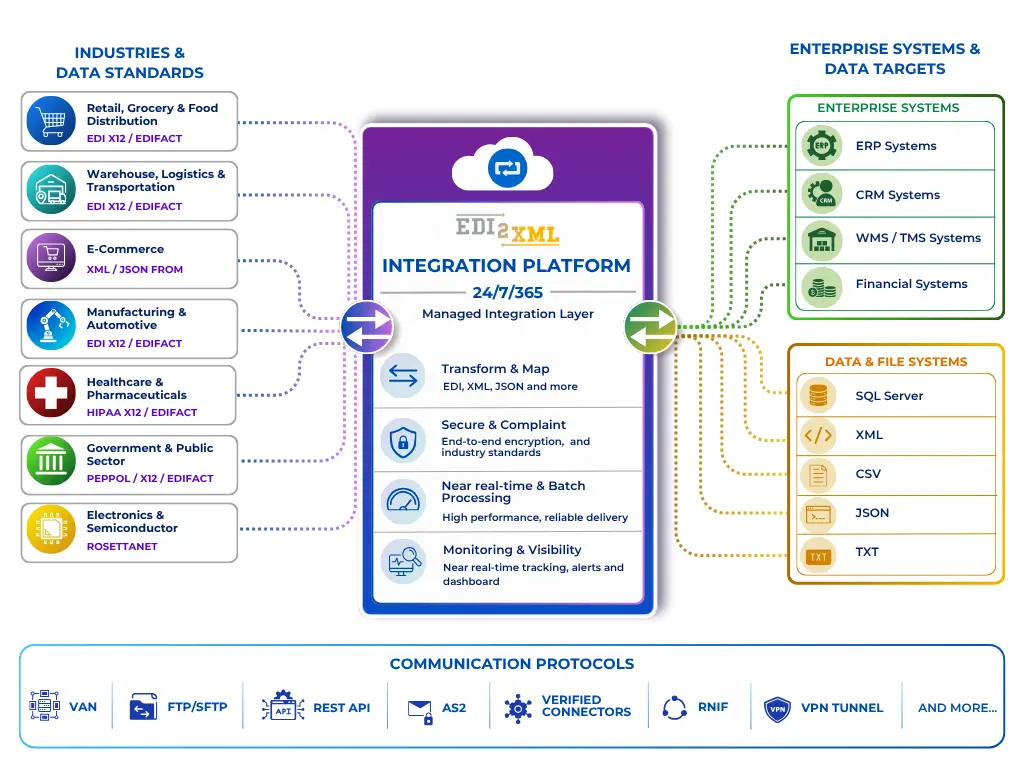
In other words, with this option, we take care of everything: all the steps of the project from A to Z. We can even integrate directly into your ERP or CRM system. We provide certified connectors for leading IT systems such as Salesforce, JD Edwards, SAP, Dynamics CRM, Dynamics AX, and more.

Infographic of an integration platform linking industries (left) to enterprise systems (right) with data formats (SQL Server, XML, CSV, JSON, TXT) below.
 

a) Technical Details

A setup phase is mandatory for all new Trading Partners and/or EDI document implementation. This stage includes the project analysis, setup of Trading Partner accounts, configuring Partner specs and platform, defining the transfer file structure, building and setting up all required connectivities and communication protocols. It also includes an end-to-end full cycle data testing and certification.

To learn more about EDI service, download our free introductory guide here

b) Pricing

As for the pricing, it is based on pre-defined monthly service packages, including a pre-defined volume of data processed. All our packages are billed monthly based on the entry level plan (Business Light) at the beginning of each month. Subsequent month billing will include the basic plan fee PLUS the difference between the plan we billed initially (Business light) for previous month, and the plan that we were supposed bill for the previous month based on real volume of data processed for that month.

All this to say, our monthly pricing packages are dynamic, they go up and down based on the volume of data we process and integrate, and our clients are not locked in in any of the packages.

For more information about pricing, fill out a form: EDI2XML Translation Service Pricing Package

HTTP EDI Web Service (REST API)

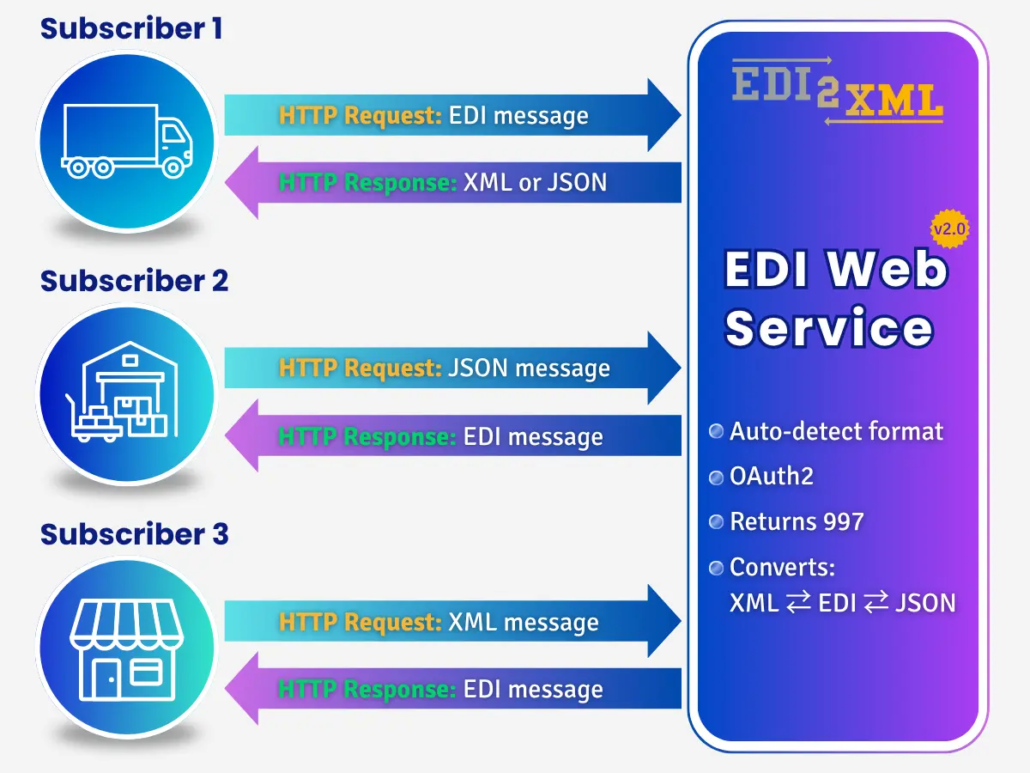
EDI2XML Web Service is an HTTP service running over the internet, on EDI2XML’s own platform that is capable of receiving HTTP requests to translate EDI messages to XML, and XML messages to EDI (based on EDI2XML’s proprietary format).

EDI2XML Web Service is much more cost-effective, and meant for companies who got their own technical resources to work with REST API (call and consume HTTP Rest Web services)

The principles of the mechanism of the EDI2XML Web Service is schematically illustrated in the diagram below.

API-Converter for EDI XML and JSON

a) Advantages

EDI2XML Web Service is the way to go for the following reasons:

  • Self-service solution
  • Low cost
  • We offer a 15 days free trial, without any commitment.
  • Get started with less than an hour
  • There is no contract, no commitment.
  • Payments are month to month; Cancel anytime with a 30 days’ notice.
  • A very simple and dynamic pricing scheme
  • Availability and reliability
  • Based on proven technology in the field for over 18 years now
  • Outstanding technical support

b) Technical Details

Implementation time: Getting started with EDI2XML Web Service, is very simple and quick. Within less than an hour, you can issue the first Call to the Web Service and see the response. Our HTTP EDI Web service is very clearly documented, and we provide instructions with each subscription.

  • Quick entry: you can be up and running in less than an hour, and it is proven; we provide everything to your developers to get started, a java client with its source code and instructions on how to work with it.
  • We offer the schemas(xsd) of the XML format our API expects, and all what you need to do is to format your data according to that format and you will be up and running.

c) Pricing

EDI2XML API service fee to use the HTTP / Web Service calls, has a very simple pricing scheme. The price consists of two elements:

  1. Monthly mailbox fee: a “fixed” monthly fee for the Web Service Mailbox usage on EDI2XML platform. It is a nonrefundable fee.
  2. Data processing fee: a “variable” fee based on the volume of data processed and translated between EDI and XML, during a calendar month. The volume of data processed is computed in both directions:
  • Incoming, and
  • Outgoing

Click here to request EDI2XML Web Service Price List

d) How to get started with EDI2XML API

To get started with our EDI Web Service three steps you need to follow:

1. You need to provide us the list of documents/transactions you want to be activated under your trial account.

2. We will simply set you up with a 15 days trial account, without any commitment from you. Just let us know when do you want to kick off, and we can take care of setting you up on a trial account.

3. We provide a Java client and its source code. You can get started with less than an hour, this will allow you to try and see the results by your own.

We’ve recently launched EDI2XML Web Service v2.0 – a smarter, faster, and more secure version of our REST API. It supports improved token-based authentication and better performance for X12, XML, and JSON document exchange. Learn more: What’s New in Version 2.0?


Watch the Video and discover which solution aligns best with your business needs and goals.


Compare key features of Fully Managed EDI Service and HTTP EDI Web Service

key feature

Fully managed EDI service

HTTP EDI Web Service

 Type of EDI solution Full service Self service
 Contract Yes No
 Commitment 24 months No
 Implementation time   (approximately) 2 weeks 1 hour
 Real-Time Connection Yes Yes
 Free Trial account No 15 days
 Data processing fee Based on the appropriate plan. It works in both directions: when the volume goes up and  when the volume goes down.   “Variable” fee based on the   volume      of data processed     and translated         between   EDI    and XML, during a         calendar    month.
 Need for internal   resources No Yes
 Need for in-house EDI expertise No No
 Technical Support Yes Yes
 Hardware Installation  Required No Yes
 Software Installation Required No No
Communication with the trading partner: setup and testing in both directions Yes

No

Free edi consultation

We, at EDI2XML, provide an EDI integration solution for every type of business. Contact us today for a free consultation and we will help you find the most appropriate option for your business.


April 12, 2019
https://www.edi2xml.com/wp-content/uploads/2019/04/Fully-EDI-vs-API-EDI-.png 350 1024 Tatyana Vandich https://www.edi2xml.com/wp-content/uploads/2024/08/edi2xml.com-EDI2XML-company-logo.png Tatyana Vandich2019-04-12 13:14:502026-07-06 13:34:33Fully managed EDI service VS HTTP Web Service: Which is Better for Your Business ?

Role of SOA, ESB, and BPM in Integration Projects

Blog
This post was updated to reflect current trends and information.

Role of SOA, ESB, and BPM in Integration Projects

Today, in order to increase efficiency and be competitive, companies must quickly respond to any internal or external changes in business processes. The company’s IT infrastructure, plays a critical role in responding to such changes considering it is built based on a flexible and agile architecture.

The complexity of the IT infrastructure leads to increased costs, resources, and integration time.

The infrastructure flexibility and agility of an enterprise, can be achieved by building an IT environment based on Service Oriented Architecture – SOA.

Key Components of a SOA:

– Enterprise Service Bus (ESB)
– Business Process Execution Language (BPEL)
– Business Rules
– Complex Event Processing (CEP)
– SOA Governance
– B2B Integration
– Business Activity Monitoring (BAM)
– Unified Management & Monitoring

Enterprise Service Bus (ESB) – is a communication system between mutually interacting software applications in the service-oriented architecture (SOA). ESB provides a cost-effective way to centrally configure, deploy, and manage services across a large enterprise.

The SOA’s goal is to set up an IT infrastructure in which all the necessary IT resources of the company are provided in a flexible, efficient and fast way.

Accelerating Business through Business Process Management and SOA

Business Process Management

BPM (Business Process Management) is a common attribute of Service Oriented Architecture (SOA), and an instrument through which a company can apply SOA to high-value business challenges. Both SOA and BPM can be applied individually, but the two agreed approaches offer mutual benefits for business.

The combination of BPM and SOA provides companies with a new generation of tools for the rapid development of composite business applications. This allows to maximize the use of all available resources of the company, as well as quickly connect new ones.

Getting Help with SOA

When implementing integration projects on the principles of SOA, we use mature products from Magic Software Enterprises – a global enterprise software company, delivering Magic xpi, a fully reliable SOA, API-driven integration platform. We take into account the specifics of each project and customer preferences. Contact us today to get a FREE-It consultation with one of our integration experts!


Integration using Magic xpi

March 26, 2019
https://www.edi2xml.com/wp-content/uploads/2019/03/Role-of-SOA-ESB-and-BPM-in-Integration-Projects-e1553716879683.png 341 1024 Tatyana Vandich https://www.edi2xml.com/wp-content/uploads/2024/08/edi2xml.com-EDI2XML-company-logo.png Tatyana Vandich2019-03-26 15:56:302021-05-26 11:46:19Role of SOA, ESB, and BPM in Integration Projects

Integration‎ based on Service Oriented Architecture (SOA)

Blog

This post was updated to reflect current trends and information.


These days, many companies have very complex and advanced IT infrastructures, numerous applications, ERP and CRM systems, and other business software.

As businesses evolve, corporate information systems become more fragmented.

It is not advisable to simultaneously abandon all outdated information systems and integrate a new one.
In addition, often just one business system cannot satisfy all the needs of a company.

The integration of various heterogeneous solution plays a key role in the corporate IT environment. In most cases, system integration is a forced measure aimed at improving the efficiency of the company’s business processes.

Responding to business needs, software manufacturers are constantly improving integration solutions.

What is Service-oriented architecture (SOA)?

SOA

Service-Oriented Architecture (SOA) is a modular approach to software development based on the use of distributed, loosely coupled, replaceable components, and equipped with standardized interfaces for interoperability over standardized protocols.

Service Oriented Architecture (SOA) was introduced in the late 1980s. It was originally presented by CORBA, DCOM, and others. There are several implementations patterns but in fact, SOA can be reduced to a few concepts:

  • Autonomy (independent evolution, scalability, and deployability).
  • User-facing application compatibility.
  • Reuse of business services.
  • Independence from a technology stack

SOA Fundamentals

The basis of SOA is the standardization of relationships between applications. Each system has an “input”, where the initial data is set, and an “output”, on which we get the result of processing this data, thus, these fragments need to be connected into one whole.

The main connecting elements are adapters (connectors) that convert incoming data (service request) and output (service results) into a standard form. Due to this, the application can use as a service a wide variety of “users” (including other applications) and for the convenience reasons, it’s necessary to form the consolidated register with the description of existing services and “rules” of their use (Enterprise Service Bus).

In this way, it is possible to connect to the service only if an adapter has been developed to the corresponding application (or database) that converts incoming / outgoing data into a standard form.

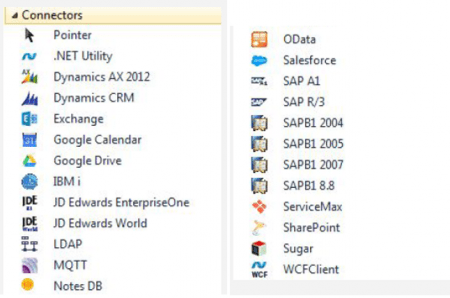
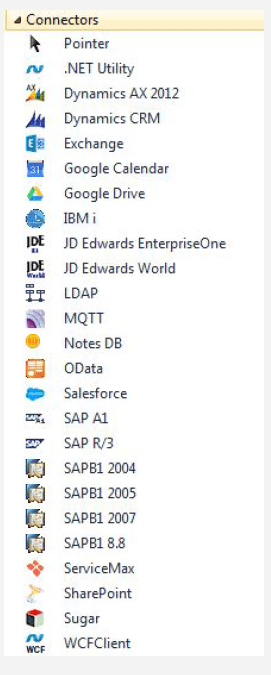
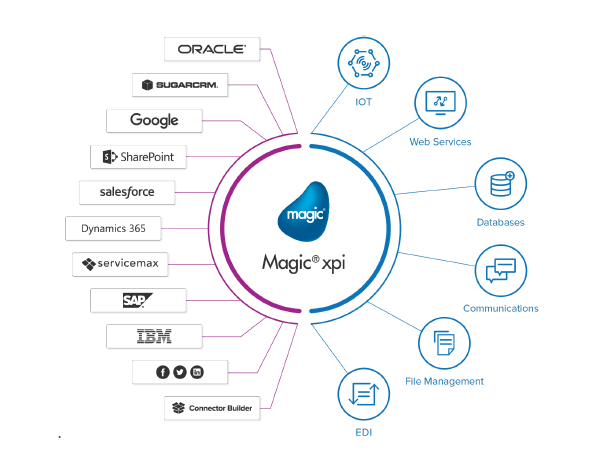
The Integration Platform Magic xpi includes 100+ prebuilt certified adapters for leading IT systems.

The Integration Platform Magic xpi includes 100+ prebuilt certified adapters for leading IT systems.

Read:  How to Choose the Right Integration Platform?


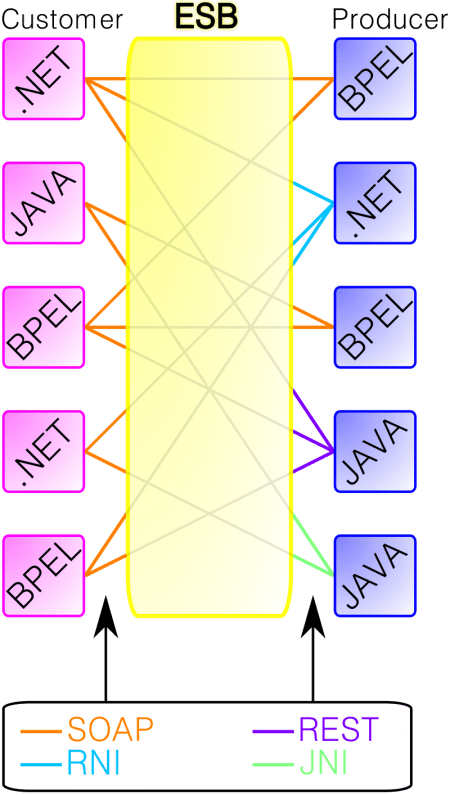
The SOA integration solution is centralized and the Enterprise Service Bus acts as the medium.

An enterprise service bus (ESB) implements a communication system between mutually interacting software applications in a service-oriented architecture (SOA). (Source: Wikipedia)

All customer services communicate in the same way with the ESB: the ESB translates a message to the correct message type and sends the message to the correct consumer service.

An enterprise service bus (ESB) implements a communication system between mutually interacting software applications


SOA standards

SOA standards have already evolved tremendously, and this happened at all levels:

  1. Modern and diversified adapters
  2. standardization of interoperability through the transport layer
  3. description of business processes

SOA standards have been developed and approved by standardization organizations, which comprise the largest vendors. The expansion of the pool of adapters to the most common industrial applications and databases continues – there are only a few hundred adapters at the moment, and partially integration problems are resolved by the expansion of the standard adapter set.

If there is no ready-to-use adapter to the application used in the enterprise, it can be developed in accordance with already established standards, thus providing the opportunity to integrate this application into the corporate IT environment as a service.

One of the main advantages of using the SOA concept is the rapid response of the information system to changes in business processes. SOA allows you to quickly and with minimal changes rebuild the system to new data manipulation schemes.

EDI2XML Offers a fully reliable SOA, API-driven Integration Solution

For over 21 years, we have been the official partner of the Global software company Magic Software Enterprises Ltd., which provides the Magic xpi integration platform. It’s a fully-trusted SOA and API-based integration platform for enterprise-level integration, business process automation, and data synchronization.

With a wide range of certified and optimized connectors and adapters, Magic xpi integrates ERP, CRM, financial and other systems, such as SAP, Oracle, Salesforce, Microsoft, IBM, and many others.

Looking for Integration Solutions? Contact Us Today

Magic xpi Integration SOA platform White paper


March 8, 2019
https://www.edi2xml.com/wp-content/uploads/2019/03/SOA-Integration.png 350 1024 Tatyana Vandich https://www.edi2xml.com/wp-content/uploads/2024/08/edi2xml.com-EDI2XML-company-logo.png Tatyana Vandich2019-03-08 09:00:532021-05-25 12:00:32Integration‎ based on Service Oriented Architecture (SOA)

9 Major E-Commerce Trends That Will Help Grow Your Online Business

Blog

This post was updated to reflect current trends and information.

E-commerce market research

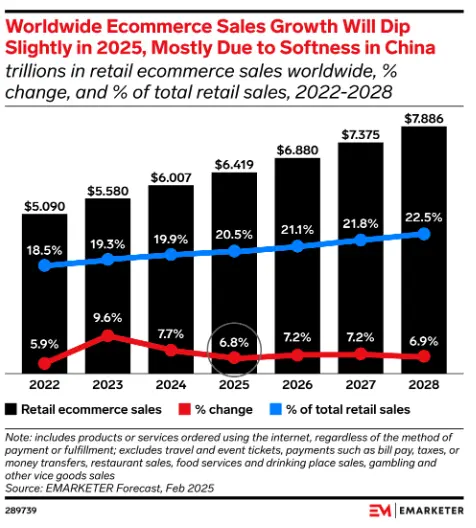
U.S. retail e-commerce keeps setting records. In 2024, Americans spent $1.19 trillion online. Aaccording to the United States Census Bureau in Q2 2025 e-commerce totaled $304.2 billion, accounting for 16.3% of all retail sales.

Globally, according to  EMARKETER, retail e-commerce is projected to reach about $6.42 trillion in 2025.

global ecommerce sales

Let’s look at what leading players are betting on—and which trends will shape the industry next.

1. Efficient logistics and reduced delivery times

e-commerce order

Amazon continues to lead the pack. In 2018, Prime Now produced delivery speed records – 8 minutes in Berkeley, CA, and 9 minutes in Kirkland, Seattle, Los Angeles, and Charlotte. Today, the scale and sophistication are even more impressive. In 2023, Amazon delivered over 7 billion items globally with same- or next-day delivery, up 65 % year-over-year, supported by a network of 55+ Same-Day Delivery sites and a highly regionalized fulfillment strategy. 


That sounds like something out of Science Fiction. But look: In the fight for customer loyalty, online stores of the leading e-commerce platforms such as Shopify, Magento, WooCommerce, Bigcommerce, Volusion and other reduce delivery times.

2. Mobile sales

Amazon dropship

Mobile commerce continues to surge. In 2024, smartphones accounted for 72% of U.S. e-commerce transactions, and sales are projected to grow at a 12.1% CAGR through 2030, according to a Mordor Intelligence report. Total U.S. mobile commerce sales are expected to climb from around $360 billion in 2021 to approximately $710 billion by 2025, based on research from Amra & Elma.

In 2023 alone, mobile purchases surpassed $510 billion, making up 41.8% of all online sales. According to eMarketer, that share will rise to 43.7% in 2024.

This reinforces the importance of adopting a mobile-first design for online stores: optimized UX/UI, simplified checkout, and fast loading speeds are now essential for conversion.

3. Augmented Reality Technologies

 
e-commerce trends Augmented reality
 

Augmented reality (AR) has moved from novelty to a core driver of e-commerce growth.

According to a BrandXR report, nearly 60% of Americans will be regular AR users by 2025, and more than 90% of shoppers have either tried AR or are willing to use it when shopping online. Remarkably, 98% say AR helps them make purchase decisions, while 92% of Gen Z consumers actively want AR tools when shopping.

Gartner forecasts that by 2025, 80% of retailers will integrate AR into their customer experience strategies. Retailers who add 3D/AR product content see conversion rates rise by as much as 94%, while return rates can drop by up to 40%, highlighting AR’s ability to build consumer confidence.

Real-world adoption is accelerating: Wayfair’s “View in Room 3D” feature has tripled conversions compared to standard product listings. Similarly, research by REYDAR shows that 80% of retail brands are expected to deploy AR-enabled product visualizations in 2025, with AR shopping experiences proving 200% more engaging than static ones.

Consumer expectations are clear: a Lumus Vision study reports that 61% of shoppers prefer stores offering AR, 71% would shop more often if AR were available, and 40% are even willing to pay more for AR-enhanced products. By 2025, it’s estimated that one-third of U.S. shoppers will use AR when shopping online, with penetration reaching up to 45% in the Middle East.


4. Using Big Data

 
e-commerce trends Big Data
 

The accumulation and analysis of consumer data is a powerful tool to increasing sales. By tracking user behavior in the network, retailers are able to make accurate offers to their customers thereby increasing the chances of making a purchase.

Large online stores have already accumulated a large amount of data about their customers. Now the question is, who will learn how to use this information more effectively – it will give a noticeable competitive advantage.

5. Social commerce and user-generated content

 
e-connerce trends - 5. Social commerce and user-generated content
 

Online stores have long used content in social media to attract a loyal audience. In recent years, online sales are increasingly merging with social networks.

On the one hand, social media are introducing more and more new features for sales.

Facebook is already testing Live Video Mode for Sellers and the ability to process payments directly to Facebook Messenger.

Several e-commerce features have tested by Instagram over the past two years – including shopping tags, Promote Ads, built-in payments, and even a separate mobile app for shopping.

On the other hand, online retailers and marketplaces learn to use user-generated content.

Everything started with the reviews, but they were not limited. For example, users can write reviews, tips, articles about products and how to choose them.

6. Artificial intelligence and real-time interaction with the client

 
e-commerce trends Artificial intelligence and real-time interaction with the client
 

The times when the online store support service could not respond to the customer’s request for several days will irrevocably disappear. Now, online retailers are increasingly relying on chat-bots to help and advice customers. They work around the clock and instantly navigate in large volumes of information about goods and services.


7. Integration of ERP Software with e-commerce

 
e-commerce trends ERP (Enterprise Resource Planning) software
 

Internal processes of e-commerce retailers are also switching to total automation. Previously, entire departments of employees were required to interact with suppliers and track items in warehouses.

Now, more and more successful companies, adopted ERP (Enterprise Resource Planning) software for the management of core business processes. The most popular ERP software for e-commerce:

• Oracle JD Edwards
• Microsoft Dynamics family of ERPs
• SAP
• and other more ERP software solutions


Helpful Information:

  • Oracle JD Edwards and B2B e-commerce Integration for efficient online sales
  • Shopify and Microsoft Dynamics Nav Integration: Things you should know
  • How to Successfully Complete SAP/R3 EDI Integration Projects Using iDoc

Fully integrated with B2C or B2B e-commerce web-stores, an ERP software can power your business and move your online store to the next level.


8. Integrating e-commerce and CRM application

 
e-commerce trends -CRM integration
 

CRM (Customer-relationship management) system allows to collect, manage and use customer relationship data to improve your online business. CRM can eliminate lost sales, and help you build a loyal customer base.

Key e-commerce companies that run their business successfully on leading platforms for global trade, such Amazon, eBay, Alibaba, Shopify, Magento etc.,  have already integrated their CRM with their online stores and enjoy the benefits.


Helpful Information: How to get more out of Salesforce with EDI Integration


9. Electronic Data Interchange (EDI) and B2B e-commerce

 
e-commerce trends EDI Integration
 

Last but definitely not least: your e-commerce business should be supported by EDI (Electronic Data Interchange). In many cases, it’s almost impossible to trade without using EDI. In B2B e-commerce, EDI has become mandatory for trading with the majority of big retailers such as Target, Walmart, Home Depot or Costco, because they work exclusively with businesses that meet their EDI requirements and comply with their EDI specifications.


What are the benefits of EDI in e-commerce?

 
  • Reduced document processing time
  • Works all over the world, does not depend on time and provides a fast flow of information
  • No errors related to manual data input
  • Guaranteed delivery of messages (due to notify the sender about documents delivery);
  • Acceleration of logistics operations
  • Security and confidentiality of information
  • Reduction of costs associated with paper circulation

Helpful Information:

  • How EDI integration can boost your e-commerce Store
  • E-Book: Introduction to EDI Communication
  • Whitepaper: Fully Managed Shopify Integration with EDI2XML
  • Integration with Oracle JD Edwards Enterprise

For the last 25 years, EDI2XML has been helping companies of all sizes with their EDI integration projects. We take care of all aspects of EDI “complexities” due to our fully managed EDI service, or EDI Web Service

Total Automation 


Automation of everything that can be automated is the most important trend of our time. If you are looking to develop a high-volume e-commerce business, and you don’t yet have all the elements outlined, it’s time to start. We can help you with the most important part of e-commerce integration with ERP, CRM, and EDI.

Our “Fully managed cloud integration” service can solve all your integration challenges, and you’re your company achieve its business and technical goals in this highly competitive space.

Contact our team for a free consultation.

FAQ E-Commerce Trends

What are the current trends shaping the future of e-commerce?

The key trends include efficient logistics with reduced delivery times, a surge in mobile sales, the adoption of augmented reality technologies, utilization of big data, social commerce and user-generated content, artificial intelligence for real-time customer interaction, integration of ERP and CRM systems, and the implementation of EDI for B2B transactions.

How is logistics innovation impacting e-commerce delivery times?

Leading companies like Amazon are significantly reducing delivery times through regionalization, advanced warehousing technology such as robotic systems, and innovative services like Prime Air drones, enabling same-day or next-day delivery and boosting customer satisfaction.

Why is mobile commerce so important in e-commerce growth?

Mobile commerce is essential because smartphones accounted for 72% of U.S. e-commerce transactions in 2024, and this share is expected to grow further. A mobile-first design optimizes the shopping experience, leading to higher conversion rates and increased sales.

What role does augmented reality play in online shopping?

AR enhances online shopping by allowing customers to visualize products in their real environment, increasing confidence in purchase decisions, reducing return rates, and making the shopping experience more engaging, especially among younger consumers like Generation Z.

How does EDI facilitate efficient B2B e-commerce?

EDI streamlines document processing, ensures secure and error-free data exchange, accelerates logistics, and reduces costs associated with manual processes. It is crucial for trading with large retailers such as Target and Walmart, which require EDI-compliant transactions.


Free EDI consultation and demo
March 7, 2019
https://www.edi2xml.com/wp-content/uploads/2019/03/9-e-commerce-trends.png 350 1024 Tatyana Vandich https://www.edi2xml.com/wp-content/uploads/2024/08/edi2xml.com-EDI2XML-company-logo.png Tatyana Vandich2019-03-07 13:30:222025-08-20 15:09:049 Major E-Commerce Trends That Will Help Grow Your Online Business

API Web Service for EDI X12 exchange – Discover the advantages

Blog

This post was updated to reflect current trends and information.


API Web Service for EDI X12 Exchange – Discover the Advantages

For over 25 years, we have been working with EDI, integrating systems, and helping companies of all sizes in their digital transformation journey. We have been writing extensively and covering hot topics about EDI integration with e-commerce such as Shopify, Amazon, and other e-commerce platforms, or EDI for drop-ship business, or EDI Integration with Salesforce and other different CRM and ERP systems.

We have extensive knowledge in Electronic Data Interchange (EDI), and we share our knowledge by writing a large number of articles in our Blog; we take up questions from our readers and contacts, related to different EDI topics, including types of EDI messages, EDI Standards and we try to respond to those in our blog.

In this article, there is an important topic I want to expand on: it is our EDI2XML API service, to translate EDI to XML (and vice versa) through our Http/https/httpss REST Web Service; This service, now available as Version 2.0, has gained significant traction among CTOs, integrators, and developers. With major improvements to security (OAuth2), performance, and documentation, the upgraded version is ideal for integration projects using SOA (or service-oriented architecture) or ESB (enterprise service bus).

What Is EDI2XML Web Service and How Does It Work?

EDI2XML Web Service is an HTTP/HTTPS/HTTPSS service running over the internet, on EDIXML own platform that is capable of receiving HTTP/HTTPS/HTTPSS requests to translate EDI messages to XML, and XML messages (based on EDI2XML’s proprietary format) to EDI. The principles of the mechanism of EDI2XML Web Service is schematically illustrated in the figure below.

API-Converter for EDI XML and JSON

Is EDI2XML Web Service Right for Your Business or Development Team?

EDI2XML Web Service is for developers and businesses interested in building their own EDI (Electronic Data Interchange) integration flows and programs. Normally, these individuals are capable of interacting with external API and Web Services to translate EDI to XML and XML to EDI, and have the resources and expertise to work with Web Services and HTTP/HTTPS/HTTPSS requests in order to achieve their goals. With Version 2.0, EDI2XML Web Service becomes an even more powerful and reliable option for IT professionals seeking a secure, fast, and flexible solution to handle EDI data exchanges.

Getting Started with EDI2XML API: Setup in Under 60 Minutes

In order to access EDI2XML Web Service and start taking advantage of our HTTP/HTTPS service in your EDI integration projects, we require that you fill the form on our EDI2XML website.

Getting started with EDI2XML Web Service is very simple and quick. Within less than an hour, you can issue the first Call to the Web Service and see the response.

Our Web Service is very well documented, and instructions are provided with each subscription. The instructions on how to get started are very straight forward and simple to follow. We provide detailed instructions and screenshots.

For a junior developer who is able to follow instructions, he can see results within less than an hour, just by following instructions from our quick start guide.

Moreover, we offer a 30-minute courtesy technical call for every new subscriber.

What Are the Limitations of the EDI2XML REST API?

Access to our EDI2XML Web Service is unlimited, and there are no limits for http/https calls. EDI2XML format supports currently the most commonly used EDI formats in North America: X12 and EDIFACT. You can check supported EDI transactions listed on our website. In case a transaction you are looking for is not on the list, we can simply just add it and activate into the service at no additional fee.

Understanding the XML Schema for EDI2XML API Integration

When translating from EDI to XML, our EDI2XML Web service will generate a “proprietary” XML format we call it “EDI2XML format”. This is a very structured format where we also provide the corresponding schemas (.xsd) for each transaction, in order to ease developers’ lives.

When translating from XML to EDI, EDI2XML expects a proprietary XML format, which we do provide the schemas (.xsd).

What’s New in EDI2XML Web Service v2.0?

  • OAuth2 Token-Based Authentication – for improved security over HTTP/HTTPS
  • Improved Performance – faster processing of large EDI documents
  • Updated Developer Documentation – clearer examples and onboarding
  • New Sandbox Mode – for testing and simulation
  • Full Support for JSON – convert EDI ↔ JSON with ease (in addition to XML)

Version 2.0 reflects our commitment to continuous improvement and developer support.

Does EDI2XML Web Service Support HTTPS?

EDI2XML API service supports http and https REST calls. We do realize how important is to transmit EDI information on a public tunnel such as the internet, with full security, when calling our EDI2XML web service.

Why Businesses Choose EDI2XML Web Service for Secure EDI Data Exchange

  • Get started with less than an hour
  • No contract: pay as you go
  • Very simple and dynamic pricing scheme
  • Availability and reliability
  • Based on proven technology in the field for over 20 years now
  • Outstanding technical support
  • Self-service solution
  • Cloud based
  • Low cost
  • Quick entry: you can be up and running in less than an hour, since we provide everything an integrator/developer needs to get started. We provide java client with its source code and instructions on how to try it.
  • Free trial for [15] days, with no commitment.

EDI Consultancy

We do offer EDI projects consultancy. We help companies plan, deploy, test and integrate EDI projects. You can simply call us (450) 68-3009 Ext 223 or write us sales@namtek.ca if you need any EDI consulting work. We have proven 25 years of experience in EDI and integration projects.

EDI Web Service for edi integration

February 15, 2019
https://www.edi2xml.com/wp-content/uploads/2019/02/API-Web-Service-for-EDI-X12-exchange-Discover-the-advantages-e1550256721256.png 311 1024 Tatyana Vandich https://www.edi2xml.com/wp-content/uploads/2024/08/edi2xml.com-EDI2XML-company-logo.png Tatyana Vandich2019-02-15 14:04:242026-06-04 14:52:02API Web Service for EDI X12 exchange – Discover the advantages

EDI Web Service v2.0 – Fast, Secure EDI to XML/JSON API for Developers

Blog

What Is EDI Web Service and How Does It Work?

EDI Web Service v2.0 is a RESTful HTTP/HTTPS API that lets you translate EDI (X12/EDIFACT) to XML or JSON, and vice versa.
It runs on our cloud-based platform and is trusted by developers, integrators, and IT teams building EDI workflows using modern integration stacks or ESB architectures.

Our EDI Web Service gives developers the power they need to do EDI easily. EDI Web Service solution solves developer’s problem because we have an expertise in an EDI technology that is difficult for developers to replicate. This solution enables to increase in efficiency and reduces the cost of EDI implementation.

Read more about EDI Web Service here

Benefits of Using the EDI2XML API for EDI Integration

✅ Get started in less than 60 minutes

🔐 Secure token-based access (OAuth2)

🔄 Bi-directional conversion: EDI ↔ XML / JSON

☁️ Fully cloud-based & scalable

📃 Simple pay-as-you-go pricing — no contracts

💡 Includes Quick Start Guide + sample Java client

🧑‍💻 Free 30-min onboarding call for new users

🧪 15-day free trial — no credit card required

📈 Proven solution, in production for over 20 years

What’s New in EDI Web Service v2.0?

We’ve upgraded our EDI Web Service to version 2.0 – with major improvements based on developer feedback:

  • Faster document processing

  • OAuth2 authentication for secure API access

  • Enhanced support for JSON and XML

  • Streamlined error handling and debugging

  • Updated developer documentation and XSDs

Looking for an easy way to convert EDI to XML or JSON via a secure API?
Get started today with a 15-day free trial of EDI2XML Web Service v2.0 — no credit card or contract required.
👉 Request our pricing and FAQ guide or email us at sales@namtek.ca.

free edi web service trial


EDI Web Service – Related Posts:

API Web Service for EDI X12 exchange – Discover the advantages

SOAP or REST Web Services: what you should use for EDI implementation?

Seamless EDI implementation through Web Services

Download EDI Web Service overview

February 6, 2019
https://www.edi2xml.com/wp-content/uploads/2019/02/EDI-web-Service-free-15-days-e1549468986953.png 341 1024 Tatyana Vandich https://www.edi2xml.com/wp-content/uploads/2024/08/edi2xml.com-EDI2XML-company-logo.png Tatyana Vandich2019-02-06 11:18:282026-06-04 14:53:02EDI Web Service v2.0 – Fast, Secure EDI to XML/JSON API for Developers

How to Choose the Right Integration Platform?

Blog

As information technology is getting engrained into enterprise management processes, the challenges of integrating systems, data and flows are becoming increasingly important.

System integration ensures the integrity and consistency of all information in the enterprise. Avoid duplication of data entry, as well as improve the timely exchange of information between all groups of employees, departments and contractors.

The range of integration is very wide: from making two business applications talk to each other, to the creation of a single information environment within the enterprise. Integration can go beyond a company four walls. Today, the integration consists of orchestrating and integrating systems and applications of business partners along in addition to streamlining processes within an enterprise…

The complexity and relevance of integration are also highlighted by the impressive investment amounts spent on such integration projects. Independent analysts estimate that the biggest part of IT budget in large companies, is spent on integration tasks and projects. The strategic approach and the right choice of integration technology can reduce the risks and costs associated with systems integration projects.

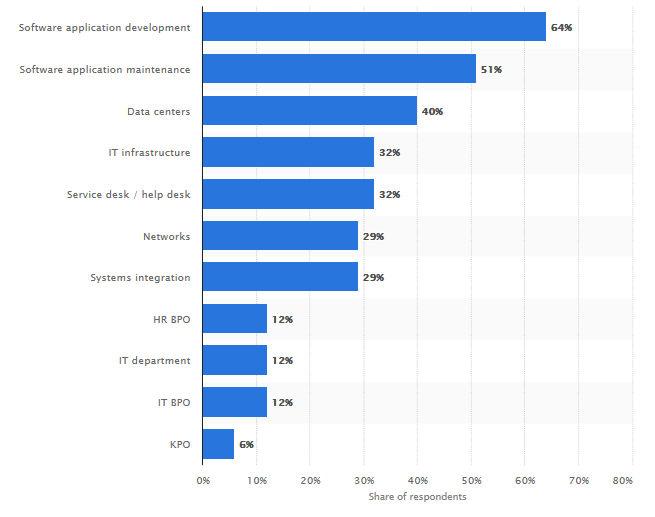
The statistic reveals the IT functions most commonly outsourced by IT leaders worldwide. As you can see from the graph below, system integration was outsourced to 29% of respondents.

the IT functions most commonly outsourced by IT leaders worldwide

Source: Statista.com

Integration factors:

Let’s list and analyze the factors that affect integration projects:

Processes acceleration. Business development requires more and more often to change the data structures, business processes, let alone the design and user interface, which is just constantly in change.

Dispersal. Organizations are becoming increasingly large, and the challenges are increasingly complex, with logical, organizational and geographical dispersion.

Heterogeneity. In a large project, it is almost never possible to adhere to platforms and tools from one manufacturer. Many companies use different on-premise and cloud/on-demand applications such as Microsoft SharePoint, Lotus Notes, Salesforce.com, or other industry specific software and applications. Thus, you have to consider and support the features of multiple platforms.

Heredity. Inability to completely abandon the legacy system, old hardware, which, by the way, sometimes give quite good indicators of reliability and performance, but they do not easily contribute to integration.

Interactivity. Users constantly raise their expectations about the speed of system response, speed, and efficiency of information delivery. Most processes tend to perform in real time.

High load. The complexity of integration is affected by the number of users in the system, the amount of data, and the intensity of data processing.

Continuity of the work cycle. System integration and upgrades must almost always be seamless, smooth, incremental, and imperceptible to the enterprise and its customers.

Cross-system integration. Integration tasks are not limited within the company. Increasingly, enterprises need to integrate different complex solutions with partners, customers, suppliers, contractors and even with government agencies (B2G integration).

Selection of integration platform

The system integration remains a hot topic for many companies, regardless of their industry or sphere of activity. In integration, especially when it comes to complex and large-scale projects, the key issue is the choice of the optimal platform.

Loosely-Coupled Architecture

According to Wikipedia in integration loose coupling in broader distributed system design is achieved by the use of transactions, queues provided by message-oriented middleware, and interoperability standards. Four types of autonomy, which promote loose coupling, are: reference autonomy, time autonomy, format autonomy, and platform autonomy.

Generally, point-to-point integration applications become inseparable from each other, leading to risks and instability.

Therefore, it is better to focus on loosely coupled integration technologies that give the opportunity for a variety of architectural approaches and topologies ranging from the hub and spokes model to an ESB to an SOA.

Standard connectors

It is no secret, manual programming is lengthy and risky, so to avoid manual programming or custom-coded interfaces, it is better to use standard certified connectors.

Furthermore, best practices in software integration are using standard application and technology components.

Magic xpi provides and maintains components for most of the major solutions, such as Salesforce, JD Edwards, SAP, Dynamics CRM and more.

In total Magic xpi includes 100+ prebuilt components “out-of-the-box”, lots of them are certified adapters for leading IT systems. Moreover, and a Connector Builder for everything else.

Visual approach

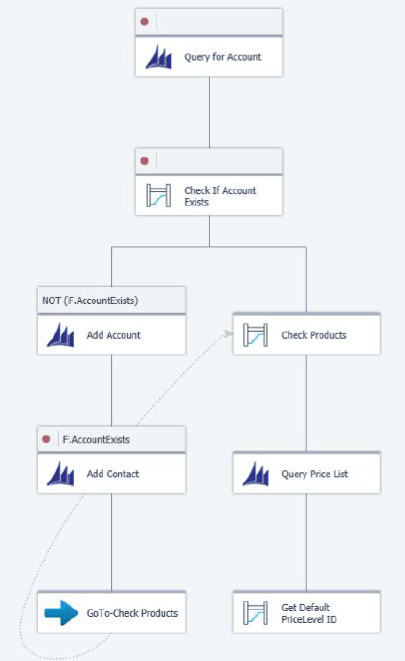
When planning and implementing an integration project, the use of a graphical user interface which can visualize processes ensures consistency of actions and facilitates communication of all integration participants.

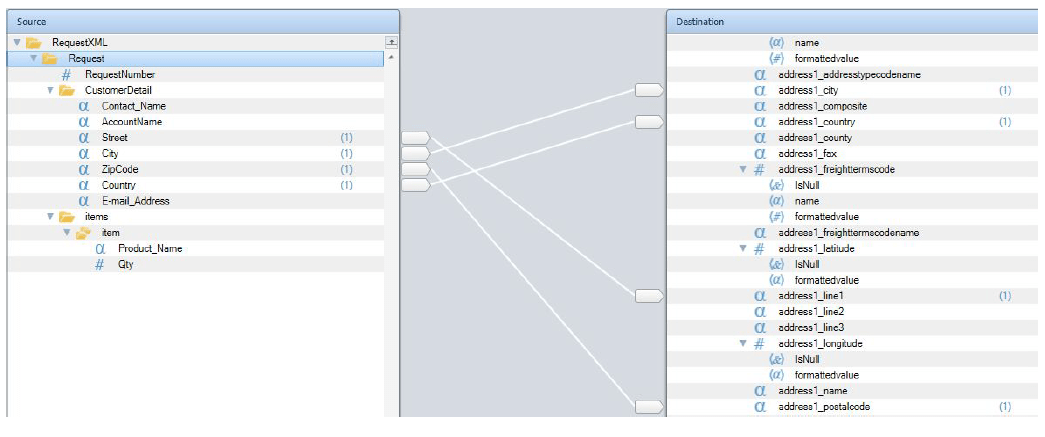
Easy-to-use Data Mapper

Business processes are continuously changing. Therefore, it requires constant technical changes to the configurations that should be easily implemented. In the case where integration with a third-party system, such as Salesforce.com, or another ERP or CRM system is hard-coded using the point-to-point programming method, it becomes difficult to make changes.

Magic xpi allows doing all these configuration changes in few clicks to modify the flow, or the way data is exchanged or transformed, such as adding new data fields, names, types, and sizes or even changing the way the business process works.

Independent integration technology platform

Leading integration experts recommend that system integration technology, must be platform-independent. It must integrate easily with most (if not all) software solutions and be able to interact with Web applications, mobile, or even IBM i-based applications. This applies to connectors: The integration platform should offer connectors for major IT solutions, so that they can be integrated in a platform independent manner.

Experienced Integration provider

Doing business with an experienced business partner is an additional criteria companies are looking into. An experienced integration partner that is responsive, will “add value” to a company’s projects, and becomes a backup resource to their internal staff, knowing that today companies are short in resources, and management are pushing into more integration and automation projects.

Accessible Manufacturer

It has become very common today to look for an integration technology manufacturer that is always present and backing up his software products/services. Enterprises are looking for a more human oriented technical support, and not a company who would treat its support requests as only tickets and numbers. A manufacturer who interacts with the end-user, understand his needs, supports him and build/update the software and integration platform for the real life, and not for a “virtual reality”.

Monitoring the business processes

Monitoring business processes after any integration project implementation, will allow you to monitor and manage error handling and have a visibility on performance. If interoperability is delayed, it can affect the routine of the whole enterprise.

Automatic documentation

Self-documentation of integration processes is very useful in any integration project. Inadequate documentation in integration projects may result in the loss of critical project information.

Since documentation can be a very time-consuming manual process, when an integration technology provides an automatic documentation feature based on the project flows, specialists and analysts, are much more likely to adopt and use in their integration projects.

The right integration partners

As a long-time partner of Magic Software Enterprises (a global provider of innovative end-to-end business integration and application development solutions), EDI2XML has been recommending and using Magic xpi integration platform for proven, successful integration projects.

We provide the right combination of technology, people, and processes to transform your company. Our specialists have a proven record of successfully solving various integration problems and overcoming great challenges.

January 8, 2019
https://www.edi2xml.com/wp-content/uploads/2018/12/Integration-platform.png 350 1024 Tatyana Vandich https://www.edi2xml.com/wp-content/uploads/2024/08/edi2xml.com-EDI2XML-company-logo.png Tatyana Vandich2019-01-08 12:14:572021-05-10 15:38:51How to Choose the Right Integration Platform?

Integrating CRM With Business Software Using Magic xpi

Blog

This post was updated to reflect current trends and information.


More and more businesses are running multiple software systems – CRM, ERP, EDI, eCommerce platforms, and more – to manage their operations. But without integration, these systems often work in silos, causing data errors, inefficiencies, and lost opportunities.

CRM integration with ERP, EDI, and other business applications is the key to automating workflows, improving data quality, and gaining a complete view of your customers. In this article, we’ll explore why CRM integration matters, real-world use cases, benefits, and how platforms like Magic xpi make integration simple and effective.

Key Takeaways

  • CRM (Customer Relationship Management) systems help businesses manage customer data, improve relationships, and increase sales growth.
  • The CRM market is booming – expected to reach nearly $100 billion by 2025, driven largely by SaaS solutions.
  • The top CRM vendors include Salesforce, SAP, Oracle, and Microsoft Dynamics 365, each offering different deployment models and strengths.
  • CRM integration with ERP, EDI, eCommerce, and finance applications ensures data consistency, reduces errors, and enables a unified view of customers.
  • Common use cases include syncing eCommerce orders, automating accounting data, and connecting CRM with ERP for order management.
  • Benefits of CRM integration: streamlined workflows, reduced costs, fewer errors, and better customer insights.
  • Magic xpi Integration Platform provides a no-code, pre-built connector approach to easily integrate CRM with ERP, EDI, HRMS, logistics, and more.
  • Digital transformation success depends on embracing integration to stay competitive and meet evolving customer expectations.

What is CRM (Customer Relationship Management) and Why Is It Important?

If you refer to Wikipedia, you find the following definition: “Customer-relationship management (CRM) is an approach to manage a company’s interaction with current and potential customers. It uses data analysis about customers’ history to improve business relationships with customers, specifically focusing on customer retention and ultimately driving sales growth”.

In other words, a CRM is a tool for managing clients and their related information, as well as a way to speed up and streamline sales processes.

CRM Software Market Growth: Key Trends and Forecasts (2025 and Beyond)

According to Statista, the revenue for the Customer Relationship Management Software market is forecasted to reach US$98.84bn in 2025. The market was driven by strong software as a service (SaaS) growth.

The Customer Relationship Management (CRM) software market is expected to grow over 14% through 2025 according to Gartner.

There are a lot of companies in the CRM system market, but the four largest vendors of CRM system offerings are:

Salesforce: is a leader of the CRM software market. American developer of the CRM system, provided only the SaaS model. Technical experts mark the company as the “main players in the cloud computing market” along with Oracle, SAP, Google, Microsoft, Amazon.com


Suggested Readings: How to get more out of Salesforce with EDI Integration


SAP: is a European multinational software corporation that develops enterprise software to manage business operations and customer relations. SAP provide new generation of CRM tools and customer engagement solutions. SAP Hybrid solutions are more than traditional CRM software, they provide in-memory technology and Big Data insights to help companies drive contextual, personalized customer engagement in real time – across any channel or line of business.


Suggested Readings: How To Successfully Complete SAP/R3 EDI Integration Projects Using iDoc


Oracle: is an American multinational computer technology corporation. Oracle CRM is one of the leading products in the CRM market. It has a robust and intuitive interface and a variety of product lines and deployment models:

a) Oracle CRM On-Premises: is a traditional on-premises deployment where the customer needs to buy or lease his own hardware, operating systems and databases, and install a packaged Oracle CRM system on it.

b) CRM On Demand and Oracle Sales Cloud are cloud CRM solutions which are accessible over the internet and paid for by a monthly subscription fee.


Suggested Readings: Oracle JD Edwards Integration: the key to Digital Transformation


Microsoft is an American multinational technology company. One of the leading companies in the CRM space with its Microsoft Dynamics 365. Dynamics 365 platform offers companies an exceptional set of productivity tools across sales, marketing, and customer service. Microsoft Dynamics 365, is unique of its kind in the CRM marketplace, and leading the way in innovation, usability and user experience.


Suggested Readings: The main reasons why you need Microsoft Dynamics Integration with your business Systems


What is CRM Integration and How Does It Work with ERP, EDI, and Other Systems?

Today, it is very common to see enterprises running different types of systems to run their business. It is common for example, to see a company adopting JD Edwards Enterprise One as an ERP, while at the same time, having their sales and marketing department leveraging Salesforce.com as their CRM software.

Natively, both branded software systems (JDE and Salesforce), do NOT connect together “out-of-the-box”. However, both of these solutions, offer an API or web service to read/write data.

Integration of a CRM with an ERP helps automate the processes, reduce human errors and maintain a better quality of data for the enterprise.

Additionally, integrating a CRM system to another ERP software, aims at creating an omnichannel (unified) system to collect data about the client from all sources: call center, store, online store, website and social networks. The company must have complete information about its client — this will make the most advantageous offers and provide the best support. Analysis of CRM systems shows that the effect of integrating CRM with other corporate applications can significantly increase company productivity.

Thanks to the integration, data into a CRM system can be visible and transferred to other applications.

Real-World CRM Integration Use Cases (eCommerce, ERP, Finance, and More)

Integration of CRM with the e-commerce site(s): This is very common integration, that allows to synchronize data from an eCommerce site into a CRM system. On the e-commerce site your customers can register and make orders and at the same time, customer contacts are sent from the e-commerce site to your CRM systems. Next, with these contacts, the work can be done already in the CRM system. Namely, the initial call to the customer, the appointment, the second call and so on.

Integration of CRM with accounting and finance: Most often this method is used to upload customer data to accounting programs. Back from the accounting program can be taken in CRM information about payments and receivables from customers.

Large companies that use ERP systems can integrate applications even more closely. For example, orders are initially sent from the e-commerce site to CRM and processed by sales managers, then, automatically transferred to the ERP system. In ERP, further work will be done with the customer’s order (production, logistics, etc.). The status of the order will be returned to CRM.

Book your Free Consultation with Integration expert

Top Benefits of CRM Integration for Businesses (Efficiency, Cost Savings, Customer Insights)

Integration of CRM with other business applications and systems used by the business will allow:

  • spend less time on search and exchange of information between departments;
  • reduce personnel costs;
  • reduce the risk of losing contacts and other important information about the clients;
  • see full statistics of company activity and configure the end-to-end analytics;
  • migrate workflows into a single interface;
  • reduce paperwork to the minimum;
  • configure automatic data exchange with partners and contractors — for example, a delivery service, bookkeeping outsourcing company or coalition loyalty programs;

How to Overcome CRM Integration Challenges with Magic xpi (No-Code Platform)

Using the Magic xpi Integration platform, you can easily integrate enterprise-level solutions due to Magic xpi code-free, business process automation, and data synchronization solutions.

Magic xpi has pre-build, optimized, and certified adaptors for most branded CRM systems such as Microsoft Dynamics, Salesforce, SugarCRM, and other.

Magic xpi extends the capability and usage of your CRM system. You can achieve simple and intuitive integration with your company’s business applications, like IBM i, JD Edwards, SAP, Lotus Notes, accounting, ERP, supply chain management, HRMS, logistics, and many more.

Magic xpi, using its visual and intuitive design tools, can simplify and unify the interfaces of your CRM, as well as other business systems in use, while not using any custom coding.

To learn more about the Magic xpi integration platform, watch this video

Magic xpi Integration Project Lifecycle: From Analysis to Monitoring

  1. Analysis: Analyze your business processes.
  2. Design: Design and build your business processes and integration flows in the Magic xpi Studio.
  3. Connection: Quickly connect all your existing enterprise applications using Magic xpi’s built-in certified connectors and adaptors.
  4. Testing: Test the integration flows on simulated business processes, without interrupting real business activity.
  5. Optimization: Before full deployment, perform risk-free optimization of your business processes and integration flows.
  6. Deployment: Deploy your new integration solution using the Magic xpi server.
  7. Monitoring: Monitor the integration of your business processes.

Click here to download our free White Paper on Magic xpi Integration Platform


Digital Transformation: Why CRM Integration Is the Key to Business Success

Changing traditional workflows and introducing new technologies is never easy. Employees may resist change, but automating and integrating your business systems has proven benefits: higher efficiency, better data quality, and improved customer experience.

Why now? With competition increasing and AI-powered tools reshaping customer expectations, businesses that delay digital transformation risk losing market share. Integrating CRM with ERP, EDI, and other systems ensures companies can respond faster, deliver personalized experiences, and stay ahead in an increasingly data-driven world.

FAQ: CRM Integration & Business Systems

Q1: How can small businesses benefit from CRM integration without a full ERP system?
A: Even without a full ERP, small businesses can automate workflows between CRM, eCommerce, and accounting software. This reduces manual data entry, prevents errors, and provides a complete view of customer interactions.

Q2: Can CRM integration improve customer loyalty programs?
A: Yes. By syncing CRM with loyalty platforms, companies can track purchases, preferences, and engagement. This enables targeted promotions and personalized offers, improving retention and satisfaction.

Q3: How does real-time data exchange work in integrated CRM systems?
A: Modern integration platforms allow instant synchronization between CRM, ERP, and other systems. Real-time updates ensure accurate stock levels, order status, and customer information across all channels.

Q4: Is CRM integration secure for handling sensitive customer data?
A: Absolutely. Platforms like Magic xpi support secure protocols, encryption, and audit trails to protect customer data while enabling seamless integration between business applications.

Q5: What role does automation play in reducing operational costs through CRM integration?
A: Automation eliminates repetitive manual tasks, accelerates order processing, and minimizes human errors. This reduces labor costs and allows employees to focus on higher-value activities.


Free CRM Intergation consultation

January 7, 2019
https://www.edi2xml.com/wp-content/uploads/2019/01/Integrating-using-Magic-xpi.png 350 1024 Tatyana Vandich https://www.edi2xml.com/wp-content/uploads/2024/08/edi2xml.com-EDI2XML-company-logo.png Tatyana Vandich2019-01-07 10:16:412026-05-28 16:16:16Integrating CRM With Business Software Using Magic xpi
Page 17 of 24«‹1516171819›»
Recent
  • EDi Integration for SMB - Complete Guide
    Electronic Data Interchange (EDI): The Complete Guide for...July 17, 2026 - 4:46 pm
  • EDI Process Guide from EDI EDI Provider
    How EDI Documents Work Together: A Complete Guide to the...July 9, 2026 - 1:22 pm
  • Wayfair EDI & API Integration Guide
    Wayfair EDI & API Integration Guide for SuppliersJune 30, 2026 - 3:24 pm
  • Promotional banner about whether EDI is required for small businesses and a supplier’s guide to retail onboarding. Women at a desk inside a circular cutout image on the right.
    Is EDI Required for Small Businesses? A Supplier’s Guide...June 17, 2026 - 7:02 pm
  • EDI compliance with Loblaw
    How to Meet Loblaw EDI Requirements as a Small BusinessJune 4, 2026 - 2:05 pm
Popular
  • How to Quickly Connect to a Large Retailer's EDI Requirements
    How to Get EDI-Compliant Quickly For A Large RetailerNovember 21, 2025 - 4:29 pm
  • EDI-as-a-services
    EDI Translation Software “On-premises” or “As...January 21, 2014 - 1:28 pm
  • order-automation in e-commerce
    Why Is It Crucial to Automate the E-Commerce Order Fulfillment...May 10, 2022 - 1:58 pm
  • EDI for Logistics and transportation
    EDI Integration for Efficient Transportation ManagementOctober 6, 2023 - 1:33 pm
  • information technology definitions
    Business Tech Terms DefinitionsMay 24, 2018 - 1:32 pm

Browse by tag

Amazon Amazon Integration ANSI ASC x12 ASC X12 EDI B2B EDI integration e-commerce e-commerce business e-commerce integration eCommerce eCommerce integration EDI EDI2XML EDI 850 EDI as a Service EDI Communication EDI converter EDIFACT EDI for supply chain EDI for Third-Party Logistics EDI for transportation EDI implementation EDI Integration EDI Integration Project EDI project EDI Translation EDI Web Service EDI x12 ERP Integration integration platform integration project JDE Magic xpi Magic xpi Integration platform NetSuite online store Salesforce Shopify Shopify eCommerce integration Shopify integration Supply Chain Supply Chain Management Translation Software X12 EDI XML

Subscribe to our Blog

Menu

  • Home
  • About the EDI2XML Company
  • About EDI2XML EDI Converter
  • Blog
  • Book A Free Consultation
  • Privacy Policy EDI2XML Company

Our Services

Fully Managed Integration

E-Commerce Integration

Business Systems Integration

Fully Managed EDI

EDI Web Service 

On Premises EDI 

Managed Cloud Service


Latest Blog Posts

  • EDi Integration for SMB - Complete Guide
    Electronic Data Interchange (EDI): The Complete Guide for Modern BusinessesJuly 17, 2026 - 4:46 pm
  • EDI Process Guide from EDI EDI Provider
    How EDI Documents Work Together: A Complete Guide to the EDI Transaction ProcessJuly 9, 2026 - 1:22 pm
  • Wayfair EDI & API Integration Guide
    Wayfair EDI & API Integration Guide for SuppliersJune 30, 2026 - 3:24 pm

Contact Us

400 Blvd Curé-Labelle, #304 Laval QC H7V 2S7 Canada

Contact EDI2XML Team
Phone: +1 450-681-3009
Website: https://www.edi2xml.com/

© 2000-2026 EDI2XML (by Namtek Consulting Services). All rights reserved.
  • Link to Facebook
  • Link to LinkedIn
  • Link to X
  • Link to Youtube
  • Blog
Scroll to top Scroll to top Scroll to top