EDI2XML
  • About
    • The Company
    • EDI2XML
    • Advantages
    • Partnership with EDI2XML
    • Testimonials
  • Services
    • Enterprise AI
    • Fully Managed Integration
    • Fully Managed EDI Services
    • EDI Web Portal
    • EDI Web Service
    • EDI On Premises
    • Managed Cloud Services
    • Amazon Integration
    • Shopify Integration
    • BigCommerce Integration
    • NetSuite Integration
    • JD Edwards Integration
    • Dynamics 365 Integration
    • SAP B1 Integration
    • Salesforce Integration
    • Industry 4.0 Integration
  • Pricing
    • EDI Managed Services
    • EDI Web Service
    • EDI On-Premises
    • Managed Cloud Services
    • Shopify Integration
    • JD Edwards Integration
    • E-commerce Integration
    • All other Integrations
  • Blog
  • Resources
    • Resource Center
    • List of EDI Codes
    • List of EDIFACT Messages
    • EDI Documents Library
    • Trading Partners
  • Contact us
  • Book a Consultation
  • Click to open the search input field Click to open the search input field Search
  • Menu Menu
  • Link to Facebook
  • Link to LinkedIn
  • Link to X
  • Link to Youtube

Optimize your business processes with Electronic Data Interchange EDI solutions—streamline data exchange, improve accuracy, and enhance efficiency.

Tag Archive for: EDI

The Advantages of Business Automation through EDI

Blog

Today, there are still decision-makers who are debating whether to invest in EDI integration projects or to hire a few new employees to manually enter and process data from trading partners.

Since EDI is still a difficult topic for non-technical people to understand, hiring data entry administrators may seem like a reasonable choice. It is commonly believed that EDI requires a significant initial investment.

Let’s take a look at what EDI automation is and how companies can find the most cost-effective solution.

What is EDI Automation?

EDI (electronic data interchange) is a technology used by business partners to exchange business electronic documents in standard formats without requiring human intervention.

These exchanged documents are called – EDI Transaction Set. If you want to see the full list of documents that can be exchanged in EDI format check our Complete List of EDI X12 Codes.

 
What is EDI
 

How Does EDI Benefit Businesses?

The use of EDI greatly improves the overall state of the business as it has many benefits.

– Reducing costs. Saving time for employees to process documents and enter them into databases. EDI reduces an enterprise’s printing, shipping, and storage costs.

– Speed. Documents can be exchanged instantly with a business partner. You won’t lose documents along the way or among the papers on your desk.

– Automation. EDI significantly improves the business because it automates processes and reduces the time delays associated with manual data entry.

– Accuracy.  Elimination of errors associated with manual data entry.

Useful: Download our free Guide “Introduction to EDI Communication” to learn more about EDI

What Documents are Used in EDI?

As mentioned above, you can exchange almost any type of document using EDI, but the most common ones are:

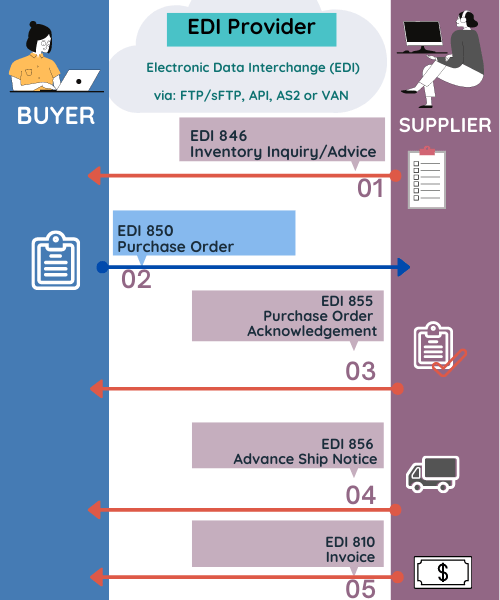
Purchase Order – EDI 850

Useful Reading: All You Need to Know About EDI ANSI X12 Transaction Set 850 Purchase Order


Invoice – EDI 810

Useful Reading: What is an ANSI ASC X12 EDI 810 Invoice?


Purchase Order Acknowledgment – EDI 855

Useful Reading: What is EDI 855 Purchase Order Acknowledgment?


Inventory Inquiry/Advice – EDI 846

Useful Reading: What is EDI 846 document?


Advanced Ship Notice (ASN)– EDI 856

Useful Reading: What is Advanced Ship Notice (ASN) 856 Transaction Set?


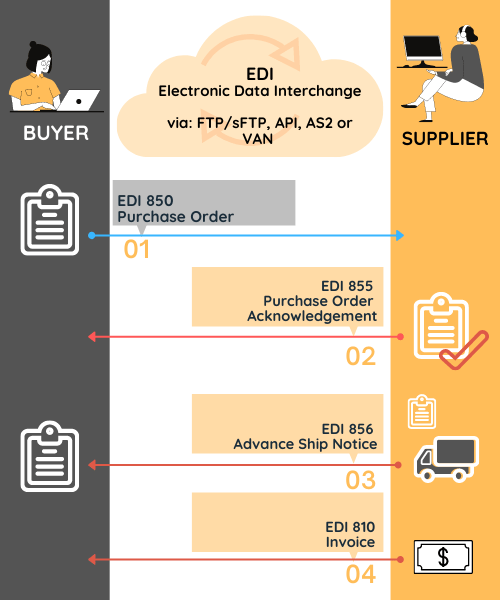
Below is an example of an EDI flow between trading partners.


Types of EDI (Electronic Data Interchange) Solutions

Currently, many EDI providers offer various EDI solutions. There is no one-size-fits-all EDI solution for every company. A company should evaluate which option will be most cost-effective for its business model. Thus, the main offers on the EDI market are:

  • Managed EDI
  • Web EDI
  • On-premises EDI

Our company offers all three named EDI solutions. If you don’t know which solution is right for you, contact our experts for a free consultation.

EDI Document Business Flow

1. One business partner (generally the buyer) generates a document (i.e. Purchase Order) in his internal ERP system (i.e. SAP, Microsoft Dynamics, JD Edwards, etc.). Depending on the company’s business process, the document can be generated automatically or manually.

2. EDI providers can either pick up the generated document directly from the company’s ERP system, or they can transfer it to them.

3. The EDI provider converts the document into an X12 EDI transaction set. After conversion, suppliers receive an EDI X12 document.

What is the Fastest Way to Connect to EDI?

With EDI2XML and its “HTTP EDI Web Service (REST API)” model, companies can connect their EDI partners in less than one hour! EDI web services reduce the cost of EDI integration projects and improve efficiency and accuracy in a short amount of time.


As a result of using the EDI Web Service from EDI2XML, a company can quickly and efficiently exchange business documents with its business partner.

Learn more about EDI2XML Web Service its advantages and how it works.

Request EDI2XML Web Service Price List

Free EDI consultation
July 29, 2022/0 Comments
https://www.edi2xml.com/wp-content/uploads/2022/07/EDI2XML-Automation-through-EDI.png 675 1200 Tatyana Vandich https://www.edi2xml.com/wp-content/uploads/2024/08/edi2xml.com-EDI2XML-company-logo.png Tatyana Vandich2022-07-29 14:28:322026-02-13 15:24:08The Advantages of Business Automation through EDI

Business Automation: How to Choose the Right EDI Solution

Blog

Business Automation through EDI Solution

Most entrepreneurs who have never experienced EDI before feel overwhelmed when it comes to selecting an EDI provider or solution to start exchanging business documents with their trading partner.

There are multiple EDI solutions from different big and small EDI Providers. At first blush, each EDI solution looks better than the other, but how do you choose the best EDI solution for your business?


The Electronic Data Interchange (EDI) is the exchange of business documents electronically between business partners.


In this article, I will review the main EDI solutions on the market, using the solutions from EDI2XML as an example. Additionally, I will give you useful tips on how to choose an EDI provider without losing sight of key points that will affect the long-term success of EDI.

Why You Should Be Careful When Choosing an EDI Solution?

For many organizations, EDI is a mission-critical application whose failure can lead to a complete stoppage of activity; therefore, the choice of an EDI solution, as well as EDI provider, must be approached carefully.

EDI is responsible for supporting a wide variety of business processes – inventory management, orders, purchasing, logistics, tenders, etc.

Perhaps there is no such field of activity where you can run without the exchange of documents at all, which means that EDI solutions can be needed everywhere.

Choosing the Right EDI Solution to Automate Your Business

EDI is used for B2B communication in all industries by both large corporations and the smallest companies. That is why there are different EDI solutions designed for different markets and companies.

EDI allows businesses to exchange documents quickly since it eliminates the need to prepare and process mail or to make phone calls, faxes, or paperwork when ordering or selling.

By choosing the right EDI solution, you will make it easier to communicate with your business partners and bring value to your business.

EDI automation
 

For example, if you are a small company that has only one trading partner that requires EDI exchange, you need a simple EDI solution that does not require a large initial investment, which will allow you to quickly start exchanging EDI documents with your business partner.

Continuing on the topic of EDI solutions, let’s take a look at the different options of EDI solutions on the market, using the example of EDI2XML as EDI service provider.

It should be remembered that the details of EDI solutions from different EDI providers always differ. However, the description below will give you a general idea of the existing EDI solutions.

Fully Managed EDI Services

EDI fully managed service refers to a service where the EDI provider takes full responsibility for managing EDI operations and integrating them on behalf of the client.

With Fully Managed EDI Service, there is no need for customers to install any software or hardware on their computers. The EDI provider will take care of the implementation and configuration of the process flows. He will be in charge of handling the data routing and will be responsible for the data format conversion and integration.

Through the fully managed EDI service, an EDI provider will take on a wide range of responsibilities that are usually handled by an internal IT department. With a fully managed EDI solution, EDI2XML delivers a turnkey project to connect your business partners.


Which Companies Can Benefit From a Fully Managed EDI Service?

Companies that need to use EDI but don’t want to spend the time and effort on the EDI implementation themselves, or who don’t have the necessary EDI skills and specialists who can do it, need an EDI service provider to handle all the configuration and integration of EDI. In this case, a fully managed EDI service is the ideal solution.

Find out more about Fully Managed EDI Services its process flow, features, technical details and pricing.

EDI Web Service

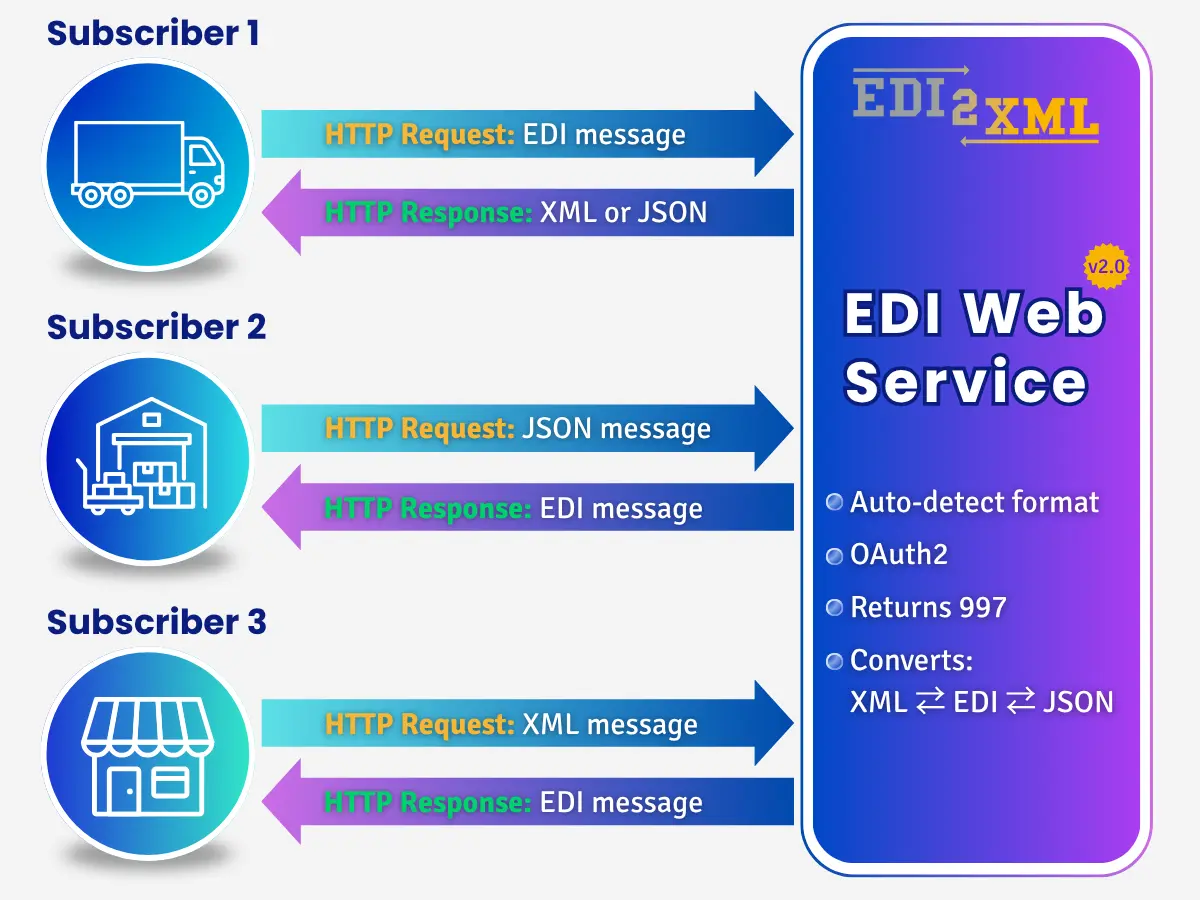
The EDI Web Service is an HTTP service from EDI2XML that works over the internet on the private platform. This HTTP EDI Web Service (REST API) can receive HTTP requests to convert EDI messages to XML and XML messages to EDI (based on EDI2XML’s proprietary format).

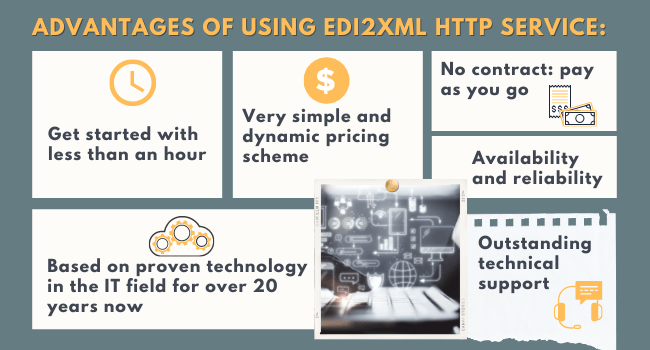
There are many reasons why EDI2XML Web Service is the right choice:

1. Solution based on self-service

2. An affordable price

3. Our free trial period lasts for 15 days without any obligation, so you have nothing to lose.

4. Getting started will take you less than an hour

5. There is no contract with us, and no commitment.

6. We charge on a month-to-month basis; you can cancel at any time with 30 days’ notice.

7. There is a very simple and dynamic pricing scheme that is easy to understand and use

8. The availability and reliability of the service

9. Using proven technologies that are backed by a wealth of experience 

10. Support from a highly skilled technical team is outstanding

It is very simple and quick to get started with the EDI2XML Web Service. Within less than an hour, you can make the first Call to the Web Service and see the response. 

We offer a well-documented HTTP EDI Web service, and each subscription includes instructions.  

Cloud Services EDI
 

Who is the EDI Web Service For?

The EDI web service is intended for developers and enterprises who want to create their own EDI (Electronic Data Interchange) integrations.

Typically, these users can interact with external APIs and web services to convert EDI to XML and XML to EDI. Additionally, they have the expertise and resources to work with web services and HTTP requests.

EDI2XML Web Service is a reliable service for IT professionals who need to perform such integration projects.

We suggest EDI Web Service to companies that have their own technical resources to work with REST APIs (calls and consumptions of HTTP Rest Web services).

Request EDI2XML Web Service Price List

On-Premises EDI Solution

On-premises EDI refers to the implementation of EDI software that is installed and operated through the customer’s own server and computing infrastructure.

On-premises EDI deployment from EDI2XML involves two components that will be deployed on-premises:

1. EDI2XML translation and transformation engine to convert X12/EDIFACT messages to XML and vice versa.

2. A license of Magic xpi a third-party integration and automation platform.


Read more about Magic xpi integration platform as the best fit for enterprise data integration


Features of the EDI2XML service “on premises”

1. The application is deployed on the customer’s server

2. Service that is based on a subscription

3. There is a standard XML format for incoming EDI messages

4. Standard XML format for Outgoing X12

5. XML schemas (.xsd) are also provided

6. SMTP/FTP/sFTP protocols are included in the package

EDI-On-Premises solution
 

When On-Premises EDI is is Right for You?

On-premises EDI is suitable for companies that have strict IT management rules and procedures that they can only deploy software solutions on their own premises.

You should also consider how much EDI data you want to exchange with your business partner. If you expect a very large volume of data, you might consider an on-premises EDI solution. A company’s IT architecture and its team play a vital role in implementing EDI on-premises. Make sure the company has the proper hardware infrastructure, and that the IT department is ready to tackle this project.

Request EDI On-Premises Pricing Plans

Choosing an EDI Provider: What to Look For

Now that we’ve discussed the main types of EDI solutions, let’s talk about what to look for in an EDI provider. There are several different kinds of EDI service providers available.

In developed markets, as a rule, a large service provider gets almost everything – the vast majority of customers start using its product because they do not bother with in-depth analysis of technologies and services, but use the same thing that other companies or business partners utilize.

It is for this reason that demonstrations of a large number of customers are one of the most popular marketing techniques. Of course, a large customer base may indicate the reliability of the EDI provider (which does not always correlate with the quality of the EDI solution, price flexibility, service, and technical support) that you can get from smaller EDI providers.

The following are some basic recommendations about what you should look for when choosing an EDI provider for your company.

– Exclude sales and market share statistics from your list of EDI provider criteria.

– Rely on relatively new projects that are comparable in scope to your organization as references.

– It is critical to pay attention to how quickly the company responds to your requests when you contact them.

– A provider of EDI services should be able to connect you with technical experts for a personalized consultation.

– If you need a customized quote, how quickly will they be able to provide it to you?

– How does an EDI provider support its customers? When it comes to technical issues, how quickly can they resolve them?

– Check if the prices of the company can be adjusted based on your needs.

Remember that a big EDI provider doesn’t always mean the best.

Conclusion: How to Choose the Right EDI Solution

The use of EDI has become a necessity for most companies today. Meanwhile, the choice of an EDI solution has become very difficult for companies. This is because the market for EDI solutions is currently quite large, in addition, EDI solutions in terms of technical characteristics and functionality have become quite similar to each other.

Therefore, factors such as the reliability, experience, and flexibility of the EDI provider often become the last argument when choosing an EDI solution.

If you are not completely satisfied with your EDI provider, then read this helpful article How to Change Your EDI Service Provider


Are you looking for ways to improve your business processes? Then look no further! Our EDI services are here to help! Our EDI experts are available to give you a free consultation if you are still unsure which EDI solution is right for you.

 
Get A Free EDI Consultation
July 12, 2022/0 Comments
https://www.edi2xml.com/wp-content/uploads/2022/07/EDI2XML-EDI_Automation.png 675 1200 Tatyana Vandich https://www.edi2xml.com/wp-content/uploads/2024/08/edi2xml.com-EDI2XML-company-logo.png Tatyana Vandich2022-07-12 15:50:422026-02-13 15:28:41Business Automation: How to Choose the Right EDI Solution

All You Need to Know About EDI 812 Credit/Debit Adjustment

Blog

Modern businesses are constantly striving to improve and automate their business processes, especially when it comes to supply chains. However, even the best-run supply chains can face situations where adjustments need to be made. If a problem arises with a purchase order, the trading partner uses EDI 812.

What is an EDI 812?

EDI 812, formally known as an EDI X12 812 Credit/Debit Adjustment Transaction Set, is an EDI document used by trading partners (buyer and seller) in B2B communication to indicate that adjustments have been made to a specific payment or to demand an adjustment or bill-back.

Using EDI 812 transaction, trading partners can reconcile payments with invoices and eliminate the need for paper credit or debit memos.

Who Uses The EDI 812 Debit/Credit Adjustment?

EDI 812 is used to automate B2B communications in all industries. This EDI document can be used by various companies such as:

 
  • Retailers/ grocers
  • suppliers of goods and services
  • manufacturers of goods
  • wholesalers
  • warehouses
  • 3 PL Logistics
  • transport companies (providing road, rail, sea (river) and air transportation) and many others.

When is The EDI 812 Document Used?

Trading partners use EDI 812 Credit/Debit Adjustment in various cases, the most common examples are:

  • The products that were ordered were not delivered.
  • There was a mistake in sending the products.
  • A defective, damaged, or spoiled item was received.
  • The manufacturer’s discount or retailer’s markup needs to be adjusted.
  • In the original purchase order or invoice, there was an error in the pricing.
  • There is an inconsistency in the quantity of goods delivered. For instance, when more or less goods are delivered than ordered.
  • Consumers are returning the goods to the retailer

What Information is Included in EDI 812 Debit/Credit Adjustment?

Generally, an EDI 812 document refers to a specific Purchase Order or Invoice and contains detailed information such as:

  • The number of the original PO or Invoice.
  • The total amount of the adjustment.
  • The items that are being adjusted.
  • Identification of the items.
  • Quantity of the items.
  • Credit, debit, or adjustment justification.
  • Debit/Credit Memo

EDI X12 812 Transaction Set Specification

EDI X12 812 Credit/Debit Adjustment Transaction Set is an electronic document used in the context of EDI where:

EDI – Electronic Data Interchange is a technology used to exchange commercial data between companies in a structured digital form based on regulated message formats and standards.

X12 – is a cross-industry standard for electronic exchange of business documents between business partners. In the United States, it is the most commonly used EDI standard.

812 – is a unique three-digit number to identify an EDI transaction. A three-digit code is assigned to each type of EDI document that is used in the X12 standard.

Transaction Set – is an electronic document that is the equivalent of a paper document.

The following is an example of the specification for the EDI 812 Transaction Set. The 812 contains mandatory and optional data, as with any other EDI document. Depending on the field of activity and the requirements of the trading partner, additional data may be required.

A typical structure for this document would be as follows:

EDI 812 Transaction Set Heading:

     
Segment ID Name Purpose:
ST Transaction Set Header Indicating the start of a transaction set and assigning a control number
BCD Beginning Credit/Debit Adjustment Provide the receiver with the identifying date and number for the transaction set and the monetary value of the transaction
N9 Extended Reference Information Transmit identifying information as specified by the Reference Identification Qualifier
PER Administrative Communications Contact Identification of the individual or office to whom administrative communications should be addressed
SHD Shipment Detail To specify shipment details, such as weight, quantity, and routing instructions regarding crediting or debiting returned products
N1 Party Identification Identification of a party based on type of organization, name, and code
 

EDI 812 Transaction Set Detail:

     
Segment ID Name Purpose:
CDD Credit/Debit Adjustment Detail Provide information concerning a line item adjustment  
LIN Item Identification Identifying basic information about an item  
PO4 Item Physical Details To describe the physical characteristics, packaging, weights, and dimensions of an item  
N9 Extended Reference Information Ttransmit identifying information as specified by the Reference Identification Qualifier  
SE Transaction Set Trailer To specify the end of a transaction set and report the number of segments transferred (including beginning (ST) and ending (SE) segments). SE represents the final segment of a transaction set.  
 

What Communication Protocol is Used to Send and Receive EDI 812?

At present, most companies that use EDI to communicate with their business partners do so over the Internet using FTP, sFTP, or AS2 communication protocols. For a variety of reasons, some companies may opt to use VAN, which is a more expensive solution.

Learn more about EDI communication protocols in the free EDI guide: Introduction to EDI Communication

EDI B2B Automation Through 812 Translation

The information transmitted by EDI 812 needs to be translated into a functional format for further processing or for integration into the company’s business system. Many companies use the Fully Managed EDI Services from EDI2XML. Through this service, EDI 812 information can be synchronized with an internal system, such as an ERP/CRM or accounting system, eliminating the need for manual data entry. In this way, the data received from trading partners via EDI is immediately pushed into the business system and can be processed quickly.

Learn more about the Fully Managed EDI Service

As an alternative to fully managed EDI, to transmit and translate an EDI 812 or any other EDI document, company can use low-cost and flexible EDI solution from EDI2XML – the HTTP EDI Web Service (REST API).

EDI2XML Web service is a web-based HTTP service that runs over the Internet and converts EDI messages into XML and XML messages into EDI (based on EDI2XML’s proprietary XML schema).

Learn more about this EDI service in the article: How to Become EDI Compliant in Under 60 Minutes (Yes, Really)

Benefits of Using the EDI 812 Credit /Debit Adjustment


Both the seller and the buyer benefit from EDI 812 credit/debit adjustment by automating the transaction process. Below are some of the advantages that can be realized by both trading partners:

  • Sending and receiving credits/debits can be done more quickly and with less effort
  • Gain operational efficiencies by reducing paperwork
  • Automated data entry reduces errors
  • Maintains documentation for deductions and credits

FAQ – EDI 812 Credit/Debit Adjustment

What is the EDI 812 Credit/Debit Adjustment?

The EDI 812 is an X12 transaction used to communicate credit or debit adjustments between trading partners. It explains why an invoice amount has changed, such as returns, pricing errors, discounts, or chargebacks. This document helps automate corrections in Accounts Payable and Accounts Receivable systems.

What information is included in an EDI 812?

An EDI 812 typically includes the adjustment amount, the type of adjustment (credit or debit), the reason code, references to the original invoice, item-level details when needed, partner identifiers, dates, and currency. The exact structure depends on the trading partner’s companion guide.

How is the EDI 812 different from the EDI 810 Invoice?

The EDI 810 sends the original invoice, while the EDI 812 communicates a correction to that invoice. The 810 creates the billing request, and the 812 updates that request with new financial information, such as a reduced or increased amount.

When do companies use the EDI 812?

Companies use the EDI 812 when they need to correct previously issued invoices. Common situations include product returns, pricing discrepancies, quantity errors, promotional allowances, deductions, freight adjustments, or vendor chargebacks.

What are common reason codes in an EDI 812?

Reason codes describe why the adjustment is being made. Examples include damaged goods, incorrect pricing, promotional discounts, quantity shortages, transportation issues, or administrative errors. Many retailers also provide custom reason codes in their technical specifications.

What is the role of the 997 Functional Acknowledgement for the EDI 812?

The 997 confirms that the trading partner received the EDI 812 and that the document meets the required format and syntax. If the 997 reports errors, the sender must correct the file and resend it.

Which industries use the EDI 812?

The EDI 812 is widely used in retail, distribution, manufacturing, automotive, consumer goods, and logistics. Any business that deals with high invoice volume or frequent financial adjustments relies on this transaction.

Conclusion: All You Need to Know About EDI 812 Credit/Debit Adjustment

For more information on how to implement EDI 812 in your company, contact us for a free consultation with one of our EDI experts.

You can also gain a lot of useful knowledge about business and e-commerce automation and integration of EDI, ERP, and CRM by exploring our Blog

Free IT Consultation


June 13, 2022/0 Comments
https://www.edi2xml.com/wp-content/uploads/2022/06/EDI2XML-EDI-812.png 675 1200 Tatyana Vandich https://www.edi2xml.com/wp-content/uploads/2024/08/edi2xml.com-EDI2XML-company-logo.png Tatyana Vandich2022-06-13 13:36:202025-11-25 09:52:13All You Need to Know About EDI 812 Credit/Debit Adjustment

The Top 4 EDI Documents for Freight Transportation Companies

Blog

We recently published a blog post on EDI (Electronic Data Interchange) for Specific Industries, where we took a quick look at various industries and their use of EDI.

In this article, we will take a closer look at the use of EDI in transport logistics and especially in motor carrier freight transportation companies. In this article, we will review a list of the most commonly used EDI documents in the transportation industry. We will examine what each EDI document is used for and what benefits EDI provides to transportation and shipping companies and their clients.

EDI for Transportation and Logistics Management

Transport logistics is accompanied by a constant “paperwork” associated with the movement of goods. Many participants are involved in this process such as manufacturers of goods, warehouses, carriers, retailers, etc.

For efficient logistics, it is necessary to automate communication between all participants of the logistics process: carriers, shippers, consignees, freight customers, and a freight broker.  The use of EDI for automatic data exchange is the most effective technological solution to overcome such a challenge.

Advantages of Using Electronic Data Interchange (EDI) in Transportation

EDI has changed the way business partners interact and optimized the business processes of the supply chain. Using EDI, companies can effectively manage document flow at all stages of working with business partners: from ordering and receiving at the warehouse to reconciliation and returns. You can send orders, invoices, and other documents without paperwork and efforts duplication.

EDI for transportation Industry
 
  • Transport optimization. EDI helps to optimize and consolidate shipments from different customers.
  • Prompt document exchange. EDI allows you to instantly exchange important shipping documents with your business partners, saving both parties time and resources.
  • Labor Cost optimization. EDI allows you to automate daily routine operations related to entering data into ERP, CRM, TMS, WMS, or accounting systems, processing, sending, and archiving documents. Thus, by automating the processing of documents using EDI, there is no need to manually verify documents, enter data, and perform other repetitive actions that take a lot of time.
  • Seamless integration of EDI with other business systems within a company.
  • Synchronization of data exchange between EDI and business systems improves all stages of the supply chain in a transport company and eliminates the inefficient use of resources.

The Most Commonly used EDI Documents in the Transportation Industry

Let’s look at the most used EDI document in more detail.

EDI 204 Transaction Set: Motor Carrier Load Tender

What is a 204 Tender?

The EDI X12 204 Motor Carrier Load Tender, is an electronic document sent by the shipper (a manufacturer, a retailer, or a distribution center or wholesalers) to the freight carrier company to present an offer for an FTL shipment.

The term FTL Full Truck Load describes a mode of transportation that consists of at least one complete cargo trailer or does not allow other loads to be transported simultaneously.

Key Information of EDI 204 Motor Carrier Load Tender

EDI 204 Motor Carrier Load Tender contains important shipment information including:

  • Product description, including weight, size, and quantity.
  • The size of the required trailer as well as other requirements for equipment if necessary to arrange transportation.
  • delivery schedule
  • pickup and drop destination,
  • Information about consignees (delivery address and contact details)
EDI for transportation and Logistics
 

Why Use EDI 204 for Load Tender?

Load tendering is a bidding process where customers offer equal opportunity to transportation companies and carriers to submit their pricing and bid on the transportation of goods, based on pre-defined criteria and parameters. The carriers can accept or reject the shipper’s offer.

Using EDI 204 to tender among transport companies is a common practice. It helps ensure contract compliance and automates payments to carriers. In addition, the use of EDI provides detailed information throughout the entire delivery process from loading to delivering the goods to its final destination.


If you want to know more about EDI X12 204 read this article: EDI X12 204 Motor Carrier Load Tender – overview


EDI 990 Transaction Set: Response to a Load Tender

What is an EDI 990 Response to a Load Tender?

EDI 990 is a response to an EDI 204 Motor Carrier Load Tender sent by transportation companies to a shipper. EDI 990 can be used to accept, accepted with conditions, or reject a load tender (EDI 204).


What is Important to Know About EDI 990

Typically, an EDI 990 is required for each incoming EDI 204 to accept or reject a load request. Therefore, most often these two EDI documents are implemented in the transport company at once.

When working with documents such as the 204 and 990, time is critical. The business partners usually agree on how long after receipt of the EDI 204, the transport company must respond with an EDI 990 before the contract is transferred to another carrier.


Useful reading: EDI for Third-Party Logistics providers (3PL)


EDI 214 Transaction Set: Transportation Carrier Shipment Status Message

What is EDI 214 Transportation Carrier Shipment Status Message?

The transportation company sends an EDI 214 to the shipper to provide information on the delivery status. Typically, an EDI 214 contains information about the status of the shipment, place of delivery, estimated time of arrival, route Information, description of shipment – weight, packaging, and quantity.

Depending on the preliminary agreements of business partners, as well as the specifics of the business, EDI 214 can be generated and transferred to the shipper from once a week to 6 times a day.


Who Uses EDI 214?

Document EDI 214 is widely used in transport logistics and especially in international deliveries.

The largest transport companies, such as FedEx Freight, Old Dominion Freight Line, DHL Supply Chain & Global Forwarding, and much more use the Transportation Carrier Shipment Status Message (EDI 214) to convey the delivery status to the shipper.


To find out more useful information about EDI 214 and learn how to start exchanging EDI 214  in an hour or less, please read this article: EDI for transportation – EDI 214 Transportation Carrier Shipment Status Message


EDI 210 Transaction Set: Motor Carrier Freight Details and Invoice

What is an EDI 210?

EDI 210 is an electronic document sent by the carrier to the shipper to provide detailed information related to the cost of transportation services. This EDI document can be used as an invoice to request payment for motor freight transportation or to provide information about the transportation fees.


What Data Does the EDI X12 210 Transmit?

The EDI 210 contains standard invoice information such as the number and date of the invoice, address of the consignee and the shipper, information about the product (name, quantity, weight, and size), billing information, as well as motor carrier expense details, delivery methods, and route information.


Useful reading: All You Need to Know about EDI 210 – Motor Carrier Freight Details and Invoice


Digital Transformation of the Logistics Business with EDI

Our company helps logistics companies in their digital transformation. Our advanced EDI solutions drive business growth by improving business processes and reducing labor costs for document and data management.

Contact us for a free consultation with one of our EDI experts.

Free EDI Consultation


April 14, 2022/0 Comments
https://www.edi2xml.com/wp-content/uploads/2022/04/EDI2XML-Blog-Post-2022-11.png 675 1200 Tatyana Vandich https://www.edi2xml.com/wp-content/uploads/2024/08/edi2xml.com-EDI2XML-company-logo.png Tatyana Vandich2022-04-14 16:44:132026-02-13 16:36:38The Top 4 EDI Documents for Freight Transportation Companies

All You Need to Know about EDI for Suppliers

Blog

Suppliers can offer a retailer a broad selection of products that can range from 10 to 300 or more different items. Considering that a large retailer (as well as a supplier) can have dozens or even hundreds of different trading partners. Exchanging such a volume of information by fax or e-mail, and manually entering an order, invoice, and other related information into the ERP system becomes completely inefficient.

The need to transfer and enter data manually has been eliminated by EDI technology. EDI saves staff time and greatly improves supply chain management.

NOTE: EDI is the exchange of electronically structured messages in accordance with agreed standards (X12, EDIFACT) between the information systems of trading partners. The message refers to the business documentation which was traditionally exchanged in paper form. Invoice, Purchase Order, Inventory Inquiry/Advice, and so on.

What is a Supplier in Business?

A supplier is a company (manufacturer, vendor, wholesaler, distributor) that provides goods and services to another organization. The supplier is part of the supply chain. Recently, more and more common suppliers are engaged in dropshipping, that is, they deliver goods directly to the buyer’s customers.

EDI for Supplier
 

Benefits of EDI for Trading Partner

EDI integration has many benefits for both the supplier and the buyer and allows you to automate operations related to external data.

Through the use of EDI, companies can:

– ensure the security of commercial data transmission;

– guarantee fast and timely transfer of information;

– increase productivity through fast transmission and processing of information;

– minimize errors that occur during manual data entry, which often lead to additional costs;

– reduce operational costs;

– significantly increase the trade turnover between business partners, increase the profitability and competitiveness of the company in the market.

EDI Order Processing

EDI serves as a “link” between suppliers and buyers. In the retail industry, the retailer defines the format (X12/EDIFACT) and the list of required EDI documents and sets strict rules for exchanging EDI documents with all of its suppliers. Supplier companies that want to work with retailers are required to follow the established rules.

The scheme of EDI interaction on the example of the EDI order processing between a retailer (buyer) and a product supplier is shown in the figure below.

The buyer creates an order for the goods, which is converted into an electronic data interchange (EDI) format (i.e. X12, EDIFACT), encoded, and sent in encrypted format over an FTP, sFTP, AS2, API, or VPN to the supplier.

At the supplier side, this EDI transaction set is decoded and converted into the supplier application format (XML, CSV, TXT, JSON) and the incoming EDI message could be integrated into the ERP/CRM system of the supplier.

EDI order process
 

The simplest and most common business process looks like this:

– Buyer: prepare and send the order (EDI X12 850) to the supplier.

– Supplier: sends to the buyer a Purchase Order Acknowledgment (EDI X12 855) to confirm the supplier’s intention to fulfill the order.

– Supplier: Once the products are shipped, the supplier sends an Advanced Ship Notice (EDI X12 856) to the buyer.

– Supplier: send the buyer an invoice (EDI X12 810) to get paid.

The Most Used EDI Documents by Suppliers

Below is a list of the most used EDI documents between a supplier and a buyer.

Documents in X12 Standard (Common in North America)

  • EDI 810 – Invoice
  • EDI 812 – Credit/Debit Adjustment
  • EDI 832 – Price/Sales Catalog
  • EDI 846 – Inventory Inquiry/Advice
  • EDI 850 – Purchase Order
  • EDI 855 – Purchase Order Acknowledgment
  • EDI 856 – Advanced Ship Notice (ASN) /Manifest

Documents in the EDIFACT Standard Used in Europe

  • ORDERS Purchase order (order for delivery of goods or services
  • ORDRSP Purchase Order Response (order confirmation
  • DESADV Despatch advice (notice of shipment)
  • RECADV Receiving advice (delivery notice)
  • INVOIC Invoice
  • PRICAT Price/sales catalog message (product catalog
  • PROINQ Product inquiry (price list request)
  • COACSU Commercial account summary (the act of review of mutual accounts

In addition to those listed above, trading partners can exchange other types of documents that depend on the industry in which the company operates and its business processes.

You can find the full list of EDI documents with their codes at the links below:


  • Complete List of EDI Transactions Sets & Codes for ANSI ASC X12 Standard
  • Complete List of EDIFACT Messages

EDI 810 Invoice Example

The following example of EDI Transaction Set details X12 810 invoice.

ISA*00*          *00*          *12*5141231234     *12*5034564567     

*181122*1220*U*00501*000000001*0*T*> GS*IN*5141231234*504564567*20181122*122047*1*X*005010

ST*810*0001

BIG*20181122*I-0042537

N1*RI**92*10055500

N1*ST**92*00262

ITD*05*1*****100

DTM*011*20190120

IT1**2*EA*5.45**UP*888077648572

SDQ*EA*92*00682*1*70674*1

IT1**2*EA*5.45**UP*888077650123

SDQ*EA*92*00111*1*11356*1

IT1**3*EA*4.85**UP*888077648954

SDQ*EA*92*00682*1*11356*1*70674*1

IT1**3*EA*5.15**UP*888077649105

SDQ*EA*92*00011*2*00111*1

IT1**1*EA*5.9**UP*888077648867

SDQ*EA*92*00682*1

TDS*5770

CAD*A***FDEG

CTT*5

SE*20*0001

GE*1*1

IEA*1*000000001

Benefits of Using Fully Managed EDI Services for Suppliers

The use of EDI by businesses, in particular by suppliers has many benefits. However, it should be noted that there are many EDI service providers, and they all provide different services at different prices. Therefore, the benefits of using EDI may differ.

We, as  EDI service provider with more than 21 years of experience, offer suppliers to take advantage of our Fully Managed EDI Service, which can bring the following business benefits:

  • Increase productivity and performance of administrative and sales departments.
  • No manual data entry and no lost documents.
  • Reducing administrative costs.
  • Improve the quality of incoming and outgoing business data.
  • Flexible and adaptive pricing plan. Depending on the amount of transmitted information, EDI prices can both increase and decrease monthly. (Request Fully Managed EDI Service Pricing Plans)
  • The ease of use of our EDI service – you don’t need any IT or EDI skills.
  • Support from our EDI and business experts.

USEFUL: If you want to know how to change your EDI provider (or choose a new one), read this article.

EDI Solution for Suppliers

We offer affordable EDI solutions for suppliers.

Web EDI

Fully Managed EDI

On-Premises EDI

These proven EDI solutions improve the efficiency of our customers by making it easy to manage transactions, shipments and improve efficiency across the entire supply chain.

To get more out of EDI, we can integrate your EDI with any ERP, CRM, accounting application, shipping service, eCommerce solution, WMS, and more.

Contact us for an initial free consultation.

Free EDI Consultation
March 17, 2022/0 Comments
https://www.edi2xml.com/wp-content/uploads/2022/03/EDI2XML-Blog.png 675 1200 Tatyana Vandich https://www.edi2xml.com/wp-content/uploads/2024/08/edi2xml.com-EDI2XML-company-logo.png Tatyana Vandich2022-03-17 15:19:552026-02-13 16:57:31All You Need to Know about EDI for Suppliers

EDI for Specific Industries

Blog

How Does EDI Facilitate Business Document Exchange?

EDI – Electronic Data Interchange is a well-established protocol of business data exchange, which has become more and more widespread in recent years among businesses of all sizes and various industries.

Through EDI, companies can exchange business documents that were traditionally communicated on paper or by e-mail.

By replacing the exchange of paper or e-mail documents with EDI, companies save time and eliminate manual data processing, which often leads to errors and costly delays in all business processes.

Companies today use EDI to send all kinds of documents, from orders and invoices to motor carrier load tenders, customs manifests, and more.

The exchange of EDI takes place between business partners who exchange goods or services.

All EDI transactions comply with standards developed and maintained by several organizations, including UN/CEFACT, X12, ODETTE, GS1, Peppol, and others.

However, despite uniform standards, each industry can use a certain set of specific EDI transactions. Below, we provide some examples of EDI documents for specific industries.

USEFUL: A complete list of documents that can be exchanged via EDI

EDI for Transportation and Logistics Industries

The Transportation industry actively uses EDI and, in addition to standard transactions, this industry use sets of specific EDI documents.


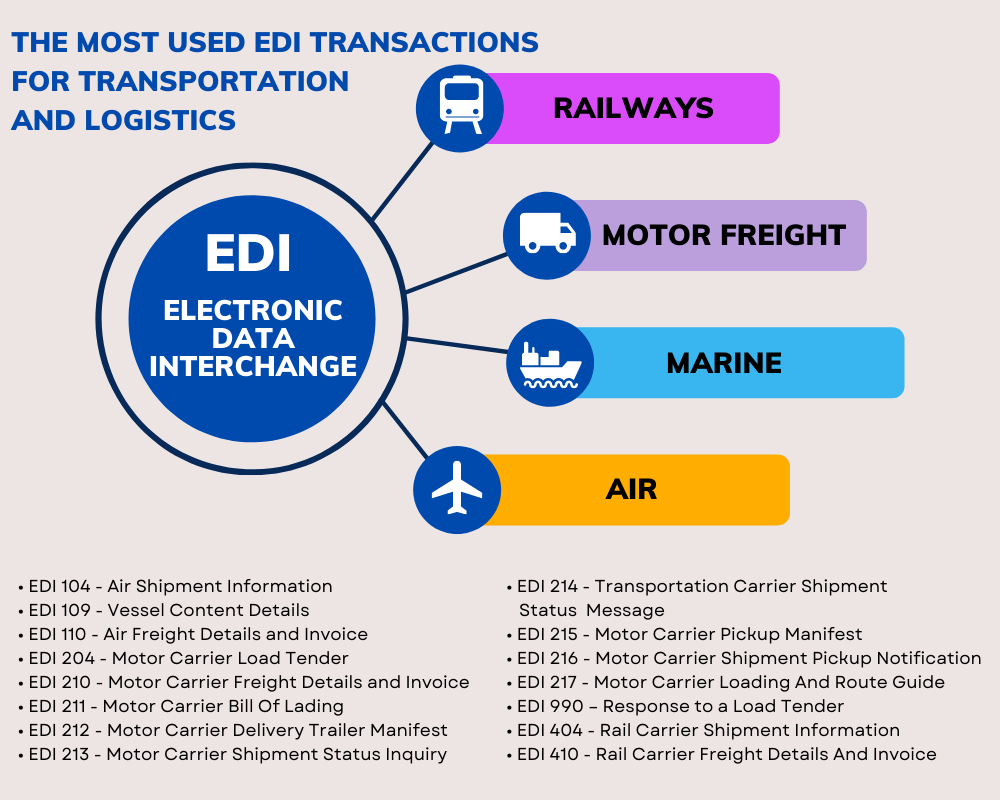
The transport industry includes a huge variety of different types of transportation. It includes marine, air, rail, and motor freight. Accordingly, the EDI transactions used for example, in rail transportation will differ from those used by motor freight.

The Most Used EDI Transactions for Transportation and Logistics

  • EDI 104 – Air Shipment Information
  • EDI 109 – Vessel Content Details
  • EDI 110 –  Air Freight Details and Invoice
  • EDI 204 – Motor Carrier Load Tender
  • EDI 210 – Motor Carrier Freight Details and Invoice
  • EDI 211 – Motor Carrier Bill Of Lading
  • EDI 212 – Motor Carrier Delivery Trailer Manifest
  • EDI 213 – Motor Carrier Shipment Status Inquiry
  • EDI 214 – Transportation Carrier Shipment Status Message
  • EDI 215 – Motor Carrier Pickup Manifest
  • EDI 216 – Motor Carrier Shipment Pickup Notification
  • EDI 217 – Motor Carrier Loading And Route Guide
  • EDI 990 – Response to a Load Tender
  • EDI 404 – Rail Carrier Shipment Information
  • EDI 410 – Rail Carrier Freight Details And Invoice

USEFUL: You can find a complete list of EDI transportation codes in our article “EDI Integration for Transportation and Logistics”

EDI for the Supply Chain Industry

The supply chain industry includes many processes such as distribution, inventory, purchasing, production planning, sales, supply chain planning, interaction with trading partners and warehouses.


The use of EDI in the supply chain allows the company to quickly exchange documents electronically with all suppliers, exchange prices and catalogs, track information on shipments and acceptance of goods. EDI allows to make the supply chain as transparent and efficient as possible, receiving up-to-date data on the movement of goods and funds in real-time.

USEFUL: EDI for Third-Party Logistics providers (3PL)

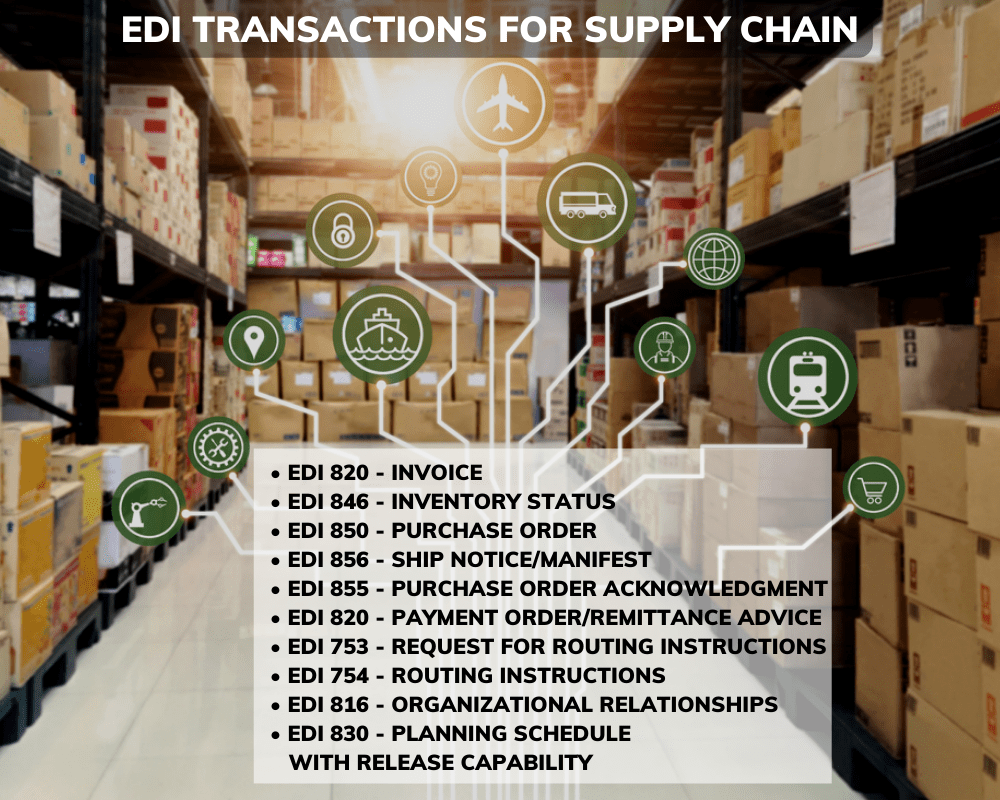
EDI Transactions for Supply Chain

Here are some of the most common EDI documents in the supply chain:

  • EDI 810 – Invoice
  • EDI 846 – Inventory Status
  • EDI 850 – Purchase Order
  • EDI 856 – Ship Notice/Manifest
  • EDI 855 – Purchase Order Acknowledgment
  • EDI 820 – Payment Order/Remittance Advice
  • EDI 753 – Request For Routing Instructions
  • EDI 754 – Routing Instructions
  • EDI 816 – Organizational Relationships
  • EDI 830 – Planning Schedule With Release Capability

To learn more about the use of EDI in the supply chain, read our article: Electronic Data Interchange (EDI) in the Supply Chain It covers the following questions:

– What is EDI?

– Why use EDI in the supply chain?

– How does EDI work?

– Typical EDI workflow process

– Additional and specific types of EDI messages

– Benefits of EDI for Supply Chain Management

– Effective EDI Solution for Supply Chain


EDI for HealthCare and Insurance Industries

EDI is of great value to healthcare organizations because it provides a secure way to electronically exchange sensitive information.

The healthcare industry includes health insurance activities, which are carried out by both commercial and public health organizations.


Most Common EDI Transaction Sets in HealthCare

  • HIPAA / X12 270 – Eligibility, Coverage, or Benefit Inquiry
  • HIPAA / X12 271 – Eligibility, Coverage, or Benefit Response
  • HIPAA / X12 276 – Healthcare Claim Status Request
  • HIPAA / X12 277 – Health Care Claim Status Response
  • HIPAA / X12 837 – Health Care Claim (Professional, Institutional, and Dental)
  • HIPAA / X12 999 – Implementation Acknowledgment
  • EDI 273 – Insurance/Annuity Application Status
  • EDI 274 – Healthcare Provider Information
  • EDI 275 – Patient Information
  • EDI 834 – Benefit Enrollment And Maintenance
  • EDI 835 – Health Care Claim Payment/Advice
  • EDI 852 – Product Activity Data (to exchange information between Manufacturers and Pharmacies)
  • EDI 999 – Implementation Acknowledgment (for Health Care Insurance)

To learn more about EDI in healthcare, please read this article: All you need to know about HIPAA EDI compliance in Healthcare

EDI for the Retail Industry

The Retail Industry is a pioneer in the implementation of EDI. Large retailers are actively automating business processes and introducing new information technology solutions to reduce costs and increase sales.

Thus, the use of EDI in retail is a must. Since large retail companies have a huge number of suppliers, they have to exchange thousands of documents every month. It is simply impossible to go through so much documentation manually.


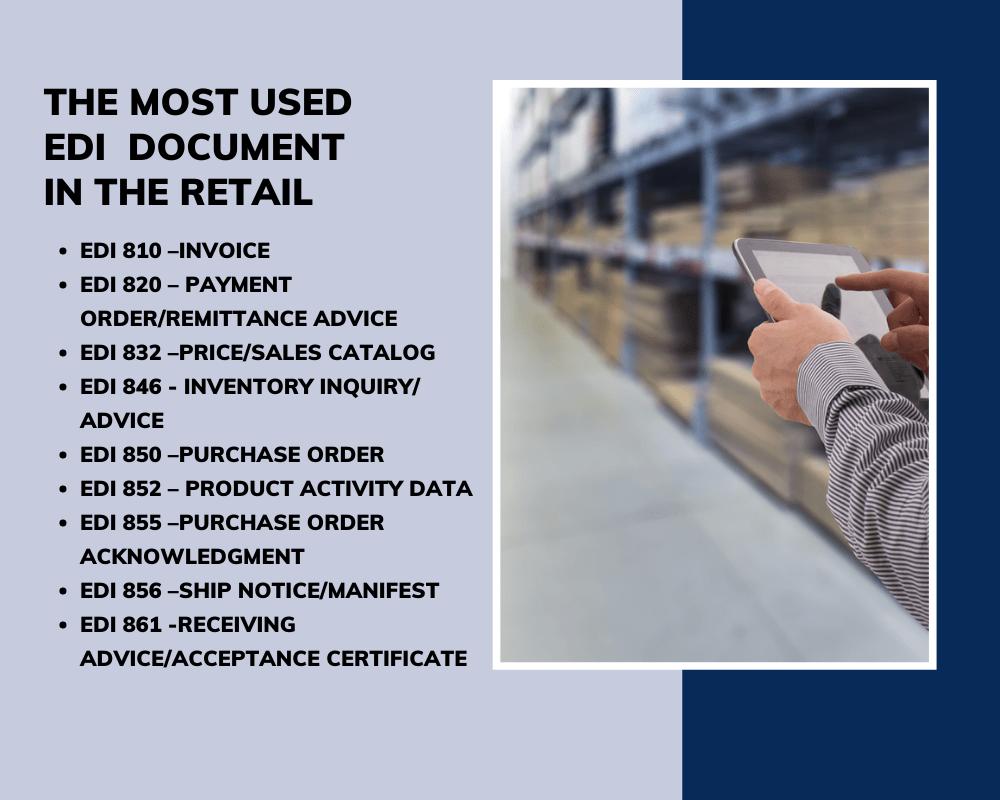
The Most Used EDI Documents in the Retail

  • EDI 810 – Invoice
  • EDI 820 – Payment Order/Remittance Advice
  • EDI 832 – Price/Sales Catalog
  • EDI 846 – Inventory Inquiry/ Advice
  • EDI 850 – Purchase Order
  • EDI 852 – Product Activity Data
  • EDI 855 – Purchase Order Acknowledgment
  • EDI 856 – Ship Notice/Manifest
  • EDI 861 – Receiving Advice/Acceptance Certificate

The use of EDI in retail offers many benefits, ranging from savings in paperwork and avoiding manual data entry errors, to reducing transport and logistics costs and increasing company profits.

If you want to learn more about the use of EDI in retail, please read this article: The Top 6 EDI Documents for Retail Suppliers

Conclusion: EDI for Specific Industries

In this article, we explored the use of electronic data interchange in some industries, however, if you have any questions regarding EDI, you can always contact us for a free initial consultation.

Our more than 21 years of experience in the implementation of EDI for various industries allows us to offer our customers the most profitable and effective EDI solutions.

Free EDI Consultation
February 22, 2022/0 Comments
https://www.edi2xml.com/wp-content/uploads/2022/02/EDI-for-Specific-Industries.png 675 1200 Tatyana Vandich https://www.edi2xml.com/wp-content/uploads/2024/08/edi2xml.com-EDI2XML-company-logo.png Tatyana Vandich2022-02-22 17:15:262026-02-13 15:11:28EDI for Specific Industries

How to Become EDI Compliant in Under 60 Minutes (Yes, Really)

Blog

How to Become EDI Compliant in Under 60 Minutes (Yes, Really)

Being an EDI-compliant company is one of the most effective ways to drive business growth.

There are times when SMEs cannot collaborate with large companies because small companies do not meet their EDI requirements.

In other cases, companies may lose their long-term large business partner because a large company moves to EDI and starts requiring all of its suppliers to exchange documents via EDI.

This can happen to any company.

However, EDI is still the main tool for interacting between business partners and the possibility of cooperation with large companies.

In fact, all major retail companies such as Walmart, Kroger, Home Depot, Costco, Target, and others actively use EDI to communicate with their suppliers, carrier companies, and 3PL partners.

So, what tool can enable you to quickly exchange EDI and become EDI compliant? How to start exchanging EDI documents quickly and cost-effectively, without losing an existing trading partner, and be ready to cooperate with new ones?

HTTP EDI Web Service (REST API) – an Easy Way to Exchange Business Documents

EDI connectivity is a pain for many SMEs. Often, they simply do not have the necessary resources for an EDI integration and can’t afford the monthly EDI fees that must be paid to the EDI provider. Moreover, often, it is simply not profitable and very expensive, since small companies often have a small volume of transactions per month.

With 25 years of experience as an EDI provider, we have identified this problem that small businesses need to solve every day, and developed a unique, easy-to-use solution for SMEs to become EDI-compatible quickly and easily.

We have built a robust and well-established EDI tool that allows you to connect to EDI in record time and start exchanging EDI documents with your trading partners.

What Is an EDI Web Service and How Does It Work?

The EDI2XML Web Service is a web-based HTTP service that runs over the Internet and is capable of translating EDI messages to XML and XML messages to EDI (based on EDI2XML’s proprietary xml format or schema). In addition to XML, the EDI2XML Web Service now supports JSON input and output, allowing developers to choose their preferred data format when converting EDI documents.

API-Converter for EDI XML and JSON
 

EDI Web Service is a low-cost alternative solution to on-premises EDI, SaaS EDI, or Managed EDI.

EDI2XML now includes built-in 997 Functional Acknowledgments and secure OAuth2 token-based authentication for production-grade reliability and security.


This EDI solution offers almost the same benefits of a traditional EDI, including speeding up business document transformation, eliminating document loss, and reducing administrative contact with trading partners.

Supported EDI Transactions

In our EDI document library here you can find a list of supported EDI X12, EDIFACT, HIPAA / X12 transactions that you can start transformation, and be ready to exchange in less than an hour. However, we can add any additional EDI transaction set at your request, without any fees.

How Much Does EDI Web Service Cost? Pricing Breakdown

Payment for the use of the EDI web service is very simple and consists of two parts:

  1. The monthly payment for using the web service mailbox.
  2. Payment for the volume of processed data. This fee is variable and depends on the volume of data converted (between EDI and XML) during a calendar month.

GOOD TO KNOW: All new users of our API web service can benefit from our 15-day free trial.


How to Become EDI Compliant in 3 Simple Steps

I will give you a specific formula in 3 easy steps you need to follow to quickly become EDI compliant without spending a lot of time and money.

Step #1: Learn About the EDI2XML REST API for Fast EDI Integration

Learn full information about the HTTP EDI Web Service on the page: What is EDI2XML Web Service? On this page, you will find information about how the EDI web service works and what its benefits are.

Step #2: Get Custom Pricing for EDI2XML API Usage

Fill out the short contact form on this page to receive a document with a detailed pricing scheme. This document will also contain a section with answers to frequently asked questions. We recommend that you also read it as it contains very valuable information.

Step #3: Getting Started with EDI2XML Web Service in Record Time

After filling out the form and submitting it, we will contact you within [24] hours with the information you need (Token and password) in order to start interacting with the Web Service. Each subscription comes with detailed instructions and documentation regarding our Web Service.

FAQ (frequently asked questions) about EDI2XML REST API for Fast EDI Integration

What are the benefits of becoming EDI compliant for my business?

Becoming EDI compliant can significantly enhance your business growth by enabling faster, more efficient document exchange with large partners, securing long-term contracts, and maintaining competitiveness within the industry.

How does the EDI Web Service (REST API) facilitate quick EDI integration for SMEs?

The EDI Web Service (REST API) provides a low-cost, easy-to-use solution that allows small and medium-sized enterprises to connect to EDI systems rapidly, start exchanging documents seamlessly, and avoid expensive traditional EDI setup costs.

What is an EDI Web Service and what functionalities does it support?

An EDI Web Service is a web-based HTTP platform that translates EDI messages to XML and JSON formats over the internet, supporting secure, reliable, and quick exchange of business documents, including support for functional acknowledgments and OAuth2 authentication.

What types of EDI transactions are supported by this service?

The service supports a wide range of EDI transactions including EDI X12, EDIFACT, and HIPAA/X12 transactions, with the ability to add custom transaction sets upon request at no additional cost.

What are the steps to become EDI compliant quickly using the EDI2XML Web Service?

To become EDI compliant swiftly, you should fill out a short form to receive access details, allowing you to start integrating and exchanging documents within hours.

Final Thoughts: Get EDI Compliant in Under an Hour with EDI2XML

You may have already spent weeks looking for the right EDI solution; now you can quickly become EDI compliant without wasting another day of your time.

Our EDI web service is fast and stable, and brings results to our customers.

If you have any questions, please contact us for a free EDI consultation.

 
EDI web service
February 10, 2022/0 Comments
https://www.edi2xml.com/wp-content/uploads/2022/02/EDI2XML-edi-web-service.png 675 1200 Tatyana Vandich https://www.edi2xml.com/wp-content/uploads/2024/08/edi2xml.com-EDI2XML-company-logo.png Tatyana Vandich2022-02-10 15:38:242025-07-31 12:51:42How to Become EDI Compliant in Under 60 Minutes (Yes, Really)

EDI for Manufacturing Companies

Blog

Manufacturing and EDI: Introduction

Electronic Data Interchange (EDI) is an essential part of the modern manufacturing business process. EDI can speed up production, reduce labor and storage costs, and improve all manufacturing business processes.

In this article, we will analyze how and why EDI is used in manufacturing companies and how to get started with electronic data interchange.

Electronic data interchange (EDI) is the process of exchanging documents (such as purchase orders, invoices, shipping notices, etc.) electronically with a business partner.

Why Use EDI in the Manufacturing Industry?

Every day manufacturing companies in all sectors face many challenges. Managing the procurement of raw materials and components for production, maintaining stocks at an optimal level, accelerating the turnover of finished products, quickly receiving payments, all these and many other challenges are being faced daily at most manufacturing enterprises.


That is why automation through the use of EDI helps to successfully manage many processes in production.

Manufacturing B2B Communication

One of the particularities of a manufacturing company is that it can act both as a buyer when buying raw materials, components, and consumables, and as a seller when selling finished products.

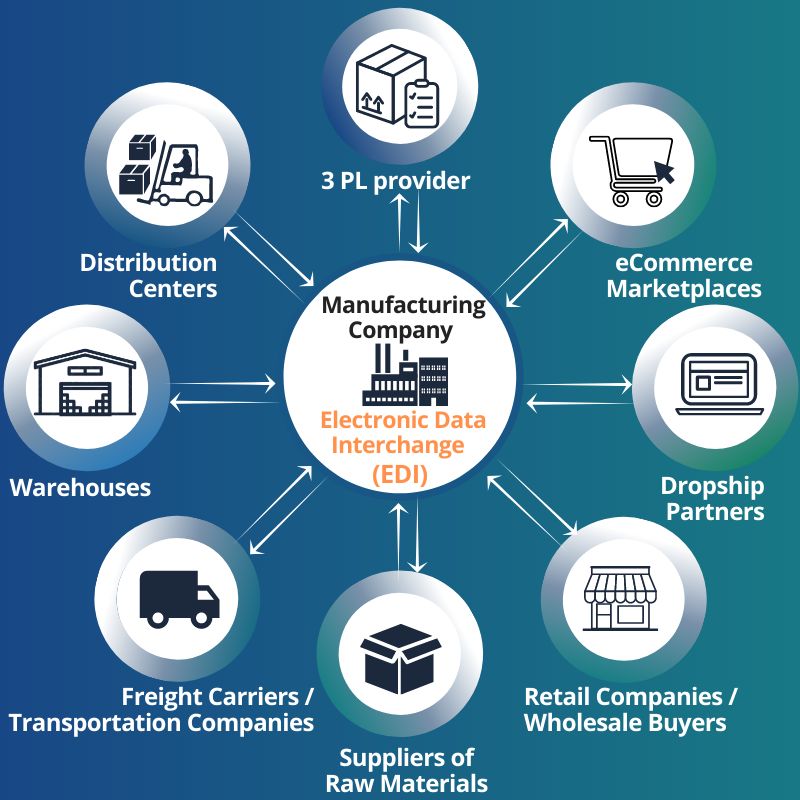
A manufacturing company can have different EDI partners; it can exchange EDI documents with the following business partners:

  • supplier of raw materials and component parts;
  • wholesale buyer;
  • distribution centers;
  • retail companies;
  • eCommerce marketplaces;
  • dropship partners;
  • warehouses / public warehouse;
  • third-party logistics service providers (3 PL providers);
  • freight carriers, transportation companies, and many others.
 

Manufacturing EDI Transactions

A manufacturing company may need to exchange bi-directional EDI transactions with different business partners. The type and number of EDI documents vary according to the business processes within the manufacturing company.

Below is a list of EDI documents for manufacturing; Some of them are used only for manufacturing enterprises, while others are being widely used in any business.

  • EDI 196 – Contractor Cost Data Reporting
  • EDI 830 – Planning Schedule / Material Release
  • EDI 832 – Price/Sales Catalog
  • EDI 844 – Product Transfer Account Adjustment
  • EDI 846 – Inventory Inquiry/Advice
  • EDI 849 Response to Product Transfer Account Adjustment
  • EDI 850 – Purchase Order
  • EDI 852 – Product Activity Data
  • EDI 855 – Purchase Order Acknowledgment
  • EDI 856 – Advance Shipment Notice
  • EDI 860 – Purchase Order Change
  • EDI 861 – Receiving Advice/Acceptance Certificate
  • EDI 862 – Shipping Schedule
  • EDI 866 – Production Sequence
  • EDI 867 – Product Transfer and Resale Report
  • EDI 869 – Order Status Inquiry
  • EDI 870 – Order Status Report
  • EDI 894 – Delivery/Return Base Record
  • EDI 895 – Delivery/Return Acknowledgment or Adjustment
  • EDI 940 – Warehouse Shipping Schedule
  • EDI 943 – Warehouse Stock Transfer Shipment Advice
  • EDI 944 – Warehouse Receipt Advice
  • EDI 945 – Warehouse Ship Advice
  • EDI 997 – Functional Acknowledgment

As stated above, you will probably only need to integrate some of the EDI documents I listed above to automate your business processes and establish an electronic document exchange with your trading partner.

6 Essential EDI Documents for Manufacturing

What are the most common EDI documents used in manufacturing? As mentioned above, different manufacturing companies may use various sets of EDI transactions based on their own business processes and manufacturing characteristics. However, there are some basic EDI transactions that most manufacturing companies use.

Below you will find the 6 EDI transactions used in manufacturing in the ANSI X12 standard (which is widely used in North America), and their equivalent in the EDIFACT standard for Europe.

1. EDI X12 830 – Planning Schedule with Release /EDIFACT (SLSFCT) – Sales forecast message

EDI 830 / EDIFACT( SLSFCT) transmits forecast data related to products, such as location, period, product identification, price, quantity, market sector information, etc.

This enables the recipient to process the data automatically and utilize it for production, planning, marketing, analytics, etc…

2. EDI X12 850 – Purchase Order / EDIFACT (ORDERS) Purchase Order Message

EDI 850 / EDIFACT (ORDERS) is the most commonly used EDI document, not just in the manufacturing industry, but across all industries since it is used when ordering goods. In the case of manufacturing companies, EDI 850 can be used either as an incoming or outgoing EDI document.

– Incoming EDI 850 is sent from the buyer to the manufacturing company when ordering finished products.

– Outgoing EDI 850 is sent by the manufacturing company to its supplier of raw materials or components.

The purchase order contains all the information about the ordering product such as item description, price, and quantities, payment terms, shipping details, requested delivery date, etc.

3. EDI X12 855 – Purchase Order Acknowledgement / EDIFACT (ORDRSP) Purchase Order Response)

EDI 855/ EDIFACT (ORDRSP) is an EDI transaction set that sellers send to a buyer as a response to a purchase Order X12 850/ EDIFACT (ORDERS), to confirm or reject the delivery of products.

PO Acknowledgement (855) is based on EDI 850 and contains similar information about the products, buyer, and seller information, order confirmation number.

4. EDI X12 856 – Advance Shipment Notice (ASN) / EDIFACT DESADV Despatch advice message

EDI 856 message should be sent immediately after the shipment leaves the supplier’s premises.

The ASN 856 includes information about the contents of the delivery, the order, the packaging method, and the product description.

EDI 856 simplifies and speeds up the process of receiving goods, providing details about cargo, transferring information about shipments, and tracking the delivery.

5. EDI X12 810 – Invoice / EDIFACT (INVOIC) – Invoice

EDI 810 / EDIFACT (INVOIC) sent by the seller to the buyer to receive payment for goods provided.

In the case of a manufacturing company, EDI 810 can be used as an outgoing document from the manufacturing company to the buyer of the finished product, or as an incoming document from the raw material supplier to the manufacturing company.

6. EDI X12 EDI 846 – Inventory Inquiry/Advice / EDIFACT INVRPT – Inventory Inquiry/Advice

EDI 846 is sent by a manufacturer to inform its business partners (dealers, distributors, retailers, etc.) of current and future stock levels.

EDI 846 transmits full information about the product such as item description, quantity available in stock, price, as well as quantity forecasted, quantity sold already.

EDI Integration with Manufacturing Software, ERP, or CRM

Electronic Data Interchange (EDI) is a powerful tool that can greatly streamline business processes, particularly when it comes to manufacturing. By integrating EDI with manufacturing software, Enterprise Resource Planning (ERP), and Customer Relationship Management (CRM) systems, manufacturers can improve efficiency and accuracy in areas such as order management, inventory control, and invoicing. EDI allows for the automated exchange of data between systems, reducing the need for manual data entry and minimizing errors. This integration can also help manufacturers better manage their supply chain, by providing real-time visibility into inventory levels and order status.

Get even more EDI benefits and improve your production efficiency by integrating EDI with your manufacturing software or your ERP, CRM, or accounting system. We can rapidly Integrate EDI with:

  • Salesforce Cloud
  • JD Edwards EnterpriseOne
  • Oracle ERP Cloud
  • SAP / SAP S4HANA
  • Dynamics 365
  • Oracle NetSuite
  • DBA manufacturing software and many other

Overall, integrating EDI with manufacturing software, ERP, and CRM systems can help manufacturers improve productivity, reduce costs, and enhance customer satisfaction.

We can connect EDI to any of your business systems in the cloud, on-premises, or in hybrid deployments using a no-code, low-maintenance approach that allows the manufacturing company to maximize the ROI from EDI.

Manufacturing Document Processing Automation with EDI Service Provider

An EDI integration and service provider, such as EDI2XML, can take over the entire task of exchanging EDI documents with your business partners.

EDI2XML can take care of all the EDI integration steps: from planning the EDI project to designing the file format that the customer requests (XML, TXT, CSV), to connectivity and full-cycle testing with the trading partner.

With our cloud-based fully managed EDI service we receive EDI files on behalf of our customers from its trading partners, convert incoming documents to the necessary format (XML, CSV, TXT, JSON, etc.) then push converted files directly to the business system of our customer.

Benefits of using EDI in Manufacturing

EDI has numerous business benefits for manufacturing companies, which includes:

– Accuracy. Reduce human interaction and errors associated with manual data entry. Thus, by automating the exchange of EDI documents, you can eliminate manual data entry and significantly reduce costs.

– Back-office productivity. Eliminating the need to store and manage physical documentation, and reducing transaction times.

– Production productivity. Through the use of EDI, manufacturing companies are achieving significant reductions in response/cycle times.

– Improve supply chain. EDI helps streamline processes throughout the supply chain and improve all operational processes in manufacturing.

– Improving business relationships with your retailers, wholesalers, and customers.

EDI integration helps to significantly improve logistics and production processes: from the purchase of raw materials to sales support and financing.

USEFUL: With our cloud-based Fully Managed EDI Service, we guarantee cost-effective initial and ongoing EDI service costs. Request our Fully Managed EDI Service Pricing Plans here

EDI Integration for Manufacturing with Any Trading Partner

As an EDI service provider with over 20 years of experience, we help our clients exchange EDI documents with their trading partners in the most efficient and cost-effective way. We can set up the exchange of EDI documents with any company, anywhere in the world, and no matter what industry it operates in.

Contact us for your first free consultation with one of our EDI integration experts.

January 31, 2022/0 Comments
https://www.edi2xml.com/wp-content/uploads/2022/01/EDI-for-Manufacturing.png 675 1200 Tatyana Vandich https://www.edi2xml.com/wp-content/uploads/2024/08/edi2xml.com-EDI2XML-company-logo.png Tatyana Vandich2022-01-31 11:57:082024-10-17 15:25:56EDI for Manufacturing Companies

Fully Managed EDI Service for Outsourcing B2B Communication

Blog

In today’s highly competitive business market the efficiency gained through EDI implementation and integration is enormous. EDI (for electronic data interchange) allows companies to interact effectively with their business partners and opens new doors for small businesses to collaborate with large companies.

There are various types of EDI solutions, it can be either locally installed on-premises or cloud-based. Our company as a leading EDI provider offers all types of EDI services:

  • EDI on-premises
  • Web EDI
  • Fully managed EDI

Each of the above EDI service models has its specific benefits. In today’s article, let’s look at the fully managed EDI service, and why companies can benefit from this EDI service or solution.

What is EDI?

Electronic Data Interchange (EDI) is the electronic exchange of business documents using a standardized format. EDI allows business partners to exchange business documents electronically rather than paper or e-mail.

Despite the widespread use of EDI in business, some companies still do not use EDI. They can be limited by the complexity of setting up their EDI flows and processes, or the lack of the necessary IT skills to do such an implementation. All these problems can be solved by hiring an outside EDI service provider that can take care of fully managing their EDI processes and its integration to their internal ERP/CRM system.

What is Fully Managed EDI Service?

The fully managed EDI service offering provided by EDI2XML means that we will fully manage the EDI operations and integration on the behalf of the customer.

Customers using our Fully Managed EDI Service do not need to install any software or hardware, we will setup and configure the process flows, take care of the data routing, and be responsible for data format transformation and integration.

With our fully managed EDI service, we will take on a wide range of responsibilities that are usually performed by an internal IT department and deliver a turnkey project when onboarding a client’s partners.

During the execution of any EDI project, our team will perform the following activities:

  • Initial analysis of the entire EDI Integration Project.
  • Work with the client to define the points of connectivity between both platforms.
  • Perform the communication testing, between the EDI2XML integration platform and the Trading Partner.
  • Configure the EDI2XML platform, according to the Trading Partners’ specific requirements.
  • Perform connectivity and full-cycle testing with the trading partner.
 
Fully managed EDI Service
 

EDI Managed Services for B2B Integration

A fully managed EDI service is ideal for companies that need to use EDI, but don’t want to spend time and effort to do the implementation themselves, or don’t have necessary EDI skills and specialists who can do it. They, therefore, need a partner (EDI service provider) who will take care of all the configuration and integration of EDI into any on-premises or cloud-based ERP or CRM system.

Advantages of The EDI Fully Managed Services

With an EDI managed service provider such as EDI2XML, you no longer have to worry about your EDI transactions because the EDI provider will professionally handle electronic data exchange on your behalf, so you can focus on growing your business.

Managed EDI

– No overpayments. For businesses, this is much more profitable than integrating EDI on-premises.

– Reliable level of security. The EDI3XML platform is hosted on our private cloud, in a state-of-the-art secured data center in Canada.

– No client-side installation. End-users do not need to download and install anything on their computers.

– Minimum requirements for user devices.


– EDI Fully Managed Services delivered by highly qualified EDI experts. Your company can benefit from the technical expertise of the EDI provider staff. You don’t have to deal with the cost of additional training for your own IT department or hiring additional EDI specialists.

– Possibility to seamlessly integrate EDI transactions into your business management system. We have implemented many projects to integrate EDI with Salesforce, SAP, Oracle’s JD Edwards, Shopify, and other business systems. This integration between EDI and ERP/CRM eliminates the need to manually enter data for each EDI transaction.

Useful reading: How to Change Your EDI Service Provider

EDI Fully Managed Service Price

Each month, our clients pay what we call the “ceiling” value, that is fixed in $ value, and includes a specific volume of data. At the end of the month, the monthly fee is re-evaluated based on the logs. So, depending on the volume, the price will be pre-calculated based on pre-packaged pricing packages per month, that increase (or decrease) dynamically based on the volume of data processed during a specific month.

In other words, when the monthly amount of data processed exceeds a certain threshold, the customer will be billed based on the respective pricing plan. It works both ways: when the volume is increased and when the volume is decreased.

Request our EDI Pricing Package here for more information.

EDI Outsourcing

Our company is a successful EDI service provider operating in North America and connecting trading partners worldwide for over 20 years. Our clients are large companies as well as small businesses from various industries.

Due to our level of experience and expertise, we helped each of our clients to choose the most optimal EDI solution for their business and qualified enough to handle all kinds of EDI scenarios.

Contact us for your first free consultation with one of our EDI integration experts.

January 19, 2022/0 Comments
https://www.edi2xml.com/wp-content/uploads/2022/01/EDI2XML-fully-managed_EDI.jpg 675 1200 Tatyana Vandich https://www.edi2xml.com/wp-content/uploads/2024/08/edi2xml.com-EDI2XML-company-logo.png Tatyana Vandich2022-01-19 14:28:162024-10-17 15:27:11Fully Managed EDI Service for Outsourcing B2B Communication

What is an EDI 824 Application Advice?

Blog

EDI 824 Definition

EDI 824 Application Advice is an EDI document that is sent in response to a previously received EDI transaction. EDI 824 reports the receipt of an EDI document and indicates its status. Application Advice can report various statuses:

– acceptance

– rejection

– acceptance with change

Normally, trading partners discussed and agree in advance to each one of the above statuses.

How is EDI 824 Application Advice used?

To generate an EDI 824 transaction, some verifications must be performed on the received EDI document. For example, the list of items in EDI 856 (ASN) should be the same as in the previously submitted EDI 855 (PO Acknowledgement). If a deviation is found in the EDI document, an EDI 824 message with the appropriate status will be generated.

A company can implement Application Advice EDI 824 in response to any EDI document except if a specific response document already exists in EDI business practice, for example:

– EDI 855 Purchase Order Acknowledgment in response to EDI 850 Purchase Order

– EDI 990 Response to a Load Tender in response to EDI 204 Motor Carrier Load Tender

– EDI 754 Routing Instructions in response to EDI 753 Request For Routing Instructions

Why Trading Partners Need EDI 824 Application Advice?

EDI 824 is designed to promptly inform business partners about the accuracy of the information in the previously submitted EDI documents.

This allows the company to promptly correct mistakes and send the adjusted document to their trading partner. EDI X12 824 is based on a general business practice and can be used in any type of business or industry, by any trading partner to advise, reject or indicate any errors on a previously received EDI document.


What are the Benefits of EDI 824?

Cloud Services Provider By using EDI 824, trading partners can quickly report issues related to incoming EDI documents they received, which helps to improve and speed up the order processing and avoid errors.
Cloud Services Provider Application Advice indicates exactly which elements of the received EDI document contain errors, so the sender can quickly correct the EDI document and resend it. This eliminates the need to spend time identifying inaccuracies and errors in the EDI document. This type of electronic exchange of errors and statuses, improves the process of communication between business partners.

Cloud Services Provider EDI 824 is generated automatically, eliminating manual processing of each rejected document.

What are the Differences between EDI 824 and EDI 997?

Even though both EDI 824 and EDI 997 are acknowledgment messages that are sent as a response to the received EDI message, they are very different EDI messages with different functions.

EDI 997 Functional Acknowledgement simply confirms the delivery of the EDI message and that the syntax of the EDI Transaction Set was correct. Accordingly, the EDI FA 997 informs the sender that the envelope has been received by the recipient, and its structure was validated, and it was accepted (or rejected) by the recipient, obviously without validating the content of the received EDI document.

Unlike EDI 997, the EDI 824 works differently; it is the result of the validation of the content of the received initial EDI document. Application notification parses the content of the message and returns a message with a specific status and indicates errors in the content of the message.

824 EDI Document Type

The formal name of this EDI document is X12 824 Application Advice Transaction Set.

EDI 824 Application Advice is supported by the X12F Finance Subcommittee under the X12 Accredited Standards Committee.

In the EDIFACT standard, which is used mainly in Europe, the APERAK – Application Error and Acknowledgement message perform the same function.

EDI Transaction Types – Complete List of EDI Transactions Sets & Codes for ANSI ASC X12 Standard

EDI 824 – Application Advice Structure

ANSI ASC X12 824 Application Advice, can have the following structure:

ISA Interchange Control Header

GS Functional Group Header

ST Transaction Set Header

BGN Beginning Segment

N1 Name

PER Administrative Communications Contact

OTI Original Transaction Identification

REF Reference Identification

DTM Date/Time Reference

AMT Monetary Amount

TED Technical Error Description

SE Transaction Set Trailer

GE Functional Group Trailer

IEA Interchange Control Trailer

How to Integrate and Exchange EDI 824

To exchange EDI 824 or any other EDI documents, each company can choose the most optimal solution that will be most beneficial for it and meet the business requirements of their trading partners.

As an EDI service provider with over 20 years of experience, we understand that requirements can be different from a company to another. One company may have a huge number of EDI transactions that need to be integrated directly into their ERP or CRM system (for example, Salesforce, Oracle JDE, SAP, etc.)

Another company may only have a few transactions per week, and it is not profitable for them to implement a fully managed EDI solution on their own premises.

Some companies may be leaning towards the “on-premises” EDI solution when they have “internal policies” or they are a large enterprise with their own team of IT experts.

That is why we have developed different types of EDI solutions and support different EDI standards (X12, EDIFACT, RosettaNet, etc.) and can use different communication protocols (like AS2, VAN, FTP / SFTP, HTTP / HTTPS) to meet the need of any company.

EDI Web Service

EDI2XML web service is a REST API to convert X12 to XML and vice versa. This API web service for EDI exchange is very low cost and meant for companies who got their own technical resources to work with REST API. Thus, this is a self-service solution with no contract, and no commitment, moreover you can be up and running in less than an hour.

Fully Managed EDI Solution

EDI2XML Managed Services is our popular EDI service that includes translation and communications services. All EDI file conversions are done on our side, so customers don’t need to install software or hardware on-site. This is a complete turnkey EDI solution.

Moreover, with these fully managed services, all EDI documents can be synchronized with the company’s internal system such as ERP, CRM, eliminating the need for manual data entry and fully automating the EDI process.

EDI On-Premises Solution

We offer EDI services with “on Premises” deployment at the customer servers.

In this case, companies need to have some resources such as proper in-house EDI expertise, expertise to work with XML, necessary IT infrastructure.

We help companies choose the best personalized EDI integration solution for their business. To find out more, contact us for a free consultation with one of our EDI experts.


You may also be interested in reading about:

EDI integration for B2B exchange to optimize and grow your business

The Top 6 EDI Documents for Retail Suppliers

Electronic Data Interchange (EDI) in the Supply Chain

December 14, 2021
https://www.edi2xml.com/wp-content/uploads/2021/12/EDI824.png 675 1200 Tatyana Vandich https://www.edi2xml.com/wp-content/uploads/2024/08/edi2xml.com-EDI2XML-company-logo.png Tatyana Vandich2021-12-14 15:37:022026-02-13 15:18:43What is an EDI 824 Application Advice?
Page 2 of 9‹1234›»
Recent
  • Is EDI Required for Small Businesses? A Supplier’s Guide...June 17, 2026 - 7:02 pm
  • EDI compliance with Loblaw
    How to Meet Loblaw EDI Requirements as a Small BusinessJune 4, 2026 - 2:05 pm
  • The Infrastructure Behind Modern Commerce: Why EDI Still Matters
    EDI in E-Commerce and Retail: Why Modern Commerce Still...May 1, 2026 - 4:54 pm
  • Key Statistics on AI Use in the Workplace
    The Risks of Using Public AI Tools in Business: Data Privacy,...March 11, 2026 - 5:51 pm
  • Enterprise AI
    How to Securely Access Enterprise AI: GPT, DeepSeek &...February 20, 2026 - 3:09 pm
Popular
  • How to Quickly Connect to a Large Retailer's EDI Requirements
    How to Get EDI-Compliant Quickly For A Large RetailerNovember 21, 2025 - 4:29 pm
  • EDI-as-a-services
    EDI Translation Software “On-premises” or “As...January 21, 2014 - 1:28 pm
  • order-automation in e-commerce
    Why Is It Crucial to Automate the E-Commerce Order Fulfillment...May 10, 2022 - 1:58 pm
  • EDI for Logistics and transportation
    EDI Integration for Efficient Transportation ManagementOctober 6, 2023 - 1:33 pm
  • information technology definitions
    Business Tech Terms DefinitionsMay 24, 2018 - 1:32 pm

Browse by tag

Amazon Amazon Integration ANSI ASC x12 ASC X12 EDI B2B EDI integration e-commerce e-commerce business e-commerce integration eCommerce eCommerce integration EDI EDI2XML EDI 850 EDI as a Service EDI Communication EDI converter EDIFACT EDI for supply chain EDI for Third-Party Logistics EDI for transportation EDI implementation EDI Integration EDI Integration Project EDI project EDI Translation EDI Web Service EDI x12 ERP Integration integration platform integration project JDE Magic xpi Magic xpi Integration platform NetSuite online store Salesforce Shopify Shopify eCommerce integration Shopify integration Supply Chain Supply Chain Management Translation Software X12 EDI XML

Subscribe to our Blog

Menu

  • Home
  • About the EDI2XML Company
  • About EDI2XML EDI Converter
  • Blog
  • Book A Free Consultation
  • Privacy Policy EDI2XML Company

Our Services

Fully Managed Integration

E-Commerce Integration

Business Systems Integration

Fully Managed EDI

EDI Web Service 

On Premises EDI 

Managed Cloud Service


Latest Blog Posts

  • Is EDI Required for Small Businesses? A Supplier’s Guide to Retail OnboardingJune 17, 2026 - 7:02 pm
  • EDI compliance with Loblaw
    How to Meet Loblaw EDI Requirements as a Small BusinessJune 4, 2026 - 2:05 pm
  • The Infrastructure Behind Modern Commerce: Why EDI Still Matters
    EDI in E-Commerce and Retail: Why Modern Commerce Still Depends on EDIMay 1, 2026 - 4:54 pm

Contact Us

400 Blvd Curé-Labelle, #304 Laval QC H7V 2S7 Canada

Contact EDI2XML Team
Phone: +1 450-681-3009
Website: https://www.edi2xml.com/

© 2000-2026 EDI2XML (by Namtek Consulting Services). All rights reserved.
  • Link to Facebook
  • Link to LinkedIn
  • Link to X
  • Link to Youtube
  • Blog
Scroll to top Scroll to top Scroll to top