EDI2XML
  • About
    • The Company
    • EDI2XML
    • Advantages
    • Partnership with EDI2XML
    • Testimonials
  • Services
    • Enterprise AI
    • Fully Managed Integration
    • Fully Managed EDI Services
    • EDI Web Portal
    • EDI Web Service
    • EDI On Premises
    • Managed Cloud Services
    • Amazon Integration
    • Shopify Integration
    • BigCommerce Integration
    • NetSuite Integration
    • JD Edwards Integration
    • Dynamics 365 Integration
    • SAP B1 Integration
    • Salesforce Integration
    • Industry 4.0 Integration
  • Pricing
    • EDI Managed Services
    • EDI Web Service
    • EDI On-Premises
    • Managed Cloud Services
    • Shopify Integration
    • JD Edwards Integration
    • E-commerce Integration
    • All other Integrations
  • Blog
  • Resources
    • Downloadable Guides
    • List of EDI Codes
    • List of EDIFACT Messages
    • EDI Documents Library
    • Trading Partners
    • Customer Case Studies
  • Contact us
  • Book a Consultation
  • Click to open the search input field Click to open the search input field Search
  • Menu Menu
  • Link to Facebook
  • Link to LinkedIn
  • Link to X
  • Link to Youtube

HL7 vs FHIR: Fast Healthcare Interoperability Resources

Blog


History of HL7

In 1987, at the initiative of the IT company Simborg Systems, a non-profit organization was created to develop a new standard for improving the interaction of independent health information system (HIS).

Today, Health Level Seven International is a leading global provider of standards for the interoperability of medical information systems, accredited by the American National Standards Institute (ANSI).

The result of HL7’s work was the creation of three generations of standards.

HL7 V1

The first version of the HL7 standard (released in 1987) was intended only to test the concept and determine the content and structure of the standard. Actual use in production began with HL7 2.1 (1990).

HL7 V2

FHIR standardThe HL7 2.x (V2) standard describes the exchange of administrative, financial and clinical information in the form of text messages. These messages use a non-XML encoding syntax based on segments (lines) and one-character delimiters.

Messages are of various types and subtypes, for example, ADT – (Admit Discharge Transfer) messages for the transmission of administrative information about the visit, ORU message – for transmits observations and results.

HL7 v2.x has allowed for the interoperability between the following systems:

– Patient Administration Systems (PAS).

– Medical practice management (PMS) systems.

– Laboratory Information Systems (LIS).

– Electronic Medical Record (EMR) systems.

– Electronic Health Record (EHR) systems.

– Dietary systems

– Pharmacy systems

– Billing systems

Most commonly used HL7 (v2) message types:

  • ACK – General acknowledgment message
  • ADT – Admission, Discharge and Transfer message
  • BAR – Add or change the billing account
  • DFT – Detailed financial transaction
  • MDM – Medical document management
  • MFN – Master files notification
  • ORM – Pharmacy/treatment order message
  • ORU – Observation result (unsolicited)
  • QRY – used to query source data systems about things like patient demographics, etc.
  • RAS – Pharmacy/treatment administration
  • RDE – Pharmacy/treatment encoded order message
  • RGV – Pharmacy/treatment give message
  • SIU – Scheduling information unsolicited

The development of new technologies led in 1995 to the development of a new generation of HL7 V3 standards that were not backward compatible with V2.

HL7 V3

HL7 V3, unlike V2, is a standard based on the Reference Information Model (HL7 RIM); data type model.

According to HL7 International: “The HL7 Reference Information Model (RIM) is a critical component of the HL7 V3 family of standards. It is the root of all information models and structures developed as part of the V3 development process”

Unfortunately, even though HL7 V3 was theoretically deeply and conceptually developed, the development of subject areas took too much time. Also, the complexity of the standard at the implementation stage caused a serious wave of criticism and several attempts to simplify the standard.

HL7 FHIR

HL7 FHIR appeared in 2011. The new HL7 FHIR development approach is based on RESTful principles. FHIR is designed to simplify and accelerate the implementation of HL7 with the goal of efficient interaction between legacy healthcare systems, as well as access to medical data from various devices (computers, tablets, mobile phones).

Why FHIR is Better

HL7 FHIR (Fast Healthcare Interoperability Resources)The main idea of FHIR is to create a basic set of resources that, individually or in combination, can satisfy most use cases. FHIR resources define the content and structure of a core set of information that is common to most implementations.

FHIR Resources are divided into types and groups, each type has its own field structure, whose values can be primitive or composite types and links to other resources. Fields may be mandatory or optional, contain one or more values. For example, the “Patient” resource contains primitive type fields: date of birth / gender / …, composite type: name / address / …, links to the organization and the list of referring physicians, etc. Resources are based on the following structures:

  • XML
  • JSON
  • HTTP
  • Atom
  • OAuth

FHIR Data Exchange

HL7 Specification FHIR describes several approaches for exchanging data between systems. Systems can exchange resources separately or collect related resources into groups (Bundles) and exchange these resource groups (Bundles).

Data exchange options:

RESTful API (HTTP) – the interaction between systems occurs by performing operations on resources using REST requests.

Messaging – the interaction between systems is organized in the form of sending messages between systems. Each message contains information that one system wants to communicate to another. A message is a group of related resources of a certain type.

Documents – the interaction between systems occurs at the document level, i.e. one system requests documents from another system and receives them.

A document is a group of resources combined into a document through a special composition resource and secured at the time of signing the document.

Depending on the architecture of your solution and the tasks you are solving, you can use the appropriate exchange option.

FHIR 4

In January 2019, a new version of FHIR became available. In FHIR4 future changes will be backward compatible. Moreover, some key FHIR elements from now became normative, including RESTful API, XML and JSON formats, terminology layer, conformance framework, as well as Patient and Observation resources.

The FHIR standard and open application programming interfaces (APIs) are today considered critical elements to ensure the interoperability of medical data.

If you want to know more about HL7 Standard read our blog: Introduction to HL7 Standards (Health Level 7)

Contact us for free IT Consultation +1 (450) 681 3009

October 9, 2019
https://www.edi2xml.com/wp-content/uploads/2019/10/HL7-vs-FHIR.png 350 1024 Tatyana Vandich https://www.edi2xml.com/wp-content/uploads/2024/08/edi2xml.com-EDI2XML-company-logo.png Tatyana Vandich2019-10-09 14:35:312019-10-09 14:35:31HL7 vs FHIR: Fast Healthcare Interoperability Resources

What is Dropshipping on Amazon?

Blog

This post was updated to reflect current trends and information.


What is Dropshipping on Amazon?

Amazon is a huge marketplace where products are sold not only from Amazon but also from third-party stores. Customer service is supported by the terms and conditions that are common to all vendors. Amazon is very popular with buyers and many people are shopping for their products right there on Amazon.

Concept of Dropshipping – What it Really is

Drop shipping is the concept of selling by “intermediary”, where direct delivery of goods to the customer is done by the manufacturer. That is, first the intermediary finds the customer, then makes an order from the manufacturer and the manufacturer delivers the goods to the buyer.

How to Dropship on Amazon

How Does Dropshipping Work?

  1. The customer (or consumer) finds the product interested in at the seller; in this example, the Amazon website is the seller.
  2. The customer orders and pays for the product online, on Amazon’s site.
  3. Once the order is placed at Amazon, the “Ship To” information is obviously noted.
  4. Amazon will transfer the order to the appropriate manufacturer
  5. Upon receiving the order, the manufacturer delivers the goods directly to the consumer, on behalf of the Seller (Amazon); All paperwork (i.e. invoice, packing slip…) will look as if it was sent from Amazon since he is the Seller known by the customer.
  6. The manufacturer advises Amazon of the delivery of goods to the customer
  7. The manufacturer sends the invoice to Amazon, who in turns transfers the payment based on delivery of goods and pricing agreed upon in advance.

 Useful reading: 4 Challenges of EDI and Drop-Ship in eCommerce

Get Started With Dropshipping on Amazon

If you are looking to start a retail drop ship business on Amazon, without having any manufacturing or warehousing capabilities, we recommend finding reliable suppliers that are used and capable of working under the dropshipping model. Given the great interest of manufacturers in dropshipping, this is not difficult to find.

Dropshipping on AmazonArrange with them your price, discounts, returns, your ability to track stock balances and how the goods move to the buyer.

But not everything is as simple as it might seem. The difficulties of dropshipping is that you have competitors (one manufacturer may have dozens or even hundreds of trading partners like you) and this will make your margin low. To make good money, you need to sell hundreds of products. You should be aware of the availability and balances of all goods in the warehouses of manufacturers in order to avoid long delivery and returns. Fortunately, there is a solution that can greatly simplify the life of a drop-shipper. We, at EDI2XML, propose an integration of your Amazon store with your supplier’s software system.

Useful reading:

Integration with Amazon Web Services (MWS): Things you should know

Integration with Amazon Seller or Vendor account: Things you should know

Dropshipping and Amazon Buyers

Amazon dropshipOften consumers buying from Amazon (and other online shopping platforms) do not even know (and do not want to know) according to which sales scheme they buy goods. They come to Amazon mainly because they want to quickly and conveniently place an order, have quality feedback from the seller, and quickly receive goods.


To maintain a high customer service there is a department, the Seller Performance Team, which monitors all accounts, especially new ones, and monitors the seller’s activity and customer satisfaction. Here are some criteria for evaluating an Amazon account:

  • The number of canceled orders;
  • The number of returns;
  • Timely delivery;
  • Accuracy of delivery tracking data;
  • The speed of reaction to customer requests (answers to questions);
  • The degree of customer satisfaction with seller support services and others.

Therefore, if most of the indicators fall below acceptable levels, and sometimes it’s only 4% of the number of transactions, Amazon’s algorithms will lower the “health” of the seller account and it will be more difficult to sell.

Amazon Dropshipping Policy

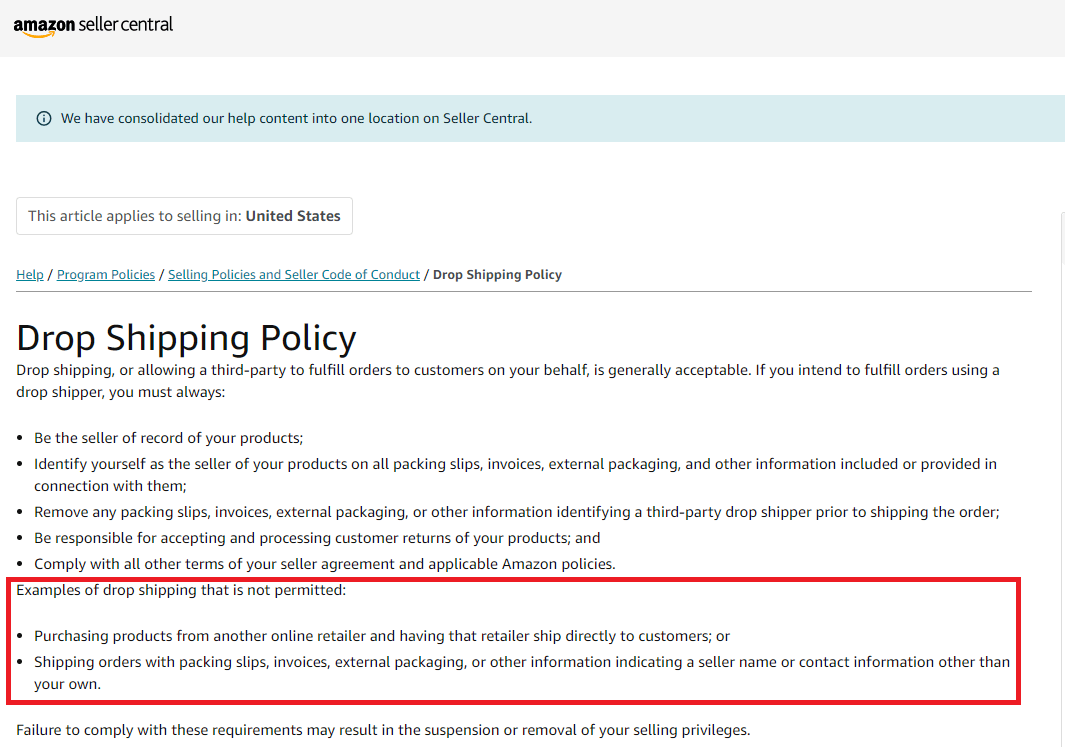
According to Amazon’s dropshipping policy, dropshipping is generally acceptable, but the seller must follow the rules. Amazon may block the seller’s account for a violation of its rules.

 “Examples of drop shipping that is not permitted:

– Purchasing products from another online retailer and having that retailer ship directly to customers; or

– Shipping orders with packing slips, invoices, external packaging, or other information indicating a seller name or contact information other than your own.”

 Amazon drop ship Policy

It follows that Amazon prohibits the sale of goods that will be sent to the customer by another seller. Consequently, the package should not have documents with other names than the seller.

Please also note that Amazon requires the seller to take responsibility for the transaction. Therefore, such excuses as “I did not send the goods, so, I am not responsible for its quality” will not work. Even if the seller never seen a product, the sale and the processes associated with it (delivery, return, replacement) are only his own responsibility.

Is Amazon Dropshipping Profitable?

Even with Amazon’s strict rules, dropshipping is an opportunity to start selling with minimal investment. By developing dropshipping, sellers can get exclusive conditions from a supplier or manufacturer. Most likely, despite all the conditions of Amazon, dropshipping using this marketplace will be several times more profitable than any other online store that anyone might create and develop.

Read also: 9 Major E-Commerce Trends That Will Help Grow Your Online Business

A great chance to learn more about effective dropshipping

Today thousands of sellers make money on Amazon and millions of people buy goods. All conditions are created for doing business on Amazon. Dropshipping is the most convenient and affordable way to start trading on Amazon. We can help you make your business on Amazon profitable and easy. Contact us today to have a free consultation!

Amazon Integration


For more information on the Amazon integration, please read these articles:

  • Integration with Amazon Seller or Vendor account: Things you should know
  • Integration with Amazon Web Services (MWS): Things you should know
  • Amazon Business: How to increase the B2B sales on Amazon?
October 9, 2019
https://www.edi2xml.com/wp-content/uploads/2019/10/EDI2XML-Dropshipping-on-Amazon.jpg 675 1200 Tatyana Vandich https://www.edi2xml.com/wp-content/uploads/2024/08/edi2xml.com-EDI2XML-company-logo.png Tatyana Vandich2019-10-09 11:29:482024-05-24 11:55:48What is Dropshipping on Amazon?

Amazon Business: How to increase B2B sales on Amazon?

Blog

This post was updated to reflect current trends and information.


What is the Amazon B2B sale?

Amazon is the main online store for millions of customers. People buy on Amazon around the clock, all year round. However, until 2015, B2B sales on Amazon did not grow rapidly. This situation changed drastically when Amazon launched the new Amazon Business program in 2015.

Since 2015, Amazon has increased its market share of B2B. In the first year alone, Amazon Business sales reached $1 billion. Hundreds and thousands of companies bought their products to the platform and sold it to other people using Amazon Business Account.

What is Amazon Business Account?

Amazon Business is the Amazon website version for business customers whose needs are different from those of ordinary customers. For example, the Amazon Business allows multiple users to use one business account at once. They also have access to additional payment methods and credit. Besides, Amazon Business offers fast delivery and discounts on wholesale orders.

The advantage of Amazon Business is that all sales can take place from one account. You can do both B2B and B2C sales. At the same time, for business customers, you can offer a different assortment, prices, and conditions.

Main advantages of Amazon Business account

– Each one of the following benefits plays a major role in the B2B sales cycle:

– Wholesale prices and discounts

– Multi-user account

– Full reporting

– Ability to purchase on credit

– Flexible payment terms

– Free shipping for Prime business accounts

amazon integration

Amazon Business created lots of features to simplify B2B communication and sales. For example, a multi-user account allows different employees of the same company to track orders, change the delivery address, add multiple addresses, or choose different payment methods.

Amazon offers for Business Prime accounts Free One-Day Shipping on millions of items, or Free Same-Day Delivery on eligible orders, or unlimited FREE Two-Day Shipping. Prices and discount sizes for a business account also differ from offers for an ordinary buyer.

Amazon also took care of the assortment for B2B. Business account owners can easily find specific products. For example, road signs or industrial equipment.

Integration to increase your Amazon B2B sales

Your B2B sales on Amazon will be more efficient with the Business account. However, to increase the productivity of your B2B sales, you need to integrate your ERP/CRM systems with your Amazon Business account. This integration will allow you to quickly and professionally manage all the resources of your enterprise, both material as well as human, and increase your sales. Integrating CRM and ERP with Amazon will automate all the routine processes. So, your employees can focus on solving more important tasks. The inventory will take a minimum of time, and you will have accurate information about each item.

Amazon Business Account integration with ERP, CRM, and other back-end systems using Magic xpi Integration Platform

As I mentioned above, the integration of your business systems with Amazon will automate all the basic functions. According to our 18+ years of successful experience in e-commerce integration, the most common integrations are:

  • Salesforce integration with Amazon
  • SAP Business One integration with Amazon
  • Microsoft Dynamics NAV with Amazon
  • JD Edwards EnterpriseOne Integration with Amazon

Through integration, it will be possible to import and unload goods in Amazon, load customer orders and update their statuses automatically:

  • Place products from your internal business system to Amazon.
  • Update Amazon prices and product balances when they change in ERP.
  • Upload customer orders from Amazon to ERP
  • Update customer order statuses in CRM from Amazon

An integration platform like Magic xpi, connects your business systems with Amazon Marketplace and allows you to work with a wide range of products and many corporate clients in a fully automatic scheme, without human interaction.


Useful reading: Magic xpi Integration Platform: The Best Fit for Enterprise Data Integration


Magic xpi will help you organize your company’s management more efficiently, increase your customer flow and increase your company’s profitability.

Sell to Businesses: Amazon B2B

Every successful Amazon seller is interested in selling as much as possible, so companies willing to buy your product through a regular account will be happy to buy it with Amazon Business, where they will have more benefits.
Wholesale discounts on Amazon Business encourage companies to buy even more. Which means it benefits you too.

How to connect Amazon Business

To get started, you will need to register a seller account on Amazon. At the same time, your account should be with a good rating, as Amazon Business is available only to those who are professionally and seriously concerned with sales.


Useful reading: Integration with Amazon Seller or Vendor account: Things you should know


Amazon also puts its own condition. You should be ready to maintain a higher level of work than the requirements for standard Amazon sellers.

Make your B2B sales on Amazon as efficient and profitable as possible.

If you would like to simplify your Amazon sales, contact us to receive more information about our integration solution or to request a demo.

Don’t miss the opportunity to work with large companies! You can start integration with Amazon right now.

Amazon Integration
September 3, 2019
https://www.edi2xml.com/wp-content/uploads/2019/09/EDI2XML-Amazon-Business.jpg 675 1200 Tatyana Vandich https://www.edi2xml.com/wp-content/uploads/2024/08/edi2xml.com-EDI2XML-company-logo.png Tatyana Vandich2019-09-03 12:12:552023-04-10 14:45:18Amazon Business: How to increase B2B sales on Amazon?

Introduction to HL7 Standards (Health Level 7)

Blog


This post was updated to reflect current trends and information.

The seamless exchange of health information between medical systems is crucial for improving patient care and operational efficiency. HL7 (Health Level 7) has become the leading international standard for the management and integration of clinical data. In this article, we will take a closer look at HL7, its key components, and how it supports healthcare data exchange. Additionally, we’ll cover HL7 FHIR, the latest version designed to enhance data interoperability in modern healthcare systems.

HL7 – Health information exchange

Digital transformation has affected many industries and processes. One of the processes affected is Health Information Exchange — HIE. It is evident, that effective exchange of medical data between various health institutions allows serving more people and could reduce the cost of treatment.

In this article, we will discuss the international standards for the transfer of clinical and administrative data Health Level 7 (HL7).

Health Information System (HIS)

Introduction to HL7 StandardsHealth service digitization has led to the creation of many Health Information System (HIS) which are systems to automate document management in a medical institution and consists of electronic medical records, data from various studies, monitoring from different medical devices related to the patient’s condition, and other information.

The focus of any Health Information System is the Electronic Health Records (EHR). The medical information stored in the EHR is represented by a complex set of heterogeneous data, both textual, digital, and graphics, which are originally located in different systems. For successful synchronization of this information in different HIS, it is necessary not only to transfer them via protocols, but also to convert this data to the form that is accepted in another Health Information System, and vice versa.

To solve Health Information Systems integration challenges, there is a set of international standards that define the rules for the exchange of information in the Healthcare Industry.

Health Information Exchange standards

It should be mentioned that over the past 50 years, many different standards for Health Information Exchange have been developed. The most Popular are:

  • Digital Imaging and COmmunications in Medicine (DICOM)
  • UN/EDIFACT
  • HL7

However, by comparison all other, HL7 standard showed the best results and is currently the most common in the Healthcare Industry.

How is HL7 used in healthcare

The following is a comparative table of the functionality of the three standards:

 FUNCTION DICOM  UN/EDIFACT  HL7
 Hospital information system  X  X  X
 Radiology information  X  –  X
 Storage and sharing of images  X  –  X
 Master Patient Index (MPI)  –  –  X
 Graphic diagnosis  X  –  X
 Archiving  X  –  X
 Comments on the diagnosis  –  –  X
 Images in the documentation  X  –  X
 Intermediate reports  –  –  X
 Video in the documentation  –  –  X
 Patient registration  –  –  X
 Electronic health record (EHR)  X  X  X
 Invoice creation  –  X  X
 Recipes  –  –  X
 Transforming data  –  –  X
 Emergency information  –  –  X
 Medical practices  –  X  X


As you can see in the table above, HL7 Standard can transmit graphic images. This option was developed due to the specifics of the healthcare industry, since often during the examination and treatment of patients in addition to text, visual information is generated. This may include x-rays, ultrasound, and tomographic results, and the volume of visual graphics data is growing annually.

What is HL7 standard?

HL7 - Health information exchangeThe HL7 standard (Health Level 7) is the set of international standards for the exchange, management, and integration of electronic medical information.

Health Level Seven International (HL7) is not-for profit organizations that are developing standards for the integration, exchange, sharing, and retrieval of electronic health information. HL7 has more than 1,600 members from 50 countries, including over 500 corporate members such as healthcare providers, government agencies, pharmaceutical companies, and others.

The HL7 standard is widely used for electronic document exchange in medical institutions, especially in those where the patient receives intensive care, for example, in hospitals.

HL7 includes:

  • conceptual standards (HL7 RIM)
  • application standards (HL7 CCOW)
  • documentary standards (HL7 CDA)
  • messaging exchange standards (HL7 v2., 0 and HL7 FHIR).

Objectives, concepts and general structure of HL7

In the HL7  “Seventh level” – an analogy with the highest level of the communication model of Open Systems Interconnection model (OSI). The seventh level supports the performance of such tasks as:

  • structuring the transmitted data;
  • system design capabilities;
  • achieving gear consistency;
  • security;
  • identification of participants;
  • availability

The most important components of HL7

RIM Reference Information Model

Reference Information Model – the basic concept for all HL7 is the information model – the main source of data content for all HL7 messages and documents.

RIM consists of several technologies:

  • USAM – Unified Service Action Model. An object model for any action possible in the system;
  • MIM – Message Information Model. Messages models;
  • R-MIM Refined Message Information Model. A context-based model.

Storyboard

Functional model in terms of system design UML. The concept of a storyboard is taken from the movie industry and represent significant moments of message transmission as frames. Each frame describes the key participants and their interaction. A set of frames represents both the transmission of a message and the functioning of a large system.

A description of the operation of triggers that launching events (for example, a form after filling out becomes “filled” and / or “signed”). Each interaction is described by a storyboard (in the UML sequence diagram).

Each interaction is described by a storyboard (in the UML sequence diagram). By means of RIM and storyboard, it is possible to express a highly personalized patient history.

Vocabulary

Descriptions of the specifics of subject areas. An attribute in a RIM-description can be a dictionary item.

HMD

Hierarchical Message Descriptor – determinant of the hierarchical structure of the message.

HMD principles:

  • The transmission system must understand the genesis of classes.
  • messages during transmission are arranged in a linear structured sequence.

EHR System

Electronic Health Record Systems – the system of electronic medical history. Description of the full functionality of the EHR consisting of sections:

  • Care Management
  • Clinical Support
  • Information Infrastructure – a total of 125 functions.

HL7 FHIR (Fast Healthcare Interoperability Resources)

HL7 FHIR (Fast Healthcare Interoperability Resources) The most popular version of HL7 standards is HL7 FHIR (Health Level 7 – Fast Healthcare Interoperability Resources). According to HL7 International Annual report 2018 one of the strategic goals of this organization is: “Establish Fast Healthcare Interoperability Resources (FHIR) as a primary standard for global health data interoperability and enhance and maintain quality of and accessibility to HL7 standards in current use”.
 

What is the difference between hl7 and FHIR?

HL7 FHIR combines all the successful solutions of previous versions of HL7 and contains a new architectural concept, as well as an open approach to the development and evolution of the standard.

Key principles of HL7 FHIR

  • focus on practical implementation (convenient for developers)
  • Following the evolving web technologies
  • Incorporating only the most important/common concepts into the specification to keep it small and describe 20% of the concepts involved in 80% of the informatized scenarios;
  • Open standard and Open Source development
  • Mandatory “human-readable data” level during the exchange.

Get in touch with our experts

If you want to know more about Health information exchange or Electronic Data Interchange in general, please contact our specialists

Get in touch with our EDI expert for a free consultation

August 20, 2019
https://www.edi2xml.com/wp-content/uploads/2024/08/edi2xml.com-EDI2XML-company-logo.png 0 0 Tatyana Vandich https://www.edi2xml.com/wp-content/uploads/2024/08/edi2xml.com-EDI2XML-company-logo.png Tatyana Vandich2019-08-20 11:49:592024-09-19 08:22:15Introduction to HL7 Standards (Health Level 7)

EDI ANSI ASC X12 Standards – Technical Overview

Blog

This post was updated to reflect current trends and information.


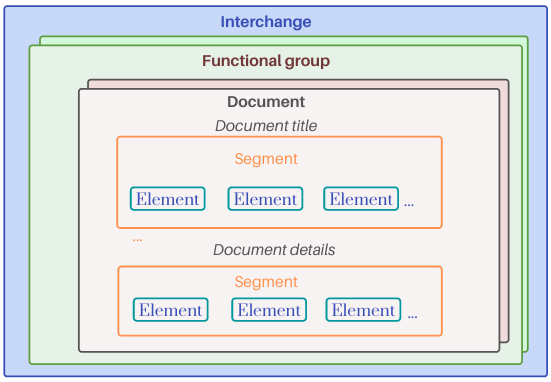
Understanding the Basics of  EDI ANSI ASC X12

This article describes the EDI ANSI ASC X12 standard (American National Standards Institute Accredited Standards Committee X12).

This overview provides full information on the EDI ANSI X12 standards, including general terms (Interchange, functional group, document), description of the main components of an EDI document (segments, elements), and how an EDI document is structured.

What is Meant by EDI?

EDI Electronic Data Interchange is the process of electronically exchanging business documents (in a pre-defined format) between trading partners.

The EDI ANSI ASC X12 standard has different versions (related to development standards) – 4010, 5010, 5020

In EDI X12, each document has a three-digit number identifier. For example, an Invoice is 810, an Inventory Inquiry/Advice is 846,  an Advance Ship Notice  is 856, etc. more detailed list of EDI X12 documents with its identifier you can find here: Complete List of EDI X12 Codes


ANSI (American National Standards Institute) is a non-profit organization that oversees the development of voluntary consensus standards for products, services, processes, systems, and personnel in the United States. EDI is handled by the Accredited Standards Committee X12 (ASC X12), it develops and maintains the X12 Electronic Data Interchange (EDI).

EDIFACT (Electronic Data Interchange for Administration, Commerce, and Transport.) EDIFACT standard is used mainly in Europe.


EDI Terminologies:

Interchange (or Envelope)

An interchange envelope is a structured data set to deliver electronic transactions to a receiving party. Interchange can include a package of groups of documents, but may also contain only one group with one document.

The Interchange structure

EDI document structure

Interchange begins with the ISA segment and ends with the IEA segment (ISA / IEA Envelope).

EDI X12 – Functional Group

A functional group is a group of one or more similar transaction sets. The beginning of the functional group is determined by the GS segment and the end by the GE segment.

How Does an EDI Document Look (Example)

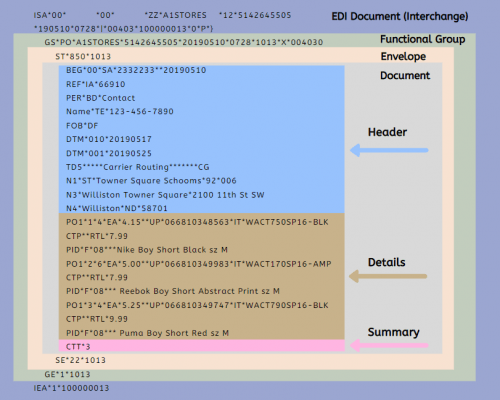
ISA*00*          *00*          *ZZ*A1STORES    *12*5142645505     *190510*0728*|*00403*100000013*0*P*}

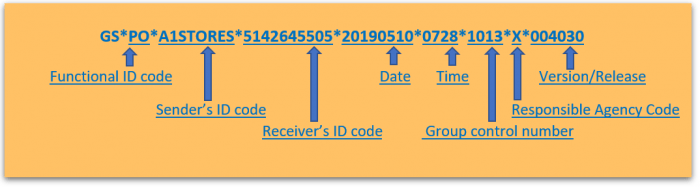
GS*PO*A1STORES*5142645505*20190510*0728*1013*X*004030

ST*850*1013

BEG*00*SA*2332233**20190510

REF*IA*66910

PER*BD*Contact Name*TE*123-456-7890

FOB*DF

DTM*010*20190517

DTM*001*20190525

TD5*****Carrier Routing*******CG

N1*ST*Towner Square Schooms*92*006

N3*Williston Towner Square*2100 11th St SW

N4*Williston*ND*58701

PO1*1*4*EA*4.15**UP*066810348563*IT*WACT750SP16-BLK

CTP**RTL*7.99

PID*F*08***Nike Boy Short Black sz M

PO1*2*6*EA*5.00**UP*066810349983*IT*WACT170SP16-AMP

CTP**RTL*7.99

PID*F*08*** Reebok Boy Short Abstract Print sz M

PO1*3*4*EA*5.25**UP*066810349747*IT*WACT790SP16-BLK

CTP**RTL*9.99

PID*F*08*** Puma Boy Short Red sz M

CTT*3

SE*22*1013

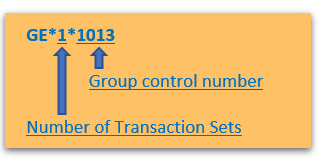
GE*1*1013

IEA*1*100000013

What is an EDI Envelope?

The outer envelope ISA / IEA contains one or more functional Groups (GS/GE Envelopes) that contain the data, each in a separate envelope (ST/SE Envelopes).

The ISA / IEA envelope contains the addresses of the recipient company and the sending company.

The GS / GE envelope contains information about the type of documents contained in it, they are denoted as a two-letter code. (functional ID code). For example, PO for 850 Purchase Order, IN for 810 Invoice. Such an envelope contains only documents of the same type. GS also contains sender’s and receiver’s ID code, functional Group control numbers, date and time.

Functional Group Header (GS)


Functional Group Trailer (GE)

Functional Group Trailer (GE)

EDI Segments

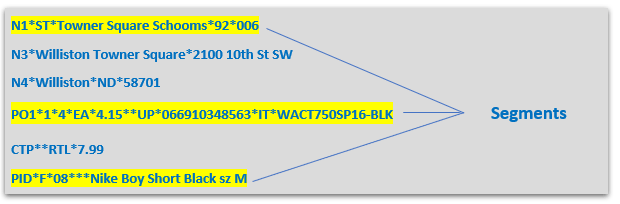
A segment in an EDI document is a group of identical data elements that may occur several times, to provide information about a product (i.e. weight, color, size, etc.)

edi x12 Segment

EDI Segment Optionality

Segments in an EDI X12 document  can be of two types:

M (mandatory) – a mandatory segment. Such a segment contains the basic information of the document. The mandatory segment cannot be omitted from the document. Example of the mandatory segment:

BEG*00*SA*2332233**20190510

This is the (BEG) segment of the header, it contains general document information:

  • Destination (00 – Original)
  • type (SA – Stand-alone Order)
  • order number (2332233)
  • 20190510 – Mai 10, 2019

This segment identifies the document.

O is an optional segment. These are segments containing secondary information. Optional segments may not be present in the EDI document. An example of an optional segment:

PER*BD*Contact Name*TE*123-456-7890

This is a PER segment – Administrative Communications Contact, i.e. “contact information”. This segment contains the following information:

  • BD- Buyer Name or Department
  • TE – Telephone
  • The phone number itself 123-456-7890

EDI Document Structure

The initial segments of each section, is called Header, and the final segment is called Trailer:

  • ISA – Interchange Control Header – this is the segment that defines the sender and recipient.
  • GS – Functional Group Header – this segment defines the type of document(s) that are included in this group.
  • ST – Transaction Set Header – this segment starts the document and is used to assign a control number.
  • SE – Transaction Set Trailer – the segment defines the end of the document.
  • GE – Functional Group Trailer– defines the end of the data that was started by the GS segment.
  • IEA – Interchange Control Trailer – is ending the Interchange segment.

EDI document: Header, Details, and Summary

Each EDI document (i. e. an order, an invoice) is divided into three groups – Header, Details, and Summary.

EDI structure

The Header of the document contains general information such as number, contact information, dates of delivery, addresses, etc.

The details of the EDI document contain information about the ordered product (quantity, price, etc.).

The Summary contains information such as the total cost of the goods, the number of goods, etc.

Using EDI in Business

EDI is used in many industries, but primarily in trading, transport, and logistics.

Retailers such as Costco, Walmart, and others use EDI X12 to exchange electronic documents with their trading partners.

Typically, a retailer and its suppliers exchange the following EDI documents:

  • EDI 850 – Purchase Order (PO)
  • EDI 856 – Advanced Ship Notice/Manifest ASN
  • EDI 810 – Invoice

EDI is the connecting suppliers and retailers and allows business partners to minimize errors, and automate processes.

Free EDI consultation

RELATED POSTS:

What is EDIFACT? | UN / EDIFACT standard overview

Electronic Data Interchange: Key Information You Need to Know

What Are the Differences Between ANSI X12 and UN/EDIFACT

A technical introduction to EDI

August 12, 2019
https://www.edi2xml.com/wp-content/uploads/2019/08/edi2xml-x12-overview.png 350 1024 Tatyana Vandich https://www.edi2xml.com/wp-content/uploads/2024/08/edi2xml.com-EDI2XML-company-logo.png Tatyana Vandich2019-08-12 14:09:572025-04-23 09:09:19EDI ANSI ASC X12 Standards – Technical Overview

What is EDIFACT? | UN / EDIFACT Standard Overview

Blog

UN / EDIFACT Standard Overview

What is UN/EDIFACT standard?

United Nations/Electronic Data Interchange for Administration, Commerce and Transport (UN/EDIFACT) is the International EDI standard ISO 9735-1987, developed under the UN

The general standard is adopted by national and sectoral standards bodies to better reflect the needs of each industry.

At least twice a year, the standard is updated globally. The reason of this update is to create a new directory of data and messages, in addition to improving the usability of existing EDIFACT messages.

The UN/EDIFACT standard has been developed for trade and transport management. The concept of “trade” was interpreted in a broad sense (orders, deliveries, insurance, payment of goods, customs formalities). Currently, the use of UN/EDIFACT has expanded to include accounting, customs control, pensions, health care, social insurance, judicial practice, employment, statistics, construction, finance, insurance, manufacturing, tourism, trade, freight, and container transportation.

The UN/EDIFACT standard is developed and supported by two international organizations: United Nations Economic Commission for Europe — UN ECE and the International Organization for Standardization. – ISO

EDIFACT Subsets

EDIFACT is predominant outside of North America. Due to its complexity, branch-specific subsets of EDIFACT have been developed. These subsets are subsets of EDIFACT and contain only the functions relevant to specific user groups, such as:

  • EANCOM consumer goods industry
  • ODETTE European automotive industry.
  • CEFIC chemical industry
  • EDICON standard used in the construction industry
  • RINET – the Insurance industry
  • HL7 standard is used in healthcare.
  • IATA air transportation
  • SWIFT banking
  • UIC 912 rail transport
  • EDIFICE electronics, software, and telecommunications industry. EDIFICE has played an important role in the implementation of RosettaNet standards in Europe. EDIFICE became the European RosettaNet User Group.

EDIFACT Messages: Structure and Syntax of the Standard

EDIFACT is a special, structured data language that describes all types of commercial activities, based on information logistics. Using elements and segments of standard informational messages, you can create a description of any document, generate its electronic form and transmit it in open telecommunication networks without fear of interception of private commercial information.

UN / EDIFACT Structure

Any document in UN / EDIFACT standard has a hierarchical structure. The entire electronic document is called a message. A message consists of data groups combined in some way, for example, a data group describing customs payments, a group of data describing the attributes of documents, etc. In turn, the group consists of typical data segments that describe document attributes in more details. The standard provides about 200 different types of segments from which messages are composed. The segments themselves also have a hierarchical structure and consist of data elements that can be simple (data field) and composite (usually 2-3 data fields).

The following is the structure of an EDIFACT transmission:

  • Service String Advice
  • Interchange Header
  • Functional Group Header
  • Message Header
  • User Data Segments
  • Message Trailer
  • Functional Group Trailer
  • Interchange Trailer

EDI Guide

Example EDIFACT

UNA:+.? ‘
UNB+UNOB:2+ XYZCORPORATION:ZZ+COMPANYX:ZZ+190521:1604+906019++++++1′
UNH+1+ORDERS:D:96A:UN’
BGM+220+4500265532+9′
DTM+137:20190425:102′
RFF+CT:CompanyX’
NAD+BY+2010::91′
CTA+OC+2010:G. Smith ‘
COM+044-1010605:TE’
COM+044-1010662:FX’
NAD+SE+0000906300::92′
CTA+SC+0000906300′
NAD+DP+++Consulting Inc St+ Begun + Laval++8003+CA’
CUX+2:CHF:9′
LIN+10++TH300010:BP’
PIA+1+000000000000500807:SA’
IMD+A++::92:HIR0010H12′
QTY+22:1:PCE’
DTM+2:20190423:102′
LIN+20++T0004671:BP’
PIA+1+000000000000501516:SA’
IMD+A++::92:CCGT060204NS LT1110S’
QTY+22:10:PCE’
DTM+2:20190423:102′
LIN+30++T2001171:BP’
PIA+1+000000000000501328:SA’
IMD+A++::92:LTPNG-R20-3.0′
QTY+22:1:PCE’
DTM+2:20190423:102′
UNS+S’
UNT+28+1′
UNZ+1+906019′

Principles and Technologies of Application of the UN / EDIFACT Standard

The EDIFACT Standard has three types of reference books:

The first type is directories that are based on the ISO standards. It includes directories of currency codes, country codes, units of measurement, modes of transport, delivery conditions, and some others.

The second type of directories, are the ones included in the EDIFACT standard., by default

The third type of directories is developed by different organizations responsible for issuing codes. Here is the list of organizations 3055 Code list responsible agency code

There are four main components in EDIFACT that are subject to standardization, when preparing documents for exchange between business partners.

  • data elements
  • standard data segments
  • standard messages
  • syntax rules

Data elements are the smallest, non-dividing parts of information, for example, the document date, the name of the destination, the amount of tax. More than 600 data elements used in international trade and transport have been published in a special UNTDID directory.

EDIFACT Standard Principles

The UN / EDIFACT standard is based on the following principal:

1. Standardize data at the segment and element level. Any document intended for electronic exchange should consist of typical segments. This means that the segment of the supplier’s address or delivery address is described by the same elements, regardless of what kind of document it is – invoice, order, declaration, etc. The practice has shown that to describe almost any document, it is enough to have no more than 100 typical segments. The fields inside the segments are standardized the same way, and the ratio of fields to segments is one-to-many, i.e. the same field can be included in different segments.

2. Record the fields used in segments as code. It is assumed that the partners exchanging electronic documents have identical code tables (directories). The composition and content of the reference books is standardized at three levels – international, national and corporate.

3. The independence of standards from the language of communication. The peculiarity of the UN / EDIFACT standards is that more than 90% of the electronic message consists of different codes. Another feature is that only the content of the document is transmitted, without a form. The document form is restored when the message is decoded.


Book a FREE one-on-one EDIFACT consultation session with our in-house experts.


EDIFACT Messages

The EDIFACT standard which provides a set of standard messages has greatly simplified international and multi-branch trade and the exchange of electronic business documents between countries and various industries.

The standard message UN / EDIFACT has a six-letter identifier that reflects the short name of the message, for example:

  • CUSDEC – CUStoms DEClaration
  • CUSRES –CUStoms RESponse

Some of the standard EDIFACT messages with X12 equivalent are listed in the table below.

X12 Transaction Number EDIFACT Transaction ID Transaction name
850 ORDERS Purchase order message
855 ORDRSP Purchase Order Acknowledgment
846 INVRPT Inventory Inquiry/Advice
856 DESADV Shipment Notification ASN
810 INVOIC Invoice
997 CONTRL Functional acknowledgment
860 ORDCHG Purchase Order Change – Buyer Initiated

Due to the independence from the language and the transfer of only the contents of the document, the restoration of the form of the document takes place on the receiving side in accordance with the rules that apply in this place.

Benefits of EDIFACT

EDIFACT benifits

EDIFACT has a competitive advantage that positively affects the efficiency of a company and improves business processes. The main advantages of EDIFACT:

Profitability – reducing the volume of papers to be processed leads to a decrease in personnel and administrative costs.

Efficiency – large volumes of commercial data can be transferred from one computer to another within minutes

Accuracy – the use of EDIFACT eliminates human errors that are inevitable when manually keying in data.

EDIFACT is a key component of a just-in-time strategy that ensures prompt customer satisfaction. EDIFACT in conjunction with the Internet allows real-time electronic transactions and accelerates the interaction between trading partners.

Easy EDIFACT Integration

Our company has many years of proven experience in implementing EDI and EDIFACT projects. We offer our clients Fully managed EDI Service and HTTP Web Service.

Contact us today for a free consultation and we will help you find the best option for your business.

EDIFACT Free consultation

July 26, 2019
https://www.edi2xml.com/wp-content/uploads/2019/07/Featured-Image-EDIFACT.png 350 1024 Tatyana Vandich https://www.edi2xml.com/wp-content/uploads/2024/08/edi2xml.com-EDI2XML-company-logo.png Tatyana Vandich2019-07-26 12:23:592025-02-04 11:57:51What is EDIFACT? | UN / EDIFACT Standard Overview

EDI Integration of B2B E-commerce for Small Companies

Blog

Navigating B2B E-Commerce: A Small Company’s Guide to Seamless EDI Integration

More and more companies in the B2B vertical, are expanding their business to the web and doing more of what is called today B2B e-commerce. Those companies of all sizes are realizing the importance of automation and the value of exchanging EDI with their business partners, suppliers, and buyers.

For small companies in the B2B market, trading with large retailers such as Costco, Wal-Mart, Target or Home Depot is a great opportunity for their business. However, many small and medium-sized enterprises are missing out on this chance due to the fear of large retailers’ requirement to comply with their EDI rules.

In most cases, EDI is the de-facto protocol to communicate and exchange business documents between big-box retailers and their suppliers.

EDI is used to automate the process of exchanging business documents between trading partners. Essentially, it is the solution for B2B and is quite popular amongst retail, manufacturing, transportation, health care, and other industries. By automating documents exchange process, companies can benefit in many areas.

To those who do not know much about Electronic Data Interchange (EDI), it sounds quite complicated at first. There are different EDI standards, requirements, EDI formats, communication protocols such as AS2, sFTP, VAN, different documents / transactions (i.e. 850, 810, 846 856, etc.) which differ depending on company and industry.

EDI Integration projects seem daunting and expensive, which can explain why many smaller businesses still do not communicate with their trading partners through EDI. However, the key is to find the right EDI provider who can offer solutions and services that are simple, affordable and quick to onboard.

An EDI provider like EDI2XML offers 2 options for EDI integration projects:

  • EDI as a Service, also known as EDI outsourcing or fully managed EDI service
  • EDI2XML web services, REST API to convert X12 to XML and vice versa, known as self-service API.

Fully Managed EDI

This option is a “turn-key solution” where our team at EDI2XML, takes care of all the project: setup, configuration, testing, certification with your EDI partners …

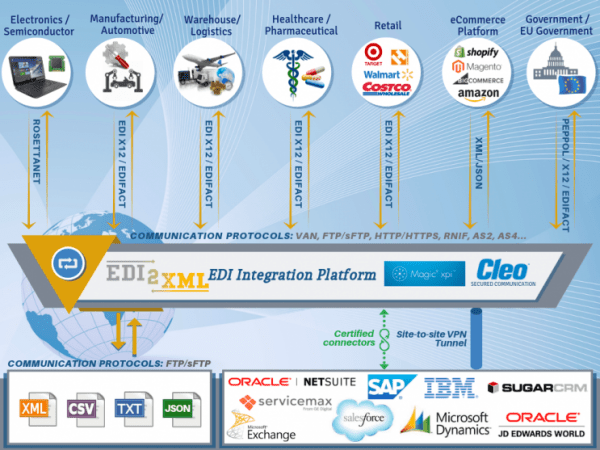
Our monthly pricing packages are dynamic, they go up and down based on the volume and you are not locked in in any tier. Following is a diagram illustrating the flow of information with our EDI as a service offering.

EDI integration platform

By using our EDI Web Service, you can enhance efficiency, reduce errors, and improve collaboration with your trading partners.

EDI2XML Web Services

This option is meant for companies who got their own technical resources to work with REST API (call and consume HTTP Rest Web services); In such a scenario EDI2XML web services is the way to go for the following reasons:

  • Self-service solution,
  • Low cost,
  • Quick entry: you can be up and running in less than an hour, and it is proven; we provide everything to your developers to get started, a java client with its source code and instructions on how to work with it.
  • We offer the xml schemas (xsd) of the XML format our API expects, and all that you need to do is to format your data according to that format and you will be up and running.
  • We offer 15 days free trial, without any commitment.

Advantages of Using EDI

B2B edi Integration

Integrating Electronic Data Interchange (EDI) into B2B e-commerce can bring significant benefits to small companies. EDI allows for the automated exchange of business documents and data between trading partners, streamlining communication, reducing manual effort, and improving efficiency.

Integrating Electronic Data Interchange (EDI) into B2B e-commerce can bring significant benefits to small companies. EDI allows for the automated exchange of business documents and data between trading partners, streamlining communication, reducing manual effort, and improving efficiency.

With EDI, orders, invoices, and other business documents can be sent straight from your ERP management system to the EDI Provider, where they can process this XML file into EDI format and then sent to the Trading Partner.

Orders come in as EDI, get translated into XML format and then get sent straight to your ERP system (if integration was done). In most cases where integration to your ERP solution is done, no human intervention is even needed. This saves so much time and effort and finally allows your employees to get a lot more time on their hands for other important tasks, eliminating so much of the manual data entry.

When it comes to EDI, every case is different. It’s all about finding the right EDI provider that can help you with this process and ensure it’s simple and efficient as can be. Automating B2B processes with EDI can help companies stay profitable by letting them keep up with market changes and trends.

Look at EDI2XML, and book a free consultation with one of our EDI experts!

EDI price
July 12, 2019
https://www.edi2xml.com/wp-content/uploads/2019/07/EDI-integration-for-B2B-e-comm.png 350 1024 Tatyana Vandich https://www.edi2xml.com/wp-content/uploads/2024/08/edi2xml.com-EDI2XML-company-logo.png Tatyana Vandich2019-07-12 16:17:052024-04-09 17:12:12EDI Integration of B2B E-commerce for Small Companies

Canada Border Services Agency (CBSA) ACI eManifest

Blog

This post was updated to reflect current trends and information.


Canada Border Services Agency (CBSA) ACI eManifest

Canada Border Services Agency (CBSA) requires all cargo transporters (Highway Carrier, Air Carrier, Marine Carrier, Rail Carrier, Freight Forwarder, Warehouse Operator, and Account Security Holder) to send electronically and in advance commercial information about their shipments in what is called Custom Manifest or Canadian Advance Commercial Information (ACI) eManifest. This measure is necessary to improve the security of international trade and to optimize commercial cross-border processes.

There are two possibilities to transmit electronically pre-arrival information to Canada Border Services Agency (CBSA). Companies may choose between:

  • eManifest Portal or,
  • Electronic Data Interchange

Differences between CBSA Electronic Data Interchange and eManifest Portal

EDI and eManifest Portal have different terminologies, data requirements, and business rules. The differences are mainly because EDI and the eManifest Portal are based on two different technologies and interfaces.

EDI refers to the exchange of information, thus, companies using EDI can get statuses and receive notifications, while eManifest Portal refers to the submission of information only, and refers to Statuses.

Canada Border Services Agency CBSA EDI exchange

Similar to the US Customs and Border Protection (CBP) the Canada Border Services Agency (CBSA) is committed to both the ANSI X12 and UN/EDIFACT Electronic Data Interchange standards.

Communication Methods for Electronic Data Interchange (EDI) to CBSA

There are three options to transmit electronic commerce information to CBSA:

Value Added Network, or Direct Connect (DC) to the CBSA

Some VANs have an interconnect with the CBSA to allow EDI exchange with the trading partners and shipping companies; However, Direct Connect (DC) is an alternative that provides a special direct connection to CBSA. All new connections require an initial investment of $ 25,000 ($ 5,000) for customization.

 Customs Internet Gateway (CIG)

CBSA has developed a Customs Internet Gateway (CIG) for transmitting and receiving data over the Internet. Clients must acquire certain encryption and decryption software, as well as develop or acquire protocol software to connect to the CIG. Customers will need to transfer data from the Canadian office, as the certificate is assigned only to the device in Canada.

Third-Party EDI Service Provider

For those companies who are unable or unwilling to transfer data directly to CBSA, there are third-party service providers who are setup and to transmit and exchange data with CBSA in both directions. These organizations offer various EDI solutions, and usually, offer a wide range of EDI services.

Information of Freight/Cargo Manifest for CBSA

The various information must be shown on Freight/Cargo Manifest. (paper form A6A) for example for Marine Carrier:

  • Records the registered name of the vessel
  • Port where the report is made (presented) – Canadian port where the vessel arrived or departed
  • Nationality of ship
  • Name of Master – Self explanatory
  • Port of loading/discharge
  • Final Destination (if on-carriage)
  • Date of sailing from the port of loading
  • Shipper, Consignee information
  • Number of the ocean bill of loading
  • Marks and numbers on each package
  • Number and type of packaging, product description
  • Gross shipping weight of cargo in each category by unit measure.
  • Freight details, charges, etc.

In addition, all carriers and freight forwarders must have a carrier code issued by CBSA.

What Kind of Customs Documents Companies May Exchange via EDI with CBSA?

Depending on your business type and needs, you can submit and request different EDI documents and receive all acknowledgment and reject messages from CBSA:

– Highway carrier – cargo and conveyance documents for highway shipments.

– Air carrier – cargo, conveyance, house bills, and conveyance arrival documents for all air shipments.

– Marine carrier – cargo, conveyance, house bills, bay plan, and conveyance arrival documents for all marine shipments.

– Rail carrier – cargo, conveyance, house bills, and conveyance arrival documents for all rail shipments

– Warehouse operator – can request ACI notices.

– Freight Forwarders – house bill and close notifications for all shipments, all modes of transport

– Account Security Holder – receive notifications based on advanced trading data for all shipments and all modes of transport.

Timeframes for Submitting Custom Manifest to the CBSA

EDI for CBSA

Air carriers – 4 hours

Air carriers transporting cargo to Canada must transmit information on cargo to CBSA at least four hours before arriving in Canada. If the duration of the flight is less than four hours, at the time of departure.

Highway carriers – 1 hour

Highway carriers that ship goods to Canada must transfer information about goods electronically to CBSA prior to arrival. CBSA must receive and verify cargo and transport data at least one hour before the cargo arrives at the border.

Marine carriers – 24 to 96 hours

Depending on the type and origin of the goods marine carriers carrying goods to Canada must submit cargo and conveyance information to CBSA within the prescribed time frame before arrival or before loading.

Rail carriers – 2 hours

CBSA must receive electronically cargo and conveyance information from rail carriers, within a minimum of two-hours before the conveyance arrives at the border.

The Best EDI Service Provider to Exchange EDI

At EDI2XML, we know that our first task is to provide innovative and effective solutions to solve the most difficult EDI task when crossing the border and saving you time and improving efficiency.

Are you need to submit your eManifest to Canada Border Services Agency (CBSA)? We have the solution! Contact us to learn more about ACI eManifest.

Free EDI consultation

RELATED POSTS:

CBP EDI 309 Customs Manifest Transaction

EDI X12 204 Motor Carrier Load Tender – overview

What is Advanced Ship Notice (ASN) 856 transaction set?

July 8, 2019
https://www.edi2xml.com/wp-content/uploads/2019/07/Featured-ACI.png 350 1024 Tatyana Vandich https://www.edi2xml.com/wp-content/uploads/2024/08/edi2xml.com-EDI2XML-company-logo.png Tatyana Vandich2019-07-08 14:54:372022-10-14 09:49:26Canada Border Services Agency (CBSA) ACI eManifest

CBP EDI 309 Customs Manifest Transaction

Blog


CBP EDI 309 Customs Manifest Transaction

EDI 309The EDI 309 Customs Manifest is an important EDI document to be exchanged, when moving goods cross the borders to the United states whether for export or import of goods. The EDI 309 document is issued by the freight company (or carrier), in order to provide US customs with manifest information about cargo arriving or departing, on oceangoing ships, railway trains, trucks, trailers or other types of vehicles.
The 309 Transaction Set contains information about the cargo arrival and the delivery vehicle namely:

  • trip identifier;
  • conveyance details;
  • crew/passenger’s identifier(s);
  • equipment details and shipment details;
  • hazardous materials and their classification codes
  • Contact persons
  • Source, destination of the merchandise, in addition to ports of entry and route.

Without the provision of a Customs Manifest, customs control authorities do not accept goods for customs clearance to go through the US border.

The information specified in the Customs Manifest Transaction Set (309) must match with the goods sent to customs control.

Manifest 309 Sample Message

Here is a sample 309 message sent to the US customs agencies:

ISA*00*    *00*    *02*12AB     *ZZ*RCCECECTPP     *190512*0615*U*00300*000000021*0*T*:~
GS*AQ*12AB*CAIA1A*20190512*0615*19*X*007050~
ST*309*00019001~
M10*12AB*J***2525*******32*00~
P4*0315*20190511***1030~
LX*2~
M11*12ABG0001234*LOCATION**********12AB*************L~
N9*79*ETD**20190511*1030*TD~
N9*NR*00~
N9*CL*G0001234~
N1*SH*GOLD METAL CORP.~
N3*9876 OLD OAKWOOD RD~
N4*OAKWOOD** 30542*US***GA~
PER*IC**TE*770-550-0101~
N1*CN*LICORN INC~
N3*40 BAKERY ST~
N4*DARTMOUTH**A3B 1J9*CA***NS~
M12*54~
R4*J*SC*OAKWOOD**US***GA~
R4*5*CD*0315~
R4*6*CD*0315~
VID*NC**NO NUMBER~
N10*22*Adjustment By Radio Operator*NO MARKS OR NUMBERS****L*121092**SKD~
N10*22*CAR PARTS*SKIDS****L*0**SKD~
SE*22*00019002~
ST*309*00019001~
M10*12AB*J***2525*******32*00~
P4*0315*20190511***1030~
LX*2~
M11*12ABG0001234AA*LOCATION**********12AB*************L~
N9*79*ETD**20190511*1030*TD~
N9*NR*00~
N9*CL*G0001234AA~
N1*SH*MPC PLATING INC~
N3*1859 E 63RD STREET~
N4*CLEVELAND**44103*US***OH~
PER*IC**TE*216-881-7220~
N1*CN*LICORN INC~
N3*40 BAKERY ST~
N4*DARTMOUTH**A3B 1J9*CA***NS~
M12*54~
R4*J*SC*CLEVELAND**US***OH~
R4*5*CD*0315~
R4*6*CD*0315~
VID*NC**NO NUMBER~
N10*8*Adjustment By Radio Operator*NO MARKS OR NUMBERS****L*1670**SKD~
N10*8*CAR PARTS*NO MARKS OR NUMBERS****L*0**SKD~
SE*22*000190002~
GE*3*19~
IEA*1*000000021~

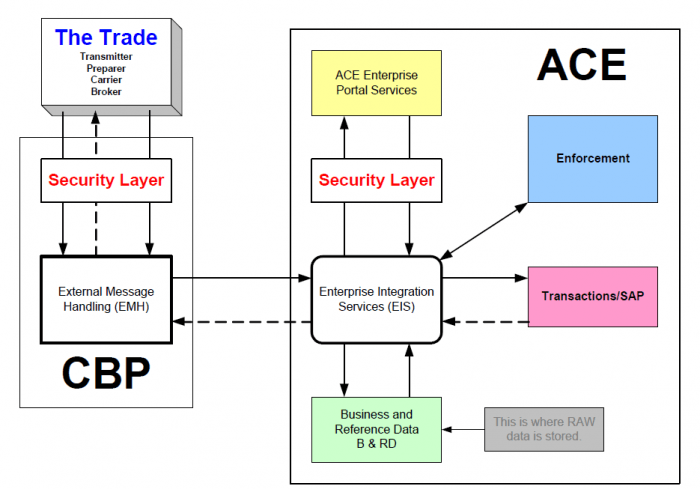
Electronic Manifest message flow

There are four main Trade ‘parties’ that need to be identified:

Carrier – a legal entity that has entered into a legal contract for the transport of goods on conveyance for a shipper.

Preparer – an organization authorized by the carrier to create a manifest in a standard data format, which is transmitted to customs by a transmitter. The preparer can be a broker, port authority, service provider, carrier agent, or another third party.

Transmitter – an organization with which the carrier or manifest prepare has entered into an agreement for the transfer of manifest data to customs. The transmitter can be a service provider, a broker, a port authority, a carrier agent, or another third party.

Broker – A person licensed to prepare documents and fulfill other legal requirements.

Below is a high-level process flow diagram for the EDI process:

Electronic Manifest message flow

US Customs and Border Protection (CBP) Automated Systems

Currently in the USA, there are several systems designed to automate the customs clearance of imported goods. Here are the main ones:

Automated Commercial Environment (ACE)

The Automated Commercial Environment (ACE) is a system through which import and export of goods are reported, and customs authorities determine admissibility. ACE has replaced the Automated Commercial System (ACS).

Automated Business Environment (ACE) is used by US Customs and Border Protection to track, control, and process all goods imported into the United States. Namely, ACE performs the following functions:

  • Collection of all ship manifests and air waybill from arriving and departing vessels.
  • Communication with customs brokers to receive and correct electronic declarations.
  • Calculation and acceptance of customs payments from brokers
  • Communication with government agencies involved in the registration of imports of products
  • Selection of incoming cargo for inspection
  • Build statistical reports
  • Provide importers and customs brokers with information on current payments, quotas for goods and countries, government regulation measures in relation to individual countries
  • History registration of companies and goods for a further selection of goods for inspection.

Automated Broker Interface (ABI) CATAIR

Automated Broker Interface (ABI) is a system by which brokers, importers, carriers, port authorities, and independent service centers send electronic declarations to customs containing information about imported goods, and can also send requests and receive answers about the classification of goods and selected quotas for the goods they are interested in. All records and entry summaries from ABI are transmitted to ACE.

U.S. Customs and Border Protection (CBP) | Importer Security Filing (ISF) via EDI

For EDI there are three formats used see below links:

  • Automated Broker Interface
  • Automated Manifest System CAMIR filing
  • Automated Manifest System X.12 filing

Most of the information on ISF can be found on the website of U.S. Customs and Border Protection in this section

EDIFACT and ANSI X12 standards for US Customs and Border Protection

The US Customs Service supports the use of EDIFACT standards. Thus, Customs Manifest can be submitted to US Customs and Border Protection in either format the EDI ANSI X12 309 or EDIFACT CUSCAR (Customs Cargo message).

In addition, the following documents can be used by carriers, terminal operators, port authorities, or service centers to provide data to and receive information from U.S. Customs and Border Protection (CBP) on cargo arriving in the United States.

EDIFACT messages:

  • CUSDEC (Customs Declaration Message) is a report on the cargo customs declaration. The message may contain several commercial documents used for import, export or transit purposes. The use of communication is supposed between an exporter in one country and an importer in another, also between customs administrations and between customs authorities and other government agencies.
  • CUSRES (Customs Response Message) is a “customs response” message to send data from the customs authority to the sender of the original message.
  • CUSCAR (Customs Cargo message), CUSREP (Customs Conveyance Report Message) are messages for the transfer of cargo manifests to customs authorities.

ANSI X12 interface transaction sets:

  • EDI 309 Customs Manifest Transaction Set
  • EDI 350 Customs Status Information Transaction Set
  • EDI 353 Customs Events Advisory Details Transaction Set
  • EDI 355 U.S. Customs Acceptance/Rejection Transaction Set
  • EDI 358 Customs Consist (Trip) Information Transaction Set
  • EDI 997 Functional Acknowledgment Transaction Set

Advantages of EDI for Export and Import of goods

EDI provides significant advantages in the physical distribution of goods, namely:

  • The average time of customs formalities is significantly reduced.
  • Facilitates the preparation of consignments for shipment.
  • You can easily determine the location of the goods, the vehicle or the container.
  • It is easy to determine the presence of stocks in the warehouses of the distribution network and the manufacturer.
  • Always know the exact time of goods arrival at the destination;
  • Significantly simplified procedures for planning, transportation, and monitoring.

CBP and EDI integration with EDI2XML

Our EDI2XML service, simplifies the process of sending and receiving EDI messages with US Customs and Border Protection. It is designed to handle EDIFACT and X12 transaction sets. Our services were designed to meet the EDI needs and budgets of companies of ALL sizes. Our team focuses on simplifying the processes, and releasing your internal teams from the burden and complexity of EDI integration. Contact us for more information.

EDI Integration Guide

June 10, 2019
https://www.edi2xml.com/wp-content/uploads/2019/06/EDI-309.png 350 1024 Tatyana Vandich https://www.edi2xml.com/wp-content/uploads/2024/08/edi2xml.com-EDI2XML-company-logo.png Tatyana Vandich2019-06-10 14:46:522021-06-08 13:55:05CBP EDI 309 Customs Manifest Transaction

EDI X12 204 Motor Carrier Load Tender – Overview

Blog

This post was updated to reflect current trends and information. 


What Is EDI 204 Motor Carrier Load Tender? A Complete Guide

EDI 204 integration

The EDI X12 204 Motor Carrier Load Tender is an electronic document originating from a paper Motor Carrier Load Tender. The EDI 204 transaction set is used to communicate an offer for a shipment to a full load motor carrier.


The EDI X12 204 Tender is typically sent from a retailer, a manufacturer, or a distribution center to the carrier. However, an EDI 204 transaction could be sent by any company that is interested in the delivery service.

The 204 can be used to create a new shipment or to update, replace, or cancel a shipment.

Generally, companies cannot use an EDI X12 204 Motor Carrier Load Tender to transfer information related to a less-than-truckload bill of lading, manifest, or pick-up notification.

Full Truck Load (FTL) and Its Role in EDI 204 Transactions

Full Truck Load or FTL is a type of transportation that takes up at least one full cargo trailer or does not allow other loads to be carried at the same time.

The carrier is the party responsible for transporting the goods or freight. Generally, the carrier owns and manages transport assets. Alternative names for the carrier are: transportation provider, or 2PL (Second-Party Logistics). 

How EDI 204 Works in Transportation Logistics: Step-by-Step Workflow

The EDI 204 transaction is partnered with additional EDI transactions, the Load Tender Acknowledgement – EDI 990, and the EDI 214 -Shipment Status Message.

1. An EDI 204 is sent to the carrier by the shipper.

204 transaction set contains critical shipment information including load reference identification, window required for shipping, pickup, drop destination, equipment requirements, and, commodities.

2. In return, the transportation provider responds with an EDI 990 – Load Tender Acknowledgement to inform acceptance or rejection of the shipment order.

Unless agreed to beforehand with the shipper, a response with EDI 990 to accept or decline the load tender is required for each EDI 204. The response time for EDI 990 sent within the EDI 204 is specified as: “Must Respond By Date” and “Must Respond By Time”. If the EDI 990 is not received by the indicated time in EDI 204, the load may be reassigned to another carrier.

Often, timing is critical for an EDI 990 document. For example, Amazon.com requires that EDI 990, which accepts the load request, must be generated within 90 minutes after Amazon.com sends the 204 transaction.


Certain companies could make some exclusions, for example, Amazon.com could allow an EDI 214 document as acceptance of the load if the carrier cannot generate an EDI 990, but the carrier has to inform about this, as it will require Amazon’s approval.


3. In case of acceptance, the carrier sends back to the trading partner a Transportation Carrier Shipment Status Message- EDI 214

EDI 214 will provide specific information about the shipment including pro-number, shipment codes, date and time of shipment/delivery.

4. After delivery is complete, the carrier submits to the shipper an EDI 210 transaction set – Motor Carrier Freight Details and Invoice

An EDI 210 transaction is used to provide the full information about the cost of services provided by the transportation provider. This transaction set used both as an invoice for a payment request and as information relating to the freight charges.

5. Once the EDI 210 document is received by the shipper, an EDI 997 Functional Acknowledgement is sent back from the shipper to the carrier to indicating that the 210 Motor Carrier Freight Details and Invoice transaction, was received.

Many companies integrate the EDI 210 transaction set into their ERP, business or accounting software applications. EDI2XML can deliver quick and efficient EDI integration. We provide certified connectors for leading IT systems such as SAP, Salesforce, JD Edwards, Dynamics CRM, Dynamics AX, and more. Contact us for a free consultation and for demo.

The Structure of an Electronic Document

An EDI transaction set contains one or more “envelopes” that identify the sender and recipient of the document.

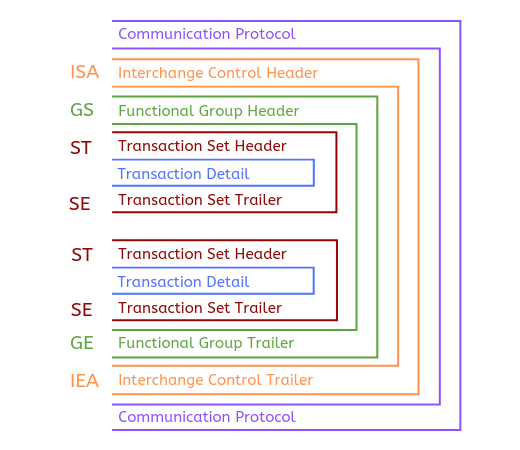
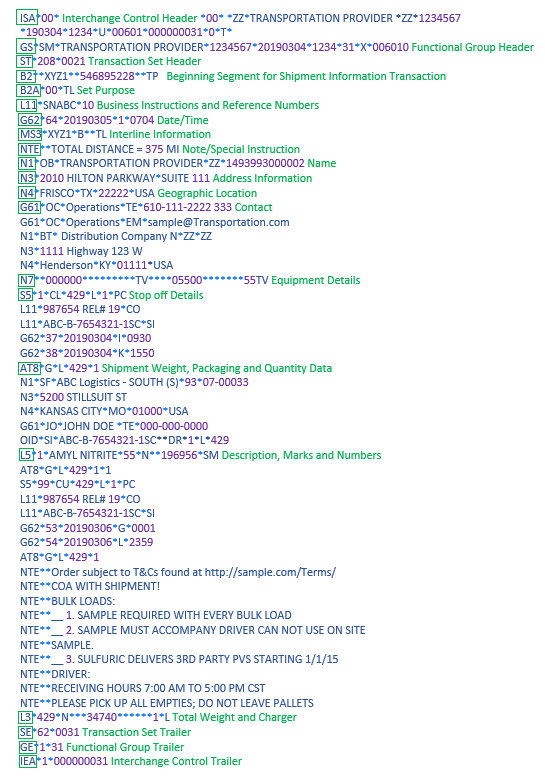
The ISA segment denotes the beginning and the IEA end of the envelope. In an envelope, the transaction sets are formed into one or more functional groups that are limited to the GS (Functional Group Header) and GE (Functional Group Trailer) segments. The figure below shows the format of an EDI transmission with several tender transactions.

The Structure of an Electronic Document

Sample EDI 204 Document: Structure, Segments, and Format

The EDI 204 transaction set is composed of functional groups that describe the content of the deal. The following example details the various data elements and segments of EDI 204

Below is a sample of EDI 204 document.

EDI 204 integration

REST API for EDI 204 Integration: Fast and Flexible Setup

If you need to integrate X12 EDI 204 (Motor Carrier Load Tender) transaction set into your existing flows, by converting the X12 document to XML (and vice versa) you can use our  REST HTTP EDI Web Service (API). It is a cost-effective solution meant for companies who got their own technical resources to work with REST API. It easy and simple to connect, there is no contract, moreover, you can set up a 15 days free trial account, without any commitment from you.

Complete List of EDI Documents (ANSI ASC X12 EDI Transactions Set) in Transportation and Logistics

Following is the list of the most frequently used EDI documents in the Transportation and logistics vertical, typically exchanged between the shipper, the transportation provider, and the consignee:

  • EDI 204 – Motor Carrier Load Tender
  • EDI 210 – Motor Carrier Freight Details and Invoice
  • EDI 211 – Motor Carrier Bill of Lading
  • EDI 212 – Motor Carrier Delivery Trailer Manifest
  • EDI 214 – Transportation Carrier Shipment Status Message
  • EDI 990 – Response to a Load Tender
  • EDI 997 – Functional Acknowledgment
  • EDI 106 – Motor Carrier Rate Proposal
  • EDI 107 – Request for Motor Carrier Rate Proposal
  • EDI 108 – Response to a Motor Carrier Rate Proposal
  • EDI 213 – Motor Carrier Shipment Status Inquiry
  • EDI 215 – Motor Carrier Pick-up Manifest
  • EDI 216 – Motor Carrier Shipment Pick-up Notification
  • EDI 217 – Motor Carrier Loading and Route Guide
  • EDI 218 – Motor Carrier Tariff Information
  • EDI 240 – Motor Carrier Package Status
  • EDI 250 – Purchase Order Shipment Management Document
  • EDI 251 – Pricing Support
  • EDI 601 – US Customs Export Shipment Information
  • EDI 602 – Transportation Services Tender
  • EDI 753 – Request for Routing Instruction
  • EDI 754 – Routing Instructions
  • EDI 920 – Loss or Damage Claim – General Commodities

Benefits of Using EDI in the Transportation Industry

204 document

In recent years, the haulage and transportation industry faced increasing pressure to shorten delivery times, but with EDI, the carriage is significantly easier and faster to manage. It’s no secret that logistics necessitates a lot of documentation, and EDI allows automated flows between all logistics partners. In fact, there are many benefits of EDI for transportation providers:

  • No need for manual processing from the dispatch, operational, and billing systems, therefore saving time and money.
  • Eliminating any costly data entry mistakes
  • Employees have more time to focus on more productive tasks and provide better customer service.
  • Ability to communicate electronically and seamlessly with all parties in the supply chain process.
  • Integrating EDI with transportation management systems or direct carrier systems will help to tender loads

Choosing the Right EDI Solution: Fully Managed vs REST API

Are you looking to exchange an EDI 204 document with one of your business partners? Do you need a cost-effective solution? Or maybe you would like to integrate your EDI 204 transaction set directly into your ERP CRM or TMS system? We provide flexible and reliable EDI solutions to help make your businesses more profitable.

Read this blog to compare key features of our Fully managed EDI service versus our REST HTTP EDI Web Service, to find out which is better for your business.

Please contact us to discuss your EDI challenges with one of our EDI experts.

FAQ – EDI 204 Motor Carrier Load Tender

What is the EDI 204 Motor Carrier Load Tender and what is its purpose?

The EDI 204 Motor Carrier Load Tender is an electronic document used to communicate an offer for a shipment to a full load motor carrier, originating from a paper Motor Carrier Load Tender to facilitate digital communication in transportation logistics.

How does the EDI 204 transaction work in transportation logistics?

The EDI 204 transaction involves the shipper sending shipment details to the carrier, who responds with an acceptance or rejection via EDI 990. If accepted, the carrier provides shipment status through EDI 214, completes the delivery, and submits invoice details with EDI 210, which is acknowledged by an EDI 997.

What is Full Truck Load (FTL) and what role does it play in EDI 204 transactions?

Full Truck Load (FTL) refers to transportation that takes up an entire cargo trailer or does not allow for other loads, and it is a key element in EDI 204 transactions as it involves the carrier responsible for full truck shipments, streamlining communication and logistics.

What are the main benefits of using EDI in the transportation industry?

Using EDI in transportation reduces manual processing and data entry errors, saves time and money, enables seamless electronic communication between logistics partners, and allows integration with transportation management systems, improving overall efficiency.

How can businesses choose the right EDI solution for their needs?

Businesses should decide between fully managed EDI services or REST API integration based on their technical resources and budget, consulting EDI providers for tailored solutions that best fit their operational and integration requirements.

EDI integration guide


May 31, 2019
https://www.edi2xml.com/wp-content/uploads/2019/05/EDI-204.png 350 1024 Tatyana Vandich https://www.edi2xml.com/wp-content/uploads/2024/08/edi2xml.com-EDI2XML-company-logo.png Tatyana Vandich2019-05-31 08:00:182025-08-07 14:23:28EDI X12 204 Motor Carrier Load Tender – Overview
Page 16 of 24«‹1415161718›»
Recent
  • EDi Integration for SMB - Complete Guide
    Electronic Data Interchange (EDI): The Complete Guide for...July 17, 2026 - 4:46 pm
  • EDI Process Guide from EDI EDI Provider
    How EDI Documents Work Together: A Complete Guide to the...July 9, 2026 - 1:22 pm
  • Wayfair EDI & API Integration Guide
    Wayfair EDI & API Integration Guide for SuppliersJune 30, 2026 - 3:24 pm
  • Promotional banner about whether EDI is required for small businesses and a supplier’s guide to retail onboarding. Women at a desk inside a circular cutout image on the right.
    Is EDI Required for Small Businesses? A Supplier’s Guide...June 17, 2026 - 7:02 pm
  • EDI compliance with Loblaw
    How to Meet Loblaw EDI Requirements as a Small BusinessJune 4, 2026 - 2:05 pm
Popular
  • How to Quickly Connect to a Large Retailer's EDI Requirements
    How to Get EDI-Compliant Quickly For A Large RetailerNovember 21, 2025 - 4:29 pm
  • EDI-as-a-services
    EDI Translation Software “On-premises” or “As...January 21, 2014 - 1:28 pm
  • order-automation in e-commerce
    Why Is It Crucial to Automate the E-Commerce Order Fulfillment...May 10, 2022 - 1:58 pm
  • EDI for Logistics and transportation
    EDI Integration for Efficient Transportation ManagementOctober 6, 2023 - 1:33 pm
  • information technology definitions
    Business Tech Terms DefinitionsMay 24, 2018 - 1:32 pm

Browse by tag

Amazon Amazon Integration ANSI ASC x12 ASC X12 EDI B2B EDI integration e-commerce e-commerce business e-commerce integration eCommerce eCommerce integration EDI EDI2XML EDI 850 EDI as a Service EDI Communication EDI converter EDIFACT EDI for supply chain EDI for Third-Party Logistics EDI for transportation EDI implementation EDI Integration EDI Integration Project EDI project EDI Translation EDI Web Service EDI x12 ERP Integration integration platform integration project JDE Magic xpi Magic xpi Integration platform NetSuite online store Salesforce Shopify Shopify eCommerce integration Shopify integration Supply Chain Supply Chain Management Translation Software X12 EDI XML

Subscribe to our Blog

Menu

  • Home
  • About the EDI2XML Company
  • About EDI2XML EDI Converter
  • Blog
  • Book A Free Consultation
  • Privacy Policy EDI2XML Company

Our Services

Fully Managed Integration

E-Commerce Integration

Business Systems Integration

Fully Managed EDI

EDI Web Service 

On Premises EDI 

Managed Cloud Service


Latest Blog Posts

  • EDi Integration for SMB - Complete Guide
    Electronic Data Interchange (EDI): The Complete Guide for Modern BusinessesJuly 17, 2026 - 4:46 pm
  • EDI Process Guide from EDI EDI Provider
    How EDI Documents Work Together: A Complete Guide to the EDI Transaction ProcessJuly 9, 2026 - 1:22 pm
  • Wayfair EDI & API Integration Guide
    Wayfair EDI & API Integration Guide for SuppliersJune 30, 2026 - 3:24 pm

Contact Us

400 Blvd Curé-Labelle, #304 Laval QC H7V 2S7 Canada

Contact EDI2XML Team
Phone: +1 450-681-3009
Website: https://www.edi2xml.com/

© 2000-2026 EDI2XML (by Namtek Consulting Services). All rights reserved.
  • Link to Facebook
  • Link to LinkedIn
  • Link to X
  • Link to Youtube
  • Blog
Scroll to top Scroll to top Scroll to top