EDI2XML
  • About
    • The Company
    • EDI2XML
    • Advantages
    • Partnership with EDI2XML
    • Testimonials
  • Services
    • Enterprise AI
    • Fully Managed Integration
    • Fully Managed EDI Services
    • EDI Web Portal
    • EDI Web Service
    • EDI On Premises
    • Managed Cloud Services
    • Amazon Integration
    • Shopify Integration
    • BigCommerce Integration
    • NetSuite Integration
    • JD Edwards Integration
    • Dynamics 365 Integration
    • SAP B1 Integration
    • Salesforce Integration
    • Industry 4.0 Integration
  • Pricing
    • EDI Managed Services
    • EDI Web Service
    • EDI On-Premises
    • Managed Cloud Services
    • Shopify Integration
    • JD Edwards Integration
    • E-commerce Integration
    • All other Integrations
  • Blog
  • Resources
    • Resource Center
    • List of EDI Codes
    • List of EDIFACT Messages
    • EDI Documents Library
    • Trading Partners
  • Contact us
  • Book a Consultation
  • Click to open the search input field Click to open the search input field Search
  • Menu Menu
  • Link to Facebook
  • Link to LinkedIn
  • Link to X
  • Link to Youtube

Optimize your business processes with Electronic Data Interchange EDI solutions—streamline data exchange, improve accuracy, and enhance efficiency.

Tag Archive for: EDI

How to Solve the Biggest EDI integration Problems With JDE

Blog, Magic xpi


This post was updated to reflect current trends and information.


EDI integration projects have always been time consuming, as it requires an expert team with EDI knowledge and many resources. No matter how small or large the company is, the previous statement falls true for them all. It is the nature of EDI and all the processes involved that makes an EDI integration project complex and problematic for the developers and executives. In this article, I would like to identify a few of the major problems of EDI integration with JDE (JD Edwards) and how to solve them, in order to have a smooth and successful EDI implementation.

About JDE

JD Edwards, also known as JDE, is an Enterprise Resource Planning (ERP) software that Oracle sells and supports. JDE is offered in two different lines (or editions): JD Edwards EnterpriseOne and JD Edwards World. In most cases, JDE software solutions are implemented and deployed in corporate level enterprises. It is less present in small enterprises since most SMEs cannot afford its maintenance costs.

Why EDI integration with JDE is a problem

Read: EDI Integration with JDE Made Easy with EDI2XML

While JDE is a great corporate level ERP solution, offering lots of tools and connectors for data integration (flat file and other format), it does NOT offer out of-the-box an integrated EDI solution or connector that would make EDI integration seamless. It offers the necessary interfaces to define file formats for export and import, but it stops short on completing the loop into a full EDI solution.
For EDI project integration, JDE heavily relies on third-party “EDI translation software” to send or receive EDI files, and to turn the EDI files into a format (flat file for example) that can be easily interpreted and processed by JDE.

Having said that, you can now imagine how complex and time-consuming integration of EDI in JDE is for a company’s IT personnel and developers. The major problems can be summarized as follows:

  1. IT personnel need to have an extensive EDI expertise; for example, a high knowledge of EDI is needed to be able to define the data to be extracted from the incoming EDI file
  2. They need to learn how the “EDI Translation software” works as well as how and when to extract data and transform it into the proper format for JDE
  3. Of course, they need to know how to work with JDE and setup interfaces and connectors. This one is not of a major concern as IT personnel handling JDE are experienced with this platform

Looking to integrate your EDI or eCommerce processes with Oracle JDE enterprise one, look no further, since we have the best integration option where we turn your Oracle JDE system into a modern REST API, that receives https requests and acts accordingly. LEARN MORE>


How to solve the integration problems

In order to solve problems associated with EDI integration with JDE, it comes down to reducing the number of points identified in the previous section to 2 rather than 3, by capitalizing and building on JDE expertise. So how can this be done in order to have an EDI integration project run smoothly, on budget and on time?

Read: Top 3 Challenges to Overcome in Salesforce and EDI Integration Projects

The answer is simple. Companies running JDE can leverage:

  • EDI2XML : the technology to convert EDI to XML (and XML to EDI)
  • Magic xpi: the business integration platform from Magic Software, that is able to orchestrate the entire business process. It is an “Oracle Validated Integration” solution for both JD Edwards EnterpriseOne and JD Edwards World.

Magic xpi comes with a lot of built-in features to support an EDI project implementation such as:

  • Communication components (FTP,sFTP)
  • Ability to execute scheduled tasks based on several triggers
  • Ability to execute tasks based on file scanning triggers

EDI2XML has complementary features to make an EDI integration project within JDE very simple and straightforward:

  • EDI2XML is able to generate FA 997 out-of-the box for incoming EDI documents
  • EDI2XML turns the EDI files received into readable XML format, so no need for extensive EDI expertise

Therefore, EDI integration projects with JDE don’t have to be so dreadful anymore. The marriage of EDI2XML, Magic xpi and our team’s EDI expertise can definitely benefit your company and make EDI projects easy and under budget.

To read more about using EDI with JD Edwards and the third-party applications, Click here

Free consultation ecommerce JDE integration
February 6, 2014/0 Comments
https://www.edi2xml.com/wp-content/uploads/2024/08/edi2xml.com-EDI2XML-company-logo.png 0 0 Pierre Namroud https://www.edi2xml.com/wp-content/uploads/2024/08/edi2xml.com-EDI2XML-company-logo.png Pierre Namroud2014-02-06 11:06:572020-03-26 14:54:33How to Solve the Biggest EDI integration Problems With JDE

EDI Translation Software “On-premises” or “As a Service”

Blog

This post was updated to reflect current trends and information.


As soon as there is a requirement for EDI implementation and integration, company executives, along with their IT personnel, begin by determining how they will comply with their EDI business partner to exchange EDI documents. They will need to acquire EDI translation software, initiate testing, and so on. This however is a complex and lengthy process, which many executives do not look forward to. Difficult questions arise, such as, “Shall we outsource to an EDI service provider? Shall we do it ourselves “on-premises”? Shall we do the translation and conversion of EDI “as a service” using an outside provider?

Which of these options is the best and most affordable way to go?”

Why Do We Need To Translate EDI

As you already know, EDI (Electronic Data Interchange) is the standard to exchange business data between business partners in a very proprietary EDI format. Your business partner would send data such as a P/O (EDI 850), an Inventory Inquiry/Advice (EDI 846), or any other EDI transaction, based on his own terminology of business parameters. It is then up to the “receiving party” to take the sender’s EDI data and information, translate it into a well-understood format, which the receiver’s system will be able to use and process. With EDI2XML, we translate the EDI format of incoming documents to a much simpler, more structured XML format so humans, namely the IT developers, and systems can easily work with.

Translate EDI “On-premises”

Normally, translating incoming EDI documents “on-premises” requires a lot of parameters before launching such a project. As a starting point, a good level of expertise in EDI, EDI communication, and systems integration is required. Integrators should also have a fairly advanced knowledge and expertise in how the company’s software system (ERP, CRM, etc.) works and how to integrate and push data into that system.

While the ability to integrate with the most commonly used ERP and CRM systems does not create any major challenge for experienced IT developers, the main problem is having a high level of proficiency in EDI implementation.


Another major task for the “on-premises” translation is, in most cases, the need for the company to invest on hardware, software licenses, and services (internet, dedicated IP, VAN) to be able to exchange EDI documents with their business partner.


Useful Reading: What are the advantages of using EDI2XML?


Translate EDI “As a Service”

With the emergence of cloud-based IT services and the affordable plans offered by service providers, the ability to translate EDI “as a service” in the “cloud” and deliver the end result to the ultimate destination, has become a more productive approach.

Typically, an EDI service provider offering EDI translation “as a service” will:

– Act as an intermediary layer between the EDI sender and EDI receiver

– Receives the EDI incoming document (i.e. 850, 860, 864,…) on behalf of the “ultimate receiver”

– Extract the data received in EDI format and translate it into a standard format (i.e. XML)

– Transmit the XML data to its ultimate destination for Integration OR integrate directly into the software system of the ultimate receiver.

To send EDI documents out, the EDI service provider will be acting also as an intermediary hub between business partners and do the following:

– Receive data in XML format to be sent to the business partner from the sender through FTP or sFTP

– Translate data received and convert from XML to EDI format

– Transmit that EDI data to the destination

Dive into the world of EDI (Electronic Data Interchange) with our insightful video explanation. Explore the video


Advantages of EDI Translation “As a Service”

With the EDI translation in the cloud offered as a service, companies have a lot of great advantages:

– Quick implementation cycle

– Secured and proven platform to exchange EDI with partners

– No initial investment on hardware or software licenses

– Get up-and-running quickly: your projects are on-time and on-budget

– Use the wealth of expertise your EDI service provider has in EDI

– Let your team of IT professionals focus on integrating XML files into your system rather than learning EDI

– Predictable and static recurring monthly fee for the service

– Possibility to move to “on premises” mode any time

– Ability to integrate to your system directly without your internal IT resources

Discover how you can streamline and simplify your EDI projects with EDI2XML Fully Managed Services

The Best EDI Solution

Most companies usually lean towards the “on-premises” option when they have “internal policies” and security measures in place or are a large enterprise with their own team of IT experts.

The “as a service” option is much more advantageous for small to mid-sized enterprises, where they may have a lower number of exchanged EDI transactions.

As the “as a service” option’s low initial investment and quick deployment are attractive features, every situation is different and should be dealt with on a case-by-case basis with one of our EDI experts prior to making a final decision.


January 21, 2014/6 Comments
https://www.edi2xml.com/wp-content/uploads/2014/01/EDI2XML-edi-as-a-services-vs-on-prem.png 675 1200 Tatyana Vandich https://www.edi2xml.com/wp-content/uploads/2024/08/edi2xml.com-EDI2XML-company-logo.png Tatyana Vandich2014-01-21 13:28:572025-07-03 11:09:27EDI Translation Software “On-premises” or “As a Service”

Convert EDI to XML: The EDI2XML Way

Blog, EDI, EDI2XML

This post was updated to reflect current trends and information.


Why convert EDI to XML?

In this blog post, I will explain why our team decided to convert EDI to XML as well as the advantages and benefits of using this conversion from EDI to XML. On many occasions, EDI consultants, project managers and EDI developers and implementers brought up the following questions:

What are the benefits of having an EDI X12 file format converted to XML?
Why do we need to convert from EDI to XML and not to a database, csv or other file formats directly?

Quick review of EDI2XML

As you might already know, EDI2XML is a technology to convert X12 EDI to XML for incoming EDI documents. At the same time, the engine is intelligent and capable of converting an XML document to an EDI X12 format. This process of turning an X12 EDI file to XML happens because we have taken the time to build pre-defined xml schemas (xsd files) that respond to the business needs of 99.99% of EDI consumers.

EDI developers and integrators are able to use any loop, node or element they need to push to their database for incoming EDI documents. While for outgoing EDI documents in XML format, they are able to pick and choose the node, or EDI element they want to transmit out, fill it in, and send over to EDI2XML engine in order to create the EDI file in X12 format.

Read: Best EDI Processing Options: Service Bureau VS Translation & Integration Solution

Convert EDI to Database or other formats

In the beginning stages of development, we established a list of objectives and a list of possible formats we can use. This was essential, as we needed to evaluate which file format would be best to use as a destination format for incoming EDI documents and outgoing EDI documents.

Objectives to convert EDI

We wanted our EDI conversion technology to respond to the following criteria, as much as possible:

  • Cross-platform: could be triggered on multiple platforms (at least Windows and Linux)
  • Scalable: easily upgradable without the need for heavy work and programming to add a new document or process
  • Portable: could run without any limitation on database, file format or operating system
  • Simple to operate and launch: at the time, we wanted to have the solution as simple as possible so no need to have a very extensive EDI expertise and knowledge in order to work with our EDI conversion tool.

Options for EDI conversion

Below is the list of formats we had put together when we started the R&D, during our brainstorming sessions prior to developing the engine to convert EDI.

  • Convert EDI to Database: this was the first option we had in mind since it was simple and easy to deploy. However, we went into the limitations of portability and compatibility as well as the choice of the Database. What database is the most portable?
  • Convert EDI to CSV: option #2 was also on the table early on, since the csv format is commonly known and heavily used. However, because of the quality of data that anyone might receive within an EDI transmission (carriage return, line feed, special characters…), which might cause the data to be a little less “sanitized”, we opted out of this option and eliminated this format from our list.
  • XML: this was the last option we had on the table. We decided that this would be the best choice due to its flexibility, good structure and ease of use. It responded extremely well to all our technological objectives and more.

Why EDI to XML

Read: Free EDI to XML converter: What’s the catch?

There are many reasons why we selected the XML format as a destination to translate EDI, over other means. Following are some of these reasons:

Simplicity and self-descriptive: data encoded in XML is easy to read and understand by humans (i.e. EDI developers,) and it was becoming easier to process by computers

  • XML format is standardized: XML is a W3C standard and it is endorsed by software industry market leaders
  • XML is structured: No fixed tags; it represents perfectly the hierarchical structure of an EDI file.<
  • Support of multi-lingual and Unicode: very important for exchanging EDI documents at the international level
  • Rapid adoption by programmers and developers: since the use of XML was on the rise, converting EDI to XML was a good decision. Nowadays, it is very rare to find a developer or a consultant who does not work with XML

Having the ability to convert X12 EDI to XML gave us a competitive advantage over other developers involved in EDI projects. We have already implemented this converter in many businesses as well as helped IT consultants leverage EDI2XML in their EDI integration projects.

If you would like to know more about the plans offered for EDI2XML (Free Consultation), or would like to see it in action (live Demo), please do not hesitate to contact us.


Free EDI Demo


January 6, 2014/0 Comments
https://www.edi2xml.com/wp-content/uploads/2024/08/edi2xml.com-EDI2XML-company-logo.png 0 0 Pierre Namroud https://www.edi2xml.com/wp-content/uploads/2024/08/edi2xml.com-EDI2XML-company-logo.png Pierre Namroud2014-01-06 14:30:552020-02-27 10:53:57Convert EDI to XML: The EDI2XML Way

Free EDI to XML converter: What’s the catch?

Blog

This post was updated to reflect current trends and information.


Free EDI to XML converter

Recently, I have received many questions and inquiries about our EDI2XML technology and why it is not offered for “free” like many apps or tools available on the Internet. Just the other day, an acquaintance of mine was contesting that he could find another API for EDI conversion to XML, download it and use it “free of charge”. I decided to write this blog post to share my past experience with free EDI to XML conversion tools and hopefully give you more insight into why a Free EDI to XML converter is NOT a good option for your business.

EDI2XML converter

Being an EDI professional, I realize and implement EDI projects. I have encountered many situations where I needed to accomplish urgent and quick results using any code I could find in the moment; library or API that can be downloaded quickly from the Internet for FREE! Everyone likes free things and I am no exception to this.

Therefore, during one of my first experimental EDI projects, I found a free tool to convert EDI to XML. Once I downloaded the tool, I started to work on how to turn EDI X12 to XML, and vice versa. Below are the observations I noted from that experience:

Limited help

After running the setup program, I hit a few installation errors. I then started the process of identifying these issues, however, I found this process to be very hard, long and tedious since only some of the errors were documented, while most of them were not. In addition, I had to write to the community of the support team. I received a reply two days later, which is a terrible response time if you are in a hurry. We found the issue to be some .NET compatibility between the installer and the operating system I had on my machine.

Features: fell below expectations

After the long installation process, I was finally glad that my Free EDI converter to XML was setup properly. It was now time to experiment its conversion features. Unfortunately, it wasn’t long before I was disappointed over the fact that this converter had many limitations. It was not converting the EDI to XML based on a format I was expecting. It simply put the XML tags before and after each EDI element and grouped each one of the segments into node. This is not any easier than working with raw EDI. In addition, the tool was not able to convert XML back to EDI. Therefore, the simple features it promised were not even working.

“Black Box” solution

I didn’t give up just yet. I then figured that if I can tweak the code through parameters or code modification, it could work. Unfortunately, that was not possible; I had downloaded a “black box” solution where I cannot do any modifications or tweaks to my needs.


Little or no support

At this point, I decided to contact, yet again, the community of support as well as the software developer. Unfortunately, the support offered by the developer was an expensive paying option. In addition, if I wanted to customize the engine, I would need to pay a high fee. Bottom line, I wasn’t left with many choices. I had to live with the community support, which was relatively good, but not like any commercial support where response time is on average 2-4 hours.


Read: Convert EDI to XML: the Winning SaaS Option


Lack of scalability

In the end, we hit a wall with the converter. In order for me to reach my expectations with this converter, I would need to pay for a custom job. Once it is custom made, scalability becomes on us, based on how much money we can invest in developing the tool and make it scalable. At this point, I was hesitant, since I would have gone from a Free EDI to XML converter to a very expensive tool. However, if we stuck with the basic free option, then it is quite clear, the EDI conversion tool would not perform, as we had needed.

Is it a feasible approach?

Having gone through all of the above, we took a step back to reassess what our options were. Should we invest in upgrading a Free EDI to XML converter or should we build it from scratch in-house?

We needed to ask ourselves if it was a feasible approach to have a business depend on a free tool, knowing in advance it is a “black box” without support and scalability.

Our answer was “NO”. This is when we decided to go ahead with our alternative solution.

EDI2XML, an alternative

Having spent much time exploring the possibilities of using a Free EDI to XML converter, we came to the conclusion that we would be better off building it ourselves. Our goal was to make it quick, easy, affordable and simple to deploy for us and for our clients with the capability of translating XML to EDI, and vice versa. Other pre-requisites were to ensure scalability and flexibility of EDI2XML as well as the availability of a great support team for EDI2XML. In the end, we succeeded! Our very own EDI2XML solution is offered  as a Services  and HTTP service  for companies of all sizes.

EDI2XML Web Service is for developers and businesses, interested in building their own EDI (Electronic Data Interchange) integration flows and programs. Normally, these individuals, are capable of interacting with external API and Web Services to translate EDI to XML and XML to EDI, and have the resources and expertise to work with Web Services and HTTP requests in order to achieve their goals. EDI2XML web service, is the premier choice for IT people as a reliable service to accomplish such Integration projects.


December 12, 2013/0 Comments
https://www.edi2xml.com/wp-content/uploads/2013/12/Free-edi-to-xml-converter.png 350 1024 Pierre Namroud https://www.edi2xml.com/wp-content/uploads/2024/08/edi2xml.com-EDI2XML-company-logo.png Pierre Namroud2013-12-12 09:26:462021-05-26 14:19:37Free EDI to XML converter: What’s the catch?

Convert EDI to XML – the Winning SaaS Option

Blog

This post was updated to reflect current trends and information.


Intro: Convert EDI to XML 

In today’s competitive world of eCommerce, mobility, and electronic business transactions, small and mid-sized enterprises are facing more and more challenges with “integration”.  It is not an option anymore for an SME to be able to communicate and exchange business data electronically with its partners; it is a “necessity”.

Major retailers, manufacturers, transport companies, health institutions, and insurance companies in North America are requesting, more than ever before, that their trading partners comply and become capable of exchanging electronically business related data.

Whether it be a purchase order (850), an advance shipping notice (856), an invoice (810) or a payment remittance advise (820), all these EDI documents are becoming essential to the daily activities of an SME.

More often than not, SMEs do not contest the demand to comply with these methods of communication enforced by the “major players”, considering the flexibility and efficiency EDI delivers for both business partners in the long run. However, during the process of beginning an EDI project, a lot of pressure is put on the executives and employees of an SME for the following reasons:

Limited IT resources

In general, SMEs have a small team of IT people that are busy running their day-to-day operations. Adding EDI integration projects on their shoulder complicates their lives. In some smaller businesses, there may not even be an IT technician on staff.

Limited or No EDI experience

Even when an SME has enough IT resources, EDI expertise is very rare and hard to find. IT developers and programmers tend to follow the new trends and work with the most recent technologies of data exchange such as XML or JSON, rather than developing expertise with an old complex protocol like EDI.

Expensive EDI consultants

When a company does not have enough expertise in EDI, normally they call the services of outside consultants and developers for such needs. It is not a secret that experienced EDI consultants are very expensive nowadays.

Time consuming to build

Assuming the internal resources and EDI expertise exist within an SME, it takes a long time to build an EDI solution that integrates seamlessly with their own internal ERP systems. In fact, it takes much longer to stabilise such a solution, in the sense that every department in the company will be going through the same cycle of “trials and errors” as the developers, before one could say that the solution is perfect. It could take months or even years to have a stable and strong EDI software solution.

The above points make an EDI integration project a burden for an SME. It can become a very expensive step that most companies cannot afford especially in this economic time. Even worse, it is an option that they cannot escape from if they want to do business with big players, like Wal-Mart, Amazon, etc.

Read: EDI2XML | SAAS EDI translation software

Therefore, what is an alternative option that could provide the possibility to comply with EDI, without incurring the upfront huge investments on labour, software licences, and hardware architecture? Which option will increase efficiency during and after the implementation stage?

Convert EDI to XML “as a Service”

In the last few years, the model of using services and software under the SaaS model (Software as a Service) where companies and individuals pay a monthly subscription fee for its use has become very popular. Many companies are adopting this model for their IT needs since it has been proven to be secure and reliable.

The same concept of “service” exists with EDI also!


EDI2XML

When an SME subscribes to this service, it means that it selected the shortest possible path to integrate EDI into their system, using the most cost effective manner:

  • No need to install any EDI software or licences on premises (on their servers)
  • No need for expensive EDI consultants
  • No need to hire in-house developers with high level of EDI experience

Any integrator with a decent knowledge in data structures, such XML, and an understanding of the architecture of the company’s system and how to integrate external data within, will be able to accomplish such projects on time and on budget.

Basically, EDI2XML would be used as a hub for converting the data:

  • From EDI to XML in the case for incoming documents
  • From XML to EDI in the case for outgoing documents

With this model in place, all the complexity related to EDI mapping will be eliminated. SMEs will have easier and better control at the application level, using a structured format like XML.

In addition to the above, the EDI2XML team will support the developers in their projects, by providing assistance and help on how to read and interpret the EDI2XML formatted EDI.

Free EDI and System Integration consultation
December 4, 2013/0 Comments
https://www.edi2xml.com/wp-content/uploads/2023/04/N1.jpg 749 1600 Tatyana Vandich https://www.edi2xml.com/wp-content/uploads/2024/08/edi2xml.com-EDI2XML-company-logo.png Tatyana Vandich2013-12-04 10:35:562025-03-12 15:36:02Convert EDI to XML – the Winning SaaS Option

The Advantages of EDI integration projects

Blog

Why use an EDI integration project?

In today’s business world, lots of decision makers are still wondering whether to plunge into EDI integration projects or to hire a couple of new employees to manually enter data received and processed by a third party EDI service bureau.

Which option is much more beneficial for their company and returns the most on their investment?

At a quick glance, hiring data entry clerks might seem appealing for the following reasons:
1) The EDI understanding is still a complex topic to understand by non-technical people;
2) The considerable initial capital investment on integration projects: professional services, EDI consultants, professional services…
3) The ongoing EDI service bureau transactional fees, connectivity fees..
4) The time and effort needed to integrate EDI with their ERP, or Business management software solution, that will be billed by IT consultants, EDI specialists and consultants.

While the above reasons are completely valid, companies stop short from researching about the evolution of the EDI world.

With EDI2XML and its “Software as a Service” model, companies are able to cut over 75% of their EDI integration projects costs and gain efficiency and accuracy within a short amount of time. Just by implementing and using EDI2XML translators, the IT consultant of an SMB, will be able to focus on building the integration between XML data files and the business management software solution in place, since XML is widely used and understood nowadays. EDI2XML is able to generate a readable XML of the EDI file, easily understood by humans and systems. As long as the IT consultant has access to the ERP database structure, he will be able to read the EDI formatted file in XML, and push to the tables, after applying all kinds of business validation. The same applies for outgoing EDI documents. As long as the IT consultant is able to generate an output XML file based on a pre-defined schema, XML2EDI engine will process that file and convert into an EDI file format.

EDI communication protocols are becoming very straightforward today; less complexity and more security. Major retailers and corporations are using AS2 or FTPs secured in order to communicate EDI documents back and forth between business partners. Even better, if a company is not able to handle EDI projects due to lack of budget or expertise, EDI2XML technology is used and empowering erpwizard which is a fully integrated business management software solution offered “as a service” (SAAS) either “on customer premises” or in “the cloud“. Not only is it a fully integrated ERP software solution, but it offers a complete EDI solution.

We have over 15 years in EDI integration in the retail, manufacturing, distribution and healthcare industries. We’ve been very active in Montreal, Canada, where our EDI consultants are experienced at the business level just as much as they are at the technical level.

Read: Free EDI to XML converter: What’s the catch?


Free EDI Demo


September 23, 2013/0 Comments
https://www.edi2xml.com/wp-content/uploads/2024/08/edi2xml.com-EDI2XML-company-logo.png 0 0 Tatyana Vandich https://www.edi2xml.com/wp-content/uploads/2024/08/edi2xml.com-EDI2XML-company-logo.png Tatyana Vandich2013-09-23 12:34:062021-05-26 14:23:57The Advantages of EDI integration projects

EDI2XML | SAAS EDI translation software

Blog, EDI, EDI2XML

EDI (or Electronic data interchange) is the electronic file format used to exchange business transactions between trading partners. ANSI X12 is the most commonly used format of EDI in North America in the retail, manufacturing and healthcare industries.

EDI2XML is a mapping tool, capable of converting EDI files to XML. “Out of the box” EDI2XML translates EDI documents (i.e. 850, 860, 820…) into XML format that is readable by people and systems. It is capable of translating an XML format into an EDI format (i.e. 810,856,..). Basically, EDI2XML is an EDI to XML converter; it is also an XML to EDI converter.

Using EDI2XML helps you:

  • Streamline and simplify EDI projects, and cut EDI mapping software costs by 75 %.
  • Increase your Return on investment on EDI integration projects, by eliminating the need for complex EDI systems, and expensive EDI software that takes weeks and months to setup and configure.
  • Increase efficiency of your developers and EDI integrators, by providing them with a great EDI translation software, without the need of  extensive EDI expertise. “Out of the box”, the edi2xml engine provides an easy to read EDI document in a user friendly XML format which is very simple to integrate into any business software application.

EDI2XML converts EDI to XML. The same engine is intelligent enough to process XML and convert to EDI. Both engines, are bundled together and offered under the SAAS model (software as a service), where you pay per EDI docmeunt, per trading partner and per year. EDI2XML is the EDI translation software as a service that can help you get started with your EDI integration projects at a very low initial capital investment.

Read: Convert EDI to XML: the Winning SaaS Option


Free EDI Demo 


Not interested in EDI integration projects, and looking for a complete Business Management Software Suite, that has a built-in EDI capability? Click here to learn more about our ErpWizard Suite, our premium management software solution!

September 11, 2013/0 Comments
https://www.edi2xml.com/wp-content/uploads/2024/08/edi2xml.com-EDI2XML-company-logo.png 0 0 Pierre Namroud https://www.edi2xml.com/wp-content/uploads/2024/08/edi2xml.com-EDI2XML-company-logo.png Pierre Namroud2013-09-11 09:51:402021-05-26 14:25:23EDI2XML | SAAS EDI translation software

How Much Does an EDI License Subscription Cost?

Blog

This post was updated to reflect current trends and information.


EDI2XML’s Subscription Cost

EDI2XML licensing is affordable since we take the time to listen to our customers’ EDI requirements and price it accordingly. We’ve also ensured that our monthly subscription plans fall within the budgets of companies of all sizes (from small to large). We offer two types of services:

EDI Web Service

Fully Managed EDI Services

EDI Web Service

EDI2XML Web Service is an HTTP EDI Web Service (REST API) that runs over the internet on EDI2XML’s own platform that takes HTTP requests to translate EDI messages into XML, and XML messages (based on EDI2XML’s proprietary format) into EDI.

You can get started quickly and easily with EDI2XML Web Service. It takes less than an hour to place a first call to the Web Service and sees the response.

EDI2XML Web Service Costs

The EDI2XML charges for using EDI HTTP/Web service calls are based on a very simple pricing system. The prize consists of [2] elements:

  1. The monthly mailbox fee is a “fixed” fee for Web Service Mailbox usage on the EDI2XML platform.
  2. During a calendar month, a “variable” fee is assessed based on the volume of data processed through EDI and XML translations.

Request EDI2XML Web Service Price List

Fully Managed EDI Services

With this SaaS option, all conversions of EDI files are done on our end, leaving you with no installation of software or hardware on your premises.

We offer EDI2XML Managed Services, a fully managed EDI service that includes translation and communication services to businesses of all sizes, in a variety of industries. We drop off and pick up all EDI documents to and from your trading partner’s server and send you email alerts when this is done.

Pricing for these options consist of a one-time affordable setup fee (only determined after a consultation call) as well as a monthly subscription fee, based on volume consumption in a given month (inbound and outgoing EDI transactions).

Don’t worry if your business has EDI documents that aren’t in the list of documents; we can always work with new documents.

We invite you to:

– Download the evaluation sheet and fill in the appropriate information

– Once the Excel evaluation sheet is filled in, please feel free to email it to sales@namtek.ca

– Download our EDI2XML Service Pricing Package to see the monthly plans we offer.

Within 24 hours someone will be contacting you for a free consultation to discuss your EDI requirements in more depth.

Get A Free EDI Consultation

Read: Fully managed EDI service VS HTTP Web Service: Which is Better for Your Business ?

August 29, 2013/0 Comments
https://www.edi2xml.com/wp-content/uploads/2024/08/edi2xml.com-EDI2XML-company-logo.png 0 0 Pierre Namroud https://www.edi2xml.com/wp-content/uploads/2024/08/edi2xml.com-EDI2XML-company-logo.png Pierre Namroud2013-08-29 13:20:292024-04-02 15:45:30How Much Does an EDI License Subscription Cost?

How is EDI2XML licensed ?

Blog, EDI, EDI2XML

The licensing scheme of EDI2XML


EDI2XML is licensed in two ways: On Premises or as a Service. Both of these plans consist of converting EDI X12 files to XML format, as well as XML to EDI X12. The licensing scheme is affordable and very simple, allowing users to have unlimited EDI transactions per month per partner.

A license consists of an affordable one-time initial investment fee per partner as well as a recurring fee – maintenance & support fee paid yearly for the ‘on Premises’ option and a monthly subscription fee for the SaaS option.

Please consult our list of features for EDI2XML on premises as well as for EDI2XML as a Service.

We provide an EDI2XML portal for self-service users, where they are able to login and manage their EDI2XML profile at any moment.

EDI2XML was developed to simplify EDI projects and keep them under budget. Start enjoying cost savings and more free time when it comes to your EDI assignments!


Read: How much does a license subscription cost?


Free EDI Demo


*Please note that the EDI2XML “on premises” engine (or executable) runs on your server, on a platform running Microsoft windows operating system and .NET framework.

*VAN fees are NOT included

August 26, 2013/0 Comments
https://www.edi2xml.com/wp-content/uploads/2024/08/edi2xml.com-EDI2XML-company-logo.png 0 0 Pierre Namroud https://www.edi2xml.com/wp-content/uploads/2024/08/edi2xml.com-EDI2XML-company-logo.png Pierre Namroud2013-08-26 07:56:132021-05-26 14:28:04How is EDI2XML licensed ?

How does EDI2XML work ?

Blog, EDI, EDI2XML

How does EDI2XML work?


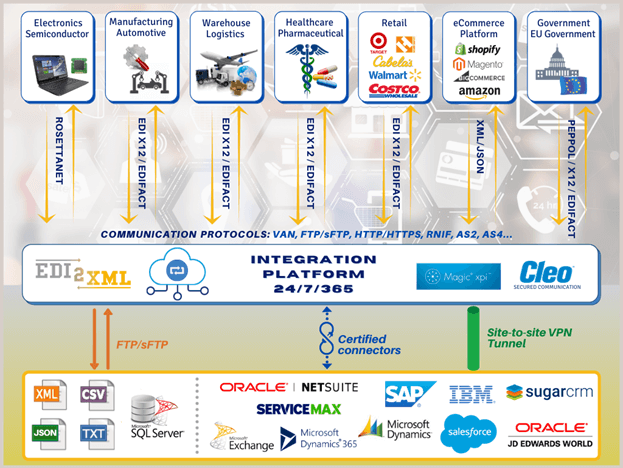
In simple terms, EDI2XML is a converter from EDI X12 format to XML format. The result XML format file is based on a pre-defined schema (xsd); we call it our “EDI2XML format”. Here is a very simple graphical description of the EDI2XML engine “in action”.

EDI Platform

Read: What is EDI ?

EDI2XML can work in two directions by changing a little switch when executing the command:

  • Convert incoming EDI X12 files to XML format
  • Convert outgoing XML format files to EDI format
For incoming EDI files, after a raw X12 EDI file is received using communication software and the EDI2XML engine is triggered, the following actions are executed one after the other:
– EDI2XML will verify the structure of the received file to make sure it is a valid raw EDI X12 format file
– If the raw EDI X12 file is valid in terms of structure, it will run another path to eliminate any information not considered part of EDI; for example, some headings and footers sent through the EDI VAN are automatically cleaned as it does not relate to any business information exchanged with the EDI partner
– The engine is smart enough to split a batch of incoming EDI files inside the same physical file, by envelop (ISA) and by ISA id, as a preparation for the conversion to XML, regardless of its EDI standard and revision
– Once all of the above is completed, the engine would generate for each one of the EDI files an equivalent XML formatted file.
The EDI2XML engine works a little differently when converting raw X12 files from an XML format. Once the engine is triggered with the option to convert XML to EDI X12 format, it will do the following actions:
– For each XML file found, EDI2XML will validate its structure and find out if it is well formed, to make sure it is compliant with edi2xml format and schema
– For each valid XML file, the engine will convert from XML to X12 raw EDI format
*It is important to note that the XML file should comply with a pre-defined xsd (or schema). All necessary information related to EDI versions and standards are sent within the XML file. For incoming and outgoing edi2xml formatted files, only files from the “ licensed” partners are being processed. Any EDI or XML file sent from/to an unlicensed partner will NOT be processed at all.

Read: How is EDI2XML licensed ?


Free EDI Demo


August 22, 2013/0 Comments
https://www.edi2xml.com/wp-content/uploads/2024/08/edi2xml.com-EDI2XML-company-logo.png 0 0 Tatyana Vandich https://www.edi2xml.com/wp-content/uploads/2024/08/edi2xml.com-EDI2XML-company-logo.png Tatyana Vandich2013-08-22 08:37:462024-04-05 09:37:31How does EDI2XML work ?
Page 8 of 9«‹6789›
Recent
  • Is EDI Required for Small Businesses? A Supplier’s Guide...June 17, 2026 - 7:02 pm
  • EDI compliance with Loblaw
    How to Meet Loblaw EDI Requirements as a Small BusinessJune 4, 2026 - 2:05 pm
  • The Infrastructure Behind Modern Commerce: Why EDI Still Matters
    EDI in E-Commerce and Retail: Why Modern Commerce Still...May 1, 2026 - 4:54 pm
  • Key Statistics on AI Use in the Workplace
    The Risks of Using Public AI Tools in Business: Data Privacy,...March 11, 2026 - 5:51 pm
  • Enterprise AI
    How to Securely Access Enterprise AI: GPT, DeepSeek &...February 20, 2026 - 3:09 pm
Popular
  • How to Quickly Connect to a Large Retailer's EDI Requirements
    How to Get EDI-Compliant Quickly For A Large RetailerNovember 21, 2025 - 4:29 pm
  • EDI-as-a-services
    EDI Translation Software “On-premises” or “As...January 21, 2014 - 1:28 pm
  • order-automation in e-commerce
    Why Is It Crucial to Automate the E-Commerce Order Fulfillment...May 10, 2022 - 1:58 pm
  • EDI for Logistics and transportation
    EDI Integration for Efficient Transportation ManagementOctober 6, 2023 - 1:33 pm
  • information technology definitions
    Business Tech Terms DefinitionsMay 24, 2018 - 1:32 pm

Browse by tag

Amazon Amazon Integration ANSI ASC x12 ASC X12 EDI B2B EDI integration e-commerce e-commerce business e-commerce integration eCommerce eCommerce integration EDI EDI2XML EDI 850 EDI as a Service EDI Communication EDI converter EDIFACT EDI for supply chain EDI for Third-Party Logistics EDI for transportation EDI implementation EDI Integration EDI Integration Project EDI project EDI Translation EDI Web Service EDI x12 ERP Integration integration platform integration project JDE Magic xpi Magic xpi Integration platform NetSuite online store Salesforce Shopify Shopify eCommerce integration Shopify integration Supply Chain Supply Chain Management Translation Software X12 EDI XML

Subscribe to our Blog

Menu

  • Home
  • About the EDI2XML Company
  • About EDI2XML EDI Converter
  • Blog
  • Book A Free Consultation
  • Privacy Policy EDI2XML Company

Our Services

Fully Managed Integration

E-Commerce Integration

Business Systems Integration

Fully Managed EDI

EDI Web Service 

On Premises EDI 

Managed Cloud Service


Latest Blog Posts

  • Is EDI Required for Small Businesses? A Supplier’s Guide to Retail OnboardingJune 17, 2026 - 7:02 pm
  • EDI compliance with Loblaw
    How to Meet Loblaw EDI Requirements as a Small BusinessJune 4, 2026 - 2:05 pm
  • The Infrastructure Behind Modern Commerce: Why EDI Still Matters
    EDI in E-Commerce and Retail: Why Modern Commerce Still Depends on EDIMay 1, 2026 - 4:54 pm

Contact Us

400 Blvd Curé-Labelle, #304 Laval QC H7V 2S7 Canada

Contact EDI2XML Team
Phone: +1 450-681-3009
Website: https://www.edi2xml.com/

© 2000-2026 EDI2XML (by Namtek Consulting Services). All rights reserved.
  • Link to Facebook
  • Link to LinkedIn
  • Link to X
  • Link to Youtube
  • Blog
Scroll to top Scroll to top Scroll to top