EDI2XML
  • About
    • The Company
    • EDI2XML
    • Advantages
    • Partnership with EDI2XML
    • Testimonials
  • Services
    • Enterprise AI
    • Fully Managed Integration
    • Fully Managed EDI Services
    • EDI Web Portal
    • EDI Web Service
    • EDI On Premises
    • Managed Cloud Services
    • Amazon Integration
    • Shopify Integration
    • BigCommerce Integration
    • NetSuite Integration
    • JD Edwards Integration
    • Dynamics 365 Integration
    • SAP B1 Integration
    • Salesforce Integration
    • Industry 4.0 Integration
  • Pricing
    • EDI Managed Services
    • EDI Web Service
    • EDI On-Premises
    • Managed Cloud Services
    • Shopify Integration
    • JD Edwards Integration
    • E-commerce Integration
    • All other Integrations
  • Blog
  • Resources
    • Downloadable Guides
    • List of EDI Codes
    • List of EDIFACT Messages
    • EDI Documents Library
    • Trading Partners
    • Customer Case Studies
  • Contact us
  • Book a Consultation
  • Click to open the search input field Click to open the search input field Search
  • Menu Menu
  • Link to Facebook
  • Link to LinkedIn
  • Link to X
  • Link to Youtube

Why Is It Crucial to Automate the E-Commerce Order Fulfillment Process?

Blog

E-commerce businesses have grown exponentially over the past few years, and consumer demand and expectations are rising as well, so now more than ever, it is essential for online businesses to ensure fast and accurate order fulfillment. Thus, providing customers with a seamless order fulfillment experience is a key competency for e-commerce businesses to stay competitive in the market.

Automation plays a very important role in streamlining all your e-commerce fulfillment processes, right from receiving orders from the customers, arranging for the ordered products, and finally delivering them to the customers.

E-commerce Automation: A Way to Save Time and Money

According to Deloitte research, it is better to focus on improvements that can fundamentally change how your business operates rather than making incremental changes.

E-commerce automation is exactly what can change the way your online business functions.

Online stores of all sizes, from small boutiques and startups to huge corporate e-commerce websites from Fortune 500 companies, are using e-commerce automation to improve their e-commerce business.

online store automation
 

No matter what platform your online e-commerce store is running on, Shopify, BigCommerce, Magento, or any other, automation can give you a significant advantage over your competitors and help you gain customer loyalty.

What is the Process of Order Management in E-Commerce?

Companies that can organize their main online business processes effectively win in the highly competitive e-commerce market.

It is already known that the speed of order fulfillment affects the volume of sales. Fast order fulfillment encourages the customer to make repeat purchases from this particular online store.

Order management includes the following processes:

  • Warehousing of goods (can be both in the company’s own warehouse, and in the warehouse of suppliers, or a drop shipper).
  • Receiving and processing orders in the online store, which includes reconciliation with current stocks in the warehouse and confirmation of purchase order.
  • Picking and packing orders.
  • Transfer of the order to transport companies for delivery/ or delivery of orders.
  • Informing the buyer about the current status of the order.
  • Updating inventory stock information.
  • Receiving payment from buyers (B2B or B2C).
  • Work with returns.

The main objective of order management is to provide accurate and fast execution at all stages of the sales cycle, which helps increase customer loyalty, and the profitability of the company, and maintain a positive reputation.

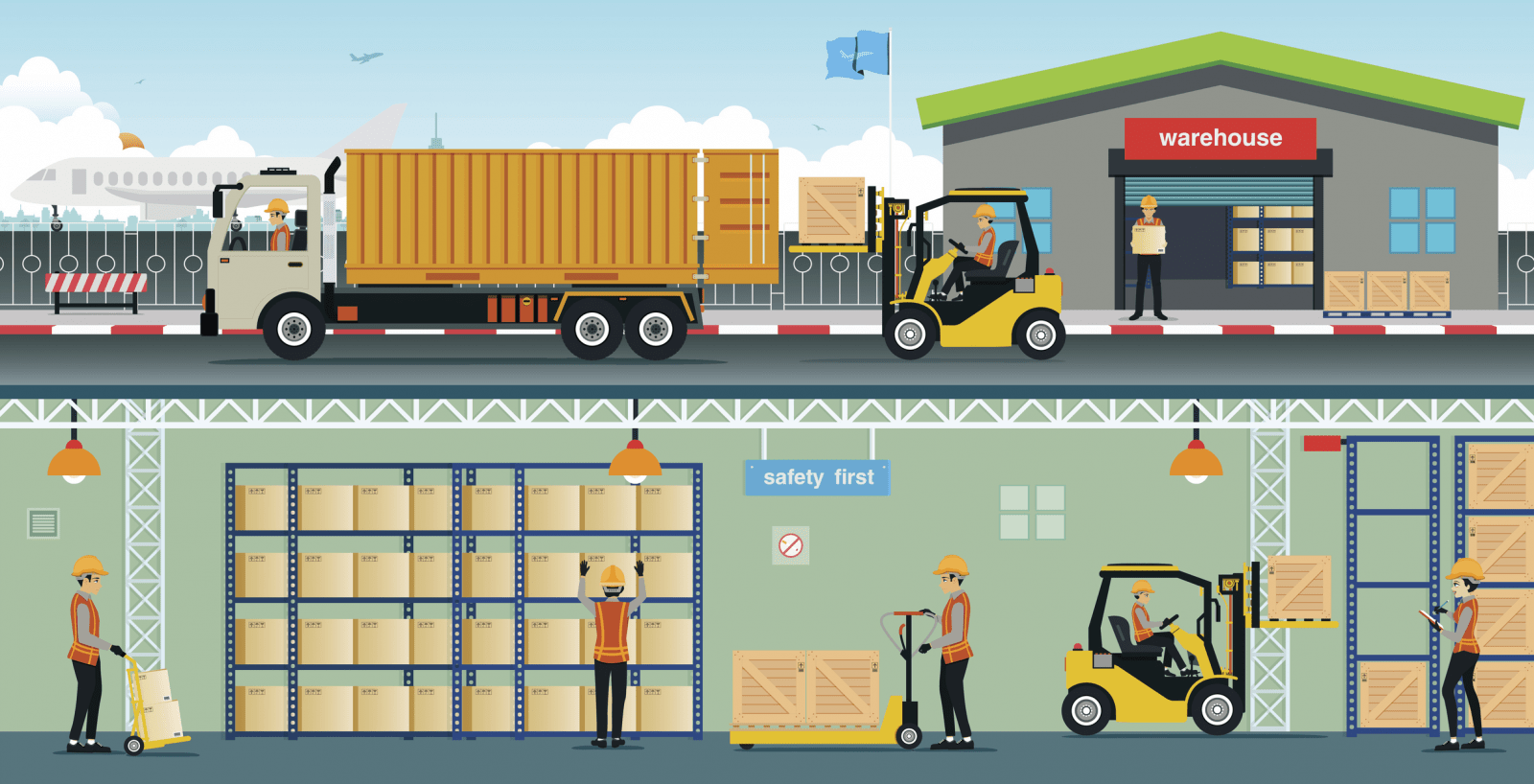
Currently, a large number of online businesses outsource the fulfillment function. However, keep in mind that when order fulfillment is transferred to a 3PL provider as a fulfillment center, the set of specific fulfillment operations may vary. For example, a company can deal with returns on its own.

Fulfillment Meaning in E-Commerce

E-commerce fulfillment is a complex set of business operations that start from the moment the customer places an order in an e-commerce online store until the moment he receives the purchased products or goods.

An e-commerce company can complete the order fulfillment process internally or outsource it to a third-party logistics (3PL) provider.
 

In e-commerce, the term order fulfillment refers to two main types of order fulfillment:

1. Business-to-business (B2B) where orders are shipped to a company or big retailers (Walmart, Costco, Home Depot, etc.) Normally, B2B orders include large quantities of many items.

2. Business-to-Consumer (B2C) where individual shoppers are provided with products directly at home. In general, these are not large orders consisting of an extremely high count of products, although the frequency of purchase can be greater.

E-commerce Order Management: Order Fulfillment Automation

In e-commerce, order management is one of the most important processes, which directly impacts profit. That’s why automating the order fulfillment process is crucial to creating a successful online business.

Order fulfillment automation can be successfully implemented under any of the following scenarios:

  • Delivery of goods from the company’s own warehouse
  • Delivery of goods from the supplier’s warehouse
  • Dropshipping
  • 3PL warehouse
 

Based on our many years of experience in integration and e-commerce automation, we can guarantee that automation of order fulfillment will allow your online business to run much more efficiently.

Benefits of Order Fulfillment Automation

The best solution for optimizing order fulfillment is to automate this process. It gives the online businesses a lot of opportunities:

  • the speed of receiving and processing the order.
  • Manage orders coming from different sales channels (e.g. Shopify store, Amazon seller, etc.)
  • Ensure high speed, transparency, and continuity of processes.
  • Minimize errors that occur during manual order processing.
  • Improve customer service and increase profits.

Order Fulfillment Automation – Behind the Scene


Let’s take a look behind the scenes when we talk about automating the online order fulfillment process.

In fact, e-commerce automation is the integration of an enterprise business system such as CRM or ERP and an e-commerce platform to synchronize the exchange of data in both directions incoming and outgoing.

The goal of e-commerce automation is to configure and deploy a cloud-based, integration process (not a widget) that will be running 24/7/365 to synchronize business data between the e-commerce online store and the ERP /CRM system of the company.

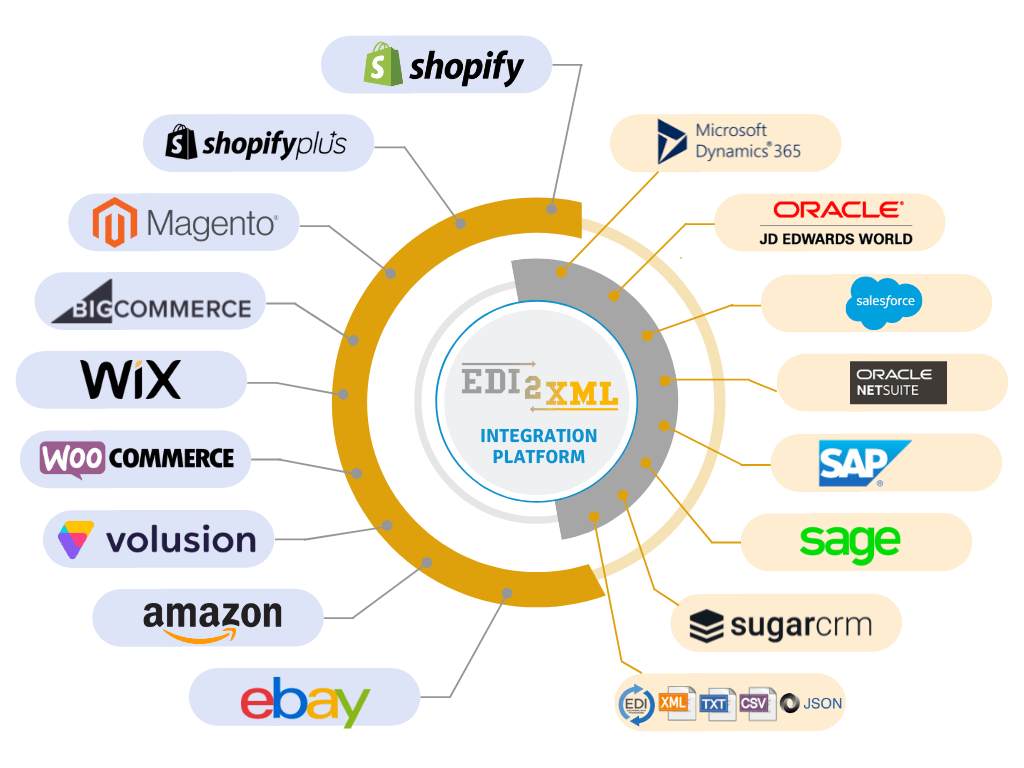
Of course, depending on the specifics of the business, there are a variety of e-commerce integration scenarios. Usually, it is the integration of an online store running on Shopify, BigCommerce, Magneto, and WooCommerce with back-end management systems such as SAP, Microsoft Dynamics, Oracle, NetSuite, Salesforce, HubSpot, and EDI (Electronic Data Interchange).
Automation e-commerce
 

Based on our many years of experience in integrating e-commerce, the following is the most common integration scenario:

Shopify Salesforce Integration

Shopify and Salesforce integration is one of the most common integrations for automating an online store.

This type of integration is very common due to the fact that both platforms are very popular and used by hundreds of thousands of users around the world.

Shopify is one of the most popular platforms for creating and running an e-commerce website. It powers over 800,000 businesses.

Salesforce is a leading cloud-based customer relationship management (CRM) platform for businesses of all sizes.

By integrating Shopify with Salesforce, you can sync all your data and streamline processes across the two platforms.

Shopify Salesforce Integration with EDI2XML

Shopify integration

Let’s take a look at how we, in EDI2XML, automate e-commerce using the example of Shopify and Salesforce integration.

EDI2XML typically acts as an intermediary between a customer’s e-commerce instances and their trading partner (shipper, supplier, 3PL) or customer’s internal business systems.


Shopify Sales Orders Synchronization

Here are the steps of one-way synchronization from Shopify to Salesforce:

1. Our EDI2XML integration flow will start every pre-defined period (recommended every 15 minutes).

2. The integration flow will connect to a Shopify instance to read and extract the list of Orders created since the last call, that are not yet transferred to Salesforce.

3. It will bring those orders with their corresponding details

4. Our EDI2XML flow will than transform these orders into a format ready to be pushed to Salesforce

5. The orders will be submitted to Salesforce.

6. An email will be triggered for a mailing list to advise about a new order(s) sent to the Salesforce

Shopify Order Fulfillment Synchronization

Here are the steps of one-way synchronization from Salesforce to Shopify:

1. Upon fulfilling the order and shipping the goods of an order in Salesforce, the status of the order will change.

2. Our EDI2XML integration flow will start every pre-defined period (recommended every 15 minutes).

3. When it wakes up, it will do the following:

a) Extract the list of Orders that are originating from Salesforce that are not yet fulfilled

b) For each not fulfilled Order, it will check its status in Salesforce

c) If the orders status in Salesforce is now fulfilled, it will extract the fulfillment necessary information and it will update the Shopify instance.

d) It will also send an email to a mailing list, to advise about the fulfillment of the order in question.

Conclusion: Why is It Crucial to Automate the E-Commerce Order Fulfillment Process?

Can automation of online business boost your income? Definitely yes! Automation is designed to reduce the routine, and to get the maximum income from customers, as well as attracting a new target audience.

Contact us for your first free consultation with one of our experts and find out how you can automate your online business.


May 10, 2022/6 Comments
https://www.edi2xml.com/wp-content/uploads/2022/05/e-commerce-order-fulfillment-automation.png 675 1200 Tatyana Vandich https://www.edi2xml.com/wp-content/uploads/2024/08/edi2xml.com-EDI2XML-company-logo.png Tatyana Vandich2022-05-10 13:58:272026-02-13 15:32:42Why Is It Crucial to Automate the E-Commerce Order Fulfillment Process?

Why Automation of Inventory Management is Critical for E-commerce

Blog

The ability to quickly complete all e-commerce processes, from ordering to updating stock levels, is vital for any business that wants to make a profit and provide a high-quality customer experience, all of which cannot be achieved without process automation. Thus, automation of an online store is one of the main pre-requisites for operating a successful online business.
What Processes Should be Automated in an Online E-Commerce Store?

Almost all processes can be partially or completely automated in e-commerce. But first, let’s understand the concepts, what is automation in general?

AUTOMATION is a technology by which a process is carried out quickly, error-free, and with little or no human intervention.

E-COMMERCE AUTOMATION is a process that converts manual, repetitive, and labor-intensive tasks in an online store into automatic execution, that is, it performs tasks automatically instead of manually.

E-commerce automation and system integration is an “automatic program” unlike a human, does not get tired, does not make mistakes; it works efficiently and reliably around the clock.

So, back to the question: when it comes to automating processes in an online store, what should be automated first?

We recommend automating some of the labor-intensive tasks that are currently performed manually in your e-commerce store.

Inventory update is the first and most important stage of automating an online store.


Automation of inventory update will allow you to get accurate information about the availability of goods in stock and will avoid problematic situations with customers.

E-commerce Inventory Management

Adding and updating information about products in an online store is one of the most important and time-consuming tasks when done manually.

E-commerce online stores constantly need to receive information about stock balances from their own warehouses, either from suppliers’ warehouses or from drop shipper partners. There may be more than a dozen such partners. Most often, suppliers send information about stock balances in various formats, so you can receive many files in different formats that you have to work with daily.

Loading information about the availability of goods in the online store each time requires special data preparation. This process takes quite a long time.

That is why, first, it is necessary to automate the process of updating availability statuses in an online store.

Inventory management is an essential part of a successful e-commerce store, so automating product update is necessary and it is considered the initial task to be start with when automating an e-commerce business.

What is Inventory Management?

Inventory management in general is a complex process that includes tracking inventory levels (in the company’s warehouse or at a drop shipper’s partner), orders, sales, deliveries, replenishing stocks, storing, and forecasting inventory.


Inventory management in an e-commerce store, most often refers to the process of updating inventory levels and, accordingly, automatically hide the publication of products that are out of stock, and republish when these products are back in stock.

Why is Inventory Update Important in E-commerce?

Prompt updating of inventory is necessary so that online buyers do not place an order for goods that are out of stock. In such a case, the company has to make a refund or delay delivery, which negatively affects the company’s reputation and leads to financial losses.

By automating your inventory updates, you can save time, increase product visibility, achieve reliable and accurate inventory control, and provide your customers with the best possible service.

Benefits of Automated E-commerce Inventory Management

Improving the Quality of Customer Service

Customer experience largely depends not only on the product itself but primarily on service. Having the right products in your online store affects a positive customer experience. With automated inventory update, you can keep your website up to date.

This is especially important if you sell your products through different channels, such as Shopify, Magento, or BigCommerce online store and a marketplace like Amazon and eBay.

E-commerce Stock Availability

By automating inventory updates, you are practically offering a guarantee that the right product is in stock for your consumer.

The lack of goods in the online store due to wrong inventory management can have a big impact on the business. Missed sales opportunities, especially during the high sales season, can cause you to lose customers and profits.

 

According to research, when a customer doesn’t find the right product from you, 43% of consumers will go to another online store to buy the same product.

The Internet Retailer magazine found that more than 52 % of online shoppers abandon their entire shopping cart when one or more items they ordered are not in stock.

Automation of E-commerce Through Integration with ERP / CRM Systems

E-commerce automation involves the integration and synchronization of data between an e-commerce online store based on one of the platforms such as Shopify, WooCommerce, BigCommerce, Magento, etc., and an enterprise ERP/CRM system (for example, SAP, Oracle JDE, NetSuite, Microsoft Dynamics)…


Most often, companies synchronize e-commerce platforms with the following business systems:

  • Shopify, BigCommerce, Magento to Salesforce
  • Shopify, BigCommerce, Magento to NetSuite
  • Shopify, BigCommerce, Magento to Microsoft Dynamics
  • Shopify, BigCommerce, Magento to Oracle JDE

Automating E-commerce Through a Private or Public Application, Which One to Choose?

In order to automate the process in your e-commerce online store running on any platform Shopify, BigCommerce, WooCommerce, Magento, and so on you have to integrate your site with other third-party systems, thus you can subscribe to a private application, which is usually available on a monthly or yearly subscription basis.

Based on our proven expertise in e-commerce automation the best option is to use a reliable custom-made private application because the more your business grows, the more orders and more products you will have to keep track of. If you don’t have a reliable automated inventory management system, you can lose money and opportunities.

If you’re interested in learning more about using public and private applications in e-commerce integration and automation, check out this expert blog:

Shopify Private or Public app: What’s Best for ERP Integration

Conclusion: Streamline Your E-Commerce Business with EDI2XML

Process automation is a must for any e-commerce business. At some point, managing an e-commerce store becomes simply impossible without automating at least basic processes such as e-commerce inventory management and processing orders.

Would you like to learn more about automating your e-commerce, or see how one of the EDI2XML clients gets inventory data updates in near real-time? Contact us to schedule a call or demo with one of our integration experts.


Supporting Links:

Free, informative guides on e-commerce integration and EDI Communication

Fully Managed E-commerce Integration Service Pricing Plans

The Key Factor That Influences e-Commerce Website’s Revenue

May 3, 2022/2 Comments
https://www.edi2xml.com/wp-content/uploads/2022/05/ecommerce-inventory-management-automation-1.png 675 1200 Tatyana Vandich https://www.edi2xml.com/wp-content/uploads/2024/08/edi2xml.com-EDI2XML-company-logo.png Tatyana Vandich2022-05-03 14:36:102026-02-13 16:37:00Why Automation of Inventory Management is Critical for E-commerce

The Top 4 EDI Documents for Freight Transportation Companies

Blog

We recently published a blog post on EDI (Electronic Data Interchange) for Specific Industries, where we took a quick look at various industries and their use of EDI.

In this article, we will take a closer look at the use of EDI in transport logistics and especially in motor carrier freight transportation companies. In this article, we will review a list of the most commonly used EDI documents in the transportation industry. We will examine what each EDI document is used for and what benefits EDI provides to transportation and shipping companies and their clients.

EDI for Transportation and Logistics Management

Transport logistics is accompanied by a constant “paperwork” associated with the movement of goods. Many participants are involved in this process such as manufacturers of goods, warehouses, carriers, retailers, etc.

For efficient logistics, it is necessary to automate communication between all participants of the logistics process: carriers, shippers, consignees, freight customers, and a freight broker.  The use of EDI for automatic data exchange is the most effective technological solution to overcome such a challenge.

Advantages of Using Electronic Data Interchange (EDI) in Transportation

EDI has changed the way business partners interact and optimized the business processes of the supply chain. Using EDI, companies can effectively manage document flow at all stages of working with business partners: from ordering and receiving at the warehouse to reconciliation and returns. You can send orders, invoices, and other documents without paperwork and efforts duplication.

EDI for transportation Industry
 
  • Transport optimization. EDI helps to optimize and consolidate shipments from different customers.
  • Prompt document exchange. EDI allows you to instantly exchange important shipping documents with your business partners, saving both parties time and resources.
  • Labor Cost optimization. EDI allows you to automate daily routine operations related to entering data into ERP, CRM, TMS, WMS, or accounting systems, processing, sending, and archiving documents. Thus, by automating the processing of documents using EDI, there is no need to manually verify documents, enter data, and perform other repetitive actions that take a lot of time.
  • Seamless integration of EDI with other business systems within a company.
  • Synchronization of data exchange between EDI and business systems improves all stages of the supply chain in a transport company and eliminates the inefficient use of resources.

The Most Commonly used EDI Documents in the Transportation Industry

Let’s look at the most used EDI document in more detail.

EDI 204 Transaction Set: Motor Carrier Load Tender

What is a 204 Tender?

The EDI X12 204 Motor Carrier Load Tender, is an electronic document sent by the shipper (a manufacturer, a retailer, or a distribution center or wholesalers) to the freight carrier company to present an offer for an FTL shipment.

The term FTL Full Truck Load describes a mode of transportation that consists of at least one complete cargo trailer or does not allow other loads to be transported simultaneously.

Key Information of EDI 204 Motor Carrier Load Tender

EDI 204 Motor Carrier Load Tender contains important shipment information including:

  • Product description, including weight, size, and quantity.
  • The size of the required trailer as well as other requirements for equipment if necessary to arrange transportation.
  • delivery schedule
  • pickup and drop destination,
  • Information about consignees (delivery address and contact details)
EDI for transportation and Logistics
 

Why Use EDI 204 for Load Tender?

Load tendering is a bidding process where customers offer equal opportunity to transportation companies and carriers to submit their pricing and bid on the transportation of goods, based on pre-defined criteria and parameters. The carriers can accept or reject the shipper’s offer.

Using EDI 204 to tender among transport companies is a common practice. It helps ensure contract compliance and automates payments to carriers. In addition, the use of EDI provides detailed information throughout the entire delivery process from loading to delivering the goods to its final destination.


If you want to know more about EDI X12 204 read this article: EDI X12 204 Motor Carrier Load Tender – overview


EDI 990 Transaction Set: Response to a Load Tender

What is an EDI 990 Response to a Load Tender?

EDI 990 is a response to an EDI 204 Motor Carrier Load Tender sent by transportation companies to a shipper. EDI 990 can be used to accept, accepted with conditions, or reject a load tender (EDI 204).


What is Important to Know About EDI 990

Typically, an EDI 990 is required for each incoming EDI 204 to accept or reject a load request. Therefore, most often these two EDI documents are implemented in the transport company at once.

When working with documents such as the 204 and 990, time is critical. The business partners usually agree on how long after receipt of the EDI 204, the transport company must respond with an EDI 990 before the contract is transferred to another carrier.


Useful reading: EDI for Third-Party Logistics providers (3PL)


EDI 214 Transaction Set: Transportation Carrier Shipment Status Message

What is EDI 214 Transportation Carrier Shipment Status Message?

The transportation company sends an EDI 214 to the shipper to provide information on the delivery status. Typically, an EDI 214 contains information about the status of the shipment, place of delivery, estimated time of arrival, route Information, description of shipment – weight, packaging, and quantity.

Depending on the preliminary agreements of business partners, as well as the specifics of the business, EDI 214 can be generated and transferred to the shipper from once a week to 6 times a day.


Who Uses EDI 214?

Document EDI 214 is widely used in transport logistics and especially in international deliveries.

The largest transport companies, such as FedEx Freight, Old Dominion Freight Line, DHL Supply Chain & Global Forwarding, and much more use the Transportation Carrier Shipment Status Message (EDI 214) to convey the delivery status to the shipper.


To find out more useful information about EDI 214 and learn how to start exchanging EDI 214  in an hour or less, please read this article: EDI for transportation – EDI 214 Transportation Carrier Shipment Status Message


EDI 210 Transaction Set: Motor Carrier Freight Details and Invoice

What is an EDI 210?

EDI 210 is an electronic document sent by the carrier to the shipper to provide detailed information related to the cost of transportation services. This EDI document can be used as an invoice to request payment for motor freight transportation or to provide information about the transportation fees.


What Data Does the EDI X12 210 Transmit?

The EDI 210 contains standard invoice information such as the number and date of the invoice, address of the consignee and the shipper, information about the product (name, quantity, weight, and size), billing information, as well as motor carrier expense details, delivery methods, and route information.


Useful reading: All You Need to Know about EDI 210 – Motor Carrier Freight Details and Invoice


Digital Transformation of the Logistics Business with EDI

Our company helps logistics companies in their digital transformation. Our advanced EDI solutions drive business growth by improving business processes and reducing labor costs for document and data management.

Contact us for a free consultation with one of our EDI experts.

Free EDI Consultation


April 14, 2022/0 Comments
https://www.edi2xml.com/wp-content/uploads/2022/04/EDI2XML-Blog-Post-2022-11.png 675 1200 Tatyana Vandich https://www.edi2xml.com/wp-content/uploads/2024/08/edi2xml.com-EDI2XML-company-logo.png Tatyana Vandich2022-04-14 16:44:132026-02-13 16:36:38The Top 4 EDI Documents for Freight Transportation Companies

All You Need to Know about EDI for Suppliers

Blog

Suppliers can offer a retailer a broad selection of products that can range from 10 to 300 or more different items. Considering that a large retailer (as well as a supplier) can have dozens or even hundreds of different trading partners. Exchanging such a volume of information by fax or e-mail, and manually entering an order, invoice, and other related information into the ERP system becomes completely inefficient.

The need to transfer and enter data manually has been eliminated by EDI technology. EDI saves staff time and greatly improves supply chain management.

NOTE: EDI is the exchange of electronically structured messages in accordance with agreed standards (X12, EDIFACT) between the information systems of trading partners. The message refers to the business documentation which was traditionally exchanged in paper form. Invoice, Purchase Order, Inventory Inquiry/Advice, and so on.

What is a Supplier in Business?

A supplier is a company (manufacturer, vendor, wholesaler, distributor) that provides goods and services to another organization. The supplier is part of the supply chain. Recently, more and more common suppliers are engaged in dropshipping, that is, they deliver goods directly to the buyer’s customers.

EDI for Supplier
 

Benefits of EDI for Trading Partner

EDI integration has many benefits for both the supplier and the buyer and allows you to automate operations related to external data.

Through the use of EDI, companies can:

– ensure the security of commercial data transmission;

– guarantee fast and timely transfer of information;

– increase productivity through fast transmission and processing of information;

– minimize errors that occur during manual data entry, which often lead to additional costs;

– reduce operational costs;

– significantly increase the trade turnover between business partners, increase the profitability and competitiveness of the company in the market.

EDI Order Processing

EDI serves as a “link” between suppliers and buyers. In the retail industry, the retailer defines the format (X12/EDIFACT) and the list of required EDI documents and sets strict rules for exchanging EDI documents with all of its suppliers. Supplier companies that want to work with retailers are required to follow the established rules.

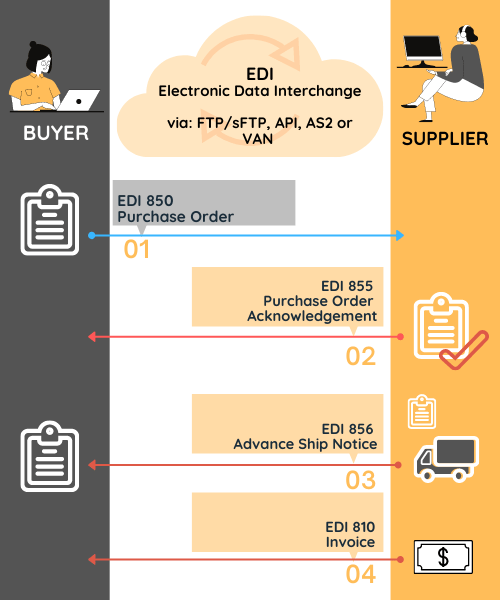
The scheme of EDI interaction on the example of the EDI order processing between a retailer (buyer) and a product supplier is shown in the figure below.

The buyer creates an order for the goods, which is converted into an electronic data interchange (EDI) format (i.e. X12, EDIFACT), encoded, and sent in encrypted format over an FTP, sFTP, AS2, API, or VPN to the supplier.

At the supplier side, this EDI transaction set is decoded and converted into the supplier application format (XML, CSV, TXT, JSON) and the incoming EDI message could be integrated into the ERP/CRM system of the supplier.

EDI order process
 

The simplest and most common business process looks like this:

– Buyer: prepare and send the order (EDI X12 850) to the supplier.

– Supplier: sends to the buyer a Purchase Order Acknowledgment (EDI X12 855) to confirm the supplier’s intention to fulfill the order.

– Supplier: Once the products are shipped, the supplier sends an Advanced Ship Notice (EDI X12 856) to the buyer.

– Supplier: send the buyer an invoice (EDI X12 810) to get paid.

The Most Used EDI Documents by Suppliers

Below is a list of the most used EDI documents between a supplier and a buyer.

Documents in X12 Standard (Common in North America)

  • EDI 810 – Invoice
  • EDI 812 – Credit/Debit Adjustment
  • EDI 832 – Price/Sales Catalog
  • EDI 846 – Inventory Inquiry/Advice
  • EDI 850 – Purchase Order
  • EDI 855 – Purchase Order Acknowledgment
  • EDI 856 – Advanced Ship Notice (ASN) /Manifest

Documents in the EDIFACT Standard Used in Europe

  • ORDERS Purchase order (order for delivery of goods or services
  • ORDRSP Purchase Order Response (order confirmation
  • DESADV Despatch advice (notice of shipment)
  • RECADV Receiving advice (delivery notice)
  • INVOIC Invoice
  • PRICAT Price/sales catalog message (product catalog
  • PROINQ Product inquiry (price list request)
  • COACSU Commercial account summary (the act of review of mutual accounts

In addition to those listed above, trading partners can exchange other types of documents that depend on the industry in which the company operates and its business processes.

You can find the full list of EDI documents with their codes at the links below:


  • Complete List of EDI Transactions Sets & Codes for ANSI ASC X12 Standard
  • Complete List of EDIFACT Messages

EDI 810 Invoice Example

The following example of EDI Transaction Set details X12 810 invoice.

ISA*00*          *00*          *12*5141231234     *12*5034564567     

*181122*1220*U*00501*000000001*0*T*> GS*IN*5141231234*504564567*20181122*122047*1*X*005010

ST*810*0001

BIG*20181122*I-0042537

N1*RI**92*10055500

N1*ST**92*00262

ITD*05*1*****100

DTM*011*20190120

IT1**2*EA*5.45**UP*888077648572

SDQ*EA*92*00682*1*70674*1

IT1**2*EA*5.45**UP*888077650123

SDQ*EA*92*00111*1*11356*1

IT1**3*EA*4.85**UP*888077648954

SDQ*EA*92*00682*1*11356*1*70674*1

IT1**3*EA*5.15**UP*888077649105

SDQ*EA*92*00011*2*00111*1

IT1**1*EA*5.9**UP*888077648867

SDQ*EA*92*00682*1

TDS*5770

CAD*A***FDEG

CTT*5

SE*20*0001

GE*1*1

IEA*1*000000001

Benefits of Using Fully Managed EDI Services for Suppliers

The use of EDI by businesses, in particular by suppliers has many benefits. However, it should be noted that there are many EDI service providers, and they all provide different services at different prices. Therefore, the benefits of using EDI may differ.

We, as  EDI service provider with more than 21 years of experience, offer suppliers to take advantage of our Fully Managed EDI Service, which can bring the following business benefits:

  • Increase productivity and performance of administrative and sales departments.
  • No manual data entry and no lost documents.
  • Reducing administrative costs.
  • Improve the quality of incoming and outgoing business data.
  • Flexible and adaptive pricing plan. Depending on the amount of transmitted information, EDI prices can both increase and decrease monthly. (Request Fully Managed EDI Service Pricing Plans)
  • The ease of use of our EDI service – you don’t need any IT or EDI skills.
  • Support from our EDI and business experts.

USEFUL: If you want to know how to change your EDI provider (or choose a new one), read this article.

EDI Solution for Suppliers

We offer affordable EDI solutions for suppliers.

Web EDI

Fully Managed EDI

On-Premises EDI

These proven EDI solutions improve the efficiency of our customers by making it easy to manage transactions, shipments and improve efficiency across the entire supply chain.

To get more out of EDI, we can integrate your EDI with any ERP, CRM, accounting application, shipping service, eCommerce solution, WMS, and more.

Contact us for an initial free consultation.

Free EDI Consultation
March 17, 2022/0 Comments
https://www.edi2xml.com/wp-content/uploads/2022/03/EDI2XML-Blog.png 675 1200 Tatyana Vandich https://www.edi2xml.com/wp-content/uploads/2024/08/edi2xml.com-EDI2XML-company-logo.png Tatyana Vandich2022-03-17 15:19:552026-02-13 16:57:31All You Need to Know about EDI for Suppliers

Why You Should Migrate Amazon MWS to Amazon Selling API (SP-API)

Blog

Amazon sellers have noticed more than anyone else that data integration provides a high level of sales automation and helps to quickly grow an e-commerce business.

Thus, for the automation data flow and best management inventory and sales operations, Amazon Sellers use a technology called “API” (Application Programming Interface).

An API is a software that establishes a connection between computer programs and allows them to interact with each other. API connects different systems and automatically coordinates data flow and process.

In this article, we will look at the new Amazon Selling Partner API (SP-API) as well as Amazon Marketplace Web Service (Amazon MWS). We’ll take a look at why Amazon sellers should switch from Amazon MWS to SP-API and the best way to do it.

What is Amazon Marketplace Web Service (Amazon MWS)?

The Amazon Marketplace Web Service (Amazon MWS) is an API service built for Amazon sellers of all sizes. MWS APIs has served Amazon merchants for over 10 years by offering programmatic access to important Amazon features.

By integrating their Amazon store data using Amazon MWS, merchants can significantly reduce order processing time and improve sales efficiency.

It helps programmatically exchange the following information:

  • product lists updates;
  • inventory updates;
  • order data;
  • payment information;
  • fulfilment;
  • reports and much more.


What is Selling Partner API (SP-API)

The Selling Partner API (SP-API) is an enhanced version of Amazon MWS. It includes all the features that existed in Amazon MWS, however, all future developments will be SP-API-only.

Thus, SP-API is Amazon’s next-generation REST-based API created on Amazon Marketplace Web Service (MWS) APIs.

REST-based Selling Partner API Key Features

As mentioned above, the SP-API is an improved version of the Amazon MWS and it has many improvements. Below are some of the new SP-API features:

  • modernized REST-based APIs that accept an input and output in JSON format
  • New service endpoints that are now supported in all regions.
  • A sandbox feature for testing with dummy data, using different sandbox endpoints. Thus, it is now possible to test applications by making calls to the sandbox environment.
  • The ability to create an SDK that will help you with LWA token exchange and authentication.
  • Dynamic usage plan that automatically adjusts bid limits for each selling partner based on various metrics.
  • SP-API has a brand new feature: API for Amazon Vendors – which is accessed through the same API control plane using the same authorization mechanisms.
  • RDTs (Restricted Data Tokens) support for a secure way to access a customer’s PII (Personally Identifiable Information)
  • Based on a variety of factors, a dynamic usage plan automatically adjusts rate limits for each selling partner.
  • Support for SP- API is now available in all regions.

Amazon MWS replaced by new Amazon Selling API (SP-API)

Amazon SP-API

According to Amazon, in the future, all new API functionality will be built into the Amazon Selling API, and MWS updates will only be performed to support some business-critical changes.

Thereby, the question that worries many Amazon sellers who are now using MWS: What will happen to the Amazon MWS?


The legacy MWS APIs is going away, so it will be deprecated.

On April 6, 2021, the first stage of Amazon MWS deprecation has already begun for the following section:

  • Orders
  • Reports
  • MFN (Merchant Fulfillment Network)

This applies to all public apps authorized by selling partners in the Marketplace appStore. To prevent interruptions, you must migrate before July 31, 2022.

NOTE: All API calls from public applications using the sections listed above of Amazon MWS will not be successful after July 31, 2022.

The specified sections will continue to be available to private applications after July 31, 2022. They are not required to migrate at this time.

By September 30, 2022, all public applications authorized by Selling Partners that use the MWS Product API must migrate to the SP-API.

By December 31, 2022, all public applications authorized by Selling Partners that use all other sections of the MWS API must be fully migrated to SP-API. This comprises applications using the following MWS API sections:

  • Feeds API
  • Finances API
  • Fulfillment Inbound Shipment API
  • Fulfillment Inventory API
  • Fulfillment Outbound Shipment API
  • Recommendations API
  • Sellers API
  • Subscriptions API
  • Push Notifications Schemas
  •  

NOTE: As long as your application is used only by your business and is not authorized by other Amazon Selling Partners, you are not obliged to migrate to SP-API this year.

So, even though it is currently not a requirement to migrate from Amazon MWS to SP-API, however, Amazon highly recommends planning the migration process as soon as possible.

So either way, at some point you will need to migrate to Amazon Selling API in order to continue using the service. Therefore, it is better to do it now, while you still have enough time, than to migrate at the last moment.

Conclusion: How to migrate Amazon MWS to new Amazon Selling Partner API (SP-API)

Companies running their Amazon Seller account, on different marketplaces, can take advantage of the EDI2XML integration service.

For many years, our company has been successfully helping businesses of all sizes to solve various integration issues on Amazon. Our e-commerce integration experts can handle anything from migration Amazon MWS to SP-API to complex data integration projects with internal accounting, or business systems such as ERP or CRM.

If you need help with Amazon integration, please contact us for your first free consultation. Our integration specialists will be happy to assist you.


March 3, 2022/0 Comments
https://www.edi2xml.com/wp-content/uploads/2022/03/Migrate-Amazon-WMS-to-SP-API.png 675 1200 Tatyana Vandich https://www.edi2xml.com/wp-content/uploads/2024/08/edi2xml.com-EDI2XML-company-logo.png Tatyana Vandich2022-03-03 12:53:362024-11-22 15:47:38Why You Should Migrate Amazon MWS to Amazon Selling API (SP-API)

EDI for Specific Industries

Blog

How Does EDI Facilitate Business Document Exchange?

EDI – Electronic Data Interchange is a well-established protocol of business data exchange, which has become more and more widespread in recent years among businesses of all sizes and various industries.

Through EDI, companies can exchange business documents that were traditionally communicated on paper or by e-mail.

By replacing the exchange of paper or e-mail documents with EDI, companies save time and eliminate manual data processing, which often leads to errors and costly delays in all business processes.

Companies today use EDI to send all kinds of documents, from orders and invoices to motor carrier load tenders, customs manifests, and more.

The exchange of EDI takes place between business partners who exchange goods or services.

All EDI transactions comply with standards developed and maintained by several organizations, including UN/CEFACT, X12, ODETTE, GS1, Peppol, and others.

However, despite uniform standards, each industry can use a certain set of specific EDI transactions. Below, we provide some examples of EDI documents for specific industries.

USEFUL: A complete list of documents that can be exchanged via EDI

EDI for Transportation and Logistics Industries

The Transportation industry actively uses EDI and, in addition to standard transactions, this industry use sets of specific EDI documents.


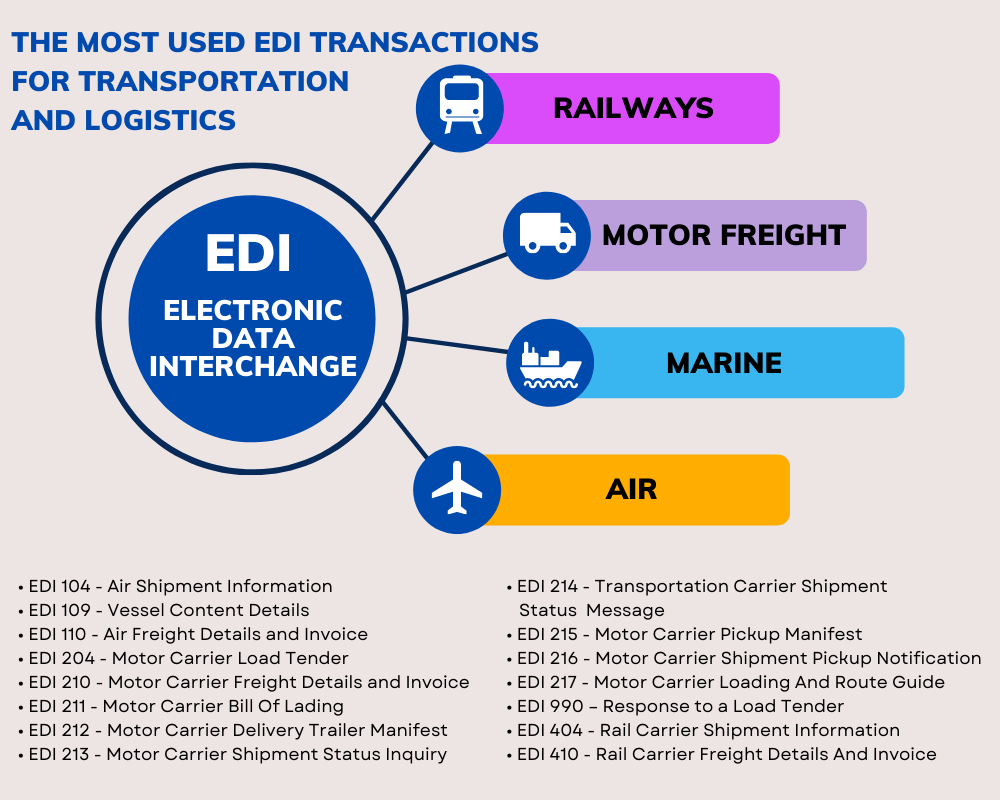
The transport industry includes a huge variety of different types of transportation. It includes marine, air, rail, and motor freight. Accordingly, the EDI transactions used for example, in rail transportation will differ from those used by motor freight.

The Most Used EDI Transactions for Transportation and Logistics

  • EDI 104 – Air Shipment Information
  • EDI 109 – Vessel Content Details
  • EDI 110 –  Air Freight Details and Invoice
  • EDI 204 – Motor Carrier Load Tender
  • EDI 210 – Motor Carrier Freight Details and Invoice
  • EDI 211 – Motor Carrier Bill Of Lading
  • EDI 212 – Motor Carrier Delivery Trailer Manifest
  • EDI 213 – Motor Carrier Shipment Status Inquiry
  • EDI 214 – Transportation Carrier Shipment Status Message
  • EDI 215 – Motor Carrier Pickup Manifest
  • EDI 216 – Motor Carrier Shipment Pickup Notification
  • EDI 217 – Motor Carrier Loading And Route Guide
  • EDI 990 – Response to a Load Tender
  • EDI 404 – Rail Carrier Shipment Information
  • EDI 410 – Rail Carrier Freight Details And Invoice

USEFUL: You can find a complete list of EDI transportation codes in our article “EDI Integration for Transportation and Logistics”

EDI for the Supply Chain Industry

The supply chain industry includes many processes such as distribution, inventory, purchasing, production planning, sales, supply chain planning, interaction with trading partners and warehouses.


The use of EDI in the supply chain allows the company to quickly exchange documents electronically with all suppliers, exchange prices and catalogs, track information on shipments and acceptance of goods. EDI allows to make the supply chain as transparent and efficient as possible, receiving up-to-date data on the movement of goods and funds in real-time.

USEFUL: EDI for Third-Party Logistics providers (3PL)

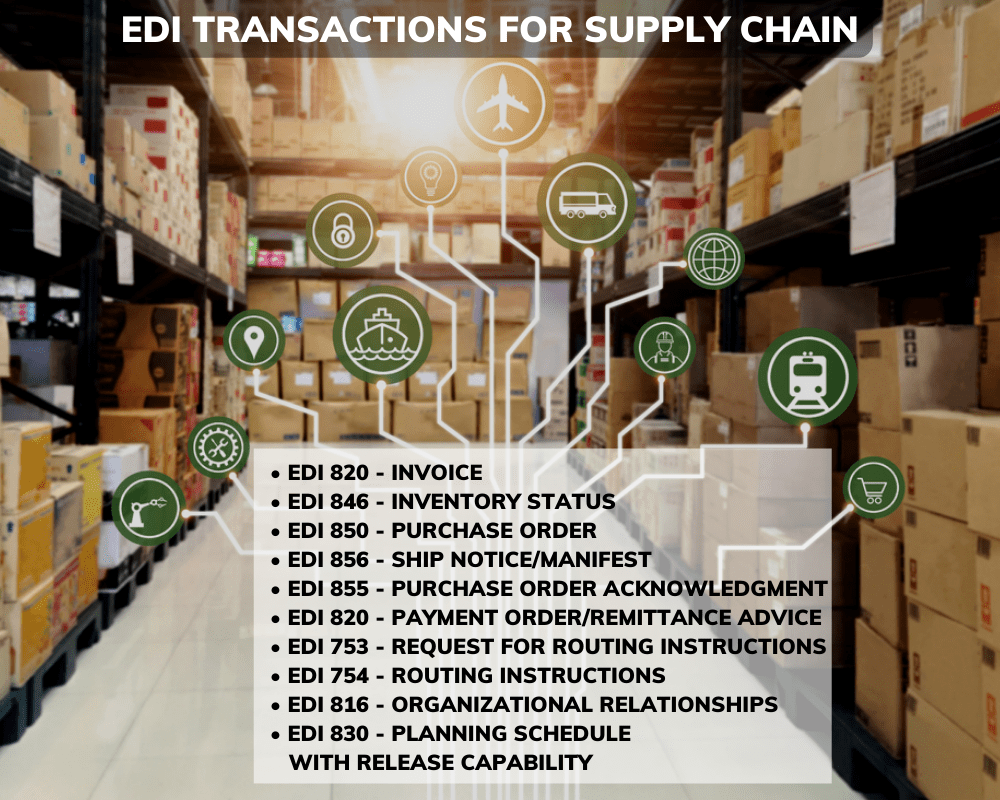
EDI Transactions for Supply Chain

Here are some of the most common EDI documents in the supply chain:

  • EDI 810 – Invoice
  • EDI 846 – Inventory Status
  • EDI 850 – Purchase Order
  • EDI 856 – Ship Notice/Manifest
  • EDI 855 – Purchase Order Acknowledgment
  • EDI 820 – Payment Order/Remittance Advice
  • EDI 753 – Request For Routing Instructions
  • EDI 754 – Routing Instructions
  • EDI 816 – Organizational Relationships
  • EDI 830 – Planning Schedule With Release Capability

To learn more about the use of EDI in the supply chain, read our article: Electronic Data Interchange (EDI) in the Supply Chain It covers the following questions:

– What is EDI?

– Why use EDI in the supply chain?

– How does EDI work?

– Typical EDI workflow process

– Additional and specific types of EDI messages

– Benefits of EDI for Supply Chain Management

– Effective EDI Solution for Supply Chain


EDI for HealthCare and Insurance Industries

EDI is of great value to healthcare organizations because it provides a secure way to electronically exchange sensitive information.

The healthcare industry includes health insurance activities, which are carried out by both commercial and public health organizations.


Most Common EDI Transaction Sets in HealthCare

  • HIPAA / X12 270 – Eligibility, Coverage, or Benefit Inquiry
  • HIPAA / X12 271 – Eligibility, Coverage, or Benefit Response
  • HIPAA / X12 276 – Healthcare Claim Status Request
  • HIPAA / X12 277 – Health Care Claim Status Response
  • HIPAA / X12 837 – Health Care Claim (Professional, Institutional, and Dental)
  • HIPAA / X12 999 – Implementation Acknowledgment
  • EDI 273 – Insurance/Annuity Application Status
  • EDI 274 – Healthcare Provider Information
  • EDI 275 – Patient Information
  • EDI 834 – Benefit Enrollment And Maintenance
  • EDI 835 – Health Care Claim Payment/Advice
  • EDI 852 – Product Activity Data (to exchange information between Manufacturers and Pharmacies)
  • EDI 999 – Implementation Acknowledgment (for Health Care Insurance)

To learn more about EDI in healthcare, please read this article: All you need to know about HIPAA EDI compliance in Healthcare

EDI for the Retail Industry

The Retail Industry is a pioneer in the implementation of EDI. Large retailers are actively automating business processes and introducing new information technology solutions to reduce costs and increase sales.

Thus, the use of EDI in retail is a must. Since large retail companies have a huge number of suppliers, they have to exchange thousands of documents every month. It is simply impossible to go through so much documentation manually.


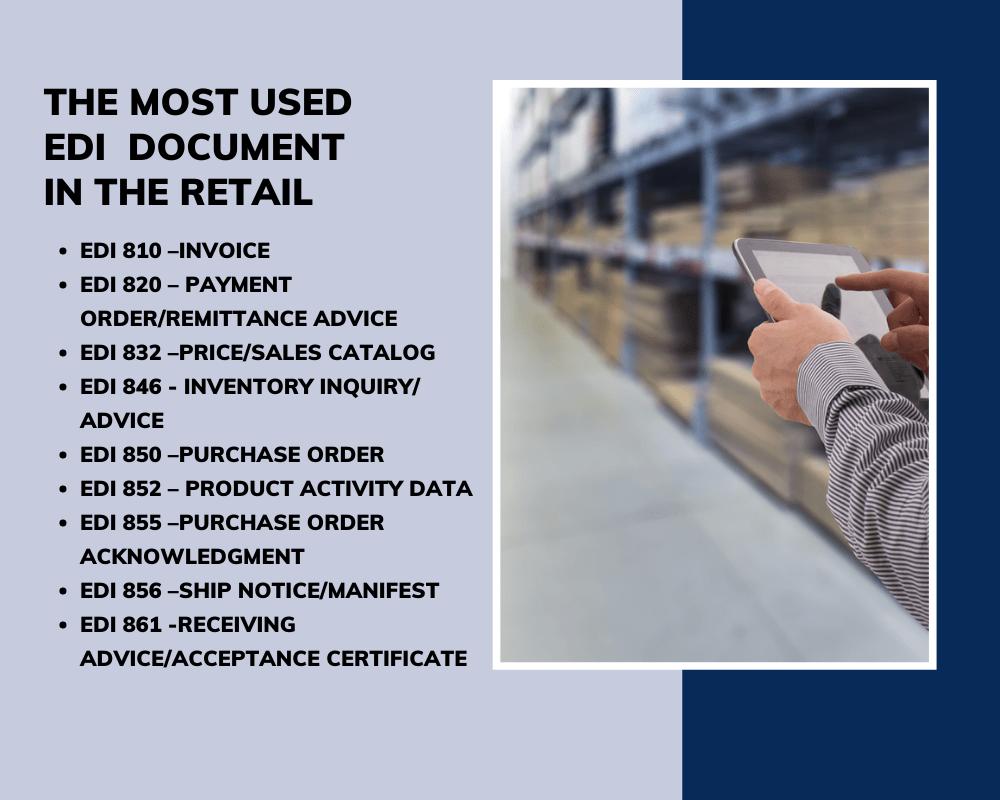
The Most Used EDI Documents in the Retail

  • EDI 810 – Invoice
  • EDI 820 – Payment Order/Remittance Advice
  • EDI 832 – Price/Sales Catalog
  • EDI 846 – Inventory Inquiry/ Advice
  • EDI 850 – Purchase Order
  • EDI 852 – Product Activity Data
  • EDI 855 – Purchase Order Acknowledgment
  • EDI 856 – Ship Notice/Manifest
  • EDI 861 – Receiving Advice/Acceptance Certificate

The use of EDI in retail offers many benefits, ranging from savings in paperwork and avoiding manual data entry errors, to reducing transport and logistics costs and increasing company profits.

If you want to learn more about the use of EDI in retail, please read this article: The Top 6 EDI Documents for Retail Suppliers

Conclusion: EDI for Specific Industries

In this article, we explored the use of electronic data interchange in some industries, however, if you have any questions regarding EDI, you can always contact us for a free initial consultation.

Our more than 21 years of experience in the implementation of EDI for various industries allows us to offer our customers the most profitable and effective EDI solutions.

Free EDI Consultation
February 22, 2022/0 Comments
https://www.edi2xml.com/wp-content/uploads/2022/02/EDI-for-Specific-Industries.png 675 1200 Tatyana Vandich https://www.edi2xml.com/wp-content/uploads/2024/08/edi2xml.com-EDI2XML-company-logo.png Tatyana Vandich2022-02-22 17:15:262026-02-13 15:11:28EDI for Specific Industries

How to Become EDI Compliant in Under 60 Minutes (Yes, Really)

Blog

How to Become EDI Compliant in Under 60 Minutes (Yes, Really)

Being an EDI-compliant company is one of the most effective ways to drive business growth.

There are times when SMEs cannot collaborate with large companies because small companies do not meet their EDI requirements.

In other cases, companies may lose their long-term large business partner because a large company moves to EDI and starts requiring all of its suppliers to exchange documents via EDI.

This can happen to any company.

However, EDI is still the main tool for interacting between business partners and the possibility of cooperation with large companies.

In fact, all major retail companies such as Walmart, Kroger, Home Depot, Costco, Target, and others actively use EDI to communicate with their suppliers, carrier companies, and 3PL partners.

So, what tool can enable you to quickly exchange EDI and become EDI compliant? How to start exchanging EDI documents quickly and cost-effectively, without losing an existing trading partner, and be ready to cooperate with new ones?

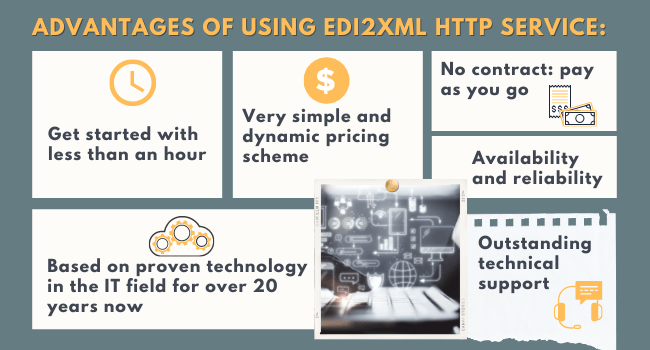
HTTP EDI Web Service (REST API) – an Easy Way to Exchange Business Documents

EDI connectivity is a pain for many SMEs. Often, they simply do not have the necessary resources for an EDI integration and can’t afford the monthly EDI fees that must be paid to the EDI provider. Moreover, often, it is simply not profitable and very expensive, since small companies often have a small volume of transactions per month.

With 25 years of experience as an EDI provider, we have identified this problem that small businesses need to solve every day, and developed a unique, easy-to-use solution for SMEs to become EDI-compatible quickly and easily.

We have built a robust and well-established EDI tool that allows you to connect to EDI in record time and start exchanging EDI documents with your trading partners.

What Is an EDI Web Service and How Does It Work?

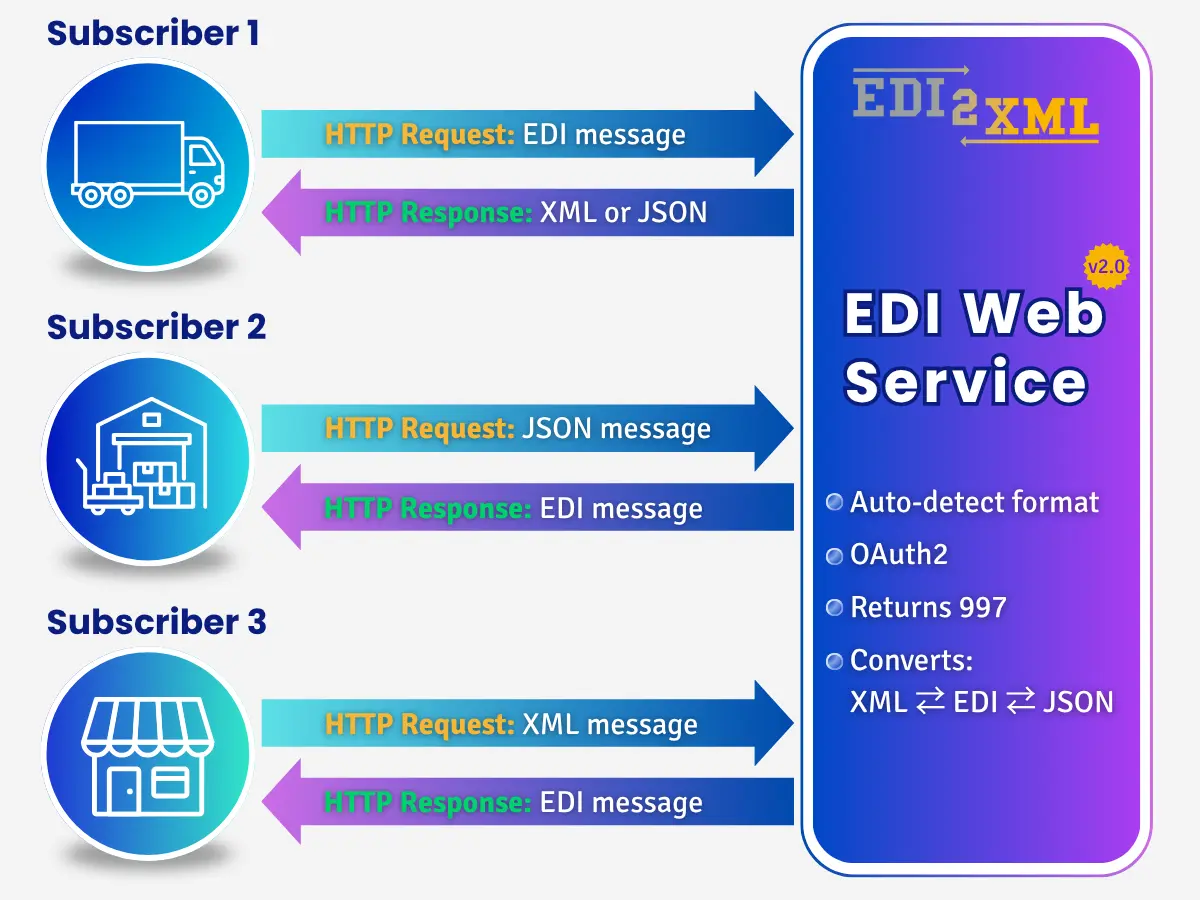
The EDI2XML Web Service is a web-based HTTP service that runs over the Internet and is capable of translating EDI messages to XML and XML messages to EDI (based on EDI2XML’s proprietary xml format or schema). In addition to XML, the EDI2XML Web Service now supports JSON input and output, allowing developers to choose their preferred data format when converting EDI documents.

API-Converter for EDI XML and JSON
 

EDI Web Service is a low-cost alternative solution to on-premises EDI, SaaS EDI, or Managed EDI.

EDI2XML now includes built-in 997 Functional Acknowledgments and secure OAuth2 token-based authentication for production-grade reliability and security.


This EDI solution offers almost the same benefits of a traditional EDI, including speeding up business document transformation, eliminating document loss, and reducing administrative contact with trading partners.

Supported EDI Transactions

In our EDI document library here you can find a list of supported EDI X12, EDIFACT, HIPAA / X12 transactions that you can start transformation, and be ready to exchange in less than an hour. However, we can add any additional EDI transaction set at your request, without any fees.

How Much Does EDI Web Service Cost? Pricing Breakdown

Payment for the use of the EDI web service is very simple and consists of two parts:

  1. The monthly payment for using the web service mailbox.
  2. Payment for the volume of processed data. This fee is variable and depends on the volume of data converted (between EDI and XML) during a calendar month.

GOOD TO KNOW: All new users of our API web service can benefit from our 15-day free trial.


How to Become EDI Compliant in 3 Simple Steps

I will give you a specific formula in 3 easy steps you need to follow to quickly become EDI compliant without spending a lot of time and money.

Step #1: Learn About the EDI2XML REST API for Fast EDI Integration

Learn full information about the HTTP EDI Web Service on the page: What is EDI2XML Web Service? On this page, you will find information about how the EDI web service works and what its benefits are.

Step #2: Get Custom Pricing for EDI2XML API Usage

Fill out the short contact form on this page to receive a document with a detailed pricing scheme. This document will also contain a section with answers to frequently asked questions. We recommend that you also read it as it contains very valuable information.

Step #3: Getting Started with EDI2XML Web Service in Record Time

After filling out the form and submitting it, we will contact you within [24] hours with the information you need (Token and password) in order to start interacting with the Web Service. Each subscription comes with detailed instructions and documentation regarding our Web Service.

FAQ (frequently asked questions) about EDI2XML REST API for Fast EDI Integration

What are the benefits of becoming EDI compliant for my business?

Becoming EDI compliant can significantly enhance your business growth by enabling faster, more efficient document exchange with large partners, securing long-term contracts, and maintaining competitiveness within the industry.

How does the EDI Web Service (REST API) facilitate quick EDI integration for SMEs?

The EDI Web Service (REST API) provides a low-cost, easy-to-use solution that allows small and medium-sized enterprises to connect to EDI systems rapidly, start exchanging documents seamlessly, and avoid expensive traditional EDI setup costs.

What is an EDI Web Service and what functionalities does it support?

An EDI Web Service is a web-based HTTP platform that translates EDI messages to XML and JSON formats over the internet, supporting secure, reliable, and quick exchange of business documents, including support for functional acknowledgments and OAuth2 authentication.

What types of EDI transactions are supported by this service?

The service supports a wide range of EDI transactions including EDI X12, EDIFACT, and HIPAA/X12 transactions, with the ability to add custom transaction sets upon request at no additional cost.

What are the steps to become EDI compliant quickly using the EDI2XML Web Service?

To become EDI compliant swiftly, you should fill out a short form to receive access details, allowing you to start integrating and exchanging documents within hours.

Final Thoughts: Get EDI Compliant in Under an Hour with EDI2XML

You may have already spent weeks looking for the right EDI solution; now you can quickly become EDI compliant without wasting another day of your time.

Our EDI web service is fast and stable, and brings results to our customers.

If you have any questions, please contact us for a free EDI consultation.

 
EDI web service
February 10, 2022/0 Comments
https://www.edi2xml.com/wp-content/uploads/2022/02/EDI2XML-edi-web-service.png 675 1200 Tatyana Vandich https://www.edi2xml.com/wp-content/uploads/2024/08/edi2xml.com-EDI2XML-company-logo.png Tatyana Vandich2022-02-10 15:38:242025-07-31 12:51:42How to Become EDI Compliant in Under 60 Minutes (Yes, Really)

EDI for Manufacturing Companies

Blog

Manufacturing and EDI: Introduction

Electronic Data Interchange (EDI) is an essential part of the modern manufacturing business process. EDI can speed up production, reduce labor and storage costs, and improve all manufacturing business processes.

In this article, we will analyze how and why EDI is used in manufacturing companies and how to get started with electronic data interchange.

Electronic data interchange (EDI) is the process of exchanging documents (such as purchase orders, invoices, shipping notices, etc.) electronically with a business partner.

Why Use EDI in the Manufacturing Industry?

Every day manufacturing companies in all sectors face many challenges. Managing the procurement of raw materials and components for production, maintaining stocks at an optimal level, accelerating the turnover of finished products, quickly receiving payments, all these and many other challenges are being faced daily at most manufacturing enterprises.


That is why automation through the use of EDI helps to successfully manage many processes in production.

Manufacturing B2B Communication

One of the particularities of a manufacturing company is that it can act both as a buyer when buying raw materials, components, and consumables, and as a seller when selling finished products.

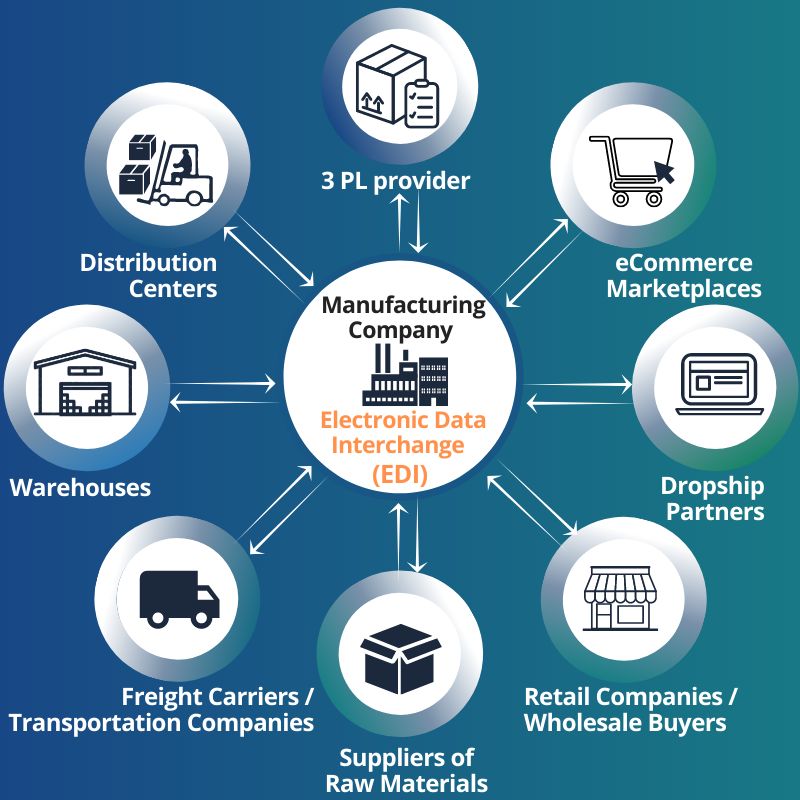
A manufacturing company can have different EDI partners; it can exchange EDI documents with the following business partners:

  • supplier of raw materials and component parts;
  • wholesale buyer;
  • distribution centers;
  • retail companies;
  • eCommerce marketplaces;
  • dropship partners;
  • warehouses / public warehouse;
  • third-party logistics service providers (3 PL providers);
  • freight carriers, transportation companies, and many others.
 

Manufacturing EDI Transactions

A manufacturing company may need to exchange bi-directional EDI transactions with different business partners. The type and number of EDI documents vary according to the business processes within the manufacturing company.

Below is a list of EDI documents for manufacturing; Some of them are used only for manufacturing enterprises, while others are being widely used in any business.

  • EDI 196 – Contractor Cost Data Reporting
  • EDI 830 – Planning Schedule / Material Release
  • EDI 832 – Price/Sales Catalog
  • EDI 844 – Product Transfer Account Adjustment
  • EDI 846 – Inventory Inquiry/Advice
  • EDI 849 Response to Product Transfer Account Adjustment
  • EDI 850 – Purchase Order
  • EDI 852 – Product Activity Data
  • EDI 855 – Purchase Order Acknowledgment
  • EDI 856 – Advance Shipment Notice
  • EDI 860 – Purchase Order Change
  • EDI 861 – Receiving Advice/Acceptance Certificate
  • EDI 862 – Shipping Schedule
  • EDI 866 – Production Sequence
  • EDI 867 – Product Transfer and Resale Report
  • EDI 869 – Order Status Inquiry
  • EDI 870 – Order Status Report
  • EDI 894 – Delivery/Return Base Record
  • EDI 895 – Delivery/Return Acknowledgment or Adjustment
  • EDI 940 – Warehouse Shipping Schedule
  • EDI 943 – Warehouse Stock Transfer Shipment Advice
  • EDI 944 – Warehouse Receipt Advice
  • EDI 945 – Warehouse Ship Advice
  • EDI 997 – Functional Acknowledgment

As stated above, you will probably only need to integrate some of the EDI documents I listed above to automate your business processes and establish an electronic document exchange with your trading partner.

6 Essential EDI Documents for Manufacturing

What are the most common EDI documents used in manufacturing? As mentioned above, different manufacturing companies may use various sets of EDI transactions based on their own business processes and manufacturing characteristics. However, there are some basic EDI transactions that most manufacturing companies use.

Below you will find the 6 EDI transactions used in manufacturing in the ANSI X12 standard (which is widely used in North America), and their equivalent in the EDIFACT standard for Europe.

1. EDI X12 830 – Planning Schedule with Release /EDIFACT (SLSFCT) – Sales forecast message

EDI 830 / EDIFACT( SLSFCT) transmits forecast data related to products, such as location, period, product identification, price, quantity, market sector information, etc.

This enables the recipient to process the data automatically and utilize it for production, planning, marketing, analytics, etc…

2. EDI X12 850 – Purchase Order / EDIFACT (ORDERS) Purchase Order Message

EDI 850 / EDIFACT (ORDERS) is the most commonly used EDI document, not just in the manufacturing industry, but across all industries since it is used when ordering goods. In the case of manufacturing companies, EDI 850 can be used either as an incoming or outgoing EDI document.

– Incoming EDI 850 is sent from the buyer to the manufacturing company when ordering finished products.

– Outgoing EDI 850 is sent by the manufacturing company to its supplier of raw materials or components.

The purchase order contains all the information about the ordering product such as item description, price, and quantities, payment terms, shipping details, requested delivery date, etc.

3. EDI X12 855 – Purchase Order Acknowledgement / EDIFACT (ORDRSP) Purchase Order Response)

EDI 855/ EDIFACT (ORDRSP) is an EDI transaction set that sellers send to a buyer as a response to a purchase Order X12 850/ EDIFACT (ORDERS), to confirm or reject the delivery of products.

PO Acknowledgement (855) is based on EDI 850 and contains similar information about the products, buyer, and seller information, order confirmation number.

4. EDI X12 856 – Advance Shipment Notice (ASN) / EDIFACT DESADV Despatch advice message

EDI 856 message should be sent immediately after the shipment leaves the supplier’s premises.

The ASN 856 includes information about the contents of the delivery, the order, the packaging method, and the product description.

EDI 856 simplifies and speeds up the process of receiving goods, providing details about cargo, transferring information about shipments, and tracking the delivery.

5. EDI X12 810 – Invoice / EDIFACT (INVOIC) – Invoice

EDI 810 / EDIFACT (INVOIC) sent by the seller to the buyer to receive payment for goods provided.

In the case of a manufacturing company, EDI 810 can be used as an outgoing document from the manufacturing company to the buyer of the finished product, or as an incoming document from the raw material supplier to the manufacturing company.

6. EDI X12 EDI 846 – Inventory Inquiry/Advice / EDIFACT INVRPT – Inventory Inquiry/Advice

EDI 846 is sent by a manufacturer to inform its business partners (dealers, distributors, retailers, etc.) of current and future stock levels.

EDI 846 transmits full information about the product such as item description, quantity available in stock, price, as well as quantity forecasted, quantity sold already.

EDI Integration with Manufacturing Software, ERP, or CRM

Electronic Data Interchange (EDI) is a powerful tool that can greatly streamline business processes, particularly when it comes to manufacturing. By integrating EDI with manufacturing software, Enterprise Resource Planning (ERP), and Customer Relationship Management (CRM) systems, manufacturers can improve efficiency and accuracy in areas such as order management, inventory control, and invoicing. EDI allows for the automated exchange of data between systems, reducing the need for manual data entry and minimizing errors. This integration can also help manufacturers better manage their supply chain, by providing real-time visibility into inventory levels and order status.

Get even more EDI benefits and improve your production efficiency by integrating EDI with your manufacturing software or your ERP, CRM, or accounting system. We can rapidly Integrate EDI with:

  • Salesforce Cloud
  • JD Edwards EnterpriseOne
  • Oracle ERP Cloud
  • SAP / SAP S4HANA
  • Dynamics 365
  • Oracle NetSuite
  • DBA manufacturing software and many other

Overall, integrating EDI with manufacturing software, ERP, and CRM systems can help manufacturers improve productivity, reduce costs, and enhance customer satisfaction.

We can connect EDI to any of your business systems in the cloud, on-premises, or in hybrid deployments using a no-code, low-maintenance approach that allows the manufacturing company to maximize the ROI from EDI.

Manufacturing Document Processing Automation with EDI Service Provider

An EDI integration and service provider, such as EDI2XML, can take over the entire task of exchanging EDI documents with your business partners.

EDI2XML can take care of all the EDI integration steps: from planning the EDI project to designing the file format that the customer requests (XML, TXT, CSV), to connectivity and full-cycle testing with the trading partner.

With our cloud-based fully managed EDI service we receive EDI files on behalf of our customers from its trading partners, convert incoming documents to the necessary format (XML, CSV, TXT, JSON, etc.) then push converted files directly to the business system of our customer.

Benefits of using EDI in Manufacturing

EDI has numerous business benefits for manufacturing companies, which includes:

– Accuracy. Reduce human interaction and errors associated with manual data entry. Thus, by automating the exchange of EDI documents, you can eliminate manual data entry and significantly reduce costs.

– Back-office productivity. Eliminating the need to store and manage physical documentation, and reducing transaction times.

– Production productivity. Through the use of EDI, manufacturing companies are achieving significant reductions in response/cycle times.

– Improve supply chain. EDI helps streamline processes throughout the supply chain and improve all operational processes in manufacturing.

– Improving business relationships with your retailers, wholesalers, and customers.

EDI integration helps to significantly improve logistics and production processes: from the purchase of raw materials to sales support and financing.

USEFUL: With our cloud-based Fully Managed EDI Service, we guarantee cost-effective initial and ongoing EDI service costs. Request our Fully Managed EDI Service Pricing Plans here

EDI Integration for Manufacturing with Any Trading Partner

As an EDI service provider with over 20 years of experience, we help our clients exchange EDI documents with their trading partners in the most efficient and cost-effective way. We can set up the exchange of EDI documents with any company, anywhere in the world, and no matter what industry it operates in.

Contact us for your first free consultation with one of our EDI integration experts.

January 31, 2022/0 Comments
https://www.edi2xml.com/wp-content/uploads/2022/01/EDI-for-Manufacturing.png 675 1200 Tatyana Vandich https://www.edi2xml.com/wp-content/uploads/2024/08/edi2xml.com-EDI2XML-company-logo.png Tatyana Vandich2022-01-31 11:57:082024-10-17 15:25:56EDI for Manufacturing Companies

Fully Managed EDI Service for Outsourcing B2B Communication

Blog
Read more
January 19, 2022/0 Comments
https://www.edi2xml.com/wp-content/uploads/2022/01/EDI2XML-fully-managed_EDI.jpg 675 1200 Tatyana Vandich https://www.edi2xml.com/wp-content/uploads/2024/08/edi2xml.com-EDI2XML-company-logo.png Tatyana Vandich2022-01-19 14:28:162026-07-06 13:32:46Fully Managed EDI Service for Outsourcing B2B Communication

NetSuite Integration to Gain More Advantages for Your Business

Blog

Integration with NetSuite

To optimize business processes and improve business productivity, companies that use (or plan to use) NetSuite need to integrate it with various business systems and applications in the enterprise.

Integrating NetSuite with the existing front office and back office business systems can give a business a competitive edge.

In this article, we will discuss common options for integrating NetSuite with other third-party business systems and applications.

What is NetSuite used for?

NetSuite (a subsidiary of Oracle Corporation) is a leading provider of cloud-based business management software for small and medium-sized enterprises.

NetSuite assists businesses in managing fundamental business activities using a single, fully integrated system that can include ERP, CRM, PSA, financial management, e-commerce, warehouse management/inventory, and more.

What does NetSuite integrate with?

Netsuite integration

An integration provider such as EDI2XML can integrate your NetSuite with leading enterprise applications and systems like Salesforce, SAP, Oracle, Google Apps, as well as with EDI (Electronic Data interchange) and eCommerce platforms such Shopify, Magento, or BigCommerce…


Moreover, NetSuite can be integrated with legacy and on-premises business systems and databases.

Does NetSuite have an open API?

NetSuite has excellent capabilities for integration with other applications thanks to its REST Web Services.

NetSuite REST web services provide users with:

  • seamless access to record metadata;
  • Capacity to find different API resources;
  • Link-based navigation;
  • Unified approach to working with custom and standard records.

NetSuite REST web service covers the growing need to optimize business processes to meet business needs.

NetSuite Integration with Salesforce

CRM (Customer Relationship Management) software Salesforce, the world’s best cloud-based CRM platform, allows businesses to generate more leads, offer streamlined services, and run a more effective marketing campaign, among many other advantages.

Salesforce and NetSuite are between the most powerful and dominant SaaS business management solutions today.

Typical two-way integration between NetSuite and Salesforce are as follows:

  • Synchronization Contacts from Salesforce to NetSuite
  • Synchronization Sales Orders and Order Status from NetSuite to Salesforce
  • Synchronization Item Fulfillments from NetSuite to Salesforce

The integration of NetSuite and Salesforce can bring many business benefits:

Improved performance and data quality

Integration between NetSuite and Salesforce can improve business processes and increase consistency across your company by providing a bidirectional data flow between finance and sales. Additionally, it can decrease the time and effort required for updating data since all changes made or created in Salesforce will be reflected in NetSuite and vice versa.

Data Accuracy

Reliable data is essential for making the right strategic business decisions. However, due to manual data entry, businesses are frequently faced with a situation where NetSuite and Salesforce data do not match. By integrating NetSuite with Salesforce, companies can ensure data reliability.

NetSuite E-commerce and Marketplace Integration

Today, almost every company – especially those in the retail sector – has an online store on e-commerce platforms such as Shopify, Magento, BigCommerce, etc. There are also increasing numbers of B2B companies developing their eCommerce businesses and establishing their own online stores.

To remain competitive and efficient, companies that use NetSuite to run their business and have their online store need NetSuite and e-commerce integration. Synchronizing data between your e-commerce website and NetSuite, automates the ordering process, inventory management, and more.

Most often, companies synchronize NetSuite with the following e-commerce platforms and marketplaces:

  • Shopify
  • Magento
  • BigCommerce
  • WooCommerce
  • Amazon
  • Walmart
  • eBay

NetSuite eCommerce Integration allows companies to automate the most important e-commerce processes and avoid manual transfer of data from the online store to the company’s internal system.

Therefore, by synchronizing NetSuite and eCommerce the following process optimization is achieved:

  • Product lists in your online store are synchronized with NetSuite. Thus, they are automatically updated, added, or removed from NetSuite.
  • Orders from an online store or marketplace, as well as all customer information, are sent automatically to NetSuite.
  • Shipment and tracking information is automatically updated in the order.

NetSuite Integration with Shopify

Shopify is one of the most popular e-commerce platforms today. Both large companies and small businesses use Shopify to develop their e-commerce business. This is why one of the frequent requests is Shopify NetSuite integration to synchronize the flows of orders, stocks, catalog, shipments, shipment confirmations, billing, and more.

Synchronizing data between NetSuite and Shopify gives the following advantages:

  • Order management fulfillment becomes easier and faster as all order data from Shopify is automatically transferred to NetSuite.
  • Synchronization of stock levels allows you to display the current stock level in the online store, thereby avoiding orders of out-of-stock items.

NetSuite EDI Integration

NetSuite EDI integration is highly demanded because, in modern business, nearly all companies rely on EDI for exchanging business documents with their business partners.

Any business, whether it is a manufacturer, distributor, supplier, or retailer, using EDI and NetSuite is looking to streamline the process and integrate two systems to synchronize inbound and outbound EDI documents with NetSuite.

Companies need NetSuite EDI Integration to support sales, purchase order processing, warehouse, and supply chain management.

Below are the typically used EDI documents when synchronizing with NetSuite.

– EDI 846 Inventory Update

– EDI 850 Purchase Order

– EDI 856 Advance Shipment Notice

– EDI 810 Invoice

NetSuite EDI Integration Benefits

NetSuite and EDI (Electronic Data Interchange) integration offers several benefits for businesses. Here are some of the key advantages:

1. Streamlined Data Exchange. EDI integration enables seamless and automated data exchange between your NetSuite ERP system and your trading partners, such as suppliers, customers, and logistics providers. This eliminates the need for manual data entry, reduces errors, and enhances the speed and accuracy of information exchange.

2. EDI documents status visibility. By integrating EDI with NetSuite you will be able to monitor the status of the EDI transaction at any time.

3. Improved Efficiency. By automating the exchange of business documents (such as purchase orders, invoices, and shipping notices) through EDI integration, you can streamline your business processes. This leads to increased operational efficiency, reduced processing time, and improved order fulfillment, resulting in cost savings and enhanced customer satisfaction.

4. Enhanced Accuracy: EDI eliminates the need for manual data entry, which reduces the chances of human error in data transfer. This accuracy improvement translates into fewer mistakes, fewer disputes, and faster order processing cycles. Integration of EDI with NetSuite significantly reduces order processing time and cuts the errors associated with manual data entry into the NetSuite system.

5. Faster Order Fulfillment: With NetSuite EDI integration, orders can be received and processed in real-time, allowing for quicker order fulfillment. This leads to improved inventory management, reduced lead times, and better customer service.

Overall, NetSuite EDI integration offers numerous benefits, including streamlined data exchange, improved efficiency, enhanced accuracy, faster order fulfillment, increased visibility, cost savings, scalability, and compliance. It enables businesses to optimize their supply chain processes, enhance customer service, and gain a competitive edge in the marketplace.

Our fully managed EDI solution simplifies order management from your NetSuite system. We provide great functionality and a fully automated solution.

If you need seamless EDI integration with NetSuite, contact us for a free consultation and pricing.

Why Choose EDI2XML?

Whatever integration you need, our company can help you. We provide comprehensive ERP, CRM, eCommerce, EDI integration services that are faster, more efficient, and less expensive than other solutions on the market.

Contact us for a free consultation.

January 5, 2022
https://www.edi2xml.com/wp-content/uploads/2022/01/EDI2XML-Netsuite-integration.png 675 1200 Tatyana Vandich https://www.edi2xml.com/wp-content/uploads/2024/08/edi2xml.com-EDI2XML-company-logo.png Tatyana Vandich2022-01-05 09:05:002024-10-17 15:35:09NetSuite Integration to Gain More Advantages for Your Business
Page 10 of 24«‹89101112›»
Recent
  • EDi Integration for SMB - Complete Guide
    Electronic Data Interchange (EDI): The Complete Guide for...July 17, 2026 - 4:46 pm
  • EDI Process Guide from EDI EDI Provider
    How EDI Documents Work Together: A Complete Guide to the...July 9, 2026 - 1:22 pm
  • Wayfair EDI & API Integration Guide
    Wayfair EDI & API Integration Guide for SuppliersJune 30, 2026 - 3:24 pm
  • Promotional banner about whether EDI is required for small businesses and a supplier’s guide to retail onboarding. Women at a desk inside a circular cutout image on the right.
    Is EDI Required for Small Businesses? A Supplier’s Guide...June 17, 2026 - 7:02 pm
  • EDI compliance with Loblaw
    How to Meet Loblaw EDI Requirements as a Small BusinessJune 4, 2026 - 2:05 pm
Popular
  • How to Quickly Connect to a Large Retailer's EDI Requirements
    How to Get EDI-Compliant Quickly For A Large RetailerNovember 21, 2025 - 4:29 pm
  • EDI-as-a-services
    EDI Translation Software “On-premises” or “As...January 21, 2014 - 1:28 pm
  • order-automation in e-commerce
    Why Is It Crucial to Automate the E-Commerce Order Fulfillment...May 10, 2022 - 1:58 pm
  • EDI for Logistics and transportation
    EDI Integration for Efficient Transportation ManagementOctober 6, 2023 - 1:33 pm
  • information technology definitions
    Business Tech Terms DefinitionsMay 24, 2018 - 1:32 pm

Browse by tag

Amazon Amazon Integration ANSI ASC x12 ASC X12 EDI B2B EDI integration e-commerce e-commerce business e-commerce integration eCommerce eCommerce integration EDI EDI2XML EDI 850 EDI as a Service EDI Communication EDI converter EDIFACT EDI for supply chain EDI for Third-Party Logistics EDI for transportation EDI implementation EDI Integration EDI Integration Project EDI project EDI Translation EDI Web Service EDI x12 ERP Integration integration platform integration project JDE Magic xpi Magic xpi Integration platform NetSuite online store Salesforce Shopify Shopify eCommerce integration Shopify integration Supply Chain Supply Chain Management Translation Software X12 EDI XML

Subscribe to our Blog

Menu

  • Home
  • About the EDI2XML Company
  • About EDI2XML EDI Converter
  • Blog
  • Book A Free Consultation
  • Privacy Policy EDI2XML Company

Our Services

Fully Managed Integration

E-Commerce Integration

Business Systems Integration

Fully Managed EDI

EDI Web Service 

On Premises EDI 

Managed Cloud Service


Latest Blog Posts

  • EDi Integration for SMB - Complete Guide
    Electronic Data Interchange (EDI): The Complete Guide for Modern BusinessesJuly 17, 2026 - 4:46 pm
  • EDI Process Guide from EDI EDI Provider
    How EDI Documents Work Together: A Complete Guide to the EDI Transaction ProcessJuly 9, 2026 - 1:22 pm
  • Wayfair EDI & API Integration Guide
    Wayfair EDI & API Integration Guide for SuppliersJune 30, 2026 - 3:24 pm

Contact Us

400 Blvd Curé-Labelle, #304 Laval QC H7V 2S7 Canada

Contact EDI2XML Team
Phone: +1 450-681-3009
Website: https://www.edi2xml.com/

© 2000-2026 EDI2XML (by Namtek Consulting Services). All rights reserved.
  • Link to Facebook
  • Link to LinkedIn
  • Link to X
  • Link to Youtube
  • Blog
Scroll to top Scroll to top Scroll to top