EDI2XML
  • About
    • The Company
    • EDI2XML
    • Advantages
    • Partnership with EDI2XML
    • Testimonials
  • Services
    • Enterprise AI
    • Fully Managed Integration
    • Fully Managed EDI Services
    • EDI Web Portal
    • EDI Web Service
    • EDI On Premises
    • Managed Cloud Services
    • Amazon Integration
    • Shopify Integration
    • BigCommerce Integration
    • NetSuite Integration
    • JD Edwards Integration
    • Dynamics 365 Integration
    • SAP B1 Integration
    • Salesforce Integration
    • Industry 4.0 Integration
  • Pricing
    • EDI Managed Services
    • EDI Web Service
    • EDI On-Premises
    • Managed Cloud Services
    • Shopify Integration
    • JD Edwards Integration
    • E-commerce Integration
    • All other Integrations
  • Blog
  • Resources
    • Downloadable Guides
    • List of EDI Codes
    • List of EDIFACT Messages
    • EDI Documents Library
    • Trading Partners
    • Customer Case Studies
  • Contact us
  • Book a Consultation
  • Click to open the search input field Click to open the search input field Search
  • Menu Menu
  • Link to Facebook
  • Link to LinkedIn
  • Link to X
  • Link to Youtube

EDI Integration for Warehouse

Blog

Most distribution companies are faced with delays in delivering and receiving merchandise and the acceptance of shipments. There are many reasons for these delays:
– employee’s efficiency
– an ineffective system of storage of goods within the warehouse
– lack of technology tools.

In this article, we will tell you how to optimize and speed up the warehouse using EDI ( Electronic Data Interchange)

Warehouse Management Issues

How quickly the warehouse starts picking an order received from an ERP– depends on the internal business process in an organization.

There are situations where orders received before 12:00 noon are shipped on the same day, and all other orders – only the next morning.

There are companies whose warehouse business processes are built in such a way that it takes 2-3 days to process and ship one order.

If the company operates in the FMCG market, then the logistics should be very fast. For example, when delivering perishable goods such as fish and seafood, dairy products, fruit, and vegetables.

The time to receive and accept the goods also depends on the form in which the documents and related paperwork are presented.

Acceptance of goods from a large truck can take from one to three hours.

EDI can significantly reduce the processing time for goods acceptance documentation. Companies that have implemented and integrated EDI in their warehouse business processes realized a reduction in processing time of up to 90%.

Moreover, with large volumes of deliveries, there are other advantages of electronic data Interchange.


eBook:  EDI – Key Information You Need to Know  


EDI Transaction Sets for the Supply Chain

In supply chains, the EDI 856 Advanced Ship Notice and EDI 861 Receiving Advice/Acceptance Certificate transaction sets are very commonly used. DESADV – Despatch advice message and RECADV – Receiving Advice Messages perform the same function in the EDIFACT standard.

An EDI 856 document contains information about the shipment and other detailed information:

  • shipment id
  • physical characteristics of the goods
  • recipient and sender identifiers
  • barcodes
  • transportation information.

When receiving an 856 EDI document, the recipient does not need to enter data manually. Product information may automatically flow into the accounting business system. Advanced Ship Notice helps to prepare for acceptance. Even before the arrival of the supplier’s truck, the buyer already has a list of goods shipped, integrated into his own system.

EDI for Warehouse

The response to the EDI 856 document, to confirms the acceptance of the goods, is EDI 861. The Receiving Advice is transmitted from the buyer to the supplier. EDI 861 indicates the list of goods received or not received, accepted or not accepted, as well as other accompanying information.

EDI improves the accuracy of work with deliveries and reduces the number of human errors when processing documents in the warehouse. Since the data comes even before goods delivery, it is possible to arrange a schedule so that unloading begins immediately after the arrival of the goods.

Using SSCC codes, is a companion to the EDI 856 transaction, which makes it possible to mobile scanners to automatically read information on the contents of pallets, regardless of the number of assortments.

EDI Integration for Warehouse and Supply Chain

For suppliers working with retailers and other distributors, it is possible to use both of EDI2XML offerings: EDI web service that allows to send and receive EDI 856 /861, as well as the fully managed EDI solution…

Integration of EDI with accounting /warehouse business system is importantly relevant, when a huge number of transactions is being processed daily; it will help accelerate the work at the warehouse.

free edi consultation

RELATED POSTS:

  • DELFOR, DELJIT, DESADV – key EDI messages in supply chain management for manufacturing
  • ORDERS and ORDRSP: The main EDIFACT messages in the supply chain management
  • What is Advanced Ship Notice (ASN) 856 transaction set?
  • What Are the Differences Between ANSI X12 and UN/EDIFACT
June 2, 2020
https://www.edi2xml.com/wp-content/uploads/2019/05/iStock-637372676.jpg 1067 1600 Tatyana Vandich https://www.edi2xml.com/wp-content/uploads/2024/08/edi2xml.com-EDI2XML-company-logo.png Tatyana Vandich2020-06-02 13:52:332022-07-26 11:17:02EDI Integration for Warehouse

Advantages of Fully Managed EDI Solution for Companies in a Post COVID-19 Era

Blog

This post was updated to reflect current trends and information.


What is EDI (Electronic data interchange)?

Fully Managed EDI

Electronic data interchange (EDI) is the exchange of structured data, according to a pre-defined format agreed upon, between computer systems and without human intervention. It is the basis of successful entrepreneurship. This is precisely the reason why business partners want to do business electronically, with their business partners such as suppliers or customers.

This will be particularly the case in the post-COVID-19 world since enterprises need to quickly rebuild their business.

Trading Partners Requiring EDI?

For many companies, especially in the Retail Industry, EDI is essential to keep supply chain processes running smoothly, and often these organizations put some pressure on their suppliers to start exchanging EDI. Moreover, EDI is often one of the fundamental conditions for suppliers to start working with large retailers such as (Walmart, Home Depot, Costco, Target, etc.).

However, many suppliers do not have the necessary technical knowledge and expertise to successfully implement EDI in their organization, or they do not have available IT team to setup and manage EDI platforms to connect and exchange electronic EDI documents with new trading partners.

What if the Company Does Not Have the Resources to Implement and Manage EDI?

Our fully managed EDI service is designed for companies that are engaged in various industries such as Retail/Wholesale, Healthcare/Pharmaceutical, Manufacturing, Logistics, etc. who need to use EDI for their business activities.

Because EDI is not their main competence, such companies prefer to use our Fully Managed EDI service offering.

We at EDI2XML, always focus on providing EDI integration solutions that ensure the most efficient operation of various business processes.

Key Features of our Fully Managed EDI Service

Following are the most important key features of the Fully Managed EDI service offered at our company EDI2XML:

  • Over 21 years of expertise in integration projects and EDI implementations
  • Support of all commonly used EDI standards (i.e. X12, EDIFACT, RosettaNet, HIPAA/X12, XML, CSV, etc.)
  • Support of all commonly used communication protocols (i.e. AS2, FTP, sFTP, VAN, RNIF…)
  • 24/7 Helpdesk email support
  • Safe and stable infrastructure (deployed on our private Cloud)
  • Dynamic monthly service prices

Benefits of Managed EDI /EDI Outsourcing

  • No investment in hardware and software required by the client
  • Service offered based on monthly subscription
  • Suitable for all business sectors, regardless of the company size, or geographic location.
  • Seamless connection to your business partners
  • Seamless connectivity and bridging to your branded ERP/CRM or homegrown software system

The Fully Managed EDI Integration Process

We always start by analyzing data flows, systems, and trading partners that must be connected.

After completing the analysis, we submit our commercial business offer.

The offer clearly indicates the type and numbers of EDI documents, communication protocol, flow of Incoming and outgoing EDI documents, and costs associated with the One-Time Initial Investment and Monthly Integration Service Fees.


If you would like our company to submit a  free EDI quotation for you, please fill out our EDI Evaluation Sheet, available here, and send it by e-mail to: sales@namtek.ca


Our team of EDI specialists will be responsible for all stages of EDI integration: including planning an EDI project, Integration, testing, and certification with your company’s trading partners.

Your Trusted EDI Services Provider

For over 20 years, EDI2XML has been delivering advanced EDI integration solutions tailored to the specific needs of each company. We have helped various enterprises to successfully integrate EDI into their business and have empowered our clients to exchange EDI with numerous trading partners.

Whether it is a large or small company, with our Managed EDI service offering, we will completely relieve your IT team of responsibility in the field of EDI.

By outsourcing your EDI to EDI2XML, you guarantee a degree of support and expertise that is difficult to match by an in-house team. Our customers benefit from a higher degree of productivity, and a quick return on investment.

Would you like more information about what EDI2XML can do for you? Please contact us or call us on +1 450-681-3009.

Free EDI consultation

RELATED POSTS:

Request EDI2XML Service Pricing Package

The Impact of coronavirus (COVID-19) on e-commerce

Fully managed EDI service VS HTTP Web Service: Which is Better for Your Business ?

What is EDI (Electronic Data Interchange)?

eBook: EDI – Key Information You Need to Know

May 25, 2020/0 Comments
https://www.edi2xml.com/wp-content/uploads/2020/05/Fully-managed-EDI-for-post-COVID-19.png 350 1024 Tatyana Vandich https://www.edi2xml.com/wp-content/uploads/2024/08/edi2xml.com-EDI2XML-company-logo.png Tatyana Vandich2020-05-25 15:53:582024-02-08 16:27:48Advantages of Fully Managed EDI Solution for Companies in a Post COVID-19 Era

EDI for Third-Party Logistics providers (3PL)

Blog


Almost every manufacturing and distribution company today, work with third-party logistics providers (3PL) to organize and manage their transportation of goods. This allows companies to save on their cost of warehouse management, easily track the movement of their goods, inventory, preparation of documentation, cargo handling, and delivery to the buyer.

In this article, let us talk about 3PL and EDI (Electronic Data Interchange) since this is the key technology in logistics.

What is Third-Party Logistics?

A third-party logistics company or 3PL provider is a company that provides full logistics services: transportation, forwarding, warehousing, customs clearance, and other logistics-related activities. 3PL stands for Third Party Logistics. In other words, the term 3PL is synonymous with logistics outsourcing, which means the transfer of part or all the logistics functions, to a logistics service provider.

The Third-Party Logistics Study shows that shippers and their 3PL providers are increasingly looking to work together. Both parties confirm that the use of technology helps them to progress. According to the study, many 3PLs are already making significant investments in technology. Most of the shippers indicate that IT capabilities are a necessary element of 3PL expertise.

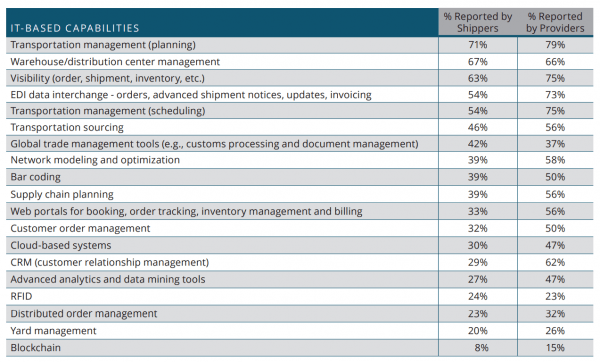
The table below shows the answers of the shipper and 3PL to the question: “What information technologies, systems or tools should 3PL have to successfully serve customers?”

3PL IT study

You can see from the table above, EDI transactions such as order, shipment, inventory, advanced shipment notices, invoicing, etc. are very important in the logistics. Thus, this once again underlines the importance of EDI for 3PLs.

Why EDI Is Important For 3PL Companies?

EDI provides the best results in exchanging data with 3PL providers. This is the most reliable, secure, and economical way to share business information.

A 3PL provider for example, needs detailed information about the location of the delivery points, the date of shipment, the quantity of the goods, information on the packaging, its size, etc.

The supplier of goods needs to monitor the state of inventory, track the movement, and write-off of the goods, as well as receive information about shipments to certain outlets for a specific range.

Lack of reliable information can lead to a shortage of goods in the store, lost profits, as well as monetary and temporary losses due to erroneous deliveries, long approvals, and frequent account adjustments.

On average, every day large logistics companies must send from several hundred to thousands of documents. To process such a volume of data manually using traditional paper documents, couriers, faxes, e-mail, or telephone, is rather a difficult and costly task.

Therefore, 3PL providers and their clients use EDI to exchange all necessary information about orders, deliveries, shipments, balances, reports, etc. electronically.

To automate the process of data exchange, 3PL providers and product suppliers usually integrate EDI into their business systems. This allows business partners to eliminate intermediate steps in which they must manually enter data into the accounting or business system. EDI messages are transmitted instantly, and they exclude errors related to the human factor.


Useful reading: A must-have guide for a successful systems integration with EDI


Third-Party Logistics EDI Documents

Third-Party Logistics (3PL) providers use a variety of Electronic Data Interchange (EDI) documents to exchange information with their customers, suppliers, carriers, and other partners. Some of the commonly used EDI documents in 3PL include:

  1. 850 Purchase Order: This document is used to transmit a purchase order from a customer to a 3PL provider. It includes information such as item description, quantity, and price.
  2. 855 Purchase Order Acknowledgement: This document is used by the 3PL provider to acknowledge the receipt of a purchase order from the customer.
  3. 856 Advance Shipment Notice: This document is used to inform the customer of the expected delivery date and time of the shipment.
  4. 940 Warehouse Shipping Order: This document is used by the 3PL provider to notify the warehouse of an impending shipment.
  5. 945 Warehouse Shipping Advice: This document is used by the warehouse to notify the 3PL provider that the shipment has been shipped.
  6. 944 Warehouse Stock Transfer Receipt Advice: This document is used by the warehouse to notify the 3PL provider that a stock transfer has been received.
  7. 997 Functional Acknowledgment: This document is used to acknowledge the receipt of an EDI document by the recipient.
  8. 810 Invoice: This EDI document is used to provide the customer with an electronic invoice for services rendered, including information such as the billing period, charges, and payment due date.

These EDI documents help 3PL providers to automate their processes and improve their efficiency in handling orders, inventory, and shipments. They also help to reduce errors and improve communication between the 3PL provider and their partners.

Let us look for the most used EDI documents by 3 PL providers. These messages could be used in ANSI X12 standard (if the company is in North America), or in UN/EDIFACT standard (which is more common in Europe). However, messages in both standards perform a similar function.

Sales Report and Sales Forecast: EDI 852 / EDIFACT –  SLSRPT and EDI 830 / EDIFACT-  SLSFCT

Inventory data can be used in conjunction with actual sales data transmitted in SLSRPT – Sales Data Report message (EDI 852 Product Activity Data) and SLSFCT – Sales Forecast (EDI 830 Planning Schedule)

Accurate data on inventory and sales forecasting allows manufacturers to better control their production needs, and distributors to maintain the necessary stock of goods, considering the market situation.

Inventory update: EDI 846 / INVRPT

One of the most used documents for Inventory management calls EDI 846 Inventory Inquiry/Advice in ANSI X12 Standard or INVRPT – Inventory Report in EDIFACT.

Inventory report allows suppliers to control their inventory of materials and products.

The message contains information about the quantity in stock, as well as data on the receipt and withdrawal of goods for a certain period. Information about the quantity of the product and packaging can be detailed in different groups: by lot, location, expiration date, etc.

Companies use this type of messages to reduce the costs and errors associated with manual processing. INVRPT or EDI 846 is also used to inform trading partners about the availability of goods, without obliging them to make a purchase. Besides, the buyer or trading partner can request information to obtain up-to-date data on product balances.

Typical EDI Workflow with 3PL

Advanced Ship Notice (ASN) 856 transaction set?

The direct interaction between the supplier and its 3PL provider is based on a standard set of EDI messages widely used in retail.

First, the supplier transfers its nomenclature (master data) to the logistics company using the PRODAT message. The message contains basic data that rarely changes – to identify and describe products. This long-term information includes a technical and functional description of the product, but not commercial terms.

Next, goods are shipped to the warehouse, accompanied by the DESADV – Despatch advice message (or EDI 856 Advanced Ship Notice (ASN) in case partners use the ANSI X12 standard).

This message does not physically accompany the delivery but utilized to inform in advance the recipient of the contents of the shipment.

Due to Advanced Ship Notice, the logistics company will know in advance that the goods are on the way. For acceleration and convenience of reception, SSCC codes and scanners are used: the goods can be taken in pallets.

At the next stage, the warehouse sends the supplier the RECADV message – Receiving Advice (EDI 861 – Receiving Advice/Acceptance Certificate) informing about the delivered and received goods.

When the supplier company receives a request for the supply of goods from its customers, it sends an ORDERS message – Purchase (EDI 850 Purchase Order) to the 3PL operator’s warehouse.

If the EDI was fully integrated with the business system, the information immediately goes to the accounting system of 3 PL providers, bypassing outdated communications, for example, e-mail, where information may be missed or may not reach the destination.

A 3PL company forms a shipment and sends it to the right address, notifying the other side using DESADV (EDI 856).

Of course, it should be noted that different logistic projects may use other, more specialized EDI messages.

How EDI Contributes To The Success of Third-Party Logistics Providers (3PL)

Even by introducing a minimum number of EDI messages for working with orders, deliveries, and reports, the parties achieve the following benefits:

  • Reducing manual entry and saving time for operators, managers, accountants, warehouse workers, drivers.
  • Ability to optimize/reduce staff.
  • Reduction in operating expenses.
  • Fast transfer of data and documents.
  • Elimination of losses and reduction of errors during data transmission.
  • Reducing conflict situations and increasing the loyalty of partners.
  • Security of data transmission.
  • Acceleration of payments due to prompt receipt of documents by customers.

3PL-companies can generate significant additional profit by optimizing business processes and increasing work efficiency.

New Opportunity For 3PL Companies with EDI2XML

EDI2XML is a Cloud based B2B integration service provider, focused on EDI and eCommerce integration, since year 2000.

Our EDI integration service offerings help solve business problems associated with electronic document management – in logistics, retail, healthcare, and other industries.

Contact us today for a free consultation.

EDI integration for 3PL

RELATED POSTS:

DELFOR, DELJIT, DESADV – key EDI messages in supply chain management for manufacturing

ORDERS and ORDRSP: The main EDIFACT messages in the supply chain management

What is Advanced Ship Notice (ASN) 856 transaction set?

What Are the Differences Between ANSI X12 and UN/EDIFACT

May 13, 2020
https://www.edi2xml.com/wp-content/uploads/2020/05/EDI-3PL-1.png 350 1024 Tatyana Vandich https://www.edi2xml.com/wp-content/uploads/2024/08/edi2xml.com-EDI2XML-company-logo.png Tatyana Vandich2020-05-13 10:34:152023-06-15 15:02:35EDI for Third-Party Logistics providers (3PL)

How to Change Your EDI Service Provider

Blog

This post was updated to reflect current trends and information.


Today, companies switching from one EDI service provider to another, is not different from someone changing his mobile operator.

Successful companies are always looking for better services and conditions. They are not afraid to change their EDI service provider, considering they add a value with their new selected choice.

Typically, the main reasons for leaving the “old” EDI service provider:

  • The speed of service and SLA is not adequate to the company.
  • the price is no longer justifiable.
  • poor support service.
  • frequent failures.
  • technological weaknesses.
  • lack of expertise and difficulties with integration.

It happens that the contract between the EDI provider and the client was concluded a long time ago, and after a while, its terms were disadvantageous for the company.

There are cases when the client has accumulated a critical number of claims that he is ready to change the EDI service provider, regardless of the investment.

Sometimes, big retailers recommend their partners to work with a particular EDI service provider, hence, they go by that recommendation, since they do not have enough time to select the most reliable EDI provider more carefully, and they get stuck with that service provider for long, and living the good and the bad….

How to Choose the Right EDI Service Provider

Primarily, to change the EDI service provider, you need to carefully select a new one. This step requires careful study. Here are the qualifications that should be looked at when looking for a new EDI service provider:

A.  The technology and qualification of the EDI provider

Companies often use a variety of business systems (SAP, Oracle JD Edwards, Salesforce, etc.), as well as e-Commerce (i.e. Amazon, Shopify). It is important that the new EDI service provider has the optimal solution for integrating EDI processes into these systems.

B.  Ability to offer diversified and comprehensive services

Secondly, it is desirable that your EDI provider can offer comprehensive diversified services that relate to EDI. For example, a good EDI provider, that offers integration services such as e-commerce integration, and direct integration with leading ERP/CRM systems, in addition to EDI is a very important criterion and one more plus in favor of the provider.

C.  Great technical support and quick response time to “resolve”

EDI provider support

Third, comes technical support. The EDI service provider must ensure that an experienced technical team is always available for any type of request. It should be available to respond quickly to resolve issues (when it happens) within a very reasonable time frame, tolerated by the business. Of course, company experience plays an important role.


Since companies with many years of experience in their field, thanks to their experience, often have more effective solutions.

Where to Start and How to Prepare to Change EDI Provider

Before a potential provider submits a quotation, he will certainly request important information upon which he would want to build his pricing. It is worth preparing the following in advance:

  • EDI standard used (i.e. X12, EDIFACT, RosettaNet, HIPAA/X12, XML, CSV, etc.)
  • Number and name (when possible) of trading partners.
  • Type of documents for each trading partner (Order, Order Acknowledgment, Invoice, etc.)
  • Direction of each document (incoming or outgoing).
  • Communication Protocols (i.e. AS2, FTP, sFTP, VAN, RNIF…)
  • Integration interface to the internal system (i.e. direct integration, API, XML, CSV or Json messages)
  • Type of deployment of the solution, the company is looking for (i.e. On-premises, Cloud based)

If you want to get an EDI quotation from our company, please fill in our EDI Evaluation Sheet available here and send it by email to: support@edi2xml.com


After receiving the necessary information, the future provider gets down to the “drawing board”; based on the above information, the service provider will analyze the business process, and offer the most profitable options for EDI integration.

Here are the EDI integration services our company EDI2XML offers:

Fully Managed EDI Service: with this option, there is an on-boarding one-time fee, and a monthly fee. Our team at EDI2XML takes care of all your EDI project, and we offer a “turn-key solution”; we take care of all the setup, configuration, transformation, testing, certification with your EDI partners. Our monthly pricing packages are dynamic, they go up and down based on the volume and you are not locked in any tier.

EDI2XML web services: our REST API to convert X12 to XML and vice versa , is much more cost effective, and meant for companies who got their own technical resources to work with REST API (call and consume HTTP Rest Web services); In such a scenario, it is the way to go for the following reasons:

  • Self-service solution
  • Low cost per KC
  • Support is included with the subscription without any additional fees
  • Quick entry: you can be up and running in less than an hour, and it is proven; we provide everything to your developers to get started, a java client with its source code and instructions on how to work with.
  • We offer the schemas (xsd) of the XML format our API expects, and all what you need to do is to format your data according to that format and you will be up and running.
  • We offer a [15] days free trial, without any commitment.

EDI2XML On-Premises: is our offering to deploy our solution on customer’s premises.

How to Get a Discount

Chances for a discount increase if:

  • the company moves to a new provider having more than one trading partner.
  • The company has a significant volume of transactions.
  • The company requires integration with internal business systems (JDE Oracle, SAP, MS Dynamics, etc.)

How is the Process of Migrating to a New EDI Provider?

The transition from the old to the new EDI provider consists of two parts: formal and technical parts.

The formalities normally take between 2 to 5 business days before signing the agreement.

The technical part depends on the integration option selected and the volume of technical work involved:

– EDI web services. In this case, you do not even need to sign a contract. The connection is very fast within an hour, you can exchange EDI documents with your trading partner.

– Integration options such as Fully managed EDI service or On-Premises EDI Services or Integration with business system may take more time.

Do You Want to Start?

So, do you think it is time to change your EDI provider? However, you still have doubts. Not sure, which EDI solution is right for you? Contact us for a free consultation. Our EDI experts will advise you on the most cost-effective EDI solution according to your business processes.

Free EDI consultation

Related Posts:

What is EDIFACT? | UN / EDIFACT standard overview

Electronic Data Interchange: Key Information You Need to Know

What Are the Differences Between ANSI X12 and UN/EDIFACT

May 11, 2020
https://www.edi2xml.com/wp-content/uploads/2020/05/EDI2XML-_-Change-EDi-Provider.png 350 1024 Tatyana Vandich https://www.edi2xml.com/wp-content/uploads/2024/08/edi2xml.com-EDI2XML-company-logo.png Tatyana Vandich2020-05-11 16:11:382025-01-06 10:11:22How to Change Your EDI Service Provider

EDIFACT – Delivery Just in Time for manufacturing

Blog

EDI for logistics

Advanced and successful enterprises whose activities are highly dependent on the exact timing of deliveries of goods use an efficient and reliable way to solve the supply problem – implementing electronic data interchange (EDI).

EDI Implementation in JIT (Just in Time) concept

EDI allows companies to streamline deliveries within the framework of the Just in Time concept.

The Just-in-time concept is the organization of the flow so that goods are delivered in the required quantity, to the right place, and exactly at the appointed time.

At the same time, companies do not need large reserve stock that “freezes” the company’s money.

DELFOR, DELJIT, DESADV – key EDI messages in supply chain management for manufacturing

UN/EDIFACT DELFOR Delivery Schedule message transmits in electronic structured form information about the delivery plan. The DELFOR message is sent by the purchasing company to the supplying company to indicate the need for products. This message can be used by retailers with their trading partners or a manufacturing company receiving components or raw materials from their partners.

The delivery schedule message DELFOR is used to provide continuous material flow between the supplier and the buyer when the delivery specifications cannot be fully defined in the contract or order.

DELFOR message allows refining and detailing the requirements and providing the supplier with information that enables him to predict the future needs of the buyer.

Time management and UN/EDIFACT DELFOR message

Delivery schedules transmitted through DELFOR message can be of two types:

  • urgent
  • perpetual

Perpetual is used to describe regular orders and deliveries. Urgent is applied for a limited period (for example, with an increased delivery regime) with a start-and-finish date.

A DELFOR message can be sent at any frequency (once a month, once a week, etc.) and covers any period (e.g., week, month, quarter, half-year, year). Medium- and long-term schedules transmitted every month may change to short-term ones issued every week.

All products and materials indicated in the delivery schedule message must be uniquely identified by the order, item number, article number, or part number.

The identification number can be determined either by the customer or by the supplier – the parties agree on this issue at the stage of concluding the contract.

The delivery schedule message may indicate the place of delivery of the goods it could be:

  • warehouse of the enterprise;
  • specific assembly line;
  • distribution center;
  • warehouse of the logistics company.

By receiving such a message, the supplier gets the opportunity to confirm or reject the request, or make changes. Using the DELFOR message, business partners can agree on which day the buyer can accept the order and on which day the supplier can deliver it.

DELFOR message can also be used for the forecast plan. In this case, the supplier has the opportunity to understand the long-term needs of his customer. This helps to plan the delivery of raw materials and more flexibly manage production.

Business partners usually agree in advance on the purpose of sending DELFOR messages – for a quick order or for planning deliveries for a long time.

How EDI is implemented in practice

In a world practice, DELFOR is one of the most widely used transaction in the manufacturing industry, where supply chain can be very complex and fragmented. At the same time, all the collaborators must be strictly coordinated. Errors in the exchange of information at one stage can affect subsequent elements of the chain, up to the end consumer. For this reason, EDI is one of the most used technologies in production planning, inventory allocation, logistics, and transportation.

Using the DELFOR message, a manufacturing company can send its partners an approximate supply plan on a weekly basis.

In the case of more operational tasks, companies can implement DELJIT (Delivery Just in Time) message.

In this way, suppliers are informed of the exact shipping schedule requirements in the next 24 hours. However, each enterprise can flexibly customize processes exclusively for its needs and production cycles.

EDI 856

The third message related to the delivery schedule in the manufacturing space, is the DESADV Despatch advice message (or EDI 856 Advanced Ship Notice in the X12 standard). The supplier should send this message immediately after shipment leaves its premises.

The message indicates the contents of the delivery and additional information about the shipment, the order, type of packaging and product description and characteristics.

A dispatch message improves supply chain management. Manufacturers and distributors can control and track shipments, orders, and inventory more effectively. The whole process becomes traceable; it becomes possible to know when the goods will be sent when it will reach its destination.

According to Industry Week’s Best Plants analysts who studied more than 100 companies with the Just in Time logistic concept implemented using EDI messages, their average results were very positive:

  • The volume of stock instead of the maximum 15 days was reduced to 2 days
  • Stock of finished products decreased by one third
  • The duration of the production cycle decreased by 40%
  • Production costs decreased by 20%


RELATED POSTS:

What is Advanced Ship Notice (ASN) 856 transaction set?

What is EDIFACT? | UN / EDIFACT standard overview

Electronic Data Interchange: Key Information You Need to Know

What Are the Differences Between ANSI X12 and UN/EDIFACT

April 28, 2020
https://www.edi2xml.com/wp-content/uploads/2020/04/EDI-messages-for-manufactoring.png 350 1024 Tatyana Vandich https://www.edi2xml.com/wp-content/uploads/2024/08/edi2xml.com-EDI2XML-company-logo.png Tatyana Vandich2020-04-28 14:36:562021-11-30 15:41:45EDIFACT – Delivery Just in Time for manufacturing

Inventory Management and Planning Schedule Using EDI 846, EDI 852, EDI 830

Blog

Inventory management and planning schedules can be efficiently handled using Electronic Data Interchange (EDI) transactions such as EDI 846, EDI 852, and EDI 830. These EDI transactions allow for the automated exchange of inventory-related information between trading partners, streamlining the supply chain process.

Effective management of the supply chain and stock, helps outperform competitors. A supplier company, where these processes are set at a high level, can save on inventory replenishment and increase sales.

Without accurate information about inventory levels, a company can stay with inaccurate stock in its warehouse, and obviously loose sales, time and profit.

In the world of electronic data interchange, these challenges can be easily overcome using the following EDI messages in both X12 and EDIFACT standards:

UN/EDIFACT Standard ANSI X12 Standard
INVRPT – Inventory ReportEDI 846 Inventory Inquiry/Advice
SLSRPT – Sales Data ReportEDI 852 Product Activity Data
SLSFCT – Sales ForecastEDI 830 Planning Schedule

EDI 846 Inventory Inquiry/Advice

EDI 846 Inventory Inquiry/Advice (EDIFACT – INVRPT) contains information related to stock of goods in a store or warehouse by the range of a particular supplier. The message may contain information about:

  • amount of open stock;
  • actual stock;
  • maximum and minimum reserved;
  • receipt and withdrawal of goods for a certain period.

Besides, information on the quantity of the product can be detailed by different aggregation groups: parties, series, manufacturers, locations, expiration dates, etc.

Using EDI 846 suppliers can control their stock in real-time, improve delivery route planning of goods to their customers, schedule replenishment of each of the warehouses, and calculate the cost of delivery of goods.

EDI 846 is also used to inform trading partners about the availability of goods, without any commitment to make a purchase. The buyer can request information to obtain up-to-date data on the remaining goods, or stock availability.

Companies can get additional savings by reducing costs and errors associated with manual data processing. INVRPT is transmitted and processed automatically.

Automatic stock replenishment

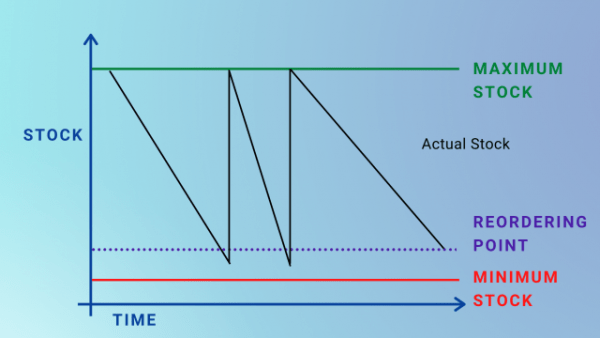
reordering using EDIFACT INVRPT-message

Using the EDi 846 message, you can automatically generate the delivery of new batches of goods when the quantity of goods in the warehouse falls below the reordering point.

The interval between the reordering point and the minimum level of stock, generally depends on the time required to deliver the goods, as well as on the volume of turnover of products.


KEY TAKEAWAYS

The just-in-time (JIT) inventory system is a management strategy that minimizes inventory and increases efficiency.


EDI 852 – Product Activity Data

The EDI 852 transaction, also known as Product Activity Data, (EDIFACT SLSRPT) is used to transmit sales and inventory activity information from the seller to the buyer. This transaction provides detailed data on product movements, such as sales, returns, and stock levels. By exchanging EDI 852, the buyer can effectively analyze demand patterns, plan for inventory replenishment, and optimize their supply chain operations.

EDI 852 contains information about the actual sales of goods in a particular store or warehouse. Commonly, the buyer sends this EDI transaction to the supplier.

The EDI 852 usually indicates:

  • location of the outlet;
  • period of sales;
  • quantity of goods sold;
  • selling price;
  • Amount;

In retail, this type of EDI messages is used to evaluate the product line to see if the entire assortment is on sale, whether the required volume of promotional products and top-end products is supported.

EDI 830 – Planning Schedule with Release Capability

The EDI 830 Planning Schedule (EDIFACT SLSFCT) is used by the buyer to communicate their long-term production and inventory requirements to the supplier. The EDI 830 includes information such as part numbers, quantities required, release dates, and forecasted demand. This transaction allows the supplier to plan their production schedules and adjust their inventory levels accordingly, ensuring a smooth flow of goods.

EDI 830 message contains similar data, but as predictive for a certain period. Using EDI 830 you can know the sales forecast for a specific product by:

  • place of sale sales
  • channels
  • prices
  • quantity
  • turnover
  • consignments

Accurate data on inventory and sales forecasting allows manufacturers to better control their production needs, and distributors to maintain the necessary stock of goods, optimize the assortment due to relevance, and reduce transportation costs.

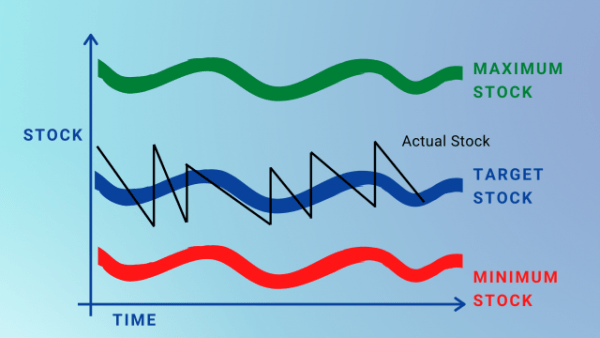
Sales Forecasted target stock

UN/EDIFACT Message SLSFCT

The exchange of EDI transactions in these situations, helps maintain the actual inventory level as close as possible to the ideal model in which deliveries are frequent and delivery times are short.

The reordering point can change position at any time because it depends on the target inventory level.

By utilizing these EDI transactions, businesses can achieve improved accuracy, efficiency, and visibility in their inventory management and planning processes. The automated exchange of information reduces manual errors, minimizes communication delays, and enables real-time visibility into inventory levels, demand, and supply. This, in turn, helps organizations optimize their inventory levels, minimize stockouts, reduce carrying costs, and enhance overall supply chain performance.

Connect EDI X12 or UN/EDIFACT With Any Trading Partner Anywhere In The World

The core of EDI2XML’s mission is the digital transformation of businesses of all sizes. For over 21 years, we have been continuously engaged in EDI integration projects between business partners, working both with global corporations and local small and mid-size businesses.

Our effective EDI services and solutions are designed for all kinds of verticals, including and not limited to manufacturing, transport, retail chains, distributions, financial organizations, telecoms, and many others.

Contact us today to get a free consultation and learn more about our solution offerings.


Related Posts:

What is EDIFACT? | UN / EDIFACT standard overview

Electronic Data Interchange: Key Information You Need to Know

What Are the Differences Between ANSI X12 and UN/EDIFACT

April 27, 2020
https://www.edi2xml.com/wp-content/uploads/2020/04/EDI-846-edi-852-edi-830-1.png 350 1024 Tatyana Vandich https://www.edi2xml.com/wp-content/uploads/2024/08/edi2xml.com-EDI2XML-company-logo.png Tatyana Vandich2020-04-27 11:19:042023-05-10 16:27:01Inventory Management and Planning Schedule Using EDI 846, EDI 852, EDI 830

What is UN/EDIFACT INVRPT Inventory report message?

Blog


This article provides the definition and specification of the inventory report message (INVRPT) for UN/EDIFACT (United Nations for Electronic Data Interchange for Administration, Commerce and Transport) EDIFACT standard very commonly used in Europe, Oceanian countries, and some Asian counties. EDI 846 Inventory Inquiry / Advice is an analog document for the ANSI X12 standard, which is widely utilized in North America.

UN/EDIFACT INVRPT (inventory report) function

INVRPT (inventory report) is an electronic message for exchange between trading partners; it contains information about the supplier’s held inventories. The message is widely used regardless of the type of business or industry, both in domestic and international trade.

The information contained in the INVRPT message relates to availabilities and stock of goods. This message generally exchanged between the manufacturer and distributor (wholesaler) or the manufacturer and different type of seller: such us big-box retail, e-commerce, especially in the dropshipping model.

Primarily, the INVRPT message is often used to report stock held and movement of merchandise or raw materials, between business partners…

INVRPT message has a functionality that allows separating stock based on classes, to facilitate a financial assessment of stocks, production and supply planning.

The Inventory report message can indicate the initial stock, final stock and the movement of goods (incoming or outgoing) in the warehouse for a certain period.

UN/EDIFACT Terms Definition

Let’s look at some EDIFACT definitions to help you understand the INVRPT message.

Message

This is information related to a particular transaction exchanged by business partners through EDI. Each message consists of logically grouped segments.

Segment

A segment is part of the information in a message. A segment is composed of a predefined set of data elements. Each segment starts with a unique “segment identifier”, that is a three-letter code, and ends with a segment terminator.

The different segments in a message can be have a Mandatory (M) or Conditional (C) usage.

Each segment has its own place in the message and the same type of segment can be found multiple times in any of the sections of a message (Header, Details, or Summary).

Group of Segments

An identified group of functionally related segments that can be repeated.

How does UN/EDIFACT INVRPT (inventory report) looks like?

To see easier the data structure in the example INVRPT message below, the segments are separate from each other using a new line.

UNA:+.?*’
UNB+UNOC:4+1111111111111:14+2051254890007:14+20150421:1000+0001+INVRPT’
UNH+1+INVRPT:D:19B:UN:EAN007′
BGM+220+822106+5′
DTM+137:20161122:102′
DTM+366:20140416:102′
NAD+BY+2051254890007::5′
NAD+SU+SUPPLIER GLN::5′
NAD+WH+AMAZON WAREHOUSE CODE::73′
RFF+IA:123456′
CUX+2:EUR:10′
LIN+1++EAN_1:BP’
PIA+5+ABCDEF:SA’
IMD+F++:::TPRG item description 1:TPRG second item description 1′
INV++++1′
QTY+145:13′
LIN+2++EAN_2:BP’
PIA+5+ABCDEF:SA’
IMD+F++:::TPRG item description 2:TPRG second item description 2′
INV++++1′
QTY+145:23′
LIN+3++EAN_3:BP’
PIA+5+ABCDEF:SA’
IMD+F++:::TPRG item description 3:TPRG second item description 3′
INV++++1′
QTY+145:33′
LIN+4++EAN_4:BP’
PIA+5+ABCDEF:SA’
IMD+F++:::TPRG item description 4:TPRG second item description 4′
INV++++1′
QTY+145:43′
LIN+5++EAN_5:BP’
PIA+5+ABCDEF:SA’
IMD+F++:::TPRG item description 5:TPRG second item description 5′
INV++++1′
QTY+145:53′
UNT+35+1′
UNZ+1+0001′

UN/EDIFACT INVRPT Message segment clarification

UN/EDIFACT INVRPT message is structured in two sections, a Header Section and a Detail Section. The header used to give general information relating to the message. The detail section consists of segments and groups.

In the list below you can find a short summary about the meaning and the functionality of the segment which are indicated on the INVRPT example given above.

Header section

UNH – Message header. A service segment uses to head, identify and specify a message.

BGM – Beginning of message uses to indicate the type and function of a message and to transmit the identifying number.

DTM – uses to specify the date, and/or time, or period. Date/time/period associated with the whole message. In order to determine the date when the inventory report was prepared, the segment must be indicated at least once.

Segment groups

NAD – Name and address. This segment serves to identify names and addresses and their functions related to the entire inventory report. In the inventory message, it is recommended to use the code form of ID to indicate the parties.

RFF – Reference. This segment is used to indicate documents that refer to the entire message of the inventory report, for example, dispatch advice number, contract, etc.

CUX – Currencies. This segment defines currencies and, if necessary, exchange rates for the entire message.

LIN – Line item. A segment that identifies a specific item in the INVRPT Message. All other segments in the detailed section are related to the line item.

PIA – Additional product id. The function of this segment to transmit additional product identification.

IMD – Item description. This segment used for describing the item.

INV – inventory management related details. Function: Providing various information related to inventory management functions that necessary for the processing of stock movements and stock balances.

QTY – Quantity.  This segment provides quantity information

UNT – Message trailer. A service segment indicates an ending of the message. Indicate the total number of segments in the message (including the UNH & UNT) and the control reference number of the message.

UNZ – Interchange trailer. Function: to end and check the completeness of an interchange.

Benefits of Using Inventory Report (INVRPT)

The benefits of using the INVRPT EDI Message are obvious to both trading partners:

– The supplier can promptly inform you when the goods are out of stock or out of production.

– Much easier e-commerce management. This is one of the most popular and at the same time one of the most complex EDI document in the e- commerce.

– Provides information to the trading partner when the product will be available again if it is not available, thereby helping to better plan stocks and placing orders.

– Allows a business partner (usually a dropshipping online store) to manage data in his online store, such as the available quantity of goods in stock, and to delete or add goods to the online store accordingly.

No-Cost Estimate and Free EDI Consultation

EDI2XML is ready to discuss your EDI challenges and offer turnkey solutions. You can start exchanging the EDIFACT INVRPT message (or any other EDIFACT or X12 document) in an hour using our popular EDI Web service. In this case, you do not need to sign a contract and you can stop using the service whenever you want. In addition, we provide free 15 days trial period.

We also provide Fully Managed EDI Service where we take care of everything.

Contact us today and we will help you quickly and efficiently establish your EDI communication.


Related Posts:

What is EDI 846 document?

Why EDI 846 is important to do business with big-box retailers

What is EDIFACT? | UN / EDIFACT standard overview

Electronic Data Interchange: Key Information You Need to Know

What Are the Differences Between ANSI X12 and UN/EDIFACT

April 14, 2020
https://www.edi2xml.com/wp-content/uploads/2020/04/EDIFACT-INVRPT.png 350 1024 Tatyana Vandich https://www.edi2xml.com/wp-content/uploads/2024/08/edi2xml.com-EDI2XML-company-logo.png Tatyana Vandich2020-04-14 10:59:572020-04-14 11:01:31What is UN/EDIFACT INVRPT Inventory report message?

Recognize Warning Signals: How Urgent it is to Integrate E-Commerce with ERP?

Blog

This post was updated to reflect current trends and information.


Clear navigation, great visual branding, and a simple user-friendly layout – this should look like a good online store. E-commerce platforms such as Shopify, Magento, Woocommerce, BigCommerce, and the likes, already perform these functions.

However, no matter how important usability is, this is only part of the success of your e-commerce business. Long delivery time for example or errors in the order have a decisive influence on customer satisfaction. We all know, that only happy customers will buy again from your eCommerce online store in the future.

The effective work of the online store is ensured primarily, by having a streamlined internal business process and flows, fully integrated with the company’s business management software such as the ERP.

e-commerce automation and integration with ERP and CRM

However, many online store owners, waste valuable time with poorly performing and none-integrated applications, isolated solutions, or even manual work.

If you recognize one of the following warning signals from your everyday work, it is time to act and make a change!

Shopify Store: Not Enough Time for Everyday Activities

What is your daily work in the Shopify online store? Is manual data entry or complex import and export a daily occurrence in your workplace? For small startups, it is reasonable to manage e-commerce business processes using the free basic features of Shopify store.

But if you spend more time synchronizing data than in everyday work, the effectiveness of your online store will drop rapidly.

Online Store: Long Order “Lead Time”

Your store doesn’t have automated processes. Without consistent automation, orders “lead time” for delivery will be on the rise, which affects your service and, above all, the satisfaction of your customers.


KEY TAKEAWAYS

A “lead time” is a measurement of how long it takes to complete a process from start to finish.
For example, the time between placing an online order by a client and delivering goods to him.


The Standard Features of The Online Store are Not Enough

Are the processes in your Shopify store system insufficient to match the growing requirements, even if you have already hired new employees? As company success grows, so does the demand: new functionality must always be embraced.

E-Commerce Store Isolated From Other Business Systems

Do you use your e-commerce store as an isolated solution? If your online store is not connected to the business systems of the enterprise (ERP, CRM, EDI, accounting system, etc.), a separate operation in your company provides double keying-in of data – this is annoying and often leads to human errors.

Loss of Sales

Are you losing sales because you do not have enough goods in stock or there are delays in production or the supply chain? Or maybe you have delays with third-party services such as dropshipping?

e-commerce sales orders automation

Competition

Are you losing qualified employees or applicants to the competition, because they expect a modern, productive work environment?

ERP Integration for Your Online Store

Have you recognized your business and understood the source of the problem? Do you want to change something? We can help you!

We have many years of successful experience in ERP integration with online stores. Our customers note that the integration expanded the functions of the online store, increased the productivity of their online trading, and contributed to the effective growth of their business.

Contact us to get a free consultation on the integration of your online store.

Shopify integration price list

RELATED POSTS:

Must-Have Integration between E-Commerce and Business Systems

9 Major E-Commerce Trends That Will Help Grow Your Online Business

The main reasons why you need Microsoft Dynamics Integration with your Business Systems

PRICING PACKAGES: Shopify Integration

Shopify and Microsoft Dynamics Nav Integration: Things you should know

March 26, 2020
https://www.edi2xml.com/wp-content/uploads/2020/03/EDI2XML-_-Shopify-ERP-integration.png 350 1024 Tatyana Vandich https://www.edi2xml.com/wp-content/uploads/2024/08/edi2xml.com-EDI2XML-company-logo.png Tatyana Vandich2020-03-26 12:36:152024-05-24 11:27:55Recognize Warning Signals: How Urgent it is to Integrate E-Commerce with ERP?

The Impact of coronavirus (COVID-19) on e-commerce

Blog

This post was updated to reflect current trends and information.


In almost all countries where coronavirus (COVID-19) has spread, isolation, social distance, and lockdown measures were taken. Whenever possible, employees have been asked to work remotely from home, schools have been closed, and people have been asked to avoid public crowded places.

It is not surprising that in this pandemic of coronavirus disease situation more and more people turned to shop online. Thus, the COVID-19 virus can stimulate e-commerce, as consumers avoid visiting places like shops, malls, and shopping centers.

People’s habits are changing very quickly, therefore the category of consumers who never made online purchases previously, are somehow forced to do so, because of the Coronavirus pandemic; consumers will likely continue to do online purchases in the future, considering they live a positive shopping experience online. Hence why companies running online commerce stores must be ready to quickly and efficiently meet the needs of an increasingly growing number of customers and their demands, while the pandemic’s curve does not seem to be likely in the near future…


Read also: Coronavirus Is Changing How Consumers Shop


Increase E-Commerce Efficiency by Connecting online store to ERP Software

ERP is a business management software. It is used to collect, store and manage data of various business processes of an enterprise. Implementation of an ERP system is considered necessary for the effectiveness of the management of any company.

ERP systems, originally implemented only by industrial enterprises, are now adopted by most organizations, regardless of the size of the company, industry, or country. One of the most popular ERP systems is SAP ERP Software, Oracle JDE for large enterprises, and Microsoft Dynamics suite in addition to numerous ERP systems for the mid and small market…

E-commerce stores must be viewed from two sides. The first is the store’s external interface, which allows online visitors to shop online. The second side is the internal business process of your online store. Inventory, orders, and sales management.

Connecting ERP / SAP (for example), to your online store is critical to the successful functioning and development of your online business.

Yes, your online store can work even without integration with your ERP system. However, in this case, a company will have to leverage human resources to manually manage orders, inventory, and sales orders, which is usually a very demanding job, inefficient, often leading to lots of human errors and increasing the delivery window of the orders… This will certainly result in a loss of profit, hence defeating the purpose of the basics of eCommerce.

Key Benefits of Integrating ERP with Shopify e-commerce store

Integration to Shopify or any other e-commerce platform with a company’s ERP prevents inefficient manual data entry between the business system and the online shop. Manual data entry is very time-consuming and involves a high risk of costly errors.

Data transfer errors are one of the most common errors that occur in online stores that are not integrated with the company’s business system. These can be errors with both, the end-users and the suppliers. These errors lead to financial losses; company’s executives should take it seriously and should not ignore those facts.

Integrating the ERP of a company with its online eCommerce store, will certainly eliminate all these errors and provide a close to real-time synchronization between the ERP and Shopify for example, which is necessary to guarantee error-free data transmission between both systems/platforms.

Integration can save companies a lot of time by providing continuous and uninterrupted data transfer between the online store and their business system. This means the purchase order, inventory update, etc. can be automatically updated on both systems, eliminating duplicate data entry.

The integration service that we provide at EDI2XML, is bi-directional between the Shopify online store and a company’s ERP. In other words, information is transferred back and forth between both systems.

Through integration, an order created in the online store is registered in the ERP system without any human intervention. This not only avoids errors but also saves on salary costs.

In the same way, the availability of stock data from the ERP is synchronized with the online store. Thus, online customers have up-to-date information on available products, always.

How to Connect Shopify e-commerce store with SAP ERP Software

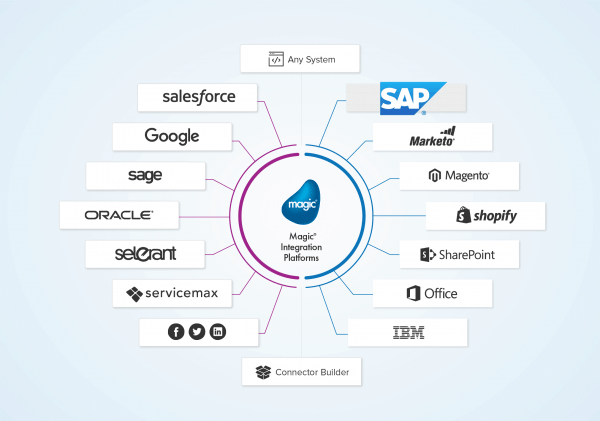
Shopify is a popular eCommerce platform that can be integrated with your ERP software using Magic xpi integration platform while leveraging Magic’s SAP-certified connectors.

Magic xpi Integration Platform lets you easily integrate, synchronize and automate processes between ERP systems and e-commerce store and provides a robust integration with any ERP. It is a proven Integration Platform certified for SAP Applications, SAP NetWeaver, and other major enterprise application vendors.

Shopify integration with SAP

Below are some of the examples of business process integration between Shopify and business systems:

  • ERP – eCommerce Catalog data integration
  • inventory data pushed to the Shopify store
  • ERP to eCommerce pricing updates (bidirectional)
  • real-time inventory checks
  • real-time credit checks
  • order information pushed to ERP
  • address book updates (bidirectional)
  • shipping confirmations
  • delivery notices
  • inventory alarms to eCommerce managers
  • call center integration
  • CRM integration

With near real-time processes, information is updated within seconds. Magic xpi automates the way you deal between ERP and Shopify processes.

Integration Partners That Will Grow Your Business

Any integration project requires technical expertise. We, at EDI2XML offer our customers, Integration services to complex ecosystems such as SAP, ServiceMax, Salesforce, JD Edwards, Oracle ERP, SugarCRM, and more.

For over 21 years, we have been partner with a Global software company Magic Software Enterprises Ltd., which provides the Magic xpi integration platform.

Professionally made synchronization of the e-commerce online store with ERP really helps to make business processes as efficient as possible.

Our company will gladly help you with any Integration project. Contact us to get a free consultation.

Shopify integration price list

RELATED POSTS:

Must-Have Integration between E-Commerce and Business Systems

9 Major E-Commerce Trends That Will Help Grow Your Online Business

The main reasons why you need Microsoft Dynamics Integration with your Business Systems

PRICING PACKAGES: Shopify Integration

Shopify and Microsoft Dynamics Nav Integration: Things you should know

March 20, 2020
https://www.edi2xml.com/wp-content/uploads/2020/03/COVID-19-ecommerce.png 350 1024 Tatyana Vandich https://www.edi2xml.com/wp-content/uploads/2024/08/edi2xml.com-EDI2XML-company-logo.png Tatyana Vandich2020-03-20 11:37:252022-06-06 14:43:47The Impact of coronavirus (COVID-19) on e-commerce

The Fourth Industrial Revolution and Industry 4.0: How to maximize the benefits of innovation?

Blog

This post was updated to reflect current trends and information.


Many countries and big businesses are active participants in the Fourth Industrial Revolution. Commercial associations and non-profit organizations were created to support the development of Industry 4.0.

Experts identify some basic technologies that include Industry 4.0

– Industrial Internet of Things

When manufacturing equipment is combined into one common network and is controlled by a single production management system.

– Augmented reality

Applicable for various purposes, for example, displaying instructions for repair and maintenance of equipment, etc.

– BIG DATA and business intelligence

Analytics of a large amount of data, which allows to optimize product quality, save energy and increase equipment uptime.

Today let’s talk about the most important technology in Industry 4.0 – Industrial Internet of Things

What is The Industrial Internet of Things (IIoT)?

The Industrial Internet of Things (IIoT) refers to the integration of internet-connected devices and sensors with industrial processes and systems. It extends the concept of the Internet of Things (IoT) to industries, such as manufacturing, energy, transportation, and agriculture, to enhance operational efficiency, productivity, and safety.

IIoT leverages various technologies, including sensors, actuators, cloud computing, machine learning, and data analytics, to enable real-time monitoring, control, and automation of industrial operations. It involves connecting physical devices, machines, and equipment to the internet, allowing them to collect and exchange data.

The key components of IIoT are:

  1. Devices and Sensors: Industrial equipment, machines, and devices are equipped with sensors to collect data on parameters like temperature, pressure, humidity, vibration, and more.

  2. Connectivity: IIoT relies on robust and secure network connectivity, such as Wi-Fi, Ethernet, cellular networks, or dedicated industrial protocols like MQTT or OPC-UA, to transmit data between devices, sensors, and backend systems.

  3. Cloud Computing: IIoT systems utilize cloud platforms to store, process, and analyze the massive amounts of data generated by connected devices. Cloud-based services provide scalable and flexible infrastructure for data storage and computing resources.

  4. Data Analytics and Machine Learning: IIoT leverages advanced analytics and machine learning algorithms to extract valuable insights from the collected data. These technologies enable predictive maintenance, anomaly detection, optimization, and decision-making.

  5. Industrial Applications: IIoT finds applications across various industries, including manufacturing, where it enables remote monitoring of production lines, predictive maintenance of machinery, and optimization of supply chains. It is also used in energy grids for smart metering and grid management, in transportation for fleet management and logistics, and in agriculture for precision farming, among other sectors.

IIoT: History and Forecast

One of the first sectors where the Internet of things began to be actively introduced was the energy industry. Intelligent analytics is especially necessary where industrial facilities operate autonomously, distributed across different territories and vulnerable to various external threats.

The IIoT allows connecting natural gas-powered electricity plants located in different cities (for example, there are 1,793 natural gas-powered electricity plants in the United States) to a single forecasting and remote monitoring system, building digital models of the power station.

According to a report “IIoT & Remote O&M” published by the McIlvaine Company, the power industry represents a $ 19 billion annual Industrial Internet of Things (IIoT) market growing at 8 percent annually.

As reported by Machina Research and Nokia, revenues of the global market for the industrial Internet of Things will reach 484 billion euros in 2025, and the main industries will be Transport, Industry, Housing and Utilities, Healthcare, and Smart home applications. At the same time, the main revenue will come from applications, analytics, and services for end-users.

How does the Industrial Internet of Things work?

Industrial Internet of ThingsAt the first stage of IIoT implementation, sensors, actuators, and other controllers are installed on industrial equipment. Thus, it becomes possible to collect information that allows management to obtain objective and accurate data on the state of production. Processed data is provided to all departments of the enterprise. This helps to establish interaction between employees of different departments and make informed decisions.

The information obtained can be used to avoid unplanned downtime, equipment breakdowns, reduce unscheduled maintenance and supply chain management problems, thereby allowing the company to function more efficiently.

Filtering and adequate interpretation of huge array unstructured data coming from equipment’s sensors becomes a priority for Industry4.0. Thus, for delivery information in understandable and clear form manufacture 4.0 use advanced analytical platforms. These platforms designed to collect, store and analyze data on technological processes in real-time.

Wireless devices such as smartphones, tablets, and sensors, are already actively used in manufacturing. Existing wired sensor networks expanding and supplementing by wireless networks, which significantly expand the use of monitoring and control systems at manufacturing enterprises.


Useful info: Industry 4.0: How to Manage Digital Transformation in manufacturing enterprises? 


As digital ecosystems evolve, manufacturing enterprises from isolated systems that perform all the necessary production processes on their own will be transformed into open systems uniting various production participants (Raw material suppliers, manufacturers, warehouses, distribution networks, etc.)

The Best Solution for Industry 4.0

Industry 4.0 and industrial internet of things A survey conducted by Honeywell with KRC Research among more than 200 executives in North American manufacturing companies revealed that unplanned downtime was seen as a major threat to revenue growth.

At the same time, 42% of respondents admitted that they operate equipment with a greater load than they should.

To avoid downtime at the enterprise, it is necessary to introduce technologies to detect and predict risks. Continuous monitoring of key indicators makes it possible to identify the problem and take the necessary measures to solve it. The instant analysis helps operators find the causes of problems faster.

Thus, manufacturers are approaching the point where they need to improve business results and make proactive, informed, more intelligent decisions without the need to change existing systems or infrastructure.

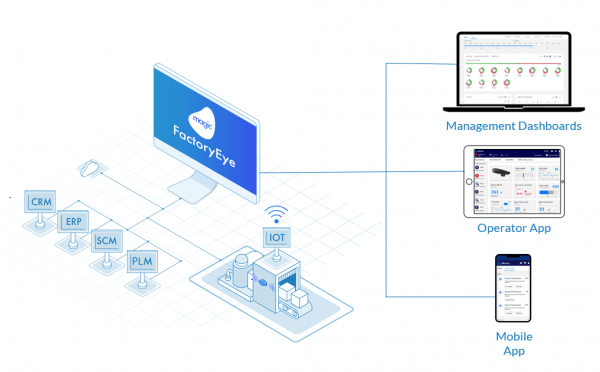
We have a solution for Manufacturers of all Sizes. FactoryEye is a great solution, designed for manufacturers.

With this comprehensive solution, manufacturers can track not only production but also all business process in real-time. It allows you to make dynamic, proactive decisions, delivering tangible business results at every stage.
Industry 4.0

Benefits of Switching to the Internet of Things Model

Using more and more robots and introducing IIoT in production will reduce staff costs, overhead and improve quality. For example, the Philips razor factory in the Netherlands operates in a dark manufactory with 128 robots. The entire plant staff consists of nine employees.


Lights-out manufacturing, often called a dark factory, is the methodology of production, and not a specific process. Factories that turn off the lights are fully automated and do not require a human presence on site.


Our solution Factory Eye gives to manufacturers a lot of benefits:

  • Increased productivity
  • Reduced material waste
  • Improved on-time delivery
  • Increased costing accuracy
  • Better knowledge preservation
  • Better control

Where to start IIoT?

The Industrial Internet of Things is changing business models, enabling companies to achieve high economic results. In the modern world, business success is determined by the ability to apply innovation and focus on results.

If you want to know more about what benefits the implementation of the principles of Industry 4.0 can bring to your business and how to transform it based on advanced technologies, contact us.


Industry 4.0 whitepaper

March 9, 2020
https://www.edi2xml.com/wp-content/uploads/2020/03/the-fourth-industrial-revolution.png 350 1024 Tatyana Vandich https://www.edi2xml.com/wp-content/uploads/2024/08/edi2xml.com-EDI2XML-company-logo.png Tatyana Vandich2020-03-09 12:40:302023-06-16 14:53:29The Fourth Industrial Revolution and Industry 4.0: How to maximize the benefits of innovation?
Page 14 of 24«‹1213141516›»
Recent
  • EDi Integration for SMB - Complete Guide
    Electronic Data Interchange (EDI): The Complete Guide for...July 17, 2026 - 4:46 pm
  • EDI Process Guide from EDI EDI Provider
    How EDI Documents Work Together: A Complete Guide to the...July 9, 2026 - 1:22 pm
  • Wayfair EDI & API Integration Guide
    Wayfair EDI & API Integration Guide for SuppliersJune 30, 2026 - 3:24 pm
  • Promotional banner about whether EDI is required for small businesses and a supplier’s guide to retail onboarding. Women at a desk inside a circular cutout image on the right.
    Is EDI Required for Small Businesses? A Supplier’s Guide...June 17, 2026 - 7:02 pm
  • EDI compliance with Loblaw
    How to Meet Loblaw EDI Requirements as a Small BusinessJune 4, 2026 - 2:05 pm
Popular
  • How to Quickly Connect to a Large Retailer's EDI Requirements
    How to Get EDI-Compliant Quickly For A Large RetailerNovember 21, 2025 - 4:29 pm
  • EDI-as-a-services
    EDI Translation Software “On-premises” or “As...January 21, 2014 - 1:28 pm
  • order-automation in e-commerce
    Why Is It Crucial to Automate the E-Commerce Order Fulfillment...May 10, 2022 - 1:58 pm
  • EDI for Logistics and transportation
    EDI Integration for Efficient Transportation ManagementOctober 6, 2023 - 1:33 pm
  • information technology definitions
    Business Tech Terms DefinitionsMay 24, 2018 - 1:32 pm

Browse by tag

Amazon Amazon Integration ANSI ASC x12 ASC X12 EDI B2B EDI integration e-commerce e-commerce business e-commerce integration eCommerce eCommerce integration EDI EDI2XML EDI 850 EDI as a Service EDI Communication EDI converter EDIFACT EDI for supply chain EDI for Third-Party Logistics EDI for transportation EDI implementation EDI Integration EDI Integration Project EDI project EDI Translation EDI Web Service EDI x12 ERP Integration integration platform integration project JDE Magic xpi Magic xpi Integration platform NetSuite online store Salesforce Shopify Shopify eCommerce integration Shopify integration Supply Chain Supply Chain Management Translation Software X12 EDI XML

Subscribe to our Blog

Menu

  • Home
  • About the EDI2XML Company
  • About EDI2XML EDI Converter
  • Blog
  • Book A Free Consultation
  • Privacy Policy EDI2XML Company

Our Services

Fully Managed Integration

E-Commerce Integration

Business Systems Integration

Fully Managed EDI

EDI Web Service 

On Premises EDI 

Managed Cloud Service


Latest Blog Posts

  • EDi Integration for SMB - Complete Guide
    Electronic Data Interchange (EDI): The Complete Guide for Modern BusinessesJuly 17, 2026 - 4:46 pm
  • EDI Process Guide from EDI EDI Provider
    How EDI Documents Work Together: A Complete Guide to the EDI Transaction ProcessJuly 9, 2026 - 1:22 pm
  • Wayfair EDI & API Integration Guide
    Wayfair EDI & API Integration Guide for SuppliersJune 30, 2026 - 3:24 pm

Contact Us

400 Blvd Curé-Labelle, #304 Laval QC H7V 2S7 Canada

Contact EDI2XML Team
Phone: +1 450-681-3009
Website: https://www.edi2xml.com/

© 2000-2026 EDI2XML (by Namtek Consulting Services). All rights reserved.
  • Link to Facebook
  • Link to LinkedIn
  • Link to X
  • Link to Youtube
  • Blog
Scroll to top Scroll to top Scroll to top