EDI2XML
  • About
    • The Company
    • EDI2XML
    • Advantages
    • Partnership with EDI2XML
    • Testimonials
  • Services
    • Enterprise AI
    • Fully Managed Integration
    • Fully Managed EDI Services
    • EDI Web Portal
    • EDI Web Service
    • EDI On Premises
    • Managed Cloud Services
    • Amazon Integration
    • Shopify Integration
    • BigCommerce Integration
    • NetSuite Integration
    • JD Edwards Integration
    • Dynamics 365 Integration
    • SAP B1 Integration
    • Salesforce Integration
    • Industry 4.0 Integration
  • Pricing
    • EDI Managed Services
    • EDI Web Service
    • EDI On-Premises
    • Managed Cloud Services
    • Shopify Integration
    • JD Edwards Integration
    • E-commerce Integration
    • All other Integrations
  • Blog
  • Resources
    • Downloadable Guides
    • List of EDI Codes
    • List of EDIFACT Messages
    • EDI Documents Library
    • Trading Partners
    • Customer Case Studies
  • Contact us
  • Book a Consultation
  • Click to open the search input field Click to open the search input field Search
  • Menu Menu
  • Link to Facebook
  • Link to LinkedIn
  • Link to X
  • Link to Youtube

E-commerce Automation: How to Integrate NetSuite with E-Commerce Platform

Blog

Introduction: NetSuite and E-commerce Automation

NetSuite is a cloud-based business management suite that provides companies with a wide range of tools to manage their financials, inventory, e-commerce, and customer relationships.

One of the key features of NetSuite is its ability to integrate with various e-commerce platforms.

Some examples of e-commerce platforms that integrate with NetSuite are BigCommerce, Shopify, Adobe Commerce (formerly Magento), Wix, and WooCommerce.

 

In addition to e-commerce platforms, NetSuite can also integrate with online marketplaces such as Amazon, eBay, AliExpress, Walmart, and Target.

Integrating NetSuite with ecommerce allows businesses to streamline online operations and improve efficiency.

This article explores various key aspects of integrating NetSuite with e-commerce platforms.

Oracle NetSuite Key Features

NetSuite offers a number of key functions, including the following:

Financial Management

NetSuite offers a range of financial management tools, including accounting, budgeting, and forecasting.

Inventory Management

NetSuite’s inventory management system allows businesses to track inventory levels, set reorder points, and generate reports.

E-commerce (SuiteCommerce)

SuiteCommerce is a fully integrated e-commerce platform that is built on top of NetSuite. It allows businesses to manage their online store, inventory, and financials from one central location.

CRM (Customer Relationship Management)

NetSuite’s CRM tools provide businesses with the ability to manage customer interactions, track sales, and generate reports.

Reporting and Analytics

NetSuite offers a variety of reporting and analytics tools, allowing businesses to access real-time data and make more informed decisions.

By integrating ecommerce with NetSuite’s wide range of features, businesses can streamline their operations and improve ecommerce efficiency.

E-commerce Automation through NetSuite Integration

The integration of e-commerce online store and NetSuite can automate several business processes and bring significant benefits to your business. Below are some examples of what processes of e-commerce store can be automated:

Automation of Inventory Management

By integrating your e-Commerce platform with NetSuite, inventory levels and the stock availability of your online store can be automatically updated in near real-time. As a result, you no longer have to manually enter inventory information and ensure that your e-commerce store always displays accurate inventory information.

Order Fulfillment Automation

Integrating NetSuite with an e-commerce store allows businesses to automatically process orders and update inventory levels in real-time.

Additionally, NetSuite can be integrated with shipping and logistics providers to automate shipping and order tracking. This ensures that orders are fulfilled quickly and accurately, improving customer satisfaction.

 

Payment Processing Automation

The integration can allow for the seamless transfer of payment information from your eCommerce platform to NetSuite. This can help to reduce errors and improve the accuracy of your financial data.

Sync Customers to NetSuite

Synchronization of customers’ data between NetSuite and your e-commerce store, includes information such as customer name, address, purchase history and more.

Financial Reporting

By integrating NetSuite with an e-commerce platform, businesses can automate financial reporting. Businesses can make better decisions and respond to market changes based on real-time data on e-commerce sales, expenses, and profits.

E-commerce Customer Management

An e-commerce platform can be integrated with NetSuite’s CRM features to automate customer management. This includes tracking customer interactions, managing customer data, and generating reports on customer behavior.

Return and Refund management

NetSuite can integrate with e-commerce platform to automate return and refund management process, making it more efficient and reducing the time and effort required for manual processing.

What E-commerce Platforms Can Be Integrated with NetSuite?

NetSuite’s integration capability is one of the key features that make it a popular choice among businesses.

Thus, NetSuite can integrate with various e-commerce platforms and applications to automate the transfer of data mentioned above.

The integration of NetSuite with e-Commerce platforms allows businesses to automate processes, improve inventory management, access real-time data, and streamline their operations. The ability to integrate with different ecommerce platforms ensures that businesses can choose the platform that best suits their needs.

Some of the most popular e-Commerce platforms that integrate with NetSuite include:

BigCommerce

BigCommerce is a leading e-commerce platform that can be integrated with NetSuite. BigCommerce allows merchants to create an online store quickly, providing them with a wide range of features and tools to manage their store, including inventory management, order fulfillment, and payment processing. It also offers options to integrate with other software solutions, such as NetSuite.

Magento

Magento is a widely used open-source e-commerce platform that can be easily integrated with NetSuite.

Magento comes with a range of features that make it an ideal platform for e-commerce businesses, including powerful marketing and analytics tools, a wide range of payment options, and the ability to create customized store designs. It is also highly scalable, allowing businesses to easily adjust and add features as their needs change.

Shopify

Shopify is a popular e-Commerce platform that can be integrated with NetSuite. Shopify provides users with an easy-to-use interface to set up an online store. It also allows users to easily connect to NetSuite and manage their product inventory and other business operations.

WooCommerce

WooCommerce is an open-source e-Commerce platform that can be integrated with NetSuite.

This integration enables businesses to efficiently manage all operations of their e-Commerce websites. WooCommerce also provides users with a range of features, including payment processing, inventory management, and analytics, that they can use to optimize their online stores.

Amazon Marketplace

Amazon is a leading e-commerce marketplace that can be integrated with NetSuite. By integrating Amazon with NetSuite, businesses can streamline their operations and make their e-commerce operations more efficient. This integration allows businesses to manage their products, orders, customers, and inventory more effectively. It also provides access to Amazon’s wide range of services, such as Amazon Payments, Amazon Prime, and Amazon Logistics.

eBay

eBay is one of the largest online marketplaces in the world. The eBay marketplace can be integrated with NetSuite. It allows business to easily connect their eBay store with their NetSuite account to automate tasks such as updating product information, orders, and customer data.

Salesforce Commerce Cloud

Salesforce Commerce Cloud, formerly known as Demandware, Salesforce Commerce Cloud is a cloud-based e-commerce platform that can be integrated with NetSuite.

It provides an end-to-end platform that enables merchants to rapidly build, deploy, and manage omnichannel e-commerce experiences across web, mobile, and in-store locations while providing real-time insights into customer behavior and performance.

SAP Hybris

SAP Hybris is a leading e-commerce platform that can be integrated with NetSuite.

SAP Hybris makes it easy for businesses to manage customer data, product information, and orders across multiple sales channels. It also provides advanced analytics capabilities to help businesses better understand customer behavior and optimize their operations.

These are just a few examples of e-Commerce platforms that can be integrated with NetSuite. Other e-Commerce platforms can also be integrated with NetSuite.

Benefits of Integrating NetSuite with E-commerce Platforms

The integration of e-commerce platforms and NetSuite can bring several benefits to your organization, including:

  • Streamlined Operations. By automating processes of your ecommerce store, you can can reduce the need for manual data entry, and the risk of errors. Thus, company can streamline online operations, increase efficiency, and reduce errors.
  • Improved Data Accuracy: The integration can ensure that your website always displays accurate inventory information and that customer data is up-to-date, improving the overall accuracy of your data.
  • Better Visibility: By integrating NetSuite with your eCommerce platform, you will have a more holistic view of your business, which can help you to make more informed decisions.
  • Increased Productivity: Automation of these processes can save your employees time, allowing them to focus on other important tasks, this can increase productivity and overall business performance.
  • Cost savings: Automating these processes can reduce errors, increase efficiency, and streamline operations, which can ultimately lead to cost savings for your business.

How to Successfully Integrate NetSuite with E-commerce Platforms with the Help of an Experienced Integration Services Provider

Integrating NetSuite with an e-commerce platform can help businesses streamline their operations, improve efficiency, and increase productivity. However, it’s always recommended to use an integration services provider that has experience in integrating NetSuite with the specific e-commerce platform you’re using, as they can help you to avoid common mistakes and ensure a smooth integration process.
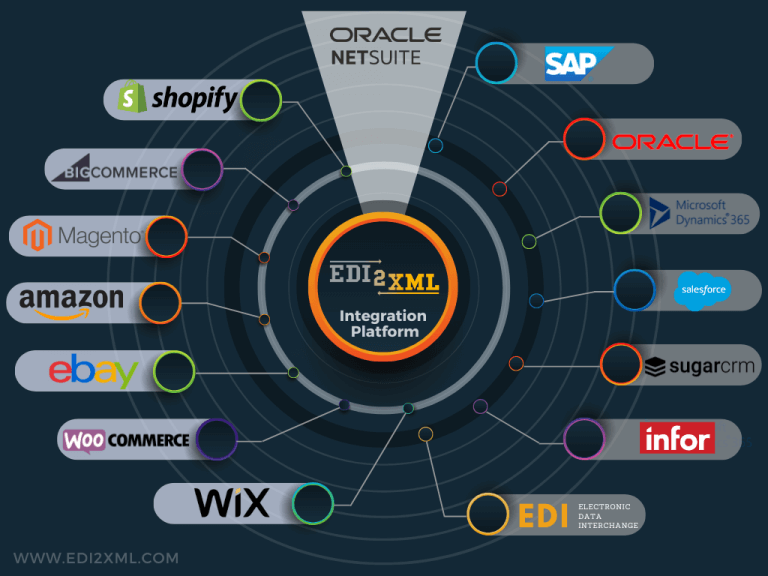
Our company provides NetSuite integration services with e-commerce platforms.

With over 20 years of experience in system integration, we know the ins and outs of NetSuite integration.

By leveraging our experience in NetSuite and e-commerce integration, businesses can take advantage of the many benefits that NetSuite offers. Whether you’re looking for integration with Magento, Shopify, BigCommerce, WooCommerce, Salesforce Commerce Cloud, or SAP Hybris, we have the experience to make it happen.

Contact us today for a free consultation to learn more about how we can help you with your integration project.


February 3, 2023/0 Comments
https://www.edi2xml.com/wp-content/uploads/2023/02/Netsuite-integration-edi2xml.com_-.png 576 1024 Tatyana Vandich https://www.edi2xml.com/wp-content/uploads/2024/08/edi2xml.com-EDI2XML-company-logo.png Tatyana Vandich2023-02-03 12:16:412025-02-11 10:26:29E-commerce Automation: How to Integrate NetSuite with E-Commerce Platform

Maximizing Efficiency and Accuracy with NetSuite Integration

Blog

What is Oracle NetSuite ERP?

Oracle NetSuite is a cloud-based enterprise resource planning (ERP) software suite used by businesses of all sizes. It provides a comprehensive set of modules to help manage finances, operations, customer relationship management (CRM), inventory, and more. Its core modules are designed to help optimize financials and operations, while its advanced modules offer customizability and flexibility.

Oracle NetSuite also offers integration and customization options, allowing businesses to connect their existing business systems and customize workflow to meet their specific needs. Additionally, Oracle NetSuite provides industry-specific solutions for retail, manufacturing, and services businesses.

Introduction to NetSuite Integration

One of the key benefits of using NetSuite is its ability to integrate with other systems and applications. In this blog, we will explore the various ways in which NetSuite can be integrated and the benefits of doing so.

Methods for Integrating NetSuite

There are several methods for integrating NetSuite with other systems. One of the most common methods is through the use of APIs (Application Programming Interfaces) or web services. NetSuite offers a range of web services, that allow developers to build custom integrations between NetSuite and other systems. These web services can be used to extract data from NetSuite, update records, or trigger actions within the system.

To efficiently integrate with NetSuite, we recommend the use of third-party integration platforms like Magic xpi.


USEFUL READING: Magic xpi Integration Platform: The Best Fit for Enterprise Data Integration


Magic xpi integration platform provides pre-built connectors to easily connect NetSuite with other applications and business systems such as Salesforce, SAP, Microsoft Dynamics, and many more. This can be a quick and cost-effective way to integrate with NetSuite, as the connectors are pre-built and require little configuration.


NetSuite Integration with E-commerce

Oracle NetSuite integration with e-commerce platforms such as BigCommerce, Magento, Shopify or Amazon allows businesses to streamline their online operations and improve customer experience. With the integration, businesses can easily manage their entire e-commerce operations cycle from a single platform. It allows businesses to track orders, inventory, customers, and payments all in one place.


USEFUL READING: E-commerce integration: How to integrate Shopify, BigCommerce, Magento, with ERP/CRM systems


The integration also provides businesses with access to powerful analytics tools that help monitor and analyze customer behavior and preferences. The integration of business systems and e-commerce helps track and analyze orders and customer preferences. This allows companies to improve their e-commerce operations and customer experience.

EDI Integration with NetSuite

EDI (Electronic Data Interchange) is a common method for exchanging business information such as purchase orders (EDI 850), invoices (EDI 810), Inventory Inquiry/Advice (EDI846) and many more EDI documents electronically.

One way to integrate NetSuite with EDI is to use Fully Managed EDI Service. This service allows incoming EDI documents to be converted into a format that can be processed by NetSuite. Fully Managed EDI service ensures that all incoming EDI documents are automatically imported into NetSuite without requiring manual data entry. For outgoing documents, the managed EDI service converts them to the required format (e.g. X12) and sends them to your business partner.

Netsuite-EDI
 

Alternatively, businesses can use an HTTP EDI Web Service (REST API) to integrate EDI with NetSuite. Companies can use the EDI2XML REST API service to send and receive EDI documents such as invoices, purchase orders and other. The API supports X12 and EDIFACT standards, as well as other EDI document standards.

Regardless of the method used, integrating NetSuite with EDI can help businesses streamline their operations and reduce the need for manual data entry and document handling.

Benefits of Integrating NetSuite

There are several benefits to integrating NetSuite with other management systems, application, ecommerce, or EDI. One of the most significant benefits is the ability to share data across systems. By integrating NetSuite with other applications, businesses can avoid the need to manually enter data into multiple systems, which can save time and reduce the risk of errors.

Integration can also improve the accuracy and quality of data. By connecting NetSuite with other systems, businesses can ensure that all data is up to date and consistent across all systems. This can be especially useful for companies that rely on real-time data for business operations or decision-making.

Another benefit of integrating NetSuite is the ability to automate processes. By connecting NetSuite with other systems, businesses can set up automated workflows that trigger actions or updates in one system based on events or data changes in another system. This can help businesses streamline their operations and reduce the need for manual intervention.

NetSuite Integration: Conclusion

In conclusion, NetSuite integration is a powerful way for businesses to improve efficiency, accuracy, and automation. By connecting NetSuite with other systems and applications, businesses can share data, improve the quality of data, and automate processes. Whether through APIs or third-party integration platforms, NetSuite integration is an important consideration for businesses looking to get the most out of their technology investments.

Free  consultation
January 30, 2023/0 Comments
https://www.edi2xml.com/wp-content/uploads/2023/01/NetSuite-Integration-EDI2XML-1.png 675 1200 Tatyana Vandich https://www.edi2xml.com/wp-content/uploads/2024/08/edi2xml.com-EDI2XML-company-logo.png Tatyana Vandich2023-01-30 14:59:552025-12-01 09:30:21Maximizing Efficiency and Accuracy with NetSuite Integration

How Do Companies Send EDI Files?

Blog

What is EDI? Explain Electronic Data Interchange (EDI) and Its Role in B2B Automation

The Electronic Data Interchange (EDI) standard was developed by the American National Standards Institute (ANSI). It allows companies to exchange information about products, services, orders, and payments electronically in a standardized format.

Therefore, EDI is a technology that replaces the exchange of paper/file information between business partners with an automated exchange between their computer systems.

EDI is used by many different types of organizations, including banks, insurance companies, healthcare providers, manufacturers, and retailers.

EDI automation
 

List the Top Benefits of EDI for B2B Communication and Supply Chain Efficiency

EDI (Electronic Data Interchange) implementation is a great way for automating business-to-business (B2B) processes. EDI allows companies to exchange business documents such as purchase orders, invoices, etc. in a standardized electronic format, eliminating the need for manual data entry and reducing the risk of errors.

By automating these processes, EDI can help companies to improve efficiency, reduce costs, and increase accuracy in their B2B operations. Furthermore, implementing EDI can help companies to streamline their supply chain and improve communication with business partners.

Here are some key advantages:

1. Efficiency and Speed:

Faster Transactions: EDI enables the exchange of business documents in a standardized electronic format, reducing the time required for processing orders, invoices, and other documents.

Real-Time Processing: EDI facilitates real-time data exchange, minimizing delays associated with traditional paper-based methods.

2. Accuracy and Error Reduction:

Automated Data Entry: With EDI, data is entered automatically into the recipient’s system, reducing the likelihood of manual errors associated with manual data entry.

Data Validation: The EDI 997 (or EDI Functional Acknowledgement), ensures that data is accurate and ensuring the integrity and reliability of EDI transactions.

3. Cost Savings:

Reduced Paper and Printing Costs: By eliminating the need for paper documents, printing, and manual handling, EDI helps businesses save on material and operational costs.

Lower Administrative Costs: Automation of document processing reduces the need for manual intervention, leading to cost savings in terms of labor and resources.

4. Enhanced Visibility and Tracking:

Transaction Visibility: Businesses can track the status of transactions in real-time, providing better visibility into the supply chain and allowing for proactive management of processes.

Audit Trails: EDI systems often maintain detailed audit trails, which can be valuable for compliance purposes and resolving disputes.

5. Improved Customer Relationships:

Faster Response Times: Quicker order processing and communication lead to faster response times, enhancing overall customer satisfaction.

Reduced Errors: Fewer errors in order fulfillment and invoicing contribute to positive customer experiences.

6. Compliance with Industry Standards:

Regulatory Compliance: EDI often adheres to industry-specific standards and regulations, ensuring that businesses comply with relevant requirements in their sector.

7. Environmental Impact:

Reduced Environmental Footprint: The move from paper-based to electronic transactions contributes to environmental sustainability by reducing paper usage and waste.

In summary, EDI in B2B communication offers a range of benefits, including increased efficiency, accuracy, cost savings, security, and improved relationships with trading partners. It has become an integral part of modern supply chain management and business operations.

How to Automate B2B Processes with EDI: Step‑by‑Step Guide

If your company decides to implement EDI in order to exchange EDI files with your business partners, there are several important parameters to help in this decision:

1. Compare EDI Standards (X12 vs. EDIFACT vs. HL7 vs. RosettaNet) for Your Industry

The EDI standard prescribes mandatory and optional information that must be contained in each document, as well as established rules for the structure of the document.

In most cases, an EDI standard is selected based on the location of the company or its industry. It is more common in North America to use the X12 standard. European Union companies mostly use EDIFACT. HL7 is a standard used for processing medical data. RosettaNet is used in the electronics and semiconductor industry.

These articles can help you learn more about standards:

  • ANSI ASC X12 Standards Overview
  • What is EDIFACT? | UN / EDIFACT standard overview
  • Introduction to HL7 Standards (Health Level 7)
  • RosettaNet and B2B EDI Integration: All you need to know

2. What Kind of EDI Documents Will You Exchange with Your Business Partner? 

Typically, large companies dictate which EDI documents they require. Thus, if your business partner requires the exchange of documents in electronic format, most likely he already has a specific list of documents. An EDI document typically contains the same information as a paper document.

The following are some of the main documents that are exchanged electronically:

  • Invoice (EDI810)
  • Purchase Order (EDI 850)
  • Purchase Order Acknowledgment (EDI855)
  • Advanced Ship Notice (ASN) /Manifest (EDI 856)

However, EDI is not limited to business data related to trade but covers all areas such as medicine (for example, laboratory test results), transportation (container information), insurance, etc.

Take a look at the full list of EDI documents that you can exchange with your business partners. List of EDI documents in X12 standard and EDIFACT.

3. Evaluate EDI Communication Protocols: FTP, SFTP, AS2, and VAN Explained

Unlike an EDI standard or a list of EDI documents that your trading partner may require you to comply with, you will most likely be able to choose which EDI communication protocol you will use.

One of the most critical aspects of exchanging EDI documents is the way information is transferred. Thus, you need to decide how you will send and receive EDI files.

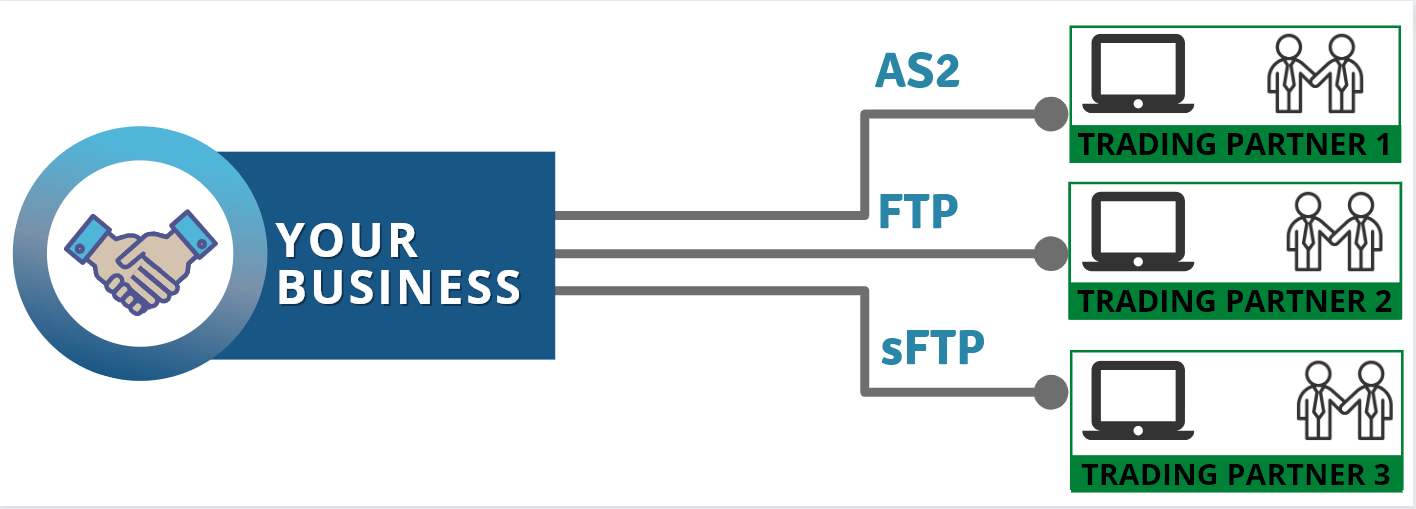
There are several different methods for sending EDI files. Here we will take a closer look at the most frequently used EDI protocols: FTP and SFTP, AS2 and VAN.

What is EDI Communication Protocol?

EDI communication protocols are the methods and technologies used to send and receive electronic data interchange messages. They are used to transfer data between businesses.

EDI Direct Connection (Point-to-Point Connection)

Direct connection allows you to transfer your EDI data directly from your computer to the computer of your business partner. A direct EDI connection can be made via VPN (Virtual Private Network), FTP (File Transfer Protocol), SFTP (Secure File Transfer Protocol), and AS2, which encrypts data before it is sent over the Internet.

EDI-communication
 

Compare Secure EDI File Transfer Methods: FTP vs. SFTP in Practice

FTP/SFTP – File Transfer Protocol/Secure File Transfer Protocol. In order to exchange EDI documents, businesses use these file transfer protocols to connect with their partners over the Internet.

There are a lot of benefits to using SFTP for transferring encrypted files since it is an easy-to-use protocol. Encryption calculations and public/private keys protect data transferred between the SFTP server and the client. The combination of these two elements provides robust protection known as public-key authentication. It is also possible for users to authenticate transmissions using an SSH key or a password.

AS2 (Applicability Statement 2) for EDI Communication

By encrypting EDI data and using digital certificates, AS2 provides a secure method of exchanging documents over the Internet.

The AS2 protocol has become widely adopted and implemented because of the internet’s popularity and HTTP’s leveraging.

AS2 uses a secure HTTPS connection and encrypts messages. The AS2 protocol allows enterprises to exchange EDI data in real-time and directly between their systems.


Walmart was one of the first companies to adopt AS2 for EDI communications. All of its suppliers were required to use the same protocol.


VAN (Value Added Network)

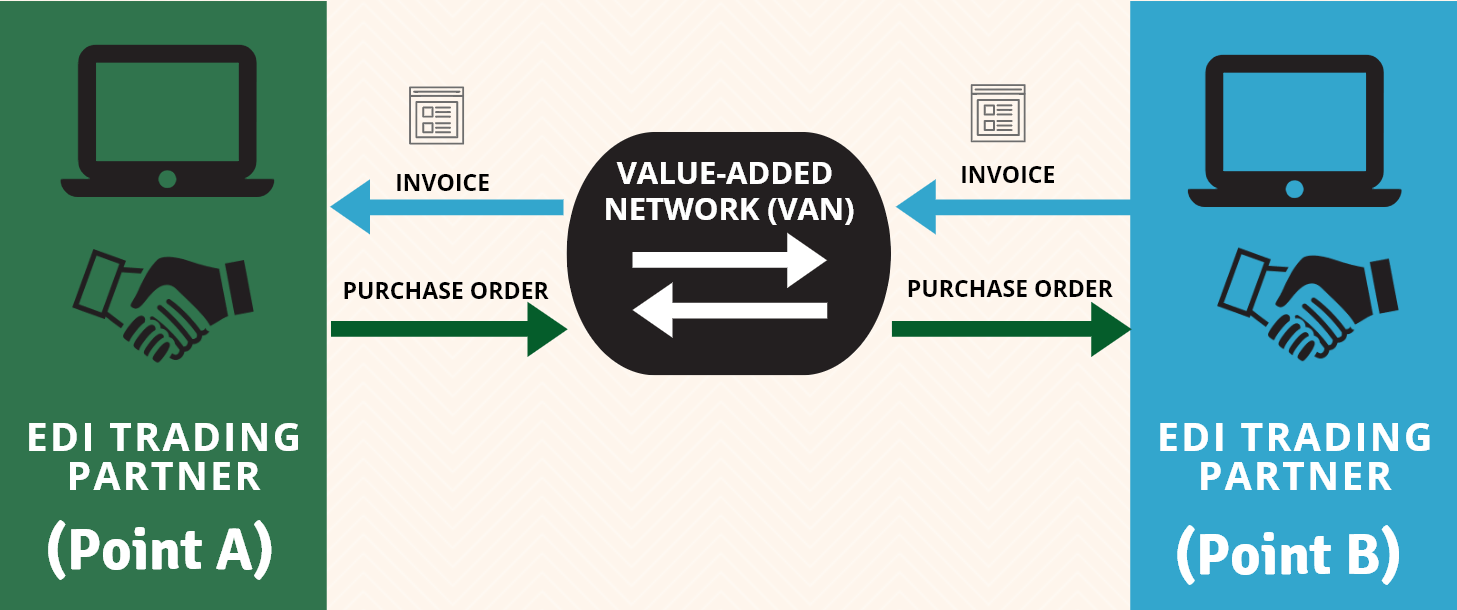
VANs (value-added networks) are private, hosted services that are designed to provide companies with a secure way to exchange EDI information with their business partners.

VAN can be compared to a “post office” where business partners can collect and sort incoming EDI documents.


It is estimated that only a small number of businesses currently use VANs. It is because of the low cost of the Internet and the level of security that can be achieved using Internet communication protocols. Point-to-point communications have become the norm for most of the “big players” in retail.

Conclusion: How Do Companies Send EDI Files? 

Does your partner require an EDI document exchange?

If you do not know where to start, don’t hesitate to get in touch with us. Our EDI experts will be happy to help you make the right decision and answer all your questions.

Free IT Consultation
December 5, 2022
https://www.edi2xml.com/wp-content/uploads/2022/12/EDI-Files.png 675 1200 Tatyana Vandich https://www.edi2xml.com/wp-content/uploads/2024/08/edi2xml.com-EDI2XML-company-logo.png Tatyana Vandich2022-12-05 09:17:422025-04-22 13:50:53How Do Companies Send EDI Files?

SAP S/4HANA Magento Integration

Blog

What is SAP S/4HANA?

SAP S/4HANA is a next-generation enterprise resource planning (ERP) system developed by SAP AG. It was released in 2015 and is currently being rolled out across various industries. SAP S/4HANA is designed to help companies manage their entire business processes from sales to finance to human resources.

SAP S/4HANA combines the best of both worlds: cloud computing and on-premises solutions. With SAP S/4HANA, you get the benefits of cloud computing without having to worry about managing servers and data centers.

With SAP S/4HANA, you can manage your entire business from anywhere at any time, whether you’re working from home, traveling, or sitting in front of your computer. You can access your data from any device, and you can use it to automate processes, streamline operations, and improve customer service.


What is Magento?

Magento is a free open-source eCommerce software solution that helps businesses sell online. It is built on PHP and MySQL and supports multi-store functionality that provides online merchants with a flexible shopping cart system and control over the look, content, and functionality of their online store.

It is compatible with many payment gateways including PayPal, Stripe, Authorize.net, etc. It was first developed by Varien Inc., and later acquired by Adobe Inc. Magento is known for its robust features, scalability, and customization capabilities, making it a popular choice for businesses of all sizes.

What is Integration?

Integration is the act of connecting two or more systems together. In this case, we are going to discuss about connecting SAP S/4HANA and the Magento e-commerce platform.

This integration is essential for businesses that use both SAP for their enterprise resource planning (ERP) needs and Magento for their online sales and e-commerce operations.


Have a question about integration? Book a FREE one-on-one consultation with our integration expert.


The Power of SAP S/4HANA for Magento Online Store

SAP S/4HANA integrates with Magento Commerce, allowing you to create an online storefront using the power of SAP.

The integration between SAP S/4HANA and Magento allows you to create a single view of all your business processes across multiple channels. You can easily manage your inventory, sales, marketing, and service operations through the unified interface.

e-commerce automation and integration with ERP and CRM
 

B2B Customer Data Synchronization from SAP S/4HANA to Magento

Usually, the source for B2B customers master data is considered to be SAP’s S/4HANA. Thus, existing B2B customers in S/4HANA can be imported into Magento, and their contact persons are automatically registered as users. They can place orders on behalf of the company.

Based on S/4HANA data, the following B2B customer information is synchronized with Magento.

  • General information about the company, such as its name, address, and email address
  • Details about the company’s contact persons.
  • The address of the company to use for delivery.
  • Company credit Information
SAP Integration
 

The Most Popular S/4HANA – Magento Integration

In order to get the most out of SAP and Magento integration, companies typically sync the following entities:

Products – the e-commerce store owners can synchronize products between SAP and Magento. The synchronization process includes all product information, including product specifications, categories, product types, images, prices, etc.

  • Products. The most critical integration is synchronizing the entire product catalog between SAP S/4HANA and Magento eCommerce store. Integration includes product specification, product category, and product type.
  • Inventory. Inventory synchronization between the company’s SAP system and the e-commerce store.

Synchronization will provide real-time information on the availability and balance of goods in the online store. As a result, you will be able to avoid selling out-of-stock items on your Magento eCommerce store. The synchronization of inventory improves the overall efficiency of the online store and increases customer confidence and satisfaction.

  • Orders. Through the integration, you can stay up-to-date on all your orders, including payment details, status, credit notes, invoices, and shipping information.
  • Pricing. Syncing product prices will help you better manage your sales.

Synchronization of Sales Orders from B2C/Guest and B2B Customers

All sales orders placed through Magento synchronize with SAP S/4HANA almost in real time and are converted into SAP sales orders.

In this way, everything can be synchronized, such as billing data, status, credit notes, invoice, and delivery.

A B2B customer’s sales orders will be recorded in SAP with their SAP customer number. Furthermore, any purchase made with credit by a B2B customer will also update the credit usage status in Magento.

Benefits of SAP S/4HANA on Your eCommerce Business

  • Integration brings together a lot of disparate data to keep your business running smoothly. The company’s employees have easy access to all relevant information from orders and delivery, to communication with customers and product procurement processes.
  • The integration of ERP with an e-commerce store eliminates manual data entry and prevents information redundancy caused by data transfers between systems, saving time and preventing errors.
  • The integration of Magento and SAP allows to generate and analyze real-time reports, making it easier to keep up with the fast-paced e-commerce environment without having to wait for data to be transferred or information to be collected from multiple sources. This will allow you to instantly adjust processes and make the necessary management decisions, which can save you money.
  • Integration improves customer relations, as well as provides easy access to information for sales representatives and customer support. As a result, brand loyalty and sales increase.
  • Saving. While SAP integration with Magento requires some investment, it saves businesses money in the long run. How does it work? As a result of automating internal business operations, the company will be able to reduce transaction costs. In addition, the accuracy of the information provided will lead to a higher level of customer satisfaction, and ultimately to higher profits for the company.

Conclusion: SAP S/4HANA Magento Integration

SAP S/4HANA is a new-generation enterprise application suite that includes a range of products designed to help companies manage their data, processes, and people. Integration of SAP with Magento helps businesses manage customer information, inventory, and financial transactions. It also helps companies streamline business processes and improve efficiency.

With over 20 years of experience integrating ERP systems with e-commerce platforms and many successful projects under our belts, we are always happy to help you. Integrating SAP ERP with Magento with the help of professionals will save you time and money.

Please feel free to contact us if you would like to schedule a free consultation with one of our integration experts.

Retail automation
October 24, 2022/0 Comments
https://www.edi2xml.com/wp-content/uploads/2022/10/EDI2XML-SAP-Magento-Integration.png 675 1200 Tatyana Vandich https://www.edi2xml.com/wp-content/uploads/2024/08/edi2xml.com-EDI2XML-company-logo.png Tatyana Vandich2022-10-24 11:42:092025-11-28 12:17:58SAP S/4HANA Magento Integration

All You Need to Know About Global Trade Item Number (GTIN)

Blog

GTIN: Introduction

Our blog covers the most relevant topics for retailers, such as EDI and how it is used in retail and the supply chain. We shared useful information about integration with e-commerce platforms such as Amazon, Shopify, BigCommerce and many others.

In this article, we are going to discuss Global Trade Item Number – GTIN, which is an important topic for all retailers. We will look at what a GTIN is, what it is for, how to get it, why a GTIN is needed in e-commerce and many other important aspects related to global retail and commerce.

What is GS1 US

GS1 US is part of GS1 which is one of the largest non-profit international organizations responsible for identification standardization and bar coding of goods.

GS1 is an international standards organization that develops and maintains global standards for business communication and identification systems. The organization’s main focus is on the development and implementation of barcoding and electronic product code (EPC) standards.

The most widely known of these standards – Barcodes are symbols printed on products that can be scanned electronically.

The GS1 US maintains and develop best practices of the use of a number of other standards that support the supply chain, but the most significant is the GTIN – Global Trade Item Number. GTIN allows products to be uniquely identified around the world and represent the basis of the GS1 system.

GS1 US provides services, education, and support to companies in the United States to help them implement and utilize these standards effectively. The organization facilitates the adoption of GS1 standards, such as the Global Trade Item Number (GTIN), which is a unique identifier for products, and the Global Location Number (GLN), which is used to identify physical locations in the supply chain.

What is Global Trade Item Number GTIN?

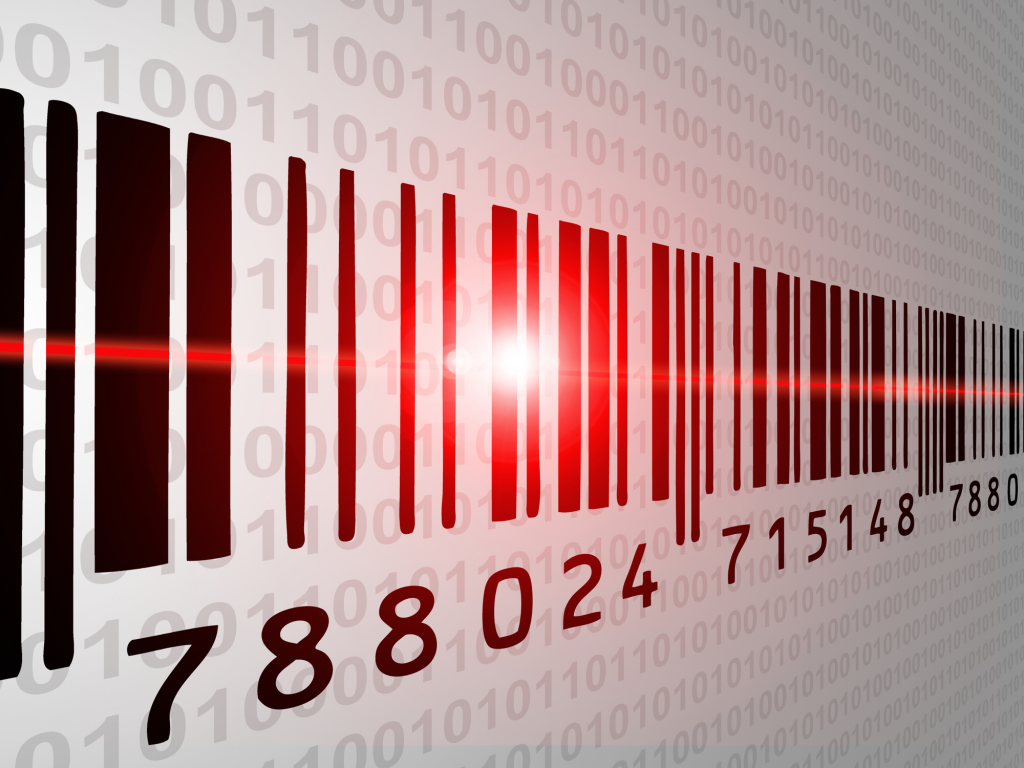
Global Trade Item Number is also known as GTIN. The GTIN is a number encoded into a barcode that allows you to identify any trade item. The GTIN barcode uses only numbers. Letters or other symbols are not allowed.


The term trade item refers to an item that is subject to trade. It is a term used mainly in supply chain management. The trade item has one or more distinctive characteristics such as size, composition, appearance, etc. in relation to other goods. Trade items include not only single products, but also whole boxes, pallets, and other shipping containers.


There is a GTIN on every package. It looks like a set of numbers. They are also presented as a barcode so that the scanner can quickly read them. GTIN-marked goods are included in the unified international GS1 database.

It is possible for a batch or multiple batches of the same product to have the same GTIN. However, a new GTIN is registered for each distinct product item.

Any change in a product such as composition, package, net weight, etc. requires a new GTIN.


Since GTIN is an international identifier, the same GTIN number cannot be assigned to another product anywhere in the world.

Why Do Companies Need a GTIN?

A GTIN is an essential part of product labeling. Typically, the manufacturers or importers of the product are responsible for obtaining the GTIN. You cannot generate GTINs yourself, as only GS1 assigns Trade Item Numbers.

Where is the GTIN Used?

GTIN in a global supply chain

The GTIN is required for labeling and logistics in the global supply chain. GTIN allows you to uniquely identify products and find them in databases. It is used at all stages of the supply chain from manufacturers to distributors, namely:

  • in distribution centers
  • in retail and wholesale trade
  • in warehouses
  • in 3PL logistics
  • in EDI (for example, in documents such as purchase orders and invoices)
  • in accounting and so on.

GTIN in advertising

It is also necessary to have a GTIN in order to promote goods online.

For example, to place an official commercial or announcement in the Google advertising service, you need to fill in the “GTIN” column. So the search engine understands what product is being advertised. It checks if they sell a product prohibited by law and looks for alternatives with a different price.

How to Get a GTIN?

It is possible to receive an authentic GTIN in two different ways:

GTIN for small busimess

For small businesses, the most cost-effective option is to license individual GS1 US GTINs for $30 each. The identification number is generated automatically in this case.

A second way is to license a GS1 Company Prefix if your business is planning to launch 10 or more products.


This license lets brands create authentic GTINs in bundles of 10, 100, and more. For businesses that license a GS1 Company Prefix, a GTIN is generated from their Prefix.

Companies are linked to products through the Prefix, which represents the first few numbers of the GTIN.

GTINs issued by GS1 US are automatically added to the GS1 Global Registry, a database used by retailers and online marketplaces to verify product identification. 

A certificate of ownership will also be provided for either option, ensuring authenticity for retail partners. 

The Importance of GTIN for E-commerce

Major retailers, online stores, and marketplaces such as Amazon, require companies to provide a GTIN for all products they deal with.

GTINs are often required by online marketplaces in order to verify that sellers are selling legitimate products and to support inventory management.

Marketplaces may hide your product listings if they are not identified with an authentic GTIN.

The Importance of GTIN for Resellers

Global Trade Item Numbers (GTINs) play a crucial role in the world of reselling products, and their significance cannot be overstated. These unique identifiers are essential for product identification and are integral to efficient supply chain management. Here’s why GTINs are indispensable for resellers like you:


Product Identification: GTINs are like fingerprints for products. Each GTIN corresponds to a specific item, allowing for accurate and standardized identification across various platforms and marketplaces. By using GTINs, resellers ensure that the products they offer are correctly recognized, reducing the risk of confusion and errors during the listing process.

Supply Chain Management: In the vast landscape of global trade, a seamless supply chain is crucial for success. GTINs facilitate efficient supply chain management by enhancing product visibility and traceability. These unique identifiers allow for better inventory management, easier tracking of stock movement, and streamlined order fulfillment processes.

Compatibility with Various Platforms: GTINs adhere to universal standards, making them compatible with multiple e-commerce platforms and marketplaces. As a reseller looking to expand your reach and list products on different online channels, having GTINs associated with your inventory is essential. Many popular e-commerce platforms, including Walmart Marketplace, rely on GTINs for proper product categorization and identification.

By using GTINs, you increase the chances of your products being displayed accurately on these platforms, maximizing visibility and potential sales.

Expert Advice for Resellers on Walmart Marketplace

As a re-seller on Walmart Marketplace, you may have questions about how to handle Global Trade Item Numbers (GTINs) for the products you list. We reached out to a GTIN specialist from GS1 US for expert advice to address your concerns.

According to the specialist, if your company is a re-seller of a product and you are not making any changes to the packaging, adding your brand name, or altering the product in any way, you have to use the original GTIN/UPC provided by the manufacturers. In this scenario, there is no need to create your own Company Prefix (GTIN) via GS1.org. Walmart can identify your brand, as the seller using the existing GTINs associated with the products.

This means that if you have permission from the suppliers and manufacturers to resell products without any modifications, you should utilize the original GTIN/UPC for each product. Doing so will streamline the identification process for Walmart, and you can confidently list your products on their platform.

U.P.C. vs GTIN

A Universal Product Code (U.P.C.) is the most commonly used type of barcode symbol printed on retail product packaging which contains GTIN information. 

In retail systems, U.P.C. used to capture GTIN numbers through scanning.

Thus, the U.P.C. represents a barcode symbol with black lines, while the GTIN describes the numbers that identifies a product.


Many online sellers mistakenly believe that a U.P.C. and GTIN are interchangeable and mean the same thing.

As e-commerce has evolved, more and more GTINs are being used on their own in product listings on the Internet. It serves as a link between the physical presence of a product and its digital identity, and it also allows you to verify the legitimacy of the product. As a result of the use of U.P.C. barcodes and GTINs, businesses have the ability to track their products more easily. 

A number of online retailers and marketplaces check all GTINs provided to them against the GS1 database. If vendors’ GTINs are found to be invalid, they may be delisted.

Which Products Do Not Require a GTIN?

There is a small category of products that do not need GTIN:

  • exclusive – a unique product in a single copy;
  • antiques – antiquities are not assigned GTIN;
  • handmade – handmade crafts differ from each other, so they cannot have a classifier
  • collectible models – which are not mass-produced;
  • used products – everything that has already been used by someone cannot have a repeated GTIN.

Benefits of Using a GTIN

GTIN significantly improves the processes associated with the receipt, movement or sale of goods. By using a code reader in warehouse inventory, employee errors are reduced to almost zero because basic tasks are performed automatically.

GTIN also makes it easy to transport goods through customs. Customs checks GTIN numbers on packages and accompanying documents.

Conclusion: All You Need to Know About Global Trade Item Number (GTIN)

GTIN is helpful for working with documentation, organizing, and searching for goods in warehouses and stores (acceptance, accounting, and shipment), in accounting systems, when automating inventory management, in payment documents and when placing orders, in delivery documents, etc. In electronic data interchange (EDI), GTINs serve as links to refer to the master data, which drastically reduces the amount of information transmitted by a trading partner.

Thus, the standards developed by GS1 US and GS1 globally enable businesses to improve supply chain efficiency, enhance product traceability, enable accurate and efficient inventory management, and facilitate electronic data exchange between trading partners. These standards are widely used in industries such as retail, healthcare, foodservice, logistics, and more.

Need Help?

Our company helps retailers launch, automate, and build efficient business processes. If you have questions, please contact us to schedule a free consultation with one of our experts.

Retail automation
September 26, 2022/0 Comments
https://www.edi2xml.com/wp-content/uploads/2022/09/EDI2XML-GTIN-1.png 675 1200 Tatyana Vandich https://www.edi2xml.com/wp-content/uploads/2024/08/edi2xml.com-EDI2XML-company-logo.png Tatyana Vandich2022-09-26 13:35:352026-02-05 17:01:17All You Need to Know About Global Trade Item Number (GTIN)

The Advantages of Business Automation through EDI

Blog

Today, there are still decision-makers who are debating whether to invest in EDI integration projects or to hire a few new employees to manually enter and process data from trading partners.

Since EDI is still a difficult topic for non-technical people to understand, hiring data entry administrators may seem like a reasonable choice. It is commonly believed that EDI requires a significant initial investment.

Let’s take a look at what EDI automation is and how companies can find the most cost-effective solution.

What is EDI Automation?

EDI (electronic data interchange) is a technology used by business partners to exchange business electronic documents in standard formats without requiring human intervention.

These exchanged documents are called – EDI Transaction Set. If you want to see the full list of documents that can be exchanged in EDI format check our Complete List of EDI X12 Codes.

 
What is EDI
 

How Does EDI Benefit Businesses?

The use of EDI greatly improves the overall state of the business as it has many benefits.

– Reducing costs. Saving time for employees to process documents and enter them into databases. EDI reduces an enterprise’s printing, shipping, and storage costs.

– Speed. Documents can be exchanged instantly with a business partner. You won’t lose documents along the way or among the papers on your desk.

– Automation. EDI significantly improves the business because it automates processes and reduces the time delays associated with manual data entry.

– Accuracy.  Elimination of errors associated with manual data entry.

Useful: Download our free Guide “Introduction to EDI Communication” to learn more about EDI

What Documents are Used in EDI?

As mentioned above, you can exchange almost any type of document using EDI, but the most common ones are:

Purchase Order – EDI 850

Useful Reading: All You Need to Know About EDI ANSI X12 Transaction Set 850 Purchase Order


Invoice – EDI 810

Useful Reading: What is an ANSI ASC X12 EDI 810 Invoice?


Purchase Order Acknowledgment – EDI 855

Useful Reading: What is EDI 855 Purchase Order Acknowledgment?


Inventory Inquiry/Advice – EDI 846

Useful Reading: What is EDI 846 document?


Advanced Ship Notice (ASN)– EDI 856

Useful Reading: What is Advanced Ship Notice (ASN) 856 Transaction Set?


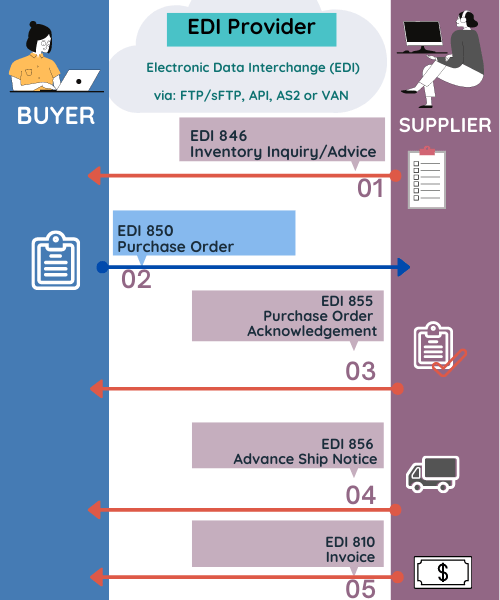
Below is an example of an EDI flow between trading partners.


Types of EDI (Electronic Data Interchange) Solutions

Currently, many EDI providers offer various EDI solutions. There is no one-size-fits-all EDI solution for every company. A company should evaluate which option will be most cost-effective for its business model. Thus, the main offers on the EDI market are:

  • Managed EDI
  • Web EDI
  • On-premises EDI

Our company offers all three named EDI solutions. If you don’t know which solution is right for you, contact our experts for a free consultation.

EDI Document Business Flow

1. One business partner (generally the buyer) generates a document (i.e. Purchase Order) in his internal ERP system (i.e. SAP, Microsoft Dynamics, JD Edwards, etc.). Depending on the company’s business process, the document can be generated automatically or manually.

2. EDI providers can either pick up the generated document directly from the company’s ERP system, or they can transfer it to them.

3. The EDI provider converts the document into an X12 EDI transaction set. After conversion, suppliers receive an EDI X12 document.

What is the Fastest Way to Connect to EDI?

With EDI2XML and its “HTTP EDI Web Service (REST API)” model, companies can connect their EDI partners in less than one hour! EDI web services reduce the cost of EDI integration projects and improve efficiency and accuracy in a short amount of time.


As a result of using the EDI Web Service from EDI2XML, a company can quickly and efficiently exchange business documents with its business partner.

Learn more about EDI2XML Web Service its advantages and how it works.

Request EDI2XML Web Service Price List

Free EDI consultation
July 29, 2022/0 Comments
https://www.edi2xml.com/wp-content/uploads/2022/07/EDI2XML-Automation-through-EDI.png 675 1200 Tatyana Vandich https://www.edi2xml.com/wp-content/uploads/2024/08/edi2xml.com-EDI2XML-company-logo.png Tatyana Vandich2022-07-29 14:28:322026-02-13 15:24:08The Advantages of Business Automation through EDI

Business Automation: How to Choose the Right EDI Solution

Blog

Business Automation through EDI Solution

Most entrepreneurs who have never experienced EDI before feel overwhelmed when it comes to selecting an EDI provider or solution to start exchanging business documents with their trading partner.

There are multiple EDI solutions from different big and small EDI Providers. At first blush, each EDI solution looks better than the other, but how do you choose the best EDI solution for your business?


The Electronic Data Interchange (EDI) is the exchange of business documents electronically between business partners.


In this article, I will review the main EDI solutions on the market, using the solutions from EDI2XML as an example. Additionally, I will give you useful tips on how to choose an EDI provider without losing sight of key points that will affect the long-term success of EDI.

Why You Should Be Careful When Choosing an EDI Solution?

For many organizations, EDI is a mission-critical application whose failure can lead to a complete stoppage of activity; therefore, the choice of an EDI solution, as well as EDI provider, must be approached carefully.

EDI is responsible for supporting a wide variety of business processes – inventory management, orders, purchasing, logistics, tenders, etc.

Perhaps there is no such field of activity where you can run without the exchange of documents at all, which means that EDI solutions can be needed everywhere.

Choosing the Right EDI Solution to Automate Your Business

EDI is used for B2B communication in all industries by both large corporations and the smallest companies. That is why there are different EDI solutions designed for different markets and companies.

EDI allows businesses to exchange documents quickly since it eliminates the need to prepare and process mail or to make phone calls, faxes, or paperwork when ordering or selling.

By choosing the right EDI solution, you will make it easier to communicate with your business partners and bring value to your business.

EDI automation
 

For example, if you are a small company that has only one trading partner that requires EDI exchange, you need a simple EDI solution that does not require a large initial investment, which will allow you to quickly start exchanging EDI documents with your business partner.

Continuing on the topic of EDI solutions, let’s take a look at the different options of EDI solutions on the market, using the example of EDI2XML as EDI service provider.

It should be remembered that the details of EDI solutions from different EDI providers always differ. However, the description below will give you a general idea of the existing EDI solutions.

Fully Managed EDI Services

EDI fully managed service refers to a service where the EDI provider takes full responsibility for managing EDI operations and integrating them on behalf of the client.

With Fully Managed EDI Service, there is no need for customers to install any software or hardware on their computers. The EDI provider will take care of the implementation and configuration of the process flows. He will be in charge of handling the data routing and will be responsible for the data format conversion and integration.

Through the fully managed EDI service, an EDI provider will take on a wide range of responsibilities that are usually handled by an internal IT department. With a fully managed EDI solution, EDI2XML delivers a turnkey project to connect your business partners.


Which Companies Can Benefit From a Fully Managed EDI Service?

Companies that need to use EDI but don’t want to spend the time and effort on the EDI implementation themselves, or who don’t have the necessary EDI skills and specialists who can do it, need an EDI service provider to handle all the configuration and integration of EDI. In this case, a fully managed EDI service is the ideal solution.

Find out more about Fully Managed EDI Services its process flow, features, technical details and pricing.

EDI Web Service

The EDI Web Service is an HTTP service from EDI2XML that works over the internet on the private platform. This HTTP EDI Web Service (REST API) can receive HTTP requests to convert EDI messages to XML and XML messages to EDI (based on EDI2XML’s proprietary format).

There are many reasons why EDI2XML Web Service is the right choice:

1. Solution based on self-service

2. An affordable price

3. Our free trial period lasts for 15 days without any obligation, so you have nothing to lose.

4. Getting started will take you less than an hour

5. There is no contract with us, and no commitment.

6. We charge on a month-to-month basis; you can cancel at any time with 30 days’ notice.

7. There is a very simple and dynamic pricing scheme that is easy to understand and use

8. The availability and reliability of the service

9. Using proven technologies that are backed by a wealth of experience 

10. Support from a highly skilled technical team is outstanding

It is very simple and quick to get started with the EDI2XML Web Service. Within less than an hour, you can make the first Call to the Web Service and see the response. 

We offer a well-documented HTTP EDI Web service, and each subscription includes instructions.  

Cloud Services EDI
 

Who is the EDI Web Service For?

The EDI web service is intended for developers and enterprises who want to create their own EDI (Electronic Data Interchange) integrations.

Typically, these users can interact with external APIs and web services to convert EDI to XML and XML to EDI. Additionally, they have the expertise and resources to work with web services and HTTP requests.

EDI2XML Web Service is a reliable service for IT professionals who need to perform such integration projects.

We suggest EDI Web Service to companies that have their own technical resources to work with REST APIs (calls and consumptions of HTTP Rest Web services).

Request EDI2XML Web Service Price List

On-Premises EDI Solution

On-premises EDI refers to the implementation of EDI software that is installed and operated through the customer’s own server and computing infrastructure.

On-premises EDI deployment from EDI2XML involves two components that will be deployed on-premises:

1. EDI2XML translation and transformation engine to convert X12/EDIFACT messages to XML and vice versa.

2. A license of Magic xpi a third-party integration and automation platform.


Read more about Magic xpi integration platform as the best fit for enterprise data integration


Features of the EDI2XML service “on premises”

1. The application is deployed on the customer’s server

2. Service that is based on a subscription

3. There is a standard XML format for incoming EDI messages

4. Standard XML format for Outgoing X12

5. XML schemas (.xsd) are also provided

6. SMTP/FTP/sFTP protocols are included in the package

EDI-On-Premises solution
 

When On-Premises EDI is is Right for You?

On-premises EDI is suitable for companies that have strict IT management rules and procedures that they can only deploy software solutions on their own premises.

You should also consider how much EDI data you want to exchange with your business partner. If you expect a very large volume of data, you might consider an on-premises EDI solution. A company’s IT architecture and its team play a vital role in implementing EDI on-premises. Make sure the company has the proper hardware infrastructure, and that the IT department is ready to tackle this project.

Request EDI On-Premises Pricing Plans

Choosing an EDI Provider: What to Look For

Now that we’ve discussed the main types of EDI solutions, let’s talk about what to look for in an EDI provider. There are several different kinds of EDI service providers available.

In developed markets, as a rule, a large service provider gets almost everything – the vast majority of customers start using its product because they do not bother with in-depth analysis of technologies and services, but use the same thing that other companies or business partners utilize.

It is for this reason that demonstrations of a large number of customers are one of the most popular marketing techniques. Of course, a large customer base may indicate the reliability of the EDI provider (which does not always correlate with the quality of the EDI solution, price flexibility, service, and technical support) that you can get from smaller EDI providers.

The following are some basic recommendations about what you should look for when choosing an EDI provider for your company.

– Exclude sales and market share statistics from your list of EDI provider criteria.

– Rely on relatively new projects that are comparable in scope to your organization as references.

– It is critical to pay attention to how quickly the company responds to your requests when you contact them.

– A provider of EDI services should be able to connect you with technical experts for a personalized consultation.

– If you need a customized quote, how quickly will they be able to provide it to you?

– How does an EDI provider support its customers? When it comes to technical issues, how quickly can they resolve them?

– Check if the prices of the company can be adjusted based on your needs.

Remember that a big EDI provider doesn’t always mean the best.

Conclusion: How to Choose the Right EDI Solution

The use of EDI has become a necessity for most companies today. Meanwhile, the choice of an EDI solution has become very difficult for companies. This is because the market for EDI solutions is currently quite large, in addition, EDI solutions in terms of technical characteristics and functionality have become quite similar to each other.

Therefore, factors such as the reliability, experience, and flexibility of the EDI provider often become the last argument when choosing an EDI solution.

If you are not completely satisfied with your EDI provider, then read this helpful article How to Change Your EDI Service Provider


Are you looking for ways to improve your business processes? Then look no further! Our EDI services are here to help! Our EDI experts are available to give you a free consultation if you are still unsure which EDI solution is right for you.

 
Get A Free EDI Consultation
July 12, 2022/0 Comments
https://www.edi2xml.com/wp-content/uploads/2022/07/EDI2XML-EDI_Automation.png 675 1200 Tatyana Vandich https://www.edi2xml.com/wp-content/uploads/2024/08/edi2xml.com-EDI2XML-company-logo.png Tatyana Vandich2022-07-12 15:50:422026-02-13 15:28:41Business Automation: How to Choose the Right EDI Solution

What is eBay and How Does it Work?

Blog

eBay Inc. is an American e-commerce company that facilitates online shopping with eBay, allowing sales of products and services between consumers and businesses through its website.

Since its founding in 1995, eBay has grown to become one of the most popular and successful e-commerce sites on the internet. eBay is a multinational company that operates all over the world in approximately 32 countries. At the beginning, eBay began as an online auction website but later, added the ability to purchase goods at a specified price (“buy it now” option) like a regular online store.

How Much Does eBay Take Per Sale?

The payment structure on eBay is straightforward and easy to understand. Up to a certain limit, there is no listing fee, so sellers only have to pay to list items after a limited number of free listings. Sellers also have to pay a commission on items sold. eBay withholds a portion of the sale when an item is sold. In most categories, the final fee is 12.9% of the selling price or less, plus $0.30 per order.


eBay’s goal is to make it easy for sellers to understand what they’re paying for so they can maximize their sales. Check out eBay’s seller fees page for more information about selling fees.

What’s the Difference Between eBay and Amazon?

Although both eBay and Amazon are online marketplaces, there are many differences between the two companies in terms of pricing and additional services for both sellers and buyers.

While Amazon operates as a traditional online store, online shopping with eBay offers both auction-based purchases and fixed-price transactions.

Thus, the fundamental difference is that Amazon operates like a traditional online store, while eBay is more like an auction.

In comparison to eBay, Amazon is more focused on the buyer and continuously strives to improve customer service, while eBay is more focused on the seller.

eBay Integration with Shopify

In order to expand their online businesses, companies attempt to be present on the best online marketplaces and sell through their own e-commerce stores. Since Shopify is one of the most popular e-commerce platforms for building and growing online stores, many companies around the world use it.

Often companies that have eBay accounts and their own Shopify eCommerce store face inventory management issues. Solving this problem requires automation and integration of Shopify with eBay.

The integration between a Shopify store and an eBay account allows you to manage your inventory and orders fluidly.

You have two options for performing this integration. Choose from one of the Shopify public apps in the Shopify marketplace. Alternatively, your company can integrate through a customized private application that is not available for the public, and performs the integration by accessing the backend system and data through means provided by the manufacturer, rather through custom-built widget or app.

Thus, for businesses looking to streamline online shopping with eBay, integrating their Shopify stores can help automate order and inventory management.

Why Online Shopping with eBay is a Great Choice

Online shopping with eBay offers a unique blend of variety, competitive pricing, and convenience. With millions of products listed by sellers from around the world, shoppers can find everything from electronics to collectibles in one place. eBay’s secure platform ensures that both buyers and sellers have a safe transaction process, and with options like auctions or the “Buy It Now” feature, customers can choose how they want to purchase. eBay also provides comprehensive customer support and easy return policies, making it a preferred option for online shoppers worldwide.

Read our expert blog about the best way to integrate Shopify


Choose the Best Integration provider for eBay integration with Shopify

We at EDI2XML, are a successful integration provider that have been helping our clients automate their e-commerce for over 21 years.

Contact us for a free consultation and we will help you find the best integration solution for your business.

EDI Integration and automation
July 8, 2022/0 Comments
https://www.edi2xml.com/wp-content/uploads/2022/07/EDI2XML-ebay-automation.png 675 1200 Tatyana Vandich https://www.edi2xml.com/wp-content/uploads/2024/08/edi2xml.com-EDI2XML-company-logo.png Tatyana Vandich2022-07-08 11:54:252024-09-20 12:41:42What is eBay and How Does it Work?

All You Need to Know About EDI 812 Credit/Debit Adjustment

Blog

Modern businesses are constantly striving to improve and automate their business processes, especially when it comes to supply chains. However, even the best-run supply chains can face situations where adjustments need to be made. If a problem arises with a purchase order, the trading partner uses EDI 812.

What is an EDI 812?

EDI 812, formally known as an EDI X12 812 Credit/Debit Adjustment Transaction Set, is an EDI document used by trading partners (buyer and seller) in B2B communication to indicate that adjustments have been made to a specific payment or to demand an adjustment or bill-back.

Using EDI 812 transaction, trading partners can reconcile payments with invoices and eliminate the need for paper credit or debit memos.

Who Uses The EDI 812 Debit/Credit Adjustment?

EDI 812 is used to automate B2B communications in all industries. This EDI document can be used by various companies such as:

 
  • Retailers/ grocers
  • suppliers of goods and services
  • manufacturers of goods
  • wholesalers
  • warehouses
  • 3 PL Logistics
  • transport companies (providing road, rail, sea (river) and air transportation) and many others.

When is The EDI 812 Document Used?

Trading partners use EDI 812 Credit/Debit Adjustment in various cases, the most common examples are:

  • The products that were ordered were not delivered.
  • There was a mistake in sending the products.
  • A defective, damaged, or spoiled item was received.
  • The manufacturer’s discount or retailer’s markup needs to be adjusted.
  • In the original purchase order or invoice, there was an error in the pricing.
  • There is an inconsistency in the quantity of goods delivered. For instance, when more or less goods are delivered than ordered.
  • Consumers are returning the goods to the retailer

What Information is Included in EDI 812 Debit/Credit Adjustment?

Generally, an EDI 812 document refers to a specific Purchase Order or Invoice and contains detailed information such as:

  • The number of the original PO or Invoice.
  • The total amount of the adjustment.
  • The items that are being adjusted.
  • Identification of the items.
  • Quantity of the items.
  • Credit, debit, or adjustment justification.
  • Debit/Credit Memo

EDI X12 812 Transaction Set Specification

EDI X12 812 Credit/Debit Adjustment Transaction Set is an electronic document used in the context of EDI where:

EDI – Electronic Data Interchange is a technology used to exchange commercial data between companies in a structured digital form based on regulated message formats and standards.

X12 – is a cross-industry standard for electronic exchange of business documents between business partners. In the United States, it is the most commonly used EDI standard.

812 – is a unique three-digit number to identify an EDI transaction. A three-digit code is assigned to each type of EDI document that is used in the X12 standard.

Transaction Set – is an electronic document that is the equivalent of a paper document.

The following is an example of the specification for the EDI 812 Transaction Set. The 812 contains mandatory and optional data, as with any other EDI document. Depending on the field of activity and the requirements of the trading partner, additional data may be required.

A typical structure for this document would be as follows:

EDI 812 Transaction Set Heading:

     
Segment ID Name Purpose:
ST Transaction Set Header Indicating the start of a transaction set and assigning a control number
BCD Beginning Credit/Debit Adjustment Provide the receiver with the identifying date and number for the transaction set and the monetary value of the transaction
N9 Extended Reference Information Transmit identifying information as specified by the Reference Identification Qualifier
PER Administrative Communications Contact Identification of the individual or office to whom administrative communications should be addressed
SHD Shipment Detail To specify shipment details, such as weight, quantity, and routing instructions regarding crediting or debiting returned products
N1 Party Identification Identification of a party based on type of organization, name, and code
 

EDI 812 Transaction Set Detail:

     
Segment ID Name Purpose:
CDD Credit/Debit Adjustment Detail Provide information concerning a line item adjustment  
LIN Item Identification Identifying basic information about an item  
PO4 Item Physical Details To describe the physical characteristics, packaging, weights, and dimensions of an item  
N9 Extended Reference Information Ttransmit identifying information as specified by the Reference Identification Qualifier  
SE Transaction Set Trailer To specify the end of a transaction set and report the number of segments transferred (including beginning (ST) and ending (SE) segments). SE represents the final segment of a transaction set.  
 

What Communication Protocol is Used to Send and Receive EDI 812?

At present, most companies that use EDI to communicate with their business partners do so over the Internet using FTP, sFTP, or AS2 communication protocols. For a variety of reasons, some companies may opt to use VAN, which is a more expensive solution.

Learn more about EDI communication protocols in the free EDI guide: Introduction to EDI Communication

EDI B2B Automation Through 812 Translation

The information transmitted by EDI 812 needs to be translated into a functional format for further processing or for integration into the company’s business system. Many companies use the Fully Managed EDI Services from EDI2XML. Through this service, EDI 812 information can be synchronized with an internal system, such as an ERP/CRM or accounting system, eliminating the need for manual data entry. In this way, the data received from trading partners via EDI is immediately pushed into the business system and can be processed quickly.

Learn more about the Fully Managed EDI Service

As an alternative to fully managed EDI, to transmit and translate an EDI 812 or any other EDI document, company can use low-cost and flexible EDI solution from EDI2XML – the HTTP EDI Web Service (REST API).

EDI2XML Web service is a web-based HTTP service that runs over the Internet and converts EDI messages into XML and XML messages into EDI (based on EDI2XML’s proprietary XML schema).

Learn more about this EDI service in the article: How to Become EDI Compliant in Under 60 Minutes (Yes, Really)

Benefits of Using the EDI 812 Credit /Debit Adjustment


Both the seller and the buyer benefit from EDI 812 credit/debit adjustment by automating the transaction process. Below are some of the advantages that can be realized by both trading partners:

  • Sending and receiving credits/debits can be done more quickly and with less effort
  • Gain operational efficiencies by reducing paperwork
  • Automated data entry reduces errors
  • Maintains documentation for deductions and credits

FAQ – EDI 812 Credit/Debit Adjustment

What is the EDI 812 Credit/Debit Adjustment?

The EDI 812 is an X12 transaction used to communicate credit or debit adjustments between trading partners. It explains why an invoice amount has changed, such as returns, pricing errors, discounts, or chargebacks. This document helps automate corrections in Accounts Payable and Accounts Receivable systems.

What information is included in an EDI 812?

An EDI 812 typically includes the adjustment amount, the type of adjustment (credit or debit), the reason code, references to the original invoice, item-level details when needed, partner identifiers, dates, and currency. The exact structure depends on the trading partner’s companion guide.

How is the EDI 812 different from the EDI 810 Invoice?

The EDI 810 sends the original invoice, while the EDI 812 communicates a correction to that invoice. The 810 creates the billing request, and the 812 updates that request with new financial information, such as a reduced or increased amount.

When do companies use the EDI 812?

Companies use the EDI 812 when they need to correct previously issued invoices. Common situations include product returns, pricing discrepancies, quantity errors, promotional allowances, deductions, freight adjustments, or vendor chargebacks.

What are common reason codes in an EDI 812?

Reason codes describe why the adjustment is being made. Examples include damaged goods, incorrect pricing, promotional discounts, quantity shortages, transportation issues, or administrative errors. Many retailers also provide custom reason codes in their technical specifications.

What is the role of the 997 Functional Acknowledgement for the EDI 812?

The 997 confirms that the trading partner received the EDI 812 and that the document meets the required format and syntax. If the 997 reports errors, the sender must correct the file and resend it.

Which industries use the EDI 812?

The EDI 812 is widely used in retail, distribution, manufacturing, automotive, consumer goods, and logistics. Any business that deals with high invoice volume or frequent financial adjustments relies on this transaction.

Conclusion: All You Need to Know About EDI 812 Credit/Debit Adjustment

For more information on how to implement EDI 812 in your company, contact us for a free consultation with one of our EDI experts.

You can also gain a lot of useful knowledge about business and e-commerce automation and integration of EDI, ERP, and CRM by exploring our Blog

Free IT Consultation


June 13, 2022/0 Comments
https://www.edi2xml.com/wp-content/uploads/2022/06/EDI2XML-EDI-812.png 675 1200 Tatyana Vandich https://www.edi2xml.com/wp-content/uploads/2024/08/edi2xml.com-EDI2XML-company-logo.png Tatyana Vandich2022-06-13 13:36:202025-11-25 09:52:13All You Need to Know About EDI 812 Credit/Debit Adjustment

What is the Internet of Things (IoT): How It Works and Some Examples Use Cases

Blog

Previously, the Internet of Things was a complex to understand term and rarely being implemented. Currently, it is becoming very popular in the industrial and consumer world, and literally implemented everywhere, from private homes with robot vacuums to large manufacturing enterprises with huge systems of sensors, actuators, and devices. Every year, the demand for IoT technologies continues to grow very strongly.

What is IoT?

The Internet of Things (IoT) is a network of computers, sensors, and actuators that communicate through the Internet Protocol (IP). In other words, IoT is a network of physical objects communicating with each other over the Internet. PCs, tablets, and smartphones that are connected to the Internet are not considered IoT, although they may be part of an IoT solution.

Where, How, and Why is IoT Used?

The Internet of Things is used in various fields: from the well-known smart home, which controls “things” within the same network of a house, to the industrial Internet of Things (IIoT), which automates production machines and streamline business processes. The Internet of Things (IoT) can be used to solve global problems in various industries for example:

IoT in Manufacturing

The Internet of Things (IoT) makes it possible to improve production processes and receive information about the state of production in real-time. Using data taken from the equipment, the overall efficiency is determined – average load, uptime, and production efficiency, which helps preventing downtime and equipment breakdowns.


IoT in Agriculture

IoT improves product quality and boosts production in agriculture. By using sensors on drones and agricultural machinery, you can monitor soil changes and composition. These sensors can signal when the soil needs watering or fertilizing.

Animal collars with built-in sensors can track the location of the animal and collect health data.

Using IoT in greenhouses allows to maintain the desired temperature, lighting, humidity, and air circulation.


IoT in an Urban Environment

The use of traffic lights and cameras with IoT sensors and traffic detectors make it possible to manage traffic more effectively on the roads, and increase safety.


IoT in Healthcare

Diagnostics, rehabilitation, and disease prediction are all facilitated by the Internet of Things. You can use IoT devices to monitor blood sugar levels, set reminders for taking medications, and share the results with doctors.


IoT in the Electric Power Industry

The Internet of Things allows for a more efficient allocation of resources and monitoring of complex equipments. Using IoT wire sag sensors, you can remotely monitor the condition of power lines, which helps prevent power outages.


Latest IoT Technologies

According to the leading provider of market insights for the Internet of Things (IoT), AI, cloud, and Industry 4.0 – IoT Analytics, there are several best IoT technologies, (IoT software, IoT hardware, and IoT connectivity) that people working on IoT projects should keep an eye on.

Source: IoT Analytics Research April 2022

If we compare the results of a similar IoT study for 2019, we notice three IoT technologies that have developed most rapidly over the past three years.

1.      Wi-Fi 6

The Wi-Fi 6 standard refers to the next generation of Wi-Fi technology. Wi-Fi 6 doubles the channel width and creates a faster connection between a router and the connected devices. There are several improvements in WI-FI 6 that are designed to increase efficiency speed and reduce congestion in scenarios where heavy bandwidth usage occurs.  Sometimes Wi-Fi 6 is also called AX Wi-Fi or 802.11ax Wi-Fi.

2.      Graphics Processing Unit (GPU)

The graphics processing unit (GPU) is a specialized processor used to accelerate graphics rendering. The latest GPUs are very powerful at processing and displaying computer graphics. This is because they have parallel processing capabilities, they are much more efficient at processing graphics information than a typical CPU. Moreover, GPUs can perform multiple computations simultaneously. It’s a very effective way to distribute training processes and speed up machine learning. That is why GPUs are actively used to train AI deep learning for IoT applications.

3.      Intelligent Sensors

The Internet of Things is a major driver of sensor technology development.

Sensors are designed to solve the problems associated with the monitoring and control of technological processes for various peripheral devices and applications, especially in conveyor production.

Modern sensors can process information closer to the device and interact with the user interface or actuators.

Intelligent sensors allow efficient control of continuous conveyor production.

Industry 4.0 and IoT Technologies Benefits

The IoT technologies listed above are part of the concept of Industry 4.0. Industry 4.0 also named The Fourth Industrial Revolution (4IR) is a new phase of industrial development that focuses on interconnectivity, automation, machine learning, and real-time data.

Automation and the Internet of Things technologies provide the highest mobility, data transparency, and energy efficiency, they have had a significant positive impact on the manufacturing industry. The benefits include:

1. data collection, accumulation, and analysis from sensors, production equipment, and enterprise information systems to increase business transparency and receive full reports at any time.

2. Capacity to anticipate possible failures in the operation of equipment and minimize the consequences of emergencies.

3. Automation of food production processes using IoT technologies significantly reduces the costs associated with food spoilage.

4. Receiving immediate signals in force majeure and emergency situations.

5. Direct exchange of data between equipment and management and accounting systems, which eliminates the “human factor” and related errors and inaccuracies.

6. Simplify the business processes of production and achieve greater efficiency.

IoT: How Does It Work?

A typical IoT system includes devices with sensors, actuators, controllers, and processors, and is connected to a cloud platform via Wi-Fi, Bluetooth, or LAN.

The collected data is sent to the cloud for further analysis or analyzed locally. IoT applications can control connected devices, visualize data, and monitor equipment performance.

Additionally, IoT devices can exchange sensor data with each other and take further actions based on the information received.

In most cases, a well-established IoT system runs without human intervention.

In IoT systems, automation is provided by sending data to the device. Sensors and actuators in the IoT represent two endpoints of the system.

Main Elements of IoT Systems

Like any other technology, the Internet of Things has some main and vital elements. At the same time, the Internet of Things integrates a wide range of modern and complex technologies.

IoT Analytics

Analytics – all received data must be analyzed and visualized. The volume of continuously incoming data (such as from conveyor equipment) requires special IoT analytics platforms since such a volume of data cannot be handled by standard analytics tools.

IoT Cloud services

Providing services related to data storage, servers, databases, networks, and software. Cloud managed services consist of outsourcing IT/IoT infrastructure along with its support to a Cloud Service Provider.

The cloud service provider monitor, secure, and maintain the company’s cloud environment.

IoT BigData

BigData refers to structured and unstructured data of enormous volumes, which are typically stored in the cloud. Moreover, there are different tools, approaches, and methods for processing them to use them for specific purposes.

IoT Connection

Connection. For the IoT infrastructure to work, it is necessary to establish a connection between IoT devices so that the devices communicate. This includes both exchanging information with each other and transferring it to the cloud. There are different types of connectivity in IoT infrastructure, it could be:

  • cellular connectivity with a regular SIM card.
  • IoT eSIM with a capacity to switch profiles from MNO (mobile network operator) to (OTA) over-the-air.
  •  Satellite. Provides communication with IoT devices and applications via satellite networks.
  • Wi-Fi.
  • LPWAN (Low Power Wide Area Network) or its variation such LTE-M, NB-IoT, LoRa.
  • Bluetooth. With medium-to-low bandwidth, to exchange data across short distances.
  • RFID (radio frequency identification)
  • NFC. Near Field Communication allows the exchange of information between devices that are only a few centimeters apart.

IoT Sensors

Sensors – A sensor is a device that detects changes. Data can be gathered from various sources including temperature, motion, light, and pressure. Sensors play a major role in IoT technologies since they are the source of IoT data.

A huge number of sensors exist and for a specific task, for each IoT project, the right sensor must be chosen and configured.

The most used sensors in IoT technology are:

  • Temperature Sensors
  • Humidity Sensors
  • Pressure Sensors
  • Proximity Sensors
  • Level Sensors
  • Accelerometers
  • Gyroscope
  • Gas Sensors
  • Infrared Sensors
  • Optical Sensors

Conclusion: IoT – How it Works and Some Examples Use Cases

The Internet of Things is becoming more and more popular in various industries. It allows you to automate business processes as much as possible, increase the profitability of the enterprise, and reduce labor costs.

Interested in learning more about IoT technologies? Contact us for a free consultation with one of our experts.

IoT automation
May 26, 2022/3 Comments
https://www.edi2xml.com/wp-content/uploads/2022/05/EDI2XML-IoT.png 675 1200 Tatyana Vandich https://www.edi2xml.com/wp-content/uploads/2024/08/edi2xml.com-EDI2XML-company-logo.png Tatyana Vandich2022-05-26 15:50:132026-02-05 16:56:46What is the Internet of Things (IoT): How It Works and Some Examples Use Cases
Page 9 of 24«‹7891011›»
Recent
  • EDi Integration for SMB - Complete Guide
    Electronic Data Interchange (EDI): The Complete Guide for...July 17, 2026 - 4:46 pm
  • EDI Process Guide from EDI EDI Provider
    How EDI Documents Work Together: A Complete Guide to the...July 9, 2026 - 1:22 pm
  • Wayfair EDI & API Integration Guide
    Wayfair EDI & API Integration Guide for SuppliersJune 30, 2026 - 3:24 pm
  • Promotional banner about whether EDI is required for small businesses and a supplier’s guide to retail onboarding. Women at a desk inside a circular cutout image on the right.
    Is EDI Required for Small Businesses? A Supplier’s Guide...June 17, 2026 - 7:02 pm
  • EDI compliance with Loblaw
    How to Meet Loblaw EDI Requirements as a Small BusinessJune 4, 2026 - 2:05 pm
Popular
  • How to Quickly Connect to a Large Retailer's EDI Requirements
    How to Get EDI-Compliant Quickly For A Large RetailerNovember 21, 2025 - 4:29 pm
  • EDI-as-a-services
    EDI Translation Software “On-premises” or “As...January 21, 2014 - 1:28 pm
  • order-automation in e-commerce
    Why Is It Crucial to Automate the E-Commerce Order Fulfillment...May 10, 2022 - 1:58 pm
  • EDI for Logistics and transportation
    EDI Integration for Efficient Transportation ManagementOctober 6, 2023 - 1:33 pm
  • information technology definitions
    Business Tech Terms DefinitionsMay 24, 2018 - 1:32 pm

Browse by tag

Amazon Amazon Integration ANSI ASC x12 ASC X12 EDI B2B EDI integration e-commerce e-commerce business e-commerce integration eCommerce eCommerce integration EDI EDI2XML EDI 850 EDI as a Service EDI Communication EDI converter EDIFACT EDI for supply chain EDI for Third-Party Logistics EDI for transportation EDI implementation EDI Integration EDI Integration Project EDI project EDI Translation EDI Web Service EDI x12 ERP Integration integration platform integration project JDE Magic xpi Magic xpi Integration platform NetSuite online store Salesforce Shopify Shopify eCommerce integration Shopify integration Supply Chain Supply Chain Management Translation Software X12 EDI XML

Subscribe to our Blog

Menu

  • Home
  • About the EDI2XML Company
  • About EDI2XML EDI Converter
  • Blog
  • Book A Free Consultation
  • Privacy Policy EDI2XML Company

Our Services

Fully Managed Integration

E-Commerce Integration

Business Systems Integration

Fully Managed EDI

EDI Web Service 

On Premises EDI 

Managed Cloud Service


Latest Blog Posts

  • EDi Integration for SMB - Complete Guide
    Electronic Data Interchange (EDI): The Complete Guide for Modern BusinessesJuly 17, 2026 - 4:46 pm
  • EDI Process Guide from EDI EDI Provider
    How EDI Documents Work Together: A Complete Guide to the EDI Transaction ProcessJuly 9, 2026 - 1:22 pm
  • Wayfair EDI & API Integration Guide
    Wayfair EDI & API Integration Guide for SuppliersJune 30, 2026 - 3:24 pm

Contact Us

400 Blvd Curé-Labelle, #304 Laval QC H7V 2S7 Canada

Contact EDI2XML Team
Phone: +1 450-681-3009
Website: https://www.edi2xml.com/

© 2000-2026 EDI2XML (by Namtek Consulting Services). All rights reserved.
  • Link to Facebook
  • Link to LinkedIn
  • Link to X
  • Link to Youtube
  • Blog
Scroll to top Scroll to top Scroll to top