EDI2XML
  • POINT
    • POINT – Overview
    • POINT – EDI
  • SOLUTIONS
    • EDI Integration
      • Fully Managed EDI Services
      • HTTP EDI Web Service (API)
      • EDI2XML Service “On Premises”
    • E-Commerce Integration
      • Amazon Integration
      • Shopify Integration
      • BigCommerce Integration
    • Systems Integration
      • Fully Managed Integration
      • NetSuite Integration
      • JD Edwards Integration
      • Dynamics 365 Integration
      • SAP Business One Integration
      • Salesforce Integration
      • Industry 4.0 Integration
    • Managed Cloud Services
      • Shared Hosting
      • Dedicated Hosting
      • Colocation Service
    • AI Solutions
      • AskElixir.ai
  • PRICING
    • EDI Price
      • EDI Managed Services
      • EDI Web Service (API)
      • EDI On-Premises
    • Managed Cloud Services
    • E-commerce Integration
    • Integration Services
  • BLOG
  • RESOURCES
    • Downloadable Guides
    • EDI Resources
      • List of EDI Codes
      • List of EDIFACT Messages
      • EDI2XML Documents Library
    • Trading Partners
    • Customer Case Studies
  • ABOUT
    • About the EDI2XML Company
    • Partner with Us
    • Testimonials
  • CONTACT US
  • BOOK A CONSULTATION
  • Click to open the search input field Click to open the search input field Search
  • Menu Menu
  • Link to Facebook
  • Link to LinkedIn
  • Link to X
  • Link to Youtube

Enable seamless B2B EDI Integration—automate data exchange, enhance partner communication, and boost the efficiency of your business.

Tag Archive for: B2B EDI integration

Automate with EDI2XML Cloud EDI Software Integration Service

Blog

Automating EDI with EDI2XML: A Comprehensive Cloud-Based Integration Solution

In a congested technology space, companies are constantly looking for ways to automate their processes and improve efficiency. The evolution of Cloud computing offerings especially after COVID19 era, pushed these enterprises to more and more adopt cloud solutions and service offerings, where they can leverage not only the technology to automate EDI, but also the expertise of the team behind the service.

In this blog post, let’s explore how enterprises can Automate their EDI processes with EDI2XML cloud software integration services, and how they can quickly adapt to demands from their trading partners, and become more agile in a very demanding business space.

In this article, I will start by defining few of the important terms, then explore EDI2XML Cloud EDI integration service.

What is EDI and Why It’s Important

Electronic Data Interchange (EDI) is a technology that allows companies to exchange standard business documents -such as purchase orders, invoices, shipping notifications, and inventory updates- in a standardized electronic format.

I’m not going to go further on this topic, since we have already published extensive articles about EDI and its use, which I recommend reading for more information about EDI.

For a more detailed guide on how EDI works and its common use cases, check out our articles:

  • What is EDI (Electronic Data Interchange)?
  • EDI ANSI ASC X12 Standards – Technical Overview
  • How Do Companies Send EDI Files?
  • Business Automation: How to Choose the Right EDI Solution
  • Intro to EDI (Downloadable PDF guide)

What is Cloud EDI Integration Service from EDI2XML?

EDI2XML is a cloud-based service offering, designed to simplify the process of EDI integration. Built on top of EDI2XML software transformation engine, that converts complex EDI documents into XML format, making it easier for businesses to process and manage their data.

EDI2XML cloud service is particularly beneficial for companies that need to exchange large volumes of data with their trading partners.

EDI Cloud Software solution

EDI2XML Cloud Integration Service: Key Components

EDI2XML Cloud Integration service is built on top of several technological components working together in a very orchestrated matter, to deliver an efficient cloud-based solution, that requires no maintenance.

Following is a high-level description of the components that makes up the cloud offering:

1. Cleo: the secured communication “Drummond certified” software to enable the connectivity to trading partners in both directions, using protocols such as sFTP, AS2, AS3, FTPs, https, RosettaNet and much more.

2. EDI2XML: a proprietary transformation software that is capable of transforming EDI to XML and XML to EDI, regardless of the version and sub-version of the EDI transaction.

3. Magic xpi: Magic xpi is a technology proprietary of Magic software, that offers a great interface to visually map from source to destination, any data format to any destination format. It also offers the capability to connect any software system to any other system using a certified and validated connector. Magic xpi acts as the orchestrator to manage the integration flows, triggers, and actions of EDI2XML cloud integration service. It is also the platform to connect to customers branded and none-branded ERP systems.

EDI2XML Cloud-Based EDI Software: Key Features

1. Cloud-Based Solution: The solution operates entirely in the “private” cloud of EDI2XML, eliminating the need for on-premises hardware and reducing IT overhead.

2. Seamless Integration: The EDI2XML service offering, integrates smoothly with various ERP and CRM systems, including SAP, Oracle, Microsoft Dynamics (and much more), using certified connectors.

3. Real-Time Processing: EDI2XML ensures that data is processed in real-time, allowing for faster transactions and improved business agility.

4. Scalability: Whether you’re a small business or a large enterprise, EDI2XML Cloud integration offering, can scale to meet your needs.

5. Security: With robust encryption and secure data transfer protocols, EDI2XML ensures that data is always protected.

Benefits of EDI2XML Cloud Integration Service

There are several benefits to adopt the services of EDI2XML Cloud integration services:

  • Improve automation: Eliminate human errors and improve transaction deliverability by adopting automation.
  • Increased Efficiency: Automating data exchange reduces manual entry errors and speeds up transaction times.
  • Cost Savings: By eliminating the need for paper-based processes and reducing administrative overhead, businesses can save significantly.
  • Improved Accuracy: Automated data processing ensures that information is accurate and up to date, reducing the risk of costly mistakes.
  • Enhanced Collaboration: EDI2XML facilitates better communication and collaboration with trading partners, leading to stronger business relationships.
  • Eliminate IT maintenance: EDI2XML Cloud integration offering, eliminates the need for internal IT support and maintenance.
  • No Need for EDI expertise: Entrusting EDI2XML Cloud integration service, will eliminate the need for experienced personnel in EDI. The internal IT team will focus on what they do best, and EDI2XML will handle all EDI challenges.

EDI2XML Integration Offerings

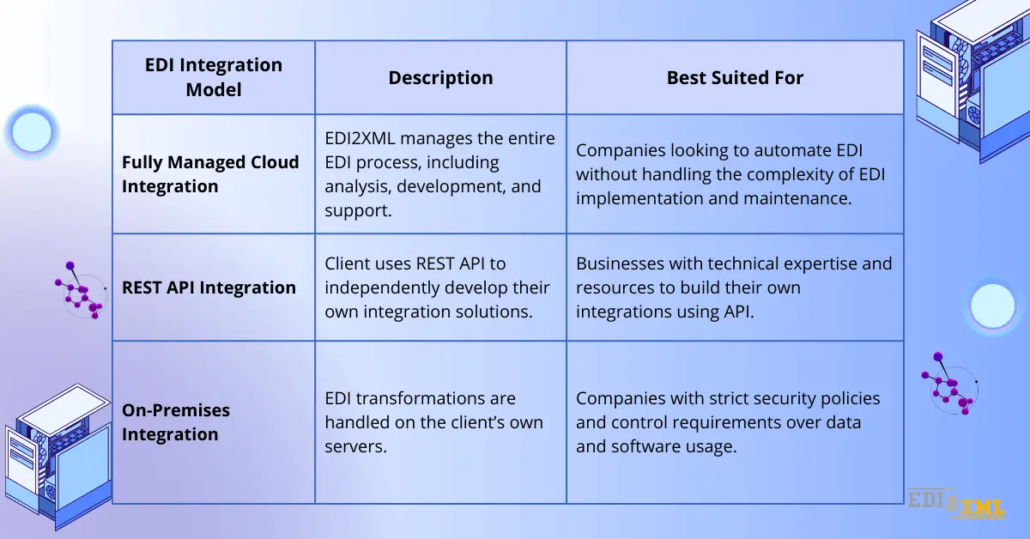
There EDI2XML integration is offered based on several business models:

Fully Managed Cloud EDI Integration

Fully managed cloud integration: the preferred option for enterprises looking to automate and integrate EDI without carrying the hassle and complexity of Electronic Data Interchange implementation, and maintenance. With this business model, the team at EDI2XML takes care of it call, from pre-implementation analysis, till development and implementation, up until the post-implementation monitoring and support.

HTTP EDI Web Service (REST API)

Cloud EDI2XML Rest API integration: this option is managed by our client. With this option the client will be provided access to EDI2XML REST API, to transform XML to EDI and EDI to XML. This is perfect for customers who has the time and expertise to develop their own integrations using REST API.

EDI2XML Service On-Premises

On-premises EDI2XML integration: Ideal for companies who would like to manage the EDI transformation on their own premises. This is ideal for companies having some strict policies on software consumption and usage.
Cloud EDI solution comparison

How to Get Started

Getting started with EDI2XML is straightforward. Simply fill up the following form to subscribe for the service. Upon filling this simple form, one of EDI2XML specialists will reach out to you to schedule a FREE one-hour Teams meeting to listen to your challenges and offer you a personalized recommendation and a comprehensive business proposal to onboard your company on one of EDI2XML offerings.

Just book a time convenient for you in our calendar.

Or click on this image to book your FREE consultation.
 

EDI Cloud Free Consultation

September 26, 2024/0 Comments
https://www.edi2xml.com/wp-content/uploads/2024/09/edi2xmlcom-EDI-cloud-solution.webp 628 1200 Pierre Namroud https://www.edi2xml.com/wp-content/uploads/2024/08/edi2xml.com-EDI2XML-company-logo.png Pierre Namroud2024-09-26 11:45:002025-05-09 09:27:07Automate with EDI2XML Cloud EDI Software Integration Service

How EDI Streamlines Supply Chain Management

Blog

Companies are constantly looking for ways to optimize their supply chain, ensuring they can quickly adapt to market changes and meet customer demands on time.

In this blog post, let’s explore how EDI streamlines supply chain management and why it’s essential for businesses today, and the benefits it brings to modern businesses.

Introduction: Electronic Data Interchange (EDI) and Supply Chain Management

The evolution of technology, standards and protocols, revolutionized this field. Electronic Data Interchange (EDI) stands is one of the main facilitators at the level of supply chain innovation.

EDI (or Electronic Data Interchange) is a standard that allows the exchange of business documents between business partners. It is based on structured format and follows some EDI standards (i.e. X12, EDIFACT…). By automating EDI exchange, business partners will be able to transform most of the manual processes into efficient, real-time tasks, increasing efficiency and eliminating human errors.

What is EDI?

Electronic Data Interchange (EDI) is a technology that allows companies to exchange standard business documents—such as purchase orders, invoices, shipping notifications, and inventory updates—in a standardized electronic format.

I’m not going to go further on this topic, since we already published extensive articles about EDI and its use, which I recommend reading for more information about EDI.

For a more detailed guide on how EDI works and its common use cases, check out our articles:

  • What is EDI (Electronic Data Interchange)?
  • EDI ANSI ASC X12 Standards – Technical Overview

What is Supply Chain Management?

Supply Chain Management (SCM) refers to complete coordination of the different elements and partners involved in the production flow of any good or service. This flow starts from its initial stages of purchasing and buying raw materials to its final delivery of the finished good to the end-consumer.

It SCM includes the phases of planning, executing, monitoring, and optimizing of all processes involved in transforming a product from being a raw material until it becomes a finished good, and delivered to the end-user.

The goal of SCM is to enhance the efficiency, reduce costs, improve quality, and deliver products faster.

SCM requires a major collaboration between suppliers, manufacturers, warehouses, transportation services, and retailers, ensuring that each step in the chain is executed on-time in a very optimal manner.

Useful: Download the Guide – EDI for Transportation and Logistics

Key Components of Supply Chain Management

For a successful supply chain management cycle, there are important key components that should be considered, planned and implemented.

  1. Planning: This is the strategic phase where companies do their research on how to meet the demand for their products or services.
  2. Sourcing: Sourcing involves selecting one or multiple suppliers who will provide the raw materials, components, or services necessary for production, for a certain product or service.
  3. Manufacturing: In this phase, raw materials are transformed into finished products.
  4. Logistics and Distribution: Once products are manufactured, they must be stored and distributed to consumers. This involves all logistical processes such as warehousing, inventory management, and transportation.
  5. Returns Management: Also known as reverse logistics, this component deals with the return of defective or excess products from consumers. Managing returns efficiently is important to minimize losses and maintaining customer satisfaction.
  6. Information Flow: Throughout the supply chain, there must be a seamless flow of information to ensure that all parties are aware of demand, inventory levels, production schedules, and shipping timelines. This helps to coordinate efforts across the supply chain, reducing delays and errors.

EDI and Logistics

Importance of Supply Chain Management

Supply chain management (SCM) is very important in today’s business landscape, to be able to deliver on-time, low-cost products and services and at a reduced risk. Here are some of the important elements:

  • Reduce Cost: SCM helps reduce costs by improving efficiencies in procurement, minimizing waste, and optimizing transportation.
  • Increase of Customer Satisfaction: Supply chain can enhance customer experience and promote loyalty. Being able to deliver to customers on time and in good condition, will improve customer loyalty.
  • Increase Company’s Agility: SCM helps companies respond to changes in demand or disruptions in the market quickly.
  • Improve of Collaboration: Better communication means better collaboration across suppliers, manufacturers, and distributors all working towards the same objective.
  • Disruption: Disruption of a Supply chain is a risk that is substantial. Such disruption can be due to different reasons (i.e. natural disasters, political instability, or other factors). Such disruptions can significantly impact a business. SCM helps mitigate risks by allowing companies to create and execute contingency plans based on maintaining relationships with multiple suppliers and monitoring global trends.

How EDI Works in the Supply Chain

As described in the above paragraph, Supply chain management (SCM), relies on several parameters to be as efficient as expected, and deliver as per business expectations. EDI has a role to play in every key component of a successful SCM.

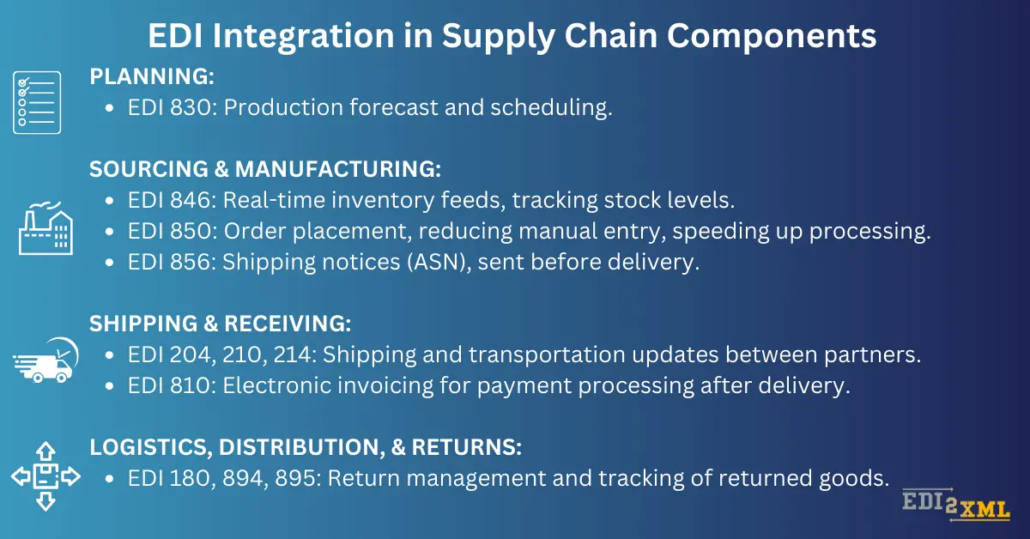
a) Planning: during the planning phase, companies part of the SCM exchange their forecast and based on customer demands and historical sales data via EDI; as an example a distribution company will share via an EDI transaction 830 (Productions forecast and scheduling) its production planning.

b) Sourcing and manufacturing: during the sourcing and manufacturing phase within a SCM, companies will exchange via EDI all kinds of transactions to complete these cycles:

    1. Inventory feeds (EDI 846): Ral-time inventory feeds and updates, are sent periodically by suppliers and manufacturers, to their own customers, via EDI 846 transaction. This allows to update them with accurate inventory levels track stock movements.
    2. Orders (EDI 850): When a customer places an order it goes via EDI 850 transaction to the supplier, this process, would eliminate the need for manual order entry and speeds up the order processing time.
    3. Shipping and Receiving: this process in SCM uses a substantial number of EDI transactions, from EDI transactions that concerns the logistics and transportation companies (i.e. EDI 204, EDI 210, EDI 214…) to the actual shipping and receiving transaction (i.e. ASN 856).
    4. Invoicing: After the goods are delivered, the supplier sends an electronic invoice EDI 810 to the customer. The customer can then process the invoice and make the payment electronically, streamlining the entire billing and payment process.

c) Logistics, distribution and returns: again, EDI is present in all of these components in the supply chain:

  1. Logistics and distribution: lots of EDI transactions come to play, when it comes to logistics, and return, EDI 204, 210, 214…
  2. Returns: EDI 180, EDI 894 and EDI 895 are typical EDI transaction for merchandise return.


How EDI Works in the Supply Chain

Useful Reading: EDI for Third-Party Logistics providers (3PL)

How EDI Streamlines Supply Chain Management

Following are some EDI attributes, that have an impact on the Supply Chain management SCM:

Faster Communication

When exchanging EDI documents, companies part of the same SCM, are opting for a full automation which means, a real-time exchange of business documents, along with automated flows to process those documents.

Eliminating bottlenecks and human errors. Orders, confirmations, and invoices flow automatically between systems, reducing lead times and allowing businesses to respond faster to changes in demand, inventory levels, or production schedules.

Reduce human errors

Manual data entry is equivalent to human errors. Errors in purchase orders, inventory levels, or shipment details can lead to costly mistakes such as overstocking, missed shipments, or payment delays. Using EDI minimizes these risks by automating data transfers.

Improve data quality and integrity

Standardized formats of data, ensure that information is accurately communicated, which will certainly improve data integrity and quality. No more human errors.

Improve Efficiency

Automating supply chain transactions with EDI leads to significant cost savings, where the most important expense is labor. Typically, the labor cost of manually entering data and correcting errors is substantial.

Exchanging EDI reduces these costs by allowing businesses to process large volumes of transactions automatically.

Improve Inventory Management

Companies exchanging EDI transactions will have a much better inventory visibility to their supplier’s inventory. It will eventually enable JIT (Just-in-time) inventory strategies and control of costs.

Improve Data Security

By exchanging EDI transactions, based on standardized protocols and encrypting the data using EDI communication protocols such as AS2, sFTP, AS3 and other protocols, business partners enhance their compliance and security footprints, ensuring secured data exchange.

Can we help in your EDI integration and automation projects?

Our specialists with over 24 years of experience in EDI integration will be happy to hope on a FREE one-hour Teams meeting to listen to your challenges and offer you the best approach and recommendation.

Just book a time convenient for you in our calendar.

Or click on this image to book your FREE consultation.

Free Consultation on EDI


September 23, 2024/0 Comments
https://www.edi2xml.com/wp-content/uploads/2024/09/edi2xmlcom-EDI-SCM.webp 628 1200 Pierre Namroud https://www.edi2xml.com/wp-content/uploads/2024/08/edi2xml.com-EDI2XML-company-logo.png Pierre Namroud2024-09-23 11:22:002024-10-01 09:27:47How EDI Streamlines Supply Chain Management

The Advantages of Business Automation through EDI

Blog

Today, there are still decision-makers who are debating whether to invest in EDI integration projects or to hire a few new employees to manually enter and process data from trading partners.

Since EDI is still a difficult topic for non-technical people to understand, hiring data entry administrators may seem like a reasonable choice. It is commonly believed that EDI requires a significant initial investment.

Let’s take a look at what EDI automation is and how companies can find the most cost-effective solution.

What is EDI Automation?

EDI (electronic data interchange) is a technology used by business partners to exchange business electronic documents in standard formats without requiring human intervention.

These exchanged documents are called – EDI Transaction Set. If you want to see the full list of documents that can be exchanged in EDI format check our Complete List of EDI X12 Codes.

 
What is EDI
 

How Does EDI Benefit Businesses?

The use of EDI greatly improves the overall state of the business as it has many benefits.

– Reducing costs. Saving time for employees to process documents and enter them into databases. EDI reduces an enterprise’s printing, shipping, and storage costs.

– Speed. Documents can be exchanged instantly with a business partner. You won’t lose documents along the way or among the papers on your desk.

– Automation. EDI significantly improves the business because it automates processes and reduces the time delays associated with manual data entry.

– Accuracy.  Elimination of errors associated with manual data entry.

Useful: Download our free Guide “Introduction to EDI Communication” to learn more about EDI

What Documents are Used in EDI?

As mentioned above, you can exchange almost any type of document using EDI, but the most common ones are:

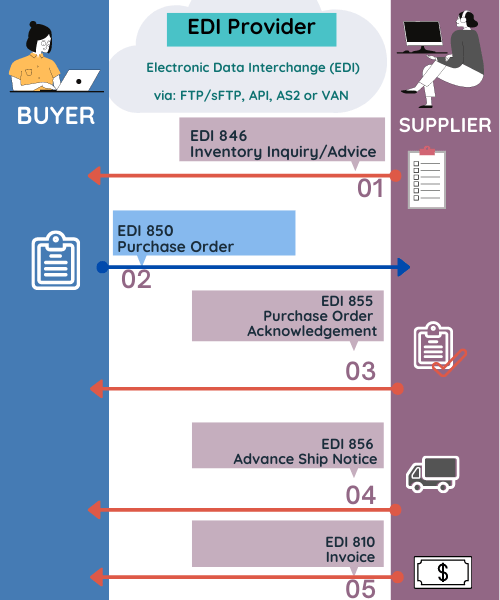
Purchase Order – EDI 850

Useful Reading: All You Need to Know About EDI ANSI X12 Transaction Set 850 Purchase Order


Invoice – EDI 810

Useful Reading: What is an ANSI ASC X12 EDI 810 Invoice?


Purchase Order Acknowledgment – EDI 855

Useful Reading: What is EDI 855 Purchase Order Acknowledgment?


Inventory Inquiry/Advice – EDI 846

Useful Reading: What is EDI 846 document?


Advanced Ship Notice (ASN)– EDI 856

Useful Reading: What is Advanced Ship Notice (ASN) 856 Transaction Set?


Below is an example of an EDI flow between trading partners.


Types of EDI (Electronic Data Interchange) Solutions

Currently, many EDI providers offer various EDI solutions. There is no one-size-fits-all EDI solution for every company. A company should evaluate which option will be most cost-effective for its business model. Thus, the main offers on the EDI market are:

  • Managed EDI
  • Web EDI
  • On-premises EDI

Our company offers all three named EDI solutions. If you don’t know which solution is right for you, contact our experts for a free consultation.

EDI Document Business Flow

1. One business partner (generally the buyer) generates a document (i.e. Purchase Order) in his internal ERP system (i.e. SAP, Microsoft Dynamics, JD Edwards, etc.). Depending on the company’s business process, the document can be generated automatically or manually.

2. EDI providers can either pick up the generated document directly from the company’s ERP system, or they can transfer it to them.

3. The EDI provider converts the document into an X12 EDI transaction set. After conversion, suppliers receive an EDI X12 document.

What is the Fastest Way to Connect to EDI?

With EDI2XML and its “HTTP EDI Web Service (REST API)” model, companies can connect their EDI partners in less than one hour! EDI web services reduce the cost of EDI integration projects and improve efficiency and accuracy in a short amount of time.


As a result of using the EDI Web Service from EDI2XML, a company can quickly and efficiently exchange business documents with its business partner.

Learn more about EDI2XML Web Service its advantages and how it works.

Request EDI2XML Web Service Price List

Free EDI consultation
July 29, 2022/0 Comments
https://www.edi2xml.com/wp-content/uploads/2022/07/EDI2XML-Automation-through-EDI.png 675 1200 Tatyana Vandich https://www.edi2xml.com/wp-content/uploads/2024/08/edi2xml.com-EDI2XML-company-logo.png Tatyana Vandich2022-07-29 14:28:322026-02-13 15:24:08The Advantages of Business Automation through EDI

EDI for Specific Industries

Blog

How Does EDI Facilitate Business Document Exchange?

EDI – Electronic Data Interchange is a well-established protocol of business data exchange, which has become more and more widespread in recent years among businesses of all sizes and various industries.

Through EDI, companies can exchange business documents that were traditionally communicated on paper or by e-mail.

By replacing the exchange of paper or e-mail documents with EDI, companies save time and eliminate manual data processing, which often leads to errors and costly delays in all business processes.

Companies today use EDI to send all kinds of documents, from orders and invoices to motor carrier load tenders, customs manifests, and more.

The exchange of EDI takes place between business partners who exchange goods or services.

All EDI transactions comply with standards developed and maintained by several organizations, including UN/CEFACT, X12, ODETTE, GS1, Peppol, and others.

However, despite uniform standards, each industry can use a certain set of specific EDI transactions. Below, we provide some examples of EDI documents for specific industries.

USEFUL: A complete list of documents that can be exchanged via EDI

EDI for Transportation and Logistics Industries

The Transportation industry actively uses EDI and, in addition to standard transactions, this industry use sets of specific EDI documents.


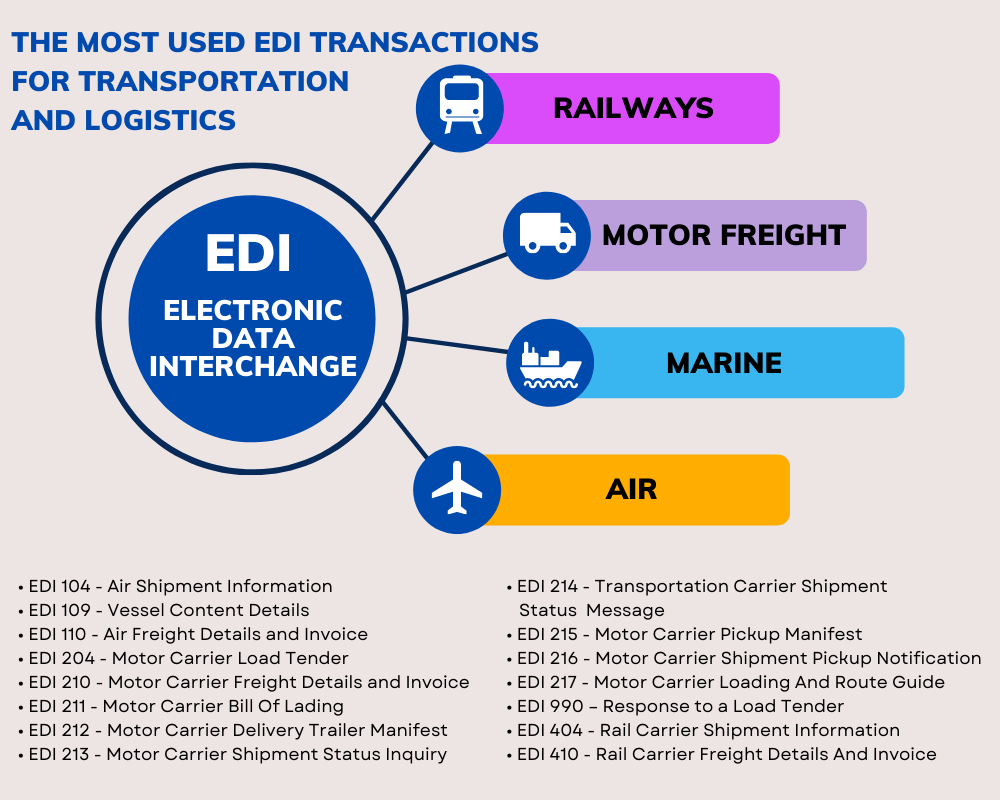
The transport industry includes a huge variety of different types of transportation. It includes marine, air, rail, and motor freight. Accordingly, the EDI transactions used for example, in rail transportation will differ from those used by motor freight.

The Most Used EDI Transactions for Transportation and Logistics

  • EDI 104 – Air Shipment Information
  • EDI 109 – Vessel Content Details
  • EDI 110 –  Air Freight Details and Invoice
  • EDI 204 – Motor Carrier Load Tender
  • EDI 210 – Motor Carrier Freight Details and Invoice
  • EDI 211 – Motor Carrier Bill Of Lading
  • EDI 212 – Motor Carrier Delivery Trailer Manifest
  • EDI 213 – Motor Carrier Shipment Status Inquiry
  • EDI 214 – Transportation Carrier Shipment Status Message
  • EDI 215 – Motor Carrier Pickup Manifest
  • EDI 216 – Motor Carrier Shipment Pickup Notification
  • EDI 217 – Motor Carrier Loading And Route Guide
  • EDI 990 – Response to a Load Tender
  • EDI 404 – Rail Carrier Shipment Information
  • EDI 410 – Rail Carrier Freight Details And Invoice

USEFUL: You can find a complete list of EDI transportation codes in our article “EDI Integration for Transportation and Logistics”

EDI for the Supply Chain Industry

The supply chain industry includes many processes such as distribution, inventory, purchasing, production planning, sales, supply chain planning, interaction with trading partners and warehouses.


The use of EDI in the supply chain allows the company to quickly exchange documents electronically with all suppliers, exchange prices and catalogs, track information on shipments and acceptance of goods. EDI allows to make the supply chain as transparent and efficient as possible, receiving up-to-date data on the movement of goods and funds in real-time.

USEFUL: EDI for Third-Party Logistics providers (3PL)

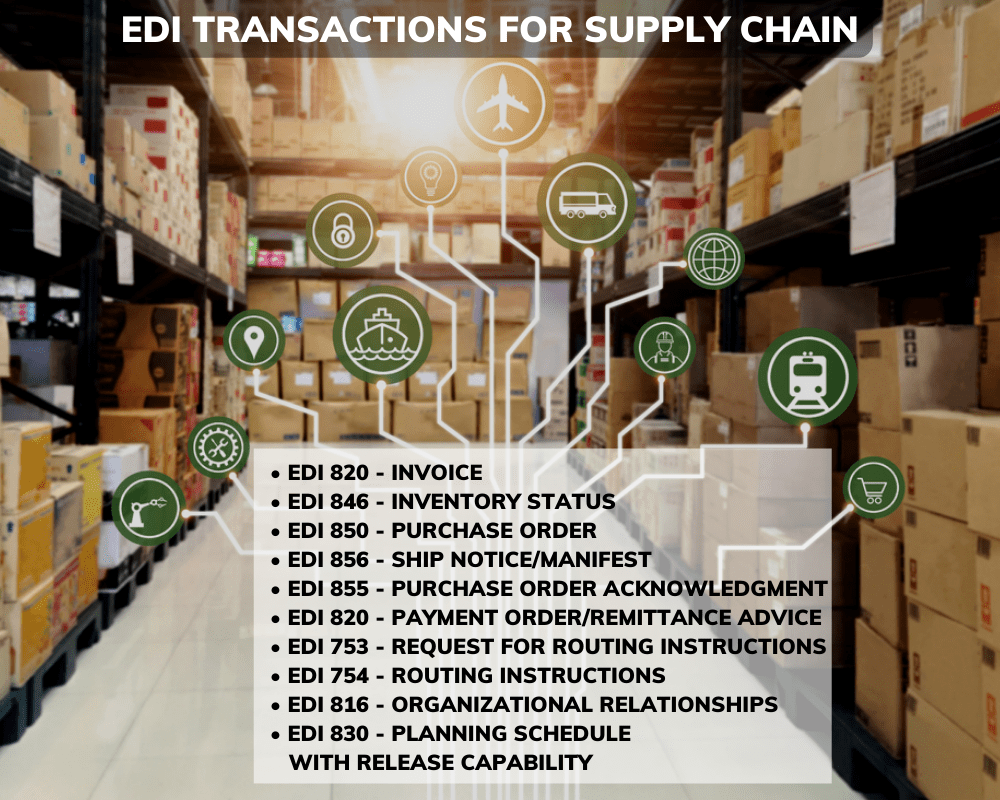
EDI Transactions for Supply Chain

Here are some of the most common EDI documents in the supply chain:

  • EDI 810 – Invoice
  • EDI 846 – Inventory Status
  • EDI 850 – Purchase Order
  • EDI 856 – Ship Notice/Manifest
  • EDI 855 – Purchase Order Acknowledgment
  • EDI 820 – Payment Order/Remittance Advice
  • EDI 753 – Request For Routing Instructions
  • EDI 754 – Routing Instructions
  • EDI 816 – Organizational Relationships
  • EDI 830 – Planning Schedule With Release Capability

To learn more about the use of EDI in the supply chain, read our article: Electronic Data Interchange (EDI) in the Supply Chain It covers the following questions:

– What is EDI?

– Why use EDI in the supply chain?

– How does EDI work?

– Typical EDI workflow process

– Additional and specific types of EDI messages

– Benefits of EDI for Supply Chain Management

– Effective EDI Solution for Supply Chain


EDI for HealthCare and Insurance Industries

EDI is of great value to healthcare organizations because it provides a secure way to electronically exchange sensitive information.

The healthcare industry includes health insurance activities, which are carried out by both commercial and public health organizations.


Most Common EDI Transaction Sets in HealthCare

  • HIPAA / X12 270 – Eligibility, Coverage, or Benefit Inquiry
  • HIPAA / X12 271 – Eligibility, Coverage, or Benefit Response
  • HIPAA / X12 276 – Healthcare Claim Status Request
  • HIPAA / X12 277 – Health Care Claim Status Response
  • HIPAA / X12 837 – Health Care Claim (Professional, Institutional, and Dental)
  • HIPAA / X12 999 – Implementation Acknowledgment
  • EDI 273 – Insurance/Annuity Application Status
  • EDI 274 – Healthcare Provider Information
  • EDI 275 – Patient Information
  • EDI 834 – Benefit Enrollment And Maintenance
  • EDI 835 – Health Care Claim Payment/Advice
  • EDI 852 – Product Activity Data (to exchange information between Manufacturers and Pharmacies)
  • EDI 999 – Implementation Acknowledgment (for Health Care Insurance)

To learn more about EDI in healthcare, please read this article: All you need to know about HIPAA EDI compliance in Healthcare

EDI for the Retail Industry

The Retail Industry is a pioneer in the implementation of EDI. Large retailers are actively automating business processes and introducing new information technology solutions to reduce costs and increase sales.

Thus, the use of EDI in retail is a must. Since large retail companies have a huge number of suppliers, they have to exchange thousands of documents every month. It is simply impossible to go through so much documentation manually.


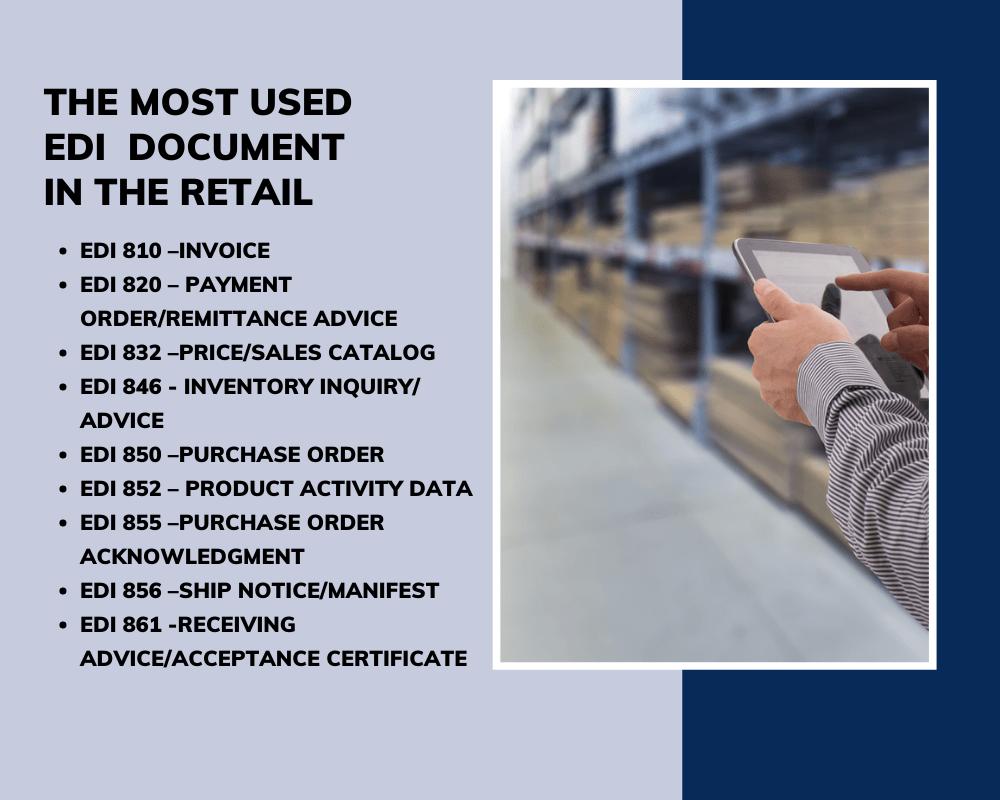
The Most Used EDI Documents in the Retail

  • EDI 810 – Invoice
  • EDI 820 – Payment Order/Remittance Advice
  • EDI 832 – Price/Sales Catalog
  • EDI 846 – Inventory Inquiry/ Advice
  • EDI 850 – Purchase Order
  • EDI 852 – Product Activity Data
  • EDI 855 – Purchase Order Acknowledgment
  • EDI 856 – Ship Notice/Manifest
  • EDI 861 – Receiving Advice/Acceptance Certificate

The use of EDI in retail offers many benefits, ranging from savings in paperwork and avoiding manual data entry errors, to reducing transport and logistics costs and increasing company profits.

If you want to learn more about the use of EDI in retail, please read this article: The Top 6 EDI Documents for Retail Suppliers

Conclusion: EDI for Specific Industries

In this article, we explored the use of electronic data interchange in some industries, however, if you have any questions regarding EDI, you can always contact us for a free initial consultation.

Our more than 21 years of experience in the implementation of EDI for various industries allows us to offer our customers the most profitable and effective EDI solutions.

Free EDI Consultation
February 22, 2022/0 Comments
https://www.edi2xml.com/wp-content/uploads/2022/02/EDI-for-Specific-Industries.png 675 1200 Tatyana Vandich https://www.edi2xml.com/wp-content/uploads/2024/08/edi2xml.com-EDI2XML-company-logo.png Tatyana Vandich2022-02-22 17:15:262026-02-13 15:11:28EDI for Specific Industries

EDI Integration for B2B Exchange to Optimize and Grow your Business

Blog

What is B2B EDI? 

B2B (Business-to-Business) Integration, also known as Electronic Data Interchange EDI, is the process of exchanging business documents electronically either internally or amongst external business partners.


Electronic data interchange (EDI) has become a standard data exchange practice in modern business. EDI allows companies to automate their business processes leading to greater efficiency. Automated data exchange allows to avoid errors, reduce order processing time, and achieve accuracy.

What is meant by EDI?

EDI (Electronic Data Interchange) is the process of exchanging documents electronically through secure communication channels from one software information system to another. In other words, from one business partner to another.

In a fully automated process, the exchange of electronic documents (for example, receiving and processing orders), can take place at the application level, without the direct involvement and participation of employees.

Who typically uses EDI?

EDI standard and connected technologies are used in a B2B data exchange protocol, of any type of businesses in different industries. These can be large, medium, or small enterprises operating in retail, manufacturing, healthcare, pharmaceutical, or any other industry. EDI is also used in international trade such as air, sea, and road transportation. Not surprising, to see customs in most of the countries using EDI heavily in their cross-border operations.

Experience shows that large retailers such as Walmart, Costco, Kroger, Home Depot, Target, etc. are always the initiators of electronic data exchange. Moreover, almost all retailers, having evaluated the advantages of using EDI, force their suppliers to exchange documents only through EDI.

EDI Integration with Business Systems (ERP/CRM)

EDI integration allows to automate the creation, sending, receiving, and processing of any business documents in electronic format with a trading partner, existing backend business systems, or applications, to provide a greater level of efficiency and complete automation.

With over 21 years of experience in EDI and the integration marketplace, our company EDI2XML has a proven experience in integrating EDI, with the most frequently used systems:

  • Oracle JD Edwards (JDE)
  • SAP
  • Salesforce
  • Microsoft Navision
  • And much more

EDI Integrations and eCommerce Businesses  

EDI is also becoming a vital element of the e-commerce business; we are receiving more and more requests for e-commerce integration with EDI.

Especially, requests for connecting online stores running on one of the major e-commerce platforms. The most frequent EDI e-commerce integration are:

  • Shopify EDI Integration
  • Magento EDI Integration
  • BigCommerce EDI Integration
  • Amazon Vendor Central EDI integration
  • Amazon Seller Central EDI integration
  • Walmart EDI Integration
  • And much more…

This means that orders from an online store will be automatically converted into an EDI document (for example X12 EDI 850 Purchase Order) and pushed into a supplier’s business system. This is the most common scenario in an eCommerce dropship business.

However, it is worth mentioning the very common request for e-commerce integration with ERP / CRM systems. This means syncing data between business software systems (SAP, Salesforce, JDE, etc.) with your e-commerce store.

Fully Managed EDI Services to automate data exchange with business partners

Our company offers a fully managed EDI service that includes transformation and connectivity services for companies of all sizes.

Our customers do not need to install any software or hardware because all EDI file conversions and transformations, are done from our side. We carry out all stages of an integration project from project planning to testing with the trading partner.

Our integration platform receives EDI files (for example x12 or EDIFACT) from the trading partner, then converts them into the required format (i.e. XML, CSV, TXT) and sends them to you (see the picture below).

Fully managed EDI Service
 

EDI2XML platform will sit in  the middle between you and your trading partner to convert, send and collect all EDI documents.


Request Fully Managed EDI Service Pricing Plans HERE for more information.


Benefits of using EDI for B2B exchange

Currently, using the latest technologies, EDI implementation is not so expensive (as many business leaders might think), but the benefits of EDI integration allow companies to significantly speed up document flow and increase sales. Besides, EDI has many advantages, namely:

  • EDI enables companies to optimize all processes in the enterprise, from planning to production management and control.
  • EDI allows increasing the speed and efficiency of data processing. Mandatory use of standards (for example X12 or EDIFACT) helps to avoid errors and improve accuracy.
  • EDI helps manufacturers to quickly respond to the requests of their wholesalers’ customers.
  • EDI document exchange allows retailers and wholesalers to improve the efficiency of logistics and procurement as well as improve inventory management. For example, using EDIFACT messages such as INVRPT, DELFOR, DELJIT, and DESADV allows reducing warehouse storage costs.
  • EDI integration allows companies to reduce the number of employees who enter data into the business system received on paper or by e-mail.
  • EDI increases the accuracy of information processing because as practice shows, errors are inevitable with manual data entry.

B2B / EDI Integration – find the best Solution

EDI2XML offers various EDI integration solutions.

  • Fully Managed EDI Service
  • EDI Web Service
  • EDI On-Premises

Whether you are a buyer, supplier, manufacturer, retailer, 3PL Warehouses, or Logistics – using our advanced EDI technology, you can exchange data electronically with all your partners quickly, reliably, and efficiently.

We’ve got an EDI solution that really makes your day-to-day tasks easier and faster!

Contact us for a free consultation with our EDI experts.

June 22, 2021
https://www.edi2xml.com/wp-content/uploads/2021/06/EDI-for-B2B-exchange.png 675 1200 Tatyana Vandich https://www.edi2xml.com/wp-content/uploads/2024/08/edi2xml.com-EDI2XML-company-logo.png Tatyana Vandich2021-06-22 11:59:092024-11-19 15:22:45EDI Integration for B2B Exchange to Optimize and Grow your Business

ORDERS and ORDRSP: The main EDIFACT messages in the supply chain management

Blog

This post was updated to reflect current trends and information.


Receiving and processing EDI purchase orders is the most common transaction faced by small businesses. This electronic business document is used to place a commercial order for goods or services by a buyer or business partner.

EDIFACT ORDERS

It’s still possible to use phone, email, or fax between two small businesses, but if you want to collaborate with a large retailer, distributor, or manufacturer, there is a high probability that you must be EDI compatible to receive orders from your B2B partners, in addition to other potential EDI documents or transactions.

What is EDIFACT ORDERS?

ORDERS (Purchase Order) is a type of EDIFACT message that contains requests for the supply of goods or services.

In EDI ANSI ASC X12 standard which is widely used in North America, the ORDERS is referred to as EDI 850 Purchase Order.

Large companies, working with small contractors demand mandatory use of EDI. Requirements for EDI compatibility is specified in contracts or in partners selection criteria.

High competition forces the business to comply, and start exchanging electronic data quickly and accurately, spending minimal time and resources on this business process. Thus, small enterprises must comply with the imposed conditions, in order not to lose a source of profitable purchases.

EDIFACT ORDERS message content

The most important main information contained in an EDIFACT ORDERS message:

  • Order number
  • Required date
  • Delivery date
  • Reference to supply contract number
  • Price and qualifier (including VAT and other taxes)
  • Identifiers of the consignee and sender, delivery location, customer, carrier, recipient
  • Information about the contents of the order (barcodes, quantity, item name, etc.).

EDIFACT ORDERS Processing

After signing the contract, the buyer uses ORDERS to send the seller a list and quantity of goods ordered.

Typically, a buyer creates the order in his ERP system (the most popular are SAP ERP, Microsoft Dynamics, Oracle JD Edwards EnterpriseOne). The created Purchase Order is instantly converted into an EDIFACT ORDERS message which is immediately sent to the seller. The seller must receive the EDIFACT message and quickly process it. He should transmit a Purchase Order Response (ORDRSP) in response to the Purchase Order received.

EDIFACT and ERP/CRM integration

To save time and money by processing the vast amount of information received from business partners, most companies (both retailers and suppliers) choose to integrate their EDI / EDIFACT messages into their ERP systems. Basically, with integration, they connect the received EDI messages and push it directly to their ERP software, through Integration Connectors designed specifically to synchronize and integrate into their ERP systems.

For example, using Magic xpi Integration Platform a company can connect a variety of heterogenous business systems such as ERP, CRM, finance, etc. by implementing out-of-the-box certified and optimized connectors.


You can find useful information on EDI integration with ERP Systems in the following articles:

  • How To Successfully Complete SAP/R3 EDI Integration Projects Using iDoc
  • The main reasons why you need Microsoft Dynamics Integration with your business Systems
  • Oracle JD Edwards and B2B eCommerce Integration for efficient online sales

How to make EDIFACT ordering even easier

EDIFACT ERP integration

As the number of outgoing or incoming orders increase, companies try to optimize the exchange of orders. In case the number of your orders exceeds a couple of hundreds per month, it’s worth thinking about integrating the flow of orders directly into your business software solution and save your company the time and money associated with human errors, delays to deliver, and increase efficiency.

The process of Order creation can be fully automated; it will not require human intervention. To do this first it is necessary to integrate your business system with EDI.


Related article:

  • Magic xpi and EDI2XML HTTP web service: the best EDI software option
  • How to Choose the Right Integration Platform?

Usually, after starting to use ORDERS message, the buyer will most likely request to receive replies to his orders, which means connecting another type of EDI message – ORDRSP. In addition, he can ask you for the dispatch advice (DESADV), and he can send you the delivery advice message. (RECADV).

What is ORDRSP and what are the benefits of using this EDIFACT message

ORDRSP (Order Response) is a type of EDIFACT message in which the supplier confirms or rejects the delivery of goods to the buyer. Using ORDRSP, the supplier can propose amendments, notify of a complete or partial delivery or confirm the entire delivery, before even processing the delivery.

Using UN/EDIFACT ORDRSP improves the logistics chain: the parties save on transportation, reduce returns due to incorrect deliveries of merchandise, increase the accuracy of delivery of the right products.

Through ORDRSP, the supplier can notify the buyer of the lack of certain products, thus avoiding disruption of supplies and maintaining a loyal business relationship. Customer, having this information, can order a similar product from the presented assortment or place an order from another supplier.

The buyer can always understand whether the supplier will deliver the goods on time, or not. He sees preliminary price confirmation and quantity of products, predicts the state of stock based on ORDRSP, and the supplier can automatically book goods for delivery in his warehouse when processing a Purchase Order Response.

What does ORDRSP contain?

ORDRSP has a direct relationship with ORDERS and are complimentary to each other. ORDRSP consists of:

  • Order number
  • GLN numbers of the buyer and seller
  • Order confirmation number
  • Date of planned delivery of goods
  • Scheduled time
  • Item No
  • Quantity approved (To Ship)
  • Price approved
  • Reason of rejection (when parameters are not matching between Order and supplier)

EDI/EDIFACT integration

In EDI/EDIFACT documents exchange, the EDI provider plays a key role. He is the one who ensures the conversion and integrity of message formats and tracking data transfers. For over 21 years now, our company EDI2XML has been successfully helping companies of all sizes switch to Electronic Data Interchange. We help speed up working with orders, shipments, acceptance, inventory of goods and reduce the risks of human errors. We have no hidden fees or confusing rates.

Contact us today for more information and a free EDI consultation.

December 2, 2019
https://www.edi2xml.com/wp-content/uploads/2019/12/Orders-and-Ordship-EDIFACT.png 350 1024 Tatyana Vandich https://www.edi2xml.com/wp-content/uploads/2024/08/edi2xml.com-EDI2XML-company-logo.png Tatyana Vandich2019-12-02 11:40:092022-07-26 09:38:48ORDERS and ORDRSP: The main EDIFACT messages in the supply chain management

What is EDIFACT? | UN / EDIFACT Standard Overview

Blog

UN / EDIFACT Standard Overview

What is UN/EDIFACT standard?

United Nations/Electronic Data Interchange for Administration, Commerce and Transport (UN/EDIFACT) is the International EDI standard ISO 9735-1987, developed under the UN

The general standard is adopted by national and sectoral standards bodies to better reflect the needs of each industry.

At least twice a year, the standard is updated globally. The reason of this update is to create a new directory of data and messages, in addition to improving the usability of existing EDIFACT messages.

The UN/EDIFACT standard has been developed for trade and transport management. The concept of “trade” was interpreted in a broad sense (orders, deliveries, insurance, payment of goods, customs formalities). Currently, the use of UN/EDIFACT has expanded to include accounting, customs control, pensions, health care, social insurance, judicial practice, employment, statistics, construction, finance, insurance, manufacturing, tourism, trade, freight, and container transportation.

The UN/EDIFACT standard is developed and supported by two international organizations: United Nations Economic Commission for Europe — UN ECE and the International Organization for Standardization. – ISO

EDIFACT Subsets

EDIFACT is predominant outside of North America. Due to its complexity, branch-specific subsets of EDIFACT have been developed. These subsets are subsets of EDIFACT and contain only the functions relevant to specific user groups, such as:

  • EANCOM consumer goods industry
  • ODETTE European automotive industry.
  • CEFIC chemical industry
  • EDICON standard used in the construction industry
  • RINET – the Insurance industry
  • HL7 standard is used in healthcare.
  • IATA air transportation
  • SWIFT banking
  • UIC 912 rail transport
  • EDIFICE electronics, software, and telecommunications industry. EDIFICE has played an important role in the implementation of RosettaNet standards in Europe. EDIFICE became the European RosettaNet User Group.

EDIFACT Messages: Structure and Syntax of the Standard

EDIFACT is a special, structured data language that describes all types of commercial activities, based on information logistics. Using elements and segments of standard informational messages, you can create a description of any document, generate its electronic form and transmit it in open telecommunication networks without fear of interception of private commercial information.

UN / EDIFACT Structure

Any document in UN / EDIFACT standard has a hierarchical structure. The entire electronic document is called a message. A message consists of data groups combined in some way, for example, a data group describing customs payments, a group of data describing the attributes of documents, etc. In turn, the group consists of typical data segments that describe document attributes in more details. The standard provides about 200 different types of segments from which messages are composed. The segments themselves also have a hierarchical structure and consist of data elements that can be simple (data field) and composite (usually 2-3 data fields).

The following is the structure of an EDIFACT transmission:

  • Service String Advice
  • Interchange Header
  • Functional Group Header
  • Message Header
  • User Data Segments
  • Message Trailer
  • Functional Group Trailer
  • Interchange Trailer

EDI Guide

Example EDIFACT

UNA:+.? ‘
UNB+UNOB:2+ XYZCORPORATION:ZZ+COMPANYX:ZZ+190521:1604+906019++++++1′
UNH+1+ORDERS:D:96A:UN’
BGM+220+4500265532+9′
DTM+137:20190425:102′
RFF+CT:CompanyX’
NAD+BY+2010::91′
CTA+OC+2010:G. Smith ‘
COM+044-1010605:TE’
COM+044-1010662:FX’
NAD+SE+0000906300::92′
CTA+SC+0000906300′
NAD+DP+++Consulting Inc St+ Begun + Laval++8003+CA’
CUX+2:CHF:9′
LIN+10++TH300010:BP’
PIA+1+000000000000500807:SA’
IMD+A++::92:HIR0010H12′
QTY+22:1:PCE’
DTM+2:20190423:102′
LIN+20++T0004671:BP’
PIA+1+000000000000501516:SA’
IMD+A++::92:CCGT060204NS LT1110S’
QTY+22:10:PCE’
DTM+2:20190423:102′
LIN+30++T2001171:BP’
PIA+1+000000000000501328:SA’
IMD+A++::92:LTPNG-R20-3.0′
QTY+22:1:PCE’
DTM+2:20190423:102′
UNS+S’
UNT+28+1′
UNZ+1+906019′

Principles and Technologies of Application of the UN / EDIFACT Standard

The EDIFACT Standard has three types of reference books:

The first type is directories that are based on the ISO standards. It includes directories of currency codes, country codes, units of measurement, modes of transport, delivery conditions, and some others.

The second type of directories, are the ones included in the EDIFACT standard., by default

The third type of directories is developed by different organizations responsible for issuing codes. Here is the list of organizations 3055 Code list responsible agency code

There are four main components in EDIFACT that are subject to standardization, when preparing documents for exchange between business partners.

  • data elements
  • standard data segments
  • standard messages
  • syntax rules

Data elements are the smallest, non-dividing parts of information, for example, the document date, the name of the destination, the amount of tax. More than 600 data elements used in international trade and transport have been published in a special UNTDID directory.

EDIFACT Standard Principles

The UN / EDIFACT standard is based on the following principal:

1. Standardize data at the segment and element level. Any document intended for electronic exchange should consist of typical segments. This means that the segment of the supplier’s address or delivery address is described by the same elements, regardless of what kind of document it is – invoice, order, declaration, etc. The practice has shown that to describe almost any document, it is enough to have no more than 100 typical segments. The fields inside the segments are standardized the same way, and the ratio of fields to segments is one-to-many, i.e. the same field can be included in different segments.

2. Record the fields used in segments as code. It is assumed that the partners exchanging electronic documents have identical code tables (directories). The composition and content of the reference books is standardized at three levels – international, national and corporate.

3. The independence of standards from the language of communication. The peculiarity of the UN / EDIFACT standards is that more than 90% of the electronic message consists of different codes. Another feature is that only the content of the document is transmitted, without a form. The document form is restored when the message is decoded.


Book a FREE one-on-one EDIFACT consultation session with our in-house experts.


EDIFACT Messages

The EDIFACT standard which provides a set of standard messages has greatly simplified international and multi-branch trade and the exchange of electronic business documents between countries and various industries.

The standard message UN / EDIFACT has a six-letter identifier that reflects the short name of the message, for example:

  • CUSDEC – CUStoms DEClaration
  • CUSRES –CUStoms RESponse

Some of the standard EDIFACT messages with X12 equivalent are listed in the table below.

X12 Transaction Number EDIFACT Transaction ID Transaction name
850 ORDERS Purchase order message
855 ORDRSP Purchase Order Acknowledgment
846 INVRPT Inventory Inquiry/Advice
856 DESADV Shipment Notification ASN
810 INVOIC Invoice
997 CONTRL Functional acknowledgment
860 ORDCHG Purchase Order Change – Buyer Initiated

Due to the independence from the language and the transfer of only the contents of the document, the restoration of the form of the document takes place on the receiving side in accordance with the rules that apply in this place.

Benefits of EDIFACT

EDIFACT benifits

EDIFACT has a competitive advantage that positively affects the efficiency of a company and improves business processes. The main advantages of EDIFACT:

Profitability – reducing the volume of papers to be processed leads to a decrease in personnel and administrative costs.

Efficiency – large volumes of commercial data can be transferred from one computer to another within minutes

Accuracy – the use of EDIFACT eliminates human errors that are inevitable when manually keying in data.

EDIFACT is a key component of a just-in-time strategy that ensures prompt customer satisfaction. EDIFACT in conjunction with the Internet allows real-time electronic transactions and accelerates the interaction between trading partners.

Easy EDIFACT Integration

Our company has many years of proven experience in implementing EDI and EDIFACT projects. We offer our clients Fully managed EDI Service and HTTP Web Service.

Contact us today for a free consultation and we will help you find the best option for your business.

EDIFACT Free consultation

July 26, 2019
https://www.edi2xml.com/wp-content/uploads/2019/07/Featured-Image-EDIFACT.png 350 1024 Tatyana Vandich https://www.edi2xml.com/wp-content/uploads/2024/08/edi2xml.com-EDI2XML-company-logo.png Tatyana Vandich2019-07-26 12:23:592025-02-04 11:57:51What is EDIFACT? | UN / EDIFACT Standard Overview

EDI Integration of B2B E-commerce for Small Companies

Blog

Navigating B2B E-Commerce: A Small Company’s Guide to Seamless EDI Integration

More and more companies in the B2B vertical, are expanding their business to the web and doing more of what is called today B2B e-commerce. Those companies of all sizes are realizing the importance of automation and the value of exchanging EDI with their business partners, suppliers, and buyers.

For small companies in the B2B market, trading with large retailers such as Costco, Wal-Mart, Target or Home Depot is a great opportunity for their business. However, many small and medium-sized enterprises are missing out on this chance due to the fear of large retailers’ requirement to comply with their EDI rules.

In most cases, EDI is the de-facto protocol to communicate and exchange business documents between big-box retailers and their suppliers.

EDI is used to automate the process of exchanging business documents between trading partners. Essentially, it is the solution for B2B and is quite popular amongst retail, manufacturing, transportation, health care, and other industries. By automating documents exchange process, companies can benefit in many areas.

To those who do not know much about Electronic Data Interchange (EDI), it sounds quite complicated at first. There are different EDI standards, requirements, EDI formats, communication protocols such as AS2, sFTP, VAN, different documents / transactions (i.e. 850, 810, 846 856, etc.) which differ depending on company and industry.

EDI Integration projects seem daunting and expensive, which can explain why many smaller businesses still do not communicate with their trading partners through EDI. However, the key is to find the right EDI provider who can offer solutions and services that are simple, affordable and quick to onboard.

An EDI provider like EDI2XML offers 2 options for EDI integration projects:

  • EDI as a Service, also known as EDI outsourcing or fully managed EDI service
  • EDI2XML web services, REST API to convert X12 to XML and vice versa, known as self-service API.

Fully Managed EDI

This option is a “turn-key solution” where our team at EDI2XML, takes care of all the project: setup, configuration, testing, certification with your EDI partners …

Our monthly pricing packages are dynamic, they go up and down based on the volume and you are not locked in in any tier. Following is a diagram illustrating the flow of information with our EDI as a service offering.

EDI integration platform

By using our EDI Web Service, you can enhance efficiency, reduce errors, and improve collaboration with your trading partners.

EDI2XML Web Services

This option is meant for companies who got their own technical resources to work with REST API (call and consume HTTP Rest Web services); In such a scenario EDI2XML web services is the way to go for the following reasons:

  • Self-service solution,
  • Low cost,
  • Quick entry: you can be up and running in less than an hour, and it is proven; we provide everything to your developers to get started, a java client with its source code and instructions on how to work with it.
  • We offer the xml schemas (xsd) of the XML format our API expects, and all that you need to do is to format your data according to that format and you will be up and running.
  • We offer 15 days free trial, without any commitment.

Advantages of Using EDI

B2B edi Integration

Integrating Electronic Data Interchange (EDI) into B2B e-commerce can bring significant benefits to small companies. EDI allows for the automated exchange of business documents and data between trading partners, streamlining communication, reducing manual effort, and improving efficiency.

Integrating Electronic Data Interchange (EDI) into B2B e-commerce can bring significant benefits to small companies. EDI allows for the automated exchange of business documents and data between trading partners, streamlining communication, reducing manual effort, and improving efficiency.

With EDI, orders, invoices, and other business documents can be sent straight from your ERP management system to the EDI Provider, where they can process this XML file into EDI format and then sent to the Trading Partner.

Orders come in as EDI, get translated into XML format and then get sent straight to your ERP system (if integration was done). In most cases where integration to your ERP solution is done, no human intervention is even needed. This saves so much time and effort and finally allows your employees to get a lot more time on their hands for other important tasks, eliminating so much of the manual data entry.

When it comes to EDI, every case is different. It’s all about finding the right EDI provider that can help you with this process and ensure it’s simple and efficient as can be. Automating B2B processes with EDI can help companies stay profitable by letting them keep up with market changes and trends.

Look at EDI2XML, and book a free consultation with one of our EDI experts!

EDI price
July 12, 2019
https://www.edi2xml.com/wp-content/uploads/2019/07/EDI-integration-for-B2B-e-comm.png 350 1024 Tatyana Vandich https://www.edi2xml.com/wp-content/uploads/2024/08/edi2xml.com-EDI2XML-company-logo.png Tatyana Vandich2019-07-12 16:17:052024-04-09 17:12:12EDI Integration of B2B E-commerce for Small Companies

What are the differences between RosettaNet, EDI ANSI X12 and EDIFACT

Blog


This post was updated to reflect current trends and information.


What is RosettaNet?

Rosettanet RosettaNet is a non-profit organization having more than 500 high-tech companies as members. These members create and implement open standards for processing business to business (B2B) transactions, especially at the supply chain level, in their appropriate vertical. The main mission of RosettaNet organization is to generate standard protocols for specific business transactions such as new Product Information, order Management, design registration, request technical data, etc.

These standards define XML schema, thus defining a hundred processes for exchanging information between partners (PIP-partner interface processes).

Founded in 1997 by Fadi Chehadé, RosettaNet is a subsidiary of GS1 US, formerly the Uniform Code Council, Inc. (UCC).

RosettaNet and the high technology industry

RosettaNet includes more than 500 members from companies all over the world. Most companies of this consortium belong to the electronics and semiconductor industry – companies that produce personal computers (PCs), computer hardware, computer software, electronic components, telecommunications equipment, consumer electronics. This organization also includes telecommunications and logistics companies.

RosettaNet includes big companies such as:

  • Cisco
  • Hewlett-Packard
  • Intel
  • Microsoft
  • SAP
  • Bosch
  • Ericsson
  • Nokia and many more.

RosettaNet has several local user groups. The European user group of RosettaNet for B2B standards is EDIFICE.

The RosettaNet standard

Electronic industry and Rosettanet RosettaNet optimizes existing standards, guidelines, and specifications of open e-business for cross-platform applications and network communications. RosettaNet defines the concepts of e-business (file formats, procedures, implementation, requirements, etc.) and develops standards for ensuring compatibility of business processes. RosettaNet is based on open XML standards.

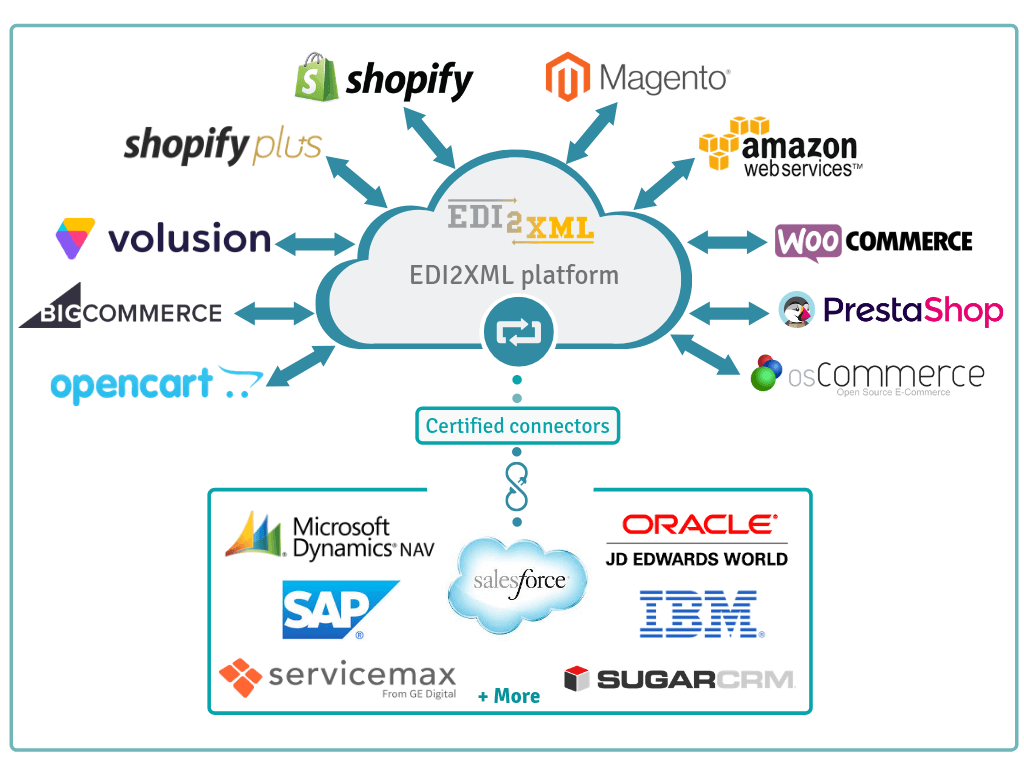
Primarily oriented in the supply chain areas, RosettaNet also addresses production, product data, and service processes.

As I mentioned above, this standard is widely distributed in the electronic components and semiconductor industries, but also in the logistics and telecommunication industries.

Partner Interface Processes (PIPs)

RosettaNet PIPs are specialized System-to-System XML-based dialogs that define business processes between partners in a value chain. Each PIP comprises a specification founded on the RNIF “RosettaNet Implementation Framework”.

A RosettaNet implementation, requires a message guideline with a PIP-specific version of the Business Dictionary, and an XML Message Guideline document that provides the models and documents.

The different PIPs are divided into clusters (areas), each covering a specific business process area:

  • Cluster 0: RosettaNet Support
  • Cluster 1: Partner Product and Service Review
  • Cluster 2: Product Information
  • Cluster 3: Order Management
  • Cluster 4: Inventory Management
  • Cluster 5: Marketing Information Management
  • Cluster 6: Service and Support
  • Cluster 7: Manufacturing

The actual PIP name is obtained from the clusters and the subsequent division.

RosettaNet PIP 3A4: Request Purchase Order

3 → Cluster 3

A → Quote and Order Entry

4 → Request Purchase Order

To learn more about RosettaNet PIP Classifications learn our previous article: RosettaNet and B2B EDI Integration: All you need to know

How RosettaNet differs From EDI ANSI X12 and EDIFACT

EDI is another standard to exchange EDI (electronic data) messages between trading partners. EDI stands for “Electronic Data Interchange.” There are numerous variations of EDI and each variation is different from the other. The ANSI X12 is the most popular in North America in various verticals, while EDIFACT is popular in Europe.

Useful reading: ANSI ASC X12 Standards Overview

There are many major elements distinguishing RosettaNet from EDI X12 and EDIFACT:

First, RosettaNet is developed principally to support logistics and supply chain interactions in the Hight- technology industry, while EDI is widely used in various industries (Retail, Wholesale, Energy, Healthcare, Pharmaceutical, Manufacturing, Logistics, Government, etc.)

The second difference between RosettaNet and other EDI standards, is that RosettaNet focuses on process and process modeling, while there are no process-focused messages in ANSI X12 and EDIFACT.

Another difference between RosettaNet and EDI is RosettaNet is XML- based while EDI (X12 and EDIFACT) is text-based. There’s a big structural difference between RosettaNet and EDI business document.

A RosettaNet message package contains two main parts: headers that define the source, destination, and purpose of the message package; and a payload (with optional attachments) that transmits the actual business information or operational signals (for example error messages). Both the headers and the payload are encapsulated in XML tags.

In addition, RosettaNet is adopting existing Industry standards, such as JEDEC, UN, the UCC/EAN, NEDA, NIST, and others.

Unlike ANSI X12 and EDIFACT, RosettaNet formed business dictionary and Technical Dictionary (RNTD)

The RosettaNet Business Dictionary (RNBD) identified business attributes to define transactions between trading partners. It defines the meaning of business terms for example “Purchase Order Acceptance” thus the trading partners can be guaranteed the processes interfaced between two businesses are being correctly mapped. The Business Dictionary serves as a central reference and reference work for other standard documents.

The RosettaNet Technical Dictionary (RNTD) provides a common language for the definition of IT products. In other words, it ensures that product information exchanged between business partners uses a common vocabulary even if one of the partners prefer a non-standard intern term.

The EDI community recognized the need for such dictionaries…RosettaNet successfully created and used the dictionaries because it restricted the scope of the dictionaries to first the IT industry, then to the Electronic Component (EC) industry, and the Semiconductor (SM), Telecommunications (TC) and Logistics (LG) industries.

How difficult is to implement RosettaNet?

You will need a good knowledge of XML, as well as some knowledge of supply chain management. Experience with SAP, Oracle Applications, or similar software for enterprise resource planning, manufacturing or supply chain will also be an advantage.

Our team of specialists has many years of successful experience working with RosettaNet and business systems integration, so if you need help or advice or professional advance, please contact us and we will more than happy to assist you!

May 30, 2019
https://www.edi2xml.com/wp-content/uploads/2019/05/Rosettanet-vs-x12-EDIFACT.png 350 1024 Tatyana Vandich https://www.edi2xml.com/wp-content/uploads/2024/08/edi2xml.com-EDI2XML-company-logo.png Tatyana Vandich2019-05-30 11:17:502020-03-18 12:53:02What are the differences between RosettaNet, EDI ANSI X12 and EDIFACT

Fully managed EDI service VS HTTP Web Service: Which is Better for Your Business ?

Blog

This post was updated to reflect current trends and information.


Electronic Data Interchange (EDI) and all the services around it are becoming more and more popular, regardless of the industry, for one major reason: EDI transactions are replacing paper documents exchanged between trading partners, and helping companies in their digital transformation projects, for a “greener” planet.

Retail was one of the first industries to fully adopt EDI, and it is still the most active vertical in its usage. EDI is a proven and effective alternative to fax, e-mail, and manually entering or re-entering data such as Invoice, Purchase Order, Inventory and many others…

There are various types of EDI and several approaches to integrate Electronic Data Interchange in a business community. Each EDI provider can offer a different EDI integration methodology, in order to become EDI compliant. We at EDI2XML, offer two options for to integrate EDI into your company, and make your business “EDI compliant”, while shortening the integration project:

Fully Managed EDI Service

HTTP EDI Web Service

How to select? What kind of EDI integration solution is a better option for your business?  First, let’s understand both options.

Fully Managed EDI Service

The EDI2XML service offered as “fully managed” includes translation and communication service offering to businesses of all sizes, from different industries.

Our team at EDI2XML, takes care of ALL the aspects of the integration project. With this model, we offer a “Turnkey EDI Solution” where we take on our shoulder all setup, configuration, testing, certification with the EDI partners …

EDI Fully Managed Service
 

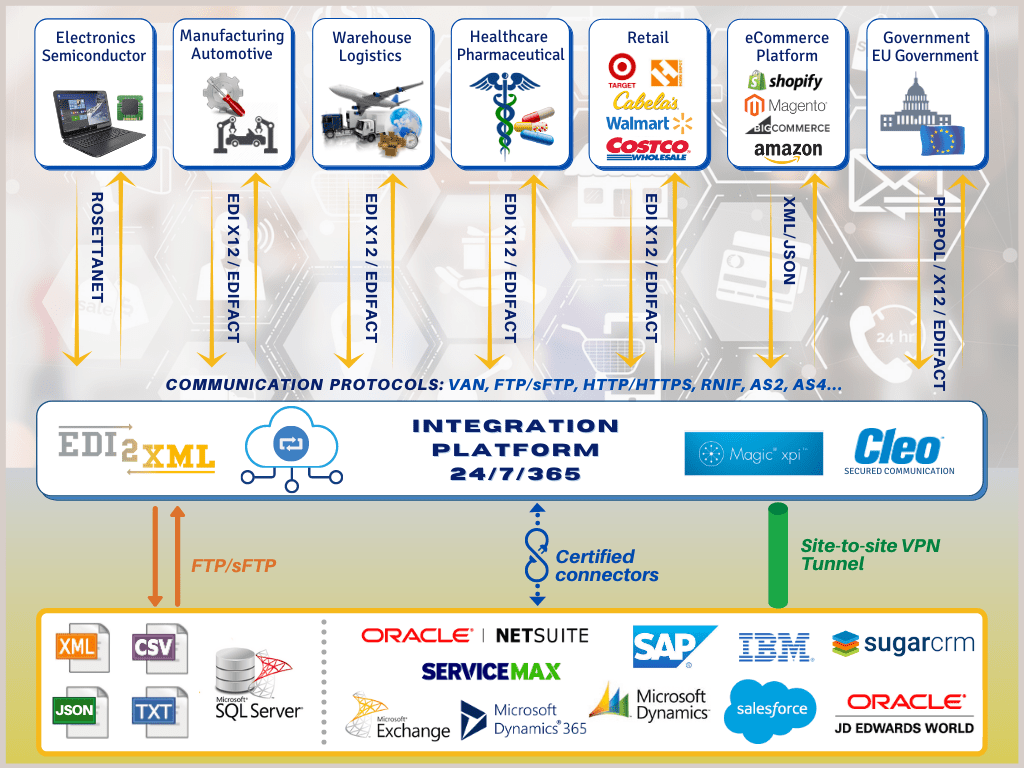
In other words, with this option, we take care of everything: all the steps of the project from A to Z. We can even integrate directly into your ERP or CRM system. We provide certified connectors for leading IT systems such as Salesforce, JD Edwards, SAP, Dynamics CRM, Dynamics AX, and more.

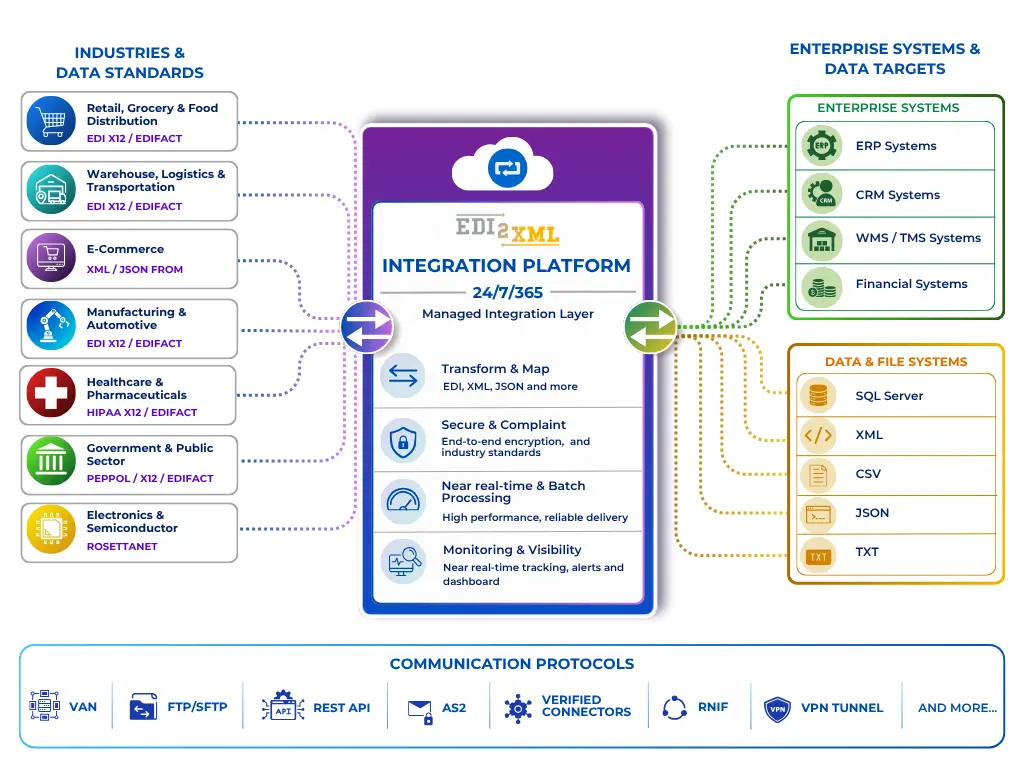
Infographic of an integration platform linking industries (left) to enterprise systems (right) with data formats (SQL Server, XML, CSV, JSON, TXT) below.
 

a) Technical Details

A setup phase is mandatory for all new Trading Partners and/or EDI document implementation. This stage includes the project analysis, setup of Trading Partner accounts, configuring Partner specs and platform, defining the transfer file structure, building and setting up all required connectivities and communication protocols. It also includes an end-to-end full cycle data testing and certification.

To learn more about EDI service, download our free introductory guide here

b) Pricing

As for the pricing, it is based on pre-defined monthly service packages, including a pre-defined volume of data processed. All our packages are billed monthly based on the entry level plan (Business Light) at the beginning of each month. Subsequent month billing will include the basic plan fee PLUS the difference between the plan we billed initially (Business light) for previous month, and the plan that we were supposed bill for the previous month based on real volume of data processed for that month.

All this to say, our monthly pricing packages are dynamic, they go up and down based on the volume of data we process and integrate, and our clients are not locked in in any of the packages.

For more information about pricing, fill out a form: EDI2XML Translation Service Pricing Package

HTTP EDI Web Service (REST API)

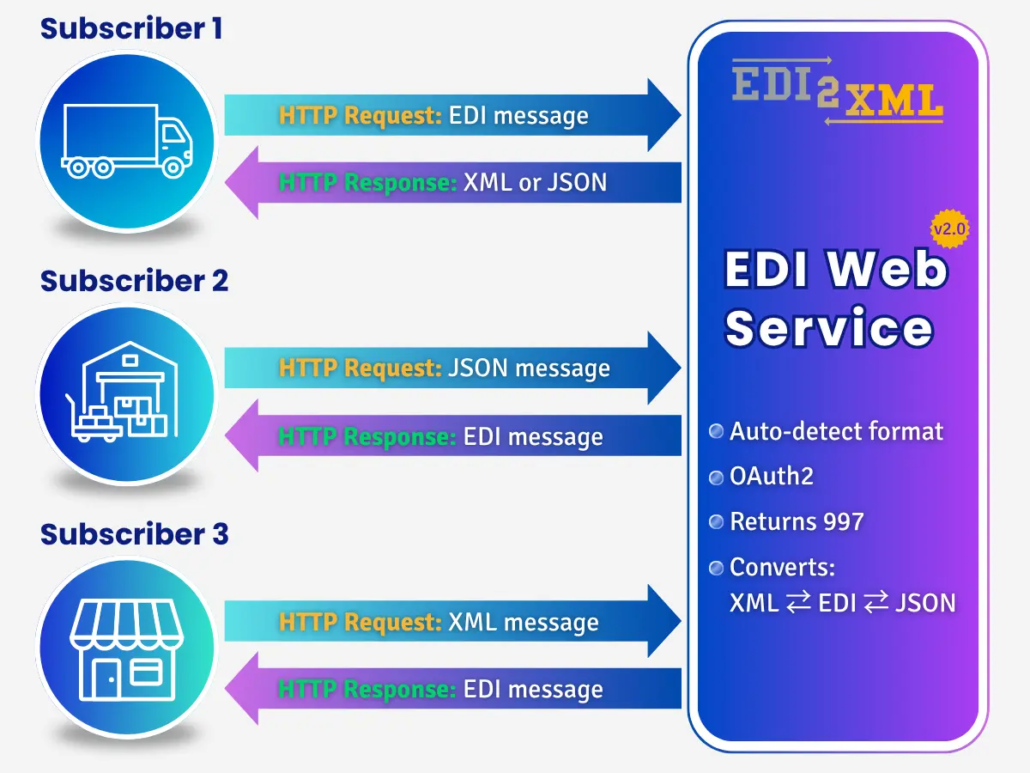
EDI2XML Web Service is an HTTP service running over the internet, on EDI2XML’s own platform that is capable of receiving HTTP requests to translate EDI messages to XML, and XML messages to EDI (based on EDI2XML’s proprietary format).

EDI2XML Web Service is much more cost-effective, and meant for companies who got their own technical resources to work with REST API (call and consume HTTP Rest Web services)

The principles of the mechanism of the EDI2XML Web Service is schematically illustrated in the diagram below.

API-Converter for EDI XML and JSON

a) Advantages

EDI2XML Web Service is the way to go for the following reasons:

  • Self-service solution
  • Low cost
  • We offer a 15 days free trial, without any commitment.
  • Get started with less than an hour
  • There is no contract, no commitment.
  • Payments are month to month; Cancel anytime with a 30 days’ notice.
  • A very simple and dynamic pricing scheme
  • Availability and reliability
  • Based on proven technology in the field for over 18 years now
  • Outstanding technical support

b) Technical Details

Implementation time: Getting started with EDI2XML Web Service, is very simple and quick. Within less than an hour, you can issue the first Call to the Web Service and see the response. Our HTTP EDI Web service is very clearly documented, and we provide instructions with each subscription.

  • Quick entry: you can be up and running in less than an hour, and it is proven; we provide everything to your developers to get started, a java client with its source code and instructions on how to work with it.
  • We offer the schemas(xsd) of the XML format our API expects, and all what you need to do is to format your data according to that format and you will be up and running.

c) Pricing

EDI2XML API service fee to use the HTTP / Web Service calls, has a very simple pricing scheme. The price consists of two elements:

  1. Monthly mailbox fee: a “fixed” monthly fee for the Web Service Mailbox usage on EDI2XML platform. It is a nonrefundable fee.
  2. Data processing fee: a “variable” fee based on the volume of data processed and translated between EDI and XML, during a calendar month. The volume of data processed is computed in both directions:
  • Incoming, and
  • Outgoing

Click here to request EDI2XML Web Service Price List

d) How to get started with EDI2XML API

To get started with our EDI Web Service three steps you need to follow:

1. You need to provide us the list of documents/transactions you want to be activated under your trial account.

2. We will simply set you up with a 15 days trial account, without any commitment from you. Just let us know when do you want to kick off, and we can take care of setting you up on a trial account.

3. We provide a Java client and its source code. You can get started with less than an hour, this will allow you to try and see the results by your own.

We’ve recently launched EDI2XML Web Service v2.0 – a smarter, faster, and more secure version of our REST API. It supports improved token-based authentication and better performance for X12, XML, and JSON document exchange. Learn more: What’s New in Version 2.0?


Watch the Video and discover which solution aligns best with your business needs and goals.


Compare key features of Fully Managed EDI Service and HTTP EDI Web Service

key feature

Fully managed EDI service

HTTP EDI Web Service

 Type of EDI solution Full service Self service
 Contract Yes No
 Commitment 24 months No
 Implementation time   (approximately) 2 weeks 1 hour
 Real-Time Connection Yes Yes
 Free Trial account No 15 days
 Data processing fee Based on the appropriate plan. It works in both directions: when the volume goes up and  when the volume goes down.   “Variable” fee based on the   volume      of data processed     and translated         between   EDI    and XML, during a         calendar    month.
 Need for internal   resources No Yes
 Need for in-house EDI expertise No No
 Technical Support Yes Yes
 Hardware Installation  Required No Yes
 Software Installation Required No No
Communication with the trading partner: setup and testing in both directions Yes

No

Free edi consultation

We, at EDI2XML, provide an EDI integration solution for every type of business. Contact us today for a free consultation and we will help you find the most appropriate option for your business.


April 12, 2019
https://www.edi2xml.com/wp-content/uploads/2019/04/Fully-EDI-vs-API-EDI-.png 350 1024 Tatyana Vandich https://www.edi2xml.com/wp-content/uploads/2024/08/edi2xml.com-EDI2XML-company-logo.png Tatyana Vandich2019-04-12 13:14:502026-07-06 13:34:33Fully managed EDI service VS HTTP Web Service: Which is Better for Your Business ?
Page 3 of 41234
Recent
  • EDI for Small Businesses: What to Automate Next
    EDI for Small Businesses: What to Automate NextSeptember 23, 2026 - 12:56 pm
  • You Adopted EDI — So Why Is Your Business Still Running...September 17, 2026 - 9:23 am
  • EDI 990 Response to a Load Tender
    EDI 990 – Response to a Load Tender: A Definitive Guide...September 1, 2026 - 3:46 pm
  • Case Study about EDI and WMS Integration
    Piper Warehouse Case Study: Automating EDI-to-WMS Integration...August 27, 2026 - 4:19 pm
  • EDI Integration with WMS
    EDI and WMS Integration: A Practical Guide for Warehouses...August 21, 2026 - 4:26 pm
Popular
  • How to Quickly Connect to a Large Retailer's EDI Requirements
    How to Get EDI-Compliant Quickly For A Large RetailerNovember 21, 2025 - 4:29 pm
  • EDI-as-a-services
    EDI Translation Software “On-premises” or “As...January 21, 2014 - 1:28 pm
  • order-automation in e-commerce
    Why Is It Crucial to Automate the E-Commerce Order Fulfillment...May 10, 2022 - 1:58 pm
  • EDI for Logistics and transportation
    EDI Integration for Efficient Transportation ManagementOctober 6, 2023 - 1:33 pm
  • information technology definitions
    Business Tech Terms DefinitionsMay 24, 2018 - 1:32 pm

Browse by tag

Amazon Amazon Integration ANSI ASC x12 ASC X12 EDI B2B EDI integration e-commerce e-commerce business e-commerce integration eCommerce eCommerce integration EDI EDI2XML EDI 850 EDI as a Service EDI Communication EDI converter EDIFACT EDI for supply chain EDI for Third-Party Logistics EDI for transportation EDI implementation EDI Integration EDI Integration Project EDI project EDI Translation EDI Web Service EDI x12 ERP Integration integration platform integration project JDE Magic xpi Magic xpi Integration platform NetSuite online store Salesforce Shopify Shopify eCommerce integration Shopify integration Supply Chain Supply Chain Management Translation Software X12 EDI XML

Subscribe to our Blog

Menu

  • Home | EDI2XML
  • About the EDI2XML Company
  • About EDI2XML EDI Converter
  • Advantages
  • Privacy Policy EDI2XML Company
  • Blog

Solutions & Services

  • POINT – Business Operations Platform
  • Fully Managed Integration Services
  • Fully Managed EDI Services
  • EDI2XML REST web service (API)
  • E-Commerce Integration Services
  • Managed Cloud Services
  • AI Solutions

Latest Blog Posts

  • EDI for Small Businesses: What to Automate Next
    EDI for Small Businesses: What to Automate NextSeptember 23, 2026 - 12:56 pm
  • You Adopted EDI — So Why Is Your Business Still Running on Spreadsheets?September 17, 2026 - 9:23 am
  • EDI 990 Response to a Load Tender
    EDI 990 – Response to a Load Tender: A Definitive Guide for Supply Chain and Transportation ProfessionalsSeptember 1, 2026 - 3:46 pm

Contact Us

400 Blvd Curé-Labelle, #304 Laval QC H7V 2S7 Canada

Contact EDI2XML Team
Phone: +1 450-681-3009
Website: https://www.edi2xml.com/

© 2000-2026 EDI2XML (by Namtek Consulting Services). All rights reserved.
  • Link to Facebook
  • Link to LinkedIn
  • Link to X
  • Link to Youtube
  • Home | EDI2XML
  • About the EDI2XML Company
  • About EDI2XML EDI Converter
  • Advantages
  • Privacy Policy EDI2XML Company
  • Blog
Scroll to top Scroll to top Scroll to top