Streamline your operations with eCommerce Integration—connect platforms, automate processes, and enhance customer experiences for seamless online transactions.

Tag Archive for: eCommerce integration

Fully Managed Integration Services: What Companies Actually Deal With and How Integration Solves It

When companies talk about improving operations or trying to reduce mistakes across different parts of the business, most people do not immediately think about integration services, even though it is usually the exact place where everything breaks. So here I want to explain, in a more direct way, what Fully Managed Integration Services actually do, and why businesses in retail, e-commerce, logistics, distribution and manufacturing keep running into the same issues until they finally decide to implement proper EDI Integration, E-commerce Integration or Business Systems Integration with a provider like EDI2XML. And I’m not trying to make it sound fancy, just explaining how it looks in real life.

Key Takeaway

  • Fully Managed Integration Services connect ERP, CRM, e-commerce, and trading partners seamlessly.
  • Automates data flows, reduces manual errors, ensures EDI and partner compliance.
  • Ideal for retail, logistics, distribution, and manufacturing companies.
  • Provider handles setup, mapping, monitoring, and error resolution—no internal IT team needed.
  • Main benefits:
    • Automated workflows
    • Accurate inventory and orders
    • Reliable reporting
    • Compliance with partners and standards
    • Cost-effective and scalable operations

The Real Problems Companies Face Before Considering Fully Managed Integration

Most businesses operate with too many disconnected systems. They have Shopify or Amazon for sales, then some ERP like NetSuite, Dynamics 365, or Oracle JDE running inventory and financials, then CRM data in Salesforce or HubSpot, and then a warehouse management tool that has completely different data. People try to keep everything updated manually, which is basically impossible when the company grows even a little.

So the result is delays, missing orders, incorrect inventory, errors in invoices, compliance issues with trading partners who require EDI documents, and a general feeling inside the team that things are constantly behind. This is the situation we see over and over when businesses contact us for Fully Managed Integration Services because they can no longer rely on spreadsheets and manual updates.

What Fully Managed Integration Services Actually Mean

When we talk about Fully Managed Integration Services, we mean that the business does not need to build, maintain, or monitor its own integrations. Instead, a provider like EDI2XML handles everything – from the initial setup to ongoing support. So there is no extra IT team required, and there is no need for internal employees to figure out technical protocols or mapping rules. The goal is simple: connect the systems so data flows automatically and accurately.

This includes EDI Integration, E-commerce Integration, and Business Systems Integration, and each area solves a very specific type of problem that companies struggle with on a daily basis.

EDI Integration: For Companies That Must Comply With Trading Partner Requirements

EDI (Electronic Data Interchange) Integration is usually the first thing a company needs when it works with large retailers, distributors, or manufacturers. Without proper EDI Integration, companies send documents manually or upload files, which slows down operations. And when something is done incorrectly, trading partners send chargebacks, delays, compliance warnings, and other penalties.

Fully Managed EDI Integration removes the manual work. Purchase orders, invoices, shipping notices, and any other required EDI documents are processed automatically and integrated directly with the company’s internal systems. This means data goes where it should without people touching every step, which reduces errors and ensures compliance.

EDI 943

What does “Fully Managed EDI Integration Services” mean

By “fully managed” we mean: you don’t do the heavy lifting. The integration provider handles everything: mapping, data flow, system-to-system connections, maintenance, error handling, partner compliance. You avoid needing a full in-house EDI integration team or dedicated IT specialists.

Specifically, the provider will:

  • Analyze your systems and data flows
  • Build connection for EDI with e-commerce or ERP/CRM
  • Implement automation so data transfer happens without manual intervention
  • Monitor operations, catch and resolve errors, manage updates or partner-side changes
  • Ensure compliance with partner requirements (document formats, EDI standards, protocols)

This lets you focus on business, rather than on fighting software mismatches.

Discover how Supplies Outlet transformed its EDI processes with our Fully Managed EDI Integration Service.

E-commerce Integration: For Businesses Selling on Amazon, Shopify, BigCommerce or eBay

E-commerce companies often deal with constant synchronization problems. Orders come in from different online platforms but inventory lives in another system, and then shipments and tracking go through different tools again. When there is no proper E-commerce Integration, the whole workflow depends on manual updates, which is why overselling, delays and wrong stock levels happen all the time.

With Fully Managed E-Commerce Integration Services from EDI2XML, online orders flow directly into the ERP or CRM system, inventory updates go back to the platforms automatically, and customers receive accurate information.

Thus, with our managed service, businesses avoid the typical issues of e-commerce operations such as delayed updates, inconsistent stock levels, or missing order information.

Discover how CIEL Book Distribution, a leading book distributor in the Middle East, partnered with us to implement a fully automated Amazon Seller Central API integration.

E-commerce Integration Price

Business Systems Integration: Connecting ERP, CRM, and Other Internal Tools

Every business that uses more than one internal system eventually realizes that the systems do not speak the same language. If the ERP does not match the CRM, or the warehouse tool operates separately, the business ends up with duplicated records, outdated information, and reporting that never reflects what is actually happening.

Business Systems Integration solves this: by connecting ERP, CRM, warehouse, accounting, e-commerce, and other tools — so data flows seamlessly, in real time or near real time.

Results: accurate inventory, unified customer data, reliable reporting, automated workflows. No more copy-paste, no more human error, no more delays.

Why Companies Choose EDI2XML for Fully Managed Integration Services

The main reason companies select EDI2XML is that the entire integration process is handled by professionals with more than 25 years of experience, and clients do not need to worry about the technical side at all. The service includes setup, monitoring, updates, error handling, and direct communication with trading partners when necessary. For small and medium businesses, this matters a lot because internal teams usually do not have time or resources to maintain integrations.

The goal is always the same: reliable automation, fewer errors, less manual work, and smoother operations across the entire organization.

The Bottom Line for Businesses Considering Integration

If a business is constantly dealing with delays, missing data, inconsistent information, or compliance issues, it is almost always because the systems are not connected. Fully Managed Integration Services help solve those problems by allowing EDI, e-commerce platforms, and internal business systems to operate in sync. It does not matter whether the company is in retail, logistics, distribution, or manufacturing – the benefits are consistent everywhere.

When the systems finally work together, the business stops fighting operational noise and can focus on growth instead of fixing the same issues every day.

Get a Free Consultation

If your business is facing the problems described above, or if you simply want to understand how integration could improve your operations, you can schedule a free consultation with our team at EDI2XML. We will look at your current systems, your workflows, and your trading partner requirements, and provide recommendations based on real experience, not generic advice.

EDIFACT FAQ

FAQ — Common Questions About Integration & EDI

What kinds of businesses benefit from Fully Managed Integration Services?

Virtually any business that uses multiple systems – sales platforms (e-commerce or marketplaces), ERP, CRM, warehouse, or accounting software – and exchanges data with partners. Retailers, distributors, manufacturers, logistics, e-commerce companies, and B2B sellers all see value. Integration helps when data is fragmented, when manual syncing becomes error-prone, or when partner requirements (orders, invoices, ASNs) demand a consistent, automated flow.

Do I need an in-house IT team to implement EDI properly?

Not necessarily. With Fully Managed Integration Services (like from EDI2XML), the integration provider handles setup, mapping, monitoring, and maintenance. You don’t need internal experts on EDI standards or data mapping. This removes the burden of managing complex protocols and lets your team focus on core business.

What are the main technical or operational challenges when implementing EDI or system integrations?

There are several common pain points: different partners may use different EDI standards or custom formats, so data mapping becomes complex and error-prone; systems may be incompatible or use different data structures; data quality issues (missing fields, inconsistent codes) may cause failures or rejections; legacy systems or older ERPs often don’t support modern data exchange protocols; and maintaining such infrastructure internally – software, servers, staff – can be costly.

How does integration help reduce errors and improve data quality compared to manual processes?

Because integration automates data transfer between platforms (orders, inventory, invoices, shipping notices, customer data, etc.), it eliminates manual data entry – the main source of typos, mismatches, and omissions. It ensures that data is converted into standardised formats, validated, and transmitted correctly, reducing risk of order mistakes, compliance issues or partner fines.

If I already have some internal systems (ERP, CRM, warehouse software), can integration still work – or do I need to replace everything?

Integration doesn’t require replacing all systems. One of the benefits of modern managed integration is the ability to map and connect existing systems – even legacy ones – with marketplaces, partners or other internal tools. The provider builds connectors or middleware to bridge differences, handle format conversion, and automate data flows, without forcing you to overhaul your entire IT stack.

Is it expensive and time-consuming to implement EDI / system integration?

Implementing EDI or integration can be challenging if done internally – due to software/hardware costs, maintenance, licenses, required expertise, mapping efforts, and partner requirements. But with an EDI managed service provider, you outsource all that: setup, mapping, support. That dramatically lowers costs for SMEs and reduces workload and risks.

What happens if trading partners use different standards or formats – can integration still handle that?

Yes – a robust managed integration handles format differences, data mapping, translation between various EDI standards (or custom formats), and ensures compatibility. So even if each partner has unique requirements, the integration layer handles conversions so your internal systems remain stable and unified.

After integration is set up, what kind of maintenance or support is needed?

Ideally, minimal on your side. Managed integration providers take care of maintenance, monitoring, updates, error handling, and partner onboarding. They ensure data flows continue working even if partners change requirements or systems evolve. This reduces internal overhead and risk.

Free IT Consultation


Many businesses leverage Dynamics 365 Business Central (D365 BC) for their back-office operations. However, connecting data between Dynamics 365 Business Central and popular e-commerce platforms like Shopify, BigCommerce, or Amazon can be a challenge.

When your data is locked away in different places, it’s hard to be efficient, keep customers happy, and make the most of every sale.

EDI2XML: Your Integration Experts

At EDI2XML, we’re not just integration providers, we’re your strategic partners. We have over 24 years of experience crafting seamless connections between disparate systems.

In fact, we integrated business systems before most e-commerce platforms even existed!

Especially, we specialize in connections between Dynamics 365 Business Central and your chosen e-commerce platform.

Our deep well of knowledge allows us to approach your project with a unique blend of proven methods and cutting-edge technology.

Streamlining the Order-to-Fulfillment Cycle

Based on our years of experience, integrating Dynamics 365 with e-commerce platforms most often automates processes to optimize the order fulfillment cycle.

This can include:

  • Automatic order creation in Dynamics 365 Business Central upon receiving a new order in your online store.
  • Dynamic inventory updates across both systems, ensuring real-time availability for customers.
  • Customer information gets synced, eliminating manual data entry and guaranteeing accurate customer records.

This automation not only saves you time and reduces errors, but also provides a smoother experience for your customers.

Benefits of Integrated E-commerce with Dynamics 365 Business Central

Accurate Information, Happy Customers: Eliminate data errors and inconsistencies. Customers see real-time inventory levels and product details, leading to a more trustworthy and satisfying shopping experience.

Streamlined Operations, Boosted Efficiency: Automate order processing, fulfillment, and customer communication can save time and resources.

Data-Driven Decisions, Informed Strategy: Gain a holistic view of your sales data across all channels. Make data-driven decisions to optimize pricing, promotions, and inventory management.

E-commerce Integration and Dynamics 365 Commerce

Dynamics 365 Commerce is a Microsoft product designed specifically for e-commerce needs. It’s part of the broader Dynamics 365 suite that offers various business applications. Here’s a breakdown of what Dynamics 365 Commerce offers:

Omnichannel Commerce: It provides a unified platform to manage your online store, in-store operations, and call center interactions. This allows for a consistent customer experience across all channels.

Inventory Management: Dynamics 365 Commerce offers real-time inventory visibility across all locations (physical stores and online store). This helps ensure accurate product availability and prevent overselling.

Integration price

Order Management: The platform streamlines order processing, fulfillment, and returns. It automates tasks like order creation, picking, packing, and shipping, leading to increased efficiency.

Marketing and Customer Engagement: Dynamics 365 Commerce integrates with marketing automation tools, allowing you to create targeted campaigns and personalize the customer experience.

Customer Relationship Management (CRM): It can connect with your CRM system, providing a 360-degree view of your customers and their purchase history.

Dynamics 365 Commerce vs Dynamics 365 Business Central

While both are Dynamics 365 products, they cater to different needs:

Dynamics 365 Business Central

This is a strong back-office ERP system that manages core business functions like accounting, inventory control (to an extent), and purchasing. It can integrate with an e-commerce platform to provide product and customer data.

Dynamics 365 Commerce

This is a dedicated e-commerce platform that offers functionalities specifically designed for online stores, including order management, marketing tools, and content management. It can also integrate with Dynamics 365 Business Central for functionalities like advanced inventory management or financial reporting.

In the context of integration: You can integrate Dynamics 365 Commerce with your D365 BC system for a more comprehensive solution, leveraging the strengths of both platforms.

Understanding the Integration Landscape: Choosing Your Path

Connecting your online store to Dynamics 365 Business Central (D365 BC) unlocks a world of efficiency and improved operations. But before diving in, it’s crucial to understand the integration landscape and choose the approach that best suits your business needs. Here’s a breakdown of the two main options:

1. Pre-built Connectors and Integration Solutions

These are pre-developed applications that act as a bridge between your e-commerce platform (Shopify, Bigcommerce, etc.) and D365 BC. They offer a faster and often more cost-effective solution, especially for small businesses with standard integration needs.

2. Custom Integration

For businesses with unique workflows or extensive integration requirements, custom development offers a tailored solution. This could be necessary even if you choose Dynamics 365 Commerce, for example, to integrate it with your existing D365 BC system or other business applications.

Custom integrations can be built to scale and adapt as your business grows. Moreover with this option, you have full control over the integration logic and data flow.

Choosing the Right Path

The best approach depends on your specific needs and resources. Here are some factors to consider:

  • Complexity of Integration Needs: How standard are your integration requirements?
  • Budget and Timeline: How much time and money can you dedicate to the project?
  • Technical Expertise: Do you have the internal resources to manage a custom development project?

By carefully considering your requirements and the pros and cons of each approach, you can make an informed decision and choose the integration path that unlocks the full potential of your online store and D365 BC. If you need help to better understand this options, just book a call with our integration expert, for a free consultation.

Tailored Customization: Meeting Your Unique Needs

Every business is unique, and so are its integration requirements. EDI2XML specializes in providing customized integration solutions that align with your specific business processes and goals. Here’s what sets our tailored approach apart:

Custom Workflows:

We design integration workflows that mirror your internal processes, ensuring a seamless fit with your existing operations. Whether you need custom order routing, unique inventory management rules, or specific customer data handling procedures, we can develop a solution that meets your needs.

Scalability and Flexibility:

Our integrations are built to scale with your business. As you expand your e-commerce operations, our solutions can easily accommodate increased data volumes and additional sales channels without compromising performance.

Comprehensive Support:

We provide end-to-end support, from initial consultation and design to implementation and ongoing maintenance. Our team of experts is always available to assist with any issues, ensuring that your integration continues to operate smoothly.

Why EDI2XML Leverages Magic xpi

Magic xpi is a robust integration platform developed by Magic Software Enterprises. It’s designed to simplify the process of connecting various business applications, databases, and APIs, enabling seamless data exchange and automated workflows.

At EDI2XML, we leverage Magic xpi’s capabilities to provide several advantages to our clients:

  • Faster Implementation: Pre-built connectors and a user-friendly interface can expedite the integration process compared to custom coding from scratch.
  • Reduced Costs: The low-code/no-code approach and pre-built connectors can potentially lower development costs compared to full custom development.
  • Flexibility: Magic xpi offers the ability to combine pre-built connectors with custom development for a solution that is tailored to your specific needs.
  • Reliable Integrations: Magic xpi is a proven platform known for its stability and performance, ensuring reliable data exchange between your systems.

By using Magic xpi, EDI2XML can deliver efficient and scalable integration solutions for your Dynamics 365 environment (BC or Commerce) and your chosen e-commerce platform.

Dynamics 365 Business Central Successful integration

Don’t let disconnected systems hold your business back. Leverage EDI2XML’s proven track record of successful integrations across varying complexities.

Contact us by filling out a simple contact form or book a time convenient for you on our calendar for a free one-on-one consultation with one of our experts.

Discover how a custom integration can unlock the full potential of your Dynamics 365 Business Central and e-commerce platform.

Free IT Consultation

This article spotlights a real-world scenario, where EDI2XML steps in to facilitate an efficient data exchange between an e-commerce entity and its dropshipping supplier.

How EDI2XML Simplifies E-commerce and Dropshipping Integration

As a company with a deep understanding of e-commerce automation, EDI2XML is committed to sharing its wealth of experience with other businesses. Through our knowledge and proven strategies, we strive to empower businesses to unlock the full potential of their online trading operations.

Role of EDI in Dropshipping for Online Retailers

The e-commerce ecosystem often relies on partnerships to enhance efficiency and broaden product selections. For instance, online retailers frequently join forces with dropshippers, eliminating the need for inventory storage and management. This mutually beneficial collaboration allows businesses to focus on customer experience and marketing, leaving the logistics to reliable dropshipping partners.


USEFUL: What is Dropshipping on Amazon?


Dropship suppliers, often require EDI (Electronic Data Interchange) for its efficiency in automating order processing, inventory management, and communication.

Integration Goals: What EDI2XML Automates in the E-commerce Workflow

Our e-commerce integration model centers on the integration between a client’s online store, which could be built on any e-commerce platform like Shopify, BigCommerce, or eBay, and a dropshipping supplier.

The primary objective is to seamlessly exchange Electronic Data Interchange (EDI) transactions, between the Client and their dropshipping partner.

Amazon Integration

This involves EDI2XML acting as an intermediary to collect and transform orders from the e-commerce store into EDI X12 format for transmission to the dropshipping supplier. Additionally, it ensures the smooth reception and processing of inventory feeds (EDI 846), and advanced ship notices (EDI 856) from dropshipper, updating the e-commerce instances using REST API connectors.

Technical Overview: EDI Documents and Connectivity Explained

Integration of e-commerce and dropshipping supplier typically involves the use of the following standard EDI documents:

  • Outgoing Documents (From Client to Dropshipping Supplier): EDI 850 Sales Order
  • Incoming Documents (From Dropshipping Supplier to Client): EDI 846 Inventory Inquiry and Advice, EDI 856 Advanced Ship Notice
  • Possible Connectivity: VAN/FTP/sFTP for Dropshipping Supplier, Shopify REST API, eBay API Tools or other API for respective e-commerce instances.

TAKEAWAY: Implementing Application Programming Interface (API) integration is fundamental for real-time communication between the e-commerce platform and the dropshipping supplier’s systems. APIs enable the exchange of data related to product information, inventory levels, order processing, and more. A robust API connection forms the backbone of a successful e-commerce integration.

Key Components of a Successful E-commerce Integration

Embarking on an e-commerce integration project, especially with a dropshipping supplier, involves several crucial components to ensure a seamless and efficient collaboration. Below are the key elements typically considered in such projects:

Automated Order Processing:

One of the primary goals of integrating with a dropshipping supplier is to automate the order processing workflow. This involves near real-time synchronization between the online store’s platform and dropshipper’s management system.

e-commerce

When a customer places an order on the online store, the integration should seamlessly transmit order details to the supplier’s system. This automation eliminates the need for manual order placement and expedites order fulfillment.

Example of the flow of data for outgoing documents from client to dropshipper

  • EDI2XML processor initiates every 15 minutes.
  • Checks for new orders on e-commerce platform.
  • Extracts information, converts to X12 format and builds EDI 850 document.
  • Connects to drop shipper’s sFTP mailbox and drops the generated x12 file(s).

Another option is when the received order is converted into the required format (XML, JSON, CSV) and pushed directly to the dropshipper’s management system.

Inventory Management, Pricing and Product Updates:

Efficient inventory management is crucial for preventing stockouts and ensuring timely order fulfillment. The integration will include a mechanism to update the online store’s inventory in near real-time based on dropshipper’s stock levels. This ensures that customers are presented with accurate product availability information.

Example of the flow of data for incoming information from dropshipper to client

  • EDI2XML processor connects to dropshipper’s mailbox every 15 minutes.
  • EDI 846-Inventory Status in x12 format.
  • Converts x12 documents to appropriate formats for e-commerce.
  • Updates inventory values (EDI 846) on e-commerce platform.
  • Sends email notification about received and processed documents.

Pricing instabilities and product updates are common in the retail industry. Exchanging EDI 846 allows the online store to reflect real-time changes in dropshipping supplier’s pricing and product catalog, ensuring that customers always receive the latest information.


Not sure if your business is running as efficiently as possible?

Book a FREE one-on-one consultation session with our integration experts.


Shipping and Tracking Integration:

Seamless communication between the online store and dropshipper’s shipping system is essential for providing customers with accurate shipping estimates and order fulfillment / tracking information. The use of EDI 856 Advanced Ship Notice enable real-time updates on shipping status and tracking details directly within the online store’s interface.

Benefits of E-commerce Automation

Time and Cost Savings:

By automating order processing, inventory management, and other essential tasks, the online store can significantly reduce the time and resources spent on manual operations. This translates to cost savings and increased overall operational efficiency.

Enhanced Customer Experience:

Automated integration ensures that customers receive accurate product information, timely order updates, and reliable shipping details. This contributes to an improved overall shopping experience, fostering customer loyalty and satisfaction.

Scalability:

In contrast to public app, our custom e-commerce integration solution can easily scale to accommodate increased order volumes and a growing product catalog.

This scalability feature becomes particularly crucial for businesses aiming to expand without facing the limitations often encountered with off-the-shelf automation tools.


Useful reading: Shopify Private or Public app: What’s Best for ERP Integration


Conclusion: E-Commerce Integration with Dropshipping Suppliers

Successful e-commerce integration with dropshipping suppliers is vital for enhancing operational efficiency and customer satisfaction. At EDI2XML, we understand the intricate details of this process and offer proven strategies to unlock the full potential of your online trading operations.

If you’re ready to streamline your e-commerce integration, take the first step by scheduling a free consultation with our integration expert.

Discover how our expertise can empower your business through seamless EDI transactions and efficient data exchange.


For over 20 years, our company, EDI2XML, has been helping all sorts of businesses connect their systems and data. We’ve learned a lot along the way, and we’re excited to share our knowledge with companies that have online stores, or are thinking about opening one using an e-commerce platform like Shopify or other marketplaces.

Retailers, manufacturers, and service providers are constantly seeking new opportunities to tap into the growing e-commerce market. However, success in the e-commerce arena isn’t just about having a great product or service; it’s also about seamless integration.

In this article, we’ll show you how e-commerce integration can make a big difference in your business. We’ll also introduce you to Magic xpi integration platform, which can make e-commerce success more achievable.

E-commerce Integration: A Necessity, Not an Option

E-commerce integration refers to the seamless connection of an organization’s e-commerce platform like Shopify with various other business systems, including Customer Relationship Management (CRM) or Enterprise Resource Planning (ERP). This integration is crucial for several reasons:

Efficiency: Integration streamlines business operations by automating data exchange. Orders, inventory, and customer information can flow seamlessly between systems, reducing manual data entry and minimizing errors.

Real-time Information: Integration provides real-time access to critical data. This enables businesses to make informed decisions, respond to customer inquiries faster, and maintain up-to-date inventory information.

Enhanced Customer Experience: Integrating e-commerce with CRM systems allows for a holistic view of customer interactions. You can offer personalized shopping experiences, targeted promotions, and exceptional customer service.

Inventory Management: E-commerce integration with ERP systems ensures accurate inventory management. You can prevent overselling and “stockouts”, improving overall customer satisfaction.

Magic xpi

Multi-Channel Selling: With integration, you can efficiently manage and synchronize product listings, pricing, and inventory across multiple online marketplaces. This is particularly crucial for companies that operate across several sales channels, such as online stores on e-commerce platforms like Shopify, BigCommerce and marketplaces like Amazon, or Walmart. Integration ensures that your product information is consistent and up to date across all these platforms, making it easier to reach a wider audience and maximize your sales potential.

The Magic xpi Solution

When it comes to e-commerce integration, Magic xpi stands out as a powerful and versatile platform.

Magic xpi is an integration platform designed to facilitate the seamless connection of various software systems and data sources within an organization. It enables businesses to automate and streamline data exchange between disparate systems, such as e-commerce platforms, Customer Relationship Management (CRM) software, Enterprise Resource Planning (ERP) systems, databases, and more.

Magic xpi offers a user-friendly visual interface and pre-built connectors, simplifying the integration process and reducing development time. It ensures real-time data synchronization, enhances operational efficiency, and empowers businesses to optimize their processes, ultimately leading to improved productivity and a better customer experience.

Here’s how Magic xpi can help:

Seamless Integration: Magic xpi provides pre-built connectors and a visual integration designer, simplifying the process of connecting e-commerce platforms with CRM, ERP, and other systems. This results in faster implementation and reduced development time.

Flexibility: Magic xpi is highly adaptable and can handle complex integrations. Whether you’re dealing with custom APIs, data transformations, or multi-system orchestration, Magic xpi can accommodate your specific needs.

Real-time Data Sync: The platform ensures that data flows in real-time, allowing businesses to maintain accurate inventory levels, provide timely order updates, and deliver a superior customer experience.

Magic xpi

Scalability: Magic xpi grows with your business. As your e-commerce operations expand, the platform can scale to accommodate increasing data volumes and system complexity.

Cost-Efficiency: Magic xpi helps businesses cut operational costs and maximize ROI by automating processes and reducing manual data entry.

Unlock Success with Magic xpi

In the world of e-commerce, integration is not a luxury; it’s a necessity. Businesses that effectively integrate their e-commerce with CRM, and ERP gain a competitive edge by providing exceptional customer experiences, improving operational efficiency, and unlocking new growth opportunities.

Magic xpi’s comprehensive integration capabilities empower businesses to harness the full potential of e-commerce. With its user-friendly design and robust features, it’s the key to seamless, efficient, and profitable e-commerce operations.

Conclusion: Trusting Our Proven Expertise with Magic xpi

Our extensive experience in seamlessly integrating diverse business systems like Oracle JDE, NetSuite, Salesforce, SAP, etc., combined with the power of Magic xpi, makes us the reliable choice for companies seeking integration solutions. Over the years, we’ve successfully executed numerous e-commerce integration projects of varying complexity, helping businesses harness the benefits of unified data and streamlined operations.

When it comes to integration, you can trust in our track record and the capabilities of Magic xpi to deliver efficient and effective solutions. We stand ready to empower your business with the magic of integration, no matter the scope or scale of your project.

Contact us for your free consultation with one of our integration experts.

Free IT Consultation

Introduction: NetSuite and E-commerce Automation

NetSuite is a cloud-based business management suite that provides companies with a wide range of tools to manage their financials, inventory, e-commerce, and customer relationships.

One of the key features of NetSuite is its ability to integrate with various e-commerce platforms.

Some examples of e-commerce platforms that integrate with NetSuite are BigCommerce, Shopify, Adobe Commerce (formerly Magento), Wix, and WooCommerce.

In addition to e-commerce platforms, NetSuite can also integrate with online marketplaces such as Amazon, eBay, AliExpress, Walmart, and Target.

Integrating NetSuite with ecommerce allows businesses to streamline online operations and improve efficiency.

This article explores various key aspects of integrating NetSuite with e-commerce platforms.

Oracle NetSuite Key Features

NetSuite offers a number of key functions, including the following:

Financial Management

NetSuite offers a range of financial management tools, including accounting, budgeting, and forecasting.

Inventory Management

NetSuite’s inventory management system allows businesses to track inventory levels, set reorder points, and generate reports.

E-commerce (SuiteCommerce)

SuiteCommerce is a fully integrated e-commerce platform that is built on top of NetSuite. It allows businesses to manage their online store, inventory, and financials from one central location.

CRM (Customer Relationship Management)

NetSuite’s CRM tools provide businesses with the ability to manage customer interactions, track sales, and generate reports.

Reporting and Analytics

NetSuite offers a variety of reporting and analytics tools, allowing businesses to access real-time data and make more informed decisions.

By integrating ecommerce with NetSuite’s wide range of features, businesses can streamline their operations and improve ecommerce efficiency.

E-commerce Automation through NetSuite Integration

The integration of e-commerce online store and NetSuite can automate several business processes and bring significant benefits to your business. Below are some examples of what processes of e-commerce store can be automated:

Automation of Inventory Management

By integrating your e-Commerce platform with NetSuite, inventory levels and the stock availability of your online store can be automatically updated in near real-time. As a result, you no longer have to manually enter inventory information and ensure that your e-commerce store always displays accurate inventory information.

Order Fulfillment Automation

Integrating NetSuite with an e-commerce store allows businesses to automatically process orders and update inventory levels in real-time.

Additionally, NetSuite can be integrated with shipping and logistics providers to automate shipping and order tracking. This ensures that orders are fulfilled quickly and accurately, improving customer satisfaction.

Payment Processing Automation

The integration can allow for the seamless transfer of payment information from your eCommerce platform to NetSuite. This can help to reduce errors and improve the accuracy of your financial data.

Sync Customers to NetSuite

Synchronization of customers’ data between NetSuite and your e-commerce store, includes information such as customer name, address, purchase history and more.

Financial Reporting

By integrating NetSuite with an e-commerce platform, businesses can automate financial reporting. Businesses can make better decisions and respond to market changes based on real-time data on e-commerce sales, expenses, and profits.

E-commerce Customer Management

An e-commerce platform can be integrated with NetSuite’s CRM features to automate customer management. This includes tracking customer interactions, managing customer data, and generating reports on customer behavior.

Return and Refund management

NetSuite can integrate with e-commerce platform to automate return and refund management process, making it more efficient and reducing the time and effort required for manual processing.

What E-commerce Platforms Can Be Integrated with NetSuite?

NetSuite’s integration capability is one of the key features that make it a popular choice among businesses.

Thus, NetSuite can integrate with various e-commerce platforms and applications to automate the transfer of data mentioned above.

The integration of NetSuite with e-Commerce platforms allows businesses to automate processes, improve inventory management, access real-time data, and streamline their operations. The ability to integrate with different ecommerce platforms ensures that businesses can choose the platform that best suits their needs.

Some of the most popular e-Commerce platforms that integrate with NetSuite include:

BigCommerce

BigCommerce is a leading e-commerce platform that can be integrated with NetSuite. BigCommerce allows merchants to create an online store quickly, providing them with a wide range of features and tools to manage their store, including inventory management, order fulfillment, and payment processing. It also offers options to integrate with other software solutions, such as NetSuite.

Magento

Magento is a widely used open-source e-commerce platform that can be easily integrated with NetSuite.

Magento comes with a range of features that make it an ideal platform for e-commerce businesses, including powerful marketing and analytics tools, a wide range of payment options, and the ability to create customized store designs. It is also highly scalable, allowing businesses to easily adjust and add features as their needs change.

Shopify

Shopify is a popular e-Commerce platform that can be integrated with NetSuite. Shopify provides users with an easy-to-use interface to set up an online store. It also allows users to easily connect to NetSuite and manage their product inventory and other business operations.

WooCommerce

WooCommerce is an open-source e-Commerce platform that can be integrated with NetSuite.

This integration enables businesses to efficiently manage all operations of their e-Commerce websites. WooCommerce also provides users with a range of features, including payment processing, inventory management, and analytics, that they can use to optimize their online stores.

Amazon Marketplace

Amazon is a leading e-commerce marketplace that can be integrated with NetSuite. By integrating Amazon with NetSuite, businesses can streamline their operations and make their e-commerce operations more efficient. This integration allows businesses to manage their products, orders, customers, and inventory more effectively. It also provides access to Amazon’s wide range of services, such as Amazon Payments, Amazon Prime, and Amazon Logistics.

eBay

eBay is one of the largest online marketplaces in the world. The eBay marketplace can be integrated with NetSuite. It allows business to easily connect their eBay store with their NetSuite account to automate tasks such as updating product information, orders, and customer data.

Salesforce Commerce Cloud

Salesforce Commerce Cloud, formerly known as Demandware, Salesforce Commerce Cloud is a cloud-based e-commerce platform that can be integrated with NetSuite.

It provides an end-to-end platform that enables merchants to rapidly build, deploy, and manage omnichannel e-commerce experiences across web, mobile, and in-store locations while providing real-time insights into customer behavior and performance.

SAP Hybris

SAP Hybris is a leading e-commerce platform that can be integrated with NetSuite.

SAP Hybris makes it easy for businesses to manage customer data, product information, and orders across multiple sales channels. It also provides advanced analytics capabilities to help businesses better understand customer behavior and optimize their operations.

These are just a few examples of e-Commerce platforms that can be integrated with NetSuite. Other e-Commerce platforms can also be integrated with NetSuite.

Benefits of Integrating NetSuite with E-commerce Platforms

The integration of e-commerce platforms and NetSuite can bring several benefits to your organization, including:

  • Streamlined Operations. By automating processes of your ecommerce store, you can can reduce the need for manual data entry, and the risk of errors. Thus, company can streamline online operations, increase efficiency, and reduce errors.
  • Improved Data Accuracy: The integration can ensure that your website always displays accurate inventory information and that customer data is up-to-date, improving the overall accuracy of your data.
  • Better Visibility: By integrating NetSuite with your eCommerce platform, you will have a more holistic view of your business, which can help you to make more informed decisions.
  • Increased Productivity: Automation of these processes can save your employees time, allowing them to focus on other important tasks, this can increase productivity and overall business performance.
  • Cost savings: Automating these processes can reduce errors, increase efficiency, and streamline operations, which can ultimately lead to cost savings for your business.

How to Successfully Integrate NetSuite with E-commerce Platforms with the Help of an Experienced Integration Services Provider

Integrating NetSuite with an e-commerce platform can help businesses streamline their operations, improve efficiency, and increase productivity. However, it’s always recommended to use an integration services provider that has experience in integrating NetSuite with the specific e-commerce platform you’re using, as they can help you to avoid common mistakes and ensure a smooth integration process.

Our company provides NetSuite integration services with e-commerce platforms.

With over 20 years of experience in system integration, we know the ins and outs of NetSuite integration.

By leveraging our experience in NetSuite and e-commerce integration, businesses can take advantage of the many benefits that NetSuite offers. Whether you’re looking for integration with Magento, Shopify, BigCommerce, WooCommerce, Salesforce Commerce Cloud, or SAP Hybris, we have the experience to make it happen.

Contact us today for a free consultation to learn more about how we can help you with your integration project.

eBay Inc. is an American e-commerce company that facilitates online shopping with eBay, allowing sales of products and services between consumers and businesses through its website.

Since its founding in 1995, eBay has grown to become one of the most popular and successful e-commerce sites on the internet. eBay is a multinational company that operates all over the world in approximately 32 countries. At the beginning, eBay began as an online auction website but later, added the ability to purchase goods at a specified price (“buy it now” option) like a regular online store.

How Much Does eBay Take Per Sale?

The payment structure on eBay is straightforward and easy to understand. Up to a certain limit, there is no listing fee, so sellers only have to pay to list items after a limited number of free listings. Sellers also have to pay a commission on items sold. eBay withholds a portion of the sale when an item is sold. In most categories, the final fee is 12.9% of the selling price or less, plus $0.30 per order.

eBay’s goal is to make it easy for sellers to understand what they’re paying for so they can maximize their sales. Check out eBay’s seller fees page for more information about selling fees.

What’s the Difference Between eBay and Amazon?

Although both eBay and Amazon are online marketplaces, there are many differences between the two companies in terms of pricing and additional services for both sellers and buyers.

While Amazon operates as a traditional online store, online shopping with eBay offers both auction-based purchases and fixed-price transactions.

Thus, the fundamental difference is that Amazon operates like a traditional online store, while eBay is more like an auction.

In comparison to eBay, Amazon is more focused on the buyer and continuously strives to improve customer service, while eBay is more focused on the seller.

eBay Integration with Shopify

In order to expand their online businesses, companies attempt to be present on the best online marketplaces and sell through their own e-commerce stores. Since Shopify is one of the most popular e-commerce platforms for building and growing online stores, many companies around the world use it.

Often companies that have eBay accounts and their own Shopify eCommerce store face inventory management issues. Solving this problem requires automation and integration of Shopify with eBay.

The integration between a Shopify store and an eBay account allows you to manage your inventory and orders fluidly.

You have two options for performing this integration. Choose from one of the Shopify public apps in the Shopify marketplace. Alternatively, your company can integrate through a customized private application that is not available for the public, and performs the integration by accessing the backend system and data through means provided by the manufacturer, rather through custom-built widget or app.

Thus, for businesses looking to streamline online shopping with eBay, integrating their Shopify stores can help automate order and inventory management.

Why Online Shopping with eBay is a Great Choice

Online shopping with eBay offers a unique blend of variety, competitive pricing, and convenience. With millions of products listed by sellers from around the world, shoppers can find everything from electronics to collectibles in one place. eBay’s secure platform ensures that both buyers and sellers have a safe transaction process, and with options like auctions or the “Buy It Now” feature, customers can choose how they want to purchase. eBay also provides comprehensive customer support and easy return policies, making it a preferred option for online shoppers worldwide.

Read our expert blog about the best way to integrate Shopify

Choose the Best Integration provider for eBay integration with Shopify

We at EDI2XML, are a successful integration provider that have been helping our clients automate their e-commerce for over 21 years.

Contact us for a free consultation and we will help you find the best integration solution for your business.

EDI Integration and automation

The ability to quickly complete all e-commerce processes, from ordering to updating stock levels, is vital for any business that wants to make a profit and provide a high-quality customer experience, all of which cannot be achieved without process automation. Thus, automation of an online store is one of the main pre-requisites for operating a successful online business.

What Processes Should be Automated in an Online E-Commerce Store?

Almost all processes can be partially or completely automated in e-commerce. But first, let’s understand the concepts, what is automation in general?

AUTOMATION is a technology by which a process is carried out quickly, error-free, and with little or no human intervention.

E-COMMERCE AUTOMATION is a process that converts manual, repetitive, and labor-intensive tasks in an online store into automatic execution, that is, it performs tasks automatically instead of manually.

E-commerce automation and system integration is an “automatic program” unlike a human, does not get tired, does not make mistakes; it works efficiently and reliably around the clock.

So, back to the question: when it comes to automating processes in an online store, what should be automated first?

We recommend automating some of the labor-intensive tasks that are currently performed manually in your e-commerce store.

Inventory update is the first and most important stage of automating an online store.

Automation of inventory update will allow you to get accurate information about the availability of goods in stock and will avoid problematic situations with customers.

E-commerce Inventory Management

Adding and updating information about products in an online store is one of the most important and time-consuming tasks when done manually.

E-commerce online stores constantly need to receive information about stock balances from their own warehouses, either from suppliers’ warehouses or from drop shipper partners. There may be more than a dozen such partners. Most often, suppliers send information about stock balances in various formats, so you can receive many files in different formats that you have to work with daily.

Loading information about the availability of goods in the online store each time requires special data preparation. This process takes quite a long time.

That is why, first, it is necessary to automate the process of updating availability statuses in an online store.

Inventory management is an essential part of a successful e-commerce store, so automating product update is necessary and it is considered the initial task to be start with when automating an e-commerce business.

What is Inventory Management?

Inventory management in general is a complex process that includes tracking inventory levels (in the company’s warehouse or at a drop shipper’s partner), orders, sales, deliveries, replenishing stocks, storing, and forecasting inventory.

Inventory management in an e-commerce store, most often refers to the process of updating inventory levels and, accordingly, automatically hide the publication of products that are out of stock, and republish when these products are back in stock.

Why is Inventory Update Important in E-commerce?

Prompt updating of inventory is necessary so that online buyers do not place an order for goods that are out of stock. In such a case, the company has to make a refund or delay delivery, which negatively affects the company’s reputation and leads to financial losses.

By automating your inventory updates, you can save time, increase product visibility, achieve reliable and accurate inventory control, and provide your customers with the best possible service.

Benefits of Automated E-commerce Inventory Management

Improving the Quality of Customer Service

Customer experience largely depends not only on the product itself but primarily on service. Having the right products in your online store affects a positive customer experience. With automated inventory update, you can keep your website up to date.

This is especially important if you sell your products through different channels, such as Shopify, Magento, or BigCommerce online store and a marketplace like Amazon and eBay.

E-commerce Stock Availability

By automating inventory updates, you are practically offering a guarantee that the right product is in stock for your consumer.

The lack of goods in the online store due to wrong inventory management can have a big impact on the business. Missed sales opportunities, especially during the high sales season, can cause you to lose customers and profits.

According to research, when a customer doesn’t find the right product from you, 43% of consumers will go to another online store to buy the same product.

The Internet Retailer magazine found that more than 52 % of online shoppers abandon their entire shopping cart when one or more items they ordered are not in stock.

Automation of E-commerce Through Integration with ERP / CRM Systems

E-commerce automation involves the integration and synchronization of data between an e-commerce online store based on one of the platforms such as Shopify, WooCommerce, BigCommerce, Magento, etc., and an enterprise ERP/CRM system (for example, SAP, Oracle JDE, NetSuite, Microsoft Dynamics)…

Most often, companies synchronize e-commerce platforms with the following business systems:

  • Shopify, BigCommerce, Magento to Salesforce
  • Shopify, BigCommerce, Magento to NetSuite
  • Shopify, BigCommerce, Magento to Microsoft Dynamics
  • Shopify, BigCommerce, Magento to Oracle JDE

Automating E-commerce Through a Private or Public Application, Which One to Choose?

In order to automate the process in your e-commerce online store running on any platform Shopify, BigCommerce, WooCommerce, Magento, and so on you have to integrate your site with other third-party systems, thus you can subscribe to a private application, which is usually available on a monthly or yearly subscription basis.

Based on our proven expertise in e-commerce automation the best option is to use a reliable custom-made private application because the more your business grows, the more orders and more products you will have to keep track of. If you don’t have a reliable automated inventory management system, you can lose money and opportunities.

If you’re interested in learning more about using public and private applications in e-commerce integration and automation, check out this expert blog:

Shopify Private or Public app: What’s Best for ERP Integration

Conclusion: Streamline Your E-Commerce Business with EDI2XML

Process automation is a must for any e-commerce business. At some point, managing an e-commerce store becomes simply impossible without automating at least basic processes such as e-commerce inventory management and processing orders.

Would you like to learn more about automating your e-commerce, or see how one of the EDI2XML clients gets inventory data updates in near real-time? Contact us to schedule a call or demo with one of our integration experts.


Supporting Links:

Free, informative guides on e-commerce integration and EDI Communication

Fully Managed E-commerce Integration Service Pricing Plans

The Key Factor That Influences e-Commerce Website’s Revenue


When Amazon opened its online bookstore in 1995, no one expected the website to become the largest retail e-commerce company in the world.

Today Amazon employs 1.46 million full and part-time workers and accounts for 41 % of the U.S. retail e-commerce market.

However, like all other retailers, Amazon is faced with many recent challenges such as the increase of freight and shipping costs, global supply chain disruption, labor shortage, rising payroll costs, and so on. Analysts predict that these along with many other challenges for retailers may increase in the coming holiday period.

Nevertheless, Amazon is committed to minimizing the impact of the above negative factors on its customers and selling partners. As Amazon noted in its latest earnings report, third-quarter order fulfillment expenses increased 25.8% compared to last year. However, by prioritizing its customers and partners, Amazon is even ready to incur short-term losses.

Why Do Companies Choose Amazon Marketplace?

Given Amazon’s excellent reputation among consumers and selling partners, as well as Amazon’s service and customer-centric approach, more and more companies are choosing to sell their products on Amazon.

Amazon is constantly improving its sales processes, for example, they recently launched the Local Seller program, to allow Amazon third-party sellers to offer BOPIS (Buy Online, Pickup in Store) service and local delivery.

Online store sales continue to grow, albeit at a slower pace compared to 2020 when many physical stores were closed due to the pandemic.

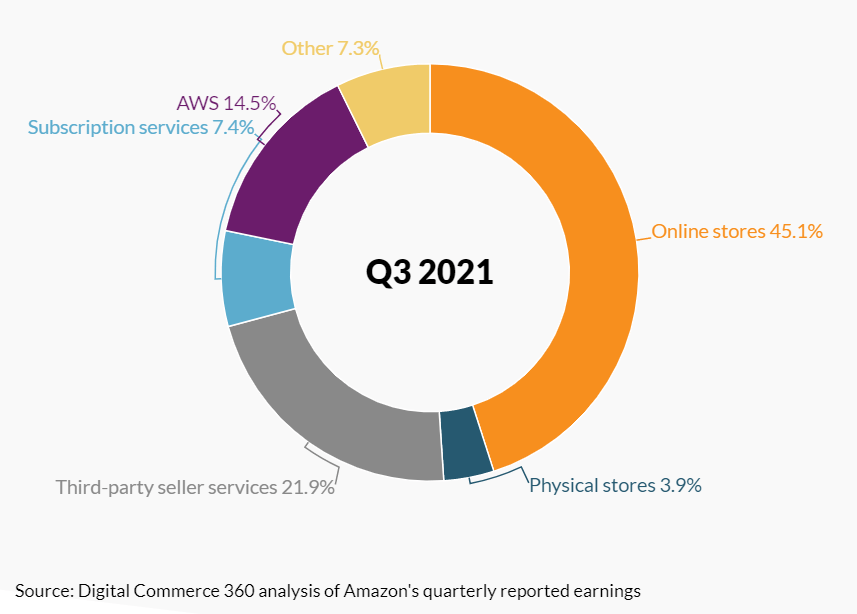
Amazon’s Q3 Net Sales by Segment

Amazon  sales by segment

Amazon vs Your Own E-commerce Store: Should You Make a Choice?

Experience over time has shown that to be competitive, businesses must offer their customers, the ability to shop online. Many entrepreneurs choose to start selling their goods on online marketplaces such as eBay, Walmart.com, Target.com, Wayfair, AliExpress, and so on, but the leading position, of course, belongs to Amazon.

You may ask: “Does a company need to create a store on Amazon if the company already has an active online store?” Our answer: without Undoubtably! Companies should expand their sales channels and an opportunity to sell on Amazon should not be missed. Amazon is one of the first places consumers go when searching and comparing products.

According to a Feedvisor survey, 89 % of users prefer to buy products from Amazon over other e-commerce sites.

Many business owners believe that having a presence on Amazon is critical to the growth of their business. However, this should not be the only marketplace or place of sale. In fact, over 80% of Amazon sellers use other marketplaces and e-commerce platforms for their own online stores.

Why Selling on Amazon Is Profitable

Amazon is one of the largest online platforms and the dominant one in North America. It opens up opportunities for sellers of almost any product.

Here is a quick overview of the main benefits of Amazon Marketplace:

  • Amazon is the first place where potential buyers come to search and compare products.
  • Amazon continues to grow steadily and gain an increasing share of the e-commerce market.
  • Amazon is gaining more and more popularity among end consumers due to its outstanding service.
  • Prime members are active shoppers with higher rate of purchase than the average online consumer.
  • Amazon is constantly developing new programs to offer sellers the opportunity to improve shipping.

Amazon Marketplace Integration

In recent years, especially under the influence of the COVID-19 pandemic, many manufacturers, distributors, and retailers have become even more motivated in offering and selling their products on different marketplaces, mainly Amazon. Amazon is chosen by both large companies that have their own e-Commerce websites, and small companies just starting their own business.

As an e-Commerce integration service provider, we helped many large and growing businesses optimize their e-commerce management and centralize operations by integrating their Amazon Seller Central with CRM, ERP, inventory management, EDI, and other back-end systems.

Moreover, we integrate Amazon with various e-commerce platforms such as Shopify, BigCommerce or Magento, and others.

The most popular Amazon integration are:

– Amazon / Shopify integration

– Amazon / Magento integration

– Amazon / eBay integration

– Amazon / QuickBooks integration

– Amazon / EDI integration

We are aware that companies are actively working to optimize their e-commerce backend processes, automate their sales and fulfillment channels, in order to provide an efficient and streamlined business cycle withing their company.

Our e-commerce integration experts have extensive expertise in e-commerce integration projects for companies of all sizes and from different industries.

Amazon Data Automation

We help Amazon sellers integrate and automate data from their Amazon Seller Central stores into their own ERP / CRM systems.

We can automate and synchronize data such as Orders, Inventory, Product updates, Fulfillment from any ERP / CRM systems to Amazon in a bi-directional way.

Find out more about our integration services here: EDI2XML integration for Amazon Seller Partners

Choose a Reliable and Experienced Partner for Your Amazon Integration

Our company has been in the integration space for over 21 years now, with proven experience in e-commerce integration. We have successfully completed a large number of integration projects using proven methodologies and state-of-the-art technology coupled with our deep technical expertise, to exceed the expectations of our clients.

We automate e-commerce and carry out integration projects of any complexity for clients from all over the world.

Contact us for your first free consultation with our Amazon integration expert.

Get a free Amazon Integration Consultation

You may also be interested in reading about:

EDI2XML integration for Amazon Seller Partners

Amazon Business: How to increase B2B sales on Amazon?

What is Dropshipping on Amazon?


A well-performing e-commerce website can attract more visitors to your business on the Internet, help you acquire more customers, and improve your reputation.

It does not matter on which eCommerce platform your online store is built; Shopify, Magento, BigCommerce, Salesforce Commerce Cloud, or some others, the main goal is to quickly and fully satisfy the needs of your online customers.

Ecommerce Business: Launch Your Online Store

As many eCommerce experts advise, an online store should be simple and straightforward, but its functionality should fulfill the modern requirements of users.

The actions of buyers in most online stores are the same:

Step-1. The buyer enters the online store and finds the desired product.

Step-2. The buyer adds the desired product to the “basket” for ordering.

Step-3. The buyer enters personal information to place and pay for the order.

Step-4. The buyer confirms all the information and the order is sent to the representatives of the online store.

Now, what happens next?

Have you ever wondered where the order should “go” after the customer submits and places it?

Actions at this stage are taken by the owners of the online store, and they could be very different. This can ultimately have a big impact on the store’s revenue and reputation.

eCommerce order management is a key revenue driver for online store

The success of any online store largely depends on the accurate and efficient organization of the order process.

Fast and accurate order processing is one of the most important competitive advantages in any e-Commerce business. However, it is impossible to speed up order processing without effective management. Order management implies an organization’s control at every stage of the cycle: from the receipt of the online order to the delivery of goods to the consumer.

One simple online order usually entails the following processes:

  • placing an order in the database;
  • verification of information from the buyer;
  • receiving of payment;
  • reconciliation with current stocks in the warehouse;
  • shipping and packaging;
  • transfer of cargo to the carrier;
  • message to the buyer about the current status of the order;
  • delivery;
  • updating stock status.

Manual eCommerce order fulfillment vs an automated process

Online store orders can be processed manually or automated.

When processing an order manually, the operator needs to do the following:

  • Key-in into the internal ERP / CRM or accounting system, data about a new client or find his data in the database.
  • Enter customer data (name, email address, phone #, delivery address, payment method, etc.)
  • Enter order data (product, quantity, etc.)
  • Submit the order for further processing.

This approach does not rule out errors and associated disruptions and delays.

The most effective option for successfully managing online orders is fully integrating the ecommerce online store with your business management systems such as ERP/CRM. In this case, all orders automatically synchronize with your internal management system and can be quickly processed.

Fully managed e-commerce Integration with ERP/CRM system

We, at EDI2XML, offer a fully managed solution to integrate your e-commerce store with any business system such as Microsoft Dynamics, Oracle JD Edwards, Salesforce, ServiceMax, SAP Business One / SAP ERP, or even any homegrown business solutions.

We are experienced in using a state-of-the-art technology that is capable of discovering/reading/writing into ERP/CRM systems, using certified connectors.

e-commerce integration service

Using our advanced integration technologies, we provide our clients with the most necessary solutions for their online business:

  • Two-way exchange “eCommerce-ERP”, “ERP-ecommerce”.
  • Secure two-way data transfer.
  • Automatic exchange processing.
  • A stable, reliable, and proven solution.
  • Flexibility and scalability. The ability to expand the functionality of your online store at any stage.
  • Work with a large array of data.
  • Numerous connections with different eCommerce, Amazon, EDI, ERP, CRM, and other business and accounting systems.

Automated eCommerce order management process flow

We eliminate the need for manual data entry by automating the most important business processes, ensuring data exchange between eCommerce and almost all ERP, CRM, and accounting systems.

  • The EDI2XML integration platform connects your ERP/business systems with your online store.
  • Orders placed on your online store are sent automatically to your business system.
  • As you fulfill online orders, the integration platform extracts shipment data from your business system and sends it directly to your ecommerce store thus your clients always have the latest order status.
  • Automatically update inventory data in your online store as frequently as you wish.

Benefits of Integrated e-commerce and ERP

Integration is the best solution for optimizing all stages of order processing. It gives companies many opportunities:

  • You will be able to receive and process orders in one interface.
  • Integration allows you to effectively manage orders in a single structured system from various sales channels (such as your own online store, Amazon account, Facebook marketplace).
  • data synchronization ensures high speed of order processing and continuity of processes.
  • avoid human errors associated with manual order processing.
  • improve customer service and increase profits.

Integration and automation of processes are necessary for online stores with large sales volumes. Additionally, it gets much more necessary, when a company is selling via the multi-channel and omnichannel environment, where the same product is sold online through different channels, and in-store.

An excellent end-to-end solution is the Magic xpi integration platform, which will help automate the process and help speed up order processing.

The popularity of online shopping is skyrocketing like never

As many surveys have shown, more customers are shopping online now than before the pandemic, and this trend continues despite physical stores started re-opening. Thus, this fact is driving the need for digital transformation.

Over the years, we have been helping our clients build successful online businesses. We have extensive and strong experience in data synchronization between eCommerce and ERP/RCM systems as well as automation of processes in the online store built on Shopify, BigCommerce, Magento, and many others.

Contact us for a free consultation and we will help you choose the most suitable integration solution for your e-commerce business.


This post was updated to reflect current trends and information.


Clear navigation, great visual branding, and a simple user-friendly layout – this should look like a good online store. E-commerce platforms such as Shopify, Magento, Woocommerce, BigCommerce, and the likes, already perform these functions.

However, no matter how important usability is, this is only part of the success of your e-commerce business. Long delivery time for example or errors in the order have a decisive influence on customer satisfaction. We all know, that only happy customers will buy again from your eCommerce online store in the future.

The effective work of the online store is ensured primarily, by having a streamlined internal business process and flows, fully integrated with the company’s business management software such as the ERP.

e-commerce automation and integration with ERP and CRM

However, many online store owners, waste valuable time with poorly performing and none-integrated applications, isolated solutions, or even manual work.

If you recognize one of the following warning signals from your everyday work, it is time to act and make a change!

Shopify Store: Not Enough Time for Everyday Activities

What is your daily work in the Shopify online store? Is manual data entry or complex import and export a daily occurrence in your workplace? For small startups, it is reasonable to manage e-commerce business processes using the free basic features of Shopify store.

But if you spend more time synchronizing data than in everyday work, the effectiveness of your online store will drop rapidly.

Online Store: Long Order “Lead Time”

Your store doesn’t have automated processes. Without consistent automation, orders “lead time” for delivery will be on the rise, which affects your service and, above all, the satisfaction of your customers.


KEY TAKEAWAYS

A “lead time” is a measurement of how long it takes to complete a process from start to finish.
For example, the time between placing an online order by a client and delivering goods to him.


The Standard Features of The Online Store are Not Enough

Are the processes in your Shopify store system insufficient to match the growing requirements, even if you have already hired new employees? As company success grows, so does the demand: new functionality must always be embraced.

E-Commerce Store Isolated From Other Business Systems

Do you use your e-commerce store as an isolated solution? If your online store is not connected to the business systems of the enterprise (ERP, CRM, EDI, accounting system, etc.), a separate operation in your company provides double keying-in of data – this is annoying and often leads to human errors.

Loss of Sales

Are you losing sales because you do not have enough goods in stock or there are delays in production or the supply chain? Or maybe you have delays with third-party services such as dropshipping?

e-commerce sales orders automation

Competition

Are you losing qualified employees or applicants to the competition, because they expect a modern, productive work environment?

ERP Integration for Your Online Store

Have you recognized your business and understood the source of the problem? Do you want to change something? We can help you!

We have many years of successful experience in ERP integration with online stores. Our customers note that the integration expanded the functions of the online store, increased the productivity of their online trading, and contributed to the effective growth of their business.

Contact us to get a free consultation on the integration of your online store.

Shopify integration price list

RELATED POSTS:

Must-Have Integration between E-Commerce and Business Systems

9 Major E-Commerce Trends That Will Help Grow Your Online Business

The main reasons why you need Microsoft Dynamics Integration with your Business Systems

PRICING PACKAGES: Shopify Integration

Shopify and Microsoft Dynamics Nav Integration: Things you should know