EDI2XML
  • About
    • The Company
    • EDI2XML
    • Advantages
    • Partnership with EDI2XML
    • Testimonials
  • Services
    • Enterprise AI
    • Fully Managed Integration
    • Fully Managed EDI Services
    • EDI Web Portal
    • EDI Web Service
    • EDI On Premises
    • Managed Cloud Services
    • Amazon Integration
    • Shopify Integration
    • BigCommerce Integration
    • NetSuite Integration
    • JD Edwards Integration
    • Dynamics 365 Integration
    • SAP B1 Integration
    • Salesforce Integration
    • Industry 4.0 Integration
  • Pricing
    • EDI Managed Services
    • EDI Web Service
    • EDI On-Premises
    • Managed Cloud Services
    • Shopify Integration
    • JD Edwards Integration
    • E-commerce Integration
    • All other Integrations
  • Blog
  • Resources
    • Downloadable Guides
    • List of EDI Codes
    • List of EDIFACT Messages
    • EDI Documents Library
    • Trading Partners
    • Customer Case Studies
  • Contact us
  • Book a Consultation
  • Click to open the search input field Click to open the search input field Search
  • Menu Menu
  • Link to Facebook
  • Link to LinkedIn
  • Link to X
  • Link to Youtube

What is an EDI 824 Application Advice?

Blog

EDI 824 Definition

EDI 824 Application Advice is an EDI document that is sent in response to a previously received EDI transaction. EDI 824 reports the receipt of an EDI document and indicates its status. Application Advice can report various statuses:

– acceptance

– rejection

– acceptance with change

Normally, trading partners discussed and agree in advance to each one of the above statuses.

How is EDI 824 Application Advice used?

To generate an EDI 824 transaction, some verifications must be performed on the received EDI document. For example, the list of items in EDI 856 (ASN) should be the same as in the previously submitted EDI 855 (PO Acknowledgement). If a deviation is found in the EDI document, an EDI 824 message with the appropriate status will be generated.

A company can implement Application Advice EDI 824 in response to any EDI document except if a specific response document already exists in EDI business practice, for example:

– EDI 855 Purchase Order Acknowledgment in response to EDI 850 Purchase Order

– EDI 990 Response to a Load Tender in response to EDI 204 Motor Carrier Load Tender

– EDI 754 Routing Instructions in response to EDI 753 Request For Routing Instructions

Why Trading Partners Need EDI 824 Application Advice?

EDI 824 is designed to promptly inform business partners about the accuracy of the information in the previously submitted EDI documents.

This allows the company to promptly correct mistakes and send the adjusted document to their trading partner. EDI X12 824 is based on a general business practice and can be used in any type of business or industry, by any trading partner to advise, reject or indicate any errors on a previously received EDI document.


What are the Benefits of EDI 824?

Cloud Services Provider By using EDI 824, trading partners can quickly report issues related to incoming EDI documents they received, which helps to improve and speed up the order processing and avoid errors.

Cloud Services Provider Application Advice indicates exactly which elements of the received EDI document contain errors, so the sender can quickly correct the EDI document and resend it. This eliminates the need to spend time identifying inaccuracies and errors in the EDI document. This type of electronic exchange of errors and statuses, improves the process of communication between business partners.

Cloud Services Provider EDI 824 is generated automatically, eliminating manual processing of each rejected document.

What are the Differences between EDI 824 and EDI 997?

Even though both EDI 824 and EDI 997 are acknowledgment messages that are sent as a response to the received EDI message, they are very different EDI messages with different functions.

EDI 997 Functional Acknowledgement simply confirms the delivery of the EDI message and that the syntax of the EDI Transaction Set was correct. Accordingly, the EDI FA 997 informs the sender that the envelope has been received by the recipient, and its structure was validated, and it was accepted (or rejected) by the recipient, obviously without validating the content of the received EDI document.

Unlike EDI 997, the EDI 824 works differently; it is the result of the validation of the content of the received initial EDI document. Application notification parses the content of the message and returns a message with a specific status and indicates errors in the content of the message.

824 EDI Document Type

The formal name of this EDI document is X12 824 Application Advice Transaction Set.

EDI 824 Application Advice is supported by the X12F Finance Subcommittee under the X12 Accredited Standards Committee.

In the EDIFACT standard, which is used mainly in Europe, the APERAK – Application Error and Acknowledgement message perform the same function.

EDI Transaction Types – Complete List of EDI Transactions Sets & Codes for ANSI ASC X12 Standard

EDI 824 – Application Advice Structure

ANSI ASC X12 824 Application Advice, can have the following structure:

ISA Interchange Control Header

GS Functional Group Header

ST Transaction Set Header

BGN Beginning Segment

N1 Name

PER Administrative Communications Contact

OTI Original Transaction Identification

REF Reference Identification

DTM Date/Time Reference

AMT Monetary Amount

TED Technical Error Description

SE Transaction Set Trailer

GE Functional Group Trailer

IEA Interchange Control Trailer

How to Integrate and Exchange EDI 824

To exchange EDI 824 or any other EDI documents, each company can choose the most optimal solution that will be most beneficial for it and meet the business requirements of their trading partners.

As an EDI service provider with over 20 years of experience, we understand that requirements can be different from a company to another. One company may have a huge number of EDI transactions that need to be integrated directly into their ERP or CRM system (for example, Salesforce, Oracle JDE, SAP, etc.)

Another company may only have a few transactions per week, and it is not profitable for them to implement a fully managed EDI solution on their own premises.

Some companies may be leaning towards the “on-premises” EDI solution when they have “internal policies” or they are a large enterprise with their own team of IT experts.

That is why we have developed different types of EDI solutions and support different EDI standards (X12, EDIFACT, RosettaNet, etc.) and can use different communication protocols (like AS2, VAN, FTP / SFTP, HTTP / HTTPS) to meet the need of any company.

EDI Web Service

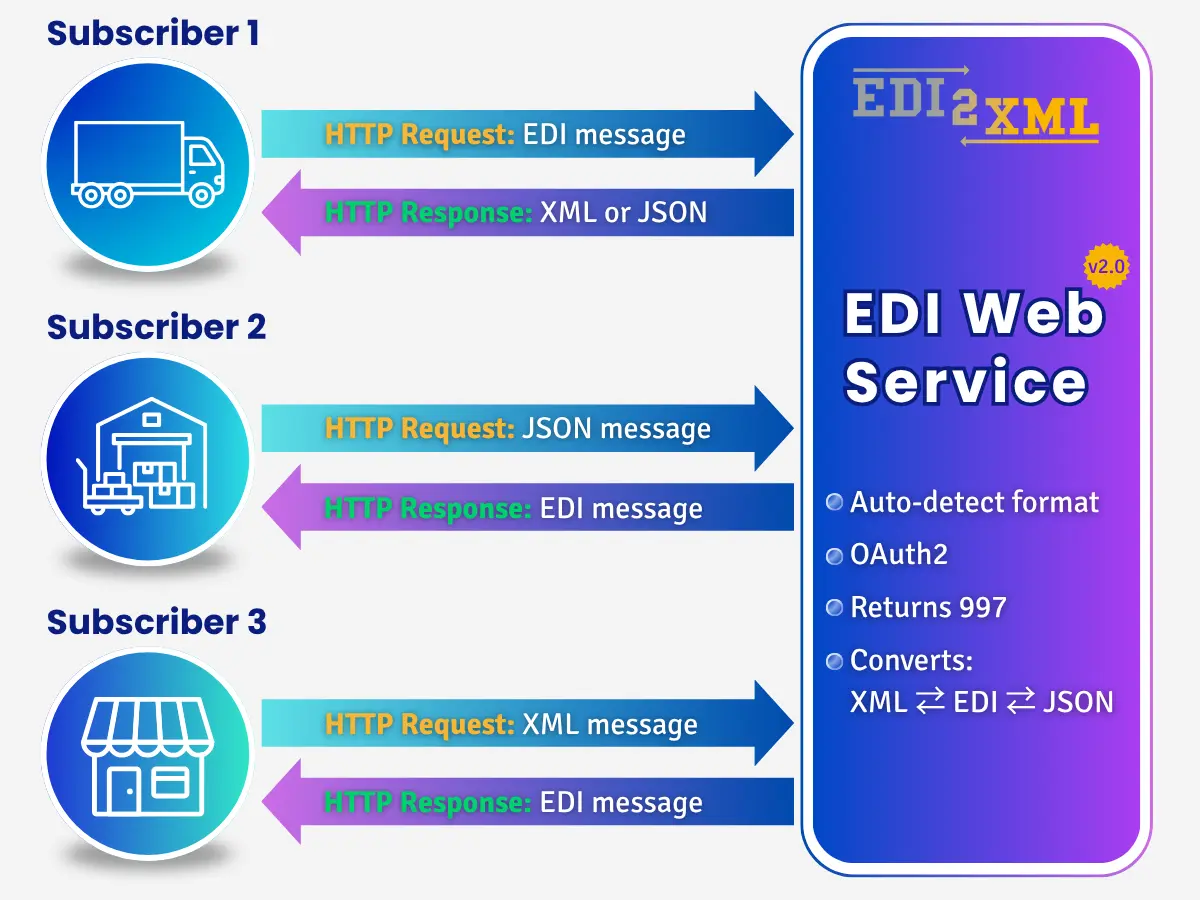
EDI2XML web service is a REST API to convert X12 to XML and vice versa. This API web service for EDI exchange is very low cost and meant for companies who got their own technical resources to work with REST API. Thus, this is a self-service solution with no contract, and no commitment, moreover you can be up and running in less than an hour.

Fully Managed EDI Solution

EDI2XML Managed Services is our popular EDI service that includes translation and communications services. All EDI file conversions are done on our side, so customers don’t need to install software or hardware on-site. This is a complete turnkey EDI solution.

Moreover, with these fully managed services, all EDI documents can be synchronized with the company’s internal system such as ERP, CRM, eliminating the need for manual data entry and fully automating the EDI process.

EDI On-Premises Solution

We offer EDI services with “on Premises” deployment at the customer servers.

In this case, companies need to have some resources such as proper in-house EDI expertise, expertise to work with XML, necessary IT infrastructure.

We help companies choose the best personalized EDI integration solution for their business. To find out more, contact us for a free consultation with one of our EDI experts.


You may also be interested in reading about:

EDI integration for B2B exchange to optimize and grow your business

The Top 6 EDI Documents for Retail Suppliers

Electronic Data Interchange (EDI) in the Supply Chain

December 14, 2021
https://www.edi2xml.com/wp-content/uploads/2021/12/EDI824.png 675 1200 Tatyana Vandich https://www.edi2xml.com/wp-content/uploads/2024/08/edi2xml.com-EDI2XML-company-logo.png Tatyana Vandich2021-12-14 15:37:022026-02-13 15:18:43What is an EDI 824 Application Advice?

All You Need to Know About EDI 210 – Motor Carrier Freight Details and Invoice

Blog

What is an EDI 210 Transaction Set?

EDI Transaction Set X12 210 Motor Carrier Freight Details and Invoice is an EDI document used in logistics by motor carrier companies. EDI 210 is usually sent by the carrier to the shipper (it could be a 3PL warehouse, distributor center, manufacturer, etc.) in order to provide detailed information about the fees for transportation services.

210 EDI Document Type

The formal name of this X12 transaction set is X12 210 Motor Carrier Freight Details and Invoice. 

EDI 210 transaction set, is maintained by a subcommittee “X12I – Transportation” operating within X12’s Accredited Standards Committee.

How is EDI 210 – Motor Carrier Freight Details and Invoice Used?

EDI for transportation

EDI 210 can be used by motor carriers in one of the following two scenarios:

1. as an invoice to request payment, or

2. to provide information about the cost of motor freight transportation.


Typically, the carrier sends the EDI 210 transaction, after the shipment has been delivered to the destination. The EDI 210 document, will indicate the full amount required for a shipment, as well as the terms of payment. The shipper can use the EDI 997 (functional acknowledgment) transaction, to confirm receipt of an EDI 210 transaction.

Benefits of Using EDI 210

Exchange of business documents via EDI is much more efficient and secure than using paper documents or emails. Electronic data interchange helps business partners to improve communication and optimize processes. By exchanging EDI business documents, companies have the following benefits:

– Eliminate the costs associated with the use of paper documents.

– Minimize the labor cost performing daily redundant data entry operations.

– Save time and increase of employee’s productivity.

– Reduce errors due to manual data entry.

– For motor carrier companies, using EDI 210 can speed up the billing process, allowing them to get paid much faster by their business partners.

– For shippers, EDI 210 provides a clear and accurate view of costs, helping to effectively plan a company’s finances.

What Information Does EDI 210 Contains?

The EDI Motor Carrier Freight Details and Invoice Transaction Set contains motor carrier expense details, billing information, and other information that a standard invoice should contain:

– Number and date of the invoice.

– The name and address of the consignee.

– Name and address of the shipper.

– Detailed information about the cargo:

  • name,
  • quantity,
  •  type of cargo,
  •  weight and size

– Delivery methods and route information.

– The total amounts to be paid.

EDI 210 – Motor Carrier Freight Details and Invoice Structure

ANSI ASC X12 Version 4010 of a 210 Motor Carrier Freight Details and Invoice, can have the following structure:

  • ISA – Interchange Control Header
  • GS – Functional Group Header
  • ST – Transaction Set Header
  • B3 – Beginning Segment for Carriers Invoice
  • C3 – Currency
  • M7 – Seal Numbers
  • S5 – Stop Off Details
  • N9 – Reference Number
  • G62 – Date / Time
  • R3 – Route Information
  • H3 – Special Handling Instructions
  • N1 – Name
  • N3 – Address Information
  • N4 – Geographic Location
  • N7 – Equipment Details
  • LX – Assigned Number
  • POD – Proof of Delivery
  • L5 – Description, Marks, and Numbers
  • L0 – Line Item – Quantity and Weight
  • L1 – Rate and Charges
  • L7 – Tariff Reference
  • K1 – Remarks
  • L3 – Total Weight and Charges
  • SE – Transaction Set Trailer
  • GE – Functional Group Trailer
  • IEA Interchange Control Trailer

EDI 210 and EDI 214

What is the difference between EDI 210 and EDI 214? Both of these documents are actively used by logistics and transportation companies, but they have completely two different purposes.

As stated previously in this post, the EDI 210 document, in most cases acts as an invoice for trucking companies. So often, trucking companies call EDI X12 210 Motor Carrier Freight Details and Invoice simply as EDI 210 Invoice.

EDI 214 is a Transportation Carrier Shipment Status Message used by the carrier to notify the shipper and consignee about the status of their cargo.


For complete information on the EDI 214 transaction set read this article: EDI for transportation – EDI 214 Transportation Carrier Shipment Status Message


Automate Logistics and Business Process with EDI2XML Integration Platform

To fully automate data exchange with their business partners, many companies integrate EDI 210 and other important EDI transactions into their internal business systems. Our EDI2XML integration platform provides secure and efficient EDI integration with most ERP, CRM, business, and accounting applications from leading vendors such as SAP, Oracle JD Edwards, Salesforce, Microsoft Dynamics, etc.

Fully managed EDI Service
 

Our robust and powerful EDI integration platform support different EDI standard (X12, EDIFACT, RosettaNet, etc.) and various communication protocols (e.g. AS2, VAN, FTP/SFTP, HTTP/HTTPS), thus we can connect business partners anywhere they are in the world, regardless of their industries.

Connecting business partners through EDI for over 21 years, our company has accumulated vast experience to carry out your EDI integration project quickly and efficiently.

Contact us for your first free consultation.

EDI in transportation and 3PL

You may also be interested in reading about:
– Electronic Data Interchange (EDI) in the Supply Chain
– How EDI can speed the receiving of goods in a warehouse
– EDI for Third-Party Logistics providers (3PL)
– DELFOR, DELJIT, DESADV – key EDI messages in supply chain management for manufacturing

November 24, 2021
https://www.edi2xml.com/wp-content/uploads/2021/11/EDI-210-1.png 675 1200 Tatyana Vandich https://www.edi2xml.com/wp-content/uploads/2024/08/edi2xml.com-EDI2XML-company-logo.png Tatyana Vandich2021-11-24 15:07:422024-10-01 09:31:28All You Need to Know About EDI 210 – Motor Carrier Freight Details and Invoice

Why Amazon is a Must for Your eCommerce Business

Blog

When Amazon opened its online bookstore in 1995, no one expected the website to become the largest retail e-commerce company in the world.

Today Amazon employs 1.46 million full and part-time workers and accounts for 41 % of the U.S. retail e-commerce market.

However, like all other retailers, Amazon is faced with many recent challenges such as the increase of freight and shipping costs, global supply chain disruption, labor shortage, rising payroll costs, and so on. Analysts predict that these along with many other challenges for retailers may increase in the coming holiday period.

Nevertheless, Amazon is committed to minimizing the impact of the above negative factors on its customers and selling partners. As Amazon noted in its latest earnings report, third-quarter order fulfillment expenses increased 25.8% compared to last year. However, by prioritizing its customers and partners, Amazon is even ready to incur short-term losses.

Why Do Companies Choose Amazon Marketplace?

Given Amazon’s excellent reputation among consumers and selling partners, as well as Amazon’s service and customer-centric approach, more and more companies are choosing to sell their products on Amazon.

Amazon is constantly improving its sales processes, for example, they recently launched the Local Seller program, to allow Amazon third-party sellers to offer BOPIS (Buy Online, Pickup in Store) service and local delivery.

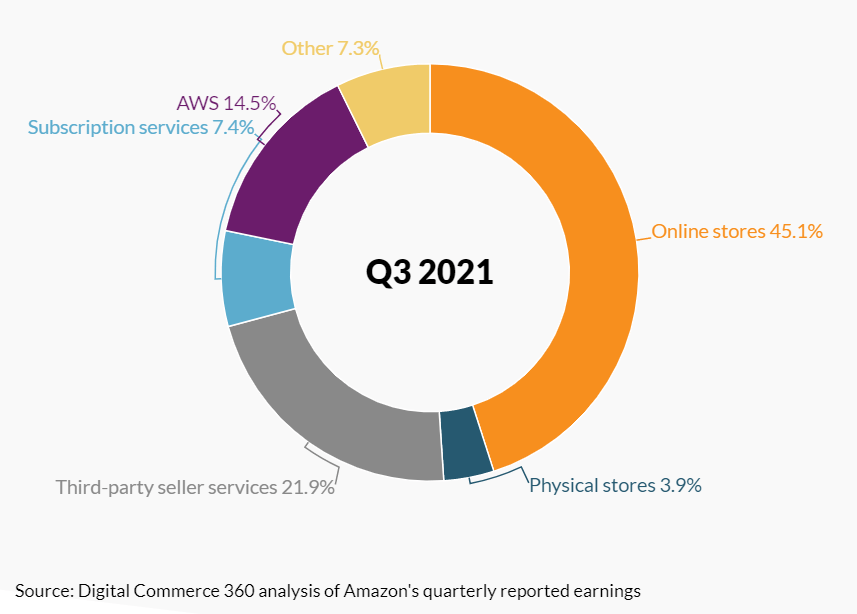
Online store sales continue to grow, albeit at a slower pace compared to 2020 when many physical stores were closed due to the pandemic.

Amazon’s Q3 Net Sales by Segment

Amazon  sales by segment
 

Amazon vs Your Own E-commerce Store: Should You Make a Choice?

Experience over time has shown that to be competitive, businesses must offer their customers, the ability to shop online. Many entrepreneurs choose to start selling their goods on online marketplaces such as eBay, Walmart.com, Target.com, Wayfair, AliExpress, and so on, but the leading position, of course, belongs to Amazon.

You may ask: “Does a company need to create a store on Amazon if the company already has an active online store?” Our answer: without Undoubtably! Companies should expand their sales channels, and an opportunity to sell on Amazon should not be missed. Amazon is one of the first places consumers go when searching and comparing products.

Many business owners believe that having a presence on Amazon is critical to the growth of their business. However, this should not be the only marketplace or place of sale. In fact, over 80% of Amazon sellers use other marketplaces and e-commerce platforms for their own online stores.

Why Selling on Amazon Is Profitable

Amazon is one of the largest online platforms and the dominant one in North America. It opens up opportunities for sellers of almost any product.

Here is a quick overview of the main benefits of Amazon Marketplace:

  • Amazon is the first place where potential buyers come to search and compare products.
  • Amazon continues to grow steadily and gain an increasing share of the e-commerce market.
  • Amazon is gaining more and more popularity among end consumers due to its outstanding service.
  • Prime members are active shoppers with higher rate of purchase than the average online consumer.
  • Amazon is constantly developing new programs to offer sellers the opportunity to improve shipping.

Amazon Marketplace Integration

In recent years, especially under the influence of the COVID-19 pandemic, many manufacturers, distributors, and retailers have become even more motivated in offering and selling their products on different marketplaces, mainly Amazon. Amazon is chosen by both large companies that have their own e-Commerce websites, and small companies just starting their own business.

As an e-Commerce integration service provider, we helped many large and growing businesses optimize their e-commerce management and centralize operations by integrating their Amazon Seller Central with CRM, ERP, inventory management, EDI, and other back-end systems.

Moreover, we integrate Amazon with various e-commerce platforms such as Shopify, BigCommerce or Magento, and others.

The most popular Amazon integration are:

– Amazon / Shopify integration

– Amazon / Magento integration

– Amazon / eBay integration

– Amazon / QuickBooks integration

– Amazon / EDI integration

We are aware that companies are actively working to optimize their e-commerce backend processes, automate their sales and fulfillment channels, in order to provide an efficient and streamlined business cycle withing their company.

Our e-commerce integration experts have extensive expertise in e-commerce integration projects for companies of all sizes and from different industries.

Amazon Data Automation

We help Amazon sellers integrate and automate data from their Amazon Seller Central stores into their own ERP / CRM systems.

We can automate and synchronize data such as Orders, Inventory, Product updates, Fulfillment from any ERP / CRM systems to Amazon in a bi-directional way.

Find out more about our integration services here: EDI2XML integration for Amazon Seller Partners

Choose a Reliable and Experienced Partner for Your Amazon Integration

Our company has been in the integration space for over 21 years now, with proven experience in e-commerce integration. We have successfully completed a large number of integration projects using proven methodologies and state-of-the-art technology coupled with our deep technical expertise, to exceed the expectations of our clients.

We automate e-commerce and carry out integration projects of any complexity for clients from all over the world.

Contact us for your first free consultation with our Amazon integration expert.

Get a free Amazon Integration Consultation

You may also be interested in reading about:

EDI2XML integration for Amazon Seller Partners

Amazon Business: How to increase B2B sales on Amazon?

What is Dropshipping on Amazon?

November 22, 2021
https://www.edi2xml.com/wp-content/uploads/2021/11/EDI2XML-Blog-amazon-Integration.jpg 675 1200 Tatyana Vandich https://www.edi2xml.com/wp-content/uploads/2024/08/edi2xml.com-EDI2XML-company-logo.png Tatyana Vandich2021-11-22 14:35:442026-05-28 16:22:02Why Amazon is a Must for Your eCommerce Business

EDI 945 Warehouse Shipping Advice in Transportation Management, 3 PL Warehouse, and Third-party Logistics.

Blog

Many different processes take place in the warehouse every day, whether it’s a regular or 3PL warehouse. All of them must be carried out quickly and accurately. In this article, we will look at the importance of using EDI (Electronic Data Interchange) especially, an electronic document – EDI 945 Warehouse Shipping Advice associated with shipment of goods. Let’s figure out who and when to use EDI 945, what information a Warehouse Shipping Advice contains, 945 EDI specifications, benefits of using this EDI document, and much more.

What is EDI 945 transaction?

The Warehouse Shipping Advice Transaction Set (EDI 945) is an electronic data interchange (EDI) document. EDI 945 is usually used by 3PL warehouse/ remote warehouse or third-party logistics company, to notify its client (depositor) that a shipment has been made. It is used to match order quantities with shipment quantities.

945 EDI document type

EDI X12 945 Warehouse Shipping Advice Transaction Set is a document base on the X12 standard. X12 is a non-profit, ANSI-accredited standards development organization for cross-business transactions that support electronic data interchange in North America.

Each set of EDI transactions is supported by a subcommittee working within the X12 Accredited Standards Committee. EDI 945 falls under X12M – Supply Chain Subcommittee.

How is EDI 945 – Warehouse Shipping Advice used?

When a supplier/depositor (for example, a manufacturer or a wholesaler) needs to ship goods from the warehouse, he sends his 3PL warehouse an EDI document 940 Warehouse Shipping Order. EDI 940 contains all the necessary information regarding the goods required for shipment (description and quantity of goods, delivery date, recipient information, etc.) as well as shipping instructions.

Useful Reading: What is EDI 940 Warehouse Shipping Order?

The warehouse, having received the EDI 940, makes the shipment of the order and returns the EDI 945 immediately after the parcel has left the warehouse.

EDI 945 transfers detailed information about the merchandise shipped and the detail of the delivery.

Based on transaction EDI 945, the supplier can generate EDI 856 Advance Ship Notice as needed to notify its customer of an upcoming delivery.

What is the shipping process in a warehouse?

Shipment is the process of preparing and sending goods to the designated location. The shipping procedure at the warehouse is carried out according to predetermined rules. Each company develops shipping regulations independently, taking into account the characteristics and specifics of the goods and warehouse space.


The procedure for shipping goods from the warehouse/ 3PL warehouse can include many stages:

  • processing of the depositor’s order (for example, entering data into the warehouse system);
  • checking the availability of goods in the warehouse;
  • receiving a picking list;
  • selection of the necessary goods from the storage place;
  • moving to the picking area;
  • packaging and labeling in containers/pallets;
  • loading of transport;
  • Preparation and entry into the warehouse system of the relevant information.
EDI- Price
 

The main task of the warehouse manager is to organize efficient work, which will ensure fast processing of orders since all shipments must be carried out on time.

Automation of warehouse processes, for example, the use of EDI can significantly improve the quality and speed of shipment of goods.

Workflow to Exchange Warehouse Shipping Advice (EDI 945)

Let’s take a closer look at the process of shipment of goods from a third-party warehouse and analyze what other EDI documents are involved in the logistics process. Of course, keep in mind that the process below may reflect only one of the possible options. Each company can establish its own business process with a third-party warehouse, which depends on the type of the company’s activity, type of product, etc.

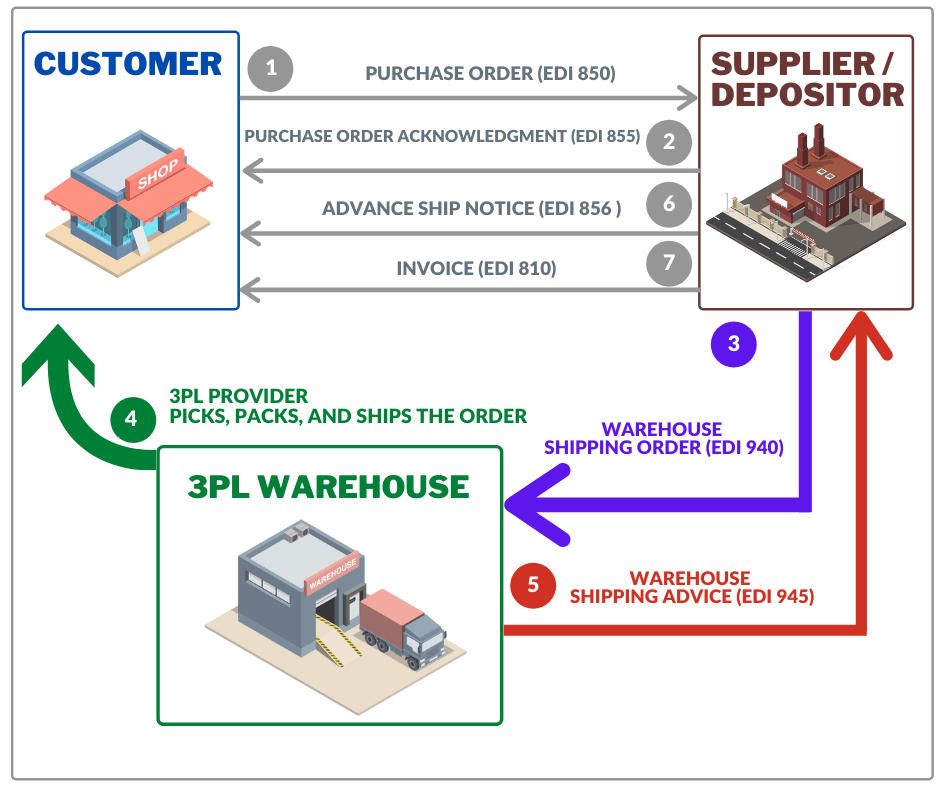
In the figure below you can see that usually the process in which EDI 945 is involved consists of at least three participants:

– Customer (it could be a retail outlet)

– Supplier (who is a client of the 3PL warehouse, or a depositor)

– 3PL Warehouse / or 3 PL logistics company.


1. The business flow begins with a Purchase Order – EDI 850 which is sent by the customer to the supplier.

2. The supplier responds to the customer with the EDI 855 PO Acknowledgement

3. The supplier sends the Warehouse Shipping Order (EDI 940) to the 3 PL warehouse

4. 3PL Warehouse process a Shipping Order and sends the goods to the supplier’s customer by the address specified in EDI 940.

5. Immediately after dispatch, the warehouse transfers the EDI 945 to the supplier.

6. Based on EDI 945, the supplier generates an Advance Ship Notice (EDI 856) and transfers it to his client.

7. The supplier sends the customer an EDI invoice 810

So, as you saw from the EDI workflow, 945 Warehouse Shipping Advice – is the main document, which confirms the fact of shipment of goods. It is used by many companies operating in wholesale and retail, including online stores.

Useful Reading: EDI Integration for Transportation and Logistics

What information does EDI 945 contain?

EDI document Warehouse Shipping Advice contains accurate and detailed information about the item shipped from the warehouse. Thus, EDI 945 includes the following information:

  • Information about the depositor, warehouse, and place of delivery (addresses, contacts).
  • Details of the carrier and the method of delivery of the goods.
  • Information about the product – cost, product name, SKUs, etc.
  • The number of goods shipped.
  • Complete order detail of the original order (EDI 940)
  • Date and time of shipment from the warehouse.
  • Transportation method

EDI 945 Warehouse Shipping Advice Structure

Like any other EDI document, EDI 945 transaction set has a precise structure and sequence of elements.

  • ISA – Interchange Control Header
  • GS – Functional Group Header
  • ST – Transaction Set Header
  • W06 – Warehouse Shipment Identification (numbers, dates, and other basic data)
  • 0100 – Loop Name (to identify a party by type of organization, name, and code)
  • N1 – Name
  • N9 – Reference Identification
  • G62 – Date/Time
  • W27 – Carrier Detail
  • W10 – Warehouse Additional Carrier Information
  • 0300 – Loop Assigned Number
  • LX – Assigned Number
  • MAN – Marks and Numbers
  • PAL – Pallet Information
  • 0310 – Loop Warehouse Item Detail
  • W12 – Warehouse Item Detail
  • N9 – Reference Identification
  • W03 – Total Shipment Information
  • SE – Transaction Set Trailer 
  • GE – Functional Group Trailer
  • IEA – Interchange Control Trailer

Benefits of using EDI 945 in Warehouses/ 3PL warehouses and Logistics

The use of EDI 945 in a 3 PL warehouses or 3 PL logistics company, allows you to get significant competitive advantages due to:

  • increasing the speed and accuracy of logistics operations;
  • reducing the cost of manual processing of documents;
  • reducing the risks of losses and information inaccuracies;
  • Increasing the speed of order processing due to receiving timely, fast, and accurate information.

Thus, automation of warehouse processes through the use of EDI document such as EDI 945, significantly improves the quality of 3PL warehouse processes.

Automate Warehouse Shipping Advice with EDI2XML Web Service

We have a ready-made EDI solution for the exchange of electronic documents in the X12 and EDIFACT standards. It is a unique HTTP service running over the internet that is capable of receiving HTTP requests to translate EDI messages to XML, and XML to EDI.

Try all the possibilities of the EDI2XML Web Service for free. We offer a 15 days free trial.

Contact us for a free consultation and find out how within an hour you can start exchanging electronic documents such as EDI 945 and many others with your trading partner.

EDI in transportation and 3PL

You may also be interested in reading about:
– Electronic Data Interchange (EDI) in the Supply Chain
– How EDI can speed the receiving of goods in a warehouse
– EDI for Third-Party Logistics providers (3PL)
– DELFOR, DELJIT, DESADV – key EDI messages in supply chain management for manufacturing


October 18, 2021
https://www.edi2xml.com/wp-content/uploads/2021/10/EDI-945-EDI2XML.png 675 1200 Tatyana Vandich https://www.edi2xml.com/wp-content/uploads/2024/08/edi2xml.com-EDI2XML-company-logo.png Tatyana Vandich2021-10-18 14:31:452025-02-11 10:31:11EDI 945 Warehouse Shipping Advice in Transportation Management, 3 PL Warehouse, and Third-party Logistics.

Hybrid Cloud: Infrastructure, Storage, Benefits, Trends, and Statistics

Blog

What is Hybrid Cloud?

The term “hybrid cloud” refers to a combination of a public cloud like Amazon Web Services (AWS), Microsoft Azure, and a private environment, such as a private cloud or on-premises resources, that remain separate entities but are linked together to provide the benefits of several deployment types.

In other words, a hybrid cloud is the capacity to integrate collocation, managed, and dedicated services with cloud resources.

A hybrid cloud enables companies to minimize IT infrastructure costs and benefit from adaptability resources.

Hybrid Cloud Definition:

Hybrid Cloud refers to a computing environment that combines on-premises infrastructure with public and private cloud services. It allows organizations to leverage the benefits of both environments, creating a flexible and scalable solution for their computing needs.

To understand why businesses are moving to a hybrid cloud, you must first understand the major differences between public and private clouds. This article will explain the difference between a private and a public cloud.

Hybrid Cloud Infrastructure

Hybrid cloud infrastructure includes networking, servers, and virtualization software. The data is hosted on servers that provide remote access to it over the network.

The principle of a hybrid cloud usually implies the use of the company’s own resources and the resources of third-party providers, therefore the components are located in two environments: on-premises and at a third-party service provider, for example, a public cloud, colocation data center, etc.

Hybrid Cloud Storage

Hybrid cloud storage provides a choice of hosting different types of data with different access requirements.

This means that companies can use less productive, but economical storage for data that is not used often, and high-performance storage for frequently used data.

This tiered storage architecture is typical of a hybrid cloud.

Typically, in a hybrid cloud storage architecture, the primary storage with frequently accessed files and application data is placed closer to users it could be a private cloud or on-premises. This helps ensure maximum performance.

The next kind of storage is usually hosted in a public cloud. Typically, a public cloud is used to store infrequently accessed data, or as a backup to the primary storage system.

Another tier of storage can also be located in the public cloud with the cheapest storage subscription. Organizations can use this tier for long-term storage of archived data that is rarely used.


Useful Reading: How to Solve data Security Challenges in the Post-COVID-19 World


Hybrid Cloud Use Cases

The use cases for a hybrid cloud are endless. For example, an organization can store sensitive data in its own private cloud but connect other applications in the public cloud.

Another option for companies working with sensitive data, is a multi-tenant cloud as part of a hybrid model that separates applications and resources from each other and can be further isolated via VLANs.

Hybrid Cloud Adoption in Midsize Organizations: Trends and Statistics

The IDG Market Pulse Global Survey of 700 IT CIOs surveyed the progress of midsize organizations on hybrid cloud adoption. The study focused on factors accelerating cloud adoption and best practices to ensure security and improve the efficiency of business and IT infrastructure.

According to those surveyed, cost savings and improved security are the top benefits of a hybrid cloud.

At the same time, 41% of respondents report improved profitability (due to optimal deployment workloads and applications), and 35% report improved security.

The following are other benefits of hybrid cloud noted by respondents.

  • Increased flexibility (35%)
  • Increased user satisfaction (34%)
  • Improved disaster recovery and resiliency (31%)
  • Simplified workload migration (29%)
  • Ability to leverage on-premises security best practices for any cloud (27%)

A hybrid cloud is an important step toward digital transformation. The interest in the cloud of midsize businesses is reflected in the IT planned budget. 49% of MarketPulse respondents said they plan to invest more in cloud infrastructure in the near future.

In terms of Canadian businesses, a recent CDW Canada’s 2021 report highlights the critical importance of cloud services in achieving Canadian firms’ digital transformation goals.

During the COVID-19 pandemic, many companies realized all the shortcomings of on-premises solutions and this was the push for the move to a hybrid cloud.

According to the Cloud Report, 52% of companies have already invested or are planning to invest in cloud infrastructure to make their business more reliable.

According to a report by Flexera, 92% of surveyed organizations have a multi-cloud strategy, with 82% adopting a hybrid cloud approach.

Canadian companies are increasingly choosing third-party cloud data centers over in-house IT environments.

By 2022, according to the report, more than half (56%) of IT budgets will be spent on running workloads in external data centers, including co-located data centers, hosted private clouds, and public clouds.

Hybrid Cloud Benefits

A hybrid cloud provides companies with many benefits and the ability to choose the right cloud type to meet the requirements and needs of the company.

We discussed the benefits of using hybrid clouds above, which were noted in the survey. However, the hybrid cloud approach has a number of additional benefits that should be mentioned:

  • Reduced infrastructure costs.
  • Improving the speed of operations.
  • Reduced downtime.
  • Improving employee productivity.
  • Improve security by hosting sensitive data workloads locally.
  • Faster and easier data backups.
  • Reduced response time.
  • Improved scalability.
  • Simplified workload migration.
  • Increased cost-effectiveness (i.e., the ability to host workloads and applications in the right cloud).
  • Increased flexibility and agility to scale according to business and/or market needs.

Take Advantage of the Managed Cloud Services

Many businesses are hesitant to migrate to the cloud because of security and privacy concerns. Actually, the deployment of a hybrid cloud is dependent on a number of criteria, including the data’s security and compliance obligations, the required measure of control over the data, and the applications. There can be confusion about integrating public, private, and hybrid cloud solutions.

Caring for our clients’ business has always been and remains our top priority: we have all the necessary tools and technologies to quickly deploy virtual infrastructure for companies of any size, scale, and support it.

If you need expert advice to reap the full benefits of the cloud, contact us for your free consultation with our cloud service specialists and experts.


You might also be interested in:

– Managed Cloud Services Price

– Private Cloud, Public Cloud, and Managed Cloud Service: What it is, Effective Strategies & Benefits

– What are Managed Cloud Services?

September 20, 2021
https://www.edi2xml.com/wp-content/uploads/2021/09/EDI2XML-Hybrid-cloud-1.png 675 1200 Tatyana Vandich https://www.edi2xml.com/wp-content/uploads/2024/08/edi2xml.com-EDI2XML-company-logo.png Tatyana Vandich2021-09-20 12:12:322026-02-13 17:31:07Hybrid Cloud: Infrastructure, Storage, Benefits, Trends, and Statistics

What is The Key Factor That Influences E-Commerce Website’s Revenue?

Blog

A well-performing e-commerce website can attract more visitors to your business on the Internet, help you acquire more customers, and improve your reputation.

It does not matter on which eCommerce platform your online store is built; Shopify, Magento, BigCommerce, Salesforce Commerce Cloud, or some others, the main goal is to quickly and fully satisfy the needs of your online customers.

E-commerce Business: Launch Your Online Store

As many eCommerce experts advise, an online store should be simple and straightforward, but its functionality should fulfill the modern requirements of users.

The actions of buyers in most online stores are the same:

Step-1. The buyer enters the online store and finds the desired product.

Step-2. The buyer adds the desired product to the “basket” for ordering.

Step-3. The buyer enters personal information to place and pay for the order.

Step-4. The buyer confirms all the information and the order is sent to the representatives of the online store.

Now, what happens next?

Have you ever wondered where the order should “go” after the customer submits and places it?

Actions at this stage are taken by the owners of the online store, and they could be very different. This can ultimately have a big impact on the store’s revenue and reputation.

eCommerce order management is a key revenue driver for online store

The success of any online store largely depends on the accurate and efficient organization of the order process.

Fast and accurate order processing is one of the most important competitive advantages in any e-Commerce business. However, it is impossible to speed up order processing without effective management. Order management implies an organization’s control at every stage of the cycle: from the receipt of the online order to the delivery of goods to the consumer.

One simple online order usually entails the following processes:

  • placing an order in the database;
  • verification of information from the buyer;
  • receiving of payment;
  • reconciliation with current stocks in the warehouse;
  • shipping and packaging;
  • transfer of cargo to the carrier;
  • message to the buyer about the current status of the order;
  • delivery;
  • updating stock status.

Manual eCommerce order fulfillment vs an automated process

Online store orders can be processed manually or automated.

When processing an order manually, the operator needs to do the following:

  • Key-in into the internal ERP / CRM or accounting system, data about a new client or find his data in the database.
  • Enter customer data (name, email address, phone #, delivery address, payment method, etc.)
  • Enter order data (product, quantity, etc.)
  • Submit the order for further processing.

This approach does not rule out errors and associated disruptions and delays.

The most effective option for successfully managing online orders is fully integrating the ecommerce online store with your business management systems such as ERP/CRM. In this case, all orders automatically synchronize with your internal management system and can be quickly processed.

Fully managed e-commerce Integration with ERP/CRM system

We, at EDI2XML, offer a fully managed solution to integrate your e-commerce store with any business system such as Microsoft Dynamics, Oracle JD Edwards, Salesforce, ServiceMax, SAP Business One / SAP ERP, or even any homegrown business solutions.

We are experienced in using a state-of-the-art technology that is capable of discovering/reading/writing into ERP/CRM systems, using certified connectors.

e-commerce integration service

Using our advanced integration technologies, we provide our clients with the most necessary solutions for their online business:

  • Two-way exchange “eCommerce-ERP”, “ERP-ecommerce”.
  • Secure two-way data transfer.
  • Automatic exchange processing.
  • A stable, reliable, and proven solution.
  • Flexibility and scalability. The ability to expand the functionality of your online store at any stage.
  • Work with a large array of data.
  • Numerous connections with different eCommerce, Amazon, EDI, ERP, CRM, and other business and accounting systems.

Automated eCommerce order management process flow

We eliminate the need for manual data entry by automating the most important business processes, ensuring data exchange between eCommerce and almost all ERP, CRM, and accounting systems.

  • The EDI2XML integration platform connects your ERP/business systems with your online store.
  • Orders placed on your online store are sent automatically to your business system.
  • As you fulfill online orders, the integration platform extracts shipment data from your business system and sends it directly to your ecommerce store thus your clients always have the latest order status.
  • Automatically update inventory data in your online store as frequently as you wish.

Benefits of Integrated e-commerce and ERP

Integration is the best solution for optimizing all stages of order processing. It gives companies many opportunities:

  • You will be able to receive and process orders in one interface.
  • Integration allows you to effectively manage orders in a single structured system from various sales channels (such as your own online store, Amazon account, Facebook marketplace).
  • data synchronization ensures high speed of order processing and continuity of processes.
  • avoid human errors associated with manual order processing.
  • improve customer service and increase profits.

Integration and automation of processes are necessary for online stores with large sales volumes. Additionally, it gets much more necessary, when a company is selling via the multi-channel and omnichannel environment, where the same product is sold online through different channels, and in-store.

An excellent end-to-end solution is the Magic xpi integration platform, which will help automate the process and help speed up order processing.

The popularity of online shopping is skyrocketing like never before

As many surveys have shown, more customers are shopping online now than before the pandemic, and this trend continues despite physical stores started re-opening. Thus, this fact is driving the need for digital transformation.


Over the years, we have been helping our clients build successful online businesses. We have extensive and strong experience in data synchronization between eCommerce and ERP/RCM systems as well as automation of processes in the online store built on Shopify, BigCommerce, Magento, and many others.

Contact us for a free consultation and we will help you choose the most suitable integration solution for your e-commerce business.


The following is a list of additional helpful information:

Must-Have Integration between E-Commerce and Business Systems

9 Major E-Commerce Trends That Will Help Grow Your Online Business

The main reasons why you need Microsoft Dynamics Integration with your Business Systems

Shopify and Microsoft Dynamics Nav Integration: Things you should know

Free Shopify Integration Whitepaper

August 30, 2021
https://www.edi2xml.com/wp-content/uploads/2021/08/EDI2XML-ecommerce-revenue.jpg 675 1200 Tatyana Vandich https://www.edi2xml.com/wp-content/uploads/2024/08/edi2xml.com-EDI2XML-company-logo.png Tatyana Vandich2021-08-30 14:03:542026-02-13 17:32:51What is The Key Factor That Influences E-Commerce Website’s Revenue?

Shopify Private or Public app: What’s Best for ERP Integration

Blog

During the COVID-19 pandemic situation, companies worldwide have shifted their business mostly to their eCommerce front, to stay the course and become effective, given the worldwide safety and restrictions. It is no secret that this kind of business shift positively affected eCommerce platform providers such as Shopify, Big Commerce, WooCommerce, Magento, and others in the marketplace.

Considering Shopify is the one of the top 5 major players in the eCommerce market in North America, we frequently get this question from clients and contacts, when discussion integration projects between Shopify and ERP/CRM:

“What is the best option to integrate the Shopify eCommerce store, is it to do it through any public app in the marketplace or through the private app?“

While this question is very generic, I will try to keep my explanation simple, with an emphasis on the pros and cons of both integration options. All this is based on our proven expertise in ERP integration to eCommerce platforms and other systems; Let me start by putting some definitions.

What is Shopify?

Shopify is a Canadian eCommerce platform company based in Ottawa (Canada), with a revenue of less than little less 3 billion US dollars as of 2020. Shopify is servicing companies and users around the globe, in providing a stable, intuitive, and solid eCommerce platform for eCommerce business.

For more information about Shopify as a company or offerings, you can always check their website

Why companies need integration to their ERP or CRM?

Companies of all sizes in today’s business reality are becoming very agile in using different means to process sales transactions and generate revenues. As an example, a typical company today in the service or retail industry will have several means to receive orders:

1. through a phone call where consumers or even B2B clients might call in, to place orders.

2. through the exchange of electronic business documents (EDI) a typical protocol mainly used by large retailers and distribution (B2B)

3. through one or multiple consumer based (B2C) eCommerce sites.

As you notice, there are different channels or protocols to communicate sales orders for that same company, which are typically through different systems (ERP, CRM, eCommerce site) and having their ERP as the main business system.

The process to consolidate all orders received from all the different sources, into one destination system (ERP or CRM), is called “integration”.

Having an integration and synchronization between an eCommerce site based on any of the known platforms of the marketplace (i.e. WooCommerce, Shopify, Big Commerce, Magento,…), and the ERP / CRM system of an enterprise (i.e. SAP, Oracle JDE, Microsoft Dynamics,….), will improve efficiency and productivity, and most importantly offer a better customer experience to their clients.


Read more about the most 3 important reasons for EDI integration with Shopify


What are the integration possibilities with Shopify?

Shopify offers several options to allow integration between an eCommerce site on its platform and other third-party systems, they are offered under two models:

a) Public Shopify apps

b) Private Shopify apps

both options are available for all Shopify subscribers. Let’s drill down and describe the difference between both integration options

a) Shopify public apps

Those types of applications (or apps) are most of the time activated per instance of Shopify, from within Shopify marketplace. Those apps can be purchased through a subscription paid annually or monthly, in return of its use.

Here are some of the characteristics of Shopify public apps:

  • Public apps are publicly available on Shopify marketplace. They are sometimes developed by Shopify team, or a certified Shopify partner or developer.
  • Most of the times, such apps do execute one and only one functionality (for example reading an inventory feed and updating the SKU available quantity in Shopify).
  • You can find on the same marketplace, multiple apps, providing the same functionality, while it is developed by different professionals, and offered at different prices.
  • Subscription to public apps is most of the times intuitive, quick, and requires little configuration for users with some level of expertise.

b) Shopify private apps

Private apps on Shopify, as per their definition are built for a single Shopify instance (or store). Shopify provides access to the underlying database through a REST API.

By selecting the option to build a private app to access Shopify, you will be given necessary credentials and security tokens to be able to read and write all the data objects available to you from your Shopify store.

Here are some of the characteristics of Shopify private apps:

  • Not available for the public; only you can use it for your own store
  • Not publicly available on Shopify marketplace.
  • This type of private apps is developed by your integration partner, to access your own data.
  • Your integration partner can develop integration flows that can sync in both directions multiple flows.

What is best a Shopify private or public app for integration?

While public apps are great applications, built by experienced developers, we have been seeing much better success when doing the integration between Shopify and a company’s ERP / CRM system using Shopify private apps. This conclusion is based on previous integration projects.

In previous projects, we were able to integrate Shopify orders, fulfillment, inventory with home grown ERP systems, and branded ERP / CRM systems such as Oracle JDE, SAP, Salesforce, Microsoft Dynamics….

Our integration flows are proven to be stable and mainly it does not conflict with different Shopify public apps active on the Shopify instance. In fact, most of the clients who use our integration services, they come to us, to solve the technological issues they face when they implement and use different public apps in their instance of Shopify.

Choose the best integration provider to integrate Shopify with your ERP or CRM

We, as a successful integration provider, have been helping our customers for 21 years quickly, reliably connect eCommerce to ERP or CRM and integrate it into business systems.

Contact us for a free consultation and we will help you choose the most suitable integration solution for your business.

Shopify Integration
August 4, 2021
https://www.edi2xml.com/wp-content/uploads/2021/08/Shopify-Public-app-Private-app.jpg 675 1200 Pierre Namroud https://www.edi2xml.com/wp-content/uploads/2024/08/edi2xml.com-EDI2XML-company-logo.png Pierre Namroud2021-08-04 11:19:372026-02-13 17:33:53Shopify Private or Public app: What’s Best for ERP Integration

EDI Integration for Transportation and Logistics

Blog

Electronic Data Interchange (EDI) Integration for Transportation and Logistics

Electronic data interchange (EDI) is the exchange of commercial and financial electronic documents between business partners. There are several EDI standards used in transportation and logistics:

– EDI X12 standard used in the United States and Canada.

– EDIFACT – mainly used in Europe and international transportation.


Useful Reading: What Are the Differences Between ANSI X12 and UN/EDIFACT


The exchange of EDI documents between business partners simplifies and speeds up business processes. That is why, in logistics, regardless of the mode of transportation, motor, marine, or rail transportation EDI is used as a fast, economical, and safe method of transferring important business information related to the transportation of goods.

How is EDI used in transportation?

Electronic Data Interchange (EDI) is widely used in transportation and logistics to automate communication and data exchange between different parties involved in the transportation process, such as shippers, carriers, and third-party logistics providers (3PLs).

In transportation, EDI is used for various tasks such as:

Shipment tracking and status updates: EDI messages can be used to provide real-time information about the status of shipments, such as pickup and delivery times, estimated time of arrival (ETA), and any delays or issues.

Shipping documentation: EDI can be used to exchange shipping documents such as bills of lading, packing lists, and customs declarations, which helps to reduce errors and streamline the shipping process.

Freight invoicing and payment: EDI messages can be used to exchange billing and payment information between shippers, carriers, and 3PLs, reducing the need for manual data entry and minimizing the risk of errors and disputes.

Capacity planning and optimization: EDI can be used to exchange information about available capacity, shipment volumes, and transportation rates, enabling carriers and shippers to plan their operations more efficiently and make more informed decisions.

What are the most important EDI documents used in transportation?

In addition to common EDI transactions such as orders or invoices, each industry uses its specific EDI documents. Electronic Data Interchange in logistics ensures the operational interaction between business partners (buyers, suppliers, 3PL warehouses, forwarders, etc.) at all stages of the delivery, and improves the management of complex business processes. Thus, in transportation, the following types of EDI documents are most commonly used:

EDI 204 – Motor Carrier Load Tender: This EDI document is typically sent from the shipper (retailer, manufacturer, or a distribution center) to the transportation provider to request pickup of the shipment.

EDI 990 – Response to the Load Tender: used by the transportation provider to inform acceptance or rejection of the shipment order.

EDI 214 Transportation Carrier Shipment Status Message: delivery status message sent by the transportation company to the shipper (retailer, manufacturer, or a distribution center) to give an update on the status of delivery.

EDI 210 Motor Carrier Freight Details and Invoice: Submits by transportation provider to the shipper after delivery. This EDI transaction contains full information about the cost of services provided by the transportation provider and is used as an invoice for a payment request.

EDI 212 Motor Carrier Delivery Trailer Manifest – send by a transportation company to consignees to inform about the contents of a trailer containing multiple loads.

EDI 856 Advanced Ship Notice (ASN): sent by transportation provider or warehouse / supplier to the consignee immediately upon closing the truck, to inform about all pertinent data relative to the shipment.

EDI 997 – Functional Acknowledgement: used by both parties t to confirm they received the transaction set.

Complete list of EDI transportation codes

Below is a complete list of EDI X12 transactions sets used in the transportation industry. The EDI transactions listed below are maintained by the X12I subcommittee under the X12 Accredited Standards Committee.

  • EDI 104 Air Shipment Information
  • EDI 106 Motor Carrier Rate Proposal
  • EDI 107 Request for Motor Carrier Rate Proposal
  • EDI 108 Response to a Motor Carrier Rate Proposal
  • EDI 109 Vessel Content Details
  • EDI 110 Air Freight Details and Invoice
  • EDI 120 Vehicle Shipping Order
  • EDI 121 Vehicle Service
  • EDI 125 Multilevel Railcar Load Details
  • EDI 126 Vehicle Application Advice
  • EDI 127 Vehicle Baying Order
  • EDI 128 Dealer Information
  • EDI 129 Vehicle Carrier Rate Update
  • EDI 160 Transportation Automatic Equipment Identification
  • EDI 161 Train Sheet
  • EDI 163 Transportation Appointment Schedule Information
  • EDI 204 Motor Carrier Load Tender
  • EDI 210 Motor Carrier Freight Details and Invoice
  • EDI 211 Motor Carrier Bill of Lading
  • EDI 212 Motor Carrier Delivery Trailer Manifest
  • EDI 213 Motor Carrier Shipment Status Inquiry
  • EDI 214 Transportation Carrier Shipment Status Message
  • EDI 215 Motor Carrier Pickup Manifest
  • EDI 216 Motor Carrier Shipment Pickup Notification
  • EDI 217 Motor Carrier Loading and Route Guide
  • EDI 219 Logistics Service Request
  • EDI 220 Logistics Service Response
  • EDI 222 Cartage Work Assignment
  • EDI 223 Consolidators Freight Bill and Invoice
  • EDI 224 Motor Carrier Summary Freight Bill Manifest
  • EDI 225 Response to a Cartage Work Assignment
  • EDI 227 Trailer Usage Report
  • EDI 228 Equipment Inspection Report
  • EDI 240 Motor Carrier Package Status
  • EDI 250 Purchase Order Shipment Management Document
  • EDI 284 Commercial Vehicle Safety Reports
  • EDI 285 Commercial Vehicle Safety and Credentials Information Exchange
  • EDI 286 Commercial Vehicle Credentials
  • EDI 300 Reservation (Booking Request) (Ocean)
  • EDI 301 Confirmation (Ocean)
  • EDI 303 Booking Cancellation (Ocean)
  • EDI 304 Shipping Instructions
  • EDI 309 Customs Manifest
  • EDI 310 Freight Receipt and Invoice (Ocean)
  • EDI 311 Canada Customs Information
  • EDI 312 Arrival Notice (Ocean)
  • EDI 313 Shipment Status Inquiry (Ocean)
  • EDI 315 Status Details (Ocean)
  • EDI 317 Delivery/Pickup Order
  • EDI 319 Terminal Information
  • EDI 322 Terminal Operations and Intermodal Ramp Activity
  • EDI 323 Vessel Schedule and Itinerary (Ocean)
  • EDI 324 Vessel Stow Plan (Ocean)
  • EDI 325 Consolidation of Goods In Container
  • EDI 326 Consignment Summary List
  • EDI 350 Customs Status Information
  • EDI 352 Customs Carrier General Order Status
  • EDI 353 Customs Events Advisory Details
  • EDI 354 Customs Automated Manifest Archive Status
  • EDI 355 Customs Acceptance/Rejection
  • EDI 356 Customs Permit to Transfer Request
  • EDI 357 Customs In-Bond Information
  • EDI 358 Customs Consist Information
  • EDI 359 Customs Customer Profile Management
  • EDI 361 Carrier Interchange Agreement (Ocean)
  • EDI 404 Rail Carrier Shipment Information
  • EDI 410 Rail Carrier Freight Details and Invoice
  • EDI 412 Trailer or Container Repair Billing
  • EDI 414 Rail Carhire Settlements
  • EDI 417 Rail Carrier Waybill Interchange
  • EDI 418 Rail Advance Interchange Consist
  • EDI 419 Advance Car Disposition
  • EDI 420 Car Handling Information
  • EDI 421 Estimated Time of Arrival and Car Scheduling
  • EDI 422 Equipment Order
  • EDI 423 Rail Industrial Switch List
  • EDI 424 Rail Carrier Services Settlement
  • EDI 425 Rail Waybill Request
  • EDI 426 Rail Revenue Waybill
  • EDI 429 Railroad Retirement Activity
  • EDI 431 Railroad Station Master File
  • EDI 432 Rail Car Hire Rate Negotiation
  • EDI 433 Railroad Reciprocal Switch File
  • EDI 434 Railroad Mark Register Update Activity
  • EDI 435 Standard Transportation Commodity Code Master
  • EDI 436 Locomotive Information
  • EDI 437 Railroad Junctions and Interchanges Activity
  • EDI 440 Shipment Weights
  • EDI 451 Railroad Event Report
  • EDI 452 Railroad Problem Log Inquiry or Advice
  • EDI 453 Railroad Service Commitment Advice
  • EDI 455 Railroad Parameter Trace Registration
  • EDI 456 Railroad Equipment Inquiry or Advice
  • EDI 460 Railroad Price Distribution Request or Response
  • EDI 463 Rail Rate Reply
  • EDI 466 Rate Request
  • EDI 468 Rate Docket Journal Log
  • EDI 470 Railroad Clearance
  • EDI 475 Rail Route File Maintenance
  • EDI 485 Ratemaking Action
  • EDI 486 Rate Docket Expiration
  • EDI 490 Rate Group Definition
  • EDI 492 Miscellaneous Rates
  • EDI 494 Rail Scale Rates
  • EDI 601 Customs Export Shipment Information
  • EDI 603 Transportation Equipment Registration
  • EDI 715 Intermodal Group Loading Plan
  • EDI 854 Shipment Delivery Discrepancy Information
  • EDI 858 Shipment Information
  • EDI 859 Freight Invoice
  • EDI 920 Loss or Damage Claim – General Commodities
  • EDI 924 Loss or Damage Claim – Motor Vehicle
  • EDI 925 Claim Tracer
  • EDI 926 Claim Status Report and Tracer Reply
  • EDI 928 Automotive Inspection Detail
  • EDI 980 Functional Group Totals
  • EDI 990 Response to a Load Tender
  • EDI 998 Set Cancellation

The Benefit of Using EDI in Transportation

The exchange of information between business partners (orders, invoices, etc.) on paper or by e-mail requires manual input of information into the ERP, CRM, accounting, or other corporate back-office application of the company. The use of EDI allows companies to avoid manual input – all transactions are performed automatically, without delays or inaccuracies.

EDI for transportation
 

The use of EDI in transportation allows:

  • to optimize the entire supply chain, namely the processes of management, planning, and control of transportation;
  • to increase the speed and efficiency of data processing and improve accuracy;
  • the manufacturer to promptly respond to the buyer’s requests;
  • transport companies to make deliveries on time;
  • wholesale suppliers to improve the efficiency of logistics and procurement, and optimally manage their inventory;
  • to reduce transportation costs;
  • improve accuracy and avoid manual input of information.

Thus, the use of EDI increases the speed and accuracy of data and allows companies to concentrate on important business tasks, and not on routine issues of processing and sending documents.

EDI integration in Logistics: Fully Managed EDI Service vs EDI Web Service (API)

Companies implementing EDI can be divided into two groups:

– EDI Initiator company

– Companies involved in the EDI process

Fully Managed EDI Service for EDI Initiator Company

Initiator – a company that realized the great potential of using EDI and decided to implement EDI in its operations with its business partners. These are usually large market players who have been using EDI for many years.

Usually, these companies have many business partners and a huge monthly document turnover. That is why they often choose a Fully Managed EDI Service.

However, the situation has changed in recent years; more and more mid-sized companies operating in the transportation industry are realizing the benefits of using EDI and are actively integrating Electronic Data Interchange to exchange critical documents with their business partners.

This is why, we, at EDI2XML offer a Fully Managed EDI service that can fit any size company.

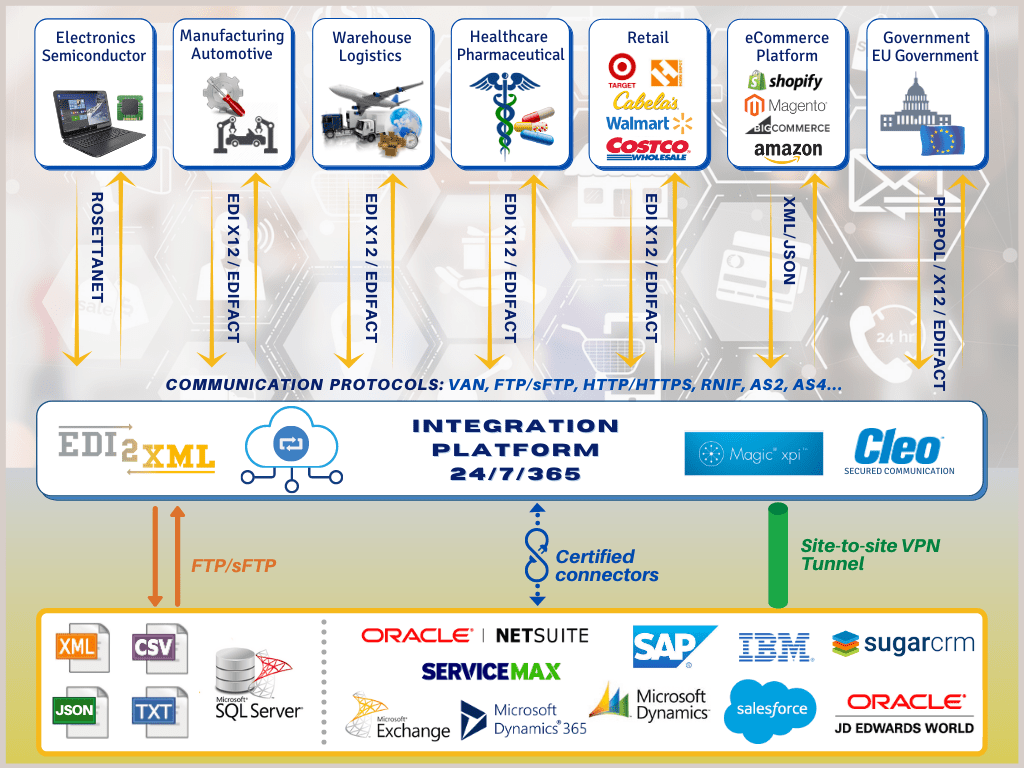
Our EDI2XML integration platform, deployed in our private cloud, runs 24/7/365 and handles all EDI file conversion and transformation between business partners, so customers do not need to install software or hardware onsite.

Fully managed EDI Service
 

We, as an integration and EDI provider, are responsible for all stages of the integration: from project planning to the development of the file format requested by the client (Json, XML, TXT, CSV), as well as testing and certification with your business partner.

Our “fully managed” EDI service solution has a dynamic monthly price that increases or decreases depending on the volume of data transferred.

This allows us to meet the needs of even small companies with a small volume of transferred documents.

EDI Web Service for Companies involved in the EDI process

Involved companies– organizations that are forced to implement EDI at the request of the initiating company to start a partnership and conclude a contract or when a business partner specifies the use of EDI as a pre-requisite or condition for further business collaboration.

In involved companies, the decision to implement EDI is made at the initiative of a third-party company. However, this requirement does not necessarily imply a large investment for EDI integration.

For companies that find themselves in a situation where a business partner requires a quick connection to EDI, we offer our unique solution EDI Web Service.

API-Converter for EDI XML and JSON

EDI2XML web service is our REST API to convert and transform X12 to XML and vice versa. The API web service is very low-cost relative to the fully managed EDI Service and is designed for companies who got their own technical resources to work with the REST API (call and consume HTTP Rest Web services). Definitive benefits of EDI Web Service is a low cost per KC, no contract, no commitment, and especially quick entry: you can be up and running in less than an hour, and it is proven; we provide everything to your developers to get started, a Java client with its source code and instructions on how to work with.

Choose the best EDI provider for the logistics and transportation industry

In modern logistics, the requirements for carriers are very high, and the use of EDI helps them keep the bar high.

We, as a successful EDI provider, have been helping our customers for 25 years quickly and reliably connect to EDI and integrate it into business systems.

Contact us for a free consultation, and we will help you choose the most suitable EDI solution for your business.


You may also be interested in reading about:

  • DELFOR, DELJIT, DESADV – key EDI messages in supply chain management for manufacturing
  • ORDERS and ORDRSP: The main EDIFACT messages in the supply chain management
  • Electronic Data Interchange (EDI) in the Supply Chain
July 14, 2021
https://www.edi2xml.com/wp-content/uploads/2021/07/EDI2XML-for-transportation-and-logistics.png 675 1200 Tatyana Vandich https://www.edi2xml.com/wp-content/uploads/2024/08/edi2xml.com-EDI2XML-company-logo.png Tatyana Vandich2021-07-14 09:00:002026-02-13 17:54:13EDI Integration for Transportation and Logistics

EDI Integration for B2B Exchange to Optimize and Grow your Business

Blog

What is B2B EDI? 

B2B (Business-to-Business) Integration, also known as Electronic Data Interchange EDI, is the process of exchanging business documents electronically either internally or amongst external business partners.


Electronic data interchange (EDI) has become a standard data exchange practice in modern business. EDI allows companies to automate their business processes leading to greater efficiency. Automated data exchange allows to avoid errors, reduce order processing time, and achieve accuracy.

What is meant by EDI?

EDI (Electronic Data Interchange) is the process of exchanging documents electronically through secure communication channels from one software information system to another. In other words, from one business partner to another.

In a fully automated process, the exchange of electronic documents (for example, receiving and processing orders), can take place at the application level, without the direct involvement and participation of employees.

Who typically uses EDI?

EDI standard and connected technologies are used in a B2B data exchange protocol, of any type of businesses in different industries. These can be large, medium, or small enterprises operating in retail, manufacturing, healthcare, pharmaceutical, or any other industry. EDI is also used in international trade such as air, sea, and road transportation. Not surprising, to see customs in most of the countries using EDI heavily in their cross-border operations.

Experience shows that large retailers such as Walmart, Costco, Kroger, Home Depot, Target, etc. are always the initiators of electronic data exchange. Moreover, almost all retailers, having evaluated the advantages of using EDI, force their suppliers to exchange documents only through EDI.

EDI Integration with Business Systems (ERP/CRM)

EDI integration allows to automate the creation, sending, receiving, and processing of any business documents in electronic format with a trading partner, existing backend business systems, or applications, to provide a greater level of efficiency and complete automation.

With over 21 years of experience in EDI and the integration marketplace, our company EDI2XML has a proven experience in integrating EDI, with the most frequently used systems:

  • Oracle JD Edwards (JDE)
  • SAP
  • Salesforce
  • Microsoft Navision
  • And much more

EDI Integrations and eCommerce Businesses  

EDI is also becoming a vital element of the e-commerce business; we are receiving more and more requests for e-commerce integration with EDI.

Especially, requests for connecting online stores running on one of the major e-commerce platforms. The most frequent EDI e-commerce integration are:

  • Shopify EDI Integration
  • Magento EDI Integration
  • BigCommerce EDI Integration
  • Amazon Vendor Central EDI integration
  • Amazon Seller Central EDI integration
  • Walmart EDI Integration
  • And much more…

This means that orders from an online store will be automatically converted into an EDI document (for example X12 EDI 850 Purchase Order) and pushed into a supplier’s business system. This is the most common scenario in an eCommerce dropship business.

However, it is worth mentioning the very common request for e-commerce integration with ERP / CRM systems. This means syncing data between business software systems (SAP, Salesforce, JDE, etc.) with your e-commerce store.

Fully Managed EDI Services to automate data exchange with business partners

Our company offers a fully managed EDI service that includes transformation and connectivity services for companies of all sizes.

Our customers do not need to install any software or hardware because all EDI file conversions and transformations, are done from our side. We carry out all stages of an integration project from project planning to testing with the trading partner.

Our integration platform receives EDI files (for example x12 or EDIFACT) from the trading partner, then converts them into the required format (i.e. XML, CSV, TXT) and sends them to you (see the picture below).

Fully managed EDI Service
 

EDI2XML platform will sit in  the middle between you and your trading partner to convert, send and collect all EDI documents.


Request Fully Managed EDI Service Pricing Plans HERE for more information.


Benefits of using EDI for B2B exchange

Currently, using the latest technologies, EDI implementation is not so expensive (as many business leaders might think), but the benefits of EDI integration allow companies to significantly speed up document flow and increase sales. Besides, EDI has many advantages, namely:

  • EDI enables companies to optimize all processes in the enterprise, from planning to production management and control.
  • EDI allows increasing the speed and efficiency of data processing. Mandatory use of standards (for example X12 or EDIFACT) helps to avoid errors and improve accuracy.
  • EDI helps manufacturers to quickly respond to the requests of their wholesalers’ customers.
  • EDI document exchange allows retailers and wholesalers to improve the efficiency of logistics and procurement as well as improve inventory management. For example, using EDIFACT messages such as INVRPT, DELFOR, DELJIT, and DESADV allows reducing warehouse storage costs.
  • EDI integration allows companies to reduce the number of employees who enter data into the business system received on paper or by e-mail.
  • EDI increases the accuracy of information processing because as practice shows, errors are inevitable with manual data entry.

B2B / EDI Integration – find the best Solution

EDI2XML offers various EDI integration solutions.

  • Fully Managed EDI Service
  • EDI Web Service
  • EDI On-Premises

Whether you are a buyer, supplier, manufacturer, retailer, 3PL Warehouses, or Logistics – using our advanced EDI technology, you can exchange data electronically with all your partners quickly, reliably, and efficiently.

We’ve got an EDI solution that really makes your day-to-day tasks easier and faster!

Contact us for a free consultation with our EDI experts.

June 22, 2021
https://www.edi2xml.com/wp-content/uploads/2021/06/EDI-for-B2B-exchange.png 675 1200 Tatyana Vandich https://www.edi2xml.com/wp-content/uploads/2024/08/edi2xml.com-EDI2XML-company-logo.png Tatyana Vandich2021-06-22 11:59:092024-11-19 15:22:45EDI Integration for B2B Exchange to Optimize and Grow your Business

EDI 820 Payment Order/Remittance Advice

Blog

What is EDI 820 Remittance Advice?

X12 EDI 820

EDI X12 820 Payment Order/Remittance Advice (or simply EDI 820), sometimes called as EDI payment, is an electronic document transmitted via EDI (Electronic Data Interchange) that business partners (seller, buyer, financial institution…) use to provide detailed payment information. Normally an EDI 820 transaction, is sent by the buyer to his supplier after issuing a payment against an EDI 810 Invoice sent by the supplier.


In North America, the Payment Order/Remittance Advice transaction set is transmitted in EDI X12 standard. The message code in EDIFACT standard for the Remittance advice message is REMADV.

REMADV is the analog of EDI 820; it has the same function and application in international business practice, mainly in Europe.

Usage of the EDI 820 Payment Order/Remittance Advice Transaction Set

Unlike typical EDI transactions exchange between two trading partners, banks and financial institutions are also involved in the exchange of EDI 820.  

Moreover, EDI 820 transaction set can be used for various purposes:

Simultaneously to make a payment and send remittance advice (sent through your bank to trading partner)

In this case, all Remittance Advice details and the Payment Order will be transferred to your financial institution (bank). The bank will then forward Remittance details to your trading partner and debit your account in favor of your trading partner.

To send remittance advice only (sent directly to your Trading Partner, payment is made independently)

If you use this option, you must make payment to your trading partner in separate transaction. This transaction must match the total amount specified in the EDI 820 detail transmission. Normally, the trading partner accepts payment details referencing invoice numbers only.

Remittance Advice can be sent directly from the payer to the recipient, through a financial institution, or a third-party agent.

To make an EDI payment (sent through your bank to a trading partner)

In this case, the payment order will be transferred to the bank and the bank will forward the file to your trading partner and debit your account in favor of this trading partner. Thus, EDI 820 can act as an instruction for a financial institution to make a payment to the beneficiary.

It should be noted that usually trading partners also require the details to be sent in EDI format.

Some companies may still accept non-EDI remittance advice, however, data sent by email, fax, or paper will incur additional manual processing fees for each transaction.

What information is included in EDI 820

As mentioned above, Payment Order/Remittance Advice document contains all important information related to the financial transactions. The EDI 820 document contains the following basic information:

  • Payer / Beneficiary identification (name, address details)
  • Invoice number(s)
  • Bank and account information
  • Invoice adjustments (if applicable)
  • Payment amount
  • Currency
  • Payment/remittance date
  • Method of payment/funds movement
  • Credit /debit confirmation
  • Check /payment number

How to send and/or receive Remittance Advice (EDI 820)

There are several different ways to exchange an EDI 820 document. The main communication protocol to transfer EDI documents are:

  • Connection with VAN (Value Added Networks). VAN is the third party in the EDI exchange process that transmits and stores data in an electronic mailbox until it is received by one of the business partners.

Point-to-point EDI exchange:

  • FTP/SFTP – File Transfer Protocol/Secure File Transfer Protocol. These file transfer protocols allow trading partners to connect with each other via the Internet to exchange EDI documents.
  • AS2 – A secure way to exchange documents electronically over the Internet by using digital certificates and encryption of the EDI data.
  • HTTP (REST) where data is transferred using content type “multi-part/form data”

Each one of the above communication protocols,  has its advantages, however, each company must decide what best fits its policy, based on the requirements of its business partner or the business processes of the company.


To learn more about EDI Communication Protocols read our article: All about EDI: 11 Complete Answers about Electronic Data Interchange


EDI 820 Payment Order/Remittance Advice Segments and Data Elements

Payment Order/Remittance Advice like any other EDI document has a structure of segments and elements predefined by the X12 standard. Some of them are mandatory, some are optional. It all depends on how this EDI 820 document will be used and the specifications requested by the trading partner.

The structure of EDI 820 could be as follow:

ISA – Interchange Control Set Header (Mandatory)

GS – Functional Group Header (Mandatory)

ST – Transaction Set Header (Mandatory)

BPR – Beginning Segment for Payment Order / Remittance Advice (Mandatory)

TRN – Trace (Mandatory)

CUR – Currency (Mandatory)

REF – Reference Numbers (Mandatory)

DTM – Date / Time Reference (Optional)

N1 – Name (Mandatory)

N3 – Address Information (Optional)

N4 – Geographic Location (Optional)

PER – Administrative Communication Contact (Optional)

ENT – Entity (Optional)

RMR – Remittance Advice Accounts Receivable Open Item Reference (Mandatory)

REF – Reference Numbers (Optional)

DTM – Date / Time Reference (Optional)

ADX – Adjustment (Optional)

SE – Transaction Set Trailer (Mandatory)

GE – Functional Group Trailer (Mandatory)

IEA – Interchange Control Trailer (Mandatory)

Integrate EDI 820 Payment Order/Remittance Advice with EDI2XML EDI Service

With over 25 years of experience in EDI integration, we offer our clients the most advanced and cost-effective EDI service.

You can start exchanging EDI 820 Remittance Advice within an hour using our EDI Web Service. It is a cost-effective, no-contract, and fast EDI solution that does not require special technical knowledge. In addition, we offer a free 15 days trial period. Find out more about our EDI web service here.

With our Fully Managed EDI Service, we take care of all:

  • EDI mapping
  • Trading Partner configuration
  • Standards maintenance
  • XML/CSV/TXT translation
  • Send & receive EDI documents, to and from Trading Partners or to and from the customer
  • Drop off & pick up Json/XML/CSV/TXT files to and from the customer.
  • Integration with ERP application with certified connectors (when required option)

Request our EDI2XML fully managed EDI service Pricing Packages here, or contact us for a free consultation with our EDI expert.

EDI - Get a free Consultation

May 26, 2021
https://www.edi2xml.com/wp-content/uploads/2021/05/EDI2XML-EDI-820.png 350 1024 Tatyana Vandich https://www.edi2xml.com/wp-content/uploads/2024/08/edi2xml.com-EDI2XML-company-logo.png Tatyana Vandich2021-05-26 10:21:212025-03-25 16:09:59EDI 820 Payment Order/Remittance Advice
Page 11 of 24«‹910111213›»
Recent
  • EDi Integration for SMB - Complete Guide
    Electronic Data Interchange (EDI): The Complete Guide for...July 17, 2026 - 4:46 pm
  • EDI Process Guide from EDI EDI Provider
    How EDI Documents Work Together: A Complete Guide to the...July 9, 2026 - 1:22 pm
  • Wayfair EDI & API Integration Guide
    Wayfair EDI & API Integration Guide for SuppliersJune 30, 2026 - 3:24 pm
  • Promotional banner about whether EDI is required for small businesses and a supplier’s guide to retail onboarding. Women at a desk inside a circular cutout image on the right.
    Is EDI Required for Small Businesses? A Supplier’s Guide...June 17, 2026 - 7:02 pm
  • EDI compliance with Loblaw
    How to Meet Loblaw EDI Requirements as a Small BusinessJune 4, 2026 - 2:05 pm
Popular
  • How to Quickly Connect to a Large Retailer's EDI Requirements
    How to Get EDI-Compliant Quickly For A Large RetailerNovember 21, 2025 - 4:29 pm
  • EDI-as-a-services
    EDI Translation Software “On-premises” or “As...January 21, 2014 - 1:28 pm
  • order-automation in e-commerce
    Why Is It Crucial to Automate the E-Commerce Order Fulfillment...May 10, 2022 - 1:58 pm
  • EDI for Logistics and transportation
    EDI Integration for Efficient Transportation ManagementOctober 6, 2023 - 1:33 pm
  • information technology definitions
    Business Tech Terms DefinitionsMay 24, 2018 - 1:32 pm

Browse by tag

Amazon Amazon Integration ANSI ASC x12 ASC X12 EDI B2B EDI integration e-commerce e-commerce business e-commerce integration eCommerce eCommerce integration EDI EDI2XML EDI 850 EDI as a Service EDI Communication EDI converter EDIFACT EDI for supply chain EDI for Third-Party Logistics EDI for transportation EDI implementation EDI Integration EDI Integration Project EDI project EDI Translation EDI Web Service EDI x12 ERP Integration integration platform integration project JDE Magic xpi Magic xpi Integration platform NetSuite online store Salesforce Shopify Shopify eCommerce integration Shopify integration Supply Chain Supply Chain Management Translation Software X12 EDI XML

Subscribe to our Blog

Menu

  • Home
  • About the EDI2XML Company
  • About EDI2XML EDI Converter
  • Blog
  • Book A Free Consultation
  • Privacy Policy EDI2XML Company

Our Services

Fully Managed Integration

E-Commerce Integration

Business Systems Integration

Fully Managed EDI

EDI Web Service 

On Premises EDI 

Managed Cloud Service


Latest Blog Posts

  • EDi Integration for SMB - Complete Guide
    Electronic Data Interchange (EDI): The Complete Guide for Modern BusinessesJuly 17, 2026 - 4:46 pm
  • EDI Process Guide from EDI EDI Provider
    How EDI Documents Work Together: A Complete Guide to the EDI Transaction ProcessJuly 9, 2026 - 1:22 pm
  • Wayfair EDI & API Integration Guide
    Wayfair EDI & API Integration Guide for SuppliersJune 30, 2026 - 3:24 pm

Contact Us

400 Blvd Curé-Labelle, #304 Laval QC H7V 2S7 Canada

Contact EDI2XML Team
Phone: +1 450-681-3009
Website: https://www.edi2xml.com/

© 2000-2026 EDI2XML (by Namtek Consulting Services). All rights reserved.
  • Link to Facebook
  • Link to LinkedIn
  • Link to X
  • Link to Youtube
  • Blog
Scroll to top Scroll to top Scroll to top